Mixing With The Classics

by Chas Danner

A reader responds to Wednesday’s Mental Health Break:

Mozart Rap is nothing new – see the above version by Turkey’s rap superstar, Ceza. The text is not quite as wholesome as the one you showed, but it is a trenchant comment on the ills of Turkish society and politics today. Mozart’s Turkish March is something like the secret anthem of Turkey (at least for the secular Westernized part of society), and has been taken up several times by Turkish musicians. My favorite is this one, showing how music is a truly global art in a unique way:

Another reader senses an opportunity:

I feel compelled to turn this into a “dudes rapping to classical music” thread, because yes please. That clip reminded me of one of my favorite rap songs, Jedi Mind Tricks’ “Animal Rap”:

Although not Mozart (sounds like it though), the actual sample is a bit more obscure: Dave Grusin’s 43 second “Coma” from the Bonfire of the Vanities soundtrack.

As far as featuring more examples from the genre, challenge accepted. Here’s the almighty KRS-One:

Know some good classical-driven raps or remixes? Send them in: dish@andrewsullivan.com

Brilliant Women Who Explain Things To Me

by Phoebe Maltz Bovy

Rebecca Mead describes the challenges Cambridge classics professor Mary Beard has faced as a prominent female academic:

At Cambridge [in 1972], the inequities of gender began to dawn on Beard. “Most of the people who taught us in the faculty were blokes,” she says. “There were only twelve per cent women among the students, and you thought, Actually, there is an issue here. You go into a dining hall of a men’s college, and everybody’s portrait was a bloke. Well, perhaps some female founder back in 1512, some lady who gave the cash—and everyone else was a bloke. For the first time I saw that, somehow, I was there as sort of a favor.” She attended women’s groups and joined campaigns to open the university further to women. The women of Cambridge were undertaking more personal voyages of discovery, too: in a drawer somewhere in Beard’s house is a plastic speculum that she acquired at one consciousness-raising gathering.

Beard left Cambridge in 1979, for King’s College London. She completed her Ph.D. in 1982; two years later, she returned to Newnham as a fellow. At the time, she says, she was one of only three women on the classics faculty, out of a total of twenty-six; before long, both of her female colleagues left. (Now there are roughly four men to each woman.)

That was then. Today, explains Mead, Beard is active on social media, and holds her own in an ongoing battle with the ubiquitous misogynistic troll contingent. Mead addresses the particularity of how Beard, whom “the Queen recently appointed … to the Order of the British Empire,” battles lesser names (or the altogether anonymous):

There is, [Beard] acknowledges, an irony in the imbalance of power: as a prominent scholar, she does have a voice, however unpleasant the threats to silence her may be. Most of her Twitter detractors are grumbling to only a handful of followers, at least until she amplifies their audience.

Mead’s article brought to mind a pattern I’ve noticed within feminism, which I’ve called the Second After Sartre problem, namely that of women who aren’t merely privileged but are major leaders of their age, who call out the obstacles that prevent them from achieving what their male equivalents can, or from doing so as easily. It’s in reference to… I’ll let LisaAppignanesi explain the story I’m referencing:

De Beauvoir and Sartre met in 1929 when they were both studying for the aggregation in philosophy, the elite French graduate degree. De Beauvoir came second to Sartre’s first, though the examiners agreed she was strictly the better philosopher and at the age of 21 the youngest person ever to have sat the exam. But Sartre, the future author of Being and Nothingness, was bold, ingenious, exuberant in his youthful excess, the satirical rebel who shouted, “Thus pissed Zarathustra” as he hurled water bombs out of classroom windows.

Being second after Sartre, when you should have been first, is indeed an injustice. Injustices that occur at the top – ones well beyond the First World Problem-ness of having-it-all feminism – are instructive (if even the most elite, confident women face sexism, perhaps sexism is actually a thing!), and of course it matters if the tippy-top of whichever hierarchy is open to all who qualify. But the trouble is that we end up hearing a wildly disproportionate amount about such injustices, because, well, who gives lectures at the British Museum? It can start to feel as if feminism is primarily about recognizing the achievements of the most accomplished women. That’s part of what feminism should be, but perhaps not quite so big a part.

See also (my grievances with) “mansplaining.” Rebecca Solnit’s article, “Men who explain things,” which more or less launched the concept, was about a man trying to explain to Solnit a topic she had just written a book about. That is… not the usual situation. More often, in cases where a man conflates maleness with superior expertise, the man and the woman know approximately as much (or as little) about the topic. Neither is likely to be a certified expert. What if a woman wishes to speak and she isn’t the world’s greatest genius? Men who fail to meet that standard have been known to say their piece.

This is my roundabout way of saying why I’m so curious about Roxane Gay’s writing. From Lucy McKeon’s review of Gay’s two new books:

Amidst Anne-Marie Slaughter’s talk of “having it all” and Sheryl Sandberg’s talk of “leaning in,” Gay’s Bad Feminist, a collection of essays of cultural criticism, offers a complex and multifarious feminism to answer the movement’s ongoing PR issues, its flaws and its failures. Gay’s is a feminism for the ignorant and misinformed as much as for the historically excluded and ignored. Analyzing a wide range of material—from 12 Years a Slave to the Sweet Valley High series, from the reality TV trope “I’m not here to make friends” to the gendered politics of likeability in fiction, from professional sports to Tyler Perry, from the fallout of mass tragedy to legislative control of women’s reproductive rights—Bad Feminist surveys culture and politics from the perspective of one of the most astute critics writing today.

Yes, the time has come for “a feminism for the ignorant and misinformed as much as for the historically excluded and ignored.” It couldn’t have come soon enough.


The View From Your Window Contest

VFYWC-220

You have until noon on Tuesday to guess it. City and/or state first, then country. Please put the location in the subject heading, along with any description within the email. If no one guesses the exact location, proximity counts.  Be sure to email entries to contest@andrewsullivan.com. Winner gets a free The View From Your Window book or two free gift subscriptions to the Dish. Have at it.

Browse previous contests here.

A Short Story For Saturday

by Dish Staff

This weekend’s short story selection is Tobias Wolff’s “Bullet in the Brain,” which begins with these arresting paragraphs:

Anders couldn’t get to the bank until just before it closed, so of course the line was endless and he got stuck behind two women whose loud, stupid conversation put him in a murderous temper. He was never in the best of tempers anyway, Anders – a book critic known for the weary, elegant savagery with which he dispatched almost everything he reviewed.

With the line still doubled around the rope, one of the tellers stuck a “POSITION CLOSED” sign in her window and walked to the back of the bank, where she leaned against a desk and began to pass the time with a man shuffling papers. The women in front of Anders broke off their conversation and watched the teller with hatred. “Oh, that’s nice,” one of them said. She turned to Anders and added, confident of his accord, “One of those little human touches that keep us coming back for more.”

Anders had conceived his own towering hatred of the teller, but he immediately turned it on the presumptuous crybaby in front of him. “Damned unfair,” he said. “Tragic, really. If they’re not chopping off the wrong leg, or bombing your ancestral village, they’re closing their positions.”

Read the rest here. For more of Wolff’s short fiction, including “Bullet in the Brain,” check out his collection Our Story Begins: New and Selected Stories. Previous SSFSs here.

Face Of The Day

by Dish Staff

dish_davidsamuelstern

David Samuel Stern creates dizzying portraits by weaving together two separate vellum prints:

This way of abstracting the images does not only offer his subjects a way to hide within themselves, but also turns digital photography into physical objects by adding geometric texture. Being poets, choreographers, artists or programmers, all of the models featured in “Woven Portraits” are creative types in their own field.

How one of Stern’s models described his reaction to first seeing the woven portrait a few years ago:

I find it interesting; it captures some kind of duality, or time/motion – reminiscent of Francis Bacon’s portraits, even in it’s literal hard edged grid. I like how the image fluctuates, it almost forces me not to focus. And in fact, while looking at it I like to actually take my eyes in and out of focus, the piece seems to encourage viewing through multiple ways of perceiving with the eye.

See more of Stern’s work here.

Auto-Admiration?

by Dish Staff

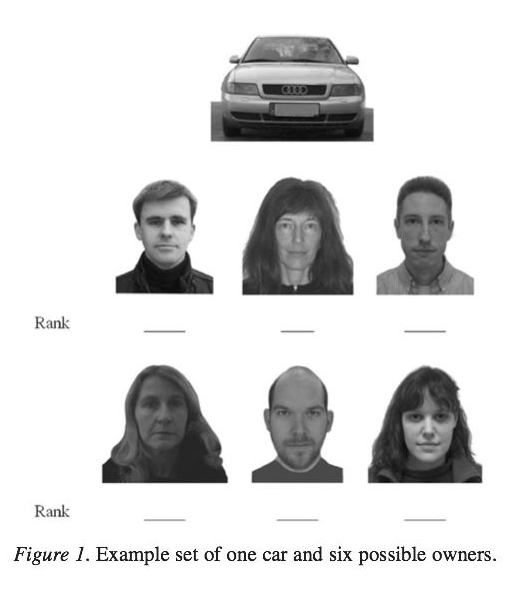
Jesse Bering reviews research suggesting that not only can people accurately match dogs’ faces to their owners, but also that “our faces also bear an uncanny resemblance to the frontend views of our automobiles.” Participants in a study were given a picture of a car and asked to rank its possible owners on a scale of 1 to 6:

[T]he authors suspected that the judges in their study would be able to match cars dish_carfaces3 with their correct owners above chance levels. And that’s what they found. “The real owner was in fact assigned rank 1 most frequently,” they write, “and rank 6 least frequently.” This proved true regardless of the subjects’ sex and age. There were an equal number of male and female judges, and they ranged widely in age—from 16 to 78 years. In case the sheer bizarreness of these data hasn’t quite registered, let me put it to you more bluntly: The average person can detect a physical similarity in the “faces” of cars and their owners. …

Implied in these results is the startling fact that most car owners are unwittingly purchasing cars that look like them. If that’s the case, figured [researchers Stefan] Stiegar and [Martin] Voracek, then is it possible that judges can even take it one step further, matching dogs to their masters’ cars? After all, we know now that it’s not a myth: dogs really do look like their owners. And since we choose both cars and dogs that physically resemble us, shouldn’t our dogs and our cars look alike too? Here, frankly, the data just get weird. Nevertheless, they’re genuine. In their third and final study, the authors added 36 portraits of dogs into the mix. Half of these were of purebreds, and the others were mutts. In a twist to the previous studies, a new group of judges saw an image of a car (again, either the front, side, or rear view) and beneath that, six individual dogs. Subjects ranked each dog on the likelihood of its master being the owner of the car shown. Amazingly, the participants were able to pull this feat off as well.

Meanwhile, Laura Bliss considers the oddly human attachments people form to their vehicles:

To many of us, [cars] are beloved, person-like companions. More than 70 percent of respondents to a recent AutoTrader survey were at least “somewhat” if not “very attached” to their cars, with 36 percent describing their vehicle as “an old friend.” In another study, nearly half of all drivers assigned a gender to their cars, and about one-third actually name them.

For many car-owners, emotional attachment can also come hand-in-hand with socio-economic mobility. For example, there’s research that suggests for certain low-income families, owning a car is linked to the ability to live in neighborhoods with lower poverty rates and lower health risks, as well as higher neighborhood satisfaction and stronger chances of employment.

Car-owners often assign human-like attributes to our cars, too. A 2006 study found significant differences between how participants understood their own personality and how they described their cars’.  And in that same AutoTrader report, more than a quarter said they felt “sad” when they thought about parting ways with their internally combusting pal.

The Essential Creepiness Of DFW Fandom, Ctd

by Dish Staff

dish_dfwlego2

An 11-year-old DFW superfan recreated Infinite Jest with Legos:

[English professor Kevin] Griffith and his son [Sebastian] had the idea to “translate” Infinite Jest into Lego after reading Brendan Powell Smith’s The Brick Bible, which takes on the New Testament. “Wallace’s novel is probably the only contemporary text to offer a similar challenge to artists working in the medium of Lego,” they write, grandly, on their website. …

Sebastian didn’t read Infinite Jest himself. “Let me be clear – Infinite Jest is not a novel for children,” says Griffith. “Instead, I would describe a scene to him and he would recreate it in a way that suited his vision.  All the scenes are created by him and he then took photos of them using a 10-year-old Kodak digital camera he received for a present long ago.  I think that having the scenes reflect an 11-year-old’s perspective gives them a little extra poignancy, maybe.”

The caption for the above image is from page 409 of Infinite Jest: “Clipperton plays tennis with the Glock 17 held steadily to his left temple.” Meanwhile, Matthew Nolan looks for lessons from DFW about why American men aren’t playing the sport better:

Wallace’s discerning tennis essays and fiction made it clear that elite tennis players cannot simply be manufactured through training by academies and player development programs. The fact that there are aspects of success that go beyond the academy helps to explain why the current top 20 players in the world represent 14 different countries, and almost all come from different training backgrounds. The recent success of junior male players, like U.S. Open Wild Card Noah Rubin from the training facility run by John McEnroe (another Wallace favorite), will excite Americans, but enthusiasm needs to be tempered with Wallace-ian recognition of the nature of the game. Wallace would not likely have lamented the state of American men’s tennis but instead would have probably sympathized with the ongoing struggles of all players, regardless of national origin. Likening tennis to life itself, a veteran player and coach in Infinite Jest respectfully sums up the game: “It is tragic and sad and chaotic and lovely.”

(Image via Brickjest)

Map Of The Day

by Dish Staff

School Demographics

Reed Jordan spotlights our schools’ racial segregation:

Despite our country’s growing diversity, our public schools provide little contact between white students and students of color. We’ve mapped data about the racial composition of U.S. public schools to shed light on today’s patterns at the county level. These maps show that America’s public schools are highly segregated by race and income, with the declining share of white students typically concentrated in schools with other white students and the growing share of Latino students concentrated into low-income public schools with other students of color.

In every state but New Mexico and Hawaii, the average white student attends a school that is majority white. This is unsurprising for large swaths of the Northwest, Great Plains, Upper Midwest and Northeast, which are home to very few kids of color. But even in diverse states like Illinois, Michigan, Pennsylvania and New York, few white children attend diverse schools.

On Learning New Things

by Bill McKibben

It turns out that Ta-Nehisi Coates spent the summer just down the hill, at Middlebury College where Sue and I both hang our hats. In the summer Middlebury’s famous language school–which makes students sign a pledge that they’ll only speak the language they’re studying all summer–takes over the campus, and this year Mr. Coates was studying French. And studying the act of learning something new, which is an easier process to see (if not to do) past a certain age. His stay resulted in a brilliant essay in the new Atlantic, which has a lot of smart things to say about race in America, the inequality of influence in our culture, and the smugness with which white people caricature African-American attitudes towards education. I, um, learned a lot reading it, and look forward to re-reading it more than once. (It’s also a subtle and persuasive follow-up to his groundbreaking piece on reparations earlier in the year).

Politics aside, it also describes the learning process with wit, rigor, and a kind of joy that makes one want to (as soon as the Labor Day weekend has passed) go out and work hard to learn some new thing!

One afternoon, I was walking from lunch feeling battered by the language. I started talking with a young master in training. I told her I was having a tough time. She gave me some encouraging words in French from a famous author. I told her I didn’t understand. She repeated them. I still didn’t understand. She repeated them again. I shook my head, smiled, and walked away mildly frustrated because I understood every word she was saying but could not understand how it fit. It was as though someone had said, “He her walks swim plus that yesterday the fight.” (This is how French often sounds to me.)

The next day, I sat at lunch with her and another young woman. I asked her to spell the quote out for me. I wrote the phrase down. I did not understand. The other young lady explained the function of the pronouns in the sentence. Suddenly I understood—and not just the meaning of the phrase. I understood something about the function of language, why being able to diagram sentences was important, why understanding partitives and collective nouns was important.

In my long voyage through this sea of language, that was my first sighting of land. I now knew how much I didn’t know. The feeling of discovery and understanding that came from this was incredible. It was the first moment when I thought I might survive the sea.

Death To Monarchs, Ctd

by Sue Halpern

Monarch

Finally a little good news to offset the bad news in my earlier post about the precipitous decline of the eastern monarch butterfly population. The first is that this year’s population appears to be more robust than last year’s, which plummeted to an all-time low. Monarch watchers at Ontario’s Point Pelee Park, a traditional migratory jumping off point for the butterflies on their way to Mexico, have seen many more monarch butterflies and monarch caterpillars, as has Professor Chip Taylor of the University of Kansas who runs the monarch conservation organization Monarch Watch. Taylor estimates that the numbers could be up by thirty or forty percent, though he points out that even so, the increase won’t offset last year’s precipitous decline.

Awareness of the monarch’s plight has reached the highest echelons of government, which is the other bit of good news.  In a letter circulated today, the naturalists Gary Nabhan and Ina Warren who have spearheaded Make Way For Monarchs, an international effort to protect the monarch from, especially, the deleterious effects of habitat destruction, note that “The White House has appointed Fish and Wildlife Director Ashe to head up the ‘high-level working group’ to work with Mexico and Canada on recovery plans, and 14 federal agencies have formed work groups and “communities of practice” to reorient their work plans toward monarch recovery.”

The Executive may not have a plan to deal with ISIS. It may be backing off on immigration reform and pretending it never heard of the Keystone XL pipeline, but at least it understands the value of monarchs.

(Photo by Joel Olives.)