Til Employment Do Us Part

by Dish Staff

Alex Fradera surveys the somewhat counterintuitive findings of new research suggesting that “life satisfaction is higher for couples who share their unemployed predicament, than for couples where only one partner loses their job”:

Maike Luhmann and her colleagues analysed over ten years of longitudinal data from 3000 co-habiting couples in Germany, where one or both partners had gone through an unemployment. … The data supported the shared fate hypothesis [that empathy and support are easier to produce when both parties are in the same boat] – when one partner was unemployed and the second partner remained in work, both parties reported lower life satisfaction than when both partners ended up without a job. The researchers reasoned that when one partner remains in work, it is easier for the unemployed partner to be stigmatised and feel anxiety about abandonment for failing in their duties to the household. In addition, the unemployed person is shunted rapidly out of one life pattern, including a regular routine and social networks, and may find themselves now alone for much of the day, with the obligation to solve their problems and “get back on track”. Moreover, their limited contact with their working partner may be an invitation for friction: just what have you been doing all day?

Luhmann and her colleagues interpreted their results as showing that unemployment “hurts primarily because of its psychological consequences,” rather than being driven by its financial impact

Tax-Funded Tampons?

by Phoebe Maltz Bovy

Jessica Valenti thinks tampons should be provided by the government:

Women in the UK are fighting to axe the 5% tax on tampons (it used to be taxed at 17.5%!), which are considered “luxuries” while men’s razors, for some baffling reason, are not. And in the US, though breast pumps, vasectomies and artificial teeth are sales tax-exempt and tax-deductible medical care, tampons are not even exempted from sales tax in some states (including California and New York, two of the most populous states).

But this is less an issue of costliness than it is of principle: menstrual care is health care, and should be treated as such. But much in the same way insurance coverage or subsidies for birth control are mocked or met with outrage, the idea of women even getting small tax breaks for menstrual products provokes incredulousness because some people lack an incredible amount of empathy … and because it has something to do with vaginas. Affordable access to sanitary products is rarely talked about outside of NGOs – and when it is, it’s with shame or derision.

Free tampons? Sounds reasonable to me. Indeed, I’d suggested the same (argued would be an exaggeration) as a sleep-deprived college student in 2005. A friend campaigned for these at our high school, and since it’s a public school, these tampons, too, would have been state-subsidized. (Don’t think it ever happened.) The counterarguments, as I recall, were principally libertarian ones about how the quality of personal-hygiene items would drop if the market weren’t involved. As in, so much for the Tampax you know, any wadded-up absorbent material would do.

So it seems that when someone who’s a famous feminist makes this point, and in the social-media era, things go somewhat differently than when a feminist college kid with a tiny blog did so before hashtags and the like. Valenti offers up a sampling of the response she got to her suggestion. Items include:

https://twitter.com/adam_mcphee/status/497892354331000832

And:

https://twitter.com/skzdalimit/statuses/497828918851043330

Fun! While there’s a case to be made against government-issued feminine hygiene products, this isn’t it.

What Everyone Misunderstands About the ‘Libertarian Moment’

by Elizabeth Nolan Brown

Pew Millenials

David Frum – shock – doesn’t think the “libertarian moment” has arrived:

Despite the self-flattering claims of libertarians, the Republicans’ post-2009 libertarian turn is not a response to voter demand. The areas where the voting public has moved furthest and fastest in a libertarian direction—gay rights, for example—have been the areas where Republicans have moved slowest and most reluctantly. The areas where the voting public most resists libertarian ideas—such as social benefits—are precisely the areas where the GOP has swung furthest and fastest in a libertarian direction.

This, of course, entirely misses the point of Robert Draper’s recent New York Times Magazine piece on libertarians. For all the Ron and Rand Paul mania, there’s little evidence the GOP has taken much of a “post-2009 libertarian turn” at all. So Frum is right that Republicans haven’t been ushering in some sort of libertarian era, I’m just not sure who’s arguing they have.

Draper’s piece—and those quoted in it, including Reason.com editor-in-chief (and my boss) Nick Gillespie—mostly suggests that, with rare exceptions, Republicans are stubbornly resisting embracing more libertarian ideals, despite the fact that it’s pretty much killing the party. “The Republicans will definitely have to move to the left on social issues,” my colleague Emily Ekins, polling guru for the Reason Foundation, says in Draper’s article. “They just don’t have the numbers otherwise.”

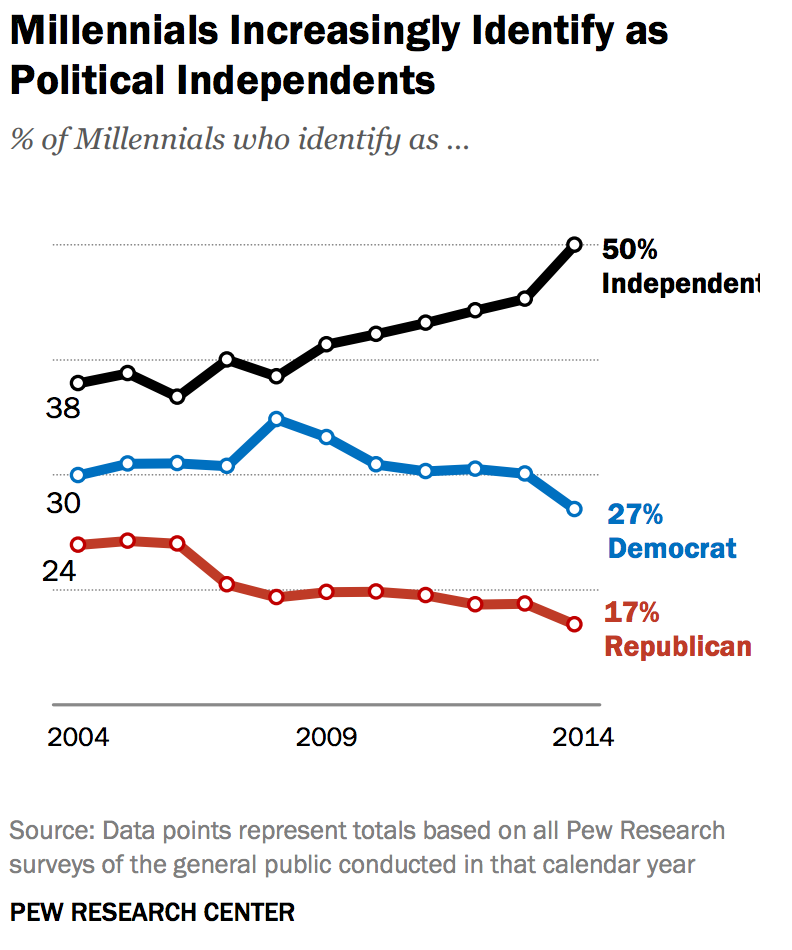
More than ever before, young people are defining themselves as politically independent, according to Pew Research Center and just about everyone else who polls them. But millennials identify as Democrats in similar proportions to older generations; it’s the GOP that’s bleeding young voters into the independent ether.

When libertarians talk about this generation’s potential, it’s not that we’re counting all these independent millennials as libertarian (as some have suggested). Nor do we think that most would identify as libertarian if only they read more about it on Wikipedia. Sure, I think libertarianism might have a bit more appeal to a generation raised on the seemingly endless and indistinguishable Bush/Clinton empire, but I’m not expecting young people to start adopting the libertarian label in droves.

Yet there is possibility for new consensuses, many of which would be appealing from a libertarian standpoint. In an electorate that doesn’t necessarily subscribe to old party divides, there’s potential to rally young liberals and conservatives together on issues like same-sex marriage, privacy, drug policy, and criminal justice reform, to name just a few. These aren’t “libertarian issues”—we’re not trying to own them (as critics also suggest)—but they are areas we’ve been keen on addressing, and it’s great to have allies of whatever stripe.

Frum snidely suggests that “the ‘libertarian moment’ will last as long as, and no longer than, it takes conservatives to win a presidential election again.” And if we’re talking about mainstream modern Republicans dressing themselves up in the label, no doubt. But again, that seems to be something only Frum is talking about. The “libertarian moment”, in so far as any of us think it exists, is about looking beyond party lines. It’s about working and coming together in new ways.

“I have no idea who will be the next president of the United States,” wrote Gillespie Sunday, but it “will matter far less than the broad currents in American society”:

That’s one of the main trends that Reason picked up in its poll of Millennials—not some self-congratulatory discovery that the kids today are junior-varsity libertarians—and folks who don’t want to grapple with that and all its implications will have less and less relevant to say about politics, culture, and ideas.

Or, as Jack Hunter wrote at Rare: “There is a significant difference between trying to make every American a libertarian and making America more libertarian. The former is impossible. The latter is happening.”

Plusses And Minuses

by Dish Staff

Tyler McCall blames plus-size women for the lack of plus-size options:

[W]hat if the problem with the plus-size industry isn’t with faceless businessmen, but with the customers themselves? “It’s become such an angry section of fashion,” one plus-size blogger, who wishes to remain anonymous, explains. “Everyone has an opinion, and it’s such a negative, negative environment, and it sounds sad, but they want to tear each other apart. Models get it all the time, brands especially. They’ll say, ‘Oh we can’t use that model again because they say that she’s too skinny.'”

McCall – whose piece comes with a provocative “Hold all comments until the end, please” subtitle – points to a range of reasons customers may be limiting their own options:

There is of course a body politic that goes into shopping for women. Everyone I spoke with agreed that women who are told that their body shape should be considered temporary, always in need of a new diet or weight loss plan, aren’t exactly going to plunk down $300 for a dress that, ideally, won’t fit them in a month. “There are so many women who don’t self identify as plus-size, and maybe they just settle for drawstring or elastic waisted pants because they don’t necessarily want to know that they’re a size 16 or an 18,” Mason says.

“An Anonymous Face”

by Phoebe Maltz Bovy

OLYMPUS DIGITAL CAMERA

Anemona Hartocollis reports (NYT) that the strong arm of the law is coming for your adorable baby photos. (Pet photos are safe, for now.) But not the ones you share on Facebook, or that you might select to illustrate a magazine essay you might choose to pen about your child. The law – as far as I know – would be fine with you going around town bearing a placard with your child’s mid-tantrum face captioned with a quote of the darndest thing he or she ever uttered. No, the only ones under attack are the photos doctors traditionally used in their office decor:

For generations, obstetricians and midwives across America have proudly posted photographs of the babies they have delivered on their office walls. But this pre-digital form of social media is gradually going the way of cigars in the waiting room, because of the federal patient privacy law known as Hipaa. Under the law, the Health Insurance Portability and Accountability Act, baby photos are a type of protected health information, no less than a medical chart, birth date or Social Security number, according to the Department of Health and Human Services. Even if a parent sends in the photo, it is considered private unless the parent also sends written authorization for its posting, which almost no one does.

Hartocollis notes that some doctors don’t see these photos as a violation:

“For me, the face of a baby, that is really an anonymous face,” said Dr. Pasquale Patrizio, director of the Yale Fertility Center in New Haven. “It was representative of so much happiness, so much comfort, so much reassurance. It is purely a clinical office now.”

At what age, then, does the face cease to be anonymous? Because this doesn’t seem to just be about baby photos:

Jacques Moritz, director of the division of gynecology at Mount Sinai Roosevelt in Manhattan, still displays baby pictures in an exam room. “There’s not a day that goes by that somebody doesn’t come in with a picture of the kid — up until 17, 18, 19 and 20,” he said.

It would be nice to think that, by high school, your photo would not be showcased at your mother’s gynecologist. At the very least.

Anyway, what struck me about this story was that it’s a rare case of children’s right to privacy being rounded up, not down.

The parental overshare wave has seemed unstoppable, and consists, to a large degree, of articles by parents, about their own children. A move towards demolishing taboos when it comes to sensitive medical diagnoses – brave and admirable when it comes to adults being open about their own health – has led to it seeming absolutely normal for a parent to publish an essay on his or her child’s mental or physical illnesses. The child is seen as an extension of the parent, not as a person who will grow up and have to contend with whichever information being readily available to future partners, employers, insurers. The child’s story, then, is seen as the parent’s to tell, the child’s medical records the parents’ property to share however widely, in a way that would never fly if a writer decided to hold forth about the medical complaints of an identifiable adult friend or relative. (Exception: the person being written about suffers from a condition that makes it impossible for them to read or be read to.) While there are clearly times when it’s not just acceptable but necessary for a parent to share a child’s medical information – with the child’s doctor, say, or with a support group, a school employee, etc. – we no longer seem to recognize that there might be limits. That, in other words, anything other than the limits of good taste should bar a parent from writing a confessional piece about the exact consistency of their child’s last… trip to the facilities.

The Hipaa concerns don’t challenge parental overshare head-on, of course, given that the loophole is that a photo’s OK to show if the parent explicitly says it is. And it’s arguably quite a bit worse for your mom to write a magazine cover story about your unusual digestive condition than for there to be some relatively small-scale photographic evidence that your mother went to an OBGYN. But it’s nevertheless good news that children’s medical histories are, in some small way, being recognized as their own.

(Photo by Daniel Lobo)

Robin Williams, RIP, Ctd

by Dish Staff

Some immediate reaction from Twitter, including many clips of Williams’ greatest moments, here. Several more clips after the jump. A reader writes a moving eulogy:

I’m sure that I’m just one of many Dishheads writing in about the horribly sad death of Robin Williams. I’m a child of the ’90s, and he was a constant fixture of my cultural world through childhood and into adulthood. Not only was he a genuine comedic genius – his bit on the invention of golf [seen above] was legendary long before today, as was his 2001 appearance on Inside the Actors Studio, to name a few drops in the bucket. But his joy, sincerity and warmth of personality left a mark that I am now surprised to find was so deep.

He was consistently open about his struggles with depression, addiction and alcoholism, and it sucks that some combination of those demons managed to overpower him, despite all the effort he put into fighting his battles and helping the rest of us fight our own. His approach to humor was so unusual among comics of this era: it was never based on cynicism or complaint, but rather, predominantly, on sharing the things that made him irrepressibly happy. He was such a transparently compassionate person that if he’d had any inkling of the outpouring of collective mourning that took place [last night], things might have gone another way.

I’ve never seen a larger or more visceral mass response to a celebrity death.

On Twitter alone, I follow close to 200 accounts, from a wide range of countries, cultures and sub-cultures, and I swear almost every single one came out of the woodwork, some of whom had been silent for years before tonight. And Twitter’s “trending” topics were completely dominated by subjects related to his life, career and death. It occurred to me that this might have to do with the fact that Robin Williams, whose filmography spans from Mork & Mindy (1978) to Night at the Museum (latest installment in post-production), is one of the few figures who looms just as large for my parents’ generation as he does for mine.

It’s really odd – I didn’t even consider myself a great fan of his, but he was a part of my life all the same, and this gutted emotional state I’m in is clear proof of that. I’ll miss him. Fuck depression.

Another points out:

If you weren’t already aware of it, I thought I would link to a WHO document [pdf] about responsible media coverage of suicide.  I learned about it through this podcast.  It’s being reported that Robin Williams killed himself, and celebrity suicides can cause a string of copycat suicides.  How the suicide is reported can influence how many copycat suicides occur and this is true for famous and not famous alike.  This is known as the Werther Effect. I’m not being critical of your coverage, but thought that you should be made aware of the WHO document.

Jennifer Michael Hecht, author of Stay: A History of Suicide and the Philosophies Against It, discussed the Werther Effect and much more in her “Ask Anything” videos for the Dish. Meanwhile, as another reader notes, Robin Williams’ performance in Bobby McFerrin’s “Don’t Worry Be Happy” music video has a dark irony this week:

A happier ending:

If you’ve never seen the standup bit of Robin Williams simulating cunnilingus, then you haven’t seen the full range of his comic genius.  It makes my cheeks hurt from laughter every time I seen it (and might have a good tie-in with your recent coverage of hirsute men):

Another reader ties in another recent thread:

Last week I was going to send Williams’ and McFerrin’s version of “Come Together”, since it is one of my fave covers, but it didn’t seem quite outre enough. Now it’s a no brainer. No video, but it does have nice pictures of Robin:

And another touches upon another Dish theme:

You covered Robin Williams’ tragic, untimely death, but I think you failed to include a video that has him mentioning a number of favorite Dish topics, including Catholicism and gay marriage:

Hard-Working To A Fault?

by Dish Staff

Patience Schell considers research that says overwork actually makes us dumber:

The authors of Scarcity: Why Having Too Little Means So Much (2013), Sendhil Mullainathan and Eldar Shafir, demonstrate that the chronically busy work less efficiently owing to a profound shortage of cognitive capacity, resulting in poor decision-making. Their research indicates that this shortage of cognitive capacity, caused by extreme lack of time (it can also be caused by extreme lack of money), measurably reduces an individual’s fluid intelligence, hampering performance. Without what they call the mental “slack” of time away from work and away from thinking about work, we will make poor decisions. We’re dumber when we don’t take a break, and it shows.

Reviewing a study published in the Stanford Social Innovation Review (“Reversing burnout,” Winter 2005), Schell finds that even disaster response workers are advised to take breaks while tending to emergencies:

[The study] uses the American Red Cross’ new management approach to highlight the necessity of breaks, even among disaster response workers. Before, Red Cross workers put in as many hours as necessary until the job was finished. Now the Red Cross recognises that workers need breaks in order to be able to respond effectively to the humanitarian crises they face. The new approach follows advice given by the American Psychological Association, whose mental health workers had supported Red Cross disaster response teams. So even the Red Cross, in emergencies, recognises that without breaks, leisure and time off, we don’t work as well as we could, we are less intelligent, we make poor decisions and we are at risk of hurting ourselves and shortening our lives.

Cody Delistraty also condemns the cult of overwork:

Busyness implies hard work, which implies good character, a strong education, and either present or future affluence. The phrase, “I can’t; I’m busy,” sends a signal that you’re not just an homme sérieux, but an important one at that. There is also a belief in many countries, the United States especially, that work is an inherently noble pursuit. Many feel existentially lost without the driving structure of work in their life—even if that structure is neither proportionally profitable nor healthy in a physical or psychological sense.

Everyone would likely agree with Aristotle that “we work to have leisure, on which happiness depends.” The motivation for employees to work hard is the carrot of a relaxing retirement. Yet this cause-and-effect often gets flipped such that we fit our lives into our work, rather than fitting our work into our lives. The widespread belief that happiness and life satisfaction can be found exclusively through hard work is at a heart more a management myth meant to motivate workers than it is a philosophical truism.

Why Intervene In Iraq And Not Syria? Ctd

by Jonah Shepp

Aki Peritz believes that ISIS poses a genuine terrorist threat to the US, and on that basis, suspects that Obama will eventually see fit to target the group in Syria as well as Iraq:

It is well and good that the president said he won’t “rule out anything,” but the reality is that multiple jihadist groups already have a permanent foothold in Syria. … Will ISIL, or another Syria-based jihadi group, try to strike American targets before Obama leaves office in January 2017? If past actions predict future behavior, then the answer is probably yes. Would the administration respond to a terror attack on America or Americans with airstrikes—or perhaps more—of its own? That too is likely in the cards, given that the United States just bombed Islamic State positions to help our Kurdish allies.

Hopefully, America’s airstrikes near Irbil will prove to be the high-water mark for ISIL’s ability to export its fanatical ideology. But the group has shown itself to be an adaptable, ruthless foe bent on destroying its enemies—including the United States. Since that’s the case, it’s only a matter of time before this White House decides that America must strike Syria as well.

And maybe it will, but the argument that it should fails on two levels. First, if ISIS wants to attack Americans, deploying more American soldiers in its areas of operation makes the targeting of Americans more likely, not less (and creates a justification for it, at least in the militants’ own view). And second, if ISIS wants to carry out an attack on US soil, it won’t do so with the soldiers and materiel in Syria that Peritz would have us bomb. Rather, that threat would likely take the form of a few fanatics with American or European passports, and I don’t see how airstrikes would address that, short of killing every single ISIS member and sympathizer in Syria and Iraq (and not only there – Peritz might want to start ginning up support for airstrikes on London and New Jersey as well).

No, this conflict is not ultimately about US homeland security; it remains, first and foremost, a regional power struggle. Certainly, some of the Syrian rebels would like us to get involved:

Moderate Syrian rebels argue that, in order to challenge ISIS in Iraq, it would be necessary to tackle them in Syria too. “To protect [the Iraqi city of] Irbil from ISIS, you need to hit ISIS hard in the Euphrates river valley in Syria,” said Oubai Shahbandar, spokesman for the opposition Syrian National Coalition. “Stopping ISIS expansion requires a ground game. U.S. needs to coordinate with the tribes and the Free Syrian Army that have been fighting ISIS since January.”

“Airstrikes won’t deny ISIS territorial gain,” Shahbandar said. “U.S. needs to support those forces like FSA and tribes in Syria already on the ground fighting ISIS.”

But others, Hassan Hassan reports, appear to have joined forces with the jihadists:

According to Samer al-Ani, an opposition media activist from Deir Ezzor, several fighting groups affiliated to the western-backed Military Council worked discreetly with Isis, even before the group’s latest offensive. Liwa al-Ansar and Liwa Jund al-Aziz, he said, pledged allegiance to Isis in secret, with reports that Isis is using them to put down a revolt by the Sha’itat tribe near the Iraqi border.

He warned that money being sent through members of the National Coalition to rebels in Deir Ezzor risks going to Isis. Another source from Deir Ezzor said that these groups pledged loyalty to Isis four months ago, so this was not forced as a result of Isis’s latest push, as happened elsewhere. Such collaboration was key to the takeover of Deir Ezzor in recent weeks, especially in areas where Isis could not defeat the local forces so easily.

This complication reveals how facile and ignorant the neo-neocon case for intervention in Syria is. Simply sussing out who our friends and enemies are within the fragmented rebel “coalition” has always been a much more daunting task than the hawks were willing to admit. We don’t have the intelligence to conduct such an intervention, well, intelligently, and there’s just no getting it now. Compare that to Iraq: it’s a mess, sure, but at least our friends (Kurds), enemies (ISIS), and liabilities (Baghdad) are much more clearly defined. That’s why Michael Totten finds the question in the headline of this post sort of boring:

The Kurds of Iraq are our best friends in the entire Muslim world. Not even an instinctive pacifist and non-interventionist like Barack Obama can stand aside and let them get slaughtered by lunatics so extreme than even Al Qaeda disowns them. There is no alternate universe where that’s going to happen. Iraqi Kurdistan is a friendly, civilized, high-functioning place. It’s the one part of Iraq that actually works and has a bright future ahead of it. Refusing to defend it would be like refusing to defend Poland, Taiwan, or Japan. We have no such obligation toward Syria.

That’s it. That’s the entire answer. Washington is following the first and oldest rule of foreign policy—reward your friends and punish your enemies.

In any case, ISIS’s positions in eastern Syria are already being bombed by the Assad regime, with much collateral damage:

Militants from the Al-Qaeda splinter group are fighting on a multitude of fronts in Syria’s complex civil war – against an array of rebel groups, regime forces, and the Kurdish YPG militia – while also being targeted by locals in the eastern province of Deir al-Zor. When ISIS entered Deir al-Zor last month, it seized a number of towns and villages along the Euphrates River, often by making agreements with locals. Since then, attacks have been staged against the jihadists, who have been accused of breaking their word and detaining residents of the area. Regime forces have only recently begun targeting ISIS positions in several provinces, while anti-regime activists say the strikes have led mainly to civilian casualties.

That’s another reason why, I suspect, Obama remains set against getting involved. A war of attrition between Assad and ISIS is very bad news for the Syrian people, but as soon as American bombs begin to fall, those civilian deaths accrue to us, and those terror attacks on Americans that Peritz fears start looking like a much more attractive option for ISIS and its allies.