Convicted In Court, Exonerated On Twitter

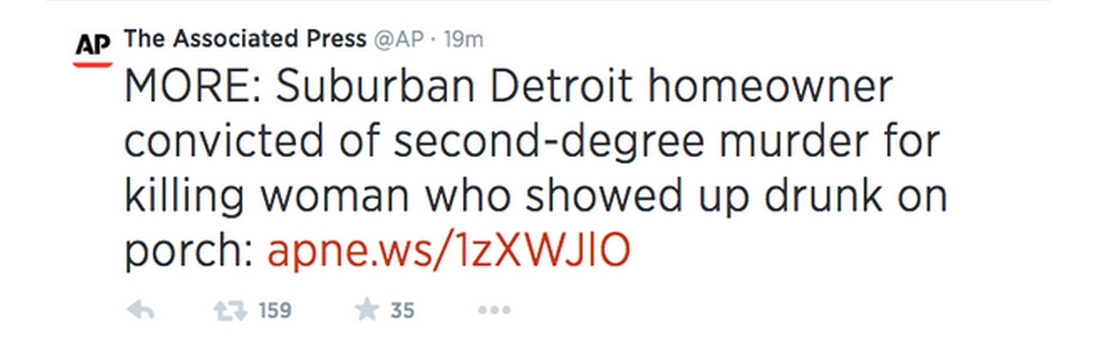
AP Tweet

The Associated Press’ tweet (since removed) regarding Theodore Wafer’s conviction in the murder of Renisha McBride has caused an outcry on Twitter, inspiring the #APHeadlines hashtag. Yesha Callahan explains:

AP prides itself on being a respectable news agency, but last night it proved that it had no respect for the 19-year-old, whom Wafer shot after she approached his porch in the middle of the night last November after she crashed her car. Although he said he was “scared” and protecting his property, Wafer was successfully convicted of second-degree murder and manslaughter.

Alexandra Brodsky adds some more context:

As many have pointed out on Black Twitter and blogs: The first tweet, which doesn’t even bother to mention McBride’s name, reduces her to the fact that she’d been drinking, clearly implying that this somehow made the killing complicated, if not acceptable. (Wafer isn’t mentioned either, but his mugshot is replaced with the smiling vision of a suburban homeowner. She is drunk; he has money.)

A sampling from the #APHeadlines feed:

https://twitter.com/elonjames/statuses/497463232563400705

Meanwhile, Joe Coscarelli provides information on the conviction itself:

After less than two days of deliberations, four black and eight white jurors found a Michigan man guilty today of killing an unarmed woman on his front porch last fall, in a case with echoes of the Trayvon Martin tragedy, but now a much different outcome. Theodore Wafer of Dearborn Heights was convicted on all three counts in the shooting of 19-year-old Renisha McBride, including second-degree murder, manslaughter, and use of a firearm in a felony.

Nicole Flatow’s trial recap goes into more detail:

Wafer said in his testimony that he shot the gun right after opening the door and did not get a good look at McBride. He said he could not detect her gender or race; and did not question her in any way before pulling the trigger. But whether or not Wafer was aware of McBride’s race when he shot her, the shooting has generated national attention because of the racial dynamic — McBride was a young black woman, shot by an older white man. The case also revived controversy over expansive “Shoot First” state laws that allow individuals to deploy their guns in self-defense without a duty to first attempt retreat. In this case, Wafer shot McBride seconds after opening the door, and called 911 after he shot her.

In his own lengthy testimony, Wafer conveyed immobilizing fear over who was outside his door that night. While he initially told police after the accident that he deployed his gun by accident, he conceded at trial that wasn’t the truth. He said he didn’t know why he lied at first, speculating that perhaps he was in “denial” about what he had done.

“I wasn’t gonna cower in my house,” he said.

He later added, “she had her whole life in front of her and I took that from her.”

The Perils Of One-Party Rule

Daniel Altman wants to vote in a Republican president … in 2024:

To be sure, a long reign by Democrats in the White House could eventually spell its own end. Complacency and corruption tend to go hand in hand with prolonged periods in power, even in highly democratic countries, and voters might revolt. I’m not saying this has happened yet — indictments and convictions of high-ranking federal officials are down under Obama versus under Bush — but it might well happen with enough years of any one party at the top. And those years have a way of multiplying in many countries; they can also lead to consolidation of control, as South Africa andArgentina have recently shown.

I would much rather that Democrats’ time in the White House ended because of a strong Republican alternative than because of their own debasement and decay. Hopefully, a worthy Republican candidate — and a more centrist, up-to-date Republican Party — will be able to sway me by 2024.

Out In The Deep South

Emily Shire applauds the Showtime documentary L Word Mississippi: Hate the Sin, which premieres tonight, for presenting an overlooked side of lesbian life in America:

The film – produced by Ilene Chaiken, who also did The L Word – acknowledges that for all the immense good that came from television portrayals of lesbians, these shows have often glossed over the hardships, bigotry, and, most frightening, well-intentioned condemnation that plagues these women in many parts of the country.  The immensely strong hold of the Bible Belt culture transcends nearly every aspect of lesbian life in southern Mississippi. Most women interviewed, regardless of age, race, or background have some deep familial connection to church. One woman, BB, is a former pastor who was outed to her congregation before she could even tell her loved ones. Being shamed by her church was tantamount to losing her community and her job.

June Thomas is aghast at the discrimination on display:

“A big problem is the churches,” says Sara, a pregnant lesbian who admits to struggling with pronouns as her physician wife transitions into her husband. Judging from this film, Sara’s assessment is quite an understatement. Over the course of 90 minutes, preachers, parents, and random guys on the street tell these women they’re deranged, depraved, and Hell-bound. It is not, to say the least, a supportive environment. These meddling churchgoers clearly believe they’re fighting for the lesbians’ souls – why else would a mother tell her daughter she is praying for the best relationship of her life to come to an end? But from the outside, at least, all they seem to be doing is messing with their loved ones’ heads. Indeed, many of the lesbians – smart women in loving, stable relationships—try to pray their own gay away. “I don’t want to die a lesbian,” says one.

How Much Do Whites Care About Racial Disparities?

New research suggests the answer is “not much”:

America’s criminal justice system disproportionately hurts people of color, particularly black and Hispanic men. Supporters of criminal-justice reform tend to point to that disparity as a good reason to change the system. But as reforms move from proposals to actual bills, the key question is how to persuade the general public that change is needed. A new study suggests that highlighting racism in the criminal justice system is not the answer, and in fact pushes white voters in the opposite direction. Even when whites believe the current laws are too harsh, they’re less likely to support changing the law if they’re reminded that the current prison population is disproportionately black.

Carla Murphy unpacks the study:

A white female researcher went to a train station near San Francisco and asked 62 white voters to watch a video of mug shots of male inmates – before asking them to sign a petition easing California’s three-strikes law. Some watched a video where only 25 percent of inmates were black. Others, where 45 percent of inmates were black. When it came time for signing, most white voters viewing the video with fewer black inmates signed the petition. Those viewing the video with a higher percentage of black inmates, however, refused to sign, “regardless of how harsh participants thought the law was.” … Researchers conducted a separate “real-life” experiment with white New Yorkers around stop-and-frisk. The results were similar to San Francisco’s.

Elizabeth Nolan Brown raises an eyebrow:

“Many legal advocates and social activists seem to assume that bombarding the public with images, statistics, and other evidence of racial disparities will motivate people to join the cause and fight inequality,” said [researcher Rebecca] Hetey. “But we found that, ironically, exposure to extreme racial disparities may make the public less, and not more, responsive to attempts to lessen the severity of policies that help maintain those disparities.”

A good reminder to heed the work of British sociologist Stuart Hall and similar communication scholars: Never assume your audience will take away what you intend for them to take away. Between the producing (“encoding” in Hall-speak) and the receiving (“decoding”) of a message, there’s a lot of space for conscious or unconscious fears and prejudices to meander in.

Jamelle Bouie sighs:

It’s disheartening. But, if I can indulge my cynicism for a moment, it’s also not too surprising. From previous research, we know that – among white Americans – there’s a strong cognitive connection between “blackness” and criminality. “The mere presence of a black man,” note [researcher Jennifeer] Eberhardt and other researchers in a 2004 paper, “can trigger thoughts that he is violent and criminal.”

Indeed, they continue, simply thinking about black Americans can lead people to see ambiguous actions as aggressive and to see harmless objects as weapons. When Michael Dunn saw 17-year-old Jordan Davis and his friends, he perceived a threat, imagined a gun, and opened fire, killing Davis. “I was the one who was victimized,” said Dunn in a phone call to his fiancée before his trial. It’s ludicrous, but it’s not dishonest. Like many other Americans, Dunn sees black people – and black men in particular – as a criminal threat.

Obama The Polarizer

Reid Cherlin remarks that the Obama administration has”managed over six years to accomplish much of what Obama promised to do, even if accomplishing it helped speed the process of partisan breakdown.” Ezra Klein remembers during the campaign when Obama promised to pass legislation by reducing partisanship:

He was half-right.

Obama pushed more change through the political system than any serious observer expected: he passed health-care reform, as well as the largest stimulus and investment package in American history, and the Dodd-Frank financial reforms (which are working better than most realize). He brought the Iraq war to a close and he actually did find and kill Osama bin Laden. There’s much left on his to-do list, but even in places where he’s failed to pass his legislative remedies into law — like immigrant reform and cap-and-trade — he’s used or is using executive actions to make huge strides.

But he didn’t do all this by fixing American politics. He did all this by breaking American politics even further. Obama hasn’t healed the divisions between Democrats and Republicans. Rather, he’s one of the most polarizing presidents since the advent of polling … Obama has brought a lot of change to America. But he’s done it by accepting — and, in many cases, accelerating — the breakdown of American politics. Judged against the rhetoric of his campaign, his presidency has been both an extraordinary success and a complete failure.

The Ebola Outbreak Gets Worse

The World Health Organization (WHO) has upgraded the severity of the crisis:

The World Health Organization has declared the Ebola outbreak in West Africa a public health emergency of international concern on Friday. The organization is encouraging global coordination to prevent the spread of both the disease and of “fear and misinformation,” according to Keiji Fukuda, the organization’s Assistant Director-General. “This is an infectious disease that can be retained,” he said, noting the region’s poor conditions and need for help. “It’s not a mysterious disease.”

Susannah Locke asks, “So what does that actually mean?”:

Technically, it means that the WHO committee thinks the outbreak is a public health risk to other nations and that the outbreak might be in need of an international response. Those are the general criteria for the PHEIC category. This does not, however, mean WHO will go in and fix everything in the Ebola fight. The declaration itself comes with recommended things that various nations should do, but it doesn’t automatically come with funding, gloves, aid workers, or any of the other resources that the exceptionally poor nations with Ebola need to actually do those things.

Abby Haglage makes clear the scale of the problem:

It’s already an unprecedented outbreak, CDC Director Dr. Tom Frieden says, and the number of infected and killed by Ebola will likely soon outnumber all other Ebola outbreaks in the past 32 years combined. According to the CDC, there have already been more than 1,700 suspected and confirmed cases of Ebola in West Africa, and more than 900 deaths—numbers that Frieden later called “too foggy” to be definitive. Ken Isaacs, the vice president of Program and Government Relations for Samaritan’s Purse, painted an even bleaker picture. According to the World Health Organization, West Africa has counted 1,711 diagnoses and 932 deaths, already, which could represent only a small fraction of the true number. “We believe that these numbers represent just 25 to 50 percent of what is happening,” said Isaacs.

On a more cheerful note, Ronald Bailey predicts a future where such outbreaks have been all but eliminated:

Advances in fields like genomics, proteomics, reverse vaccinology, synthetic biotechnology, and bioinformatics are exponentially improving the knowledge of researchers about how pathogens and the human immune system interact. All of the tools involved with identifying pathogens and producing treatments like monoclonal antibodies and vaccines will continue to fall in price and become more ubiquitous. Thus will compounding therapies become ever faster and cheaper. Long, complicated, and expensive clinical trials overseen by hypercautious regulators will no longer be required for validating the safety and effectiveness of targeted, rationally designed therapies. A couple of decades hence, infectious diseases will still strike, but any patient with a fever will be tested, her infection immediately identified, and a personalized treatment regimen crafted just for her will be administered. We may reach a time when epidemics and pandemics are ancient history.

Andrew Asks Anything: Rich Juzwiak, Ctd

Readers continue to comment on our latest podcast, sampled here and here:

I found your talk with Rich Juzwiak to be quite interesting (from my perspective of a straight older male). I have never heard such frank discussion of gay sex, and found it quitejuzwiak-banner-sq reveling in many ways. I was particularly struck with how you characterized the male gay attitude to be primarily masculine (and not necessarily gay at all). It is not something I have every really thought about, but I think you are right—the sort of “serial intimacy” you describe driven by testosterone and male orientation rings true to me, anyway. (You mention how it would be if straights were able to think of having sex with almost any woman they knew as a sort of natural and good thing, and how it would change things. Indeed.)

It made me think that perhaps male gay sexuality was more “natural” than the heterosexual male sexuality, in the sense that it seems truer to the kind of sexual drives a male naturally has! That made me laugh! I can almost imagine some argument (put in appropriately Thomistic form) for this new truth about the “laws of nature”. Certainly the kind of brotherhood you describe seems a great natural good, anyway, and one I can only envy (being, alas, “unnaturally” and firmly fixated on the female of the species).

Another dissents by quoting me:

“We actually talk about the sexual adventurism of gay men – a subculture where no women dish-podcast-beagle-transparentrestrain sexual desire – as an often wonderful thing…” Sorry, but this is pretty offensive to women  and to straight men. As if a woman’s primary role in a hetero relationship is to act as some kind of walking, talking saltpeter. And the men just glumly sit and take it. The subsequent sentence is a better expression of your point -“There may be a measure of mutual respect, friendship, democracy and brotherhood in a sexually liberated gay male world – that is perhaps unavailable to heterosexuals” – but really guys, don’t knock it till you’ve tried it!

Another makes a crucial point:

As a straight man, I have to say: We did it to ourselves. If women restrain sexual desire – and that’s probably fair – it’s because men have shamed them (or much worse) when they didn’t.

Subscribers can listen to the whole conversation here. If you’re not a subscriber yet and want to sign up for as little as $1.99/month, the link is here.