Is The Next Generation Ignorant Of HIV?

hiv_diagnoses

A recent survey found that around a third of US teens between 12 and 17 “don’t realize HIV is a sexually transmitted disease.” Russell Saunders finds it “difficult to know how much credence to give those findings” given that a “2002 study of youth at an urban clinic found that, despite spotty knowledge about STIs as a whole, HIV was identified as such by 91 percent.” Nevertheless, Saunders worries that at risk groups aren’t getting the information they need:

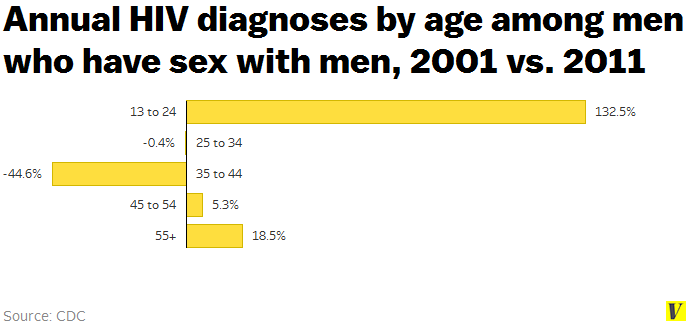
What is truly discouraging are the numbers regarding new HIV infections among men who have sex with men (MSM), the group comprising the largest number of new diagnoses by far. Among MSM aged 13-24 years rates of new infections have actually risen over the past decade, while the overall rate of new diagnoses has dropped by 30 percent. As a gay man standing on the cusp of middle age, I fear that the lessons learned by my generation and the ones that came before are being lost. While medications like Truvada can be used to lower the risk of infection for those engaged in high-risk behaviors, about which I have put my reservations aside, that doesn’t mean attention to lowering those risks isn’t important.

Though my reading of the report is that most teens have a good idea about the health risks they actually face, it remains important to inform adolescents about their risk of infection with HIV. The survey report contains no information about the respondents’ demographics beyond their ages, so it’s impossible to know how many fall into higher-risk groups. For those who do, giving them the information they need to lower that risk remains just as important as ever.

(Chart from Vox)

Back To Iraq: Blog Reax II

Waldman couches the intervention in Iraq in terms of Obama’s foreign policy doctrine, and particularly in contrast to that of his predecessor:

When he ran for president, Obama promised a new approach to military involvement overseas, one defined by limited actions with clear objectives and exit strategies. It was to be a clean break with the Bush doctrine that had given us the debacle of the Iraq War: no grand military ambitions, no open-ended conflicts, no naïve dreams of remaking countries half a world away. Of necessity, that means American military action is reactive. Instead of looking around for someone to invade, this administration has tried to help tamp down conflicts when they occur, and use force only when there seems no other option — and when it looks like it might actually accomplish something, and not create more problems than it solves.

But even though it’s designed to avoid huge disasters, this approach carries its own risks, particularly when we confront situations like the one in Iraq where there are few good options. We can take some action to keep IS out of the Kurdish north, but that might leave them just as strong, with their maniacal fundamentalism still threatening the entire region. IS is a truly ghastly bunch, with ambitions that seem unlimited. Obama said he was acting “to prevent a potential act of genocide.” What if it happens anyway, and we could have done more?

Ezra Klein focuses on how Obama expressed that doctrine in last night’s announcement:

Calling something a “genocide” has a very particular power under international law, because the US is signatory to the Convention on the Prevention and Punishment of Genocide.

The treaty says that “The Contracting Parties confirm that genocide, whether committed in time of peace or in time of war, is a crime under international law which they undertake to prevent and to punish.” The US is one of those Contracting Parties. Obama is justifying these strikes under international law as, in part, an effort to prevent a genocide.

But he’s stopping there. He’s willing to use air strikes to protect Americans and Kurds in Erbil, the capital of Iraqi Kurdistan, and to stop a genocide against the Yazidi men and women trapped in Sinjar. But he’s not willing to go further, at least not barring substantial political change in Baghdad. … Obama doesn’t oppose all wars. But to him, a smart war is a very, very limited war.

For Joe Klein, this marks the start of a new chapter in our seemingly endless war on Islamist terrorism:

Yes, we’re sick of war, sick of the region and particularly sick of Iraq–but, as seemed clear in the days after 9/11, and less clear since, this is a struggle that is going to be with us for a very long time. It doesn’t need to be the thunderous, all-consuming struggle that the Bush-Cheney government made it out to be. It will require a strategic rethink of who our friends and enemies actually are in the region. (As others have suggested, we may find that Iran is part of the solution rather than part of the problem–this is one case where America’s and Israel’s national security interests may diverge). And it will require a far smarter response than our first attempts to deal with Al Qaeda. It will have to be measured, proportionate–an insinuation rather than an invasion, acting in concert with true allies who also understand the threat and are capable of sophisticated covert operations.

Larison weighs in with characteristic skepticism:

As reasons for military action go, these are better than most, but I keep coming to the conclusion that these airstrikes are still a mistake. Many of the usual objections to military action don’t apply here, but a few still do. The airstrikes are being presented as a “limited” response, but it is hard to believe that military action of this kind will continue to be “limited” for very long. It is also taken for granted that military action won’t make things worse, but it is entirely possible that it will.

These airstrikes are at best a stop-gap measure to slow the advance of ISIS’ forces, and to the extent that they are effective they will likely become an ongoing commitment that the U.S. won’t be able to end for the foreseeable future. Administration officials claim that there is no plan for a “sustained” campaign, but now that airstrikes have begun it will be only a matter of time before there are demands for escalation and deeper involvement, and sooner or later I expect that Obama would yield to those demands. Having made the initial commitment and having accepted that the U.S. has a significant military role in Iraq’s internal conflicts, the U.S. will be expected to continue its commitment for as long as ISIS exists, and that will leave the U.S. policing the Iraqi civil war for months and years to come.

Noah Millman also has doubts:

I am terrified by what ISIS represents. I think a case can be made that our top priority for Iraq and Syria should be defeating the group. Logically, though, that likely means accepting an Assad victory in the Syrian civil war and greater Iranian influence in Iraq. And accepting those two outcomes puts us on the opposite side from the major Sunni powers, particularly Saudi Arabia. What else will we have to sacrifice to mollify them? Back when ISIS first came on the scene in Iraq, I argued that we have a moral responsibility to do what we can to ameliorate the situation in Iraq, but also that direct military intervention would likely prove counter-productive. As the situation in northern Iraq gets worse and worse, I stand by both views.

Lexington highlights “a contradiction between the extreme narrowness of the missions handed to American commanders, and the breadth of the crisis that senior American officials are starting to describe in Iraq”:

It is not clear whether Mr Obama and his inner circle consider spiralling instability in Iraq in and of itself a threat to American national security. Iraqi politicians have been wrangling over the creation of a new government for weeks. In a not so subtle nudge, Mr Obama said that more American assistance would be on offer once a new government was in place. …

Critics might also reasonably ask why averting a massacre in Sinjar should prick American consciences now, when so many other towns have fallen to the fanatics of IS without stirring a response from Washington (and when massacres in Syria have triggered a pitiful response from the West). Much of the answer involves recent advances by IS fighters towards Erbil. The Kurds are not just long-standing American allies, their capital has also become an important safe haven for refugees. American officials called Erbil “increasingly threatened” by IS on August 8th.

Though airstrikes alone won’t defeat ISIS, Paul Iddon argues that they can make a difference:

American air-power alone won’t defeat an irregular militia like Islamic State. But it can be effectively used in order to stop movements between the Islamic States’ captured territories as well as seriously hamper their efforts of consolidating their hold and control over those areas. Also coupled with extensive humanitarian aid it will serve to keep the tens-of-thousands of civilians that group displaced alive and in turn help stave off a humanitarian catastrophe. So all in all US air-power if used properly will be a worthy endeavor to help Iraq and especially the Kurds who find themselves and everything they have built over the last few years, under the auspices of American forces, at risk of destruction.

That being said the United States shouldn’t necessarily feel compelled to follow an air campaign up with an extensive deployment of boots on the ground. A decisive air campaign that will give those Iraqi state forces preparing to fight Islamic State time to get their act together and the government to take necessary reform and reconciliation steps to function as an effective governmental institution for the multi-denominational and multi-ethnic and cultural, and imperfectly secular, state which Iraq on the whole broadly constitutes.

On the other hand, Brett Logiurato relays concerns that they might backfire:

Phyllis Bennis, a scholar at the Institute for Policy Studies, progressive think tank, told Business Insider that the decision to launch airstrikes now could undermine the U.S. push for a new, more inclusive government. “The ‘humanitarian’ mission has already crept. T​he return of direct US military engagement will be seen in Iraq in the context of proving US support for the corrupt and discredited prime minister, Nuri al-Maliki, widely blamed for expanding and consolidating the sectarian political system put in place with the US occupation,” Bennis said.

“It will also undermine any possibility that al-Maliki might step down, paving the way for a broader, less sectarian government in Baghdad (the deadline was supposed to be today), since a Maliki administration with the full backing of the US military is hardly likely to give in to public political pressure to step down.”
The Yazidi Rescue: Your Thoughts

DSC02227

A reader writes:

I’ll keep it short. Do I think ISIS would really have killed, directly or indirectly, tens of thousands of Yezidis? As former military intelligence deployed to that exact area and with fairly intimate experience with how takfiris think of Yezidis, yes I do. I really thought that if someone didn’t begin to intervene in a big way, there would be tens of thousands of dead Yezidis by this time next week. Now there won’t be. I kind of don’t give a shit about anything else.

Another writes:

I spent 10 months in 2009-2010 specifically in Sinjar with the US Army. Having never heard of the Yazidi previously I was very interested in learning their background and beliefs and found them all to be easy to get along with and supportive of our presence. And as soon as ISIS started making moves in Northern Iraq, I was very worried that I would wake up one morning to news of Sinjar (an ancient Roman/Parthian/Persian border town that seems to have been traded back and forth multiple times over the centuries) and its Yazidi minority being persecuted or worse.

While I have generally appreciated the coverage of the recent events in Northern Iraq I feel like most people I listen to or read are CAEIPDS0making some large logical and geographical leaps. Sinjar, although previously occupied by the Kurdish Peshmerga, is far from the Kurdish Autonomous Region (some 200 km). Sinjar Mountain itself is a strange anomaly. The area of Western Nineveh is generally flat with small 1 to 2 meter hills that litter some patches. Then seemingly out of no where is a stand alone mountain with the town of Sinjar at its southern base. Comments like “But it will bring jubilation to the terrified thousands on Mount Sinjar, for whom salvation is now coming” are utterly ridiculous. Sinjar Mountain is not connected to the mountains that make up Kurdistan.

Sinjar, the mountain and the religious minorities are an island in the new Sunni ISIS sea. The only way to bring them real relief would be for the Kurds to gain back ground and establish supply lines to Sinjar. I would imagine that would be highly unlikely if Erbil is being threatened. I feel like more reports I have read are mixing the Kurdish and Sinjar parts of the ISIS offensive together. This is lazy and wrong and setting our expectations up for failure. I sadly do not see a good end for the Yazidi near Sinjar. Their only real hope is to get to the Kurdistan region proper. Any US attempts to do anything but drop food and water to the Yazidis on the mountain would take a lot of troops (not just special forces, so real boots on the ground) and I can’t think of a good end state even if we put the troops necessary to hold the mountain.

Another:

Thanks for your thoughtful post.  I just wanted to outline why I am supporting this intervention, while I opposed the inane intervention in Libya (you linked the two).

In Libya there was no genocide occurring.  There was no targeting of minorities. The battle was simple: a naked power struggle.  Second, in Libya we had no ally at stake.  By intervening we actually undermined an ally, as Qaddafi had assisted us post 9/11, removed his nuclear program, and had generally aligned with the West.  We destroyed that and left anarchy.

In northern Iraq the difference is acute. The minorities there will be obliterated, which is the major byproduct of our Iraq intervention in 2003; we have insured the destruction of communities that existed for thousands of years.  Second, the Kurds are an actual ally.  Our interests are aligned.  This isn’t some fanciful ally that McCain imagines exists in Syria or in Western Ukraine.  If we let the Kurds fall, then that would make us look like fools.

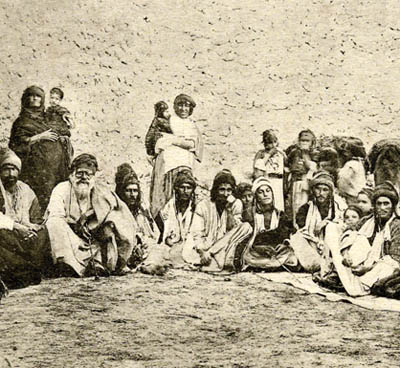
(Photos: the entrance to Sinjar, by a reader; Yazidis on the mountain of Sinjar, Iraq/Syrian border, 1920s. Via Wiki.)

Obama’s Imperial Presidency? Ctd

This week the blogosphere has been debating the legality and advisability of Obama unilaterally legalizing millions of undocumented immigrants. Douthat continues to oppose the idea:

The argument is, basically, there’s nothing really new here, this is just an extension of the way we did things already, and as for that totally sweeping new thing associated with this kind of change but not with pre-existing practice, oh, that’s just a coincidence, it’s the result of longstanding legal norms, we have nothing to do with that, didn’t really even think about it when we made the call, look, a leopard! 

The reality is that longstanding legal precedent (codified in the 1986 immigration reform, I believe, but extending earlier) does indeed allow the executive branch to grant work permits to people who receive deferred action … and that legal authority is, of course, one of the biggest reasons why activists wanted the administration to make a formal deferred-action move, rather than just circulating a memo on enforcement priorities and leaving matters there. There’s nothing accidental or unforeseen or non-central about the DACA/work permit combination, in other words; indeed, DACA explicitly created a new application system for work authorization — which, as Conn Carroll points out, is part of why this change, again supposedly just a codification of existing practice, has actually ended up snarling the system of green card and visa applications for people applying to live and work here through normal channels. And the fact that work permits can be made available once deferred action is invoked is precisely why an action on the scale of DACA — to say nothing, obviously, of the super-DACA currently being floated — represents such an aggressive use of presidential power, approaching a rewrite of the law.

Shikha Dalmia, on the other hand, defends the legality of the actions Obama is considering:

Margaret Stock, a Republican immigration lawyer and a Federalist Society member, notes that such [abuse of office] accusations don’t appreciate that all this is fully authorized by those laws. “The Immigration and Nationality Act and other laws are chock-full of huge grants of statutory authority to the president,” she explains, a point also emphasized by the nonpartisan Congressional Research Service in its 2013 brief. “Congress gave the president all these powers, and now they are upset because he wants to use them. Other presidents have used the same authority in the past without an outcry.” …

In fact, notes Stock, he could go even further and offer asylum to the Central American kids lining up at our borders, instead of sending them back as he has been promising to do. Section 207 of the INA gives him the authority to declare a humanitarian emergency and hand refugee status to all of them – and then some. And this wouldn’t be unprecedented, either.

The United States did this as part of Operation Pied Piper to accommodate fleeing children fromWorld War II and then Operation Pedro Pan in the 1960s to provide a safe haven to Cuban kids.


Putting the legal debate aside, Nyhan wonders “why Mr. Obama would engage in such a move before the election.” He remarks that “a broad executive action could provoke a backlash in the midterm elections that might be avoided with a move just a few months later”:

Given these risks, the politics of pre-election legalization seem inexplicable, creating an opening for elaborate bank-shot theories about Obama’s intentions. The columnist Charles Krauthammer floated a conspiracy theory along these lines Wednesday, suggesting on Fox News that Obama might be trying to “bait Republicans into impeachment as a way to save his party in the midterm elections.”

Such an outcome seems unlikely, but the comment illustrates just how much uncertainty there is over what Mr. Obama is doing or how Republicans — and voters — will react.

Back To War In Gaza

The ceasefire is over and fighting started again this morning:

Gaza militants resumed rocket attacks on Israel on Friday, refusing to extend a three-day truce after Egyptian-brokered talks between Israel and Hamas on a new border deal for blockaded Gaza hit a deadlock. Israel responded with a series of airstrikes, including one that killed a 10-year-old boy and wounded five children near a Gaza City mosque, Palestinian officials said. Two Israelis were wounded by rocket fire, police said. The renewed violence threw the Cairo talks on a broader deal into doubt. Hamas officials said they are ready to continue talks, but Israel’s government spokesman said Israel will not negotiate under fire.

Walter Russell Mead wonders why Hamas is still pretending it can eke out some semblance of victory from a war it has clearly lost:

War is a tricky business, in which fortunes can switch overnight, but Hamas today seems in an extremely difficult position, demanding concessions its enemies have no reason to make. Under the circumstances, both Israel and Egypt appear to have solid reasons for sticking to tough negotiating positions and awaiting events. They have inflicted a major and perhaps crushing military defeat on Hamas. They are now trying to turn this into a decisive political victory that will force Hamas to accept substantially more Egyptian power over Gaza as the price of Hamas’ survival.

Hamas is now about one-third as strong as it was at the start of the war, and it faces enemies who smell its weakness and who loathe and mistrust it. Yet it is insisting on an agreement that would amount to a victory even as its political wing reaches out to Iran. One can admire the chutzpah but doubt the wisdom of a strategy rooted in desperation and fear.

“Hamas has accomplished none of its aims,” Hussein Ibish asserts. “Not one”:

For example, Hamas sought recognition as the primary diplomatic representative of Palestinians in Gaza. But the Palestinian Authority (PA) and Palestine Liberation Organization (PLO) have kept that role, including on matters regarding Gaza, despite the fact that Hamas has held the territory since 2007. Indeed, the recent “unity deal” between Hamas and Fatah, which led to the formation of a new government with no Hamas ministers that adopted the PLO’s policy of seeking peace with Israel, did nothing to enhance Hamas’s international standing either.

Hamas also failed to conduct any kind of dramatic attack on an Israeli target, notwithstanding repeated efforts. It failed in several infiltration attempts by land and sea, and none of its rockets hit any major target, whether civilian or military. Hamas was not even able to capture a single Israeli soldier whom it could exchange for prisoners. It did execute a few successful ambushes in Gaza in which it killed Israeli soldiers. But dead Israeli troops don’t translate into a direct benefit for either Hamas or any group of Palestinians.

But Jason Burke characterizes the group as “far from disabled”:

It does appear that dozens of sophisticated tunnels leading from Gaza into Israel, which could enable cross-border raids to kill or kidnap civilians and soldiers, have been destroyed. More than 3,000 rockets have been fired on Israel from Gaza – killing three people – which Israeli officials insist is at least half of Hamas’s total stocks of the weapons. However, few senior Hamas military commanders appear to have died. …

Khaleel Habeel, an Islamic Jihad official in Gaza, admitted casualties, saying that “if you take on the fourth most powerful army in the world then of course you lose people”. Ziad Abu Oda of the Mujahideen Faction splinter group told the Guardian that his organisation had lost 50 men, including fighters and political officials. But even top-end estimates of casualties would be a fraction of the strength of Hamas’s military brigades and other groups, which are believed to have 10,000 fighters permanently under arms, with another 10,000 in reserve.

For Israel’s part, Avi Issacharoff argues, neither war nor negotiations with Hamas will achieve its security goals:

It seems that the only way to change something in this equation (apart from conquering the Strip) would be for Israel to initiate a political process with the Palestinian Authority. There is not much that Israel can do with Hamas, except undermining it in the diplomatic sphere, by offering it everything — a seaport, an airport, a lifting of the blockade, a weekly pass to the amusement park in Tel Aviv… in exchange for the disarmament of Gaza and the destruction of the rest of the tunnels. In other words, to let Hamas’s leaders choose between the Gaza Underground they’ve built and the Gaza on the surface. Hamas would say no, and Israel would gain a few points. But if it really wants to harm Hamas, to weaken it internally and in public opinion, the government of Israel would have to renew the peace talks, even at the expense of a settlement freeze.

Meanwhile, The Economist runs the numbers on the war up to yesterday. Here’s a fun fact:

33. Proportion of respondents to online poll, by Israel’s most popular TV channel on August 3rd, who say the best birthday gift for Barack Obama would be peace in the Middle East: 20% [Israeli Channel 2 TV]

34. Proportion of respondents to Israeli poll who say the best birthday gift for Barack Obama would be the Ebola virus: 48% [Israeli Channel 2 TV]

Why Did The Kurds Retreat?

David Stout scrutinizes the retreat of the peshmerga from their positions near Sinjar and the Mosul Dam, which led to the ISIS gains that tipped the scales in favor of US intervention:

Analysts say the retreat of Peshmerga troops in the face of the ISIS onslaught reveals more about the political failings of the Kurdish leadership than it does about the capabilities of what had long been considered one of the most formidable fighting forces in the region. “This advance in Sinjar and in other areas has shown the structural weakness of the KRG, the Kurdistan Regional Government,” Kawa Hassan, a visiting scholar at Carnegie Middle East Center, told TIME.

A report presented by the parliamentary commission on the Peshmerga last week explicitly stated that, while Kurdish forces had high morale, they were still under-equipped and not being paid in a timely fashion, Hassan said. The rout of Kurdish fighters in Sinjar is also particular damming for the administration of the Kurdish Regional Government’s President Masoud Barzan. Sinjar is considered a stronghold of the president’s Kurdistan Democratic Party, and his inability to protect the region will not likely fade from memory soon.

Michael Goldfarb relays a theory that the Kurds withdrew in order to precipitate a crisis and force Obama’s hand:

The idea is to create images in the west of a desperate population and an outgunned and outmanned force in need of American military aid. Indeed, news reports from the region in the last 24 hours have had pictures of Kurdish men volunteering to join existing Peshmerga forces and being handed dilapidated Kalashnikovs. That theory/rumour is as good as any.

It is hard to understand why this is happening now. IS didn’t seem to have the manpower or the inclination to push eastwards toward Erbil when it made its first breathtaking sweep into Iraq.  There was no strategic reason to do so.

Frankly, the Peshmerga are too strong and numerous a force particularly the closer any invading group gets to Erbil. The IS “army” is still reported to have not more than 15,000 men. And even with all manner of looted Syrian and Iraqi army equipment it couldn’t possibly take a city like Erbil, population 1.5m, whose people wanted to stand and fight.

But as Brett Logiurato and Michael Kelley point out, ISIS is now much better armed than the peshmerga:

ISIS is using modern U.S. weapons its fighters have seized from Iraqi forces, while the Kurds fight with Soviet arms. “They are literally outgunned by an ISIS that is fighting with hundreds of millions of dollars of U.S. military equipment seized from the Iraqi Army who abandoned it,” Ali Khedery, a former American official who has served as an adviser to five U.S. ambassadors and several American generals in Iraq, told The New York Times.

McClatchy reports that the Kurdish peshmerga, meanwhile, possess “a handful of 12.7mm Soviet-era heavy machine guns and rocket-propelled grenades,” along with a few Soviet-era T-55 tanks, to take on battle-hardened militants riding in U.S. Humvees.

Hathos Red Alert

Kristol

The usual suspects are having a collective orgasm at Obama’s decision to intervene in Iraq. In their view, it proves them right about the Obama retrenchment/surrender/capitulation to terrorism, and has them licking their chops at the prospect of “finishing the job”. Mercifully, the American people are likely to resist their insanity. Here is Bill Kristol pushing for greater involvement:

“If you’re going to get in, get in big and get in decisively now,” Kristol said. “If you go in incrementally, in this way, you don’t have the effect you want to have on ISIS; you don’t have the effect you want to have on bolstering your allies; you don’t have the effect you want to have in the region.”

Repeat after me: a whole new war. Give these fanatics an inch and they’ll be in Baghdad before you know it. Jennifer Rubin encapsulates the emerging neocon narrative we will surely see trotted out on TV and talk radio over the coming days:

Virtually every action or refusal to act has now come back to haunt Obama. Trying to reconcile past mistakes with grudging action is impossible, and yet he refuses to admit error or commit wholeheartedly to a different set of policies. As Bolton puts it, “The problem is not just Iraq, but the entire Middle East where state structures are collapsing and terrorism increasing to fill the vacuum. Thus we have moved from the American Century to the Obama Chaos.”

We should be pleased, I suppose, that he acted in some fashion. Now he needs a new policy team, a coherent policy for the region and a recognition that retrenchment failed and is indeed the cause of many of the horrors we now see. That would require adequately funding the military, taking action to prevent Iran’s hegemonic ambitions and ensuring that non-jihadi rebels in Syria succeed — to name only a few significant policy reversals that would be required. Let’s hope that this is the first indication of an about-face on Obama’s entire foreign policy approach.

The idea that what has been happening all over the Arab Muslim world since the Arab Spring is “Obama’s Chaos” just reveals that the neocons still have no idea that the world is more than America’s plaything. Wolfowitz just declared that the Iraq war had been “won” by 2009 – another sign that they have been chastened not a whit by the destruction and disorder and violence they unleashed more than a decade ago. Conor catches John Podhoretz gloating in a similar vein and rips his argument to shreds:

Alternative history cannot be definitively disproved. There’s no way to know what would be happening now if Obama had left more troops in Iraq.

But if you’ve been wrong about Iraq as frequently as Podhoretz, or the magazine he runs, it is perverse to profess certainty that the war was “all but won” by 2009, that Iraq would now be stable if only the president had listened to you, when of course you have no earthly way of knowing whether that is actually true. Podhoretz’s definition of a war that was all but won required the indefinite presence of U.S. troops. His prior positions on Iraq include a belief that firing Don Rumsfeld in 2006 would definitely lose the Iraq War, as well as the notion that perhaps the U.S. could’ve only won in Iraq by slaughtering Sunni men between 15 and 35.

Danielle Pletka insists that there is plenty we can do without re-occupying Iraq, and amps up the fear to make the case – just as the neocons did with the Iraq war:

What could Barack Obama have done, his few apologists and their libertarian cohort ask. This is not our problem, they insist. We know these isolationists and know-nothings — they’re the ones who said it didn’t matter that Afghanistan was taken over by Osama bin Laden and Mullah Omar. But, they retort, none of this would be a problem if Saddam Hussein and Hosni Mubarak and Bashar al Assad were still firmly seated on their thrones. But of course, those thrones were teetering thanks to the oppressed people of the Middle East, who have noticed that the only parties now talking liberation are the Islamist Shiites and Sunnis from Hezbollah, Hamas and al Qaeda et al.

More than a year ago, Jack Keane and I wrote about what the US could do — none of the straw men’s “boots on the ground” — to stop Assad’s slaughter here. Earlier this year, we wrote about what could — no boots — swiftly cut off IS in Iraq here. These ideas are still relevant today. Remember, Obama’s movement is a lagging indicator of the seriousness of the problem we — yes, we — face in the Middle East. More must be done or the security of the American people will be the next victim.

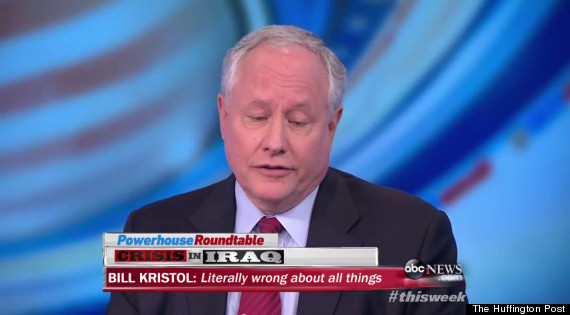
(Image of “True Chyrons For Bush-Era Iraq War ‘Experts'” from the Huffington Post.)

Why Intervene In Iraq And Not Syria?

Rodger Shanahan distinguishes between the two situations:

There will of course be accusations that Obama is a hypocrite for intervening in Iraq but not Syria. That argument is simplistic and wrong. If the US is obliged to intervene militarily everywhere there is a humanitarian need, it would never stop intervening. Obama said as much in his speech. He is one of the few US leaders to understand the limits of American power.  Moreover, the situation in Syria is far more complex. To have assisted one side would have meant breaching a nation’s sovereignty (no big deal) and potentially assisting the very Islamist forces that pose a security threat to the region and the West (a very big deal). The intervention in Iraq requires Obama to do neither of those things, so the calculus is completely different.

Ryu Spaeth elaborates:

As Obama made clear, this authorization of force has modest goals: 1) to protect U.S. personnel in the Kurdish city of Erbil and 2) to facilitate a humanitarian mission for 40,000 Yazidi Iraqis who are trapped without food or water and face imminent slaughter at the hands of the Islamic State in Iraq and Syria. There is no equivalent situation in Syria with such clear, executable goals.

Furthermore, the Iraqi government is a U.S. ally, as is the regional government in Kurdistan, where the latest action is happening. The U.S. has an interest in bolstering the regime and keeping it together; that is not the case in Syria. While Obama said he would prefer the Iraqi government to take the lead in this endeavor, the U.S.’s hand was forced after ISIS took advantage of gridlock in Baghdad to sow chaos in Kurdistan, which had once been an oasis of stability in Iraq.

Finally, the U.S. is partly to blame for the situation in Iraq. This is what happens when you recklessly invade other countries.

Also, Congress isn’t stopping Obama this time:

Last year, the Syrian government launched a chemical weapons attack that killed thousands of Syrians, crossing a red-line that Obama had previously laid down. In response, the Obama administration began laying out the case for launching airstrikes against positions in Syria, arguing that international norms and the word of the U.S. needed to be upheld. Congress, however, was quick to slam the brakes on that effort, arguing that their authorization was necessary before any new U.S. force could commence. The vote count soon slid heavily against Obama, with only the deal between the U.S. and Russia to remove Assad’s weaponssalvaging the situation. In contrast, Congress has yet to protest the actions, with Speaker of the House John Boehner (R-OH) saying that Obama’s proceeding with airstrikes “is appropriate.”

Obama’s Iraq War Begins

For those just tuning in, the US Navy launched our first airstrike on ISIS early this morning:

U.S. officials tell NBC News that two US Navy FA-18′s dropped two five-hundred pound bombs on ISIS enemy forces outside Erbil this morning. No word on casualties. The two fighter jets flew off the USS George HW Bush aircraft carrier in the Persian Gulf. The Statement by Pentagon Press Secretary Rear Admiral John Kirby: At approximately 6:45 a.m. ET, the U.S. military conducted a targeted airstrike against Islamic State of Iraq and the Levant (ISIL) terrorists. Two F/A-18 aircraft dropped 500-pound laser-guided bombs on a mobile artillery piece near Erbil. ISIL was using this artillery to shell Kurdish forces defending Erbil where U.S. personnel are located. The decision to strike was made by the U.S. Central Command commander under authorization granted him by the commander in chief.”

So who was behind last night’s airstrikes?

The most probable answer is Iraqi Su-25s, manned by Russian or Iranians — or maybe Iraqis.  “The Iraqi government was just as quick to take credit for the strikes as other governments were to deny their involvement and so, combined with the fact that the IAF can launch such operations, it actually looks like they managed to do it on their own,” Khoury told BI. In any case, Iraq’s skies are crowded.

A former high ranking CIA official in Baghdad told Jeff Stein of Newsweek that Turkish jets carried out the airstrikes. “There’s no question about it,” he said, adding that “certainly we are giving them targeting data.”  Stein notes that Turkish F-16s were reportedly patrolling the skies over the area near Sinjar in northern Iraq, where about 50,000 Yezidis are starving after fleeing ISIS militants.

The Pentagon claims to have many options for how it might carry this mission forward:

“We’re talking a very, very permissive operating environment, at least in the air,” said Mark Gunzinger, a former DoD official and now an analyst with the Center for Strategic and Budgetary Assessments in Washington. “We have to be concerned about low-altitude MANPADs, but it’s pretty permissive, so that does open up how they might posture forces in an actual concept of operations.” … It is entirely possible that a sustained campaign would be launched from outside Iraq, relying on long-distance capabilities, Gunzinger noted.

“Since we don’t have a large footprint in country and we don’t have a lot of combat aircraft in country I think anything more than small strikes and raids, if it’s a more concerted effort, will rely heavily on longer-range capabilities,” he said. “This could be a very different kind of an air campaign than we’ve done in the past, depending on the size and duration.”

But Steven Bucci doubts airstrikes will accomplish much on their own:

This is not an adequate policy.  It is a knee jerk reaction that is too little, too late. Using air power alone to “plink” at individual vehicles and pieces of equipment did not work in Kosovo for Bill Clinton, and will not work here.  The policy of “do as little as humanly possible” just so you can get credit is now coming home to roost. This requires a much larger regional response.  ISIS is a regional threat, and it will take cooperation from numerous sources to deal with it.

And Noah Rothman suggests that the odds of further escalation are high:

Regardless of the assurances the president has made to a war-weary public, a report in CBS This Morning on Friday indicates that American military officials are aware of just how comprehensive a military campaign aimed at neutralizing this fundamentalist threat will have to be. “Senior officials describe ISIL forces as swift, effective, and capable of carrying out military mission with quote ‘tremendous military proficiency,’” CBS news reporter Major Garrett reported. “The Iraqi army and Kurdish fighters have been no match for them. Now, from the air, the U.S. will join the fight. Top advisers predict a long, very long military campaign.”

CBS reporter David Martin noted that the humanitarian airlift operation “could foreshadow a much larger military campaign.” He noted that at least 150 American military advisors and an “unknown number of diplomats” remain in Erbil, a city under siege by Islamic State forces.