Can You Grin And Bear It?

David Berry gets to the root of our dentist phobia:

Most people’s fears have less to do with the cultural history of dentistry, though, than their own personal history. Sometimes that just means they’ve seen Marathon Man [see clip above], but usually it has to do with a bad experience in their past. Occasionally that means a botched procedure of some kind—true to the fascination of fear, people supposedly terrified of dentists can and do recount these experiences at some length while explaining their current discomfort… —but shame tends to be just as powerful a progenitor of dread. Phobics are not the most fabulously reliable self-reporters, but studies have suggested that up to half of even serious phobics, and more among the merely uncomfortable, have experienced nothing more traumatic than a dentist being a weapons-grade dick about how often they floss.

This is actually kind of a double-edged sword for dentists, insomuch as the longer you go without professional care, generally, the worse things get, and attempts to correct the behaviour can often just inflame the insecurity and fear. There are ways of getting you into the chair—most dentists are happy to provide either laughing gas or anti-anxiety medication, and some even specialize in just knocking you right out even for routine cleanings—but there isn’t really a way to make you floss regularly or show up ever again (at least if you’re only a dentist: cognitive behavioural therapy has been shown to be fairly effective…).

About the only saving grace to any of this is that, on the whole, people’s fear of dentists tends to decrease while they age. Although, going back to that shame thing, children are as a group less afraid of the dentist than middle-aged adults; it’s only once you start to reach retirement age that your fears begin to lessen.

For more, check out the delightful little Dish thread “Deranged Dentist Names“. Update from a reader:

Our current dentist is Dr. Pullen. In our previous city we never made it to the dentist, but the one recommended to us by our real-estate agent was a Dr. Grinder. Prior to that I went to a dentist who shared his name with a bruising right-wing for the Chicago Blackhawks, Brian Noonan, who in the early ’90s was often seen performing free amateur dental work on members of the Detroit Red Wings.

A Poem For Saturday

5602727271_57d1602d5a_b

Dish poetry editor Alice Quinn writes:

Twenty five years ago, the poet Nicholas Christopher edited an influential anthology featuring thirty seven poets who were then (as the title declared) Under 35: The New Generation of American Poets. In the years since, his talent for choosing poets whose work would grow increasingly important has been roundly confirmed.  It was there that I was introduced to the wit, gravity, and highly individualistic slant of the work of Vijay Seshadri, America’s newest Pulitzer Prize winner in Poetry.

Summer often turns our thoughts and hearts to love. We’ll feature some love poems from this landmark book in the days ahead, beginning with Seshadri’s poem dedicated to his wife Suzanne Khuri.

“My Esmeralda” by Vijay Seshadri:

 for S.O.K.

Some people like each other and are therefore like each other,
but I like you and therefore I’m
so original a burden on my time
that all the lifeguards ring their bells
when I rise from my exclusive underneath
to wash in your England of seaside hotels,

climb my perch and send off, over the panorama
of what’s most yours—those glowing herds
of prehistoric bison, sunk in clear light
up to the eyes, browsing elsewhere
extinct skyhigh ferns—
my messenger birds,
speckled and superfine,
to soar the asymptotic line
that touches you at infinity. Big mama!

Not once in any of the meretricious annals
I’m forced to read, have I read
of you, nor through the maps
I have to make sense of
have I ever watched you pass.
Among words, you’re the meaning of ‘glass,’
and you as a river will cut your own channels.

(From Wild Kingdom © 1996 by Vijay Seshadri. Reprinted with permission of Graywolf Press. Photo of the town of Hastings, on the English coast, by Luton Anderson)

Perceiving The Kindness Of Strangers

dish_faces

A new study investigated how facial features play into our initial social judgments:

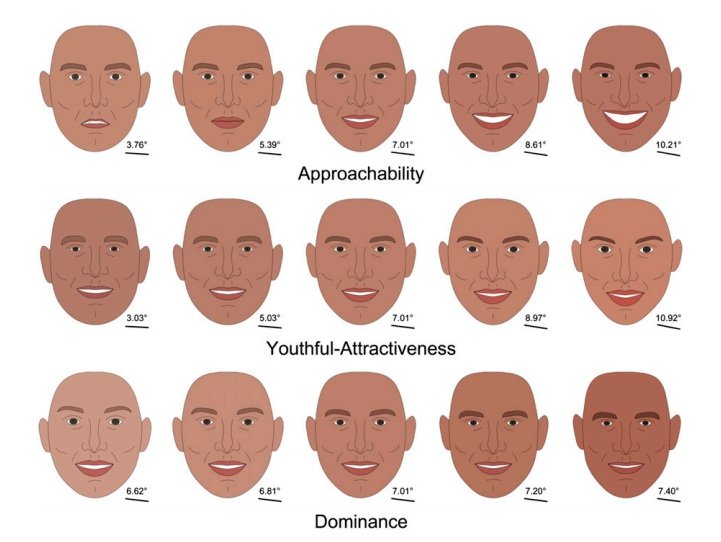
Each subject rated the faces on most-to-least scales for 16 traits, such as attractiveness and trustworthiness. The social traits were then evaluated in terms of three measures: approachability, youthful attractiveness and dominance.

For approachability, facial features concerning the mouth, such as mouth shape, were the most important. As seen in the image of model-generated faces (above), the corners of the mouth point slightly downward in the less approachable faces and turn upward in the visages that were scored as more approachable. …

In terms of youthfulness and attractiveness, characteristics of the eye and eyebrows were most strongly linked with the measure. For example, in the illustration above, the face farthest to the right features larger eyes and eyebrows with a more dramatic arch. As for dominance, that measure was most associated with facial features that may be construed as stereotypically masculine.

The study’s lead researcher, Dr. Tom Harley, is cautious about the results:

“Lots of the features of the face tend to vary together,” he explained. “So it’s very difficult for us to pin down with certainty that a given feature of the face is contributing to a certain social impression.”

There are some obvious trends however – including the tendency for masculine faces to be perceived as dominant, or for a broadly smiling face to seem more approachable and trustworthy. This points to a potentially worrying implication: brief facial expressions can make a big difference to how we are received by strangers.

“It might be problematic if we’re forming these kind of judgements based on these rather fleeting impressions,” Dr Hartley said, “particularly in today’s world where we only might see one picture of a face, on social media, and have to form our impression based on that.”

It’s So Hard Playing Famous

Alex Pappademas, whose “tolerance for Kardashian-related bullshit is pretty much limitless,” describes playing the mobile game Kim Kardashian: Hollywood. “If this game were a person it would be a horrible sociopath,” he concludes, explaining that gameplay led him to question notions of work ethic:

Although she recorded voice-overs for her avatar (“Bible — I love that on you!”), it’s unclear how involved Kim Kardashian was with the conceptualization of this game. But the gameplay itself is an extension of the compensatory mythology of hard work that the Ks have created around their body of industrious nonwork. About once per Keeping Up With the Kardashians episode, you will hear one of the Ks use the word “work” to describe activities (having their photograph taken, drinking iced coffee while walking around a potential retail space, looking at pictures of bathing suits and saying “super cute”) that no one who actually works at a job, even an easy job, would refer to as such. I love the Kardashians and I believe they’ve sustained themselves as famous people through resourcefulness and even personal sacrifice, but them saying the word “work” is always, always funny to me. They need to come up with another word to describe what they do, like “gork.” A hypothetical Khloe quote from a world where this is the case: “I’ve just really been trying to focus on gork.”

So the Kardashian game isn’t just about providing you and me with the opportunity to vicariously live the life of a professional celebrity.

It’s propaganda designed to remind us at every turn that the life of a professional celebrity isn’t easy. That it takes gork. The most important resource in the Kardashian game isn’t fake money or the sparkly “K” stars you accumulate for successfully completing a mission; it’s “energy,” represented by little Gatorade-blue lightning bolts. Every task you do in a professional context in the game takes energy, even “Grab a drink,” which, strictly speaking, isn’t even a task.

Jessica Winter is on board:

That is the genius of Kim Kardashian: Hollywood: It perfectly captures the hollow-eyed compliant monotony of the very lifestyle it’s espousing. You absorb its value system into your bloodstream on contact.

The first big dilemma my avatar faced was deciding whether or not to spend precious Adderall-bolts of energy flirting with a D-list social worker at an overlit and underpopulated party (I didn’t, and shall therefore never know if he was the nephew of a TV executive). Her first major regret was leaving a big tip for a bartender on the hunch that he had “information” (he did not, because he was just a lowly bartender). After a few hours of play, you start to understand how, if you’d been forged in this crucible like Kim and her sisters, you, too, might have turned out just like these sad, tiny people inside your phone. In miniaturizing and cartoon-izing Kim Kardashian and her brethren, KK:H renders them as less cartoonish and more empathetic than they seem in real life. Making millions to stand around doing nothing, saying nothing, thinking nothing—it’s harder than it looks.

The Power Of Names

Cody C. Delistraty mulls it over:

Not being able to pronounce a name spells a death sentence for relationships. That’s because the ability to pronounce someone’s name is directly related to how close you feel to that person. Our brains tend to believe that if something is difficult to understand, it must also be high-risk. In fact, companies with names that are simple and easy to pronounce see significantly higher investments than more complexly named stocks, especially just after their initial public offerings when information on the stock’s fundamentals are most scarce. People with easier to pronounce names are also judged more positively and tend to be hired and promoted more often than their more obscurely named peers.

There are more variables at play than just pronunciation, though. In competitive fields that have classically been dominated by men, such as law and engineering, women with sexually ambiguous names tend to be more successful. This effect is known as the Portia Hypothesis (named for the heroine of Shakespeare’s The Merchant of Venice who disguises herself as a lawyer’s apprentice and takes on the name Balthazar to save the titular merchant, Antonio). A study found that female lawyers with more masculine names– such as Barney, Dale, Leslie, Jan, and Rudell – tend to have better chances of winning judgeships than their more effeminately named female peers. All else being equal, changing a candidate’s name from Sue to Cameron tripled a candidate’s likelihood of becoming a judge; a change from Sue to Bruce quintupled it.

Dish Shirts Are Here!

shirt-combo

[Re-posted from Monday. Responses from readers here and here]

Finally – after lots of your input – we’re psyched to offer you a choice of four custom Dish shirts. If you’re dying to take a look and want to skip the descriptions below, head straight to our storefront and buy your shirt now!

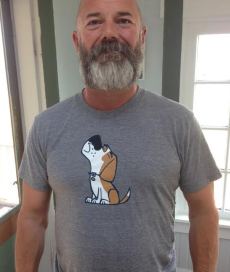
We thought we’d start our store simply enough by offering two t-shirts. The first is a light blue one emblazoned with the Dish logo across the chest (see above on the left). Or if you prefer the baying beagle by herself, check out the gray Howler Tee (modeled by the dashing bear on the right). I love the lone howler myself – only other Dishheads will get it.

andrew_howler-teeWe picked American Apparel t-shirts that use high-quality screen-printing and a higher quality tri-blend fabric that’s super soft, durable, and has a bit of stretch that retains its slim shape. There are  sizes for both men and women – no generic “unisex” option this time around, as you insisted. We’ve also lowered the price by half compared with the t-shirts we did a few years ago.
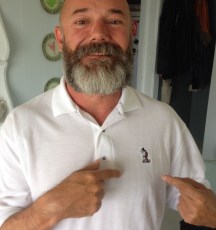
Want something a little more formal you can wear to the office, church, or restaurant? Check out the polo shirts, which come in white (see below left) and navy blue (see above right). Both of these classic polos are made with a “Silk Touch” poly-cotton fabric and embroidered with the familiar Dish beagle on the left breast. The polos run a little large, and the high-quality fabric is shrink resistant, so keep that in mind when you pick your size. For the perfect fit, consult the sizing chart.

andrew_white-poloBecause we’re doing the higher-quality screen-printing option with a bulk-ordering process, in order to keep prices down, these particular shirts will only be available for a limited time, so you need to order very soon to be part of the first printing. So if you’re interested in a shirt, don’t hesitate – buy now!

As always, we welcome your feedback in the in-tray. And send us a pic of you wearing your new shirt! You may see it appear on the blog.

But first go here to grab your new t-shirt or polo. It’s one critical way to keep the Dish independent and running for years to come. And they’re pretty sweet as well.

Write Wingers, Ctd

Responding to Adam Kirsch and Adam Bellow on the subject of conservative fiction, Douthat argues provocatively that there aren’t enough bad conservative artists out there:

[T]o be truly great, truly lasting, a novel or any other exercise in storytelling has to transcend cliches and oversimplifications, has to capture something of the deep complexity of human affairs. So at a certain level of seriousness or genius, the problem-or-is-it of conservative underrepresentation in the contemporary arts melts away, because you’re dealing with a range of creators whose talents effectively transcend partisanship and ideological fixations …. It’s that mass-market territory that more often vindicates Jonathan Chait’s powerful argument about the essential liberalism of the culture industry; it’s there that you’ll find the big-business bad guys and multicultural preachiness and paranoid stylings and caricatures of religious conservatives and Ted Mosby-ian sexual assumptions and enviro-propaganda that the right tends, understandably, to react against with anti-Hollywood fury or resigned frustration.

But this suggests a rather strange-sounding riposte to Kirsch’s question, posed after his elevation of writers like Foster Wallace into a kind of conservative literary pantheon. “With all these books to read and admire,” he asks, “why does Adam Bellow continue to believe that conservative writers are a persecuted minority?” Well, one might say, because there aren’t enough mediocre conservative writers and artists at work!

Micah Mattix adds thoughtfully:

Douthat clearly sees the problem with Bellow’s project (at least as he presents it in The National Review), but he seems unwilling to reject it completely. He worries that any attempt to “close the ‘hack gap,'” as he calls it, will make conservatives look bad. (It will.) And he writes that a conscious “conservative investment” in the arts, “as opposed to an aesthetic one, which is how most writing programs and fellowships are conceived even when their politics are fundamentally liberal” may “be foredoomed to failure, or at the very least be putting a limit on the quality of the work it fosters, and a ceiling on its potential success.” Agreed.

But conservatives should not reject Bellow’s proposal because it will make them look bad or be unsuccessful. They should reject it because it is not conservative. It inescapably treats art or culture as a tool, or weapon, in the struggle for power. This, it seems to me, is a progressive or revolutionary conception of art. Even Douthat falls into discussing art and culture in terms of utility or “success.” Part of this is because he’s responding to Bellow’s argument regarding just these things. But it also risks obscuring conservatives’ defense of a proper view of art. … Both should treat art, not as a means to an end, but as an end in itself, which, paradoxically, also makes it useful.

Mission Creep, 1914 Style

Preparations For Remembrance Sunday And Armistice Day

The centennial of the July Crisis that led Europe down the perilous path to World War I has given many historians and scholars of war an occasion to revisit the question of how the European powers managed to blunder into such a bloody fiasco. Stephen Walt asks an equally interesting question: Why on did it take more than four years to correct what was obviously a huge mistake?

Ending the war was difficult because each side’s territorial ambitions and other war aims kept increasing, which made it harder for them to even consider some sort of negotiated settlement. War aims continued to expand in part because each side kept recruiting new allies by promising them territorial gains after the war, which both increased the total number of combatants and widened the geographical scope of the war. Germany promised the Ottoman Empire slices of Russian territory to get it to join the Dual Alliance; in response, London promised several Arab leaders independent kingdoms if they revolted against the Ottomans. The British also bribed Italy to realign by offering it territory along the Adriatic Sea. But all these war-time promises required each side to try to win an even bigger victory, which in turn just spurred their enemies to fight even harder to prevent it.

Each side’s ambitions also grew because politicians had to justify the enormous sacrifices their countrymen were making. The tyranny of “sunk costs” quickly sank in: the more each side lost, the more it had to promise to deliver once victory was achieved. By 1916, therefore, German war aims included annexing Luxemburg, substantial portions of France, making Belgium a vassal state, gaining new colonies in Africa, and carving out a vast new empire in Eastern Europe. For their part, allied war aims included a complete German withdrawal from the territory it had conquered, plus “national self-determination” and the establishment of democratic rule, which implied the dismemberment of the Austrian empire and the reshaping of Germany’s political order, something neither country would agree to until it was totally defeated.

(Photo: A memorial cross and poppy lays on the floor on a blanket of fallen pine needles at the National Memorial Arboretum on November 5, 2013 in Alrewas, Staffordshire. The National Memorial Arboretum is observed a two minute moment silence on the eleventh hour of the eleventh day of the eleventh month of the year, marking the exact time when guns fell silent at the end of World War I in 1918. By Christopher Furlong/Getty Images)

The Molecular Metropolis

MIT engineering prof Franz-Josef Ulm came up with an analogy for understanding cities as molecular structures:

With colleagues, Ulm began analyzing cities the way you’d analyze a material, looking at factors such as the arrangement of buildings, each building’s center of mass, and how they’re ordered ChicagoILaround each other. They concluded that cities could be grouped into categories: Boston’s structure, for example, looks a lot like an “amorphous liquid.” Seattle is another liquid, and so is Los Angeles. Chicago, which was designed on a grid, looks like glass, he says; New York resembles a highly ordered crystal. …

So far, Ulm says, the work has two potential applications. First, it could help predict and mitigate urban heat island effects, the fact that cities tend to be several degrees warmer than their surrounding areas—a phenomenon that has a major impact on energy use. (His research on how this relates to structure is currently undergoing peer review.) Second, he says that cities’ molecular order (or disorder) may also affect their vulnerability to the kinds of catastrophic weather events that are becoming more frequent thanks to climate change.

(GIF of a satellite image of Chicago created by designer Troy Hyde for his series Lightscapes, previously featured on the Dish here.)