Emma Green presents some (very) French research findings. Bar-goers in Grenoble were asked “to give their opinion on two of philosophers’ favorite quandaries: the so-called trolley problem and its cousin, the footbridge problem”:
In the first, people must choose whether they would flip a switch to divert a runaway trolley, killing one person but sparing five others; the second asks about pushing someone off a bridge for the same purpose. “A drawing accompanied the text of each vignette in order to facilitate understanding of the story,” perhaps in case the subjects were too drunk to read.
“The idea was to look more at the more moral and ethical implications of how alcohol might affect decision-making,” said Aaron Duke, one of the researchers. His team found a correlation between each subject’s level of intoxication and his or her willingness to flip the switch or push the person—the drunker the subject, the more willing he or she was to kill one hypothetical person for the sake of the hypothetical many. This choice follows the logic of utilitarianism: More good is done by saving five people than harm is done by killing one.
A reader quotes new reporting on the Matthew Shepard case:
It was fairly well known in the Laramie community that McKinney wouldn’t be one that was striking out of a sense of homophobia. Some of the officers I worked with had caught him in a sexual act with another man, so it didn’t fit – none of that made any sense.
So that quote is probative in your mind that the attack could not have been motivated or exacerbated by homophobia? Nobody who ever got a blowjob from a guy would lash out in front of his straight buddy at an effeminate kid due to homophobia? Really? That’s the best you’ve got?
The question here is whether the crime was solely a function of the homophobic hatred of two strangers who beat up and brutally murdered someone merely because he was gay. That’s the official line of the Matthew Shepard Foundation and the Human Rights Campaign. Of course these motives could also have been involved. I’m arguing that meth can explain all of it, but may not be the only factor involved. I can’t read the meth-addled minds of the foul murderers. I can detect bullshit from the gay rights establishment. Another reader:
I’m in the awkward position of preferring to think that Jiminez is wrong while acknowledging the strength of his arguments. But I do object to this statement from you: “Those who made a small fundraising fortune off the myth – like the Human Rights Campaign (natch) – will never acknowledge the truth.”
Your clear implication here is that those who resist Jimenez’s interpretation of the events are acting in bad faith, their eyes blinded by all those lovely fundraising dollars. Is it not possible that the Matthew Shepard Foundation’s complete rejection of Jimenez’s work is based on something other than greed? That foundation was, after all, founded by Shepard’s parents. Would you not concede that a mother, facing the accusation that her murdered son was a crystal meth dealing sex worker, might reject that accusation for reasons other than that it might harm her fundraising work? That her attachment to one interpretation of the events leading to her son’s murder has more to do with how she felt about her son than it does with the petty arguments of the gay rights culture war that (I suspect) you are more attached to than she is?
I could equally suggest that your absolute conviction that Jimenez is right is a bad faith interpretation of the facts, blinded by your dislike of HRC and the fact that they’ve used his death to argue for laws with which you don’t agree. But I’d be wrong there, wouldn’t I?
I can perfectly well understand why a mother would feel that way. That doesn’t excuse her foundation of smearing decent reporters who have uncovered a more complicated truth, or justify others raising gobs of cash on her grief (yes, you have no idea how many fundraising appeals I received based on the myth), and turning this complicated and horrible crime into a rallying cry for a pre-existing legislative agenda. Another:
It seems to me that there are two extremes to this debate: one denies that drugs had anything at all to do with Matthew Shepard’s murder, the other (apparently represented by you and Jimenez) denies that homophobia had anything to do with it. Isn’t it possible that both could have been factors?
I have yet to see you address an obvious question: If it was all about the inexplicable consequences of crystal meth – and not, at least partly, “out of a sense of homophobia” – why didn’t Aaron McKinney or his attorneys use that as a defense, when it clearly could have helped him more than the pathetic “gay panic” defense did?
Obviously, the need for another fix can fuel violence. But enough to explain the sheer brutality of the attack on Shepard, when no traces of meth were found in the killers’ bloodstreams by the Laramie Police Department?
No one wants to confess a meth robbery gone haywire, and they may have thought the gay panic defense might work – and it didn’t. As for the further myth of the blood-test, over to Steve:
In the entire unsealed public record that I reviewed at the courthouse, I never saw a toxicology report or any document verifying drug testing. Your reader seems to be referring to a statement made last year on NPR by Dave O’Malley alleging such a drug test. When asked by Rachel Martin on Weekend Edition to produce such a toxicology report, O’Malley was unable to do it, and Rachel ended the show on that note. The only testing that McKinney and Henderson had that I know of was for HIV.
You referred in your recent post to the Casper Tribune’s latest smearing. In that paper last month, Shepard prosecutor Cal Rerucha was quoted as saying that had meth not been involved, there wouldn’t have been a murder. I also have at least 9 named sources on the record about McKinney’s weeklong meth use (and cocaine) in the week leading up to the crime. Let me know if you want to publish their names.
That being said, the more time that elapses between meth use and testing, the harder it is to get a conclusive result. The crime took place on a Tuesday night, McKinney wasn’t arrested until late Thurs night in Colorado, and he gave a statement to police in Laramie on Friday. So any alleged testing couldn’t have taken place before then. In 14+ years, the prosecutor has never told me of a drug test that proves what O’Malley alleges. What the prosecutor did tell me, however, is that O’Malley begged him not to tell the truth to ABC News “because of all the good that’s been done in Matt’s name.” When Rerucha refused, O’Malley asked him if he would at least “clear” what he was going to with Judy Shepard. Rerucha declined, of course.
The Matthew Shepard Foundation and the Human Rights Campaign should not be smearing and demonizing good faith work by a courageous openly gay journalist. They need to apologize, and correct the record. At some point, their convenient untruth must stop.
A personal story from the in-tray adds some critical context:
I have read this conversation with some interest, because it is all too close to home. Tomorrow, my wife and I are transferring a frozen embryo after a fresh transfer failed in late August. For these reasons, I have become all too conversant on the subject matter … yet it is a conversation that one rarely has beyond our own home. (I will note that my wife and I are very lucky in that we both have extremely generous coverage and a non-trivial cache of frozen embryos to work from; it is unlikely that we will have to ever do another egg retrieval.)
I think the piece you quoted by Pamela Mahoney Tsingdinos, along with your reader, needs to be placed in a bit more perspective. In Tsigdinos’ case, I suspect the experience she has had (which I can completely empathize with, as fertility treatment is emotionally exhausting) has led to a somewhat jaded perspective. I think a similar critique is in order for your reader.
In any given month, a perfectly fertile couple only has about a 20% chance of conceiving a child if they are trying.
So, a fertile couple doing it the “old fashioned” way, has a roughly 80% fail rate. Suddenly, the 23% success rate of frozen eggs does not seem to shabby, no? In fact, the very study that Tsigdinos cited to support her argument reached a positive conclusion relative to the achieved probabilities. This is why fertility doctors do not take on patients until they have been trying for a year without success; prior to that point, the lack of conception may very well be just due to bad dice rolls.
Here is a PDF on Penn Fertility data on embryo transfers. Of note, they are talking about embryo transfers, which is after the first culling of eggs. They do not appear to post data on frozen eggs but do state the following:
Pregnancy using already retrieved, frozen donor eggs is an incredible step forward and is possible because of the dramatic improvement in egg freezing technology. Methods of rapid freezing called vitrification are now used effectively to freeze eggs. Several large studies have been conducted using frozen donor eggs and indicate that pregnancy rates are no different when fresh or frozen eggs are used.
Under normal circumstances during ovulation, a series of things has to go right in order for a child to arrive. Sex has to happen at the right time, egg and sperm need to meet – the right egg and sperm need to meet – implantation needs to occur, and then the body needs to get on board with the pregnancy. A lot can and does go wrong between a couple having sex and a baby being the result. In fact, one of the most frustrating parts of fertility treatment is the unknown. As of now, in the midst of infertility treatment, our infertility remains “unexplained”.
The problem here is that we are talking about eggs, and our perspective gets skewed when we pull them out of a woman’s body and get to actually trace the failure rates. IVF is instructive in thinking about this. The general rule is that 50% of the retrieved eggs will not fertilize and/or reach a point where transfer is a viable option. Of the resulting 3- and 5-day embryos, a further 50% will not result in a child. What does that mean? We are back in the same ballpark of 25% of retrieved eggs resulting in a child. This is indeed sobering when you break it down, particularly for older women with weaker egg reserves. If you pull less than 8 eggs, the probabilistic expectation is for a single child to result (if that). That, however, needs to be placed alongside the fact that a fertile couple trying for 8 months would be expected to produce <2 children.
With the advent of vitrification as a technique, I suspect we will see freezing become much more common in the years ahead. The practice my wife and I are going to has data that suggests frozen embryo transfers may result in a higher rate of pregnancies than fresh transfers. If true, the reason is most likely a byproduct of the hormonal treatments involved in stimulation and retrieval. An even greater advantage is that freezing effectively stops the clock on egg/embryo aging. So, if you freeze an egg/embryo at age 25, you can transfer it at age 37, and genetically it will be as if you conceived the child at 25 (this has significant benefit given the data we have on egg reserves for 35+ women).
None of this is to suggest that freezing eggs should suddenly become Plan A. There are very real and scary potential side effects of the stimulation and retrieval process, and I worry about the long-term impact on my wife’s health.
That being said, I think expanding coverage for this procedure should be applauded, since it creates an option for women. What the data pretty much universally suggest is that women are much better off making a decision about having a family prior to hitting age 35. After that, the statistics begin to drop rapidly. So if you are an early 30s woman who wishes to have a family but are not ready to do so for whatever reason, freezing and banking eggs is something well worth considering.
Again, yes, the vast majority of the collected eggs will fail to result in a pregnancy – but that’s life, just as is the case in the wild.
Update from a reader:
Your reader is pretty much on the money. I went through two IVFs and have friends who did live and frozen transfers. Those are the stats.
The only kibble I have is about egg freezing versus embryo. Embies do well through the freezing process and the thawing. Eggs? Not so much. They are not like sperm, which also freezes and thaws fine. Eggs are much more fragile.
If companies were offering to help women harvest and fertilize eggs to create embryos for future use, THAT would be truly useful. But they aren’t. It feels more like a con.
That said, why has no one broached the subject of young men storing away their young healthy sperm for future use? The research on older fathers gets grimmer as time goes on, with a laundry lists of mental health, learning disorders and autism now being linked to “old” sperm.
A woman is born with all the eggs she will ever have. They age with her, but they were generated when she was so unlike males whose sperm quality gets spottier all the time because of the DNA damage we all pick up as we age, a woman’s eggs don’t have that particular downside to worry about. Which is why it would be great if they froze well – but they don’t.
“I don’t think it’s draconian,” Christie, appearing on the Today show, said of New Jersey’s mandatory 21-day quarantine on health care workers returning from Liberia, Sierra Leone, or Guinea. “The members of the American public believe it is common sense, and we are not moving an inch. Our policy hasn’t changed and our policy will not change.” … The governor also said the CDC has been too slow to change its policies, and is now “incrementally taking steps to the policy we put in effect in New Jersey.” The CDC announced on Monday new guidelines for people traveling from West Africa, but still recommends voluntary at-home isolation rather than state-mandated quarantines.
Ben Wallace-Wells thinks “that Christie, and also [New York Governor] Cuomo, simply misread the nature of the public alarm”:
Despite the tone on cable news, and despite the wildly over-publicized decisions of a few parents in a few school districts to keep their kids home, there hasn’t been a public panic over Ebola. People are still traveling on airplanes. They are not flooding the hospitals with anxieties that minor symptoms might portend Ebola. Everyone whose job it is to predict public opinion seems to have been bracing for a panic. But it hasn’t come.
A dumb and snotty cottage industry has developed in making fun of those who are freaking out. (As I write, the most-viewed story on The New Yorker‘s website is a “humor” column by Andy Borowitz titled, “Study: Fear of Ebola Highest Among People Who Did Not Pay Attention During Math and Science Classes.”) But really there hasn’t been much excess fear at all.
Earlier Dish on that media coverage here. In Alex Altman’s view, Christie tried to score some political points from the crisis, but his plan backfired:
For Christie, the panic wrought by the lethal virus may have seemed a prime opportunity to run his favorite play: the one where the tough leader takes a common-sense stand in the face of federal dithering. This is the move that drew bipartisan plaudits after Hurricane Sandy ravaged the Jersey shore in 2012, and one Christie may hope will propel a possible presidential candidacy in 2016. The play has worked swimmingly when run against teachers’ unions, or bungling bureaucrats, or “idiots” loitering on a stretch of beach in the face of an oncoming storm. It doesn’t wear as well when the target is a nurse who risked her life to fight a deadly disease.
The Bloomberg View editors chastise the governors:
Clearly, their decision was unnecessary and premature. Yet it also displays a worrisome disconnect in national public-health networks. Some amount of public panic is to be expected, and must be addressed. State health officials, however, should know better — both about how Ebola spreads and the dangers of mandatory quarantines. … During the SARS epidemic of 2003, public health officials learned that voluntary quarantines — simply requesting that people who might have infectious illness limit their social interactions for a period of time — are as effective as forced quarantines in helping stem an outbreak.
But Noah Rothman defends Christie from the flak he’s taking from both left and right:
Chris Christie did not deserve the left’s self-satisfied recriminations when he instituted stricter measures aimed at curtailing the spread of Ebola in America, programs which enjoy broad support, and he does not merit the scorn heaped upon him by the right for refusing to indefinitely intern a person who likely does not carry the disease. The right is deeply mistrustful of Chris Christie and, on some level, he has earned their suspicion. In this case, it is clear that apprehension among the right toward Christie is verging on compulsive and insidious. Liberals did not enjoy a victory when [Kaci] Hickox was transferred out of containment, but, by insisting Christie somehow endorsed the White House’s position, the right is busily handing them one.
Yesterday, the Centers for Disease Control and Prevention issued new guidelines for people at risk of coming down with Ebola, meaning primarily health workers returning from West Africa:
On Monday, the CDC broke down people in the orbit of Ebola into four categories. Those at highest risk are anyone who’s had direct contact with an Ebola patient’s body fluids, including health care workers who suffer a needle-stick injury during a patient’s care. For those people who are at highest risk and asymptomatic, the CDC recommended restrictions on commercial travel or attendance at public gatherings. The guidelines were not specific about where a person should stay, but officials said they meant home or hospital isolation. For those with some risk, like who lived in a household with an Ebola patient but didn’t have direct contact, travel restriction can be decided on a case-by-case basis, government officials said.
But states are not bound by these guidelines and are free to implement their own protocols, as several more states have done following New York and New Jersey’s lead:
Virginia Gov. Terry McAuliffe (D) and Maryland Gov. Martin O’Malley (D) held separate news conferences Monday announcing their plans for Ebola containment. Travelers from Guinea, Liberia and Sierra Leone will be assessed by health workers and asked to agree to a 21-day monitoring protocol. Higher-risk travelers will be visited at home by health workers and asked to stay there. Individuals refusing to sign the protocol agreement or not following the rules could be involuntarily quarantined, officials said.
Georgia Gov. Nathan Deal (R) on Monday announced a more aggressive Ebola-containment policy. Travelers from West Africa who don’t show symptoms, but who are considered high risk because of “known direct exposure” to Ebola patients, will be subject to quarantine at a designated facility, Deal’s office said.
Army spokesman Col. Steve Warren did not call the move a quarantine in a statement issued on Monday. Rather, he said that “about a dozen” troops were being monitored. “Out of an abundance of caution, the Army did direct a small number of military personnel (about a dozen) that recently returned to Italy to be monitored in a separate location at their home station (Vicenza),” Warren stated. “There has been no decision to implement this force wide and any such decision would be made by the secretary of Defense. None of these individuals have shown any symptoms of exposure.”
According to reports, the soldiers are being monitored away from their families for 21 days. The Army refuses to call the isolation a quarantine, although separating people for medical reasons meets the Centers for Disease Control and Prevention’s definition of quarantine.
Allahpundit ridicules the CDC’s recommendations, which in his opinion are “one notch more casual than [they] should be”:
To this day, if I’m not mistaken, Kent Brantly and Nancy Writebol don’t know how they contracted the disease in Africa; Doctors Without Borders, which naturally follows strict protocols in treating patients, has nonetheless seen 16 staffers come down with it, nine of whom died. Presumably Spencer had no reason to think he’d contracted it or he wouldn’t have gone bowling. If even trained professionals are getting caught by surprise in their exposure, why would the CDC err on the side of less quarantine once they’re back home? The public’s confidence in the agency is going to get much, much worse, needless to say, if we end up with another transmission from the “low” or “some risk” category.
The irony of all this, as Tim Cavanaugh notes, is that it’s the doctors at the centers of it who are making the public more, not less, anxious (not “panicked,” as is often wrongly said). If Spencer and Snyderman had diligently quarantined themselves, the public would have greater faith that voluntary quarantines are an acceptable alternative to the sort of state-imposed measure that Christie’s getting hammered for today.
And Jazz Shaw insists that protocols that rely on voluntary quarantines and self-reporting simply aren’t good enough:
People facing a potentially dire situation will frequently be in denial. We see that all the time with folks who avoid going to the doctor only to find out later that all of those warning signs were, indeed, cancer. But if you can’t bring yourself to admit it in your own mind, you likely won’t be checking off those boxes on a form either. Further, you might be thinking that it can’t possibly be Ebola, so why would I go through all the hassle of reporting this? Where would they get that idea? Maybe from hearing an endless stream of government spokesmodels being paraded across your television screen telling you that it’s almost impossible to catch in the first place. And if you’ve had that drilled into your head often enough, who wants to go get locked up in their house for three weeks for what is almost certainly just a case of the flu?
Follow all of our Ebola coverage here, compiled primarily by Jonah Shepp, the irrepressible young Dish editor.
“Argument is like all other human behaviors: subject to conditioning through reward and punishment. And we’ve created these incentives on the left: always politicize; always escalate; always ridicule. We’re living with the consequences of those tendencies now. Unfortunately, I don’t know how we build a new left discourse, given that the two current modes of left-wing expression appear to be a) showily condescending ridicule and b) utter fury.
I mean you can guess what the response by some will be to this essay: deBoer doesn’t think racism is real, he doesn’t think sexism is real, he wants people to just get over it when they’re the victims of sexism and racism. None of that is true. I write about the structural racism of our society constantly. I believe that we’re still a deeply, inherently sexist culture. (For example, you may have heard of #GamerGate.) And I absolutely believe that there are tons of daily encounters that demonstrate these problems, and that the victims of them should feel comfortable speaking out.
I just also think that we have to be able to say “you know, I don’t think that your particular political critique here is correct” without being accused of failing to oppose racism and sexism in general,” – Freddie DeBoer.
(Illustration: a visualization of the Twitterverse on Gamergate over 72 hours via Andy Baio, with the help of Gilad Lotan, chief data scientist at Betaworks. Look at the polarization. The data also found many many more misogynist tweets than those about ethics in gamer journalism.)
I started reading Waking Upafter watching Sam Harris on Joe Rogan’s podcast. In it, Harris recounts his case against free will and mentioned that he thought that the self was an illusion. I am sympathetic to that view and in a manner believe it to be true, so I purchased Waking Up primarily to read his case on the question of self.
I can’t say I really came away with the tools to feel I can prove this belief. Harris writes in the mode of a skeptic and does so well. But nowhere does the book move fully beyond skepticism to proactive persuasion. So you ultimately end up with firm evidence that common conceptions of self are false, but then the final leap seems to be that moments of awe and the truth are … just self-evident. Something that just is. But some people aren’t going to interpret these moments in that way. Certainly many Christians will associate with the idea of divine light in these moments, as you do. People of other backgrounds will see it in other ways.
Another is more critical:
I love both you and Sam. I really do. I’m with him on the dangers and damage wrought by religion. With you on most political issues. But on this question from Waking Up, regarding the nature of the so-called “selfless” state of mind human beings sometimes experience during meditation or prayer, I’m afraid you are both wrong.
Andrew, why do you both seek transcendence so badly? For what you feel, what we all feel in these oceanic moments, is neither an experience of being flooded by God’s love (your view) or a glimpse into the underlying “selflessness” of consciousness (Sam’s view).
It is simply one way – one particularly harmonious and happy way! – that our particular species of primate experiences neuronal/electrical activity in our brains. We may speculate that meditation, prayer and the like probably have the effect of quieting activity in the left hemisphere and facilitating a more direct experience of the intuitive, non-verbal right hemisphere … something like that …
Whatever it is, it is most certainly NOT anything transcendent, nor showing us a “truth” about the selfless nature of the universe. It is part of what our limited biology, fashioned by millions upon millions of years of adaptation, does.
Why is it so hard for you, and now Sam too, to accept your body and brain for what they are: your ONLY portal to experience, limited as they are, sometimes impulsive and directed, sometimes undifferentiated and peaceful, but always YOURS, beautiful and mortal and precious.
It is always self, and that is okay. Andrew, I say lovingly: go with the love you feel, and you can leave out the “God” part. To Sam I want to say: go with the love you feel, and you can leave out the incoherent idea of some “selflessness” uncannily experienced by the self.
155 years after On the Origin of Species and this is still hard for people to accept. But once you do it is clarifying, and liberating. It’s all natural, all animal – all the way down.
Another reader wonders:
One question I would ask Harris: why do we have a sense of self in the first place? Despite its evanescent nature, it likely evolved over time through natural selection because it provided an evolutionary advantage at some point. It may very well be true that it is no longer useful to thrive in the 21st century, but to dismiss it out of hand and call it an illusion, without placing it in a scientific context, is kind of misleading.
Another reminds me why I am so fortunate to be a part of this blog-community:
For many years now I have had the experience of no-self (it is not my philosophy, it is actually my experience). This experience is almost impossible to write about, but I will do my best.
To begin with, it is not the case that my self vanished one day. Rather, I stopped identifying with the self. I realized that the self is a just thought that I am aware of, but the self is not what I am. The self has continued to exist as a thought that is very useful for survival and I expect it to continue to exist until death.
So if I am not the self, then what am I? I honestly have no idea. For many years, I felt like I was nothing. This sounds terrible, but it was actually very liberating. I did not feel like a dead, cold nothing, I just felt like I was no thing in particular. Compared with identifying as a separate person that is perpetually fearful, lonely, and confused, being nothing is wonderful.
Several years ago, I experienced a shift. I started to feel more and more like I was everything. The first time the feeling came on very strongly, I was sitting in Newark airport staring out at the Queens skyline. I experienced a unity between what I am and everything I am aware of: the beautiful sunrise, the sad buildings, the bagel I was eating, all my thoughts and feelings, etc. I felt like there was no inside and outside to what I truly am (even though I was aware of a self as a thought). For the first time in my life, I truly understood what it meant to love everything unconditionally. This feeling has never really gone away since then, although it is often more in the background of my experience while the self is in the foreground.
Regarding the apparent conflict between Sam Harris’s writings and Catholicism, I see them as emphasizing different partial truths. Harris, in line with meditative traditions, emphasizes breaking identification with the self. This can alleviate suffering, but it overlooks the unity of everything and the possibility of universal love. Catholicism, and other devotional religions, emphasize allowing the self to be “overcome by divine love” as you aptly put it. But when Catholicism insists on the existence of an eternal soul, it makes God something separate that exists outside of a person.
My own experience is that there is no separate self, there is only God, but a God does not exist apart from me. This is what St. Teresa of Avila calls “spiritual marriage” in the seventh mansion, or what Meister Eckhart meant when he said “my eye and God’s eye are one eye, one seeing”.
Here are four other thoughts that seem important. First, I have no idea why this grace came to me. I am not a special person in any way. Second, I have no idea how common this realization is or if it is becoming more common. Third, it has not impaired my ability to live a normal life with a family and job. People often remark that I seem really calm, but otherwise I look like an ordinary guy. Fourth, I have no desire to evangelize about this. I am only writing about it now because I feel that your readers will benefit by hearing that freedom from self is possible.
Anyway, I don’t know if I did a very good job explaining myself, but this is the best I can manage. If you would like to push further on this, I would suggest interviewing an American teacher named Adyashanti. He speaks eloquently about these matters and his realization is very deep. And as always, I appreciate the chance to contribute to the Dish.
That reader also wrote an eloquent email about his experiences with ibogaine, a powerful psychedelic from West Africa. Follow the whole Book Club discussion here. And join in by emailing your thoughts to bookclub@andrewsullivan.com.
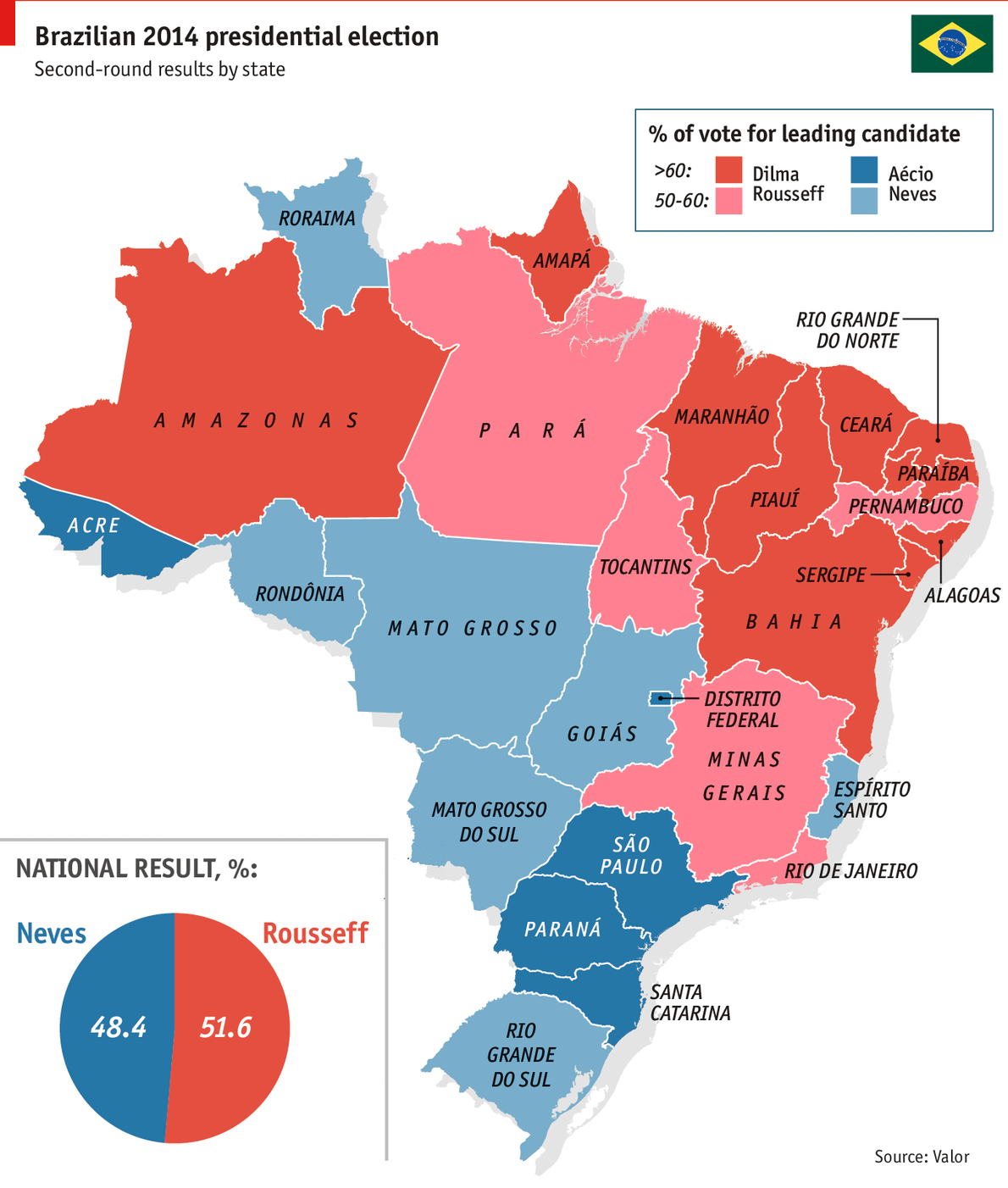
Jan Piotrowski discusses the results of Sunday’s other big election, in which incumbent president Dilma Rousseff, head of the left-wing Workers’ Party (PT), narrowly won re-election over her center-right, pro-market competitor Aécio Neves:
The upshot is that the president will lead a riven country. She romped to victory across swathes of the poor north and north-east—helped by less fortunate Brazilians’ gratitude for the PT’s popular social programmes, but also her campaign’s baseless insistence that Mr Neves would do away with them. Most of the richer south, south-east and centre-west plumped convincingly for her market-friendly rival.
“Despite winning the presidency for the fourth time in a row,” Anthony Pereira writes, “this was not a particularly good election for the PT “:
The party lost 18 seats in the lower house of Congress (though it remains the largest party) and one seat in the Senate (where it is the second-largest bloc). Congress as a whole has become more conservative and more fragmented, its 22 parties swelling to 28. The PT did win five governorships, but only one of them, Neves’s state of Minas Gerais, is in the populous and wealthy south-east. That means the centrist PMDB, a party committed to almost nothing except supporting the government in exchange for patronage, will once again be Dilma’s most important – and most problematic – political partner. The PT’s base, meanwhile, is clearly no longer the solid coalition it once was.
Mac Margolis casts doubt on Dilma’s ability to reunite the country, or even her own government:
Magnanimity is the victor’s disclaimer, but not once in her 27-minute rambling victory lap did Rousseff mention Neves or acknowledge the vote that clove Brazil in two. Lula Inc. don’t do gracious. What their Workers’ Party does do is power, and this is where Rousseff’s victory could sour. It’s not just the widening of the congressional aisle she must reach across. The hazard lies in her own court. Rousseff sits astride a nine-party coalition, where the appetites for patronage and power are now sharper.
Dom Phillips highlights the large numbers of Brazilians who didn’t vote for her, or anybody:
Rousseff needs to address another serious problem: corruption. A total of 54 million people voted for her, but 51 million voted for her opponent. A staggering 30 million simply abstained, even though voting is obligatory in Brazil, while more than seven million voted for no party. This represents a very high rejection of the Workers’ Party, a very real contempt for its repeated sleaze scandals and a widespread distrust of politicians of all stripes.
Pointing to the country’s troubled economy, the Bloomberg View editors advise Dilma to get cracking on reform:
Brazil’s economy entered a recession last quarter, and inflation is running above its targeted range. A global slowdown has hit the prices of commodities that comprise almost half its exports. Its budget deficit is widening, its credit rating in peril. Its economy remains hampered by a Byzantine tax system and formidable thicket of labor regulations. Thanks in part to its poor business climate, Brazil garners less investment than any other member of the BRICS (18 percent of its gross domestic product versus 31 percent for India). Upon news of her re-election, Brazil’s markets and currency promptly tanked. So what can Rousseff do? Her promise to revamp her cabinet offers the opportunity both to bring the country together politically and move it forward economically.
But Juan Carlos Hidalgo doubts she will move in that direction:
Can Rousseff deliver reform? Doubtful. As Mary O’Grady points out today in the Wall Street Journal, “Ms. Rousseff ran as the anti-market, welfare-state candidate.” With an economy not even growing by 1% and a stubbornly high inflation rate, the question Brazilians are asking themselves is whether Rousseff will reform or instead double-down on interventionist policies. One area to pay particular attention to is freedom of the press. What we’ve seen in a number of other Latin American countries ruled by left-wing governments is that, as the economy sours and corruption scandals mushroom, the authorities push for more regulations on the media. Will Brazil follow this pattern? There are good reasons not to be optimistic about Brazil in the next four years.
Meanwhile, Daniel Altman suspects we haven’t seen the last of Aécio – nor of Luiz Inácio Lula da Silva, Dilma’s political godfather:
As I’ve written here before, parties with a stranglehold on their countries for many years tend to become complacent and even crooked. Rousseff’s Workers Party will complete 16 years in the Palácio do Planalto at the end of her second term. At that point, it’s conceivable and even likely that Lula would come back and run again at the age of 72. Rousseff will have to earn him that third term. For now, given her record, the odds of Neves running again and winning must be quite high. He’s only 54, and hey — it took Lula four attempts to win the country’s highest office.



 The Dish