The Sharing Economy In The Big City

Airbnb

Airbnb is having some troubles in New York:

While it’s technically illegal for New York City residents to rent their entire place for fewer than 30 days at a time — room-shares and extended sublets are allowed — the city and attorney general’s office have insisted they’re not interested in small-time Airbnb-ers, but those using the share economy to become mini hospitality moguls. Their first targets: brothers Hamid Kermanshah and Abdolmajid Kermanshah, who own and operate a four-story building on Fifth Avenue and a ten-story building on West 31st Street.

Alison Griswold has more:

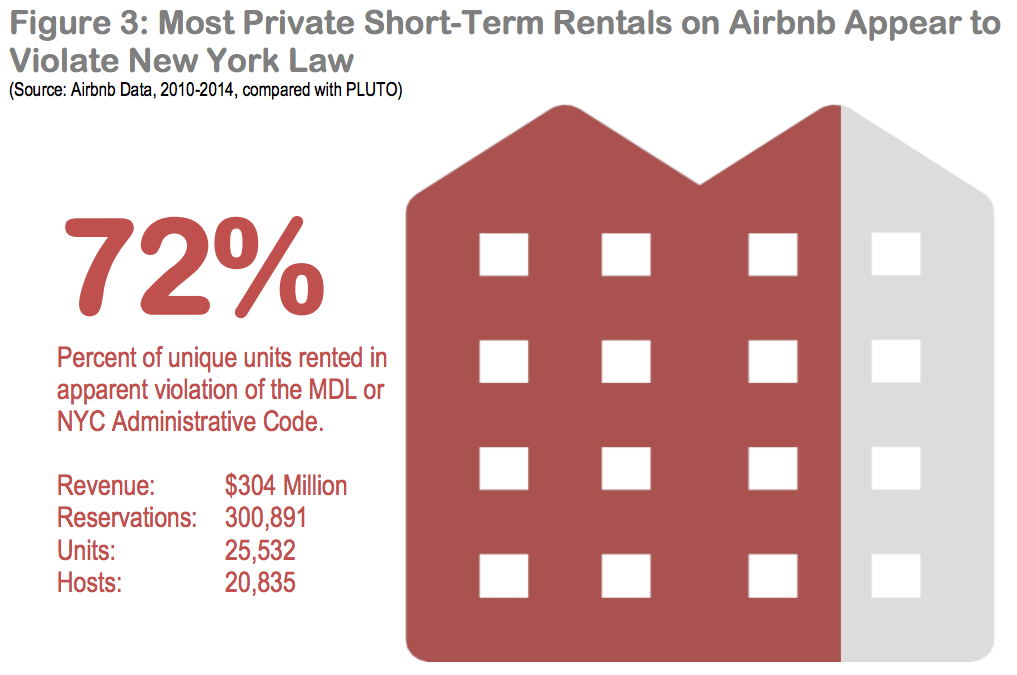
Airbnb, according to the AG’s [Attorney General’s] analysis of 497,322 transactions for stays between January 2010 and June 2014, is largely illegal, hugely profitable, and quickly consuming lower Manhattan. Rather than helping the average New Yorker make ends meet, much of Airbnb in New York City is making money for a small number of commercial hosts running large, multimillion-dollar operations.

J.J.C. weighs the pros and cons of the service:

For business travellers there are obvious benefits. Booking may be less convenient than for hotels and prices are not always lower, but travellers benefit from more choice and, usually, space. For more seasoned road warriors, Airbnb’s varied portfolio makes a refreshing change from the depressing homogeneity of hotel interiors.

But even as Airbnb claims victory in its home city the honeymoon period may be coming to an end. … Part of the problem is the gold rush Airbnb has prompted. What began as a platform for homeowners with spare rooms to make a bit of pocket money on the side, is becoming overrun with property entrepreneurs looking for lucrative short term gains. The market is also getting more crowded with competition coming from upstarts such as Roomoramaand HomeAway. Meanwhile success breeds exploitation. From trashed properties and wild parties to a multitude of scams, there are plenty of Airbnb horror stories circulating to put off prospective tenants (and landlords).

Megan McArdle considers the implications:

I love the sharing economy — what’s not to love about taking underutilized assets and making them more productive? But Airbnb has an almost uniquely difficult task in converting rooms to a permanent revenue stream. Most people are more sensitive about what happens with their homes than they are about what happens with their cars, bikes, or designer handbags. That may be particularly true in the dense, expensive areas where Airbnb is most in demand — though to be sure, I’ve also heard people in single-family home neighborhoods complaining about the potential for rowdy house parties.

Whenever a new market opens, there’s a sort of wild west period when gaps in the law allow people to make a bunch of money. Over time, however, legislators and regulators wake up, and start laying down the law. Entrenched competitors are protected, numerous interest groups are given concessions, fees are tacked on. The end result is greater certainty, but lower profits and innovation.

During his interview with Marc Andreessen, Kevin Roose brings up the politics of the sharing economy:

[Q] Politicians like Rand Paul are seizing on young people’s embrace of companies like Uber and Lyft and Airbnb that are disrupting heavily regulated industries and saying, “You know, if you’re frustrated about Uber, let me tell you about these other regulations that are terrible.” Are these companies breeding a new generation of libertarians?

[A] I guess I would say the following: If you have been in an Uber car and gotten pulled over and had the car seized out from under the driver when you were like in the middle of a trip that you were otherwise having a good time on, you might be a little bit radicalized. You might all of a sudden think, Wait a minute, what just happened, and why did it happen? And then you might discover what the taxi companies did over the last 50 years to wire up city governments and all the corruption that’s taken place. And you might say, “Wait a minute.” There’s this myth that government regulation is well intentioned and benign, and implemented properly. That’s the myth. And then when people actually run into this in the real world, they’re, “Oh, fuck, I didn’t realize.”

Previous Dish on Airbnb here and here.

Centers For Damage Control

Screen Shot 2014-10-20 at 2.20.04 PM

After its fumbling of the Ebola outbreak, the public has rightly soured on the CDC:

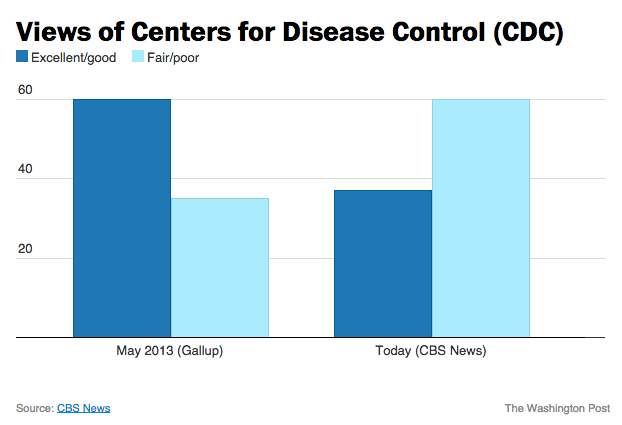
A new CBS News poll shows just 37 percent of American rate the CDC as either excellent or good, while 60 percent rate it as fair or poor — a virtual mirror image of 17 months ago. The worst part: The agency now ranks below the Secret Service, which has dealt with a series of scandals in recent weeks and years. But the CDC is still slightly more popular than the IRS.

Morrissey isn’t surprised:

Back when I worked for a defense contractor in its technical publications department, one worker had a sign in her cubicle which accurately diagnoses the phenomenon in play here: “One aws**t cancels out a thousand attaboys.” It isn’t what the CDC did for the past ten years, but what they’re doing when the spotlight is on them that counts. In fact, the CDC’s performance over the past few weeks will have people questioning just how well they’ve done their job all along, and perhaps they should.

On the other hand, it’s possible that the public perception might be a little too harsh. One amazing aspect of this poll is that the CDC is only seven points up on the VA (30%) and only six over the IRS (31%). Both of those agencies have been embroiled in scandals that involve outright corruption, not just incompetence, and yet they’re almost within the margin of error with the CDC, which to this point is only considered to be well-meaning but failing.

Harold Pollack defends the agency:

Despite the CDC’s budget problems and its recent stumbles, it is a more effective, better-led organization than it was during the Bush years, when five out of six former agency directors publicly criticized the CDC’s managerial hijinks, low morale and lapses from scientific integrity. At that time, the CDC ranked 189th out of 222 federal agencies in workforce morale. It now ranks 49th out of 300 federal agencies on such measures. That’s a striking improvement.

“When the public health enterprise loses political standing,” he adds, “it may not be listened to when it most needs to be heard”:

Almost 40 years ago, the CDC suffered public humiliation when it was perceived as having bungled a massive vaccination campaign for a Swine Flu epidemic that didn’t materialize. Only a few years later, CDC officials tried to sound warnings about a mysterious new pathogen. They were shoved aside, often by government and medical officials who specifically cited the Swine Flu debacle. One unfortunate 1983 Red Cross memo, opposing aggressive measures to protect America’s blood supply, expressed the general mood: “CDC is likely to continue to play up AIDS,” because “CDC increasingly needs a major epidemic to justify its existence.”

The End Of Geniuses?

Darrin M. McMahon, author of Divine Fury: A History of Genius, traces the origins of the modern “genius” from the Enlightenment through the contemporary “wisdom of crowds”:

This is the paradox of genius in our time: On the one hand, the world we inhabit is an inhospitable place for that creature first conceived in the 18th century as a human of sacred exception; on the other hand, we have created a new variety of the species, which threatens to overrun us all.

The risk inherent in this situation is of obscuring genuine differences in aptitude, capacity, and ability, while at the same time becoming apologists for the real inequalities of opportunity and resources that might foster those differences. Recent data on the widening education achievement gap between rich and poor paints a troubling picture of a nation all too ready to squander its human potential.  Despite our desire to “leave no child behind,” we do so every day, which prompts the terrible question: How many children living among us have the potential for genius that we’ll never know?  As the late evolutionary biologist Stephen Jay Gould once observed, “I am, somehow, less interested in the weight and convolutions of Einstein’s brain than in the near certainty that people of equal talent have lived and died in cotton fields and sweatshops.”

Which is not to say that we should mourn the passing of the genius as first conceived in the 18th century. That creature has outlived its cultural usefulness, and perhaps it is time to say the same of the more recent varieties. By kicking the habit of genius, we might better be able to cultivate what is just as important and in the long run more essential to human civilization: the potential in all of us.

More Dish on McMahon’s new book here.

Faces Of The Day

Students Celebrate Raisin Monday At St Andrew's University

Students from St Andrew’s University indulge in a tradition of covering themselves with foam to honour the “academic family” in St Andrews, Scotland on October 20, 2014. Every November the “raisin weekend”, which is held in the university’s Lower College Lawn, is celebrated and a gift of raisins (now foam) is traditionally given by first-year students to their elders as a thank you for their guidance. In exchange, they receive a receipt in Latin. By Jeff J Mitchell/Getty Images.

SCOTUS Split On Voter ID

In a ruling issued at the unusual hour of 5 am on Saturday morning, the Court allowed Texas’s voter ID law to remain in place for the upcoming elections, citing concerns about disrupting the voting process. But not all of the justices were on board:

A majority of justices rejected an emergency request from the Department of Justice and civil-rights groups to keep the state from enacting a law that requires citizens to produce prescribed forms of photo identification before they could cast a ballot, while three justices—Ruth Bader Ginsberg, Sonia Sotomayor and Elena Kagan—dissented. “The greatest threat to public confidence in elections in this case is the prospect of enforcing a purposefully discriminatory law, one that likely imposes an unconstitutional poll tax and risks denying the right to vote to hundreds of thousands of eligible voters,” wrote Ginsburg.

The order was delayed, apparently, because Ginsburg insisted on issuing a dissenting opinion. Rick Hasen digs into her six-page dissent, which he sees as laying the groundwork for a future battle:

Importantly, Ginsburg concluded that the effect of the law in its entirety would be to diminish voter confidence in the system. “The greatest threat to public confidence in elections in this case is the prospect of enforcing a purposefully discriminatory law, one that likely imposes an unconstitutional poll tax and risks denying the right to vote to hundreds of thousands of eligible voters,” she wrote.

The Texas case will likely make it back to the Supreme Court, perhaps next year, after the 5th Circuit takes a full look at the case. While the Supreme Court’s vote on the stay order in the Texas case does not tell us for sure how things will go when the court gets to the constitutional merits of the challenge, the five conservative justices on the Supreme Court are likely to let Texas put its ID law in place because of their general view of the scope of the Constitution and the Voting Rights Act. No doubt Justice Ginsburg knows this.

How Judis understands the motivation behind the law:

[Gov. Rick] Perry claimed that the law would “uphold the integrity of our state’s electoral process and insure our state has passed the proper protections against voter fraud.” The law, which requires a photo ID, was intended to prevent voter impersonation, but as [judge Nelva Gonzales] Ramos pointed out, Texas had uncovered exactly two cases of voter impersonation from 2001 to 2011. Its real purpose was to forestall a demographic time bomb that could threaten Texas’ Republican majority. From 2000 to 2010, 78 percent of Texas’s population increase consisted of African-Americans and Hispanics, who could be expected to support Democrats rather than Republicans. If those population trends were to continue, and if the new Hispanic voters (who made up the bulk of the population increase) were to flock to the polls, Republicans could be doomed.

Scott Lemieux admits that there is “a quasi-defensible reason for the court’s latest move”:

The Supreme Court is usually reluctant to issue opinions that would change election rules when a vote is imminent. For example, the court recently acted to prevent Wisconsin from using its new voter ID law in the upcoming midterms, coming to the opposite result from the Texas case. That is the principle at work here, and on a superficial level it makes sense.

But as Ginsburg — joined by Justices Elena Kagan and Sonia Sotomayor — points out, the general reluctance to change election rules at the last minute is not absolute. In Wisconsin, using the new law would have created chaos. For example, absentee ballots would not have indicated that identification was necessary for a vote to count, so many Wisconsin voters would have unknowingly sent in illegal ballots.

In the Texas case, conversely, there is little reason to believe that restoring the rules that prevailed before the legislature’s Senate Bill 14 would have been disruptive.

Ultimately, the court may end up backing Ginsburg’s contention that the law is unconstitutional, but Ian Millhiser complains that letting it stand even for one election is dangerous, and looks to history for the reason why:

For much of the Jim Crow Era, the South was a one party region. General elections were largely formalities, and the Democratic Party’s candidate was all but guaranteed victory. So, in 1923, Texas tried to prevent African Americans from voting by enacting a law providing that “in no event shall a negro be eligible to participate in a Democratic party primary election held in the State of Texas.” When this law was struck down by the Supreme Court, Texas enacted a new law allowing the state Democratic party to establish rules that only permitted “white democrats” to vote in the primary. When that law was struck down, the state party passed a resolution, pursuant to no law whatsoever, providing that only “white citizens” may vote in a Democratic primary. This action by the state Democrats was ultimately upheld by the Supreme Court, although the justices reversed course nine years later.

The lesson is that, if you allow a voter suppression law to go into effect for just one election, then the supporters of that law are likely to come up with a new way to suppress the vote if the first law is ultimately struck down. And even if the second voter suppression law is ultimately struck down, this cycle can continue forever so long as each law is allowed to be in effect for just one election.

A Smashed Pumpkin Festival

Caroline Bankoff recaps one of the stranger stories from this weekend:

Keene, New Hampshire’s annual Pumpkin Festival – which features a community-wide effort to “set a world record of the largest number of carved and lighted jack-o-lanterns in one place,” according to CBS Boston – saw at least 14 arrests and dozens of injuries this weekend as hordes of Keene State College students and their guests took to the small town’s streets for no apparent reason other than to cause trouble. The Boston Globe reports that hundreds of people were seen “throwing bottles, uprooting street signs, and setting things on fire,” as well as overturning cars and dumpsters. Cops outfitted in SWAT gear responded with “tear gas, tasers, and pepper spray.” The Keene Police Department claims that one group of rioters “threatened to beat up an elderly man” while others threatened the lives of the cops, who had to call for backup from nearby towns.

Will Bunch raises his eyebrows:

[I]f you have a few minutes, read the news accounts of what happened in New Hampshire – the youths who set fires and threw rocks or pumpkins were described as “rowdy” or “boisterous” or participants in “unrest.” Do you remember such genteel language to describe the protesters in [Ferguson] Missouri? Me neither. …

[A]t this point there have been so many “white riots” in the last couple of years – Huntington Beach, Santa Barbara, Penn State (more than once), and just this week, Morgantown, and now, most epic-ally of all-time, the great Pumpkin Festival riots of Keene, N.H. It’s gotten to the point where all of the obvious jokes, about how the white community needs to have a serious conversation about getting our own house in order, or asking where are the (white) fathers, have been made again and again and again.

Ferguson is also on Yesha Callahan’s mind:

While black people are protesting the senseless deaths of unarmed black men, white thugs are ravaging the streets because of pumpkins and football.

Freddie slams some of the snarkier coverage of the riots:

First: police violence and aggression is wrong no matter who it targets. Crazy!

Second: police violence and aggression against people we assume have social capital is a signal that those who we know don’t have social capital will get it far worse. If these cops feel that they have this much license to go wild against that white, largely-affluent crew, what do you think they’ll do when they pull over some working class black guy in a run-down car? Treating this as a barrel of laughs throws away a profound opportunity to include these types of people in a very necessary social movement against police violence, which poor people of color desperately need.

But, as Jamilah Lemieux argues, the riots “don’t even lend themselves to the conversation about overpolicing because the riot police showed up as they were actually rioting.” She adds:

For all the hashtags and the jokes, we won’t see a media assault on the youth who ruined the festival for acting in ways that were not merely inappropriate, illegal and potentially deadly, but bizarre and wrought with the stench of unchecked privilege. These causeless rebels won’t be derided as thugs, nor will people wonder why they don’t just ‘go get a job,’ (something that I heard no less than three times while attending protests in St. Louis, and have seen over and over again from Twitter trolls responding to the Missouri unrest.) Unlike the young people who have mobilized in Ferguson for an actual cause, there will likely be few serious ramifications for those who participated in making Keene, New Hampshire the laughingstock of the country, while putting themselves and others at serious risk for injury or death at a pumpkin festival.

Update from a reader:

Has anyone noted yet that John Oliver, in his recent piece on the over-militarization of local police forces vis-a-vis Ferguson, mentioned with incredulity that that Keene, NH had named their annual Pumpkin Festival as a possible target for terrorism to justify their need for military gear? About 7:30 in …

http://youtu.be/KUdHIatS36A

Hathos Alert

Hard to beat this ad from Michigan via Weigel:

Update from a reader:

I suspect you aren’t much of a college football fan and didn’t see a recent Tennessee House of Representative candidate’s ad. Lane Kiffin was a former head coach (I’d say THE former head coach, but firing Fulmer has prove a bad choice by the Volunteers) who is pretty reviled by Tennessee fans as he didn’t stay long, didn’t have much success and some of his actions resulted in NCAA sanctions. Kiffin is now the offensive coordinator at Alabama after getting fired mid-season last year.

Quote For The Day

“Let me tell you about scared. Your heart is beating so hard, I can feel it through your hands. There’s so much blood and oxygen pumping through your brain, it’s like rocket fuel. Right now, you could run faster and you can fight harder, you could jump higher than ever in your life. And you’re so alert, it’s like you can slow down time. What’s wrong with scared? Scared is a super power. It’s your super power. There is danger is this room, and guess what? It’s you!” – Doctor Who in the age of Ebolisis. Here’s a great post from Psychology Today on the episode.

A Breakthrough With Boko Haram?

On Friday, news of a ceasefire between the Nigerian government and Boko Haram raised hopes that the 219 kidnapped schoolgirls from Chibok might finally be released, but with the truce already in doubt, nobody is daring to celebrate too soon:

Two senior government sources said on Saturday that they hoped the release would be completed by Tuesday. On Friday, Air Chief Marshal Alex Badeh announced a deal with Boko Haram for a ceasefire that would enable the release of the girls, who have been held since April.

But within hours, Boko Haram had already broken the ceasefire, killing at least nine people in two attacks – one on the village of Abadam on Friday night, and another attack on the village of Dzur on Saturday morning. “I can confirm that FG (the federal government) is working hard to meet its own part of the agreement so that the release of the abductees can be effected either on Monday or latest Tuesday next week,” one source told Reuters by telephone.

Atta Barkindo questions whether the ceasefire is genuine:

The first inklings of this particular ceasefire agreement were heard on October 16 when Danladi Ahmadu, who claimed to be the “secretary-general” of Boko Haram, told the Voice of America (VOA) that an agreement had been reached between his group and the Nigerian government with the involvement of officials from Chad and Cameroon. …

But there are some credibility problems with this ceasefire agreement. First there is huge scepticism about the identity of Danladi Ahmadu. In his VOA interview, Ahmadu even referred to Boko Haram as Boko Haram and not its real name, Jama’atu Ahlul Sunnah Lidda’awati wal Jihad. Additionally, it is difficult to ascertain if Ahmadu is representing a particular faction of Boko Haram or the group’s mainstream leadership. Ahmad Salkida, a Nigerian journalist with proven records of contact with the leadership of Boko Haram, dented the credibility of the ceasefire and appeared to suggest that Nigeria may have been hoodwinked by the broker.

And even if the deal is for real, Simon Kolawole points out that some people won’t be very happy about it:

In some circles … a ceasefire represents the ultimate surrender of the Nigerian state to terrorism, a huge dent on national ego and a sign of how weak the Nigerian government has become. To the military hierarchy, this may be viewed as a humiliation, for how can we be discussing with terrorists who deserve nothing but death after all the horror they have inflicted on soldiers and civilians? I also heard several comments that President Goodluck Jonathan agreed to the peace deal because he is desperate to be returned to office next year. We all have our opinions, of course.

Jonathan’s re-election bid is just one part of the “multilayered drama” in which, to Richard Joseph’s eyes, the kidnapped girls are merely pawns:

For a start, it has been unclear how Boko Haram is financed — and how much assistance it might be receiving from disaffected members of the northern Nigerian elite, as well as those holding government positions at the federal and state levels. “Underground” campaigns involving the use of armed thugs have been a staple feature of Nigerian party politics for decades, and international human rights groups have noted a “dirty war” conducted by soldiers and government-financed militias. These abuses, combined with the dysfunction of the armed forces, complicate external assistance.

The problem for Nigeria is that although the jihadists will eventually almost certainly be crushed, as were the secessionists in Nigeria’s civil war, the clock is ticking on a greater threat to the Nigerian nation, namely popular protests in northern Nigeria following February’s presidential poll, which President Goodluck Jonathan is certain to contest.