Hadassah Rodham Clinton?

U.S. Hosts Israeli-Palestinian Peace Talks

If she’s elected, Aaron David Miller predicts that the second President Clinton will bring a quick thaw to American-Israeli relations:

Given the lack of competition, unless he stumbles badly, Netanyahu may well outlast Obama. And that brings us to the matter of Hillary Clinton. Those of you looking for a new sheriff in town — one who is willing and able to teach those Israelis a lesson, cut them down to size, and make it clear to them as Bill Clinton, who exploded in frustration following his first meeting with Netanyahu in 1996, did when he said, “Who’s the fucking superpower here?” — best lay down and lie quietly until the feeling passes.

That’s not Hillary Clinton.

Indeed, she conceded in her book Hard Choices that she was never comfortable playing the bad cop with Netanyahu to Joe Biden’s more even-tempered good cop. And yet, she has some natural advantages that would help mitigate some of the gratuitous tensions that have made an already tough relationship tougher and perhaps lay the groundwork for more productive cooperation. Should she become president, on one level, better ties with Israel are virtually guaranteed.

But while a more accommodating White House would be a boon to Netanyahu’s government, Larison stresses that it won’t exactly be good news for anyone else:

Miller’s main argument is that Clinton will probably manage the relationship with Israel more successfully than Obama has. That could be true, but it is worth noting that in practice this “better” management will be little more than endorsing and backing whatever the Israeli government does. Obama has occasionally, briefly put a little bit of pressure on Israel to maybe modify its most obnoxious policies ever so slightly, and the relationship is at its lowest nadir in twenty years and Obama is reviled for his supposed “hostility” to the country. The Bush approach was to enable and excuse almost everything that the Israeli government did or wanted to do, and Clinton seems interested in imitating Bush’s example.

(Photo: Israeli Prime Minister Benjamin Netanyahu talks to U.S. Secretary of State Hillary Rodham Clinton during the first day of direct trilateral negotiations about a Middle East peace plan in the Benjamin Franklin Room at the Department of State on September 2, 2010. By Alex Wong/Getty Images)

Singles And Onlies In China

Alexa Olesen explains why having only one child remains so common in China, despite the retracted policy:

China’s state-run news service Xinhua published an article Nov. 10 with the headline: “Why aren’t we seeing the expected baby boom?” The news agency said it had sent reporters fanning out in four provinces to ask why eligible couples were hesitating.

The respondents fell into three general categories:

those afraid to have a second kid, those who don’t want to, and those who just can’t decide. Among the “afraid” group was a 32-year-old IT worker in the rust belt city of Shenyang in northeast China who said he thought it would be too expensive to have a second child. “It’s easy to have another one, but it’s hard to raise them,” said the man who was only identified by his surname, Zhang.

Another man, surnamed Wang from Yantai, a coastal city in eastern China’s Shandong province, said it would be too exhausting to have another child and he was perfectly happy to just have his daughter. He was in the “don’t want” camp. Wang also told Xinhua he didn’t see anything wrong with raising an only child. “Our generation is all only children, and we’re doing just fine,” he said.

Representing the undecided camp was Wan Yan, a 36-year-old university lecturer who said she felt she was probably too old for a second child but hadn’t ruled it out yet. “If we can’t give the second child the best of everything, it would be very hard to commit to having another one,” she said.

Previous Dish on China’s child policy here. Meanwhile, Ben Richmond describes the country’s Singles Day holiday, comparing it with Black Friday:

It’s a young holiday, thought to date back only to 1993, when Nanjing University students picked November 11—11/11 is four singles, see?—as a sort of “anti-Valentine’s Day” where single people could buy things for themselves.

While, to me, that sounds like pretty much every day for a single person, it has blown up in China thanks to the backing of Alibaba. Since 2009 the ecommerce giant has used Singles’ Day as an excuse for a big one-day sale in order to get people buying stuff in their online Tmall—and it’s caught on. It took just 17 minutes of Singles’ Day for Alibaba to record a billion dollars in sales, according to CNBC. It took just an hour and eleven minutes to top $2 billion. According to Forbes, by just after midnight Beijing time, Alibaba was reporting that sales reached $9.3 billion, a 60 percent increase in revenue over just a year ago.

Alison Griswold adds:

The craziest thing about Singles Day is that its huge sales so far have been almost entirely driven by Chinese shoppers. What Alibaba is looking to do now is grow Singles Day from a Chinese phenomenon to a global one—an expansion that’s all the more important after Alibaba debuted on the New York Stock Exchange in mid-September. That IPO rang in as the biggest ever in the U.S. and investors across the world are watching closely to see if Alibaba can maintain its breakneck pace of sales growth.

Previous Dish on Singles Day here.

In GOP Shutout, Were Dem Voters Shut Out? Ctd

Why Not Vote

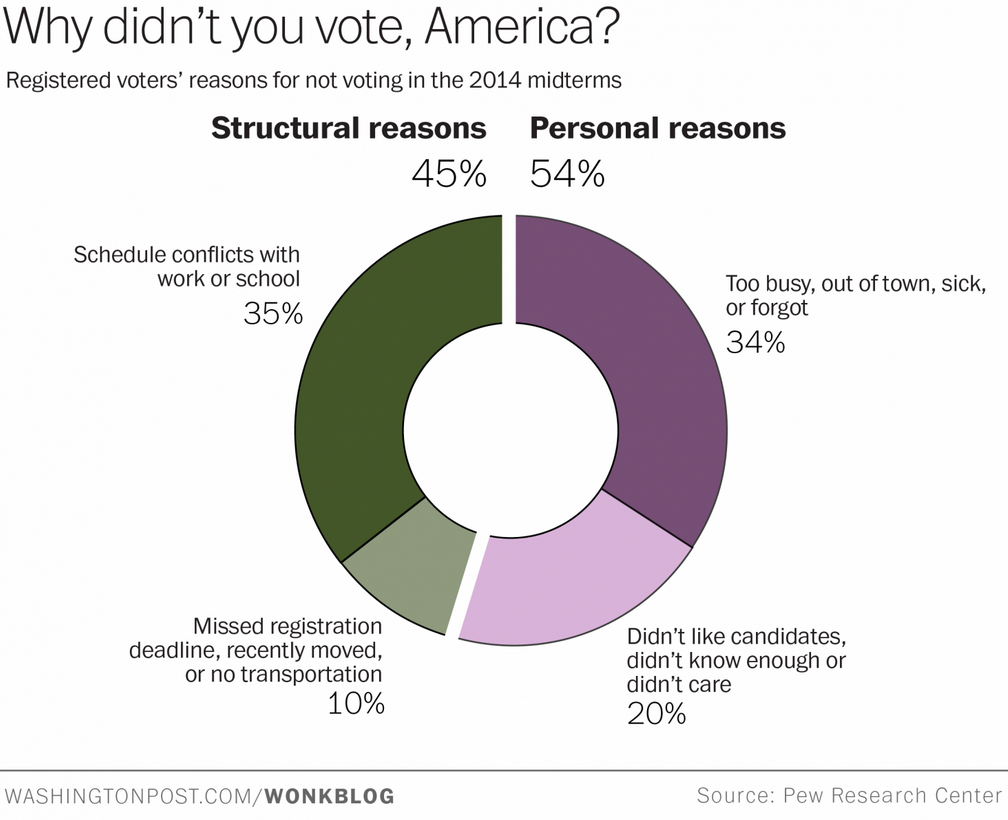
Christopher Ingraham passes along the above chart on Americans who didn’t vote:

Republican vote-suppression efforts have already received plenty of attention, and rightfully so – it’s an embarrassment that one political party sees a smaller electorate as the path to victory. But voters turned back at the polls represent at best a tiny fraction of the 10 percent who didn’t vote for technical reasons. Pew’s numbers suggest there’s a lot of work to be done to help the 35 percent of voters who couldn’t accommodate a trip to the polling place in their work or school schedules.

Frank Barry dismisses Wendy Weiser’s claim that voter restrictions suppressed so much Democratic turnout last week as to influence the outcomes of some close elections:

Weiser’s argument has been picked up by other voting-rights advocates and pundits, but it falls apart upon closer scrutiny. Even with seven fewer days, early voting in North Carolina increased this year compared with 2010 — by 35 percent. Statewide turnout also increased from the previous midterm election, to 44.1 percent from 43.7 percent. Even if turnout was lower than it would have been without the new voting law — something that’s impossible to establish — it was still higher than it had been in four of the five previous midterm elections, going back to 1994. In addition, based on exit polls and voter turnout data, the overall share of the black vote increased slightly compared with 2010.

Rick Hasen, an expert on election law, says he’s skeptical about Weiser’s analysis, and rightly so. When voting-rights advocates fail to include any balancing points in their discussion of the election, they undercut their credibility and give ammunition to Republicans who suspect that they are mostly interested in electing Democrats.


“Libidinal Pathology”

Any writer who wants to tackle touchy subjects in this day and age will be subjected to constant and often colorful insults, attacks, smears, ad hominems and general abuse. I’m used to it and don’t whine. And so I am resigned to the fact that any post or essay I might write will be condemned at some point (whatever its subject) because of my support for the Iraq War (despite countless mea culpas, including a whole e-book), or for the sentence in 2001 about a potential “fifth column” (for which I have also apologized), or for asking for some minimal documentation of the story of Sarah Palin’s astonishing fifth pregnancy (for which I see no reason to apologize), or for doubting that gender, sexual orientation or ethnicity can be entirely explained by social constructionism. And look, this is fair enough. I had my say; people also get to have theirs’ about what I wrote. Just because you’ve apologized for something doesn’t mean others have to accept it.

But one meme that crops up eternally whenever the left side of the spectrum wants to take a whack is my alleged sexual hypocrisy from as far back as 2001. A recent Gawker piece – after ticking off the usual accusations that I’m a racist, a misogynist, etc. – prompted the following reader comment:

Anyone remember when he was criticizing gay men for their “libidinal pathology” while posting ads for himself on a bareback sex site?

I do!

Except I wasn’t. That phrase – which appeared in countless articles asserting my hypocrisy – comes from Love Undetectable. It’s used in a section on circuit “rave” parties in the gay male world, and the debate they provoked in the 1990s. Here’s the full context of that phrase, and you can judge for yourself whether I was “criticizing gay men for their ‘libidinal pathology'”:

Slowly the proliferation of these events became impossible to ignore, and the secrecy that once shrouded them turned into an increasingly raucous debate on the front pages of newspapers across the country. Despite representing a tiny sub-subculture, and dwarfed, for example, by the explosion of gay religion and spirituality in the same period, the parties seemed to symbolize something larger: the question of whether, as AIDS receded, gay men were prepared to choose further integration, or were poised to leap into another spasm of libidinal pathology.

I am not criticizing gay men for “libidinal pathology” at a circuit party. I am describing a “raucous debate” about the possibility of them signifying the revival of such a thing. My own actual answer to that question was the following:

What these events really were about, whatever their critics have claimed, was not sex … what replaced sex was the idea of sex; and what replaced promiscuity was the idea of promiscuity, masked by the ecstatic high of drug-enhanced drug-music.

It also makes little sense for me to be slamming circuit parties for “libidinal pathology,” when I am describing my attendance at one – and not as a reporter but as a participant. In fact, the section is a celebration in part of unabashed gay sexuality:

What would the guardians of reality think, I remember asking myself, if they could see this now, see this display of unapologetic masculinity and understand that it was homosexual … [I]t was hard not to be struck, as I was the first time I saw it, by a genuine, brazen act of cultural defiance, a spectacle designed not only to exclude but to reclaim a gender, the ultimate response to a heterosexual order that denies gay men the masculinity that is also their own.

As to circuit parties as a whole, I have long gone to them, and, as you can see if you actually read what I wrote, celebrated them as one way I found liberation in a dark time. I met my husband at that very same party a decade later. I went to one last year. Yes, in that essay, I was trying to understand them in the AIDS era and to explain them to an outside world – and I was prepared to address some of the issues around them, including the very issue of promiscuity itself that hovered around the AIDS question. But the notion that this proves I was a sexual Puritan is ridiculous. A reviewer even lamented that in the book, “Sullivan drones on and on about his sexual encounters.” Well which is it: am I boring you with an account of my own promiscuity or condemning others for it?

Another sentence was routinely hauled out to condemn me for hypocrisy and pops up from time to time. Here is Richard Goldstein’s phrase of accusation:

[Sullivan] considers gay marriage the only healthy alternative to “a life of meaningless promiscuity followed by eternal damnation.”

Again, go check the original context. It’s from the same book. It comes from a section where I am impugning the idea of “hate the sin, love the sinner” and the failure of the churches to offer moral direction of any kind to gay men, leaving us for millennia vulnerable to, yes, sexual pathologies born out of desperation or the need for relief from the contradictions of our lives. Here’s the full passage:

If you teach people that something as deep inside them as their very personality is either a source of unimaginable shame or unmentionable sin, and if you tell them that their only ethical direction is either the suppression of that self in a life of suffering, or a life of meaningless promiscuity followed by eternal damnation, then it is perhaps not surprising that their moral and sexual behavior becomes wildly dichotic; that it veers from compulsive activity to shame and withdrawal; or that it becomes anesthetized by drugs or alcohol or fatally distorted by the false, crude ideology of easy prophets.

It’s clear from this passage that I am actually criticizing those who hold the belief that Goldstein and countless others ascribed … to me! You can watch the debate at the New School in 2002 where I directly confronted Goldstein about this … and he had nothing to say in his own defense, as the very lefty crowd discovered to their shock and mounting anger. I could go on. In the same book, I wrote explicitly about my own first experience of sex without rubbers with another survivor of HIV and a good friend. So in a book published in 1998, I recount details about my many sexual encounters and also unprotected sex with another man with HIV … and yet three years later I am a hypocrite for doing exactly the same things.

To be sure, the essay was about finding a way between no sexual boundaries and more humane ones for gay men. It does contain an implicit critique of compulsive sex – but in the context of my own experience of it. It revealed things about the gay subculture that are not usually told to heterosexuals or a general reader. It’s a raw book, written in a much more fraught time for the gay community. But it was also a memoir that placed myself in the middle of that struggle – and not above or outside it. And yes, I used terms like “hairy-backed homos” which critics took to be condemnatory – when it was anything but (as any Dishhead surely knows by now)! And, yes, arguing for marriage equality was also about ending the psychic wounds that led so many gay men into such painful places for so long. My only criticism of promiscuity per se was Randy Shilts’: when the AIDS epidemic first showed up and there was resistance to shutting down bathhouses. And Randy got slut-shamed as I was for taking what now seems like an honorable, brave and prescient stand.

Then the alleged irresponsibility. We know for certain that one of the most effective ways of curtailing HIV transmission is what we now call sero-sorting – i.e. HIV-positive men having sex only with other HIV-positive men. I was an early proponent and practitioner of it – as an informed act of responsibility. For this act of responsibility, I was hauled out to be condemned and humiliated and accused of rank hypocrisy.

This is a very old story but also a very old lie. It rests on misrepresentations of what I wrote and what I believe. Every now and again, since it is a lie that won’t die, it is perhaps necessary to remind people of this.

(Sidebar image by Marc Love)

Republicans Refuse To Save The Planet

Beutler passes along the above video, a “supercut of Republicans citing China as an excuse to ignore climate change.” His takeaway after watching it:

[T]he problems that climate pollution causes are real, and even the least accountable governments in the world understand that they need to be addressedeven if not for the purest, most idealistic reasons. Once you accept the alarming implications of climate science, then trying to avert them becomes ineluctable. And the only way to explain away how wrong conservatives were here is to conclude that they had actually internalized the view that climate change isn’t a big deal, and might just be a big hoax.

Kate Galbraith looks at how Republicans might derail Obama’s climate agenda:

If a Republican takes the White House in 2016, he or she could reverse or revise the executive orders that form the core of Obama’s climate push. And it’s going to be a hard fight even before the election: Republicans in Congress, newly empowered after recapturing the Senate this month, are already vowing to undercut the Environmental Protection Agency’s (EPA’s) regulations to reduce greenhouse gas emissions from coal-fired power plants. Sen. James Inhofe (R-Okla.), the incoming chairman of the Senate Committee on Environment and Public Works, is already plotting a way out of the U.S.-China deal. He immediately described it as a “non-binding charade.” He also vowed to do “everything in my power to rein in and shed light on the EPA’s unchecked regulations.” Inhofe has limited direct leverage over the EPA, but the Senate could withhold appropriations to the agency.

Rebecca Leber marvels at Inhofe’s grandstanding:

“Why would China ever agree unilaterally to reduce its emissions when that’s the only way that they can produce electricity?” he later asked. “Right nowand I have talked to them before, I’ve talked to people from China who kind of smile. They laugh at us and say, ‘Wait a minute, you say that you’re going to believe us that we’re going to reduce our emissions? We applaud the United States. We want the United States to reduce its emissions, because if they do that, as the manufacturing base has to leave the United States looking for energy, they come to China.’ So it’s to their advantage to continue with their increases in emissions.”

In his speech, Inhofe called himself a “one-man truth squad”twice.

Chait is disheartened by the GOP response:

The Republican Party and its intellectual allies regard close analysis of Chinese internal motivations as a useless exercise. Conservatives oppose taxes or regulations limiting greenhouse gas emissions, therefore they dismiss scientific conclusions that would justify such regulations, and therefore they also dismiss geopolitical analyses that would have the same effect. On the right, it is simply an a priori truth that nothing could persuade China to limit its emission. Obviously, the feasibility of a deal with China is far less certain than the scientific consensus undergirding anthropogenic global warming. What is parallel between the two is the certainty of conservative skepticism and imperviousness to contrary evidence. …

It would be nice to think that evidence like today’s pact would at least soften the GOP’s unyielding certainty about the absolute impossibility of a global climate accord. The near-total refusal of the right to reconsider its denial of the theory of anthropogenic global warming sadly suggests otherwise.

But Drum doesn’t think Republicans can stand in Obama’s way:

Unlike Obama’s threatened immigration rules, these are all things that have been in the pipeline for years. Obama doesn’t have to take any active steps to make them happen, and Republicans can’t pretend that any of them are a “poke in the eye,” or whatever the latest bit of post-election kvetching is. This stuff is as good as done, and second only to Obamacare, it’s right up there as one of the biggest legacies of Obama’s presidency.

Earlier Dish on the agreement here and here.

Abortion, The Islamic Way

Indonesia, the world’s most populous Muslim-majority country, also has one of the world’s highest abortion rates: 37 per 1,000 women compared to 16.9 in the US. While investigating what’s behind the high prevalence of the practice in Southeast Asia, Tom Hundley discovers that what Islam has to say about it is not as clear-cut as you might expect:

Islamic jurisprudence does not encourage abortion, but unlike the Catholic Church, it does not absolutely forbid it. Scholars of the Hanafi school of Islamic law, the most widely followed of the four schools of Islamic jurisprudence in the Sunni world, generally accept that abortion is allowable within 120 days of conception. In Indonesia, where the Shafi’i school is predominant, the ulema (religious scholars) agree that abortion is allowed within forty days of conception—this reflecting the commonly held belief that Allah instills the fetus with a soul on the fortieth day.

Opinion varies widely on permissible grounds for abortion. Almost all religious scholars agree that abortion is allowed to save the life of the mother. A 2005 study in Indonesia found surprising tolerance among Muslim clerics for terminating a pregnancy in the event of contraceptive failure or when an unwanted pregnancy would result in severe economic or psychological stress.

Chart Of The Day

crime_scatterplot.0

Dara Lind shares an important one:

An analysis by the Pew Public Safety Performance Project found that the states that shrunk their incarceration rates the most over the last five years experienced a slightly bigger drop in crime as the states where incarceration rates grew: 12 percent versus 10 percent. What about all fifty states? We made a scatterplot based on Pew’s data, mapping how a state’s imprisonment rate changed from 2008-2013 on the horizontal x axis, and how its crime rate changed on the vertical y axis. The result is, well, a scatter – there’s no clear relationship at all between prison and crime. That makes it a lot harder to justify the US’ current level of incarceration.

Meanwhile, Stephen Lurie urges Obama to cut off the money for mass incarceration:

The most pressing task is to address the enabler of incarceration: money. Policy experts from leading liberal and conservative justice-reform think tanks told me that spending is the single most important avenue for reform. Money determines outcomes; change that and you can change the whole system. In fact, as Inimai Chettiar, director of Justice Program at NYU Law School’s Brennan Center, explained to me, the current system arose out of expanded federal spending. “The federal government enacted several laws that basically gave states more money if they would increase their prison population,” she said. Truth-in-sentencing guidelines, for example, disbursed billions of dollars to “ensure that people would spend 85 percent of their sentences in prison even though those sentences were already … overly harsh.” That flow of cash, a product of the War on Drugs, also came with a series of designated metrics – like arrests or drug seizures – that incentivized states to gear performance towards what they saw to be lucrative outcomes. If the Justice Department revised its interpretation of many of these laws, it could reshape the system.

Our Climate Pact With China, Ctd

Jack Goldsmith calls the emissions reductions “aspirational”:

US China Emissions[T]he two sides do not promise to, or state that they will, reduce emissions by a certain amount. Rather, they state only that they intend to achieve emissions reductions and to make best efforts in so doing.  Whether and how the goals expressed in these intentions will be reached is left unaddressed, and one nation’s intention is not in any way tied to the other’s.  Nor would it be a violation of the “announcement” if either side’s best efforts fail to achieve the intended targets.  As we have seen with a lot with climate change aspirations, intentions are easy to state, and they change over time.  The key point is that this document in no way locks in the current intentions.  In fact it creates no obligations whatsoever, not even soft ones (except that, in a different place, both sides “commit” to “reaching an ambitious … agreement” next year, an empty commitment).  It is no accident that the document is called an “announcement” and not a treaty or pledge or even an agreement.
Tyler Cowen also provides a reality check:

First, China is notorious for making announcements about air pollution and then not implementing them.

This is only partially a matter of lying, in part the government literally does not have the ability to keep its word.  They have a great deal of coal capacity coming on-line and they can’t just turn that switch off.  They’re also driving more cars, too.

Second, China falsifies estimates of the current level of air pollution, so as to make it look like the problem is improving when it is not.  Worse yet, during the APEC summit the Chinese government blocked the more or less correct estimates coming from U.S. Embassy data, which are usually transmitted through an app.  A nice first step to the “deal” with the United States would have been to allow publication (through the app) of the correct numbers.  But they didn’t.  What does that say about what one might call…”the monitoring end”…of this new deal?

Chris Mooney is more upbeat:

[T]he experts underscore that this deal has a symbolic value that goes far beyond the literal emissions cuts (or caps) that have now been pledged, precisely because the world’s top two greenhouse gas emitters have now both come to the table. If the agreement lays the groundwork for a broader global agreement — one that encompasses other major emitters like India, Japan, and Russia — then that is the real payoff. That agreement could happen in Paris in late 2015, when the nations of the world gather to try to achieve a global agreement to cut greenhouse gas emissions.

What Michael Levi will be keeping an eye on:

I wouldn’t expect much more negotiation over either U.S. or Chinese targets, even though European leaders may want to have a discussion. Over the next year, rather than focus on any haggling over emissions numbers, it will be worth watching three things. What will the remaining details of the Chinese plan look like? How will the U.S. goals be received politically – and could they spook a Congress currently considering how much to try to interfere with pending EPA regulations? And, perhaps most important, could this display of pragmatic U.S.-China diplomatic cooperation be a sign of more to come in international climate change diplomacy – which will need to go well beyond target-setting – over the coming year?

Scott Moore reads the fine print:

Other areas covered by the agreement include new partnerships linking water scarcity and sustainable energy, a demonstration project for carbon capture and storage (CCS), and a sustainable cities initiative. Integrating energy and water issues promises to expand U.S. – China climate cooperation from an almost exclusive focus on emissions mitigation to one that also helps both countries adapt to climate change. Greater cooperation on CCS, meanwhile, will help develop a technology that is needed to help wean the world off fossil fuels by storing carbon dioxide deep underground instead of releasing it into the atmosphere.  The sustainable cities initiative, finally, builds on dynamic sub-national action on climate change in both the United States and China, with the leaders of places as diverse as New York and Jiangsu Province pledging to work together to reduce emissions.  Washington must devote serious resources to ensure that these initiatives fulfill their promise.

Max Fisher puts the announcement in context:

[I]t’s a very promising precedent of the two countries working together as global leaders on difficult issues. Over the next century, the US and China are going to face many, many more global issues on which they disagree, but on which they will both be better off if they cooperate. Indeed, the world as a whole is better served by Chinese and American cooperation and joint leadership. That’s why even Chinese state-run media is trumpeting the climate deal as “highlight[ing] a new type of major-country relations.”

But Alexa Olesen finds that China is downplaying the news at home:

Deborah Seligsohn, an expert on the Chinese environment at the University of California San Diego, told FP that Chinese leaders “tend not to enthuse,” so that may in part explain Xi’s reserve. But she also said that Beijing is under fire domestically for its unsuccessful efforts to curb local air pollution, noting that people were furious that authorities managed to clear the air for the visiting APEC dignitaries but can’t do it on a daily basis for their own citizens. ” There may be worries that focusing on climate change rather than air pollution doesn’t meet the public’s main concerns,” Seligsohn said via email.

And Michael Grunwald keeps focused on the role technology must play:

You don’t see the U.S. or China ditching oil yet, because when it comes to transportation, there’s nothing cost-competitive with oil yet. Electric vehicles are getting cheaper, and their sales are doubling every year, but internal combustion engines still rule. No international agreement will change that—and until there are viable alternatives to oil, international agreements that try to change that by fiat will end up being ignored. Ultimately, it’s unrealistic to expect developing countries or developed countries to ignore the short-term economic interests of their people, even when medium-term environmental disaster looms.

After all, the end of the Stone Age had nothing to do with stones at all. It ended when the world found stuff it liked better. It ended when better technology could do the same things more efficiently. Governments can do a lot to promote cheaper alternatives to fossil fuels, but the Fossil Fuel Age won’t end until they’re here.

Everything else is just words.

Earlier Dish on the agreement here.

(Chart from Philip Bump)

The State Of Global Gay Rights

Rights And GDP

Jay Michaelson offers an overview:

Two reports released Tuesday contain some surprising new conclusions about why some countries are more accepting of sexual minorities than others. It’s not quite religion, and not quite homophobia. It’s the economy, stupid.

The first report, “Public Attitudes about Homosexuality and Gay Rights Across Time and Countries,” was produced by the Williams Institute at UCLA School of Law and NORC at the University Chicago, and is essentially a survey of surveys, ultimately comprising 2,000 individual survey questions. … Economic development seems to matter most. According to Andrew Park and Andrew Flores of the Williams Institute, “Residents of countries whose economies that are in the top quartile are on average twelve times more likely to be supportive of homosexuality than residents of countries who economies are in the bottom quartile.”

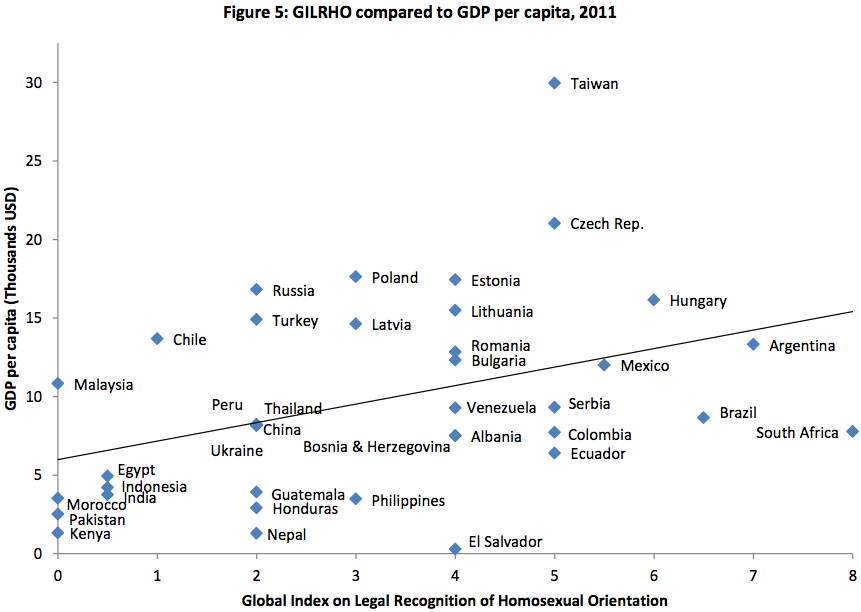
The second report, “The Relationship between LGBT Inclusion and Economic Development: An Analysis of Emerging Economies,” was produced by the Williams Institute at the UCLA School of Law, this time in partnership with the U.S. Agency for International Development (USAID), and studied 39 emerging economies. It, too, shows an overall increase in pro-LGBT policies. Using the Global Index on Legal Recognition of Homosexual Orientation (GILRHO), a new metric of eight categories of legal protection created by Dutch law professor Kees Waaldijk, it finds that the average number of SOGI rights went from one in 1990 to more than three by 2011. And again, money matters. In a neat statistic, the report shows that each additional right in the GILRHO is associated with approximately $320 in GDP per capita.

Michaelson mulls over the relationship:

Which is the chicken and which is the egg? Intuition would suggest that economic development is the cause, and pro-gay policies are the effect. The more affluent a society, the more educated, the more democratic, the more networked, and so on. But the report also suggests that anti-gay policies may harm economic development. The discrimination against, marginalization of, and criminalization of LGBT people removes them from the job market, among other things. “This research delineates the macro- and micro-level costs of not having an LGBT-inclusive workforce,” said Stephen O’Connell, USAID’s chief economist.

The Road To Libertarian Utopia

Brian Doherty lauds the now-shuttered black market Silk Road as “pretty close to a perfect site in a perfect agorist anarcho-world”:

The anonymous folk running Silk Road professed they were on a mission to do more than make money. They were out to demonstrate something important about the combination of crypto and Bitcoin: that a world made by freely chosen, private, uncoerced transactions was possible and mostly beautiful. When asking people to support Silk Road, its operator Dread Pirate Roberts once wrote, “Do it for me, do it for yourself, do it for your families and friends, and do it for mankind.” They believed in the power of agorism-the variant of libertarianism that valorizes and promotes black markets as spaces where people can live in freedom, rather than struggling fruitlessly to change the political system.

It wasn’t just the people running Silk Road who saw something wholesome in the site. In a May working paper, David Decary-Hetu, a criminologist at the University of Lausanne, and Judith Aldridge, a law professor at the University of Manchester, pointed out that Silk Road-style drug sales drastically reduced the comparative advantage that credible threats of violence brought to a drug enterprise. Good communication, good customer service, and good product were now the keys to success, not muscle.