Ed Morrissey interprets the exit polls’ breakdown of the electorate, particularly in terms of their implications for the GOP going into the next election cycle:
The GOP made slight gains in 2014 over 201o among blacks, 18-29YOs, the middle class, and a large jump among Asian-Americans. They lost ground among women, Latinos, independents, seniors and 30-44YOs, and both working class and the wealthy. None of these declines went into double digits, but aside from the income demos, they all exceed the margin of error in the polling.
Kilgore focuses on what Democrats will need to do to recapture their key demos in 2016:
[A]nother way to look at it is that minority voting preferences are returning to their pre-Obama level — still strongly Democratic, but not so strongly that in a poor turnout year they offset the heightened Republican preferences of white voters. … What are the implications, then, for the election cycle we have just entered? Some of the Republican advantage can be expected to melt away instantly due to the age and race/ethnicity differential for a presidential cycle. That shift will apply to downballot races as well. So a more favorable-to-Democrats electorate will vote on a Senate landscape as difficult for Republicans as this year’s was difficult for Democrats. The GOP will need all those wins from yesterday to survive Election Night in 2016 with a majority intact.
But more generally, and with respect to the presidential election itself, the big question is whether Barack Obama’s successor can recapture his extraordinarily high vote percentages among young and minority voters, and/or make inroads among the older and whiter voters who have now consistently rebuffed him and his party in three straight cycles.
Putting demographics aside, Sean Trende calls the election a victory for the fundamentals model:
Back in February of this year, I put together a simple, fundamentals-based analysis of the elections, based off of nothing more than presidential job approval and incumbency. That was it. It suggested that if Barack Obama’s job approval was 44 percent, Republicans should pick up nine Senate seats. Obama’s job approval was 44 percent in exit polls of the electorate, and it appears that Republicans are on pace to pick up nine Senate seats. Moreover, only one Democrat — Natalie Tennant in West Virginia — ran more than 10 points ahead of the president’s job approval.
Kevin Kelly believes the A.I. of the future might require built-in intellectual blinders:
Most of the commercial work completed by AI will be done by special-purpose, narrowly focused software brains that can, for example, translate any language into any other language, but do little else. Drive a car, but not converse. Or recall every pixel of every video on YouTube but not anticipate your work routines. In the next 10 years, 99 percent of the artificial intelligence that you will interact with, directly or indirectly, will be nerdily autistic, supersmart specialists.
In fact, this won’t really be intelligence, at least not as we’ve come to think of it. Indeed, intelligence may be a liability – especially if by “intelligence” we mean our peculiar self-awareness, all our frantic loops of introspection and messy currents of self-consciousness. … As AIs develop, we might have to engineer ways to prevent consciousness in them – and our most premium AI services will likely be advertised as consciousness-free.
If you want evidence of the lack of enthusiasm for this week’s election or of the success of the GOP’s efforts to suppress voting among minorities and the young, it’s right there above. Click the link for state-by-state data. It’s worth remembering this very low turnout in the context of Republican triumphalism. They better not over-estimate their mandate.
Today, I took another solid whack at the emptiness of the GOP’s non-agenda, but questioned whether the president’s declared intent to go ahead with executive actions on immigration is the best opening salvo for his final two years.
I also doubted that the re-elected Scott Walker really has what it takes to be presidential material. Many readers – from Wisconsin and elsewhere – told me to look more closely:
Don’t make the mistake of underestimating Scott Walker, like Wisconsin Democrats have been doing for years. He’s canny as hell and has a gift for packaging severe conservatism inside bland affability. Walker raises money with no problem, connects with both wings of his party, and has spent the last five years winning three elections within a perpetual campaign. Nobody in the Republican field has his combination of trial and success.
Imagine it’s late February 2012, Tim Pawlenty hasn’t dropped out, and the “anybody but Mitt” crowd has a plausible alternative to the Bible-thumper and the whore. Now imagine that behind Pawlenty’s down-to-earth Midwestern exterior lies a merciless political mind and an unshakeable will. That’s Scott Walker. Would Obama have been re-elected so easily? Or at all?.
Another:
Speaking as a Wisconsinite who is no fan of Walker, I have to say it’s perilous to underestimate this guy. All he does is win. No one thought he could possibly be governor when he first ran, and he won. Apparently, there was similar sentiment in Milwaukee when he ran, and was elected for, county executive. And he’s unwavering in his commitment to his conservative positions. He’s almost disconcertingly ideologically pure.
And he’s Teflon. Nothing seems to stick to him. He promised to create 250000 jobs under his administration in 2010. By all accounts, not even half of that number have been created. Wisconsin has lagged behind most other states in our region in economic growth. He dismantled the state Dept. of Commerce and replaced it with the public/private Wisconsin Economic Development Corporation, which has been beset with issues. Multiple members of his campaigns have been indicted. But he just keeps trucking along, seemingly unscathed. And he’s very skilled at calmly stoking the rural/suburban resentment towards perceived urban elites.
Seriously, the uncharitable side of me wants someone to check under his hair for a birthmark. But the pragmatist in me grudgingly has to give him credit for his ability to win and win and win.
Points well taken. One other post worth revisiting: why detente with Iran is easily the most significant and vital part of Obama’s agenda as he cements his legacy – and things just got a nudge forward.
Many of today’s posts were updated with your emails – read them all here. You can always leave your unfiltered comments at our Facebook page and @sullydish. 22 more readers became subscribers today. You can join them here – and get access to all the readons and Deep Dish – for a little as $1.99 month. Gift subscriptions are available here. Dish t-shirts are for sale here, including the new “Know Dope” shirts, which are detailed here.
Reviewing some of the Democratic delusions shattered by Tuesday’s election results, Byron York remarks on how thoroughly the Democrats’ effort to paint the GOP as fundamentally hostile to women flopped:
There were times when the midterm Senate campaigns seemed entirely devoted to seeking the approval of women voters. The Udall campaign in Colorado was almost a parody of such an appeal to women, focusing so extensively on contraception and abortion that the Denver Post called it an “obnoxious one-issue campaign.” Beyond Udall, most Democrats hoped a gender gap would boost them to victory. As it turned out, there was a gender gap in Tuesday’s voting, but it favored Republicans. Exit polls showed that Democrats won women by seven points, while Republicans won men by 13 points. The numbers are definitive proof that, contrary to much conventional wisdom, Democrats have a bigger gender gap problem than the GOP. The elections showed precisely the opposite of what Democrats hoped they would.
Matt Lewis hopes this defeat marks the end of that scare tactic:
The war on women meme was always a farce to begin with. Republicans are moms, sisters, and wives. The attack rings especially hollow in a year when Republicans have elected so many firsts. West Virginia Rep. Shelley Moore Capito and Iowa’s Joni Ernst, for example, will both become the first female senators ever elected from their respective states. New York’s Elise Stefanik last night became the youngest woman ever elected to Congress. And Utah’s Mia Love became the first Haitian-American member of Congress. I could go on…
Gardner’s win and Ernst’s likely win won’t end this campaign tactic, because Democrats figure that it motivates low-propensity voters to show up–and therefore will assume it will work better in 2016. The tactic will have to be seen to fail in a presidential year before they will abandon it.
Marcotte blames the failure of the “war on women” talking point on the war on women itself, noting that the GOP’s 64 percent share of the white men’s vote was their widest advantage among that demographic in 30 years. That was no accident, she argues:
[I]f you turned on conservative media, you heard a much different story than the cautious moderation that actual Republican politicians were trying to sell. Conservative outlets spent the past few months really ramping up the narrative of poor, put-upon white men who are under attack by women. Or, more specifically, single women. A small sampling: Tucker Carlson of Fox News complaining that the country needs “Older White Guy Appreciation Day.” Rush Limbaugh claiming there’s an “all-out assault” on marriage from liberals and suggesting that single women need to be married off so they stop voting for Democrats. Kimberly Guilfoyle of Fox News arguing that single women are too busy being “healthy and hot and running around without a care in the world” to handle civic duties like voting and jury duty properly and therefore should busy themselves with “Tinder or Match.com” instead.
In addition to securing the female vote, this line of attack was supposed to help turn out young voters for the Democrats, but it didn’t do that either. Elizabeth Nolan Brown wonders if they might have had more success with Millennials if they had run on a broader youth-focused platform:
I’d love to be able to peer into some alternate reality where Democrats like Udall had campaigned on opposition to CIA torture and NSA spying; or had attempted to motivate their minority bases by focusing on issues like those coming out of Ferguson, Missouri; or had hitched their wagon to marijuana legalization in states where it was on the ballot. These are some of the issues that matter most right now to young voters …
Could campaigns that emphasized opposition to civil-liberties abuses, police brutality, and drug criminalization have captured more ballot-box love from millennials? As we’ve seen in poll after poll—from Harvard’s to Pew Research Center’s to our own here at Reason—millennials are massively dissatisfied with traditional partisan options and more likely than any young cohort previously to consider themselves political independents. And those issues are ones not necessarily beholden to a natural partisan divide. A Republican or a Democratic candidate who ran with them could well capture post-party, post-Hope millennial passions (along with older independents, too, of course).
Tens of thousands of protesters swarmed outside the Attorney’s office in Mexico City to demand the safe return of 43 missing students after authorities arrested the main suspects in the disappearance. By Ronaldo Schemidt/AFP/Getty Images.
Yglesias comes to the conclusion that American politics is trapped in a “demographically driven seesaw”:
The presidential and non-presidential electorates look too different for either political party to optimize for both of them. Democrats have built a coalition that’s optimized for presidential years, while the GOP has one that’s optimized for off-years. And so we’re set for a lot of big swings back and forth every two years.
Douthat reminds everyone that “all of this is, in part, a political choice on the part of the people responsible for shepherding our two political coalitions”:
Clintonism and Bushism were both attempts, even if not always successful, to build or maintain coalitions that weren’t locked into boom-bust cycles, and that included a kind of internal diversity that could be sustained across presidential and non-presidential elections. (As, on a more limited scale, was Howard Dean’s fifty-state strategy in the non-seesaw year of 2006.) There are solid-enough structural reasons why that internal diversity has faded since — the aging-out of New Deal seniors has made older voters more reliably conservative, their Iraq-related disillusionment with Bush and their changing patterns of social life have made younger voters more reliably liberal, the growth of the Hispanic vote has changed incentives for both parties, the presidency of Barack Obama has furthered racial polarization in unfortunately-predictable ways.
But it’s also faded because elites in both parties have been happy to see it fade — because a lot of liberal elites don’t want to make the kind of compromises that would keep their party a little more viable in midterms with, say, some of the white Southerners or Midwesterners who voted for Bill Clinton, and because a lot of conservative elites would rather lose presidential elections while talking about the 47 percent and upper-bracket tax cuts than win them while making the kind of shifts on economic issues that might win more presidential-cycle votes from the downscale or disaffected. (And of course there are still other organizing options, libertarian and socialist and so on, that are even further afield from what party elites prefer.) And those choices, while understandable and in some sense structurally-driven themselves, are still choices, which other choices could alter or undo.
Dale Carpenter marks today’s big marriage equality news:
By a 2-1 vote, with Judge Jeffrey Sutton writing the opinion, the Sixth Circuit has upheld state prohibitions on same-sex marriages in the states of Ohio, Kentucky, Michigan, and Tennessee. Given that four other circuits have come out the other way, and that same-sex marriages are proceeding in 32 states, this is the case that produces the circuit split likely to be resolved by the Supreme Court. If petitions for certiorari are filed soon, as I expect they would be, we could still be on track for argument this Term and decision by the end of June 2015.
Lyle Denniston explains that the “challengers in the cases in the four states of the Sixth Circuit now have two legal options”:
First, they can ask the full Sixth Circuit bench (the en banc court) to reconsider their cases, and if the court does that, then the panel decision released Thursday would be wiped out and the en banc court would start fresh. The loser at that level could then seek Supreme Court review.
Second, the challengers can now move directly to the Supreme Court; they do not have any legal obligation to seek further review in the Sixth Circuit Court. If they take that path, it would be up to the Justices to decide for or against review, and it would take the votes of only four of the nine Justices to agree to hear the case.
One of the key arguments in the ruling:
When the courts do not let the people resolve new social issues like this one, they perpetuate the idea that the heroes in these change events are judges and lawyers. Better in this instance, we think, to allow change through the customary political processes, in which the people, gay and straight alike, become the heroes of their own stories by meeting each other not as adversaries in a court system but as fellow citizens seeking to resolve a new social issue in a fair-minded way.
Sutton, a George W. Bush appointee, had described these concerns during oral argument last August, and they clearly guided his vote here. Predictably, Sutton also harps upon the brief portion of United States v. Windsorthat dealt with states’ rights—while largely overlooking its concern with the dignity of gay people. In Windsor, the court held that a federal gay marriage ban “degrade[s],” “demean[s],” and “disparage[s]” gay people. Yet Sutton is unconcerned that gay marriage bans might “demean” gay people; rather, he frets that overturning such a ban would be “demeaning to the democratic process.”
Say this: Sutton hit every possible argument and issue surrounding marriage equality (although he soft-pedaled his discussion of the “marriage is for men and the women they accidentally knock-up” argument). So the opinion presents a good vehicle for thorough consideration (and reversal).
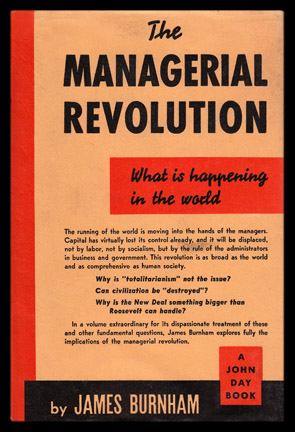
Daniel McCarthy revisits the obscure legacy of James Burnham, an ex-Marxist and philosopher who was an important figure in the postwar conservative intellectual movement (e.g. he was one of William F. Buckley’s first hires at National Review). Calling Burnham the “American Machiavelli,” McCarthy details how he “broke with Trotsky, and with socialism itself, in the 1940s, and he sought a new theory to explain what was happening in the world”:
In FDR’s era, as now, there was a paradox: America was a capitalist country, yet capitalism under the New Deal no longer resembled what it had been in the 19th century. And socialism in the Soviet Union looked nothing at all like the dictatorship of the proletariat: just “dictatorship” would be closer to the mark. (If not quite a bull’s-eye, in Burnham’s view.)
Real power in America did not rest with the great capitalists of old, just as real power in the USSR did not lie with the workers. Burnham analyzed this reality, as well as the fascist system of Nazi Germany, and devised a theory of what he called the “managerial revolution.” Economic control, thus inevitably political control, in all these states lay in the hands of a new class of professional managers in business and government alike—engineers, technocrats, and planners rather than workers or owners.
The Managerial Revolution, the 1941 book in which Burnham laid out his theory, was a bestseller and critical success. It strongly influenced George Orwell, who adapted several of its ideas for his own even more famous work, 1984. Burnham described World War II as the first in a series of conflicts between managerial powers for control over three great industrial regions of the world—North America, Europe, and East Asia. The geographic scheme and condition of perpetual war are reflected in Orwell’s novel by the ceaseless struggles between Oceania (America with its Atlantic and Pacific outposts), Eurasia (Russian-dominated Europe), and Eastasia (the Orient). The Managerial Revolution itself appears in 1984 as Emmanuel Goldstein’s forbidden book The Theory and Practice of Oligarchical Collectivism.
Despite how closely Burnham is associated with the Cold War, McCarthy asserts his continued relevance:
After all, the managerial Soviet Union is gone, and the capitalist U.S. has not only survived but thrived for decades in what is now a globalized free-market system. While the political theory of The Machiavellians doesn’t depend on The Managerial Revolution—it’s surprising, in fact, how little connected the two books are—his reputation must surely suffer for getting such a basic question wrong.
Only he didn’t get it wrong—for what is the political and economic system of China if not what Burnham described in The Managerial Revolution? Engineers, industrial planners, and managers have led China for decades, with unarguable results. Indeed, several East Asian economies, including those of American allies Taiwan, South Korea, and Japan, are managerialist. As Burnham predicted, these economies have been highly successful at controlling unemployment and raising standards of living.
The American ruling class, by contrast, has pursued a largely anti-managerial policy, ridding the country of much strategic manufacturing. Such industry—including shipbuilding and semiconductor fabrication—is now overwhelmingly based in Asia. The U.S. hybrid system, transitioning from capitalism to managerialism, outperformed the Soviet Union. Whether it can outperform the next wave of managerial revolution is very much uncertain.
The first thing that strikes me about the Alyssa Rosenberg quote is its breathtaking self-centeredness: “How much does masculine culture depend on women and femininity as a reference point?” This reminds me of the conversation that every straight guy has had with their female significant other. I call it the “You don’t have to pretend with me” talk.
Every time we straight guys talk about something we like (sports, metal music, violent video games, scotch whisky, etc.) we get the same response. “There are no guys around. You don’t have to pretend to like that stuff with me. Just be yourself!” What’s bizarre is that there is absolutely no acknowledgment that the stereotypical masculine stuff is stuff that we actually like. I like hockey fights. I like listening to Tool. I like GTA V. I like Lagavulin. Really, I do!
This is what drives me crazy about the contemporary liberal view that masculinity is nothing more than a social construct that can, with willpower, be overcome. All the things that make me a man, things that I enjoy, are apparently just externally forced cultural norms that I am too dumb and weak to transcend.
Masculinity has nothing to do with denigrating women. Period. There is no greater exemplar of modern masculinity than the character of Ron Swanson … can you imagine him denigrating women?
Many more readers chime in:
OK, straight male responding as requested! First, I will state one thing unequivocally. Masculine culture (however you want define it) is NOT under any kind of threat. This notion is as ridiculous as the idea that suddenly Sharia Law is going to take over the American judicial system.
The size, momentum, influence, and sheer predominance of straight, white, male culture makes this a frank impossibility – at least in our lifetimes. It is the de facto default; our entire society has been built around it for thousands of years. All the inroads that diversity and inclusiveness have made (particularly in the last 50 years or so) are a drop in the bucket compared to the history and established institutions that inform who we are as a society.
Second, thanks for attempting to bridge the gap between some of these disparate positions – particularly the highly polarized ones. One on my greatest frustrations in trying to discuss all of this mess is when I see people having conversations AT each other rather than WITH. As with anything, a little bit of empathy and understanding on every side helps.
On that note, Devin Faraci wrote a damn good explanation of how these gamers feel marginalized by these feminist critiques. Money quote:
Let me tell you where these kids are coming from, because I used to come from there. The first thing that’s happening is that they’re mostly males who are socially unaccepted. They’re outsiders, losers, weirdos and freaks. And most of them aren’t just male, they’re white males. What’s happening is that these men are feeling powerless in their own lives, and then along comes someone like Anita Sarkeesian telling them that as white men they are the MOST powerful group in the world. And that they should be aware of this privilege and they should be careful how they exert it.
Imagine the confusion this causes. These kids feel like the bottom of the heap, ignored and hated and mocked and here comes this woman – who is successful and admired and gets Joss Whedon to retweet her videos – telling them that they’re actually part of an invisible system keeping her down. This simply can’t compute for these guys.
I can’t read the catcalls thread without thinking of a stunning segment from This American Life about a woman undergoing a sex change. He (soon to be she) describes vividly how intensive testosterone treatment transforms the way s/he looks at women on the subway and in the street. (I may even have read this passage on these very pages a few years back, but it bears repeating I think). Here s/he describes the period following the first major injection:
The most overwhelming feeling is the incredible increase in libido and change in the way that I perceived women and the way I thought about sex. Before testosterone, I would be riding the subway, which is the traditional hotbed of lust in the city. And I would see a woman on the subway, and I would think, she’s attractive. I’d like to meet her. What’s that book she’s reading? I could talk to her. This is what I would say.
There would be a narrative. There would be this stream of language. It would be very verbal.
After testosterone, there was no narrative. There was no language whatsoever. It was just, I would see a woman who was attractive or not attractive. She might have an attractive quality, nice ankles or something, and the rest of her would be fairly unappealing to me.
But that was enough to basically just flood my mind with aggressive, pornographic images, just one after another. It was like being in a pornographic movie house in my mind. And I couldn’t turn it off. I could not turn it off. Everything I looked at, everything I touched, turned to sex. […]
I remember walking up Fifth Avenue, there was a woman walking in front of me. And she was wearing this little skirt and this little top. And I was looking at her ass. And I kept saying to myself, don’t look at it, don’t look at it. And I kept looking at it.
And I walked past her. And this voice in my head kept saying, turn around to look at her breasts. Turn around, turn around, turn around. And my feminist, female background kept saying, don’t you dare, you pig. Don’t turn around. And I fought myself for a whole block, and then I turned around and checked her out.
And before, it was cool. When I would do a poetry reading, I would get up, and I would read these poems about women on the street. And I was a butch dyke, and that was very cutting-edge, and that was very sexy and raw. And now I’m just a jerk.
Another:
I happened to read a 2010 article on Alternet today, and it reminded me very much of the issues that you and Alyssa Rosenberg were talking about a couple days ago. The author writes about his time spent as a pornography cameraman and writes in particular about the difference between straight and gay porn.
On straight porn:
What surprised me most though, was the fact that I found within myself a happy willingness to be violent, a willingness to degrade. Though my bosses may have ordered me to organize and record the scenes of degradation, I followed their orders, and not without pleasure. Something cowardly within me, an internal space, suffused with a weak kind of anger, felt satisfied when I saw a woman “take her punishment.” I clung to the sense of temporary empowerment I found through the bullying. Lust-colored aggression and the satisfaction of making “good money” guided me through scene after scene.
Of course, all participants in porno are complicit, both the bottoms and tops. Both genders willingly participate in heterosexual porn, and to some extent, both are marginalized: I was literally ordered not to film men above the waist if I could help it. And while men do make up the majority of porn’s audience, women watch heterosexual porn, too—quite a few likely doing so with major outrage or dissatisfaction. Still, though, straight porn unarguably continues to be the untrammeled domain of male fantasy.
On gay porn:
…the shame, rage, and sexual violence that I had come to associate with porn was almost completely absent. That meant something.
Gay porn, in fact, was so goddamn simple that it approached a type of Zen beauty. I mean, this was guys taking on guys, in every shape and form imaginable, for the most part in good humor and absent-minded lust. They may have stuck to roles of “tops” and “bottoms,” but in the dressing room, we all seemed equals, on the same team. Everyone laughed at me for being a straight guy shooting gay porn. Some tried to entice me to jump in front of the camera for kicks. But we all laughed about it. We all seemed like friends. The sadness and the degradation I had come to associate with my job, with videotaped sex for money, was suddenly absent.
But I’m saddened to think that the only path to the absence of hostility and anger in porn is to remove women from the equation. It doesn’t bode well, especially for a world in which men and women must continue to co-exist. In the first half of my porn-life, I lived inside of a world where it almost seemed like an entire gender was being denigrated, like that was the whole point—where very young women were choked and slapped and written-on with lipstick, simply for the crime, it seemed, of being a woman. You should have slept with me, seemed to be the unspoken message. Now see what I have to do to you.
Wow. So that was only one guy’s opinion / personal experience but in the light of recent discussions it really stood out to me.
One more reader:
I’m not sure why you’re responsible for defending straight guy culture, but Alyssa’s post is fascinating in the sense that she seems to take for granted that culture is something that is consciously shaped by its members. No one – including you – is saying that there’s nothing loathsome and regrettable about straight white guy culture. There certainly is! But all cultures have defects that don’t offer any redeeming social value and which can be safely excised, in exactly the surgical manner she wants to edit traits associated with straight guys – if only that was possible. It isn’t.
A culture describes a set of human beings. Human beings are necessarily imperfect. And so should our cultures be. What Alyssa sees as the defects of straight guy culture are – for better or worse – part of our culture. Does masculinity depend on women and femininity as a reference point? she asks. Well, yes, just as femininity depends on masculinity as a reference point. I think what she’s driving at is that too much of straight guy culture defines itself by objectifying women. Umm, sure. But that’s a snapshot of a moving target. The real question is trajectory. Cultures do not self-edit; they evolve, and straight guys have, which is why we’re shocked by the sexism in Mad Men, for example. Now clearly it’s not evolving fast enough for women like Alyssa, but they can (are!) pushing that evolution along by raising awareness about the callousness of catcalling. You can say the same thing about culture that you can about weather: If you don’t like it, wait.
And continue to make the arguments. Also, say something if you see a woman getting harassed.



 The Dish