Chart Of The Day

by Dish Staff

proposal-heart-chart

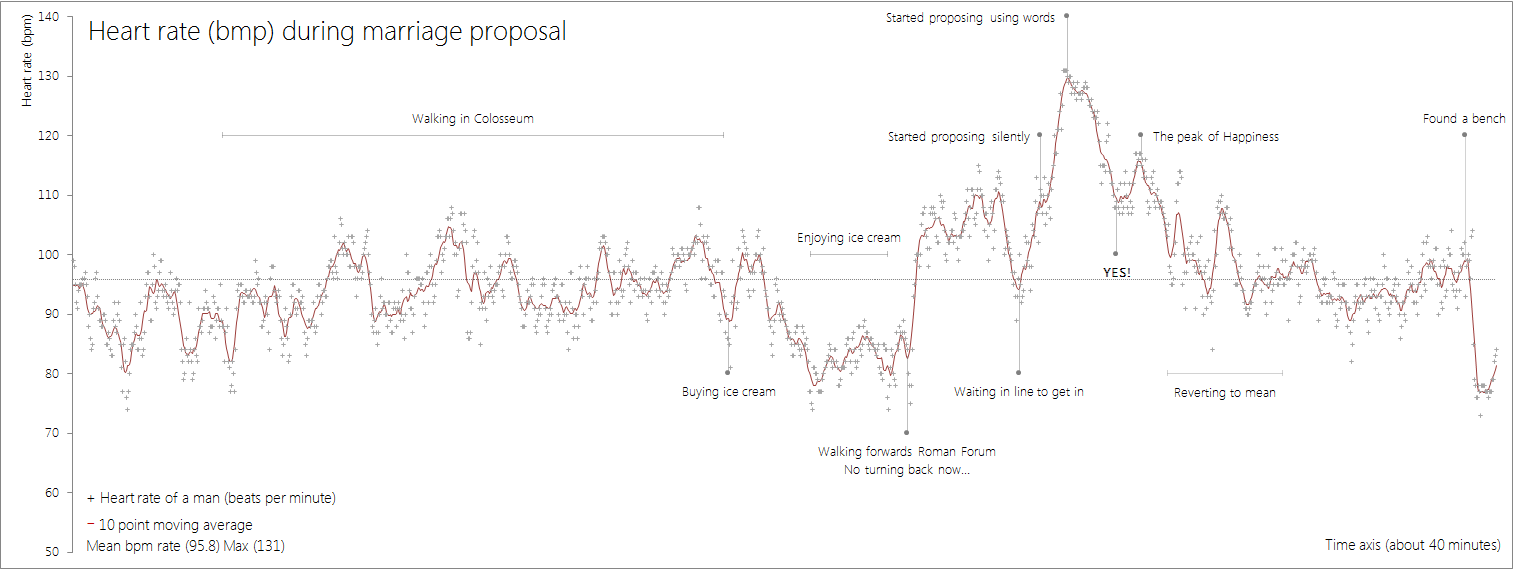
Nathan Yau captions:

Reddit user sesipikai tracked his [marriage] proposal during a trip to Italy. He happened to be wearing a heart rate belt, and you can see the rise and fall of beats per minute leading up to the question. Walk. Ask. She says yes. Bask in the happiness. Find a bench.

Full chart here.

Abe Stays On

by Dish Staff

Michael Auslin takes a broad look at the economic implications of Japanese Prime Minister Shinzo Abe’s recent win:

[T]he question now is how far Abe will push the long-awaited structural reforms that he has promised will revitalize the economy and boost wages. There is no longer any excuse for delay, as Abe has another four years ahead of him and no significant opposition standing in his way. A failure to boldly tackle the most difficult reforms, such as in the agricultural sector or in the labor market, not to mention the Trans-Pacific Partnership free trade agreement, will seem doubly damning given Abe’s parliamentary strength. The only reason he doesn’t charge full-steam ahead at this point would be that, deep down, he is not really committed to changing Japan, Inc. That would be a missed opportunity of historic proportions.

Bloomberg View’s editors hope that Abe follows through:

Even Japan’s weak opposition parties more or less acknowledge the good that the first two “arrows” in Abe’s program — massive monetary easing and fiscal stimulus — have done. The Bank of Japan’s bond-buying has driven down the yen 30 percent against the dollar and filled the coffers of companies with global earnings. The unemployment rate is remarkably low; the stock market is rising. Nor is there much quibbling about the direction of Abe’s third arrow — structural changes aimed at improving Japan’s competitiveness.

But it’s not clear that the third arrow will hit its mark:

Tweaks — taxing corporations that sit on their cash rather than investing it or raising wages, for instance — might help around the margins. But the real problem is that for all his energy and verve, Abe has not fundamentally altered the status quo in Tokyo.

Japan’s entrenched bureaucracy waters down reforms almost instinctively. That means small changes are all but certain to be whittled to nothing. Abe’s first two arrows succeeded in part because of their size and shock value: They were designed to change expectations radically, and for a time they did. Abe needs another big bang — something much more than a $25 billion stimulus package.

Back in November, John Cassidy spelled out why he supports Abe:

There’s no convincing reason why a country that is as advanced, well-educated, and hard-working as Japan should remain stuck in an economic rut for decades on end—even if it has run up a great deal of debt. Viable policy options exist to confront deflation, to effect a permanent exit from the liquidity trap, and to get the country growing again, sustainably. These policies aren’t easy to market or enact, but, after years of being saddled with pedestrian leadership, Japan has finally found a Prime Minister, in Abe, who is willing to take some of the necessary measures and confront the people who oppose them.

Be that as it may, Joel Kotkin argues that “it is increasingly clear that the epicenter of Japan’s crisis is not its Parliament, or the factory floor, but in the bedroom”:

 Japan has been on a procreation holiday for almost a generation now, with one of the lowest fertility rates on the planet. The damage may prove impossible to overcome. Japan’s working-age population (15-64) peaked in 1995, while the United States’ has grown 21% since then. The projections for Japan are alarming: its working-age population will drop from 79 million today to less than 52 million in 2050, according to the Stanford Institute on Longevity.

The Best Of The Dish Today

by Chris Bodenner

Try not to watch this Michael Bay GIF over and over and over again:

panda

Today on the Dish, guest-blogger Will Wilkinson used the news of Jeb’s exploratory committee Leadership PAC to make a contrarian case for dynastic presidents. He also argued for the abolishment of police unions, defended Uber against its snarky and socialist detractors, and reflected on his less frenetic life in Chattanooga.

Meanwhile, our other guest-blogger for the week, Michelle Dean, pondered the state of Truth in 2014, trashed year-end book lists, replied to a dissenting reader over the Sony scandal, and ended the day with Herzog.

The most popular posts were Will’s take on dynasty and Andrew’s takedown of Cheney on MTP. On that note, a reader writes:

Under Obama, the only evil-doers sent to prison are whistleblowers. Today is Chelsea Manning’s 27th birthday – and she’s barely begun an immoral 35 year sentence. Think of Dick Cheney, and Chelsea today.

Other top posts today included Dishtern Phoebe’s look at the You Had One Job meme and a reader-submitted graphic on Republican values. And don’t miss our latest installment of the riveting reader thread, “Would You Report Your Rape?” If you’re a fan of the VFYW Contest, Chas has you covered:

VFYWC-235-Guess_Collage

Many of our posts were updated with your emails – read them all here. You can always leave your unfiltered comments at our Facebook page and @dishfeed. 18 more readers became subscribers today. You can join them here – and get access to all the readons and Deep Dish – for a little as $1.99 month. Gift subscriptions are available here (you purchase one today and have it auto-delivered on Christmas Day). Dish t-shirts are for sale here and our new mugs here. A final email for the day:

I recently let my subscription lapse because I just couldn’t muster the emotional energy to keep up with partisan politics any more after my euphoric involvement with the 2008 campaign. Your “Was it something we said?” email didn’t get me to change my mind about the subscription. But as someone who shares the same experiences with TNR that Ross depicts here, and Andrew’s explanation about why The Dish is important in keeping that kind of experience afloat … well, guess what: partisanship crap or no, that is one compelling argument for a renewal of the subscription. Here’s to your ongoing stewardship of our common culture at the highest levels of intellectual engagement.

And panda GIFs. More in the morning.

Tumblr Of The Day

by Michelle Dean

herzog2

2014 has been a terrible year full of awfulness. The second half is unmatched for grimness in recent memory. It’s been so bad, actually, that my personal list of wishes for 2015 is already a mile long. Here’s just the tip of my iceberg: less hacking of any kind, fewer deaths of unarmed black men at the hands of the police, more prosecutions of state officials responsible for torture, an end to defensive press releases from any member of the Cosby family, a Supreme Court with more than passive familiarity with the female reproductive system, and single-payer health care for every American adult and child.

But if I can have none of that, I would at least like to have more Werner Herzog in my life. Is there a better guide for times of existential and political despair? There is not. The cruelties of fate are easier to bear when narrated in dulcet German tones.

IMDB informs me that in 2015 I can expect the release of a Herzog movie about Gertrude Bell. That is the kind of thing you’ll find me in a sleeping bag on the sidewalk waiting to see, James Franco’s presence in the cast notwithstanding. Until then I intend to survive on the Werner Herzog Inspirationals tumblr, which a kind and equally festive-feeling friend pointed out to me today. This should be great scrolling next week, too, when we’re all going mad at home for the holidays.

Uber, But For The Proletariat

by Will Wilkinson

Uber Graphic

There’s something about Uber, the popular ride-sharing service, that brings out the nutty in people. During the awful hostage situation yesterday in downtown Sydney, the volume of people trying to get out of Dodge by beckoning an Uber car kicked the app’s surge pricing into effect. This is most sensible. You see, the increase in demand (and no doubt the dangerous conditions) had reduced the supply of available drivers, leaving many of those desiring a car without one. Surge pricing sweetens the deal for drivers, drawing idle supply into action, helping to ensure that those who want service can get it. This does not amount to the exploitation of a dire situation. It is the best way to ameliorate it. The alternative to temporarily higher prices is a total lack of cars, not a bunch of open cars at normal non-surge pricing. This ought to be obvious, but apparently it is not, and there was an instant backlash to the implementation of surge pricing. Olivia Nuzzi of the Daily Beast gets it exactly right:

Uber’s surges are not price gouging, as some have erroneously claimed. Uber––which is actually not the only method of transportation on Earth, despite what it may seem like––warns passengers about the surge before it allows them to order a car, and if the surge is over two times the normal rate, the app forces users to type it in, just to make sure they really understand what they are getting themselves into.

As the Sydney hostage crisis unfolded, Uber customers and observers alike took to Twitter to complain about the sky-high fares, calling the policy “Marxian” and “downright predatory.”

Gawker sneered that Uber is “Ayn Rand’s favorite car service.”

Uber responded to the PR nightmare by reversing the surge, refunding those affected, and doling out free rides. They shouldn’t have. There is plenty to chastise Uber for––I am a frequent and enthusiastic critic of the company’s inadequate background check process––but price surging is not among its sins. […]

How does the world owe you a private car, priced as you deem acceptable, that didn’t exist five years ago? If you don’t like Uber’s surge pricing, you are still welcome to travel by subway, cab, bus, camel, horse and carriage, or you can just fucking walk. If none of those options appeal to you, you might consider meandering over to a country with a different economic system.

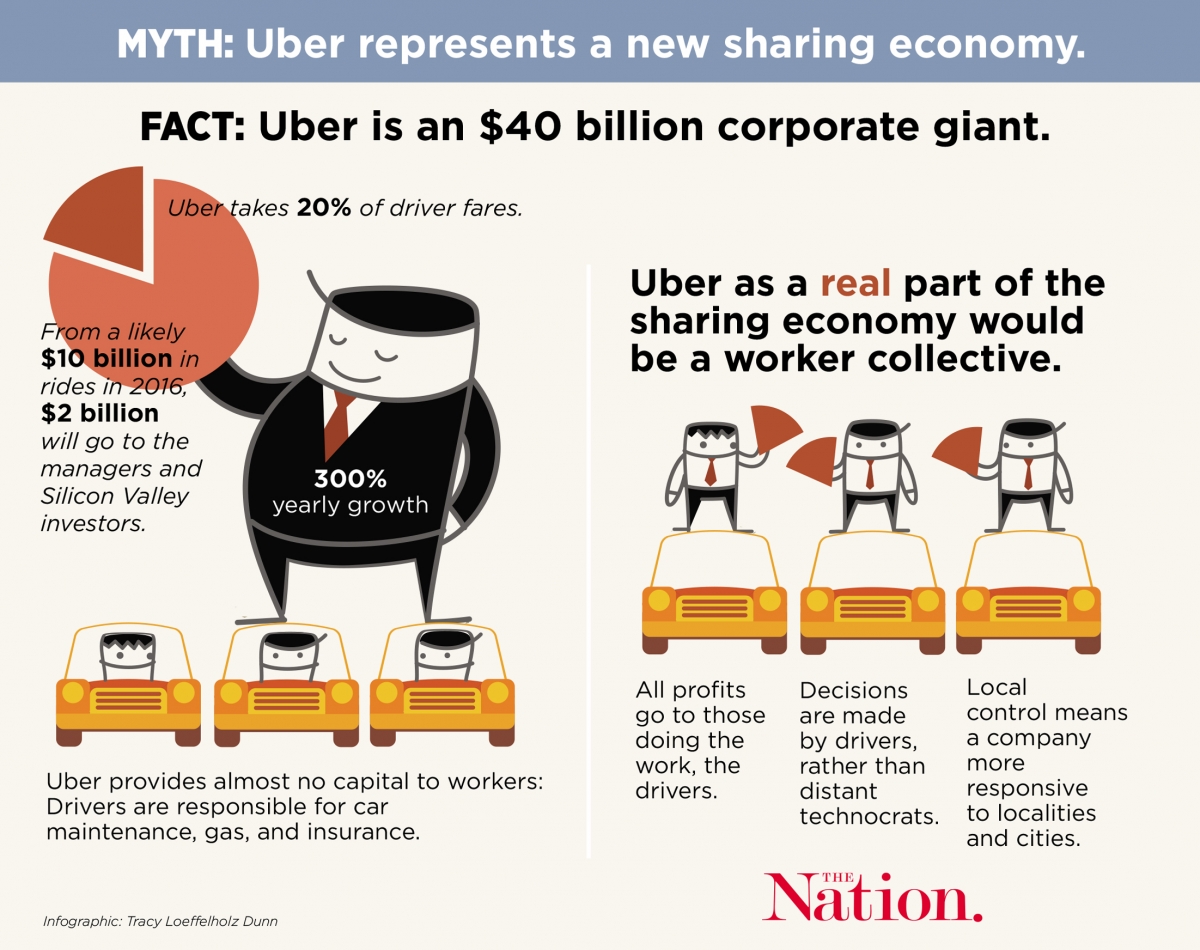
Or… Or… transform this country’s economic system and socialize Uber! That’s the entertaining proposal of Mike Konczal and Bryce Covert in The Nation:

[T]hink about what the capitalist managers at Uber are doing with their cut of the company’s money. They are fighting regulators and hiring lobbyists in order to bring down the incumbent taxi-medallion business. They are also spending money on advertising, in order to get customers interested in using a ride-sharing service. These are both expensive projects, and they open the door for competitors. Newer ride-share ventures can piggyback on Uber’s success and take advantage of these new terms, with Uber having already spent all that initial money. This is called the “second-mover advantage,” and it explains why Uber is such a vicious company.

But after this initial project, what exactly are the capitalists at Uber contributing to the company? Almost all of the actual capital is already owned by the workers, in the form of cars that they pay for and maintain themselves. And these workers labor individually, doing the same tasks, so there’s no need for a management class to control their daily operations. The capital owners maintain the phone app, but app technology isn’t the major cost, and it’s getting cheaper and easier by the day.

Given that the workers already own all the capital in the form of their cars, why aren’t they collecting all the profits? Worker cooperatives are difficult to start when there’s massive capital needed up front, or when it’s necessary to coordinate a lot of different types of workers. But, as we’ve already shown, that’s not the case with Uber. In fact, if any set of companies deserves to have its rentiers euthanized, it’s those of the “sharing economy,” in which management relies heavily on the individual ownership of capital, providing only coordination and branding.

There’s perhaps a problem or two with this proposal. “It takes an entrepreneur to start up ride-sharing,” Konczal and Covert write, “but not to run it as a firm. A worker collective is the obvious transition.” A system in which entrepreneurship is routinely rewarded with a forced “transition” to a worker collective is a system that is unlikely to continue to producing a valuable of entrepreneurial innovation.

But I really do like the idea of the drivers getting a bigger share of the profits. If it’s true, as they say, that “Newer ride-share ventures can piggyback on Uber’s success and take advantage of these new terms,” then it seems that Uber and Lyft drivers ought to be able to organize, finance the creation of a new app (no big deal, it would seem), and then dominate the market by charging less than those awful, useless, Silicon Valley tech-bro rentiers, all the while getting paid more. Why go through the tumult of trying to socialize Uber when a worker collective would so clearly out-compete Uber? Or maybe it’s not so clear that it would. Maybe organizing drivers, developing, maintaining, and continuously improving an app, doing all the necessary marketing, and managing the whole system isn’t really such a breeze, and by the time you take into account all those costs, which worker-collective drivers would have to cover, they’d end up keeping something in the neighborhood of 80% of their fares, just like Uber drivers. That’s my hunch.

Still, a more worker-centric Uber seems like a neat idea, and the prospect of developing one from the ground up, no matter how unlikely it may be, seems a lot less unlikely than simply stealing Uber – at least here in the mad-dog capitalist Amerikkka. Maybe the government of a country less in the grip of neoliberal market fundamentalism will gently force Uber to transition to a worker collective. Actually, I hope that happens. It would be interesting to see how it works out.

Face Of The Day

by Dish Staff

PAKISTAN-UNREST-NORTHWEST-SCHOOL

An injured Pakistani student lies in bed at a hospital following an attack by Taliban gunmen on a school in Peshawar on December 16, 2014. Taliban insurgents killed at least 130 people, most of them children, after storming an army-run school in Pakistan December 16 in one of the country’s bloodiest attacks in recent years. By A Majeed/AFP/Getty Images.

A C-Section Gone Medieval

by Dish Staff

The victims of a brutal procedure are finally getting some justice:

Petrified and in agony, Mary had been subjected to a symphysiotomy – a controversial operation that was seldom used in the rest of Europe after the mid-20th century, but which was carried out on an estimated 1,500 women in Ireland between the 1940s and 1980s. The procedure involves slicing through the cartilage and ligaments of a pelvic joint (or in extreme cases, called pubiotomy, sawing through the bone of the pelvis itself) to widen it and allow a baby to be delivered unobstructed.

Critics blame the continued use of the operation on a toxic mix of medical experimentation, Catholic aversion to caesarean sections and an institutional disregard for women’s autonomy.

They claim it has left hundreds of surviving women with life-long pain, disability and emotional trauma. For some in Ireland, it is yet another scandal perpetrated against women and girls, joining revelations over the Magdalene laundries (where “wayward” women were abused), the deaths of children at mother-and-baby homes and sex abuse in the Catholic church.

Not everyone agrees with this analysis: some doctors and historians argue that these criticisms fail to account for wider changes in medical culture. But this year the mothers who believe they were wronged finally got some encouraging news. In July, the UN Human Rights Committee called for the Irish government to hold an investigation into the issue. And last week saw the deadline pass for applications to the state’s ex gratia redress scheme, which offered women who have been through the procedure compensation sums of between £40,000 and £120,000. More than 300 women are said to have applied.

Their supporters say the moves are not before time. Mark Kelly of the Irish Council for Civil Liberties says that, despite having interviewed victims of torture, “this remains just one of the most appalling things that we have come across”. Nigel Rodley, chair of the UN Human Rights Committee, called the use of the operation without patients’ informed consent a “systematic assault”.

Will Torture Return?

by Dish Staff

Frederick Schwarz Jr. fears so:

[B]y making the story narrowly about how torture didn’t work in these instances rather than that torture doesn’t work at all and, more fundamentally, that it should never be used by any White House because it is immoral and illegal––as well as harmful to America’s reputation and the safety of American captives––there is greater risk a future administration faced with peril will say: “Well, we can do it better.”

Itamar Mann compares America to Israel:

The endurance of forceful interrogation in Israel, even after the Israeli Supreme Court seemingly banned it, reflects an inability to abolish such methods.

This reality has been documented by several important Israeli human right organizations, chiefly the Public Committee Against Torture, who initially brought the 1999 case to court. The most important question about torture and other abusive interrogation is not whether it is “civilized” or not. It is what kind of political reality it makes possible, and what kind of political reality it preserves. In the Israeli context, this was and remains an intractable political reality of undemocratic military control over a civilian population.

Thirteen years after 9/11, leading legal academics decry America’s “forever war” (as Harold Koh called it). The perpetrators of torture remain immune from prosecution. And somewhat surprisingly, last week CIA director John Brennan refused to say that the agency will no longer engage in torture. All these reflect a similar inability to move forward. The future of torture in America is all but guaranteed.

Do We Trust Cops Too Much?

by Dish Staff

Police Confidence

Last week, Scott Clement flagged a poll finding that recent events “might have actually increased white Americans’ belief that their local cops treat blacks fairly”:

There’s been no such boon in confidence among African Americans, though. Just 12 percent express a great deal of confidence in local police’s equal treatment of blacks and whites — a number that is squarely within the 10-to-17-point range in previous surveys. Only one-third have at least a “fair amount” of confidence in their neighborhood police, compared with 78 percent of whites.

Josh Marshall thinks “people who are part of or sympathetic to the movement tied to Michael Brown, Eric Garner, Tamir Rice and others sometimes miss just what deep wells of support and trust police have in the population”:

Police officers are consistently among the most trusted professions in the country, as attested in numerous public opinion surveys. That said, respect and trust and deference to police is heavily tied to public perceptions of the threats they protect us from. And as we’ve discussed, crime rates have been falling rapidly for two decades.

After the Garner non-indictment, Damon Linker advocated against giving officers the benefit of the doubt:

How many bad apples are there? And which ones? We have no idea — and our asinine, knee-jerk deferral to the police, our unwillingness to hold them accountable before the law when they make a questionable call to use deadly force, ensures that we will never know. And it also ensures that the bad apples will receive the message that they have free rein to do whatever they want, with nearly complete impunity.

Until this changes, all of our lofty encomiums to individual liberty and limited government will amount to nothing but empty air.