Tough In Advertising

by Dish Staff

Christie Thompson flags findings on the impact of judicial campaign ads:

A growing body of research suggests that soft-on-crime attack ads may be changing how judges rule on criminal cases. In the American Constitution Society’s study of state-supreme-court races, Emory University law professors Joanna Shepherd and Michael Kang concluded that the more TV ads aired, the less likely individual justices are to side with a defendant. The impact was fairly small but statistically significant, showing that doubling the number of TV ads in a state with 10,000 ads increased the likelihood of a vote for a prosecutor by an average of about 8 percent. … Previous studies have found that Pennsylvania judges handed out longer sentences as an election approached, and that Kansas judges chosen in partisan elections gave harsher punishments than those who kept their seats in nonpartisan retention elections.

Same-Gender Schooling, Ctd

by Dish Staff

Back in 2007, Andrew had this to say on the subject:

It’s always been a good idea, especially for boys. … The only way to ensure gender equality is to base it on a firm grasp of gender difference. In today’s educational world, a blank slate theory about human nature leads to boys’ being short-changed.

But Katie J.M. Baker cites new data running against that view:

A recent comprehensive study of 1.6 million students in grades K–12 from 21 nations found no advantage to single-sex schooling. It also found that single-sex schooling reinforces negative stereotypes, as did an oft-cited 2011 report published in Science, “The Pseudoscience of Single Sex Schooling.” Any benefit from single-sex education, the authors say, are from variables like discipline policies or parent engagement. Single-sex schooling “looks like a quick fix for low-income kids, but it’s all junk,” said Diane Halpern, Dean of Social Sciences at Minerva Schools at Keck Graduate Institute and former president of the American Psychological Association, as well as the lead author of the 2011 study. “Data simply doesn’t support that this is a superior way to teach.”

The Stubbornness Of Class Snobbery

by Phoebe Maltz Bovy

Freddie recently complained about his Facebook friends sharing a jokey item that conflated “think[ing] Olive Garden is fancy” with being a racist. Freddie’s post title, and seemingly straightforward request, is, “keep your classism out of my antiracism.”

I share his sentiment, but am pessimistic about the prospects of separating classism from not just antiracism, but social justice advocacy more generally. It’s not that sometimes, well-meaning progressive sorts slip up and accidentally insult one group while helping another. Rather, it’s that a certain kind of chic progressivism (or pseudo-progressivism) has fused with class snobbery. The chance to engage in a bit of class signaling is a feature, not a bug.

We see this in so many arenas, the most obvious being a certain kind of anti-commercialism that seems to be about defending those who can’t afford flashy-fancy items, but is in fact about those who prefer discreetly high-end items (or better yet, experiences) looking down on those whose tastes aren’t so impressive. See: Black Friday. See also: the “basic bitch,” and Noreen Malone’s spot-on explanation. The thing these days is to sneer at the schmancy in a way that seems at first to be about supporting the underdog, but that’s in fact the opposite. “Gourmet” is no longer indicative of high-end, nor are designer logos. So you’re not actually taking the pro-underdog position of you prefer Bushwick farm-to-table to special-occasion restaurants (that may well cost less). A gigantic engagement ring, a McMansion, an SUV, these are the things one can evoke as examples of how “we” i.e. Americans over-consume, but the person ostensibly including himself in this first-person-plural actually has plenty of money, status, and whichever stuff does interest him. It’s simply not done to insult the actual poor. So all the classist energies have gone towards insulting this nebulous (and unless otherwise specified, white) middle class, all the while claiming to be concerned about the environment, labor, etc. Yet those remain, for others, true concerns. The difficulty is sorting out which is which.

We also see this play out in social-media issues-of-the-day discussions. Specifically, the “privilege” conversation, which is often, as we have seen, a way for those with the right manners and terminology to exclude everyone else. Class signaling and social-justice advocacy have, on Twitter and most especially on Facebook, started to look, at times, almost indistinguishable.

An Actual War On Women, Ctd

by Dish Staff

The Islamic State’s “Research and Fatwa Department” is circulating a pamphlet on what the jihadis are allowed to do to the thousands of women and girls they have captured and enslaved in their rampage through Iraq and Syria:

Much of the pamphlet talks about ISIS’ policy on having sexual intercourse with a female slave, something that the group cites the Quran to justify. “If she was a virgin, he (the owner) can have intercourse with her 1(355)immediately after the ownership is fulfilled,” ISIS explains. “If she was not a virgin, her uterus must be purified (wait for her period to be sure she is not pregnant.)”

There are other rules as well, like that two men who co-own a captive can’t both have sex with her and that a man can’t have intercourse with his wife’s slave. As to girls: “It is permissible to have intercourse with the female slave who hasn’t reached puberty if she is fit for intercourse,” the document reads. “However, if she is not fit for intercourse, he (the owner ) can only enjoy her without intercourse.”

An English translation of the evil document, via MEMRI, is available here. Jamie Dettmer notes how many women ISIS is believed to have kidnapped:

According to Nazand Begikhani, an adviser to the Kurdistan regional government and researcher at the University of Bristol Gender and Violence Research Center, ISIS has kidnapped more than 2,500 Yazidi women. Yazidi activists, meanwhile, say they have compiled a list of at least 4,600 missing Yazidi women, seized after they were separated from male relatives, who were shot.

The women were bussed, according to firsthand accounts of women who have managed to flee, to the ISIS-controlled cities of Mosul in Iraq and Raqqa in Syria, and chosen and traded like cattle. Kurdish authorities in northern Iraq say they have freed about 100 Yazidi women. In October, ISIS justified its enslavement of the women—and of any non-believing females captured in battle—in its English-language digital magazine Dabiq. Islamic theology, ISIS propagandists argued, gives the jihadis the right, much in the same way that the Bible’s Ephesians 6:5 tells “Slaves, obey your earthly masters with fear and trembling.”

Katie Zavadski finds some perspective on the ghastly situation:

The pamphlet may be part of a response to a recent condemnation of the group by Islamic scholars from around the word, according to UMass Lowell security studies professor Mia Bloom. Instead of engaging with centuries of Islamic theological debates, ISIS is reverting to seventh-century norms, at which point “women would have fallen under the rubric of war booty.”

She also doesn’t rule out the possibility that some foreign fighters might find these guidelines attractive. “Maybe they think that this is a recruiting tool,” she says, for frustrated men from abroad. But Bloom worries that this cycle of sexual violence will be difficult to stop. “They are creating a very perverse incentive system,” she says, noting the uptick of domestic violence complaints in postwar Serbia.

Previous Dish on the Islamic State’s barbaric view of women here.

Police Discretion Just Got Worse

by Will Wilkinson

The Supreme Court ruled today, in a 8-1 decision, that a police stop based on a officer’s false beliefs about the law can lead to a legally valid search.

Nicholas Heien was stopped in his car by a Surry County, North Carolina cop for having only one working brake light, which is not against the law in North Carolina. Heien then stupidly consented to a search of his car, which turned up a bag of cocaine. Heien subsequently argued that the search ought not to valid, and the drug charge dropped, since the traffic stop was based on the officer’s mistaken understanding of the law. The crux of the issue, legally, is whether a police officer can have a “reasonable suspicion” that a law has been broken – that’s the prevailing  standard for a valid stop – when that suspicion is grounded in ignorance of the law. The court says “reasonable mistakes of the law,” like the erroneous belief that two working brake lights is legally mandatory, may make the officer’s suspicion wrong, but not unreasonable.

This is too much. We’ve somehow arrived at a place where police can do pretty well whatever they like. Cops already have immense discretion to detain us. There’s a good deal of talk these days, and rightly so, about the “criminalization of poverty,” which is part of broader trend toward the criminalization of life through the proliferation of regulation. We are, all of us, breaking some law pretty much all of the time. Even if the cop is wrong about which law we happen to be breaking, he’s apparently not wrong to prevent us from going about our lawful business. When we’re all criminals, all suspicion, even ignorant suspicion, is “reasonable.”

Who gets the raw end of this deal? The most “suspicious” among us, of course. Michael Munger, a Duke University political scientist, gets to the heart of the issue of overcriminalization, and the dilemma it creates for those of us who want a state that is both active and just:

We have criminalized so many behaviors (in the Staten Island case, selling packs of cigarettes!) that we have given the police enormous pressure to perform — and gigantic latitude to act on prejudice, bigotry, and simple anger. The police, in their defense, have an impossible job. They have come to see almost everyone around them, every day, as a lawbreaker and a danger to society. Harvey Silverglate has famously estimated that most of us commit at least three felonies per day. The only thing that prevents us from being jailed is the discretion and public spiritedness of the prosecutor. …

As long as overreaching laws effectively criminalize being black or poor, it’s not surprising that the police will continue to treat black people and poor people as criminals. This kind of race-based law enforcement is given the stink eye by our friends on the left, but they can’t seem to draw the obvious inference: the answer is not better police or more enlightened officials. The answer is fewer laws. That’s the long division in our society, the most important difference that arises from class and social status. Decriminalize normal nonviolent daily activity, and the police will have fewer excuses to harass people they don’t like — people who often can’t fight back.

Now, I don’t think decriminalizing nonviolent daily activity is any sort of panacea. There’s a great deal more than needs to be done to rein in America’s lawless police, and I’ll be discussing some ideas for doing that over the next few days. But simplifying the law and decriminalizing peaceful daily life promises to somewhat reduce the exercise of the sort of police discretion which, when combined with our culture’s lingering ethos of white supremacy, amounts to systematic racial oppression. That’s worth doing. Moreover, simplifying the law reduces the chance that police will act on “reasonable mistakes” about what it says.

That said, I do disagree to some extent with Munger. Fewer laws isn’t the only obvious inference. Better police and more enlightened officials have got to be part of the answer, or reform is doomed before it begins. Like Munger, I think it’s idiotic to expect public officials to act like angels, and I believe we ought to design our institutions from unabashedly cynical assumptions about human motivation. But it is possible to demand a minimum standard of decent behavior without succumbing to what Munger calls the fantasy of “unicorn governance.” Other countries have secret agents that don’t torture people and police that don’t behave like lawless thugs, and that’s not too much to ask.

Cruz Missile Misfires

by Dish Staff

Ted Cruz did Harry Reid a big favor on Saturday, demanding a vote on Obama’s immigration EO that backfired in a big way. Allen McDuffee explains how his shenanigans gave the Dems everything they wanted for Christmas and then some:

Reid and his Republican counterpart, Minority Leader Mitch McConnell, had worked out an agreement Friday to hold a vote on the spending package on Monday. But Cruz’s last-minute procedural maneuver to demand a vote on immigration scuttled that deal and forced senators to stay in Washington for the weekend. Not only did the immigration vote fail by a wide margin, 74-22, but the maneuver allowed Democrats to advance a slate of two dozen Obama nominees to executive branch positions faster than they otherwise would have proceeded. The nominations include Tony Blinken as deputy secretary of state, Dr. Vivek Murthy as surgeon general, Sarah Saldana as head of Immigration and Customs Enforcement and Carolyn Colvin to lead the Social Security Administration.

The “cromnibus” spending bill, meanwhile, passed 56 to 42, with 24 Republicans supporting it. Cruz’s buddies on the right are less than thrilled. Jennifer Rubin, for one, rips the junior Senator a new one:

Consistently rejecting useful and conservative legislation because of small infirmities is not the behavior of a leader dedicated to accomplishing important things, and it suggests Cruz is grossly unsuited for the Senate, let alone higher office. Imagine if he ran a state — or the country — without super-majorities of Republicans. Things would be worse than they are now. Rigidity of mind and contempt for opponents in a president have resulted in paralysis and nastiness for six years, so why repeat the experience? And really, if Cruz could find some other way to get attention, get his face on TV and get money out of gullible hard-right voters, don’t we think he’d take it?

Matt Lewis urges conservatives not to hold back from criticizing radicals like Lee and Cruz:

[T]he larger problem is that if conservatives are afraid to say “the emperor has no clothes,” then we will continue rewarding the wrong things, which means conservatives will continue losing. Is it wise to look the other way? It doesn’t do much good to pretend that the touchdown counts for your team when it was scored in the wrong end zone, but what if even after watching the game film, we still decline to tell our star player he cost us the game? This raises a question: Who cares more about something, the guy who ignores its faults or the guy who wants to address them?

Drum, meanwhile, neeners:

I’m sure the NRA is thrilled. Ditto for all the Republicans who were apoplectic over the nomination of Tony Blinken as deputy secretary of state. And megadittoes—with a megadose of irony—for Cruz, Lee, and all their tea party buddies who objected to confirming Sarah Saldaña to head Immigration and Customs Enforcement. Their objection, of course, was meant as a protest against Obama’s executive order on immigration. Now, thanks to a dumb little stunt that was pathetic even as an empty protest against Obama’s immigration plan, they’re going to lose an actual, substantive protest against an Obama immigration nominee. Nice work, guys. But I guess it’s a nice big platter of red meat that plays well with the rubes. With Cruz, that’s all that counts.

Jonathan Bernstein compares the cromnibus fight to last year’s shutdown battle, in which Cruz also played a key role:

Of course, part of normal bargaining involves a certain amount of brinkmanship and part of deliberate shutdown politics can involve claims that the other side is “really” responsible for the breakdown. The process goes off the rails when it includes excessive demands, backed up by ultimatums, that are far outside what appears to be the normal range of bargaining. Demanding a repeal of Obamacare (or “defunding”) despite a solid Democratic majority in the Senate and a Democrat in the White House is of a different order than a fight about a relatively small provision of Dodd-Frank, or the other policy riders added to the current funding bill.

In any case, it was clear from the beginning of last year that the radicals were more interested in the principle of blackmail than they were in the fate of any particular hostage. Indeed, most of the drama of the government shutdown involved Republicans flailing around looking for a good demand they could make for the shutdown they had already engineered.

Congress Doubles Down On Ukraine

by Dish Staff

The “Ukraine Freedom Support Act”, authorizing both lethal and non-lethal aid to Kiev in its ongoing conflict with pro-Russian separatists, passed both houses of Congress late last week to little fanfare:

The current legislation authorizes $350 million worth of weapons, defense equipment and training for Ukraine over three years. Lawmakers dropped a key provision in the original bill that would have taken the rare step of giving major non-NATO ally status to Ukraine, Georgia and Moldova. Senate aides said the provision was removed at the 11th hour in order to ensure final passage.

The measure hits Russia’s defense and energy sectors, punishing companies like state defense import-export company Rosoboronexport. It requires Obama to impose conditional sanctions on the defense sector should Russian state-controlled firms sell or transfer military equipment to Syria, or to entities in Ukraine, Georgia or Moldova without the consent of the governments in those nations. The rule is aimed at helping stem the flow of weapons from Russia across the border into eastern Ukraine, where Washington and Kiev accuse Moscow of fomenting separatist unrest.

The bill does not require Obama to provide lethal aid, however, and the White House has no plans to do so – at least, not yet. Russia, predictably, lashed out in response to the bill, which it called “openly confrontational” and akin to blackmail. Emma Ashford calls it counterproductive:

Arming Ukraine will escalate tensions with Russia, but it will do little to help the Ukrainian army – which is corrupt and in dire need of reform – to combat the insurgency in its Eastern regions. The bill ties the hands of diplomats, requiring that Russia ceases “ordering, controlling… directing, supporting or financing” any acts or groups which undermine Ukrainian sovereignty before sanctions can be lifted. The INF treaty stipulation [directing the President to hold Russia accountable for its violations of the Intermediate Nuclear Forces Treaty] is also dangerous, raising tensions, and increasing the possibility that both Russia and the U.S. could withdraw from the treaty.

Unfortunately, the provisions in this bill will make it all the more difficult to find a negotiated settlement to the Ukraine crisis, or to find a way to salvage any form of productive U.S.-Russia relationship. No wonder congress didn’t want to debate it openly.

Larison agrees:

As it is, the passage of this legislation was the wrong thing for Congress to do. If Obama doesn’t want to contribute to making things worse in Ukraine, he should veto it. Signing such a bill into law will just goad Russia into more aggressive behavior and will set up the Ukrainian government for another fall. There is no American interest that justifies this contribution to the conflict in Ukraine. It is an unfortunate marriage of the desire to be seen as “doing something” and the knee-jerk impulse to throw weapons at every problem.

Doug Bandow fears that the bill “offers a belligerent foretaste of what to expect from the incoming Republican Senate”:

The legislation’s chief sponsor was Sen. Bob Corker (R-Tenn.), slated to become chairman of the Senate Foreign Relations Committee. His earlier proposal, “The Russian Aggression Prevention Act of 2014,” was even more confrontational, providing for greater sanctions on Russia, more military aid for Ukraine, and intelligence sharing with Kiev; conferring “major non-NATO ally status” on Georgia and Moldova as well as Ukraine; expanding “training, assistance and defense cooperation” with Azerbaijan, Bosnia and Herzegovina, Georgia, Kosovo, Macedonia, Moldova, Montenegro, and Serbia, as well as Kiev; mandating non-recognition of Russian annexation of Crimea; and subsidizing energy development in Georgia, Moldova, and Ukraine. As chairman he is likely to encourage equally misguided military meddling elsewhere.

Ukrainian President Petro Poroshenko, meanwhile, announced the first 24-hour period without a casualty since a ceasefire went into effect in early September. According to a new UN report, 4,707 people have been killed in the fighting, including 1,357 since the ceasefire was agreed.

SantaCon vs The Millions March

by Michelle Dean

I can wax rather sentimental when it comes to protests. While I didn’t get out to the Millions March on Saturday for personal reasons, I’d meant to. I like marches. Even the best ones have a slight air of chaos, and the dominating atmosphere is usually angry despair. But there’s something about just the act of walking together that can restore your faith in the usefulness of civic engagement. And given the news of the last few weeks – which to me has felt like a relentless chant of police brutality, rape and state-sponsored torture, rinsed and repeated endlessly – I’ve been feeling the need to have my faith restored in the usefulness of civic engagement. I suspect I’m not alone.

So my heart soared when I saw those pictures of clogged streets come up in my Twitter feed. Here were people doing what they could to challenge injustice. I felt a faint flickering of hope.

And then along came Deadspin last night to post the above video of a bunch of drunken louts in Santa suits heckling the protesters.

These men are participants in a weird New York tradition known as “SantaCon.” After nearly ten years of living here I can’t figure out if SantaCon has a point. The idea, to the extent that any kind of “idea” animates SantaCon, seems to simply be that it is enjoyable to get drunk on cheap alcohol while wearing even cheaper velour. So I know it mostly as that time of year when a truly inexplicable number of Americans descend on Manhattan to get drunk in bad Irish bars and yell loudly outside them. (Granted, you people also do that on the Fourth of July.) The people who live here the rest of the year generally stay in and/or pretend it isn’t happening. The mentions I hear of it usually have the sound of gallows humor, i.e. “Ugh. SantaCon.”

But the very fact that the people of SantaCon expect to be able to be such a nuisance without reprisal seems so telling.

You can see, for example, that these men are too drunk to be particularly effective hecklers. Mostly the protesters ignore them and march on. But the tableau sticks with you. Although outnumbered in the frame these idiots in Santa hats feel representative of some larger apathy of the American public. The fact that they happen to be white guys of the “bro” varietal, as Deadspin calls them, makes the image even more depressing. They’re more interested in “having fun” than in worrying about the growing authoritarianism of this country or about the militarization of the police.

And they seem unconcerned, you can’t help but notice, that their public drunkenness and belligerence might get them arrested. I bet they were right. I bet they didn’t get arrested. I bet they spent their Sunday in a peaceful and uninterrupted hangover. The distance between their expectations, and those of black men, is exactly what these protests have been about. But I still bet they don’t know that, and probably never will.

The Bush Dynasty Won’t Die

by Dish Staff

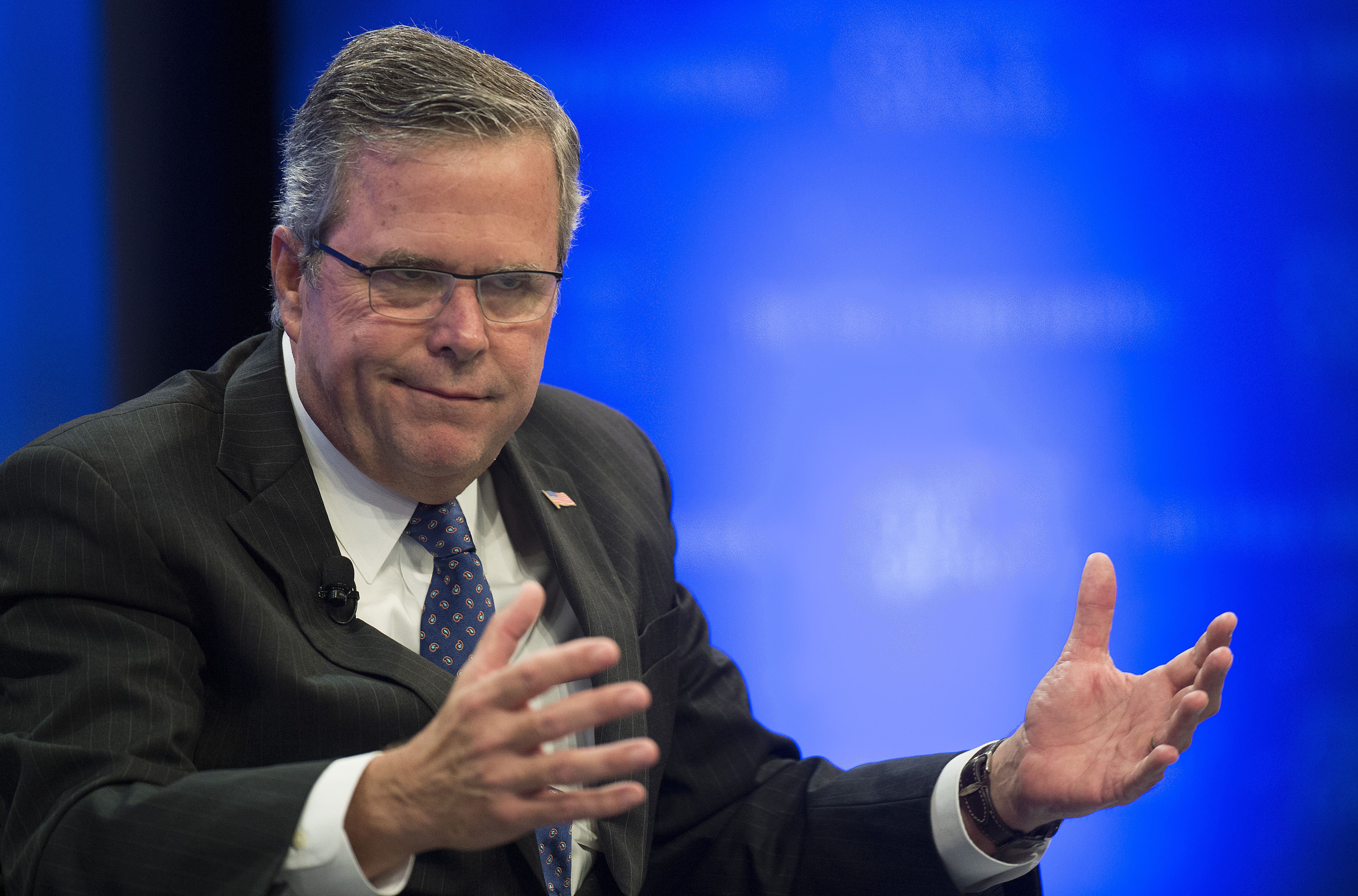
US-ECONOMY-CEO-BUSH

It sure sounds like Jeb Bush is going to throw his hat in the ring:

The big political news over the weekend is that it looks like Republican Jeb Bush is moving closer and closer to a presidential bid in 2016 — after announcing he would release 250,000 emails from his days as Florida governor, as well as release a new book. (You’re usually not taking these actions if you’ve decided AGAINST a presidential run, right?) Folks, this isn’t someone simply dipping his toes into the presidential waters; it’s someone who’s bouncing up and down on the diving board. More than anything else, Jeb’s moves are a signal to Republican donors and campaign staffers that he’s going to probably run.

Dougherty is against the idea:

Nominating Jeb Bush is an implied admission that the GOP cannot put together a post-Reagan presidential coalition without this one family.

It would mean advertising that the party that just put together an impressive, across-the-board electoral comeback in 2014, and that has performed unusually well in gubernatorial races several cycles running, is bereft of talent and must rely on an older brand — one that people tired of twice. Republicans should reject these assumptions about their party, no matter how desperate eight years out of the White House has made them.

The last few years have been ones of experimentation for the party. There is the libertarian-inflected Rand Paul; there are Chris Christies and Scott Walkers who promise dramatic confrontations with public bureaucracy. There is the family-friendly wonkery of Sen. Mike Lee of Utah. If people want to try Bushism again, they should at least have the decency to demand that Marco Rubio’s face be stretched over that political zombie’s head.

Larison reminds everyone that Jeb is as hawkish as his brother:

Everything Bush has said publicly on the subject confirms that he agrees with his party’s hard-liners on most issues, and he has never said anything that would suggest the opposite. As a domestic policy “centrist,” Bush’s ability to break with the party significantly on foreign policy is greatly reduced. Like many relative moderates, Bush overcompensates for his “centrism” on domestic policy by endorsing failed and confrontational policies abroad. For their part, quite a few movement conservatives are willing to forgive all kinds of heterodox views on many other issues so long as the “moderate” candidate fully embraces hawkish interventionism. That probably won’t be enough to win the nomination, but it will make the quality of the debate during the nomination contest that much worse.

Allahpundit doesn’t trust Jeb:

Is he running because he has a conservative vision, the odd Common Core or immigration heresy aside? Or is he running because the wingnuts are threatening to wrest the nomination from the donor class and someone with clout needs to step up and punch them in the face? Why would any tea partier turn out in the general election for a guy who took that approach with them, however successfully, in the primaries?

Jennifer Rubin disagrees with this framing:

The right wing, at least its loudest spokesman and crankiest bloggers, have decided Bush is going to snub them, run against the right and imitate Jon Huntsman, who seemed to delight in insulting conservatives. I have explained why I think this is mistaken. However, the challenge for Bush is to define what it means to be “conservative,” and not accept the notion that conservatism demands shutting down the government, rejecting a pathway to legalization (the MSM and right-wing often mischaracterize him as pushing a pathway to citizenship) and eschewing school standards. (Again, Bush contrary to the right-wing hecklers supports Common Core — or higher individualized standards).

And Husna Haq shows how much of a drawback Jeb’s last name could be:

While 73 percent of CEOs may favor a Bush candidacy, many Americans have indicated that they’re ready for fresh candidates and names – even Jeb’s own mother, Barbara Bush, who famously said last year that America “had enough Bushes.” An NBC/Wall Street Journal poll indicates that two out of three Americans (69 percent) say they agree with Barbara Bush.

(Photo: Former Florida Governor Jeb Bush speaks during the Wall Street Journal CEO Council in Washington, DC, on December 1, 2014. By Jim Watson/AFP/Getty Images)