In Defense Of Confessional Poetry

Nadia Colburn makes the case:

The themes of the domestic, of sexuality, and of mental health are labeled “confessional,” perhaps, because they are considered “not quite honorable.” After all, one goes to Catholic confession to confess one’s “sins.” But I fear that sometimes the threat of the term “confessional” prevents people from staying on the path of their own truths, a path of self discovery and ultimately potentially of a spiritual awakening that asks us to move beyond these notions of “manliness” or womanliness, or other categories. After all, the “confessional” is a religious practice that assumes that in expressing one’s problems, one can ultimately let them go and move beyond them to get closer to God.

In a recent piece called “Confessional Writing Is Not Self-indulgent,” the essayist Leslie Jamison discusses the ways in which personal writing connects people through self-recognition. Even beyond that, though, removing masks is an important task of poetry, and of all writing, because it is often exactly through revealing the personal that we are able to transcend the rigid boundaries of self and the categories around it, and to connect with others outside ourselves, both on a political and a spiritual level. Those themes that are considered “personal” are important to us all — not only in our private lives — but also in our public, communal lives. And the people who write about them, even in our age of Oprah, continue to be pioneers.

Face Of The Day

Hamburger-Crocheted-Hat

Lori Dorn captions:

Artist Phil Ferguson aka Chili Philly has combined his love for food, particularly for burgers and breakfast, with his incredible talent for crocheting and translated it into amusing and amazing headwear. Chili Philly describes himself as “Boy, living in Melbourne, making burgers and crocheting”. The full line of Chili Philly’s hats can be found via his Instagram and Facebook pages.

Putting A Novelist In Your Novel

Joanna Scutts ponders the rise of fiction based on the lives of writers :

If the biographer won’t speculate exactly how it felt to have sex with F. Scott Fitzgerald, fiction writers are happy to step in and describe it. In the past few years, a flood of what amounts to biographical fan fiction has swept conventional literary biography out of the way. The success of Nancy Horan’s 2007 novel Loving Frank, about the private life of the architect Frank Lloyd Wright, followed by Paula McLain’s 2011 hit The Paris Wife, told from the point of view of Ernest Hemingway’s first wife, has made publishers eager for stories that draw heavily on biography but wriggle out of its ethical constraints. Zelda FitzgeraldAnne Morrow Lindbergh, all the other Hemingway wives, all Wright’s other women, Sigmund Freud’s lover Minna Bernays—these real women have no defense against being shoehorned into romances that presume to tell us what we secretly want to know about famous people. This month sees the publication of Vanessa and Her Sister, a novel constructed as the fictional diary of Vanessa Bell, née Stephen, Virginia Woolf’s sister. In her author’s note, novelist Priya Parmar regrets that she almost has too much truth to work with: “It is not easy to fictionalize the Bloomsbury Group, as their lives are so well documented.”

They therefore leave little space for “invention,” which perhaps invites the question as to what invention gains, beyond allowing a character to voice thoughts like “Who knew I would like sex as much as I do?” As Parmar also tells us, Vanessa Bell never kept a diary in which she recorded a liking for sex or anything else. Is there something in that silence we ought to respect?

A Poem For Saturday

5586169711_3691d79aed_b

From Dish poetry editor Alice Quinn:

I am not a poet but reading certain poems gives me a feeling which I like to believe tells me something of what it might feel like to be a poet, one who makes the compositions that bear that sacred name. That’s how I feel when I read the work of Mary Ruefle. Her poems are sweetly mysterious and captivating, with a decisive momentum like tobaggans swiftly barreling to their last lines—sometimes holding on for dear life, sometimes fairly squealing with abandon. And thus my love of tobogganing has been restored to me.

Mary read at the 92nd Street Y in New York City this week with Christian Wiman, another illustrious contemporary poet, chief editor of Poetry Magazine from 2003-2013 and currently on the faculty at the Yale Institute of Sacred Music and Yale Divinity School.

We plan on posting poems by Christian Wiman soon in the new year, and this week we’ll feature three of Mary’s. Others of hers from The Dish can be found here, here, and here, all from the same book from which these three are drawn, Trances of the Blast, published by Wave Books in 2013.

“Platonic” by Mary Ruefle:

Did it mean anything? The stone, the rose,
darkness, wood, wind, flame, the violin.
The practical man, the visible world,
the painted ponies, the sea, the wilderness
of cellophane, my last word, my crumpled message
to my friend? Was I in search of something,
tools maybe, or seeds, for many odd things
are stowed under the overthinking.
Let’s begin to talk about things,
and what they should be named,
and whether it will be necessary
to draw any of them.
The sound of the teakettle—
it was the most terrible thing in the world.
Sometimes it was a wolf, and sometimes
a man or a woman, whatever it felt like,
even falling cherry blossoms, and always
it could take you out, and then it did,
leaving the whole room as impressive
as an unexplored cave.

(From Trances of the Blast © 2013 by Mary Ruefle. Used by permission of Wave Books. Photo by Jim Devleer)

The Perils Of Playwriting

Alena Smith considers them:

In his 2009 study Outrageous Fortune: The Life and Times of the New American Play, Todd London, artistic director of the playwrights’ advocacy organization New Dramatists, reaches a bleak conclusion: “Financially speaking, there is no way to view playwriting as anything other than a profession without an economic base.”

Data collected in London’s book, culled from the top tier of American playwrights (those who “have gone to leading schools, gained entrance to competitive playwright centers, had productions on major stages, and won prestigious awards”), and who on average are between 35 and 44 years old, shows that only 15 percent of playwrights’ incomes actually come from writing plays. So, if a playwright makes $30,000 a year, that means their actual playwriting (including commissions, productions, and publications) garnered them just $4,500. And this level of income is typical for the writers surveyed: as London reports, “The average playwright earns between $25,000 and $39,000 annually, with approximately 62% earning under $40,000 and nearly a third making less than $25,000.” …

In 21st-century America, playwriting cannot be thought of in earnest as a rival of screenwriting. In reality, it is more like a barnacle clinging to it. If not for the fact that so many writers can and do earn an actual living in Hollywood, and thereby subsidize their occasional foray into the theater, many of the plays written since, oh, the advent of the talkies, let’s say, would never have existed.

John Brennan Is Still Lying, Ctd

US-TORTURE-INTELLIGENCE-POLITICS-BRENNAN

[Re-posted from earlier today]

The CIA director made one small concession yesterday. Here is his Rumsfeldian rumination on whether torture gave the US any actionable intelligence that “saved lives”:

I have already stated that our reviews indicate that the detention and interrogation program produced useful intelligence that helped the United States thwart attack plans, capture terrorists and save lives. But let me be clear: We have not concluded that it was the use of EITs within that program that allowed us to obtain useful information from detainees subjected to them. The cause and effect relationship between the use of EITs and useful information subsequently provided by the detainee is, in my view, unknowable.

The key word there is “subsequently.” He’s arguing that some useful intelligence was later acquired from prisoners who had been tortured. What’s he’s conceding is that torture gave us no real intelligence – against the claims of his predecessors and Cheney. But he wants the broader question of whether torture played a role in prepping prisoners to give information in traditional, humane and legal interrogations to remain an open one. Well, let’s go through the report to see if he has a leg to stand on.

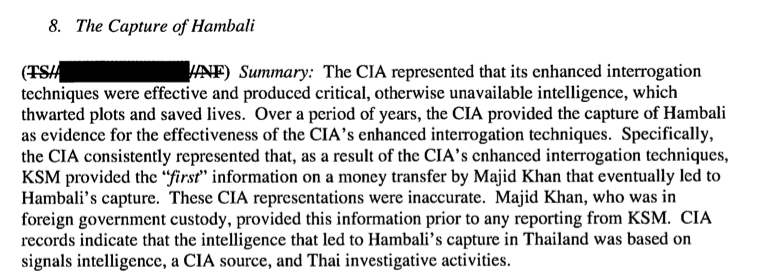
The Senate’s report lists the plots the CIA has relied most heavily on when making the case for the efficacy of torture:

CIA Plots

The report goes on to debunk torture’s role in each of these cases. Here are the key points:

Tall Buildings

So in this case, all the intelligence necessary to thwart a barely existent plot by utterly unserious criminals was discovered before torture was instigated at all.

Karachi Plots

Another claim eviscerated by the CIA’s own evidence.

Second Wave Combined

Again: torture was utterly irrelevant to this amorphous plot far from being operational.

UK Plot Four

Another phantasm of a plot revealed by sources independent of the torture program.

Faris

So this canary sang without any torture at all.
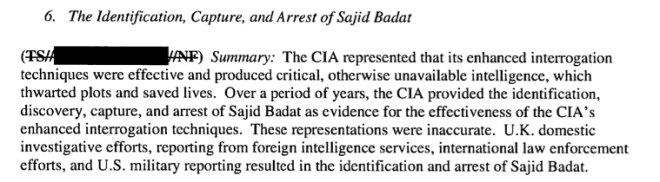
Badat

And so it goes. Notice that all of this evidence is taken from the CIA’s own internal documents. This is not the Senate Committee’s conclusion; it is the CIA’s.
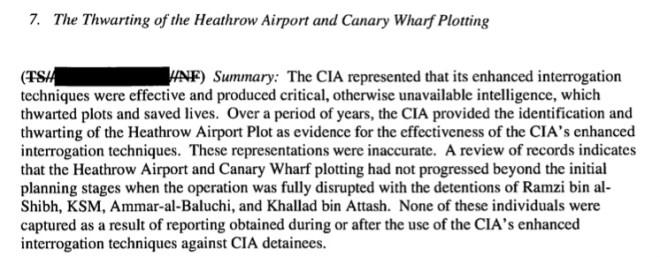
Heathrow Combined

Yet another dud. And therefore yet another lie.

Hambali Capture

Look: if every single one of the CIA’s own purported successes evaporates upon inspecting the CIA’s own records, what’s left?

Does Brennan know of other cases of alleged plots disrupted by intelligence procured through torture? You’d think in all its strenuous efforts to prove that its program worked, the CIA would have mentioned other plots. But if they don’t exist, Brennan’s claim of “unknowability” evaporates into thin air. It’s total bullshit. As for the need to interview the torturers, why? When the CIA’s own documents show that these mainly unserious plots were foiled by other means entirely, what is left for the torturers to say? That some things discovered by legal means were also blurted out – among countless untrue things – after torture sessions? As for the details of all these cases, I recommend reading all the footnotes. They flesh out the summaries above.

This seems to me to be a crucial issue of truth and falsehood.

What Brennan said yesterday was, in contrast, spin: some kind of sad attempt to square a circle that is adamantly circular. There is no evidence in the entire CIA archive that shows that any prisoner provided truthful information “subsequently” to being tortured. None. All the information necessary to foil every single plot cited by the CIA was recovered by legal, moral and humane means. All of it. This is not an opinion, a judgment … but a fact.

And that means that on this critical, foundational question, one that gets to the heart of Western civilization, John Brennan is a liar. And his lies and deceptions matter. That a CIA chief can get up and tell us that something is unknowable when it is already fully known is someone who has forfeited the public trust in a profound way. He’s lying to protect what’s left of the reputation of the CIA. He refuses to discipline any war criminal in his ranks, and defends the bulk of them. And let us be perfectly clear: all of this is criminal activity. Committing war crimes and then refusing to acknowledge them as such violates the Geneva Conventions and the UN Convention of Torture and domestic law.

I want to move past this as much as Brennan does. But you cannot move past it without reckoning with it, without facing up the the facts, and bringing accountability to government. Obama and Brennan refuse to do it. And by refusing to come to terms with the facts, they have left this as some kind of open debate, when it is, in fact, closed. And that opening is all we need to see torture return.

On this one, the war criminals meep-meeped the president. And he didn’t even seriously try to stop them.

(Photo: CIA Director John Brennan takes questions from reporters during a press conference at CIA headquarters in Langley, Virginia on December 11, 2014.  By Jim Watson/AFP/Getty Images.)

Emails Of The Day

A reader writes:

From early 2006 to late 2009, I was a part of the post-9/11 corporate-security state serving as an intelligence analyst. This is not a fact in which I take much pride. When the Abu Ghraib scandal became augmented with the information that CACI contractors were involved – CACI being known where I’m from primarily as a tech services contractor – I started to question the incentives and structure of the intelligence contracting field in which I’d become enmeshed.

Over those years I followed the torture and spying revelations closely and I took the same position then that I do now: this is plainly illegal, immoral, and the result of caustic fear, overreaction, and hysteria. Though I was not involved with anything remotely connected to torture, one of the best days of my life was the last time I walked out of that office.

I’m attaching an image that’s been making the rounds on my Facebook feed and receiving aTortureTerrorists sobering amount of likes. The reason I’m sending it along is because the people posting it are my former coworkers, people who, as far as I know, are still involved in intelligence analysis work either through some contracting company or for the government directly.

It’s important to understand how, at least where I worked, the atmosphere was one of an assumed political stance – that 9/11 was an existential threat and perhaps the greatest faced ever in the country’s history, and that we were involved in this apocalyptic battle as foot soldiers. The views of many of my coworkers at the time were, to my mind, rather extreme.

I can see now that this hasn’t changed for many of them, despite all the evidence put forth this week. Yet unlike the rest of the American public, these are people doing the work for the government. They are the people down in the trenches, generating analysis and reports. They work for companies under contracts whose primary incentive is to get bigger, longer, more expensive contracts, and one way to do this is to constantly remind people how terrified we should all be.

And here’s the kicker: many of them came into this kind of work directly out of college and were paid pretty well for it. Their entire adult lives have been based on this type of work. They’ve known nothing else. One can’t expect that such a situation wouldn’t have an effect on their political views. A subset of an entire generation has been profoundly affected in ways we don’t discuss enough. To get a full understanding of this period of torture, surveillance, and bungled wars, one must consider the contracting aspect of it and the people for whom such work created the prosperous upper-middle class life that many Americans have come to expect but which fewer and fewer can achieve.

Another insider perspective:

In my personal assessment, the reason Brennan and Obama have fought this report is to protect the promise of legal protection for lawful actions upon which every employee depends. I believe my assessment has some value, as I work at the CIA.

I can tell you that the recently-remodeled exercise facility OHB is closed for cleaning from 10 to 11.   I can tell you that the Dunkin’ Donuts is more popular than the Starbucks.  I can tell you that for weeks after the portrait of Tenet was unveiled, his ashtray and cigar were left untouched.

What I cannot tell you about is the torture program, because I do not know anything more about this program than an other American.  And by revealing this information I reveal little of my identity because this characteristic of me is shared by the vast majority of the “blue badged” and “green badged” individuals who work here.

The CIA is composed of four directorates, which each consists of many offices, divisions, and branches.  The people who work here all do very different things. This includes everything from keeping worldwide, secure, communication-systems working, to digging through old copies of Iranian technical journals, to developing tiny chemical sensors, to writing hundreds of briefings for policy makers.  The opinions of those I work with regarding the torture program probably reflect that of the general American public.  Many, like me, are horrified.  Many think folks got what they had coming.

What everyone does understand, though, is the fundamental importance of legal protection. They have been assured that if they, in good faith, seek and receive legal guidance from the Inspector General that what they are doing is legal, they can rest assured that they will not be help responsible even if this legal ruling is incorrect.

Call this the Nuremberg defense if one wishes. However, it is the same legal protection that military snipers rely upon when they squeeze the trigger.  And a key aspect of this protection is the protection of identity. A person legally authorized to do things is protected from the vengeance of those who might not agree.

My assessment is that upholding this promise to leave no man on the battlefield is so crucial to the bond of trust upon which all those who have sworn an oath to the government that it is worth fighting for.

Get Your Mug In Time For Christmas

mug-xmas

[Re-posted from earlier today]

Our new coffee mug makes a great gift for your favorite Dishhead or pet – be it dog, cat, or parrot – but time is running out to receive it in time for Christmas wrapping, so order now. Full details here:

This navy-colored coffee mug is very high quality, holds a generous 15oz, and, during our caffeine-addled test phase, it proved very durable. So the sturdy mug should last a long time in any Dishhead’s kitchen or office (and yes, it’s microwave and dishwasher safe – we tested that too). As a serious coffee-addict, I love it. The Dish mug can be yours for $15 plus shipping and handling. Just click here and follow the simple prompts to order yours today. We only have a limited number of mugs for sale, so get yours before someone else does.

A reader just got his:

I received the mug the day before I left for Madbears in Madrid, and was unable to use it until this morning.  Thank you for the obvious thought that went behind choosing the design.

Yes, I enjoy “throwing bombs,” so I’m going to go there.

This seems to be a decidedly masculine mug.  It is the only cup in my collection wherein all my fingers actually fit inside the handle.  Finally!  But my mother, who always complained about the size of my furniture (I’m 6’4”), would have hated it.  I can just imagine her saying, with the just the slightest of frowns, “It’s so big.”

I anxiously await the first accusation of mug patriarchy.

Not from this female Dishhead:

unnamed (24)

A good start to the day!

Amehrica

Aaron Blake passes along some downbeat news regarding the national mood:

1) A New York Times poll showed just 64 percent of Americans believe in the American Dream. That’s the lowest that number has been since at least 1996.12-11-2014_05

2) A Pew Research Center poll showed just under half — 49 percent — of Americans said they expect next year to be a better year than this year. That’s the lowest that’s been since the recession, and a couple years before, too.

3) An AP-GfK poll shows just 13 percent of Americans say they are confident that Republicans and President Obama can come together to address the country’s problems. (A similar question from Pew found just 20 percent expect Congress and Obama to “make progress” on important issues.)

So, to recap, Americans have hit low points on their belief in our country’s main economic principle, their general feelings about life and their faith in our government. That just about covers it.

Meanwhile, Paul Campos responds to a remark from the recent Chris Rock interview:

If poor people knew how rich rich people are, there would be riots in the streets. If the average person could see the Virgin Airlines first-class lounge,* they’d go, “What? What? This is food, and it’s free, and they … what? Massage? Are you kidding me? …

*Offers spa treatments, “expert mixologists,” and, at Heathrow, a “lodge and viewing deck” with an “après-ski vibe.”

Once a social system has moved all or nearly all of its members above the level of brute starvation, wealth and poverty soon become inherently relative concepts, but that doesn’t make them any less real. One of the consequences of living in an extremely rich country which features increasingly extreme wealth stratification is that people who would have been considered rich fifteen minutes ago are suddenly part of the “upper middle class.”

Take, for example, what has happened to economic relations within the American university.

It’s well known that American colleges and universities must increase their operating budgets every year at rates faster than inflation because of reasons, and therefore it becomes inevitable, given the contemporary economic structure of the country as a whole, that these institutions will spend enormous amounts of time and money currying favor with super-wealthy potential donors. Giving money to a “non-profit” educational institution provides the masters of the universe with sweet tax breaks, while allowing them to indulge in the ego-gratifying pleasures of plastering their names all over various buildings and centers and even whole schools and colleges.

Cillizza checks in on perceptions of social mobility:

It’s easy to believe there is direct correlation between people not believing in the American Dream and prolonged periods of economic struggle.  Which would explain the downward trend of the numbers in the Times poll over the last decade as the economy has sputtered. The question is whether the slowness of the current recovery is what’s to blame for the extended pessimism about hard work achieving results or whether we, as a country, have simply entered a different stage in our relationship with the idea of the American Dream.

There’s some reason to believe the latter explanation is more correct. Consider this, from the 2014 national exit poll: Almost half of all Americans — 48 percent — said they expected life for “future generations” to be “worse than life today,” while 22 percent said it would be better. Another 27 percent said life would be about the same. Do the math and you see that more than twice as many people are pessimistic about the future that they will leave their kids as those who are optimistic.

It’s easy to be downbeat about the state of the union this week, learning all of the horrific actions taken by the CIA in America’s name over the past decade. But this reader has it right:

I object to the Hong Kong newspaper’s characterization that “the report was a heavy blow to the credibility and global image of the U.S.” The Bush Administration’s actions described in the report are the disgrace. The Obama Administration’s unwillingness to investigate the torture program is a disgrace. But the Senate report is an affirmation of the credibility of the U.S. And hopefully it is just the first step in righting this horrific wrong.

Know hope.

Lumbersexuals, Ctd

Willa Brown reflects on the phenomenon:

Americans are currently enduring another prolonged bout of unease, stretching back at least six years. Since the Great Recession began, there has been a general handwringing in the media about the state of men—even the End of Men. The economic downturn disproportionately affected men, and it is clearer than ever that the single-breadwinner family is finally dead. The “traditional” role of the man as the primary provider is now firmly out of reach for most Americans. Which is why it seems particularly apt that (mostly) white, young, urban, middle-class men have once again picked up a symbol invented in the early twentieth century by men very much like themselves, a symbol that has long been gathering dust. …

At the turn of the last century, middle-class white men were, everyone seemed to agree, in crisis.

They were effete, anxious, tired, and depressed. Magazines and advice books worried that they had lost their vigor—the industrial economy and urban life demanded too much time inside, too much brain-work. Clerical jobs in dingy offices provided few opportunities for advancement to the ranks of the industrial elite, much less for feats of bravery and derring-do. Men trapped in cities began suffering from neurasthenia, a new disease that skyrocketed to almost epidemic status in the 1880s and 1890s. Neurasthenia was the overtaxing of the nervous system, a sort of male hysteria. Some wealthy and educated urban men suffered from what historian T. J. Jackson Lears called “cultural asphyxiation … a sense that bourgeois existence had become stifling and ‘unreal.’”

While women were ordered to bed rest for hysteria, the cure for men seemed to be just the opposite: They had lost their vital force, and they needed it back by getting in touch with their primitive, masculine nature. To do so, they looked westward.

Erik Loomis responds:

I don’t know. Is a bunch of bearded hipsters dressing like loggers really a crisis of masculinity? Are these guys really worried about a suppressed manhood that needs to come out? I’m skeptical. I agree with Brown that this is a middle-class romanticizing of working-class culture but I don’t think it’s that comparable to the Progressive Era. I think it’s really more about a broader desire for individualized authenticity among a larger group of people under the age of 35 or so that revolves around working with your hands, semi-opting out of the traditional work norms, and seeing the products of your work. It seems to me that this phenomenon is more closely related with women and the knitting craze and having backyard chickens than TR-style masculinity assertion. After all, do you feel like young hipster men today are really worried about what it means to be a man? Is that a big part of their conversation? I don’t see it in the public realm.

My thoughts on the lumbersexual here.