The Universal Appeal Of Uber

Felix Salmon sees Uber’s international reach as its key advantage:

This might not be obvious to people in San Francisco, who are spoiled with dozens of hopeful and well-funded startups, many of which are doing much the same thing that Uber is aspiring to. But leave the Bay Area, and the fears and frustrations of trying to get a cab start getting magnified — especially when you’re in a foreign country. The value of Uber is only partially in the service it provides; increasingly, it’s also in the global ubiquity of that service.

I just got back from Rome; I took a standard white cab from the airport, and then took an Uber back to it. The Uber was much a much more pleasant ride, as well as being cheaper. But most importantly, it came without any of the anxieties that generally accompany getting into a stranger’s car in a foreign country. Such anxieties are generally small, in a country like Italy, but even the locals will warn you against hailing a cab in a place like Mexico City.

He remarks that Uber is “the first app which can deliver a three-ton glass-and-steel machine to wherever you happen to be, in any of 200 cities around the world, in minutes”

That’s why Uber’s bulls think of it as a logistics company rather than a taxi company: it’s fundamentally about being able to move things (initially passengers, but that’s already expanding), within city boundaries, with unprecedented levels of efficiency. Most impressively, Uber has managed to do this within a single app: it doesn’t have a different version for every country that it’s in. Anybody with an Uber account, no matter where they’re from, can automatically use Uber in any city in the world where Uber operates. This is non-trivial, and not at all easy to replicate.

Godard’s Eternal Youth

In honor of their centennial, last week TNR reposted a classic 1966 piece by the great critic Pauline Kael. In the essay, she reserves special praise for Jean-Luc Godard, whom she hails as a hero to a new generation of independent-minded filmmakers:

There is a disturbing quality in Godard’s work that perhaps helps to explain why the young are drawn to his films and identify with them, and why so many older people call him a “coterie” artist and don’t think his films are important. His characters don’t seem to have any future. They are most alive (and most appealing) just because they don’t conceive of the day after tomorrow; they have no careers, no plans, only fantasies of the roles they could play, of careers, thefts, romance, politics, adventure, pleasure, a life like in the movies.

Even his world of the future, Alphaville, is, photographically, a documentary of Paris in the present. (All of his films are in that sense documentariesas were also, and also by necessity, the grade B American gangster films that influenced him.) And even before Alphaville, the people in The Married Woman were already science fictionso blank and affectless no mad scientist was required to destroy their souls.

His characters are young; unrelated to families and background. Whether deliberately or unconsciously he makes his characters orphans who, like the students in the theaters, feel only attachments to friends, to loversattachments that will end with a chance word or the close of the semester. They’re orphans, by extension, in a larger sense, too, unconnected with the world, feeling out of relationship to it. They’re a generation of familiar strangers.

An elderly gentleman recently wrote me, “Oh, they’re such a bore, bore, bore, modern youth!! All attitudes and nothing behind the attitudes. When I was in my twenties, I didn’t just loaf around, being a rebel, I went places and did things. The reason they all hate the squares is because the squares remind them of the one thing they are trying to forget: there is a Future and you must build for it.”

(Video: Trailer for The Married Woman)

GE Brings Vox To Life

The enmeshment of the new media site with corporate interests – in which Vox writes ad-copy for big companies, while also claiming to cover them objectively – is not new to Ezra Klein:

GE provided crucial support for media startup Vox.com, an explanatory-journalism site launched by former Washington Post blogger Ezra Klein, with whom it already had a working relationship. While Mr. Klein was still at the Post, GE courted him and others for a news website and marketing campaign in development. When Mr. Klein left to join Vox, GE and its ad dollars followed. The GE site, launched after Mr. Klein left the Post, aggregated video clips and content featuring the blogger, along with Fox News’s Bret Baier, Politico’s Mike Allen and others, discussing and expounding on the news.

The advertiser had “absolutely zero influence” on Vox.com’s editorial content, said Jim Bankoff, chief executive of parent company Vox Media. But both GE and Vox have a similar audience in mind: young, relatively affluent and policy savvy. For GE, the purpose of the relationship was to get GE in the minds of policy makers and lawmakers on Capitol Hill. “We want to target the DC millennials,” said Linda Boff, who heads GE’s global brand marketing. The Vox sponsorship ended in August.

The merger of corporate interests and what’s left of journalism is only getting deeper. And the younger generation of liberal journalists is leading the way, and is shocked, shocked that anyone might question the appearance of blatant conflicts of interest. But a reader wants to make a distinction:

In your post “Ezra Sells Out“, you seem to be confusing Vox, which is Ezra Klein & Co’s media venture, with Vox Media, the overarching company that owns Vox.com along with a number of other media outlets like Polygon and Curbed.

I don’t disagree with the brunt of your post, but it seems a bit underhanded to title the post “Ezra Sell Out” when it is likely that Ezra Klein probably does not have much agency in the story here. I just think using Ezra’s name here implies that he’s responsible for this, when really this decision is being made by Nelson and Bankoff, who run Vox Media at large.

Fair point. Another reader:

Sure, you may have confused Vox Media with Ezra’s Vox news venture.  But perhaps you should dig a bit deeper into Vox Media.  Forget the CEO; he’s just a hired gun.  Who really owns Vox Media?  Who, to put it a better way, is the Andrew Sullivan of the Vox Media empire?  Perhaps not Ezra (though both he and Mathew Yglesia are listed on the Vox Media leadership page as Vox Founders) but rather … Jerome “MyDD” Armstrong and Markos “Daily Kos” Moulitsas.  For all their screaming, shrieking, progressive liberal “corporations are not people” expose the truth reputations, they ought to know better.

And of course, is it not just a hair bit ironic that in one company you have perhaps the four giants (Kos, MyDD, Ezra, Yglesias) of the early progressive blogosphere?   One could only imagine the feigned outrage they would project if, say, Glenn Reynolds and PJ Media started drafting ad copy for the Koch Brothers, Halliburton, and the NRA and then claimed to be completely unbiased.

Meanwhile, it’s worth looking back at our coverage of Vox when it was first announced back in January:

[Vox Media CEO Jim] Bankoff told Ad Age that he has no intention of “tricking anyone” with alternative forms of advertising such as sponsored content or “native” ads — which other new-media growth stories such as BuzzFeed have said they believe are a key part of the future of content. Instead, the Vox CEO said he is counting on Vox’s ability to produce better-quality display ads that will bring in more revenue than the standard banner or site takeover. As he described it:

“We really are in the process of reinventing what brand advertising can be on the web… we believe it can be engaging and beautiful and well integrated [and] fully transparent — we’re not trying to trick anyone like some native ads do…

The beat, it goes on …

Fewer Voters Are Crossing Party Lines

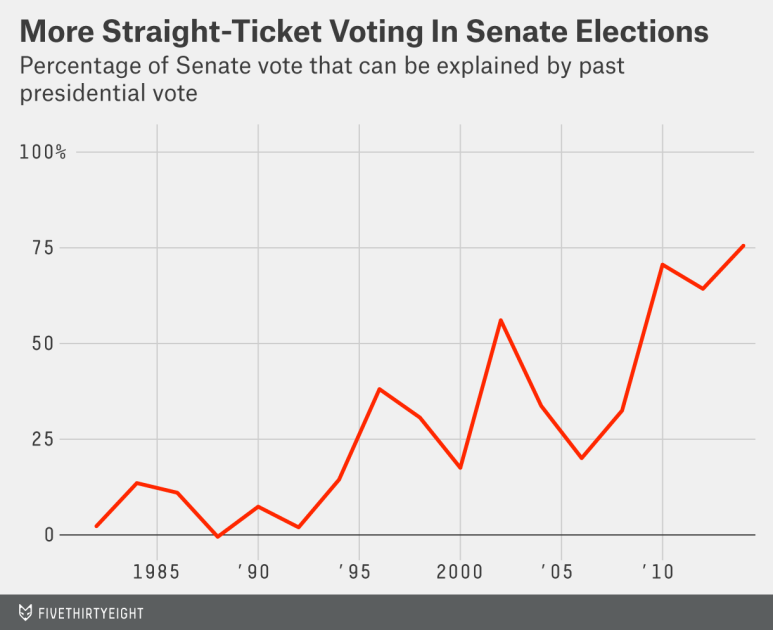
Straight Ticket

Straight-ticket voting has spiked:

Prior to 2010, 2002 was the only year in which the predictive power of past presidential results was over 40 percent. In other words, voters who favor Republican presidential candidates are now very likely to favor Republican Senate candidates. U.S. House and gubernatorial elections can be increasingly predicted by past presidential voting as well. The latter is especially interesting considering that governors are state, not federal, politicians.

The question going forward is whether the link between presidential and Senate results will increase, decrease or stay the same. If the straight-ticket effect doesn’t weaken, it could be bad news for Democrats, assuming we’re a 50-50 nation over the long haul. By our presidential vote metric, 54 Senate seats are in states that are more Republican-leaning than the nation on the presidential level, and 46 are in states that are more Democratic-leaning.

UVA: Pushing Back On The Pushback

Ari Schulman goes after Rich Bradley’s querying of the UVA gang-rape story:

Bradley also gets wrong numerous details of the Rolling Stone article itself: who was and wasn’t interviewed; the claim that all of Jackie’s friends discouraged her from going to the hospital; Jackie’s ostensible lack of identity; Jackie’s inability to identify the perpetrators. He changes a line from the article without noting it, adding quote marks around words that didn’t have them. He mischaracterizes Jackie’s claim that one in three women at UVA are raped. He also invokes the claim as evidence of a broader cultural climate surrounding rape in which “emotion has outswept reason.” The slip here is strange: The emotionality of an alleged rape victim is offered as evidence of the irrationality of those who would believe her. These are not minor problems for any argument, but they are particularly problematic for one that sells itself as a scolding in journalistic carefulness.

Most significant, Bradley says that if fraternity gang rape were so prevalent, “One would think that we’d have heard of this before.” But the article describes other instances of the practice, from two current allegations besides Jackie’s to a conviction in a court of a law for a prior gang rape by members of the very same fraternity at UVA. All of this is also easily verifiable outside of the Rolling Stone article. And the Washington Post, among others, has detailed the extensive history of gang rape at fraternities nationwide.

Kat Stoeffel defends Sabrina Rubin Erdely’s decision not to identify or interview the alleged rapists in her story:

Media critics have taken Erdely to task for not pressing Jackie to confirm their identities and allow her to track them down in person, though single-source narration happens without incident in less sensitive stories all the time. (There probably wasn’t anybody around to corroborate some of the details of GQ’s lauded feature on hermit Christopher Knight, either.) What makes Jackie’s story arguably different is the magnitude of her accusations: Critics of the story say that the men deserved a chance to offer their side of the story before having their names smeared. Except, what names? The only identified entity at risk of reputational harm in Rolling Stone is Phi Kappa Psi, leaders of which Erdely did reach. …

No journalist wants to fall for the next Stephen Glass or Duke lacrosse case. But Erdely wrote the piece in such a way that she and Rolling Stone — not Jackie and Drew — are the ones who will be most damaged by a false report. Meanwhile, the journalist backlash is putting feminists who believe in believing women in the uncomfortable position of hoping Jackie told the truth about her gang rape. Not because we want to confirm our biases about monstrous men, but because we’d hate to see confirmation for sexist biases about lying, attention-seeking women. In other words, we’re backed into the corner of hoping someone was gang-raped on broken glass — and how can that possibly constitute a happy ending? If anything, we should hope that Jackie is lying. Then exactly zero lives will have been ruined in this story.

In a series of tweets, Rolling Stone’s Tim Dickinson points out another high profile rape story in which the rapist was not contacted. Lindsay Beyerstein also counters some of the credibility pushback on the piece:

Some of the details of Jackie’s story do seem surreal, but memories of trauma are often fragmentary. She and one of her attackers allegedly tumbled through a glass coffee table. We’re told she was pinned on the floor with shattered glass digging into her back before she was raped. Hot Air’s Noah Rothman dismissed Jackie’s story as a “fantastical account of college men raping a woman atop piles of broken glass.”

Is the coffee table story really so far-fetched? I spoke to Mark Meshulam, an expert witness who testifies in court on glass and its properties. Mr. Meshulam said that the likely outcome of a fall through a glass table depends on many factors, but the biggest variable would be whether the tabletop was made of regular glass or safety glass. Both types are common, he explained. … If it were a tempered glass table, the glass would have shattered into little pebbles, which are non-lethal but still sharp enough to cut someone who’s lying on them, Mr. Meshulam said. In that case, he’d expect her to be scratched up, maybe badly enough to need stitches, but not necessarily. Which is pretty much the level of injury the story implies.

Wouldn’t all the alleged rapists have been cut up as well? Wouldn’t this have affected the entire horrifying gang rape? And one of Dreher’s readers shares a story that adds credibility to Jackie’s experience with her friends following the rape:

I was a very naive freshman going to her first college party- and I’d never been around alcohol before. I didn’t drink anything that night, but many of the people around me had a lot. One girl got incredibly drunk and a guy who wasn’t very drunk convinced her to go “watch a movie” in his room. I was too naive to understand what may have been happening here, so I didn’t do anything. When we went to leave the party with my friends, we went by that boy’s room to collect our friend- she was disheveled and extremely drunk, and her pants were down. I suspected she had been sexually assaulted.

Our group returned immediately to our dorm and an RA spotted the drunk girl as we walked in. The dorm staff called my friends and me separately into a room and asked us all exactly what we’d witnessed. Apparently their purpose was to figure out how much alcohol the girl had consumed to decide whether or not she needed to go to the ER. I naively told exactly what I’d seen that night, including the part about her disappearing to the boy’s room (so I didn’t know how much she had to drink during that time) and coming out with her pants down. Apparently no one else said anything about the boy. My “friends” figured out that I’d told that part of the story and I was immediately shunned from the social group for “tattling” and “slut-shaming.”

In light of the new criticisms about the piece, McArdle wants the cops to figure it out:

[T]he university may well be able to identify everyone, because the story strongly suggests that an entire new class of Phi Kappa Psi brothers participated in a gang rape, either of Jackie or of the two other girls who she learned were also gang raped at the fraternity around the same time that she had been.  As far as I can tell, Virginia has no statute of limitations on rape, which means the police should be aggressively investigating these sickening allegations.   The university has a duty to its own community, and to the community at large, to do its utmost to identify as many rapists as possible, and help the police to bring them to justice.  And all of us who have a stake in reducing rape — which is to say, all of us who are not rapists — should be putting as much pressure as possible on the UVA administration to ensure that it does exactly that.

And Rebecca Traister worries that people are losing sight of Erdely’s point, which is that UVA, like so many other universities, has done an abysmal job of responding to allegations of rape on campus:

The dismantling of Erdely’s storyboth by anti-feminist agonistes and by those genuinely dismayed by possible journalistic errorwould mean that Jackie’s story of being beaten and raped by seven fraternity brothers will be dismissed, and that the reading public will be permitted to slip back into the comforting conviction that stories like Jackie’s aren’t real, that rapes like that don’t happen, that our system works, and that, of course, bitches lie.

What we will all be allowed to happily forget is that there are plenty of real stories of rape: of violent rape, frat house rape, gang rape, date rape; that most rape accusers do not lie and that in fact it’s quite likely, statistically, that Jackie herself did not lie. But the most serious thing that we’ll be allowed to forget is the very point of Erdely’s story, whatever its strengths or flaws may be determined to be: The system does not work. Actually, in both the case of the UVA rape and in the case of the killing of Michael Brown in Ferguson, Missouri the major takeaway of recent weeks should be that our systems do not work.

Freddie weighs in, saying – in essence – that truth matters:

[W]hy are people so resistant to giving these stories a rigorous and skeptical review, the way we should do with any reporting? What are you so afraid of?

The standard response is that countenancing questions about reports of rape helps denialists, who will seize on problems with reporting and use them to agitate against anti-rape efforts in general. But that doesn’t make any sense, to me. In order for that argument to hold water, you’ve got to prove that preventing these questions from being asked actually defuses rape denialism. That seems to be literally the opposite of the case; denialists are emboldened by such refusal. They seize on such resistance as evidence of conspiracy  and weak evidence. I think it’s profoundly naive to believe that we can hold the line against critical review of rape narratives in such a way as to prevent denialism. Rape denialism is a sad fact of life, but it can be combated with evidence and careful argument. Denialism is an argument for being skeptical and rigorous, not an argument against it.

I’m with Freddie and Megan on this. Get to the bottom of it. And stop trying to deter legitimate skepticism toward a piece whose horrors are so detailed and whose villains so despicable that asking further questions is perfectly natural. At some point, the posturing needs to end and the fact-finding and prosecution go forward.
On This, McCain Is Right

What qualifications do a soap opera producer and a p.r. consultant have to be ambassadors to Hungary and Brazil Argentina, respectively? Well, listen to Josh Earnest above, and try not to laugh. (And thanks to my old intern, Jon Karl, for adding some dry humor to the White House presser.) But every president does this, don’t they? Even one who once committed himself to much higher standards. Well, it’s close:

By recent historic standards, Obama is starting to test the ceiling for putting friends and campaign supporters in U.S. diplomatic posts. Altogether, 35 percent of Obama’s assignments so far have gone to political people. But in his second term, the number has grown to 41 percent according to research by the American Foreign Service Association, the union representing career diplomats that would like more strict enforcement of a 1980 law that says campaign donations may not be considered a qualification for any foreign posting.

Even assuming the GOP Senate won’t countenance confirming many more big-money bundlers in the next two years, Obama looks to have assembled the most political diplomatic corps since Ronald Reagan, whose grand total was 38 percent. Thirty percent of George W. Bush’s ambassadors were from outside the ranks of the foreign service, as were 28 percent of Bill Clinton’s, 31 percent for the elder George Bush and 27 percent for Jimmy Carter.

McCain was rather funny the way he tackled this in the floor debate this week:

Rewarding supporters with cushy jobs in the Caribbean is something both parties do. I understand how the game is played. But here we are, a nation that is on the verge of ceding its sovereignty to a neo-fascist dictator getting in bed with Vladimir Putin and we’re going to send the producer of ‘The Bold and the Beautiful’ as the ambassador.

And the beat goes on.

(Hat tip: Taegan)

Hathos Red Alert

I think I’ll stay sitting down, thank you very much. But is this an indication that the Clintons will pivot toward those white working class voters turned off by the Obama years? Was Schumer’s line on healthcare reform a trial balloon for a way for the Clintons to distance themselves from Obama while arguing that they have the experience to help more people get better jobs, as in the 1990s? I guess we’ll soon find out. Update from a reader:

Another site I was reading pointed out that the video has been up since Nov. 16 and has only had 349 views. And earlier PM Carpenter had highlighted an article by Dana Milbank about her Georgetown appearance yesterday:

When it was time for Clinton’s appearance to begin Wednesday morning, half of the 700 seats in the place were empty. After a half-hour “weather delay,” diplomats and VIPs filled a few more chairs, but more than 300 remained vacant when the former secretary of state and first lady walked in…. Roughly half a dozen people rose to applaud, and for a terrifying moment it appeared they might be the only ones standing. But slowly, lazily, most of the others struggled to their feet…. Several began trickling out before the 40-minute appearance was over.

Hillary fever. Catch it!


The DOJ’s Investigation Into Garner’s Death

Damon Root supports it:

Holder’s decision to launch a federal inquiry is fully consistent with the original purposes of federal civil rights legislation, which dates back to the Civil Rights Act of 1866. That law was passed by the Republican-led 39th Congress in the wake of the Civil War in response to the former Confederate states’ attempts to harass and oppress the recently freed slaves by stripping them of their newfound liberty and property, denying them the right to keep and bear arms for self-defense, and failing–or refusing–to provide them equal treatment under the law.

In other words, the whole point of federal civil rights law is to provide a legal check against state-sanctioned injustice, such as the egregious police misconduct that killed Eric Garner. Attorney General Holder should be commended for putting federal law to its intended purpose in this case.

Paul Cassell hopes the DOJ moves quickly:

With regard to substance, the facts are disturbing — and seemingly, in large part, recorded on video.  And with regard to procedure, unlike the Michael Brown grand jury, we don’t have transcripts of testimony to peruse to make an informed assessment about the fairness of the process. Questions abound.

Here’s where the Justice Department could perform a valuable service — by actually completing this civil rights investigation expeditiously.  To be sure, the proof required for a federal rights charge is demanding. But if the Eric Garner facts are as clear cut as the video makes them out to be, there is no reason why the Justice Department can’t rapidly investigate the case and quickly announce what it finds. The Justice Department should live up to the attorney’s general’s promise yesterday to “expeditiously” announce its decision on whether charges are appropriate in the Eric Garner death … and in the Michael Brown and Trayvon Martin deaths.

But Amanda Taub isn’t expecting much from the DOJ:

Demanding a federal investigation is a good way for politicians like de Blasio, Schumer and Gillibrand to show their concern about police violence. Unfortunately it’s not likely to bring justice for Garner.

Simple murder and manslaughter aren’t federal crimes. But killing someone can be one in special circumstances, including when it’s an intentional violation of civil rights. What the DOJ can do is bring charges under the federal civil rights statute in order to prosecute Pantaleo for Garner’s death. And that legal standard is difficult to meet: prosecutors would have to prove that Pantaleo willfully deprived Garner of his civil rights. A police officer intentionally killing someone outside of the set of circumstances in which deadly force is permitted would qualify. But a civil rights charge requires proof of intent, whereas a state manslaughter case could be made by demonstrating negligence

Life As A Gay Politician In The 1960s

The rise and fall of Jeremy Thorpe, the leader of the British Liberal party in one of its more successful periods, is, in retrospect, an excruciating story of what the closet can do. Thorpe died this morning, prompting a flurry of obits and commentary, but also casting a long, dark view back to what life was really like if you were a gay man in public service not so very long ago.

In many ways, Thorpe deserves little sympathy, compared with the plight of other gay men of his era. He was a true aristocrat whose second wife was the Queen’s cousin and whose illustrious ancestry stretched to the rein of Edward II, when Speaker Thorpe of the parliament was eventually beheaded by a mob. He went to Eton, wore dashing Edwardian clothes in the era of swinging London, and had a sharp wit, a big conscience, and debating prowess. He led a double life, and, critically, had the class credentials to keep it double.

But he made one obvious mistake in having an affair with a young male model, Norman Scott, who was not entirely stable. And after Scott went public about the affair, Thorpe decided he had to contain the threat to his public career. He denied everything, but when intimate letters emerged of the affair – Thorpe called Scott “Bunnies” in rather British fashion – Thorpe had to resign as leader of his party.

Then it all got really surreal.

A man who had been in jail for shooting Norman Scott’s dog – yes, his dog – on the moors of Southwestern England confessed upon being released that he had actually been hired by friends of Thorpe to kill Scott, but he had lost his nerve and shot the dog instead. The evidence was tilted overwhelming toward the prosecution, which took twenty days to make the case, while the defense could only muster one day of arguments in response. Nonetheless, the upper-class judge all but instructed the jury to find the old Etonian Thorpe innocent, which they duly did – and which prompted the eternal sketch by Peter Cook about the biased judge, as recounted above.

Thorpe almost certainly conspired to murder someone. His career was over – and never recovered – for that very good reason. But it’s hard not to look back and see this case as part and parcel of the long reign of terror against gay people that lasted until well past the date, 1967, when gay sex was legalized in the UK.

Thorpe was an undeniably gifted man – an early campaigner against apartheid, a champion of human rights, a skilled parliamentarian – but came undone because his country could not accept him as he was. A double-life is, in fact, a life half-lived – especially a double life that requires a human being to repress and deny the love that alone makes human experience bearable. For those with far fewer resources than Thorpe, this meant often criminal arrests, social ostracism, lies, deceit, pain and shame that gutted soul after soul and life after life. Thorpe was the elegant tip of this unforgiving iceberg. And one can only hope that the occasion of his death does not only mean we should feel some retrospective compassion for the tangled, strangulating knot of his existence – but also for the countless human beings, unknown to history, whose personal tragedies were far deeper and less alloyed.

In an interview on the subject, in 2009, Thorpe, then struggling with the Parkinsons that killed him, had said:

If it happened now, I think the public would be kinder.

Wiser, I hope, too.

What’s The Point Of Body Cams?

Uri Friedman talks to criminologist Barak Ariel about the impact of putting body cameras on officers:

The technology is “surely promising, but we don’t know that it’s working,” Ariel told me. The Food and Drug Administration doesn’t approve drugs until they’ve been studied extensively, he explained, and governments should take a similar approach with body-worn cameras. It’s a solution that has yet to be proven.

Ariel should know. He’s currently researching the effects of body cameras on policing everywhere from Brazil to Ghana to Israel to Northern Ireland, and finding that some police departments (and police unions) love the idea and others hate it. Nearly all of these tests have yet to be completed, but Ariel recently co-authored a study on the practice in Rialto, California, where he found that police officers who weren’t wearing cameras were twice as likely to use force as those who were. During the 12-month experiment, the police department also saw a reduction in citizens’ complaints compared with previous years. The researchers concluded that the benefits of wearing cameras trumped the costs.

But Ariel insists that there isn’t enough evidence so far to generalize the finding and assert that body-worn cameras offer a net benefit to community policing.

Jason Koebler contends that “lack of indictment in the Garner case doesn’t fundamentally change the police body camera argument, and shouldn’t be used as an argument for or against body cameras one way or another”:

Body cameras are not a cure-all, and they don’t treat the underlying problem of police brutality or power tripping. But, well, they’re better than nothing, and they’re a good first step toward creating a culture where cops think before they act.

The main thrust of the argument behind police body cameras has never been the idea that video evidence can be used to convict a cop of murder in court or even that they can be used as evidence at all. Instead, body cameras create an environment where police intrinsically know they are being watched, that there’s at least the possibility that they’ll be held accountable for their actions.

Rebecca Leber spells out why video evidence often doesn’t make a difference:

Police still have wide leeway for using deadly force. Juries remain deferential to officers’ judgements of when to incapcitate a person or fire their weapons. As Amanda Taub has explained at Vox, “That means that to press criminal charges in a police shooting, the prosecutor has a heavy burden to overcome. The officer is likely to claim that he believed the suspect was a threat and made a split-second decision to use force. The jury is likely to believe him, even if his decision was a bad one.” At The Nation, Chase Madar pointed to the case of Kajieme Powell, John Crawford III, and Milton Hall, all of whom were shot by police and all of whose deaths were filmed on camera. None resulted in charges.

In other words, body cams can helpbut they still don’t entirely fix police abuse. Juries still show officers extreme deference, even when police violence gets caught on tape.

Matthew Pratt Guterl reflects on the countless videos of police brutality circulating online:

[T]hese videos do more than simply provide convincing evidence for lawsuits. They show the willful resistance and inventiveness of poor and racially marginalized Americans. In settings that are emotionally charged and dangerous, ordinary people are acting as interpreters and recorders of historyof police brutality racism, yes, but also of our cops’ post-9/11 militarization and depersonalized policing strategies. There are other cameras out theredispassionate security cameras and dashboard cams, and body cameras showing the police officer’s perspectivebut witness videos are as close as we, the viewers, get to the victim’s perspective. While the cameras stop nothing, they do allow us to see.