The View From Your Window

Tucson-Arizona-8am

Tucson, Arizona, 8 am. Below is another rare, snowy view from the same time, same city:

tucson-8am

By the way, many of you are asking this week:

Am I missing it, or have you not yet told us where Saturday’s VFYW Contest photo was taken? (For the record: my guess is in the Central African Republic, probably but not necessarily Bangui, based on the license plates.) Usually you do this on Tuesday morning – but so far this week, zilch! Please let us know – waiting drives some of us crazy. Thanks.

As we noted in latest contest post, the next results will be posted on Tuesday, January 6. See you then! Another reader:

What a surprise from The Dish; I just discovered my View From The Window photograph (Barga, Italy) in the Honorable Mentions of the Year. Thank you for the acknowledgement and the opportunity to share that magical place with your readers.

By the way, I’ve been sending the Mental Health Break videos to my friend who is battling cancer. The humor is a much needed distraction as she undergoes chemotherapy at the Cleveland  Clinic.  And then there is the friend who recently put her dog down who needed to read the thread “The Last Lesson We Learn From Our Pets“. I could go on and on about how many times I’ve forwarded articles from your blog – political, social or otherwise – but won’t bore you. But I am re-upping my subscription for 2015.

A big thank you to you, Andrew, and your hardworking staff and researchers. Happy New Year.

Americans Learn To Stop Worrying And Love Torture, Ctd

Mark Danner reflects on the politics of torture following the release of the Senate report:

In 2005, when the program, still secret, was beginning to wind down, a major poll found that 38 percent of the public agreed that torture could and should be used on certain occasions; now that number, depending on the poll, has risen to about 50 percent. This means that the original argument, in defense of “enhanced interrogation techniques” or—in President Bush’s phrase—the “alternative set of procedures,” has led us down an increasingly dark dead end. For what is the conclusion here? If torture was such a good idea, if it was so necessary, if it saved so many thousands of lives when nothing else could, then why did we stop doing it? Why aren’t we doing it right now? And I think on the Republican side, some arguments lately have come very close to asserting this. So we have torture as a policy choice whose popularity is growing.

It’s a deeply perverse situation that goes beyond the original choice to use torture itself. It’s also a result of the ambivalent way this choice was treated by Barack Obama and his administration. Though President Obama formally abolished torture with an executive order on his second day in office, his refusal to take other steps—to approve investigations, prosecutions, or at least a bipartisan commission—means that only his signature on that executive order stands between us and the possibility of more torture in the future.

If this issue is raised in the Republican primaries in 2016, I’d expect that most politicians on that stage will declare themselves firmly in favor of “enhanced interrogation techniques.” We may not torture now, but because torture has become a recognized policy choice, it is perfectly conceivable that our political masters, depending on who they are, might well decide to do so in the future. This is where we find ourselves, a dozen years after Abu Zubaydah first was strapped down to that waterboard.

Read all the recent Dish on torture here.

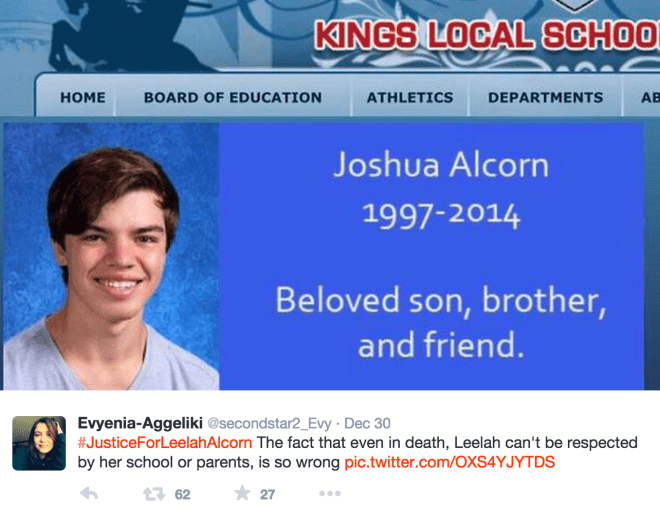
Leelah Alcorn’s Last Words, Ctd

Screen Shot 2015-01-02 at 1.12.10 AM

A reader notes that Leelah was also posting on Reddit – here and here. Another continues to question the conventional narrative:

Yes, it’s a tragedy that she didn’t feel accepted by her parents and had to endure Christianist “therapy.” That said, her decision to step in front of a truck was a terrible and selfish one. I’m sure being transgendered is hard, particularly if you have to deal with bigoted parents. But when I read her postings I hear a typically – I dare say even beyond typically – self-centered 16 year old. No matter how just her grievances, she chose the worst and most selfish way to get satisfaction.

We know that glorifying suicide can bring a rash of copycats. There was no glory in anything she did. Millions of people in this world have suffered worse but didn’t ruin a stranger’s life by forcing him or her to be the instrument of her death. If it were my blog, I’d ignore this particular story and instead focus on a more mature example of responding to transgender intolerance.

The Dish has actually covered the subject of trans children and teens pretty extensively, including posts such as When Is A Kid Truly Transgender?, Transgender Six Year OldsThe Father Of A Transgender 10 Year OldPuberty On HoldIntegrating Trans Kids, The Youtubes Of Trans Teens, and Transgender In A Small Town. And we had a long thread here on “pink boys” who dress and behave like typical girls but who are not transgender or gay. Another reader:

Why are all gender non-conforming kids being actively encouraged to transition or to take puberty-blocking drugs?

Maybe in a subset of the community this is advisable, but check out the trans reddit forum or any online trans forum and you’ll see adult transwomen actively encouraging kids in their early teens to get on hormones (as if they didn’t have enough raging through them) in preparation for transitioning. Sure, there may be some truly gender disphoric kids who need help, but all you have to do is “question” on one of these forums and you’re encouraged to pursue medical intervention.

Sorry, but WTF?  We’re relying on children – and Josh/Leelah was absolutely still a child – to self-assess?  I would have liked to have been a pretty girl when I was 13 or 14, but I ended up a perfectly happy adult gay male.  Yeah, I get that it was harder for me, but I can’t imagine as a confused kid of that age being told I was trans and that “I’d never be a pretty woman” unless I started transitioning before puberty.  Why isn’t anyone calling the trans community out on this gross misogyny?  What’s wrong with fem gay guys and butch dykes?  What’s wrong with ugly women?

Update from a reader:

I am touched by the story of Leelah’s suicide, but more, I am spurred to react to the person who pointed out the selfishness of Leelah’s suicide. Suicide is ALWAYS a “selfish” act in our society. The fact that Leelah added to the selfishness by involving another person is beyond the point. She was desperate, hopeless, driven to the ultimate act of self-destruction by the self-centeredness of everyone around her who scorned/condemned/renounced her. Her parents and the world wanted her to conform to a very narrow parameter of Acceptability, and she couldn’t be what they insisted she be.

How many people, not just transgendered, feel the same despair at being different? How many suicides are caused by society’s lack of compassion, or harsh judgement about the way we think or feel, or who we are or what we need? Look at any media page and the comments to see how readily people flock to the snark, the vilification, towards any who might opine something outside the box people seem to want to put everyone in. It is amazing to me, especially given the “Christian Nation” we’re so often told we are.

I say let’s start pushing to be interested in what makes us different, and how that makes us wonderful. And, like your reader who wants to discuss Race vs. IQ, let’s have conversations that don’t immediately devolve into finger-pointing and rude comments about how “oh, you’re one the Them!”. As to the “selfishness” of Leelah, let us forgive a 16 year old her thoughtlessness and, instead, focus on what drove her to do what she did. Let’s look at our own selfishness, too.

Read the long Dish thread on suicide here.

Collectibles Made Of Ones And Zeros

Baseball cards have gone digital:

David Roth remembers the good old days:

If any or all of this is mind-bending to you, you are probably not Bunt’s target audience. Eighty-one percent of Bunt users are between the ages of 13 and 25, and as such find nothing terribly weird about a baseball card that doesn’t exist in any corporeal sense. But as a comparatively doddering 36-year-old, I felt both old and weirdly, preemptively tired—like, octogenarian-on–Yik Yak tired—in my engagement with Bunt.

[Michael] Bramlage [a VP at trading card company Topps] is right that the younger demographic is “very rational” in its preference for phone-bound virtuality over fragile cardboard—a photo on Instagram is indeed more reliably backed-up and more readily shared than one in a scrapbook—but I’ve never known baseball cards as anything but baseball cards. Having traded them with classmates on a literal gravel-and-hormone schoolyard did little to prepare me for the scaled-up proposition of trading them on a sprawling virtual bazaar.

But he finds some similarities:

[B]aseball cards only exist as an investment because we—kids and adults, all of us held in that tenuous balance between the two that fandom demands—choose to invest these cardboard rectangles with value in the first place. These cards are worth what we decide they’re worth and only that much, and that has always been true. One generation’s cards are neglected in dust-shrouded boxes; another’s move and grow, relentlessly, in the permanent mint condition of the Internet. Which seems more valuable to you?

Update from a reader:

So now we can add baseball cards to the list of digital collectibles such as … nothing else, because people don’t collect digital goods. Home computers have been around for 30 years and I can’t think of a single digital collectible. There’s a small market for replaying old games though those are generally simple games that, aside from the nostalgia value, are legitimately competitive with basic indie games when it comes to gameplay. And either way, I don’t think anybody is making much money off them.

A collectible needs scarcity and age to be valuable. But with digital goods, scarcity means DRM, which means being tied to a specific device or organization. The moment you add DRM you lose the ability to have old files, so you no longer have collectibles.

Take away the collectible aspect – the idea that your card portfolio could exponentially grow in value – then what do you have left? It’s all down to the fun of swapping these digital cards, but without that anchor to the real world (and real value) I’m not sure how they succeed.

Will The FDA Ever Get Over Its Hemo-phobia? Ctd

A reader writes:

I am surprised how few of my fellow gay men are unwilling to consider the other side of this issue: the rights and interests of the recipients of donated blood.  The most fundamental oath doctors take is to do no harm and, for blood transfusions, that means ensuring that the risk of giving a patient contaminated blood is as low as humanly possible.  So, in altering the policy, we have to weigh our benefit from ending a stigma against the increased risk of transmitting HIV to a patient.  Put another way, how many additional people per year getting HIV is acceptable for us to feel better about ourselves?

Some (very) rough math to demonstrate this point:

About 50% of the country is male and about 5% of them have sex with men.  About 10% of MSM [men who have sex with men] have HIV and, of those, only about half know.  I am going to assume men who know they have HIV won’t donate, but the effects of shifting the stigma from gay men to HIV-positive men might not be that straightforward.  That means, in the absence of a ban, about 0.125% of all donated blood will be contaminated with HIV due to MSM (for simplicity, I assumed all HIV-negative people are equally likely to be donors).

However, as is pointed out, all blood is tested for HIV.  Even if we put in place controls that would increase the chance of catching new infections, no test is perfect.  Most modern HIV tests are weighted more towards false positives than false negatives (for obvious reasons), but still about 3 out of 10,000 tests of HIV-positive individuals will turn out negative.  That means, in the absence of a ban, an additional 0.0000375% of donated blood that reaches patients will be HIV-positive.  Put in other terms, an additional 1 in every 2.5 million blood transfusions would involve transmitting HIV contaminated blood.

That number might seem acceptably small, until you consider that in the US alone, there are about 5 million blood transfusions each year.  That means the absence of a ban could result in an additional two Americans every year being given HIV accidentally simply for going to the hospital.  That seems unacceptably high to me.

Now, most people do not support overturning the ban altogether.  That said, no one I’ve read has articulated what an acceptable increase in the risk would look like and whether their preferred policy meets that threshold. But that is precisely the issue that the FDA is grappling with and all the sanctimony in the world won’t change that.

Reading Fukuyama In Beijing

In a profile of Francis Fukuyama, the political scientist reveals that his latest book, Political Order and Political Decay, is being translated by the Communist Party in China for circulation among its senior members. His take on why they turned to the text:

“They understand that their system needs fundamental political reform,” Fukuyama says of the Chinese. “But they don’t know how far they can go. They won’t do what Gorbachev did, which was take the lid off and see what happens. But whether it will be possible to spread a rule of law to constrain state power at a pace that will satisfy the growing demands of the rising middle class is also unclear. There are 300 to 400 million Chinese in the middle class; that number will rise to 600 million in a decade. I had a debate a few years ago with an apologist for the regime.

I pointed out that in many regions of the world when you develop a sufficiently large middle class, the pressure for increased political participation becomes irresistible. And the big question for China is whether there will be a point at which its people will push for greater participation, and he said: ‘No, we’re just culturally different.’”

It was, in effect, a rehash of the old “Asian values” argument concerning the hierarchical and deferential social ethic that goes by the name of Confucianism in east Asia – allegedly the reason that Asians lacked the impulse to individual self-assertion that resulted in the demand for self-government in other parts of the world. The democratic transitions in South Korea and Indonesia put an end to that argument decades ago, Fukuyama says, just as the Arab spring debunked a parallel claim regarding Arabs. This is the part of Fukuyama’s argument about the end of history that he still stands behind without reservation or qualification – the Hegelian philosophical anthropology that saw history as the working out of the struggle between masters and slaves for recognition. “I really believe that the desire for recognition of one’s dignity and worth is a human characteristic. You can see manifestations of this in all aspects of human behaviour cross-culturally and through time.”

Previous Dish on Fukuyama’s work here.

When Just One Leg Up Isn’t Enough

Two-generation anti-poverty programs, which combine self-sufficiency initiatives for poor parents and early childhood education for their kids, have been around since the early 1990s but are recently making a comeback. These programs address a catch-22 that many struggling parents face: in order to build their careers, they must spend more time away from home, but they struggle to find and afford quality childcare, forcing them to stay home and stay poor. Alana Semuels profiles one two-generation program in Atlanta that has proven remarkably successful:

The Dunbar Learning Complex is a calm and bright space in the otherwise blighted streets of Mechanicsville. There, children receive free schooling, from infancy to pre-K, when their parents register with a career-development center to begin improving their job skills.

The complex is home to both a public elementary school and a pre-school, which accepts children beginning at six weeks of age. The pre-school, which opened five years ago, holds itself to high standards, and is part of Educare network, a national network of full-day, early-education schools. It has an entire art studio where children can experiment, part of a Reggio approach to learning, and its infant classrooms allow only eight students at once. …

The results at Dunbar have been impressive—after the first year alone, 55 percent of incoming kindergarten students at the elementary school were reading at or above grade level, up from 6 percent in 2010. The percentage of children below the thirtieth percentile on the Peabody Picture Vocabulary Test dropped by 23 percentage points the first year alone, while the percentage of those scoring above the 50th percentile increased 12 points.

Parents at the Dunbar Learning Complex also get a handful of resources to help them in parenting: Counselors help them access special teachers if their child is lagging behind in development; health navigators help ensure children get necessary vaccinations and can inspect housing, with parents’ permission, to see if anything in a family’s home might be making a child sick. The complex has monthly meetings on issues like child development, literacy, and health, and helps teach parents how to read with their children at home.

The strategy has proven so successful that there’s now a waiting list of 400 children, double the preschool’s enrollment. And that, in turn, has driven parents to show up at the Center for Working Families, up the hill, to register for job training or a career counselor. Kids can’t get on the waiting list of the Educare site unless their parents are enrolled with the Center for Working Families.

Expanding The Final Frontier

This embed is invalid


In a lengthy exploration of life aboard the International Space Station, Charles Fishman ponders the future of humanity in space:

We may eventually need resources from asteroids or the moon, depending on how we manage the resources we’ve got here on Earth. We may eventually need to become a multiplanet species—either because we literally outgrow the Earth, or because we damage it. Or we may simply want to become a multiplanet species: one day, some people may prefer the empty black silence of the moon, or the uncrowded red beauty of Mars, just as they preferred Oklahoma to Philadelphia in the 1890s.

These are long-horizon ideas—centuries-long. Even so, what’s missing from them is a sense of how hard living, working, and traveling in space still is, and how long we may need in order to change that.

We’re still at the beginning of the space age. More people can fit on a single commercial passenger jet, the Airbus A380, than have been in orbit. The Space Station’s most important purpose may turn out to be teaching us how to begin to make life in space more practical and less dangerous.

Almost anyone you talk with about the value of the Space Station eventually starts talking about Mars. When they do, it’s clear that we don’t yet have a very grown-up space program. The folks we send to space still don’t have any real autonomy, because no one was imagining having to “practice” autonomy when the station was designed and built. On a trip to Mars, the distances are so great that a single voice or e‑mail exchange would involve a 30-minute round-trip. That one change, among the thousand others that going to Mars would require, would alter the whole dynamic of life in space. The astronauts would have to handle things themselves.

(Vine video via NASA astronaut Terry W. Virts)

Lessons For The Would-Be Novelist

In his new guide to writing fiction, Beyond the First Draft, the novelist John Casey doles out advice to “the writer with a lump of a story or novel who doesn’t know what to do next to get it into shape”:

Beware of dogma, he warns. The first essay ventures a sage review of old writing-school edicts: Write what you know. Tell your story in the fewest words possible. Tell the truth. Conventional narrative is boring—you must experiment. Casey comes not to abolish the law but to tweak it, spirit over letter. Write what you know is good advice for a neophyte who falls on his face spinning a yarn about Mayan warriors—yet Tolstoy, while still on his feet, could imagine vividly the death vision of Ivan Ilych.

On sparing words, Casey recalls that his agent and his editor both judged a 604-page novel he’d sent them as much too long, so for several months he reworked it, cutting 100 pages but adding a few in the process. When he sent it back, now 640 pages, the agent and editor wrote him, separately, “Good. It’s much shorter.”

Whether Culture is local has risen from aphorism to dogma is debatable, but Casey says it has. Its propounder, in any case, was William Carlos Williams, the physician-poet who seldom set foot outside northern New Jersey. Against Williams, Casey sets Ezra Pound, who decamped to Europe, picked up Italian and Provençal, and set himself to studying Chinese poetry. Is it better for the writer to stay at home, thereby knowing better what he knows, or, in search of the novel (in both senses), to hit the road? Casey stakes out the agnostic middle ground, finding himself one day at the National Theatre in Washington, where a tile beneath his feet is inscribed “Washington—neither Rome nor home.” It happens that Casey has Washington roots: “I don’t think there’s a really good novel set in Washington,” he says, and he seems content to leave it at that.

A Poem From The Year

2909252617_1f456d0c81_b

“for deLawd” by Lucille Clifton:

people say they have a hard time
understanding how i
go on about my business
playing my ray charles
hollering at the kids—
seem like my afro
cut off in some old image
would show I got a long memory
and I come from a line
of black and going on women
who got used to making it through murdered sons
and who grief kept on pushing
who fried chicken
ironed
swept off the back steps
who grief kept
for their still alive sons
for their sons coming
for their sons gone
just pushing

Tomorrow is the last day to take advantage of The Poetry Society of America’s holiday membership drive. Please consider supporting them here.

(From The Collected Poems of Lucille Clifton 1965-2010, edited by Kevin Young and Michael S. Glasner with a foreward by Toni Morrison © 2012 by The Estate of Lucille Clifton. Used by permission of BOA Editions, Ltd. Photo by Flickr user Greg)