Equality Before The Taxman, Ctd

by Chris Bodenner

A reader adds to the great news:

Yet another aspect of the IRS ruling is the fact that many states derive their state income tax calculations from the Federal 1040 – et.al. Maryland (albeit a marriage equality state) populates its 502 form directly from the federal forms. Then you subtract the Schedule A deduction for MD state taxes, add in the County override, and you’re done. A non-marriage equality state would have to require that gay partners re-figure their tax liability as single people, and then use those numbers to file state taxes. I suspect that this level of complexity will weigh strongly against state tax agencies taking a “moral” stand against marriage equality, just to produce mountains of extra work and complexity. This is yet another tunnel being dug under the field of inequality that will contribute to its ultimate collapse.

Beard Of The Week

by Chris Bodenner

grass beard

A reader writes:

Over the weekend I was in Montreal, where I happened to stumble across a spectacular exhibit promoting urban agriculture and horticulture. The event dates back to 1998 and has shown every few years since in different cities around the world. One of the exhibits stood out to me as possible beard of the week material. I humbly submit to you, “grass beard”.

Previous honorees here and here.

Why Do Chinese Tourists Have Such A Bad Rep? Ctd

by Chris Bodenner

New York City scenes

I’m surprised a dissent like this one didn’t come sooner:

This thread has gotten really ugly really fast. Your blog is now (once again) becoming a place for undiluted bigotry. There are BILLIONS of Chinese people. Is it really proper to tar that whole group with a broad brush because a small number of Chinese tourists have acted badly? (I’m glad my ethnic heritage allows me to be coy about my nation of origin; if I want to pretend I’m Canadian overseas to avoid anti-American bigotry, I have that option.)

A reminder that all the anecdotes from Dish readers are based in a broader reality, not mere stereotype:

Recent examples [of Chinese tourists behaving badly], which have sparked a firestorm of commentary in both Chinese and Western media, include a group of snorkelers who caught and ate endangered sea creatures off the Paracel Islands, visitors to North Korea who threw candy at North Korean children as if they were “feeding ducks”, swimmers who took pictures with a dying dolphin, and a teenage boy from Nanjing who scratched graffiti on a 3,000 year-old relic while touring Egypt with his parents. In response, Chinese officials are making a concerted effort to improve the behavior of Chinese travelers abroad, issuing a list of guidelines that include no spitting, cutting lines, or taking your shoes and socks off in public. Vice Premier Wang Yang has stated that “improving the civilized quality of the citizens” is necessary for “building a good image” for the country.

As the thread has shown repeatedly, the perceived rudeness of Chinese tourists is a symptom of the PRC’s rapid ascension as a wealthy nation – a nation that now has the disposable income to enable a middle class to join the global tourism market in droves. So the thread, in a way, is actually a tribute to China. Its newly-prosperous people, like others before them, just need time to acclimate to the etiquette of traveling abroad. And after all, as our first post pointed out, “Americans are still widely viewed as the world’s most obnoxious tourists.”

Back to the thread: Many readers are recommending a wonderful essay by Evan Osnos, who accompanied a Chinese tour group through Europe a few years ago:

Until recently, Chinese people had abundant reasons not to roam for pleasure. Travelling in ancient China was arduous. As a proverb put it, “You can be comfortable at home for a thousand days, or step out the door and run right into trouble.” Confucius threw guilt into the mix: “While your parents are alive, it is better not to travel far away.” Nevertheless, ancient Buddhist monks visited India, and Zheng He, a fifteenth-century eunuch, famously sailed the emperor’s fleet as far as Africa, to “set eyes on barbarian regions.”

Over the centuries, Chinese migrants settled around the world, but Mao considered tourism anti-Socialist, so it wasn’t until 1978, after his death, that most Chinese gained approval to go abroad for anything other than work or study.

First, they were permitted to visit relatives in Hong Kong, and, later, to tour Thailand, Singapore, and Malaysia. In 1997, the government cleared the way for travellers to venture to other countries in a “planned, organized, and controlled manner.” (China doles out approvals with an eye to geopolitics. Vanuatu became an approved destination in 2005, after it agreed not to give diplomatic recognition to Taiwan.) Eighty per cent of first-time Chinese travellers went in groups, and they soon earned a reputation as passionate, if occasionally overwhelming, guests.

Back to the inbox, a reader underscores a cultural rift between people from Hong Kong and those from mainland China:

Oof, your thread hits really close to home for me. I suspect that you guys have been getting droves of emails with horror stories about badly-behaved Chinese travelers blazing paths of destruction all around the world. While I don’t have any novel reasons about why some Chinese tourists behave so badly, I wanted to share my perspective as a Hong Konger who encounters many mainlanders daily (I live right next to a mid-market shopping outlet which has become a popular tourist destination).

As a former British colony, Hong Kong already has a complicated enough relationship with its current overlord. Political differences aside, though, a whole lot of Hong Kongers truly resent the increasingly heavy presence of the mainland Chinese here. There is a perception that they are responsible for (or exacerbate) many of the city’s social ills: wealthy mainlanders snapping up new apartments in HK as real estate investments and thus driving up housing costs for everyone; “parallel traders” who travel from China to Hong Kong every day and buy out entire stores’ worth of infant milk formula (a good that is much more expensive on the mainland than in Hong Kong, so a tidy profit can be made by reselling it across the border), leading to a shortage of formula for HK mothers; pregnant mainland women entering Hong Kong on tourist visas to give birth in Hong Kong hospitals, etc, etc.

And then there are the mainland Chinese tourists.

Unlike the parallel traders and the nouveau riche apartment collectors, who are largely seen as takers but not contributors to the city, Hong Kong benefits from the money of Chinese tourists (who accounted for a whopping 72% of HK’s tourists in 2012) – but very, very begrudgingly so. (Irony #1.) The reason for the animosity? There is a concept in the Chinese language called “公德心” (pronounced gong duk sum in Cantonese, gong de xin in Mandarin, and many Cantonese blogs and forums also write it this way: “公得心”), which roughly translates into “consideration for the public.” This concept acknowledges that every individual is ultimately part of a collective, and as such we each have the responsibility to take good care of the collective. In practice, someone who has 公德心 is always aware of the effects of his/her behavior on others who share our public spaces, and is careful to respect the way those spaces should look/sound/smell. Now, this isn’t an idea that is exclusive to Hong Kong, but a common refrain among its denizens is that the majority of mainland Chinese tourists simply do not have 公德心 when they should.

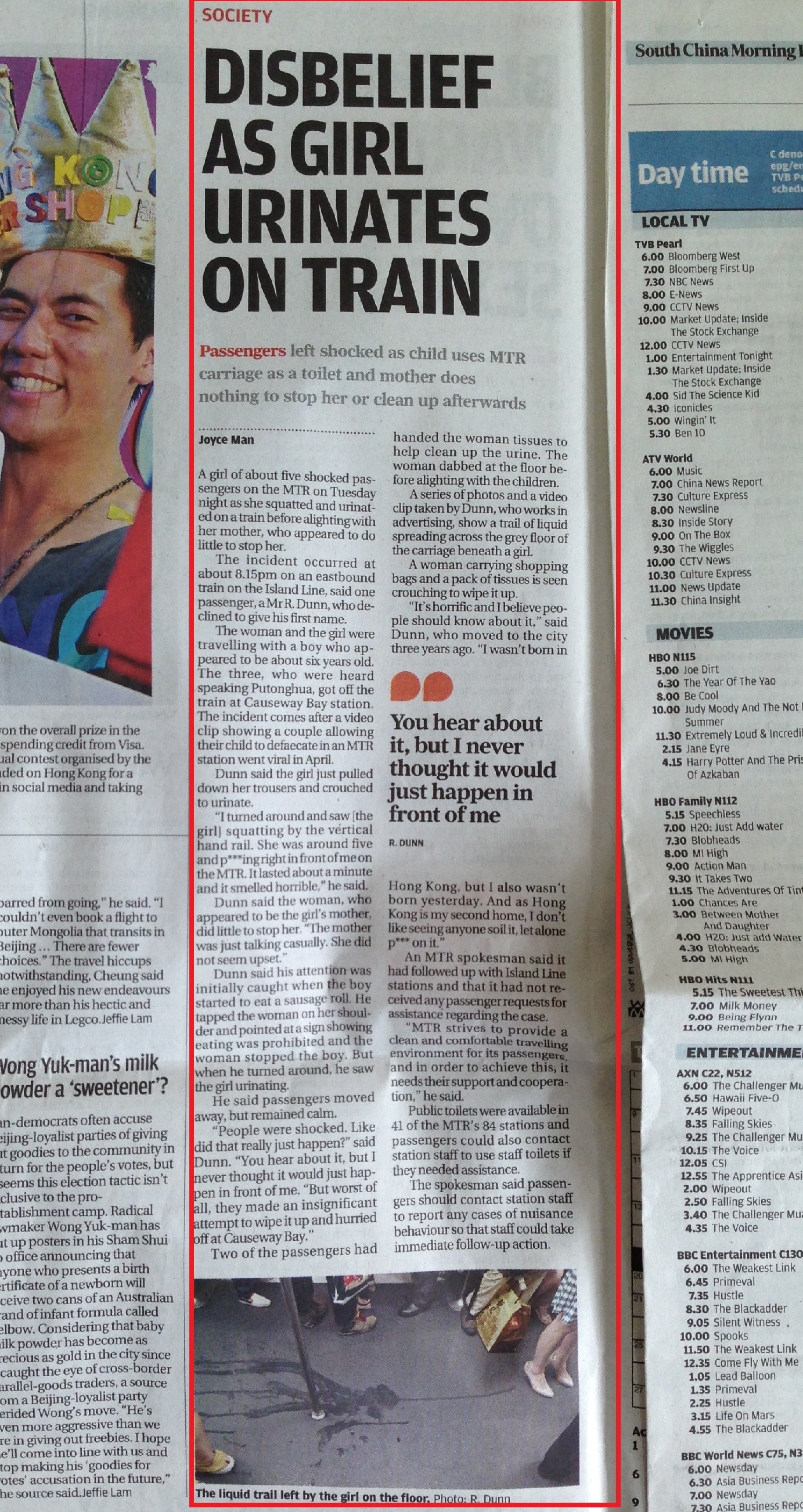
When we say that mainlanders lack 公德心, it means that they talk too loudly in public, spit on our sidewalks, push and shove on public transportation, and jump queues (this last one is IMG_3129especially infuriating because there is always a sizable line for anything you want to do in Hong Kong, whether it’s for McDonald’s or tickets to see the Big Buddha or adding more money to our Octopus cards). Where things should be orderly, people without 公德心 bring chaos. Just a couple of weeks, ago, the South China Morning Post published an article entitled “Disbelief as Girl Urinates on Train” – along with a reader-submitted picture, no less! – about an unidentified mainland child who with the permission of her mother pulled down her pants and peed in a MTR (subway) carriage. Funnily enough, the collective disdain for the ill-mannered mainland Chinese rube has fostered not only a sense of anti-mainland prejudice but a sort of Hong Kong “pride” (Irony #2): many think (whether rightly or wrongly) of Hong Kongers as being more polite, cultured, classy–a better strain of Chinese people overall. We cluck our tongues when even North Korea shakes its head at Chinese tourists; we feel validated whenever some other country’s citizens point out how rude they can be.
Of course, the kicker is that even while many Hong Kongers agree with the stereotypes and feel superior for being from Hong Kong, they are also terrified of being mistaken for mainlanders when they travel overseas. (Irony #3.) It was mentioned in this thread that mainland Chinese tourists often join together in big group tours because it is easier to get visas and easier to navigate cultural/linguistic barriers; Hong Kongers often do the same thing for the same reason. I myself am traveling to the East Coast with my mother and my 79-year-old Malaysian great-aunt in September to visit my brother. All three of us speak English fluently, but even my normally mild-mannered and even-keeled mom has voiced concerns about how we can best avoid looking like mainland tourists and what to do if someone hurls anti-Chinese slurs at us. So I suppose this is just one more grievance Hong Kongers have against the impolite mainland tourist: they make the rest of us ethnic Chinese look bad, too. (But we’ll gladly take their dollars.)

It’s a catch-22: we can’t live with them, and we can’t live without them.

Finally, I just wanted to respond quickly to your reader’s story about the older Chinese couple traveling to Adelaide: it may be the case in Chinese culture that the young are hesitant to criticize the old, but a grown child should not be allowing his parents to perform all the physical labor, either. True filial piety would have dictated that an able-bodied adult son pick up the luggage off the carousel at the direction of his parents. My mom probably would have smacked me if I’d let her struggle and fall all over the bags while I watched from the back.

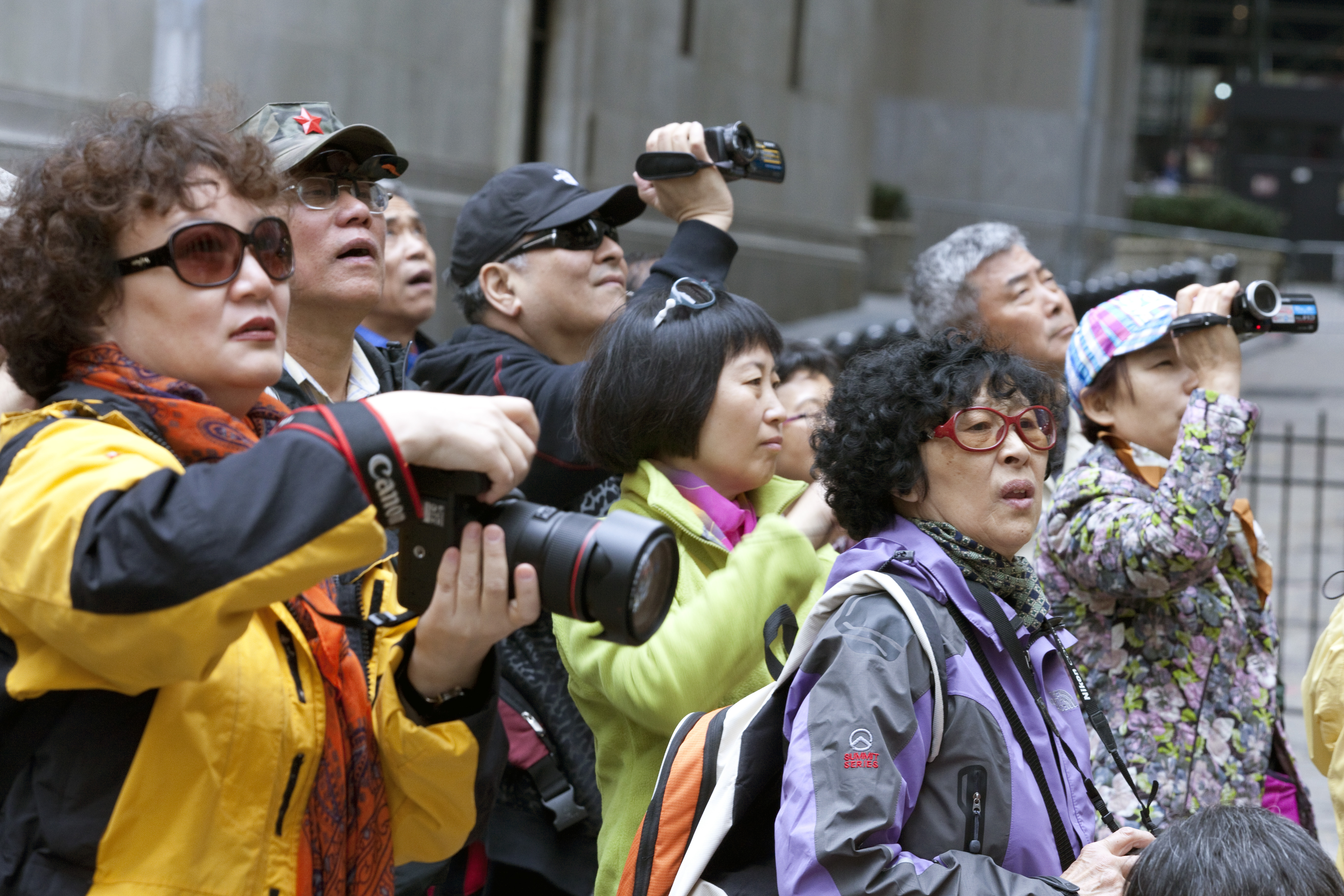
(Photo: Chinese tourists take photos on Wall Street near the New York Stock Exchange, NYSE, on April 11, 2013 in New York, New York. The growing affluence and openness in China allows the Chinese to travel. By Melanie Stetson Freeman/The Christian Science Monitor via Getty Images)

Finding Your Baby On A Dating Site

by Chris Bodenner

Daisy Buchanan praises Babyklar.nu, or “Baby Ready Now”:

[Site founder Emmanuel Limal] revealed that men make up 53% of the site’s membership. This seems surprising – in the media it is often suggested that women are the ones who are most keen to procreate. If we’re single, we’re meant to be sobbing into our white wine and worrying that there aren’t enough shoes in the world to fill our baby void, while our male counterparts are meant to be staring into the distant mountains with nothing but a fringed leather jacket for company, like the Marlboro Man.

But I know plenty of men, single and in relationships, who plan to start a family either “some day” or in the immediate future. And I know plenty of women, myself included, whose answer to the baby question is either “no” or “not sure”. Getting married and having children is no longer more or less inevitable for everyone. And when something so big can cause such a difference of opinion, doesn’t it make sense to be sure when you’re setting off on the path to happiness that it’s with someone who’s on the same page as you?

When Childhood Classics Aren’t Innocent, Ctd

by Chris Bodenner

Another classic cartoon is thrown in the mix:

Have you guys seen Dumbo? Pay close attention to the crows that appear near the end and teach Dumbo to fly. The stereotypes deployed with these characters is almost unbelievable by today’s standards. And yet, not only are they essential to the plot, but Disney has expanded the profile of Dumbo in the new Fantasyland at the Magic Kingdom in Walt Disney World here near Orlando.

If children going to the new Fantasyland haven’t seen Dumbo yet (it was released in 1941), they probably will want to see it after visiting. And then they’ll see these guys (one of whose name is actually “Jim Crow”!). While their end purpose in the movie is certainly admirable, they are portrayed as cavalier bullies at first, and the way they’re berated by Timothy Mouse is just unreal in today’s context. Hell, Song of the South is almost expunged from vision at Disney, but here’s Dumbo, portrayed in their featured theme park as one of their touchstone old films. Don’t they get it?

Another actually defends blackface, in a way:

There is a contemporary assumption that it is inherently racist for a performer to perform in blackface. Obviously this was not always the case. As recently as the mid 1980s, Billy Crystal regularly appeared in blackface to do his Sammy Davis Jr. impression:

Though of course the blackface he used was quite different from the minstrel show variety featured in your thread, where performers have their mouths accentuated, clown-like, with white makeup. Still, Billy Crystal would NEVER get away with that today. But why not? His intent wasn’t racist. It was realism. He also wore a wig and a false moustache. So the dark makeup was of a piece with the rest. But cultural norms change.

Still, the assumption that a blackface performance from the 1930s or ’40s is racist just doesn’t seem on the mark. I had a pop-culture professor back in grad school who was always going on and on about the minstrel show. He actually wrote a book on the subject. He saw the minstrel show as the sort of wellspring of all sorts of musical styles that followed, from jazz to blues to hip hop and as a very positive force in black American culture, and his argument was persuasive. The minstrel show, it is important to remember, typically featured black performers (not white ones) in blackface.

By the 1930s and ’40s, these old performances were likely a well-understood part of the cultural zeitgeist of the past, along with vaudeville. Throwing the odd minstrel show number into a musical seemed no stranger than throwing in the odd vaudeville number I’m sure.

Don’t get me wrong. White attitudes towards black Americans in the 30s and ’40s were insensitive and casually racist. But these performances are not racist in and of themselves, and we would do well as a culture to try to get over looking at them in that way. (Though I must admit that I can definitely understand how a black person watching this stuff today could be deeply offended.)

Another takes more of a middle ground:

Can I ask why everybody is so uncomfortable watching those old classics?

Are they not aware that times and culture have changed? I am asking because as a cartoon fan, I regularly reread the Tintin cartoons, and especially the first ones, written in the ’30s and ’40s have some pretty bleak stereotypes of the Soviets, Native Americans, Chinese, Japanese and Africans. Tintin in the Congo hasn’t been published in English in a long time because of its racism. But remember, the Congo was still under Belgian control in the ’30s! And if you read through the series, you see the change in culture between the ’30s and ’70s. And you see how author Herge gets more modern. How awesome is that?

I have never been perturbed by Tintin and old, off-tone films. Times change. Culture changes. You know it, so why not enjoy it? The changed culture does not make these old pieces of art better or worse; it just makes you aware that culture has changed. And since we live now, we think it’s for the good. Let’s celebrate that instead of cover it up. And who knows what they’ll think of us in another 50 years.

Another example of how a classic series reformed itself:

From 1910 to 1930, more than half of the American juvenile fiction market was produced by the “Stratemeyer Syndicate” founded by Edward Stratemeyer, who produced nearly a thousand volumes by providing 2-3 page outlines of proposed books to impecunious ghostwriters, who would do the actual writing.  The Syndicate created numerous iconic series in the period including Tom Swift, the Rover Boys, Dave Fearless, Ted Scott and the Bobsey Twins, but their most famous series today are The Hardy Boys (starting in 1927) and Nancy Drew (1930). Edward Stratemeyer died in 1930, but his daughter, Harriett Stratemeyer Adams, continued the work of the Syndicate almost to her death in 1984.

The earliest Hardy Boys and Nancy Drew books reflected their times; many of the books contained racial stereotypes (See the Hardy Boys’ The Hidden Harbor Mystery, 1935), or Jewish stereotypes (See Nancy Drew’s The Hidden Staircase, 1930).  During the 1950s, the books’ publisher, Grosset and Dunlap, started receiving complaints about the racial and religious stereotypes in the old books.  The old books also had outdated printing plates, and a much slower pace than the new titles concurrently being published.

Beginning in 1959, Harriett Adams and the Syndicate addressed these issues by discarding the original texts and putting new books inside the old titles. Some were just rewrites of the old story; some were completely new stories with the same title.  But the racial stereotyping in the original texts was gone. One of the earliest Hardy Boys books to be revised was The Hidden Harbor Mystery, 1961.  In the 1935 version, the black characters who worked on an old plantation in the South were the bad guys, stealing from the plantation owners and fomenting a feud between neighbors. But in the 1961 version, the black characters were suddenly the good guys, helping the Hardy Boys solve the mystery and end the feud.

Other stories with Chinese and Mexican stereotypes had similar revisions.  Once the new book with the original title was published, the old book simply went out print, only to be found in used book stores, or later on EBAY. (Some of the original books were also reprinted as collectors editions in the 1990s).  Despite their racist content, most collectors of the series think the original texts were much better written.  The revised texts from the 1960s remain in print today. In addition, the Hardy Boys and Nancy Drew are now owned by Simon and Shuster, which continues to publish completely new titles to this day; the new titles current 2013 sensibilities.

This is an example where we went back and excised the old racial stereotypes.  But did we lose something authentic when we painted over the 1930s America in the Hardy Boys/Nancy Drew original texts with the more sanitized 1960s America reflected in the revised texts?

On that note:

My own experience with this kind of thing occurred a few years ago when I bought some DVD collections of the old Warner Bros. cartoons for my young kids to watch on long car rides. It turns out many of these contain vile sexist and racist stereotypes. But to Warner Bros. credit, they have mostly released these as is, with a note advising essentially that times have changed and they recognize that many of these are not acceptable by today’s standards, but that they are a record and reflection of their times.

I think this is basically healthy. I think it is good that we be reminded how recently these types of terrible images were considered perfectly acceptable. It’s a good wake-up call for folks anytime we start to celebrate how far we’ve come. Many people, especially white males, but also many younger people who may never have really witnessed racial or gender-based prejudice first-hand, need to be reminded how hard it was in this country for almost every out-group until very recently.

The Best Of The Dish Today

by Chris Bodenner

While Obama insisted that he hasn’t yet decided on whether to intervene in Syria, the UK legislature, after live-streaming their debate, has:

Barack Obama’s plans for air strikes against Syria were thrown into disarray on Thursday night after the British parliament unexpectedly rejected a motion designed to pave the way to authorising the UK’s participation in military action.

The White House was forced to consider the unpalatable option of taking unilateral action against the regime of Bashar al-Assad after the British prime minister, David Cameron, said UK would not now take part in any military action in response to a chemical attack in the suburbs of Damascus last week. Although Britain’s support was not a prerequisite for US action, the Obama administration was left exposed without the backing of its most loyal ally, which has taken part in every major US military offensive in recent years.

Elsewhere in Syria coverage, we wondered how its ally Iran would react to intervention, doubted the “credibility to America” argument, and continued to question the Obama administration’s refusal to go to Congress.

Meanwhile, many black liberal bloggers were critical of the president’s MLK speech from yesterday and a few readers rushed to defend it. Readers also sent us more dead saints, looked for signs of gay acceptance in the hip-hop community, cited some unsettling depictions of Asians in classic cinema, and reminded us that all kinds of cultures can produce annoying tourists.

Obama’s March On Washington Speech, Ctd

by Chris Bodenner

Obama, Former Presidents Commemorate 50th Anniversary Of MLK's March On Washington

A few readers push back against the criticism we aired earlier:

Regarding Obama’s big speech yesterday, it was fabulous. In other words, I think the pundits are full of it. They’re upset that he didn’t get specific with policy proposals? I call bullshit. I went back and read MLK’s original. Not a whole lot of specifics in there either. I counted not a single policy proposal. MLK’s speech was a true oration. And so was Obama’s yesterday.

Near the end, when Obama said, “That’s where courage comes from,” tears came to my eyes. He moved me. He zoomed out and showed that this day isn’t about Martin Luther King. Obama made it clear this wasn’t just about black versus white. He included all of us. If anything could be called a theme of his term in office, it’s this spirit of the collective – the community. It’s not about any one man. We’re all in this together.

Another also liked the speech:

It made me think of his first inaugural address. I recall I was driving to the airport and had to keep switching stations. I was at first disappointed because I didn’t hear a capital-Q quote – an “Ask not what your country can do for you” or “The only thing we have to fear”. But the speech made me think.

I especially liked when he quoted Scripture, saying it was time to put aside childish things, mostly because it made me think what was going through Bush’s mind: “Hey not a bad speech. I wish I could deliver a line like that; it sounds like a good sermon. Hey, he’s even quoting Scripture, good for him. Childish things … put aside childish things … Hey, wait a minute, is he talking about me?”

Sometimes an inaugural quote (small-q, admittedly) will pass through my mind (e.g. “greatness is never a given”, “we rejects as false the choice between our safety and our ideals”). I think his speech yesterday will be in the same vein – no capital-Q, “I have a dream” lines, but enough good stuff to make you think.

(Photo by Chip Somodevilla/Getty Images)

Face Of The Day

COLOMBIA-FARMERS-STRIKE-CLASHES

A demonstrator shouts at the riot police during clashes that erupted after a march in support of Colombian farmers protesting in demand of government subsidies and greater access to land, in Bogota on August 29, 2013. Backed by the Revolutionary Armed Forces of Colombia (FARC), the country’s largest leftist guerrilla group, farmworkers called the open-ended protest to demand government subsidies for certain agricultural products and lower prices for inputs like seed and fertilizer. Protesters also are seeking guarantees on access to land, special land preserves for poor farmers, policies in support of traditional miners, improved delivery of healthcare, and potable water in rural areas. By Guillermo Legaria/AFP/Getty Images.

When Childhood Classics Aren’t Innocent, Ctd

by Chris Bodenner

A new angle from readers:

I’m enjoying this thread immensely. Another great film marred by racism is Breakfast at Tiffany’s. Mickey Rooney’s portrayal of Japanese neighbor Mr. Yunioshi is so incredibly over the top that it becomes very difficult to watch. I couldn’t find a good clip from the film itself, but [above] is a scene from Dragon: The Bruce Lee Story, where Bruce Lee shows his discomfort at Rooney’s character.

Another reader:

Yes, Peter Pan is bad but, Disney has a lot of clunkers in its vault. I recently watched their 1966 Dean Jones/Suzanne Pleshette film The Ugly Dachshund, which is both incredibly sexist and racist. (Much comedy is attempted at the expense of a pair of father/son Japanese caterers.) Whoever let that film be re-released on DVD ought to be fired by Disney.

And another:

The great musical South Pacific should come with a warning label: not safe to watch with your Asian children. It’s been a long time since I watched it, but I recall a terrible scene where Shirley Jones meets the children of the man she thinks she loves, and they turn out to be the fruit of his previous union with … a native! They have dark hair and slanty eyes! As Shirley Jones recoiled in horror, my recently-adopted children (then about seven years old) turned to me in puzzlement: “Mama, why she no like those kids?” Oh gosh, was it hard to think of a quick lie about that; but my daughters were neither old enough, nor linguistically proficient enough, for me to explain the actual truth. Major ouch.

Update from a reader:

Shirley Jones isn’t in South Pacific; that was Mitzi Gaynor who played Nellie Furbush. Did this reader not understand the plot of the movie? The entire love story is jeopardized by Nellie’s racism. That’s the point. There’s even a song about it: “You’ve Got To Be Carefully Taught”. This is why the musical won the Pulitzer Prize for Drama. The reader had no business showing a 7-year-old that movie in the first place. Not all musicals are for children.