by Chris Bodenner
Wes Anderson really loves his symmetry:
Wes Anderson // Centered from kogonada on Vimeo.
Wes Anderson really loves his symmetry:
Wes Anderson // Centered from kogonada on Vimeo.
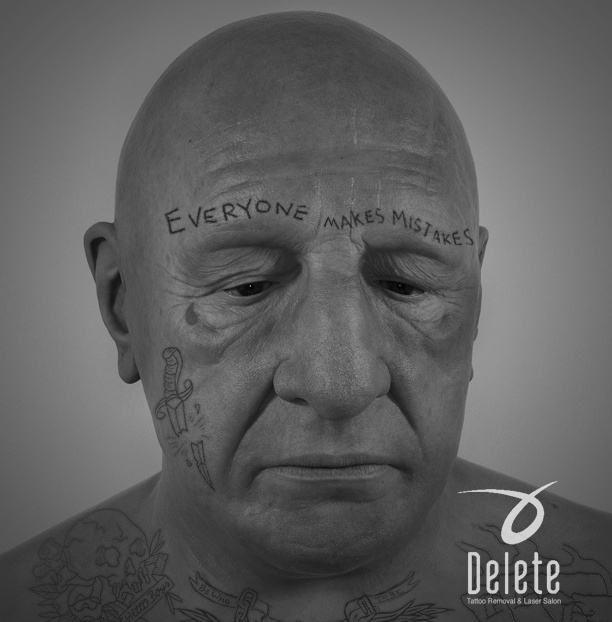
Copyranter features a campaign that solicited ad ideas from convicts behind bars (“To be clear: These are speculative ads and are not endorsed by the companies mentioned”). He reviews the one seen above, for a tattoo removal and laser salon:
It’s a perfect headline targeting tatted ex-cons. The placement is flawless as well. Excellent ad. Bravo.

A reader appears adrift:
I need help understanding this issue. Put frankly, I don’t know that I buy the imperative that we should be making a thing out of preventing suicide. Loved ones are hurt by suicide. But what else? I am not exactly suicidal, but it’s not at all infrequent for me to be acutely aware that I have no preference for being alive over not being alive.
I don’t know. I’m having trouble putting words to this. Maybe it’s our cultural aversion to death – now that the shroud of religion has become threadbare – that propagates this. Maybe it’s the opposite: a fascination with celebrity deaths as “tragedy” combined with our contemporary obsession with crafting a personal narrative out of every bullshit event in the world. Maybe it’s as simple as, if I ever were to kill myself, I’d want to be able to justify it. I don’t know. There is something that smacks of musty morality in the suicide conversation. Why should we be preventing suicide? Why should we be second-guessing individuals’ relationships with themselves?
That email provides a good reason to revive one of our most popular threads from last year, “Suicide Leaves Behind Nothing.” Many of the scores of emails we received went unpublished, such as:
One thing that seems overlooked in all these stories from loved ones left behind is the fact that we can’t hear the stories of those who left. We can only ever hear one side of the story, one side’s pain. (Suicides do sometimes leave a note, but we, the general public, usually don’t see or hear them except through the filter of loved ones left behind.) Personally, I’m with these two readers:
What could be more selfish than other people presuming that we should stay alive just to meet their needs?
And:
People can be tortured by their brain’s messed-up chemistry as brutally as they can be tortured with stress positions and sensory deprivation. People break. That’s not a character flaw. Too much pain and a person will do whatever he or she has to to make it stop.
I disagree with the first one a bit in the case of children (including adult ones). If you’ve brought people into the world, you do owe them something. Children aside, though, the reader is spot on.
The second one calls attention to something that seems overlooked, which is that the very notion of selfishness is problematic in the case of those who are mentally ill, because their sense of self is either deranged (disarranged) or completely missing. In the case of depression, for example, by the time it’s extreme enough for the sufferer to contemplate suicide, they’ve lost almost all sense of self. The barrier between self and other is gone, or is so porous it might as well be. That’s the very reason they’re in such pain: they feel everything, and all of it cuts right to the quick.
There’s a certain amount of pain that’s unavoidable in the world. How much of it should be born by one person before we’re willing to let them stop?
Several more readers share their stories:
My brother killed himself twenty years ago, six days before my second child was born.
No one in our family saw it coming. We all knew that he had been struggling with work and love, but just had no idea that he was so terribly depressed. Afterwards, my parents, five siblings and I began to reconstruct his pain and of course felt that we had let him down by not seeing his downward spiral. The guilt and questions were overwhelming. He and I were not particularly close and had definitely clashed in the past (which brings it’s own kind of despair), but even the brothers he had a close relationship with were riddled with what-ifs. It is hard to describe the anguish of watching my parents struggle with their grief.
Twenty years later, my heart still twists if someone asks how many siblings I have because I feel that I can’t say five; I have to say six, even though he is gone. He springs to mind every time I think about or prepare for my daughter’s birthday. The pain never really goes away, but I remember so clearly the moment that I reached a sort of peace about his death. It was shortly after my daughter’s birth and I was rocking her, weeping, wondering how we could ever deal with this awful reality when my husband came in and one of the things he said was, “Honey, he’s not suffering anymore”. I cannot describe the relief I felt at that moment. He had been suffering and we didn’t see it and we will have regrets forever and would do anything to change it, but he isn’t suffering any more. It is not a happy feeling, but it is a kind of peace.
Thanks for “listening”.
Another:
I’m a therapist and several years back I lost a client to suicide. He was a young man struggling with identity and relationships, and a painful rejection sent him into a spiral, overwhelming him. He denied having any suicidal thoughts, so his death was clearly a shock for me, and I will never know whether he kept those thoughts and plans to himself or if his suicide was impulsive and in reaction to the rejection.
I do know that his death changed me in so many ways, and marked a loss of innocence for me as a therapist (I was a relatively new therapist at the time). As intimately as I can come to know my clients, I now understand that there are parts of themselves they may not share with me, and that I can’t completely know them. I also believe that therapy and medication may not be enough to relieve the psychic pain some of my clients may experience, and that I have to accept the limitation of my work. Clearly, this is the hardest part of my job.
I wouldn’t say that suicide is selfish, but it certainly emerges from a very hopeless, narrow state of mind. I have to believe that I can make a difference in my clients’ struggles with this hopelessness, but I humbly accept that it may not always be effective. In that case, I do not believe I am in a position to judge that client’s decision. I can feel sad, angry, and devastated by that choice, but ultimately it is my client’s choice.
Another:
Well, as someone who had to break down the door of my brother’s bedroom after he killed himself (or, rather while he was still alive, barely), I find the title of your thread odd. Suicide leaves behind a lifetime of pain. That’s hardly “nothing”, and as for all your readers who think suicide is a selfish act, I strong disagree. My brother was not selfish. He simply wanted to escape the pain that my parents inflicted upon him (and the rest of us siblings) with their never-ending bickering and violence, which extended throughout their divorce.
I’m what’s called “an emotional wreck”, I know that. Nothing – not years of useless therapy nor years of being experimented on by misguided doctors who thought that prescribed drugs can wipe away memories – nothing can “heal” me. It’s accepting that fact that was the beginning of my new life.
When I stopped the hunt for outside salvation, I came to see the truth: that the scars that deform my very being could never be healed and that my goal is to keep on living despite the fact my scars so easily bleed when scratched. I am walking in the woods and come out into a clearing, look up, and see the same cloud formations that were in the sky the night my brother died – and SCRATCH! I think of my brother. I am in the grocery store and see the word “Swanson” on a TV dinner and SCRATCH! – it was his favorite thing to eat. I walk along the ocean, peacefully contemplating the waves, when a child runs up behind me with his dog and I look into his face and SCRATCH! I see my brother.
It never ends. I have prevailed, despite the fact that I went through years of emotional hell. I came to accept the new me. I had to accept that I would never be the same person that existed before I took a hammer and literally tore a door apart in order to collapse into a room where my brother’s face was covered with his brains after he shot himself. I’ve learned. Carry on is the only thing one can do. Accept the pain and carry on. Accept the scar that never heals and ceaselessly bleeds. It’s hardly “nothing”. I can only assume your thread is meant to be ironic. I hope so.
Anyway, I am glad you are posting about suicide. It touches so many people in so many ways and most people just don’t want to talk about it. Thank you.
One more reader:
I work in mental health and I just want to caution you about publishing opinions rationalizing suicide. Some of your respondents sound like they would benefit from professional help. It might be a good idea to append your posts with info on the national suicide prevention line:
If you are in a crisis and need help right away: Call this toll-free number, available 24 hours a day, every day: 1-800-273-TALK (8255). You will reach the National Suicide Prevention Lifeline, a service available to anyone. You may call for yourself or for someone you care about. All calls are confidential.
It is with a deep honesty and powerful frankness that New York-based photographer Kristina Knipe creates a complex narrative of self-harm in her series I Don’t Know The Names of Flowers. Returning to her hometown in Pennsylvania, Knipe collaborated with others who struggle with self-harm by contacting acquaintances and posting on NYC’s Craigslist in an attempt to find healing.

Eilean Donan, Scotland, 9 am
A reader goes in depth on the subject:
I’m all in favor of later start times for high schools so that students who need to sleep in can, but Suderman’s suggestion that vouchers and school choice will help accelerate solution overlooks two intractable reasons why schedules haven’t changed much: transportation and competitive sports.
Private schools could experiment with later starts, but that becomes difficult if they rely on public school buses, which has been true of most of the Catholic schools and most of the evangelical Christian schools I’ve known in the three states where I’ve lived. These days almost all students ride buses, and the bus routes add considerable time to the school day.
Secondly, sports create scheduling problems at the end of the school day, when public and private school teams compete.
Football is a weekend sport, but basketball, soccer, wrestling, field hockey, volleyball and numerous other sports compete one or two weeknights, and teams that travel to compete may have to miss the end of the school day if their school starts later. Game times are not going to change for private schools or for one or two enlightened high schools, as the New York Times story notes. So it’s nice to think school choice could solve the scheduling problem, but high school athletics are separated from education and transportation issues are resolved, school boards will be limited in their choices. High school sports fans and coaches may also oppose school choice if it leads to recruiting competition in public schools, since public schools already suffer from having private schools skim off top athletes in certain districts.
More generally, I have never been particularly enthusiastic about school choice because I think certain public schools will be left with the students who are discipline problems or costly to educate, such as special education students.
The only way out of the current bind that I see is total upheaval: going to year-round school. My preference would be for schools to run in quarters with a week’s vacation or somewhat more between quarters. (Other people with more knowledge of summer camp programs, church activities, and sports and marching band practice can probably come up with more refined schedules.) I’d also like to see state laws changed to mandate a total number of hours of instruction rather than “days in school.” This would also give schools more flexibility, particularly in high school, to adopt more of a college approach to scheduling where each day doesn’t have an identical schedule.
In order to continue with sports schedules after school, going to year-round school would allow athletes to have shorter days before game nights because there would be more time throughout the year to make up classwork that is currently missed when athletes leave early for games. There are some subjects that can be effectively taught through online instruction or with assistance online, so athletes and other students who want to work could manage class loads more flexibly. Sports should be severed from academics so first, there’s no pressure on teachers to pass students so they stay eligible for competition, and second, so sports teams are geographically based and, while they may compete for a specific school, rules would be in place to limit obvious competitive recruitment. This would allow home-schooled students and students at very small high schools to be part of larger community teams without prejudice.
To provide school choice as Suderman wants, I would favor school vouchers if the vouchers came with strings. Any school that accepts vouchers must accept any student who applies to the school, just as a public school does, and must assign open places based on a lottery the first year of voucher use. In subsequent years, siblings of students in the school would be accepted for open places, and then the remaining places would be open to lottery winners. Private schools can continue to stay private if they wish and reject vouchers, but vouchers would not flow to schools where admission criteria screen out certain applicants. Unused vouchers would be repurposed each year by being pooled and divided up to assist, on a per capita basis, schools with the most economically disadvantaged children.
Separate transportation vouchers would also be issued to each student and distributed, no matter which school the student is attending, to the transportation operation providing bus service or be used to purchase public transport where appropriate, with one big exception: public school districts would continue to serve a designated geographic area. A family outside the district who takes their kids and vouchers and moves them elsewhere would not be guaranteed transportation on a particular bus system. This is just a practical solution. In general, schools will not be able to provide transportation to far-flung students on standard transportation vouchers. Transportation vouchers must also be based on mileage and cost of transportation, not block grants that reward small, densely populated districts at the expense of rural schools.
Finally, along with the upheaval in the school system wrought by year-round school, I would favor another major social change in the U.S.: reduce the standard work week from 40 hours to 36 hours. It would give parents more flexibility and help create more jobs.
Update from a reader:
Your reader went on a short tangent:
I have never been particularly enthusiastic about school choice because I think certain public schools will be left with the students who are discipline problems or costly to educate, such as special education students.
The reader doesn’t need to speculate very much. Through the combination of a shaky public school foundation, suburban flight, extreme concentration of wealth, and an explosion in charter schools, Washington, D.C. has, if not de facto school choice, at least a bevy of options that results in most families opting out of their geographically-appropriate schools. The Washington City Paper ran a great cover story recently that highlighted one case that was fairly representative of the city’s problems with turning the system around.
How Uganda was seduced by America’s anti-gay conservative evangelicals: http://t.co/abr8k7Zmef via @IndyWorld @Independent
— Tim Walker (@timwalker) March 15, 2014
While many European countries and international groups have cut aid to the Ugandan government, the White House seems stuck:
Since Ugandan President Yoweri Museveni signed legislation imposing up to a lifetime prison sentence for homosexuality, Obama administration officials repeatedly have said there would be a “review” of U.S.-funded programs in Uganda, but have declined to discuss details of that review or options for reallocating funding. This is a touchy subject, since the United States has allocated more than $400 million in aid to Uganda for HIV and other health programs. While the Obama administration may want to send a message about LGBT rights and avoid funding organizations that might turn in LGBT people — some current grantees have even openly backed the anti-gay law — the administration also does not want to appear to be cutting off anti-retroviral therapy to those relying on those programs. … More than half of the 88 countries receiving assistance from the President’s Emergency Program for AIDS Relief (PEPFAR) already criminalize homosexuality.
Secretary Kerry’s paltry response is to send “experts” on homosexuality to discuss things with Museveni – whose wife, by the way, just offered these illuminating thoughts on the anti-gay law: “Uganda’s First Lady has said if cows can’t be gay, then humans can definitely not be gay.” Meanwhile, more horror stories are coming out of the country:
“As a lesbian living in Uganda, it has been very difficult,” [says gay-rights activist Clare Byarugaba]. “My mom said, ‘I’m going to hand you into police.’ What that means is corrective rape. That I can’t see my family anymore. I have received so many death threats. And now I’m facing seven years to life imprisonment simply because of the work I’m doing—and because of my sexual orientation.” …
After Byarugaba was involuntarily outed by a Ugandan tabloid “witch hunt” earlier this year, she had to take a week off from work to cope with the personal fallout. “Coming out was supposed to be my journey,” she said. “Unfortunately the media did it for me when I was not ready.” She has seen friends lose their jobs and get assaulted by the police. “A transgender friend, a mob attacked her and undressed her in public,” Byarugaba said. “I know people who have tried to commit suicide. People call me on a daily basis and say, ‘Give me five reasons why I shouldn’t kill myself.’”
Previous Dish on the crisis in Uganda here.
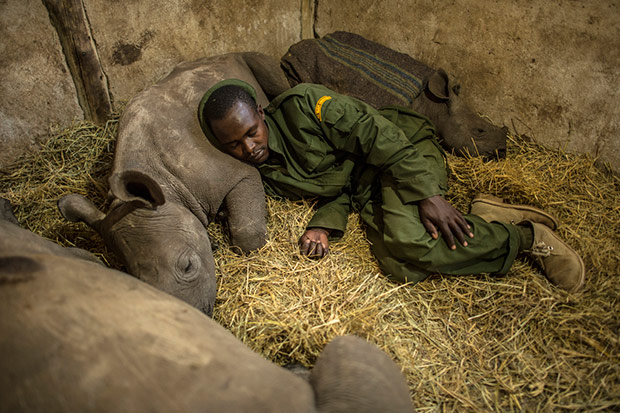
Yusuf, a keeper, sleeps with three orphaned baby rhinos at the Lewa Wildlife Conservancy in northern Kenya. The youngest rhino on the right was orphaned when poachers killed his mother on Ol Pejeta Conservancy. The largest rhino, Nicky, is not an orphan but is being hand-raised because her mother is partially blind. On the woman who took the photo:
Montana-based photographer and filmmaker Ami Vitale is shedding some much-needed light on the illegal wildlife trade and poaching of animals taking place in northern Kenya. She recently launched a crowdfunding campaign in conjunction with The Nature Conservancy and the Northern Rangelands Trust (NRT), using photography as a platform to show how local communities are working to protect their wildlife from the heavily armed criminal networks of poachers that are devastating to the rhinos, elephants and many other plains animals of Africa. … While her initial goal has just been reached, she has now turned her sights on to other related and achievable goals, like providing educational, visual storytelling initiatives for the NRT—a collective of 26 indigenous groups in northern Kenya.
In addition to Vitale’s website, you can follow her work on Twitter, Facebook, Instagram, Nikon, her Montana workshops, and her storytelling seminars with NatGeo. Previous Dish on animal poaching here, here, here, here, here, and here.
A reader tees up the viral video:
Professor Andrei Lindi receives news that his decades-long life’s work has proven fruitful: observations confirm gravity waves consistent with a rapid inflationary period in the first moments of the universe. It’s being hailed as one of the most important physics results in decades, on par with experimental observation of the Higgs Boson by the LHC. (Maybe it’s not a Face of the Day, as that’s a photo feature, but just watch the video – Lindi about passes out. It’s pretty touching.)
Here’s a video from Nature explaining the basics. For me, here’s the highlight: We often talk about the Cosmic Microwave Background Radiation (CMB) as “the echo of the big bang.” While it’s the (highly redshifted) light of the first photons able to escape the primordial cosmic soup, they date it to about 379,000 years after the Big Bang. So while it’s less than 1/10,000 of the universe’s age, it’s still a long time after the initial moment in human terms.
The BICEP2 results are a direct observation of an event that took place when the universe was 10^-34 seconds old. I just tried to write that out as a decimal, but a decimal point followed by 33 zeroes is just, well – the second time I lost count, so I gave up. That’s 47 orders of magnitude earlier than our previous view. It’s a truly mindboggling result. Talk about a Nobel slam dunk!
Hans Madsen from Yorkton, SK here for the tournament. Best fan beard, ever! #NB pic.twitter.com/8RBxykUi6S
— Matt Bingley (@mattybing) March 15, 2014
A reader passed it along:
I thought you might want this as a Beard of the Week. My colleague Matthew Bingley took the photo while covering the World Women’s Curling Championship in Saint John, New Brunswick.
Previous BOTWs here. And, because Andrew’s away from the blog, here’s a babe of the week.
 The Dish