How Partisan Are Wealthy Political Donors?

by Patrick Appel

Donor Ideology

Seth Masket uses the above graph to examine the question:

First, small donors appear to be more polarized than the CEOs and the top .01 percent. All those donors are relatively polarized, with donors clustered around the party medians, but the wealthier folks are somewhat less so.

Second, the 30 wealthiest donors in the country are actually pretty moderate, at least judging from this measure. Apart from some extremists like George Soros and the Koch brothers, most exist between the party medians.

This presents an interesting conundrum. We know Congress has grown more polarized over the past three decades. And we know that the very wealthy are donating more and more each year. But the very wealthy aren’t necessarily that polarized. If they were buying the government they wanted, they’d be getting a more moderate one than we currently have.

But Drum is unsure “that wealthy donors are quite as moderate as Masket thinks, since they often have strong views on one or two hobbyhorses that might get drowned out in broad measures of ideological extremism”:

The Waltons hate unions and Sheldon Adelson is passionate about Israel, but they might be fairly liberal about, say, gay marriage or Social Security reform. But does that make them moderate? If they spend all their money on the stuff they care about and none on the other issues, then no. They’re single-issue extremists.

Map Of The Day

by Patrick Appel

Abuse Worldwide

Olga Khazan highlights a report on abuse of women worldwide:

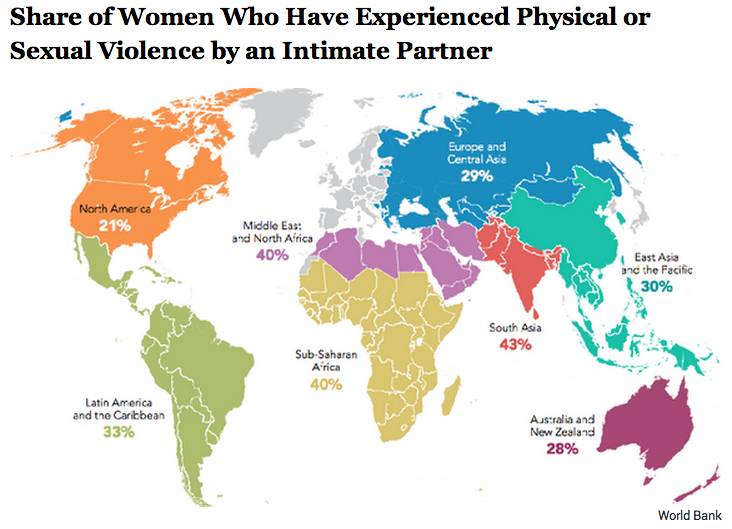
“No place is less safe for a woman than her own home,” reads a World Bank report released [last] week. Roughly 30 percent of the world’s women have experienced physical or sexual violence at the hands of their partners, and across 33 developing countries surveyed by the organization, nearly one-third of women said they could not refuse sex with their partner. …

But the Bank also found that better-educated women were more likely to not be sexually or physically abused. Each additional year of schooling was associated with a 1-percent increase in their ability to refuse sex with their partner.

The West Is Parched

by Patrick Appel

Drought Map

Plumer provides five maps that illustrate the severity of the drought:

This isn’t a one-year event: at least half of the United States has faced drought on and off since 2012 — at the peak in July 2013, some 81 percent of the country was experiencing at least some level of drought. …Put together, the 2012-14 drought has been one of North America’s biggest since the costly 1988-89 drought.

In response, Philip Bump argues that “the current level of national drought isn’t remarkable” given that “half the country has been in drought for half of the weeks since January 2000.” What is unusual:

The actual problem right now is noted by Plumer, a little further down. “[E]very single part of California is now facing ‘severe,’ ‘extreme,’ or ‘exceptional’ drought,” he writes, “the first time that’s happened in the [Drought Monitor]’s 15-year history.” The drought is substantially worse than past droughts. That’s the problem. And that is exactly what we’d expect to see in a warming world.

William Cowan urges Californians to remember that their state is just as prone to floods as it is to drought, writing that “may be no better moment than the dry present to remember the extraordinary washout of 1862, which brought what was likely the most expansive flooding in the recorded history of America’s West”:

Aridity is the norm here, but it is only part of the story. Despite its reputation for perpetual sunshine, Southern California may face as great a risk from cataclysmic flooding as any other major metropolitan region in the United States. Its geologic history tells us so. Massive floods might be the exception, and yet, these events have factored into California’s history for millennia. Whether it is cyclical, the product of a changing climate or some frightening combination of both, extremes of weather, flood, and drought appear to be occurring with more regularity. We fear how dry we are now, but we will be wet again. And we should be prepared for that, too.

On that note, John Upton warns that the next El Niño could hurt the global food supply:

A dinosaurian belch of warm water thousands of miles wide has appeared at the surface of the Pacific Ocean near the equator. The warming ocean conditions have spurred NOAA to project a two-thirds chance that an El Niño will form by summer’s end. It’s tipped to be of the monster variety—the extreme type that could become more common with global warming. Because the planet has warmed since the last extreme El Niño, some 17 years ago, there are fears that these warm waters could herald record-shattering extreme weather and temperatures.

For a sense of the type of havoc that extreme El Niños can wreak, think back to the late 1990s, or to the early 1980s, when widespread flooding and droughts plagued every inhabited continent, bleaching corals, ravaging wildlife, and killing tens of thousands of people. And as you mull over those disturbing memories of yore, chew on a sandwich—and savor it, for the weather that’s forecast to strike us could make that bread harder to get.

Rubio Isn’t Likable Enough

by Patrick Appel

Rubio

Enten examines Marco Rubio’s declining favorability:

It’s not clear why Rubio has fallen. The decline in his popularity among adults corresponds almost perfectly with his push for immigration reform; his largest drop occurred in June as the Senate was debating comprehensive changes to U.S. policy. I wouldn’t argue that pushing for immigration reform made Rubio unpopular, but it did give him a lot of press. FiveThirtyEight has previously said that Rubio’s ideology ranks as quite conservative. It’s possible that Americans learned more about Rubio than just his views on immigration during that period.

Harsanyi struggles to see Rubio’s appeal as a presidential candidate:

For me, at least, the promise of Rubio seldom corresponds with the reality. Whenever I listen to him these days, all I hear is Mitt Romney. If he’s really imbued with all these formidable political skills, why do so many of his appearances feel stilted? If he’s one of the fresh faces of a new GOP, why are his speeches crammed with platitudes that might have packed a serious punch in 1984? It’s not that he’s substantively wrong (though he offers so little in that regard). It’s not that he’s off-putting. It’s that he never really generates the sort of excitement or displays the sort of political acumen his reputation might have you believe he can, should, or will.

Forget the White House, Myra Adams thinks Rubio will have a hard time simply holding on to his Senate seat:

Rubio knows his race will be tough, since 2016 is the first time he would face a traditional two-person Senate battle. (His 2010 election was a quirky three-way race.) It has already been reported that Rubio’s most likely and strongest opponent would be Florida Congresswoman and chairwoman of the Democratic National Committee, Debbie Wasserman Schultz.

Furthermore, in a presidential election year, with Clinton likely at the top of the ticket, the electorate is going to be very different from the one that gave Rubio 49 percent of the vote in 2010.

A Debate Over A Troublesome Book

by Patrick Appel

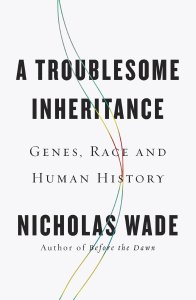
Nicholas Wade’s A Troublesome Inheritance: Genes, Race and Human History, which I finished reading last night, is a deeply flawed examination of human genetic difference. Andrew, who is more sympathetic to the notion of race as a biological construct than I am, often does not see eye-to-eye with me on matters of race and genetics. But he encouraged me to critically examine Wade’s book during this guest-blogging stint in order to move the conversation forward. Andrew will likely respond to the debate when he returns next week.

The best refutation of the book I’ve seen is comes from Agustín Fuentes, a professor of anthropology at Notre Dame. In an hour-long webinar hosted by the American Anthropological Association, Fuentes debates Wade and takes a jack-hammer to the factual foundation of Wade’s book. Alex Golub summarizes the Fuentes-Wade exchange for those who don’t have time to watch it. A key part:

Fuentes pointed out that “genes matter” but that “they’re just a small part of a whole evolutionary picture” which results in behavior. He also argued that Wade was imprecise in his terminology. “Wade uses cluster, population, group, race, sub-race, Wadeethnicity in a range of ways with few concrete definitions, and occasionally interchangeably throughout the book” he said.
Fuentes then went on to deal with the topic of human genetic variation. Humans share all of their genes and 99.9 percent of variation, he said, so what was being discussed in the webinar was just “0.1 variation of all the variation in the genome.” He emphasized that “most variation in human genetics is due to gene flow and genetic drift, which basically mean that the further apart two populations are, the more differences there are going to be between them.” Wade relied on a study which showed differences between people in Nigeria, Western Europe, Beijing, and Tokyo which showed differences between these groups but, Fuentes claimed, if you studied people from Liberia, Somalia, and South Africa you would get similar variation. “So for zoologists,” Fuentes concluded, “no human populations are different enough from one another to be called subspecies.”

Fuentes argued that the color-coded clusters of genetic data that Wade used in his book were a product of arbitrary choices made by Wade and scientists, and did not emerge automatically in the data themselves. In one study, the computer program Structure was asked to cluster data into 3, 4, 5, and 6 groups. Fuentes claimed that Wade noticed the arbitrariness of this scheme in his book and decided on a five-race scheme because it was “practical for most purposes” and not because it was naturally there in the data.

Another important point:

[Debate host Ed] Liebow asked Fuentes to talk about how biological evolution is linked with social evolution. Fuentes stresssed that “rather than just the environment shaping organisms and their gene pool, we know there’s interaction between organisms and the environment, which actually changes the way natural selection works. Evolution is ongoing over time and complex, it’s not just the environment targeting genes.”

For Fuentes complexity was clearly important. “The representation of little teeny minor differences in some areas of the DNA and connecting that to large sociopolitical and historical differences as Nicholas Wade did in his book, it’s misleading because it’s not giving true credit to the complexity of evolutionary biology and the complexity of understanding how things evolve.”

Pete Shanks comments on the webinar:

It was not so much a discussion as a debate, and in my view Fuentes defeated Wade thoroughly, though it was all very polite (too polite). Fuentes was well prepared, and able to identify, cite and comment on every study that Wade brought up to support his thesis. More important, he kept hammering away at the definition of “race” — as in, Mr. Wade, can you tell us, what is it? If you are going to claim that certain kinds of genetic variation between populations constitute a racial grouping, how do you define it?

Mostly Wade ignored the question. To the extent that he addressed it, he dismissed it as unimportant. Whether there are three or five races, or more, and where the boundaries are drawn: these are mere details until we admit the possibility of discussing race. (I’m being a little kind to him here myself; he burbled.)

Wade is full of factoids; the impressive thing about Fuentes’ performance was that he was familiar with all of them. That inevitably led to some points of agreement. For instance, at one point, Wade started to speculate about what percentage of genetic divergence would constitute a sub-species, and zoologically, they were in broad theoretical agreement. However, Wade seemed to be edging towards very dangerous waters when it came to the concept of human sub-species. Unfortunately, Fuentes and moderator Liebow were too polite to shove him in.

Over at his blog, Fuentes writes that “dialogue on such an important topic should be encouraged and as open minded as possible, but it must also be accurately informed by the science of human biology.” He provides a “mini-primer on what we what we know about human genetics to help such a discussion”:

1) Genes matter, but they are only a small part of the whole evolutionary picture and focusing on DNA segments won’t get you very far in understanding human evolution. The roundworm C. elegans has about 20,000 genes and humans have about 23,000 genes—it is pretty obvious that humans are more than 15% more complex than roundworms.

2) When making scientific argument about genetic variation you need to focus on populations–and be clear about your definitions (a common one for “population” is a geographical cluster of people who mate more within the cluster than outside of it). Many people talking about this subject use the words cluster, population, group, race, subrace and ethnicity in a range of ways, with few concrete definitions and occasionally interchangeably.  If you do not define something then you cannot measure it, test for it, or try to construct and refute or support hypotheses for it—in short you can’t do science.

3) Humans all share 100% same genes and 99.9% of the variation in the DNA. So the variation we are interested in is .1% of the entire genome. And yes, understanding that variation is important

4) Most genetic variation is due to gene flow and genetic drift so the further apart two populations are the more likely they are to have more differences

5) Nearly all the genetic variation in our entire species is found in populations just in Africa, with most of the variation found in all populations outside of Africa making up a small subset of that variation.

He ends his post with these words:

We do need to talk about Race without fear and with clarity. We certainly need more public discussions on Race, not less. But in doing so we need to accurately represent what the social and biological sciences actually tell us about genetic variation, about race, and about evolution.

That is exactly the kind of discussion I hope to engage in over the course of this week’s guest-blogging. Readers are invited to help me deconstruct Wade’s book. Even though A Troublesome Inheritance is hugely problematic, the reviews and debate surrounding it are worth examining in detail. I will follow up on this post with a series of posts focused on individual fault-lines within the larger debate.

Finding New Antibiotics Isn’t Easy

by Patrick Appel

The past few decades have lacked major antibiotics discoveries. Derek Lowe shifts blame away from the drug companies:

There’s a persistent explanation for the state of antibiotic therapy that blames drug companies for supposedly walking away from the field. This has the cause and effect turned around. It’s true that some of them have given up working in the area (along with quite a few other areas), but they left because nothing was working. The companies that stayed the course have explored, in great detail and at great expense, the problem that nothing much is working. If there ever was a field of drug discovery where the low-hanging fruit has been picked clean, it is antibiotic research. You have to use binoculars to convince yourself that there’s any more fruit up there at all. I wish that weren’t so, very much. But it is. Bacteria are hard to kill.

How McArdle sees the issue:

Antibiotic resistance is one of the few policy areas where everyone agrees that something should be done. Well, maybe except for some nutcases in the Voluntary Human Extinction Movement. Even more rarely, it is an area where we all agree on what we would like to see done. Unfortunately, the folks who actually have to do it seem to have no idea how to make it happen.

And you know what? That’s not an accident. If we knew how to find lots of great new antibiotics, this wouldn’t be a policy argument; we’d have lots of great new antibiotics, and we wouldn’t need to worry about resistance. The very existence of a policy issue tells you that it is difficult to solve, either politically or technically.

The Very Slow Death Of The Death Penalty

by Patrick Appel

Death Penalty Polling

Enten examines public opinion on capital punishment:

Overall, support for the death penalty is dropping in the U.S., but at a slow rate. When we look at the 70 polls on capital punishment in PollingReport.com’s database taken since 2000, we see that the drop has averaged only 0.4 percentage points per year. The trend suggests that, at this point, about 61 percent of Americans support the death penalty. Some polls (such as a 2013 Pew Research Center survey) put support lower, and some (such as the YouGov survey) put it higher.

If the trend continues, a majority of Americans will support the death penalty for an additional 30 years.

And there isn’t much reason to expect the trend to pick up speed anytime soon. Unlike issues such as same-sex marriage and marijuana, where a large age gap favors the more progressive position, young Americans aren’t all that more likely than older Americans to oppose the death penalty.

Meanwhile, David R. Dow explains why Texas leads the nation in executions:

As a law professor in Texas who, along with my team, has represented well over 100 death row inmates over the past 20 years, I am often asked why Texas executes so many people. This is what I say: Texas executes so many people because it executes so many people. I’m not being flip. What I mean is simply that killing people is like most anything else; the more you do it, the better you get. If killing people were like playing the violin, Texas would have been selling out Carnegie Hall years ago.

To understand how the adage that practice makes perfect applies to the execution of a prisoner, it is helpful to understand the stages and legal intricacies of a death penalty case. The law surrounding the death penalty is complex and often must be dealt with swiftly, as court deadlines and execution dates loom. The more familiar lawyers, government administrators, prison wardens, executioners and the many other relevant actors are with the process, the better they are at seeing it all the way through until its lethal end.

The Rightwing Books Glut

by Patrick Appel

GOP Candidates

McKay Coppins heralds the decline of conservative publishing:

Borders bookstores, whose widespread placement in exurban malls and rural communities made them magnets for right-leaning customers, shut down in 2011. And the web has decimated the subscription-based “book clubs” that launched a slew of conservative best-sellers in the ’90s and early 2000s.

Meanwhile, the proliferation of conservative publishers has made the economics of their genre much tougher, with an ever-increasing number of books competing for an audience that hasn’t grown much since the ’90s. One agent compared conservative literature to Young Adult fiction, an unsexy niche genre that quietly pulled in respectable profits for years until the big houses took notice, and began entering into bidding wars for promising authors, and flooding the market in a frenzied attempt to find the next Twilight.

While best-sellers by famous pundits like Bill O’Reilly’s Killing Jesus, and Charles Krauthammer’s Things That Matter continue to give conservative publishing a veneer of wild success, publishers say the ruthless competition on the right has made it increasingly difficult to turn a profit on midlist books.

Waldman thinks this “is mostly a reflection of the problems in the publishing industry as a whole”:

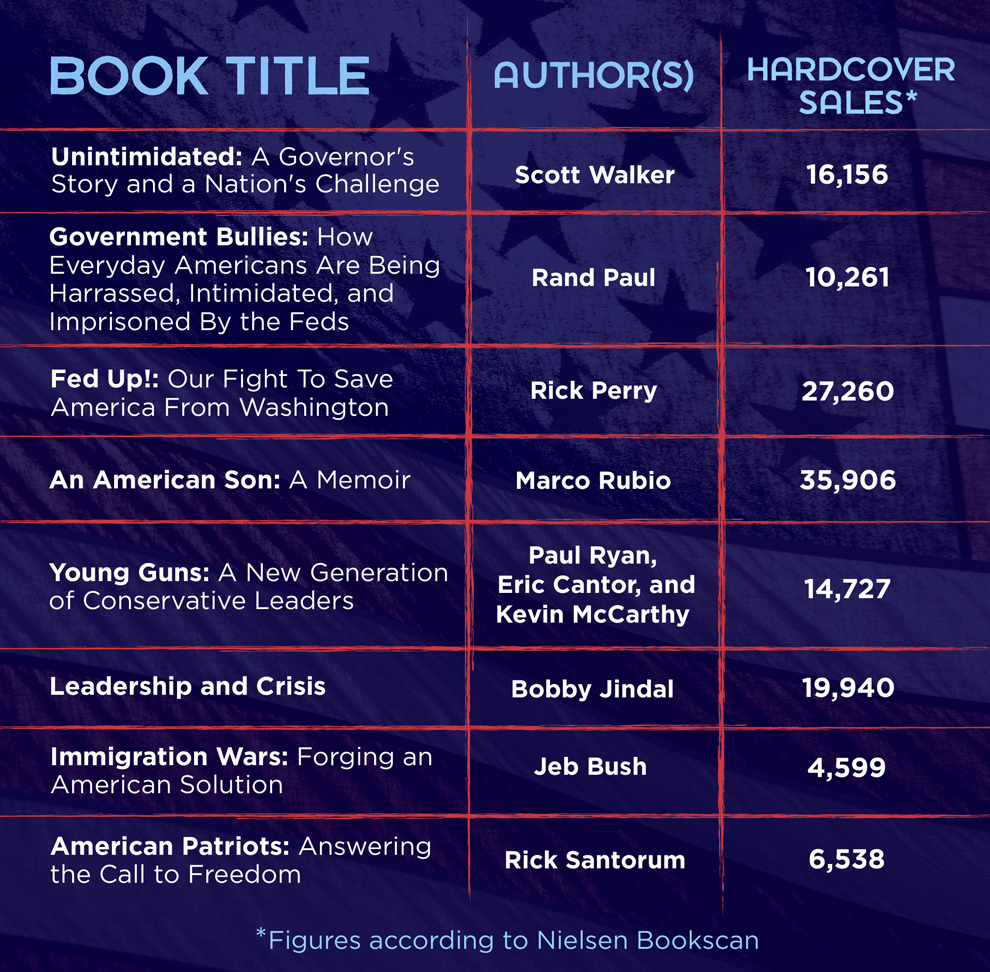
But one sub-niche that is definitely suffering is the pre-presidential-campaign book. Bizarrely, publishers still compete fervently to sign every last senator running a quixotic presidential campaign, on the off-chance that he might become president and then his book would sell spectacularly. But all but one of the candidates fails, and then the publishers have wasted their money. Just look at the pathetic sales some of these guys have generated [see chart above]

Drum blames Obama Derangement Syndrome:

Obama drove conservatives into such frenzies of hysteria that their books lost the potential to appeal to anyone except the most hardcore dittoheads. I mean, Ann Coulter built a whole career on writing ever more outrageous things in order to get a rise out of liberals, but what can you do when you’re competing with, say, Jerome R. Corsi, PhD? It’s hopeless. He makes Coulter look positively sedate.

When everyone turns the dial to 11, you aren’t a niche anymore. You’re just a crackpot fringe.

Will Russia Derail The Iran Deal?

by Patrick Appel

Rogin and Lake see it as a possibility:

Nobody knows if and how Russia will follow through on its threats to sacrifice the Iran talks to try rob Obama of the main diplomatic accomplishment of his second term as president. Russia could pull out of the so-called “P5+1” group—the world powers currently negotiating with Iran. Or Moscow could stop cooperating on international sanctions on Iran, easing pressure on Tehran and helping Russian businesses.

Roger Cohen casts doubt on the idea that Russia would cease working on the Iranian nuclear deal, noting that “Russia has its own interest in stopping nuclear proliferation, and even the Cold War did not preclude cooperation in some areas.” Larison isn’t so sure:

Moscow has been much less alarmed by Iran’s nuclear program than Western governments are. Russia may not want Iran to have nuclear weapons, but it seems much less worried that Iran is likely to acquire them. The other argument is that Russia doesn’t want to sabotage diplomacy with Iran because that would make U.S. military action more likely, but it’s not so obvious that it would greatly harm Russian interests if the U.S. and Iran couldn’t resolve the nuclear issue peacefully. Russia benefits in some ways from ongoing U.S.-Iranian hostility, and it is not harmed if the U.S. ends up waging yet another war in the Near East.

Walter Russell Mead makes related points:

[I]f Russia did manage to stop the talks dead, the result wouldn’t automatically be an Iranian bomb. The first result would be to put Obama into the horrible, no-win situation he has spent his whole presidency working hard to avoid: where his only two choices are military action against Iran and accepting an Iranian nuclear weapon. If (as the White House has continually insisted that he would) he goes for force, the United States gets involved in another Middle Eastern war, and Russia enjoys a huge financial windfall as oil prices skyrocket and a propaganda windfall as the United States (without a UN mandate, which Russia would take care to block) takes on yet another preventative war in a Middle Eastern country.

Or, alternatively, the United States endures its most humiliating and devastating foreign policy defeat in decades, leaving its prestige in tatters and its global alliance system fundamentally weakened as yet another of President Obama’s red lines, this one much brighter and deeper than the one in Syria, gets crossed—with impunity.

A New Low For Cable News

by Patrick Appel

http://youtu.be/LV6A4QiAkVw

Sarah Gary rounds up ridiculous cable news segments on MH370. Nick Martin tackles CNN’s Don Lemon, who is featured in the clip above:

Lemon has spent the last several days exploring every crazy conspiracy theory on the internet, like something out of InfoWars or an Art Bell broadcast.

On Sunday, he brought up the possibility that “the supernatural” was somehow involved in the disappearance. On Monday, he floated the idea that the plane could be hiding in North Korea. But [Wednesday] night, he really outdid himself, asking a former U.S. Department of Transportation inspector general whether the airplane was somehow sucked into a black hole. Yes, a black hole.

“I know it’s preposterous,” he said to her, “but is it preposterous?”

Abby Ohlheiser fact-checked Lemon:

A somewhat gruff Columbia astronomy professor named David J. Helfand told The Wire by email that, simply put, “black holes comparable to the mass of an airplane or somewhat bigger that could attract and swallow a plane do not exist.”

Even if a black hole capable of swallowing a plane out of the sky did exist, Peter Michelson, a professor of physics and Stanford University added, “a lot of other things would be missing as well.” when asked for examples of what we’d notice missing, Michelson said, “probably the Earth.”

Bateman piles on:

My problem is not that [individuals at CNN] are focusing on what they see as a story at the core of their capability because that is to be expected. And I do not mind at all that they are looking all over for experts. Quite a few of those they ring are obviously both professional and appropriate. My problem is that their reporters and some of their editors are doing so in such an incompetent manner.

Ambinder mounts an uncharacteristically unpersuasive defense of CNN. The strongest part:

The criticism of CNN is larded with slippery assumptions. One is that, at some point, CNN lost its way, and that’s why it no longer commands the respect and viewership it once did. That’s a tenuous theory. Competition, and CNN’s unwillingness to lose or change its ways in the face of it, helped fragment the national cable audience. We don’t get our breaking news now from cable. We get it from the internet, or radio (still). When CNN was the only place news junkies could plug in to, CNN could pretty much set whatever standard it wanted. Once Roger Ailes masterfully realized that partisan television could attract as many eyeballs as talk radio grabbed ears, most people’s expectations of cable news changed accordingly.

Jaime Weinman’s theory about why the story has boosted CNN’s ratings:

What can account for this split personality on CNN’s part, between the successful purveyor of big ongoing stories and the brutally unsuccessful network that operates on all the other days of the year? The clue might be in something veteran media analyst Brad Adgate said to Reuters last year: “CNN, despite its ratings woes, is still a destination network for the light and casual news viewers. They have been around longer than anyone else.” The people who follow something like the Flight 370 story may, in many cases, be people who don’t usually watch 24-hour news. But when a story breaks that they’re interested in following all day and all night, CNN is still the place they instinctively go. It has the brand name left over from the Gulf War in the ’90s; it has the resources for doing this kind of saturation coverage. CNN is the first network that comes to mind for this type of story.

But when there isn’t a story this juicy, with this kind of crossover appeal to people who aren’t news junkies, then CNN is lost.

Meanwhile, Chris Beam believes China was wrong to tell its media not to “independently analyze or comment on the lost Malaysia Airlines flight”:

News may be the one industry in which, rather than helping out domestic business, the Chinese government actively punishes it. China takes its international news efforts seriously, targeting overseas audiences with China Radio International, CCTV America, and China Daily—all key elements of the Party’s “soft power” push. But by forcing Chinese journalists to sit out a major story like MH370, they’re actively undermining their own quest for global influence.