America just dissolved the constitution and crowned Kate Middleton’s baby our new king
— eclecticbrotha (@eclecticbrotha) July 22, 2013
America just dissolved the constitution and crowned Kate Middleton’s baby our new king
— eclecticbrotha (@eclecticbrotha) July 22, 2013
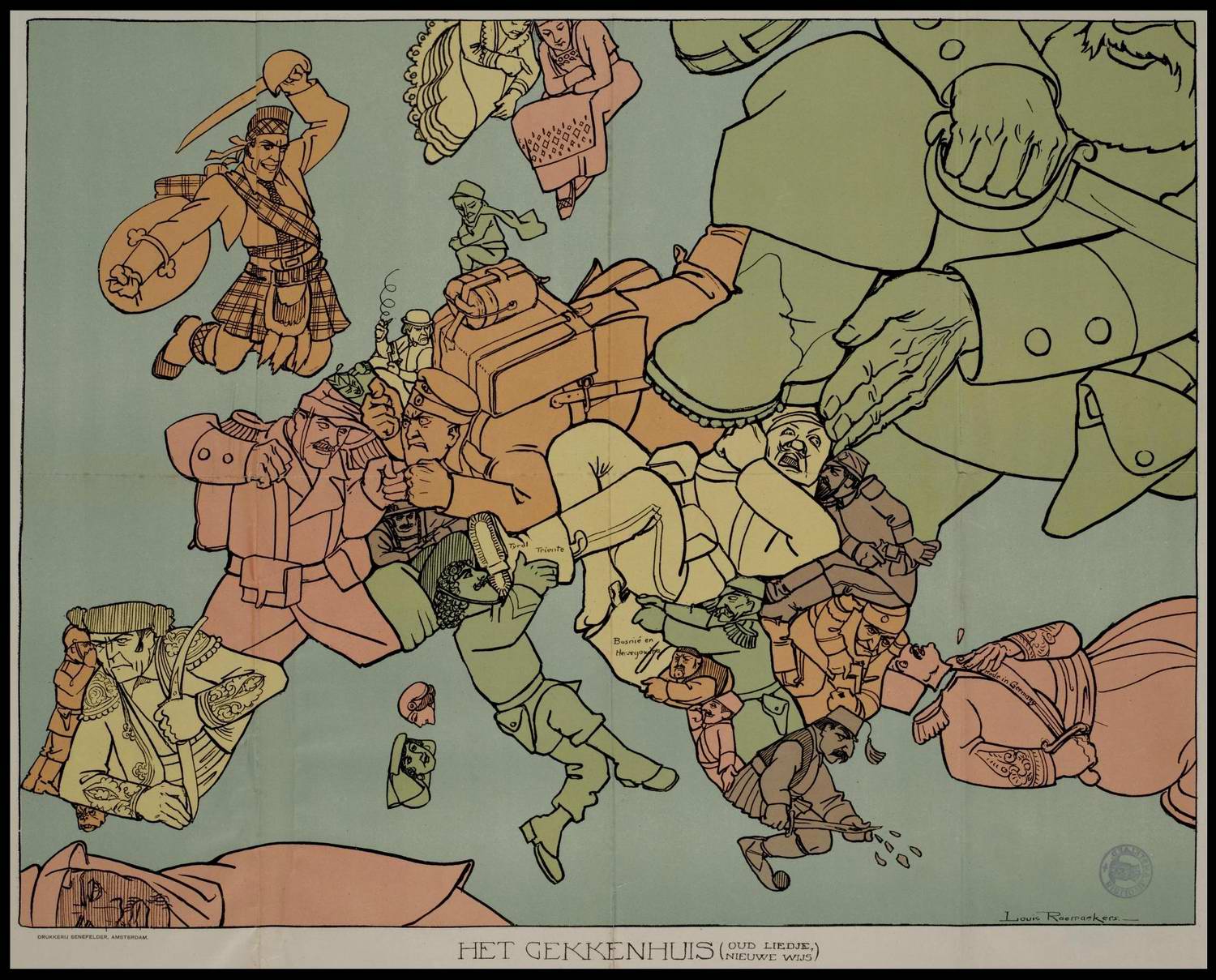
Laura Mallonnee studies the subject:
[M]aps as visual systems have never been objective, but are susceptible to manipulation–especially political censorship. Before statistics were widely available online from entities like the U.S. Census or the Center for Disease Control, the only mapmakers were either governments or large companies that could invest the capital to both gather the data and map it. Neil Alan, the current president of the North American Cartographic Information Society, pointed out that as a condition for its presence in China, Google currently lists the land contested in the Chinese-Indian border dispute as Chinese territory. Even color choice can be powerful. “Red is a warning, cautionary color, so you right away jade the readers by choosing the colors that you do,” he says.
In 2012, China put a map on its passport laying claim to a host of disputed territories, while in 2011, India forced The Economist to censor every copy of an issue featuring a map of Kashmir. In 2005, Mark Monmonier, author of How To Lie With Maps, wrote that maps by their nature are especially vulnerable to manipulation:
Most maps are massive reductions of the reality they represent, and clarity demands that much of that reality be suppressed. The mapmaker who tries to tell the whole truth in a single map typically produces a confusing display, especially if the area is large and the phenomenon at least moderately complex. Map users understand this and trust the mapmaker to select relevant facts and highlight what’s important. … When combined with the public’s naive acceptance of maps as objective representations, cartographic genrealization becomes an open invitation to both deliberate and unintentional prevarication.
Recent Dish on the power of maps here, here, and here.
(Image of a Dutch map from 1915. More propaganda maps here: “They were obtained from the University of Amsterdam website where you can zoom in to high magnification. [via Briefe an Konrad]”.)
A reader writes:
I want to echo what your reader said about his connections tethering him to the world. I
absolutely share the sentiment. I have an objectively great life, full of privilege, but I feel as if I’m always carrying around a massive dark truth about reality. At some point in my early 20s, I read a lot of existential philosophy and have been managing an existential crisis ever since. I purposely create responsibility and connections in my life to keep myself from being able to consider ending it. If I didn’t have my dog to take care of (and a family some day in the future, hopefully), I’d look at life in a “I could take it or leave it” manner.
Another reader:
I’ve never really responded to any of your posts but I felt compelled to write in about your new thread on suicide. Describing suicide as “among the most selfish acts” really resonated with me. In fact, it’s the exact lesson I learned after my failed (thankfully) suicide attempt at the age of 14.
I was in a coma for three days and I woke up to absolute devastation around me.
My parents, brother, and friends were horribly affected. For years afterwards my mother suffered from a sort of PTSD, having frequent and intrusive flashbacks to the memories of finding me unresponsive in my bed, carrying me to the car, and driving me to the hospital. At the age of 14, I learned that my life is really not mine alone to do what I please. Although I had no “dependents” (my own children, an animal), I realized that other people’s happiness, emotional and physical wellbeing did depend on my continued existence.
I am now 27, and though I have struggled off and on with thoughts of suicide throughout my young adult life (thankfully less and less as I grow older), I have never seriously considered taking my life again. It probably seems morbid, but I would often picture my family and friends if I were to take my life again, how terrible it would be for them, and it gives me a strange motivation to keep on going.
At the age of 14, I simply was not able to comprehend the complex ways that my life intersected and affected those around me. Whenever I hear or read about teenagers taking their life, I think about how it might be possible to impart this same lesson on young people without needing a failed suicide attempt to learn it.
Another:
My brother committed suicide three years ago. Suicide leaves many questions, and not enough answers. I did a lot of reading on suicide after my brother died to try and find some answers. You might be interested in the research by Dr. Thomas Joiner. His theory on suicide is right on the mark, in my opinion. Three pillars: 1. Burdensomeness, which leads to the mistaken belief that your death is worth more than your life to others 2. Loneliness/Alienation 3. A fearlessness of death that builds up over time. All three need to come together at the same time, like a perfect storm.
Another:
My father committed suicide about two years ago, and one of the hardest things to think about is whether he knew how much his family all loved him. We know he loved us. We don’t see his suicide as some big middle finger at us. But what keeps me up at night is wondering whether, in his last moments, he understood how deeply we wanted him in our lives. If he knew that and still committed suicide, so be it. His was the result of a long and terrible struggle with depression, and I can appreciate that he desperately needed to find peace. But if he left us without knowing that; if his depression prevented him from seeing it – well, what a terrible world.
Once trapped in an elevator with a rent-boy, he’s now set to run the Vatican Bank. And why not? If the Vatican were intent on only hiring straight men to high positions in Rome, they’d always be coming up empty. Which is not to dismiss the absurd, foul, laughable hypocrisy of the entire charade. Just to smile at its lofty and manifestly preposterous pretensions.

Apaioa, Spain, 10.45 am
Weigel assesses the Wyoming Senate primary:
Harper Polling, the first company to take a temperature in the Wyoming GOP Senate primary, returns with a bevy of bad news for Liz Cheney. In a trial heat with Sen. Mike Enzi, she trails him 55-21. … There’s no way Enzi ends up winning by 34 points, but Cheney has to do an unheard-of amount of damage to him to close in.
Harry Enten believes that Cheney is going to lose:
In order to successfully challenge someone in a primary, you need to be more popular than the incumbent. Enzi is actually the more popular one.
He sports a 76% favorable rating against just 6% who see him in an unfavorable light. Despite being less well known, Cheney has a higher unfavorable rating at 15%. Her favorable rating, meanwhile, is 31pt lower at 45%. That will go up as the campaign goes on, but so will her unfavorable rating.
You might be wondering whether or not Cheney’s connection to her father Dick will help her during the campaign. The former vice-president does have a 58pt net favorable rating, yet that’s significantly less than Enzi’s 70pt net favorable rating. The younger Cheney is going to have to come up with a better strategy than just connecting herself to her father if she wants to win.
Larison thinks that running as a Tea Partier won’t work for Cheney:
To think of this challenge as a Tea Party-style insurgency is to get things backwards. That sort of insurgency requires someone to pose as an opponent of political insiders and a critic of the current party leadership in Washington, and Cheney is neither of these. She might try to use the rhetoric of an insurgent candidate, but it will be impossible to miss that Cheney’s run is backed by outside money and Washington connections. It will be an exceedingly cynical attempt to exploit anti-Washington sentiment in order to entrench a family dynasty in national politics.

Ann Friedman ponders women’s hesitancy to identify as marijuana users:
In pop culture, “stoner” and “slacker bro” are practically synonymous. The modern slacker-stoner, [professor of sociology Wendy] Chapkis writes [pdf], “resists the conventional expectations of manhood” to be an ambitious breadwinner, as well as the sixties political, countercultural associations with weed. He’s just kinda … hanging out. “The slacker attitude relies on a mismatch between expectation and condition; this is why it is most available to white heterosexual men with some measure of class privilege,” Chapkis writes. “The slacker’s refusal to work hard and assume ‘adult’ responsibilities doesn’t function quite the same way for people of color and women who are already saddled with a stereotype of dependency.”
This is perhaps why so many women are hush-hush about their kush. Most women I spoke with said they didn’t feel they could publicly own up to their marijuana use, even in cases where it was truly for medicinal purposes. “I do not feel part of a ‘weed culture,’” a Canadian woman wrote me. “I am not someone you would ever suspect smokes pot. I’ve always been kind of proud of that fact. I have my shit together.” This sentiment was covered in a great 2009 Marie Claire feature on “stiletto stoners,” women who dominate in the workplace and opt for weed over white wine when it’s time to unwind at home. “One in five women who admitted to indulging in the previous month lives in a household earning more than $75,000 a year,” according to the article.
Previous Dish on women and weed here, here, here and here.
(Photo: Alfredo Estrella/AFP/Getty Images)
Compare this map on social mobility:
 With this:

A reader observes:
An interesting thing to note about the map: the deep red areas in the South are the so-called “black belt,” the majority African-American counties that remain devastatingly poor. Note that the other deep red areas – northeast Arizona, southern South Dakota – are majority Native American. Interestingly, the white south – Appalachia, Cajun Country and the area around the Gulf, the Florida Panhandle – is not red at all.
To me, it says less about Red State politics (though it still does, indirectly) than it does say about how much harder it is for poor people of color to have a chance to succeed. The Red States seem pretty good about taking care of their white, GOP brethren, even the poor ones – that’s why you’ll note Utah is so mobile.
Also, note the impact of the oil boom in the Dakotas and Wyoming – the turquoise colored counties that go up the spine of Montana/the Dakotas/Wyoming that suggest the huge amount of money that has been pumped into the economies there.
Boycotting Putin over Snowden (a product of our sloppiness) would be silly; over Navalny would be symbolic
— Zbigniew Brzezinski (@zbig) July 21, 2013
Russian activist and Moscow mayoral candidate Alexey Navalny was released from prison on Friday. Masha Lipman expects he will be jailed again in the near future:
His and his co-defendant’s conviction will most likely be confirmed by a higher court. Even if the eventual sentence is shorter than five years, it will still disqualify him as a political candidate. And if the reëxamination of the charges is scheduled for before the mayoral election, on September 8th, the Navalny campaign would have to be terminated midstream. Navalny’s fate is in the hands of Russia’s most powerful decision-makers. But although he remains securely on the hook, right now he’s free—and he’s going to use his freedom to the full.
Julia Ioffe suspects that Navalny was released so he can lose at the ballot box:
If Navalny runs against [current major Sergei] Sobyanin, he will surely lose—in the polls, he still has yet to break into the double digits, and Sobyanin enjoys all the perks of a relatively popular incumbent. Navalny losing is a way to neutralize him. The Kremlin can then say, “Look, buddy, you lost fair and square. You are not a real contender.” But given that the protest movement was basically Moscow’s rage at massive election fraud, the race has to at least appear to be maximally fair. Which is why Sobyanin is going out of his way to help Navalny, even helping Navalny clear the candidate registration hurdle. (This is normally the step where the state neutralizes opposition and keeps them off the ballot.)
Max Fisher’s bottom line:
Don’t bet against the Kremlin. As difficult as it is to know why this has happened, what Russian officials are planning and what will happen next, this is still a high-stakes political case in Putin’s Russia. The end result, however we get there, is unlikely to favor Navalny at Putin’s expense.
Adam Pasick examines the Chinese public’s largely sympathetic response to Beijing airport bomber Ji Zhongxing:
If Ji Zhongxing had set off a hand-made explosive in an airport in most other countries, he would be labeled a terrorist. But Ji, who was protesting a beating by local government officers in 2005 that left him paralyzed and in a wheelchair, is being hailed as a hero by many Chinese social media users. What’s more, officials in Guangdong, where Ji previously ran an unlicensed motorcycle taxi service, have been ordered to reopen his case.
The unusual reaction highlights the fact that many Chinese are becoming increasingly outraged at cases of official misconduct, especially thuggish behavior by municipal urban management officers known as chengguan, who are known for heavy-handed crackdowns against street vendors and other independent businesses. There have been been several high-profile violent incidents involving chengguan in recent weeks, including a watermelon vendor in Hunan province who was beaten to death.
Notably, Ji warned away bystanders before detonating the bomb and injured only himself. Pasick notes that “not all of China’s frustrated citizens have been so considerate”:
In May, a Xiamen man named Chen Shuizong, angry that officials refused to correct an error in his identity documents and give him social security benefits, killed 47 people including himself by setting a public bus on fire. By comparison, Ji was described as a “good person” by social media users, and discussion of his action was not censored by Chinese internet authorities.
That jibes with the response found on Weibo, the Chinese microblogging site:
Most of the comments on Chinese social media expressed sympathy for Ji, seeing him as a victim of social and political injustice. Ji has started writing his experience in a blog since 2006; Feng Chingyang (@风青杨V) reviewed his blog and concluded:
I finished reading Mr. Ji’s blog and found out that he was beaten and became crippled because of running an illegal motorcycle taxi. His family was in debt and they could not get any reasonable compensation after years of petitioning. His parents had passed away and his heart also died with them. I don’t agree with the way Mr. Ji handled his misfortune. However, if we don’t want to see another Mr. Ji in this country, we have to pay attention to the root of matter. He was a normal person in the very beginning, what made him abnormal?
Weibo user “South of the Sea” warned that China can expect more of the same:
All citizens who have faced injustice are a time bomb! To deactivate the bombs, grievances have to be channeled and addressed. Maintaining social stability through political control and repression is a dead end.


