The Grilling Of Howie Kurtz

A remarkable interview on his own show:

This embed is invalid


The Daily Download thing I remain befuddled by. But it may simply have been a career insurance policy – developing skills in web-TV. Obviously, er, not a successful strategy. But CNN and Kurtz deserve props for this brutal grilling. They seem to get why a media critic cannot become his own story.

A FISA Rubberstamp

David Kravets looks at the approval rate for the Foreign Intelligence Surveillance Court:

A secretive federal court last year approved all of the 1,856 requests to search or electronically surveil people within the United States “for foreign intelligence purposes,” the Justice Department reported [last] week. … The 2012 figures represent a 5 percent bump from the prior year, when no requests were denied either. The secret court, which came to life in the wake of the Watergate scandal under the President Richard M. Nixon administration, now gets the bulk of its authority under the FISA Amendments Act, which Congress reauthorized for another five years days before it would have expired last year.

Greenwald sees this as an indication of how a “drone court” might function:

[D]oes anyone believe that a “drone court” would be any less of a mindless rubber-stamp than the Fisa court already is? Except for a handful of brave judges who take seriously their constitutionally assigned role of independence, the vast majority of federal judges are far too craven to tell the president that he has not submitted sufficient proof that would allow him to kill someone he claims is a Terrorist. The fact that it would all take place in secret, with only the DOJ present, further ensures that the results would mirror the embarrassing subservience of the Fisa court.

Will Obamacare Make America Healthy? Ctd

w-medicaid2

Ezra Klein takes the long view of the Oregon Health Study, which showed little to no improvements in health among Medicaid enrollees over a two-year period:

[T]he study was simply too small, with too few sick people, to show the kind of quick health changes the researchers were looking for. Sharply increasing the number of people who are managing their diabetes and mental health, getting colonoscopies and mammograms, and making regular trips to the doctor sure seems like the kind of thing that will improve long-term health outcomes. Other studies with a less rigorous — but still credible — design and a longer timeframe have shown that states that expanded Medicaid saw a six percent drop in death rates among the newly insured group. …

I’ve seen my doctor a few times over the last two years. None of those visits had any measurable impact on my health. But if something had been wrong on one of those visits, the story would be very different. I have health insurance not because it improves my health on any given day, but because regular access to the medical system will, presumably, improve my health over time.

I get that. But if expanding Medicaid does not make people measurably healthier, the cost and benefit equation needs reviewing. I do think the study needs replicating and needs to be undertaken on a longer time scale. But, as it stands, it’s a strong argument for universal catastrophic insurance, which includes mandatory check-ups for preventive care. Drum takes issue with the study’s methodology. Beutler’s criticism:

[The] Oregon study was not designed to address the excess deaths issue, just like studies on insurance’s impact on mortality aren’t designed to test its impact on various health measures across the population. But of course, most real-world excess death studies link tens of thousands of deaths a year to uninsurance. That’s a very small percentage of the millions of uninsured in the United States. But I doubt even Medicaid’s loudest critics would shrug off 10,000 or 20,000 preventable deaths a year in most other contexts.

Chait responds to the digs from conservatives:

Okay: The case for Medicaid expansion is not as strong as I had thought. Now for the caveats: The case for Medicaid expansion is overwhelmingly strong. If a study found that puppies survive steep falls at a higher rate than expected, then you could say the case for throwing puppies out of skyscraper windows has marginally weakened, but would remain extremely strong. Indeed, data notwithstanding, either throwing puppies out of skyscrapers or throwing people off Medicaid are both acts of sadism.

The United States has very high levels of income inequality, a very stingy welfare state, and is the only advanced economy that does not guarantee access to medical care. The Oregon study does not raise particular questions about the efficacy of Medicaid; it raises questions about the efficacy of medical care in general. Measuring the impact of medicine is just really hard to do, yet almost nobody would volunteer to follow this frustrating fact to its logical conclusion and forgo the benefits of modern medicine.

Yes, but since Medicaid is paid for entirely by others, it seems only fair that they be persuaded that it’s actually value-for-money. Douthat’s take on the study:

[I]f it turns out that health insurance is useful mostly because it averts financial catastrophe — which seems to be the consensus liberal position since the Oregon data came out — then the new health care law looks vulnerable to two interconnected critiques.

First, if the benefit of health insurance is mostly or exclusively financial, then shouldn’t health insurance policies work more like normal insurance?

Fire, flood and car insurance exist to protect people against actual disasters, after all, not to pay for ordinary repairs. If the best evidence suggests that health insurance is most helpful in protecting people’s pocketbooks from similar disasters, and that more comprehensive coverage often just pays for doctor visits that don’t improve people’s actual health, then shouldn’t we be promoting catastrophic health coverage, rather than expanding Medicaid?

Liberals don’t like catastrophic plans because, by definition, they’re stingier than the coverage many Americans now enjoy. But this is where the second critique comes in: If the marginal dollar of health care coverage doesn’t deliver better health, isn’t this a place where policy makers should be stingy, while looking for more direct ways to improve the prospects of the working poor?

He puts the point delicately, but it’s a very powerful one, it seems to me. Pete Spiliakos builds on Ross’ recommendations:

Republicans could argue for moving health care financing to a model of catastrophic health insurance coverage, plus coverage for routine preventive care, plus health savings accounts to pay for non-catastrophic health care costs. James Capretta has been working on this [pdf]. Republicans would be able to plausibly argue that their plans would maintain the health care security of middle-class families while reducing health care premiums and expand health insurance coverage for low-earners at lower cost to taxpayers than Obamacare. Republicans can be the party of health care security and more take home pay and lower spending. C’mon people. You can do this.

If we had a sane and pragmatic GOP, this would have been the critique in the first place, together with a program for national catastrophic insurance on the lines Spiliakos suggests. That would have elevated and deepend the debate all round – but ideology and partisanship obscured it. Barro believes the Oregon report reveals insight into a key weakness of the ACA:

Obamacare relies mostly on bureaucratic approaches to achieving cost control. … [Liberals] are right to note that conservatives’ preferred alternative to Medicaid expansion (leaving tens of millions of people uninsured) would be worse for quality of life. But the lesson of the Oregon Health Study is nonetheless that there’s cost-effectiveness information out there that Medicaid and other health insurers aren’t exploiting. And even though conservatives have generally done a terrible job of explaining why, conservative ideas about increasing consumer direction in health care could help to exploit that information and make health care more cost-effective — without repealing Obamacare or stopping the Medicaid expansion.

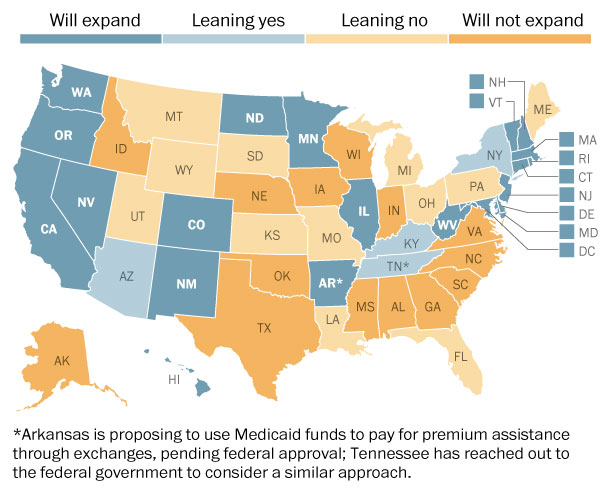
I have become far less confident that patients can act as real consumers in the healthcare marketplace. There’s such an imbalance of knowledge and the consumer is almost always desperate for a solution, with no leverage to bargain with. Meanwhile, the Florida legislature just adjourned without providing funds for a Medicaid expansion, “join[ing] 24 other states that have either decided against expanding Medicaid, or are leaning in that direction, according to analysts at Avalere Health [who created the above chart].”
A Couple Of Words On Niall Ferguson, Ctd

A reader writes:

The man who apologizes with real contrition and full acknowledgement of the depth and wrongness of his failure is perhaps a greater man than one that never puts his mouth wrong.  God knows we have plenty of shit banging around on the inside of our heads. It is in the base nature of man to wish to demean his fellow and exalt himself.  When it leaks out/misfires, it the mark of a true human being that can fall on his sword in contrition.

Other readers aren’t willing to let Niall off the hook:

Please try to separate your personal relationships from the bigoted nasty things some people say in public. Ferguson’s apology is insincere at best, since he has apparently held those views for many years:

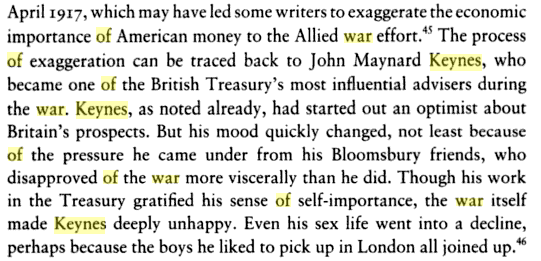
[A]s pointed out on Twitter by Justin Wolfers, there’s this passage in Ferguson’s 1999 book, The Pity of War:

Screen shot 2013-05-04 at 3.08.43 PM

So it seems this is a theory Ferguson has held for a while, that Keynes’ boy-kissing affected his policy somehow. It wasn’t an “off the cuff” remark he made at a conference when Ferguson thought he was just speaking to his finance bros who wouldn’t mind a little joking about the gays with their theory. It’s an argument he made in print and published fourteen years ago.

And from page 400 of The Pity of War:

There is, however, no question that a series of meetings with one of the German representatives at Versailles added an emotional dimension to Keynes’ position. Carl Melchior was Max Warburg’s right-hand man (……..) It may be that Keynes’ subsequent declaration that he ‘got to love’ Melchior during the armistice negotiations at Trier and Spa obliquely alluded to a sexual attraction. As we have seen, Keynes was an active homosexual at this time. However, it seems more likely that Keynes was simply captivated by the sound of his own pessimism…..

I read both those passages and I simply see a historian dealing with the facts of Keynes’ private life. I don’t see any homophobia in there myself. Another reader:

No doubt there is much to say about Niall Ferguson’s lapse into the homophobia latent in our culture, and his apology, and also about the truths of gay life in all of its dimensions. But shouldn’t this also be an occasion to reflect on Ferguson as an intellectual who claims special expertise on economic history and economic policy and international affairs? Keynes, after all, famously wrote on all of these subjects. How could a scholar so mangle Keynes’s quotation about “the long run,” as you noted?

Ferguson’s assertion about Keynes’s economic thought was no passing mistake. It was programmatic. It was ideological. It was about dogma – not history, not economics as a scholarly field. And it was in that context that Ferguson’s deployment of homophobia was not accidental, no matter that homophobia is not a character trait of Ferguson. The issue here is not only homophobia, but also intellectual bad faith.

Another notes:

Small sidepoint: Adam Smith, who said that Burke was “the only man I ever knew who thinks on economic subjects exactly as I do, without any previous communications having passed between us,” was a lifelong bachelor who never had children.

Rumsfeld vs The Rule Of Law

dogs2

A fascinating post at Empty Wheel has a legal argument that is beyond my expertise to judge. But it does include a detail from the dark days of 2001 – 2006 that helps underline how central torture was to the Bush-Cheney administration’s entire approach to counter-terrorism, and how passionately they believed in torturing prisoners. On December 30, 2005, the Congress finally banned torture by the US military in the Detainee Treatment Act. No “cruel, inhuman or degrading treatment” was allowed – a broader category than the torture techniques Bush and Cheney cribbed from totalitarian states. What did Rummy do?

In spite of this clear command, the same day Congress passed the DTA, Mr. Rumsfeld modified the Field Manual to include the cruel, inhuman and degrading techniques described above. He karpinski-rummyadded ten pages of classified interrogation techniques that apparently authorized, condoned, and directed the very sort of violations that Plaintiffs suffered. To the best of Plaintiffs’ knowledge, the December Field Manual was in operation during their detention. It was not replaced until September 2006, shortly before Mr. Rumsfeld resigned.

If anyone still thinks that torture somehow happened without the active involvement and close control of Donald Rumsfeld and Dick Cheney and George W. Bush, you need, alas, to look at the facts. These men had contempt for the rule of law, contempt for Western civilization and contempt for the very country they were trying to defend.

Whatever else these individuals were, they were not conservatives. They were lawless radicals, intent on war crimes. And it appears they will never be held accountable by the very rule of law they ignored and abolished.

The Carnivore’s Carbon Footprint

It’s pretty big:

In their report, [World Bank advisers Robert Goodland and Jeff Anhang] note that when you account for feed production, deforestation and animal waste, the livestock industry produces between 18 percent and 51 percent of all global greenhouse gas emissions. Add to this the fact that producing animal protein involves up to eight times more fossil fuel than what’s needed to produce an equivalent amount of non-animal protein, and you see that climate change isn’t intensified only by necessities like transportation and electricity. It is also driven in large part by subjective food preferences — more precisely, by American consumers’ unnecessary desire to eat, on average, 200 pounds of meat every year.

Meanwhile, Mark Bittman’s new book, VB6, recommends going vegan before 6 pm as a way to eat environmentally and lose weight, with the added benefit that “I can eat whatever I want in the evening, thus hanging out with my friends without appearing weird.” Tyler Cowen is on board:

As I’ve argued in my own An Economist Gets Lunch, eating less meat is the most socially beneficial change in your dietary habits you can make.  Here’s one very good way to do it. Of course the economist in me wonders why Bittman chose “vegan before 6 p.m.” rather than after 6 p.m. or for that matter after some point closer to the middle of the day.  Is it simply two meals vs. one?  Or is it that the prospect of meat and dairy in the evening makes vegan eating during the day more tolerable, whereas the opposite would require too much retrenchment to be sustainable?

What Really Made The South Republican? Ctd

image001

A reader created the above chart:

Last night I decided to fact-check Sean Trende’s argument, namely that:

the white South began breaking away from the Democrats in the 1920s, as population centers began to develop in what was being called the “New South”… . In the 1930s and 1940s, FDR performed worse in the South in every election following his 1932 election. By the mid-1940s, the GOP was winning about a quarter of the Southern vote in presidential elections

The evidence simply does not tell this story.  I examined and charted nine southern states: Virginia, North Carolina, South Carolina, Georgia, Alabama, Mississippi, Tennessee, Louisiana and Arkansas  (the Confederacy minus Florida and Texas) to see how the Republican presidential candidates performed relative to the nation as whole from 1916 to 1972. There was no improvement by Republican presidential candidates in the south in the ’20s, ’30s and ’40s.  In 1916, the GOP ran 18.9% points lower in these nine southern states than the country as a whole.  By 1948, the GOP was running exactly … 18.9% points lower.   Republicans had a relatively good year in the South in 1928, when Democrats nominated Al Smith, a New York Catholic.  Otherwise, GOP presidential candidates traded in a fairly narrow range in the South during these three decades.

Trende says that FDR’s winning margins declined in the South with each election.  This ignores that fact that FDR winning margins declined nationwide with each election.

When you adjust for that fact, you can see that Republicans underperformance in the South stayed about the same through four FDR elections with no obvious trend:  – 19.4% in 1932, -16.1% in 1936, -23.0% in 1940 and -18.7 in 1944.

Trende says that “by the mid-40’s the GOP was winning about 25% of the Southern vote in presidential elections”.  Yes.  But in these combined nine Southern states, the GOP had already captured 27.2% of the vote in 1916, 38.2% in 1920, 30.97% in 1924 and 45.16% in 1928.  Breaking 25% in the late ’40s was not something impressive or new for the GOP in the South.

Moreover, Trend’s thesis – that affluence spurred by the growth of cities and towns is what drew Southerners to the GOP – is completed belied by the data.   The two states with the biggest swings – from monolithically Democratic in 1920s to gaga for Goldwater in 1964 – were Mississippi and South Carolina, two states know more for their deep plantation roots than for bourgeoning metropolises.

Trende is right that a big breakthrough for the GOP in the south came in 1952 (well before the Civil Right Act of 1964).   He suggests that this attraction can’t have be driven by racial hostility since Eisenhower was sympathetic to civil rights.  However, this totally ignores what was happening on the Democratic side.   Southern delegates walked out of the Democratic convention in 1948 when Humphrey called for an end to Jim Crow and formed their own protest party (the Dixiecrats) whose chief objective was to uphold segregation.  Shortly thereafter Truman de-segregated the military.

While Democrats still had a large bloc of Southern representatives and would be less supportive of civil rights legislation in ’50s and ’60s because of it, by 1948 the Democratic leadership was signaling that is was no longer going to uphold the Southern segregation.  This encouraged many white southerners to abandon the national Democratic party (if not their own local Democratic party just yet) and to view the two parties through the prism of other issues.  That is what allowed the GOP to start making big gains in the ’50s and ’60s.

Another reader:

Geez, Trende has discovered something that students of Southern politics have known for a long time: that Republicanism was gaining in the postwar South, at least in the “Rim South.”  But he seems unaware of why.  Yes, Eisenhower sent the 101st into Little Rock, but he was constitutionally required to uphold federal authority. It was well known that Eisenhower was at best a reluctant supporter of Brown and federal civil rights legislation.

More to the point, the big story in Southern politics after 1948 was the widening gulf between Southern Democrats and the National Party.  Not only did you have the short-lived Dixiecrat movement in 1948, but its successors increasingly played footsie with the Republicans without formally leaving the party.   Increasingly homeless and unable to make the traditional case that voting Democratic was the best means of maintaining white supremacy, it’s hardly surprising that Southern conservatives who had never especially liked the New Deal would move toward the Republicans.  To be sure, Republicans for a long time drew their votes from the urban and suburban middle class; working-class whites remained Democrats, often out of gratitude for the New Deal (I remember sitting in a barber shop in Upstate SC around 1970 hearing an old white guy say, “Don’t tell me about the Republicans; I lived through the Hoover time!”), partly out of hostility to the “country club” set, but in any case because they didn’t have to choose between local Democrats and Republicans on race.

But as long as I’ve been politically aware (and I’m 65, and a lifelong South-watcher), Republicans were openly competing in the South for the anti-civil rights vote, arguing that the real threat to the “Southern way of life” were those traitorous Yankee New Dealers.  The first serious statewide run by a Republican in South Carolina was W. D. Workman’s Senate bid in 1962; Workman was a journalist best known for being the author of a segregationist screed titled The Case for the South.  This was the face of Republicanism in my home state.

But, again, there was no real difference on race between them and the Democratic establishment in the South until after 1965, when the Democrats executed one of the great pivots in American political history and reinvented themselves as a biracial party.  It still took the Republicans some time to supplant the Democrats as the “white” party, though, because of that lingering “country club” stigma; they did so by increasingly openly identifying with white southern culture – Confederacy, NASCAR, Southern Baptist religiosity, the “culture wars” generally.

Yes, it’s a complicated story; but Southern Republicans have exploited, if not racism per se, opposition to government solutions to racial discrimination, for as long as I’ve been alive.

From Science Fiction To Science Facts

Zombie thought experiments are effective teaching tools:

When you’re the last survivors of the human race, there are some very pertinent questions you must ask:

“How would you protect yourself if infection was spread through the air versus only spread by biting?”

“How well would isolation of infected people work if the incubation period is very long versus very short?”

“Why might you want to thoroughly wash your zombie-killing arrows before using them to kill squirrels, which you will then eat?”

In infectious disease terms, these are referring to the 1) vector of transmission (how does the virus travel), 2) length of incubation (how long does it take before you start passing on the disease and 3) cross-contamination (disease moving from one object to another). But this is much more interesting than talking about “why should you wash your hands before eating dinner,” especially when talking to kids.