“It Just Wasn’t That Type Of War”

Remains Of Two-Star General Killed In Afghanistan Returned To US

Elliot Ackerman, who served as an adviser to Afghan special ops forces from 2008 to 2011, revisits the rationale behind the long-drawn-out American entanglement in the Graveyard of Empires. In his Afghanistan days, he writes, “words like ‘win’ and ‘end’ weren’t part of our vocabulary. These days, such words seem even less well suited to that war”:

John Paul Vann, a U.S. official in Vietnam and the subject of Neil Sheehan’s “A Bright Shining Lie,” said of that war, “We don’t have twelve years’ experience in Vietnam. We have one year’s experience twelve times over.” The same could be said of Afghanistan. Because Afghan commanders like Kareem often work in the same provinces for decades, they see an unending stream of their U.S. counterparts come and go, fighting smaller, months-long wars amid their unending one.

When Kareem and I sat for our meetings, neither of us ever offered a plan like this: “If we hit them in Mangritay, they’ll have to move south to Rarakaray. Then we’ll hit them there, forcing them across the border, securing the district, then maybe the province, allowing me to go business school and you to tend a quiet plot of land in the shadow of the Hindu Kush.” It just wasn’t that type of war.

For professional military officers, Afghanistan is an important stop in any career, a place to earn your combat bona fides. For many servicemen, those volunteering for multiple tours, it’s been a refuge from the drudgery of garrison life. For the Afghans, the war isn’t fought for the winning. It’s been going on since 1979, a beat to walk, something to police. Cops don’t talk about winning the war against crime. They fight it, but they don’t win it. Kareem and other Afghan commanders with whom I worked thought of war in the same way.

Recent Dish on our war in Afghanistan here and here.

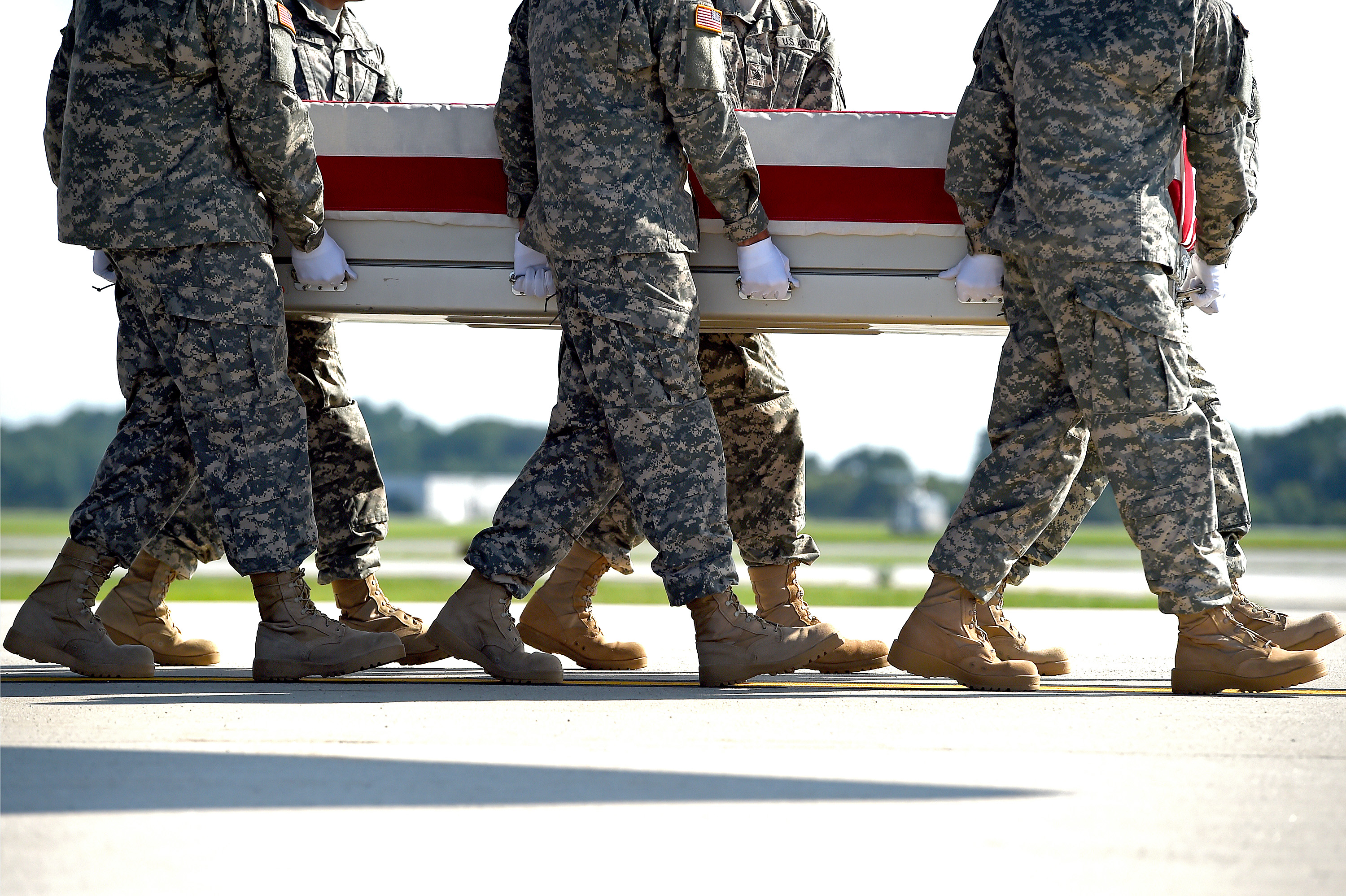
(Photo: U.S. Army soldiers carry the flag-draped transfer case containing the remains of U.S. Army Maj. Gen. Harold J. Greene during a dignified transfer at Dover Air Force Base on August 7, 2014 in Dover, Delaware. By Patrick Smith/Getty Images)

Obama’s Iraq Strikes And Executive Power

Thousands flee Iraq's Mosul

Ed Krayewski’s not so sure Obama’s decision to re-intervene in Iraq is a good idea, but he’s positive that intervening without Congress’s formal sanction is a bad idea:

As a murderous regime intent on dragging the Middle East back into the Dark Ages makes advances in the region, it’s worth remembering how governments there have encouraged virulent strains of extremist Islam as a way to maintain their own power. If the U.S. were to intervene to defeat ISIL, it would almost certainly cause more harm than good. Yet with ISIL hunting down minorities in Iraq and the Iraqi government powerless to do anything to stop them, the question of whether the U.S. ought to intervene to protect those civilians from ISIL and a situation U.S. policy helped create is a harder one to answer. President Obama’s decision to order limited air strikes in this situation may not be the wrong call. But, given the last half century of U.S. war policy, he will certainly bypass Congress despite claiming to “consult” it. Making the decision unilaterally, outside the constitutional framework, will be the wrong call.

Ilya Somin cautions Obama against escalating unilaterally:

It is possible that the military action envisioned will indeed be so small-scale that no congressional authorization is required. But what if it turns out that very limited strikes and stepped-up assistance for Kurdish and Iraqi government forces are not enough to impede ISIS’ advance? In that event, any significant increase in US military involvement would require congressional authorization.

In addition to meeting constitutional requirements, congressional support could also give military intervention valuable political legitimacy and staying power. If the president goes in on his own, political support could evaporate quickly if anything goes wrong. Since he alone would bear the blame, congressional leaders – especially those from the opposition Republicans – would have every reason to hang him out to dry. For that reason, among others, it is generally better to enter a war only if there is a broad political consensus in favor of doing so, including both the president and Congress.

But Jack Goldsmith expects that Obama’s views on his constitutional prerogatives to fight Islamist terrorism are becoming more expansive, by dint of necessity:

Wanting to declare the statutory war against Islamist terrorists over, the administration has long maintained that the residual use of Article II in this context will be exceptional and limited.  Given the large and growing nature of the Islamist threat, not just in Syria and Iraq, but elsewhere, I do not see how the President can protect U.S. national security interests with exceptional and limited uses of force under Article II.  Put more simply, the threat is not limited, and neither can (or will) be our response.  The current crisis in Iraq might be a test of this view, and of whether the Congress and the nation are comfortable with a President using force in its name under the broad, unilaterally determined parameters of self-defense, or whether it wants more formal and defined input and guidance and limitations from the legislature.

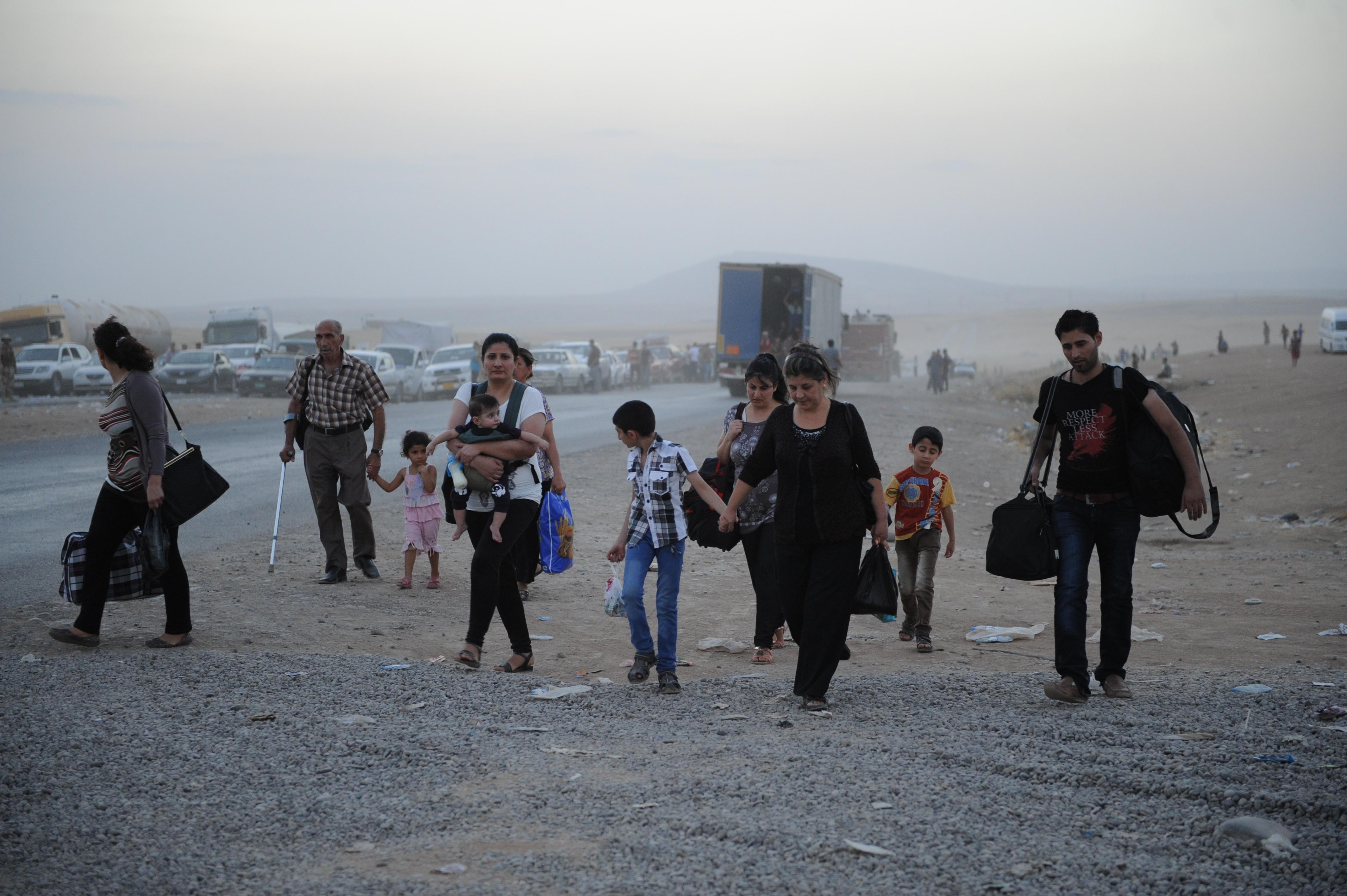
(Photo: Thousands of Yazidi and Christian people flee Hamdaniyah town of Mosul to Erbil after the latest wave of ISIL advances that began on Sunday has seen a number of towns near Iraq’s second largest city Mosul fall to the militants on August 6, 2014. By Mustafa Kerim/Anadolu Agency/Getty Images.)

Back To Iraq: Blog Reax

https://twitter.com/marieharf/status/497729146358099968

https://twitter.com/PentagonPresSec/status/497725099970031616

For Lawrence Kaplan, Obama’s decision to authorize airstrikes on ISIS targets in Iraq was a no-brainer:

The Yazidi, a tiny sect probably as old as the biblical province its members call home, have nearly been wiped out on dozens of occasions, by dozens of persecutors, and yet they survive. During the Iraq War, they turned to the Americans for protection, and the Americans turned to them for all manner of support. (The Yazidi supplied a disproportionate number of interpreters to the U.S. Army.) For this, the insurgents slaughtered the Yazidi, killing 500 on a single day in 2007. Whenever I would visit their ancestral home in the town of Sinjar, they would plead for stepped-up assistance from Washington.

The Yazidi need that assistance, and they need it today. For an administration that famously prefers to achieve its desired results abroad through suasion rather than brute force, this presents a conundrum. It should not.

Christine Allison argues that protecting Iraq’s religious minorities is a moral obligation:

If, through our own inactivity, we allow the Yazidis and Christians to suffer so much that they leave the country, what are we doing to Iraq, the cradle of civilisations? What about the smaller minorities, Shabaks and Mandaeans, who have found stability and shelter in the Kurdish region? Do we sit back and watch an extinction event in northern Iraq? As we commemorate the centenary of the first world war, we have only to look over Iraq’s border to see Turkey’s struggle to come to terms with its past in those years. Inaction in Iraq now will produce the same result: an ethnically “cleansed” landscape, a haunted population.

So now, in addition to our humanitarian efforts, we must turn to the Kurds, who, with their referendum on independence are apt to be perceived as causing “the break-up of Iraq”. But paradoxically, with their forces on the ground, they are the best protectors of northern Iraq’s diverse population. Air strikes and humanitarian drops are a beginning. But in the medium and longer term, London and Washington must find a way to maintain the balance of power between Baghdad and Kurdistan and still work closely with Kurdistan’s fighting forces to assure security.

Dreher also throws his full support behind the intervention:

It is my devout hope that the US kills as many ISIS berserkers as we possible can. I saw today video of a Christian child who had been decapitated by these monsters, and heads of Christians on pikes. There was news today that they were slaughtering Yazidi men and taking their wives as plunder. They are worse than Waffen SS. I’m pretty strongly noninterventionist, but that is not an absolute position, especially not when we can fairly be blamed for setting off this crisis. As they say in Texas, some people just need killin’.

Morrissey calls Obama’s announcement “the right and … only possible steps”, though he doubts airstrikes alone will do the job:

The Kurds have spent the last 23 years living in peace and freedom, relying on the US to protect their interests while being caught between the Turks, Iranians, and Iraqis. Walking away from the Kurds after their long support of our efforts to stabilize Iraq even at the expense of their own dreams of independence would be a betrayal that would send shock waves around the world to other groups working with the US — especially in Afghanistan. The Kurds will be the canary in the coal mine of American credibility for decades to come.

In the meantime, it will take more than a couple of airstrikes to stop the genocides of ISIS to come. The so-called Islamic State and its leadership is perhaps the most explicitly bloodthirsty regime to arise in generations or perhaps centuries, and nothing short of utter defeat will stop them from continuing to annihilate all those who do not bow down to them. The US and the West will have come to grips with this reality sooner or later, and in terms of lives lost and the effort necessary to stop ISIS, sooner would be much more preferable.

To Dan Hogdes, the events in Iraq prove that the US has to be the world’s policeman:

When people say “We don’t want America to be the world’s policeman,” I don’t think most of them actually mean it. What they really mean is “We don’t want America to be the world’s policeman, and the world’s prosecutor, judge and jury as well.”

And that’s a fair argument. But at the moment, with the implosion of the authority of the UN, there is no effective prosecutor, judge or jury. Earlier this week the UN patted itself on the back for the successful conviction of Khmer Rouge leaders Nuon Chea and Khieu Samphan. They are 88 and 83 respectively. Their victims – an estimated two million of them – died 40 years before. Pol Pot himself never faced justice. If we want a world based on laws then someone ultimately has to enforce them. And there is only one state on the planet with the means and inclination to do so. That state is the United States.

But the limits of the mission are very much in doubt. Ryan Goodman questions them:

[I]s this mission really just to protect US personnel or also to aid the Kurds? The New York Times reported that “aides said [the President’s] hand was not forced until ISIS won a series of swift and stunning victories last weekend and Wednesday night against the Kurds in the north, who have been a loyal and reliable American ally.” Similarly, Rep. Adam Smith, the ranking Democrat on the House Armed Services Committee, said “he supported intervening on behalf of the Kurds, as opposed to the unpopular Baghdad government. ‘The Kurds are worth helping and defending.’”

On the second mission (protecting religious minorities on Mount Sinjar), the President outlined three criteria for such humanitarian actions: “[1] innocent people facing the prospect of violence on a horrific scale, [2] when we have a mandate to help — in this case, a request from the Iraqi government — and [3] when we have the unique capabilities to help avert a massacre.” It is unclear, in my mind, why those three criteria won’t also apply to ISIS’s genocidal efforts elsewhere in the country, and the US ability “to help avert” those massacres.

Zack Beauchamp believes that the “key cause of all of this is ISIS’ somewhat surprising advance into territory held by Iraq’s Kurds”:

“This is a big deal,” Phillip Smyth, a researcher at the University of Maryland who follows this situation closely, said. “First, they push the Christians out of Mosul [Iraq’s second-largest city], and now they’re doing that.”

Smyth sees at least two basic motivations for the ISIS advance. One is simple opportunism: not every Kurdish unit is equally strong, and ISIS will take any territory it thinks it can, given the chance. The second is more strategy: they likely want to cut off Iraq’s Kurds from Kurdish communities in Syria, where ISIS is fighting a second front against the Syrian government. “They’re trying to cut off geographic links between those two territories,” he said.

John Cassidy asks, “Once the U.S. bombing starts, when will it stop?”:

That is one of the many tough questions that Obama and his colleagues will have to answer. Are the sole goals of the mission to help out the Yazidis and prevent Erbil from falling? Or is this the beginning of a U.S.-led effort not merely to halt the advance of ISIS on its eastern front, in the Kurdish region, but to roll it back everywhere in the country? On these questions, Obama was studiously ambiguous. … Already, though, one Rubicon has been crossed. A President who came into office on a promise to pull the United States out of Iraq, and who followed through on his pledge, has just ordered more combat operations in, or over, Iraq.

Josh Marshall wants to know what changed on the ground to tip Obama towards intervention, and why our understanding of ISIS’s and the peshmerga’s capabilities has been so wrong:

[W]hat’s happened to ISIS, which was supposed to be a fairly small, rag tag force, highly spirited perhaps but not a force capable of making gains against a disciplined regular army? Quite a bit of American weaponry did fall into ISIS hands when the Iraqi Army fled. But advanced weaponry usually requires significant training to use effectively or at all and additional time to integrate its use into a fighting force. It seems highly questionable that all that weaponry could have transformed ISIS’s capabilities so quickly.

And if ISIS hasn’t changed, is it possible that the Peshmerga were never really the vaunted force they were made out to be? That’s the question asked by this editorial in a Saudi paper. Whether it’s one of these misapprehensions or the other or both, either would seriously change the situation in Iraq from what we’d been led to believe as recently as a few days ago.

Indeed, if the Kurds can’t finish ISIS on the ground, even with American air support, what happens then? That’s where Jacob Siegel spots a major flaw in Obama’s plan:

The consensus among ex-CIA analysts, former military officers, and Iraq veterans who spoke with The Daily Beast is that the Peshmerga’s abilities were overrated. No one questions the Kurds’ willingness to fight, but their military prowess appears to have degraded in the years since the U.S. military stopped training them and withdrew from Iraq. … Air strikes against ISIS targets can weaken the group, buy time, and prevent it from massing on Kurdish forces, but according to military and CIA veterans, air power alone will not be decisive.

“The advisors need to be pushed out, if they haven’t been already,” said Nada Bakos, a CIA veteran who led the team analyzing the terrorist network that was ISIS’s predecessor in Iraq. The advisors she referred to are the special operations troops who have so far stayed away from the battlefield, offering intelligence and advice from headquarters in areas remote from the fighting.

Juan Cole is having flashbacks to 1991:

The Neocons who wanted to go to war against Iraq in the early zeroes always said that one reason a war would be good was that the US was spending a lot of money on the no-fly zone over Kurdistan– as if a whole war wouldn’t be much more expensive (it was, by about $1 trillion). Apparently not only has the Iraqi federal army almost completely collapsed, finding itself unable to take back Tikrit, but now the so-called Islamic State was making a move on Iraqi Kurdistan’s capital of Irbil. Obama’s hope that the so-called “Islamic State” can be stopped by US air power is likely forlorn. The IS is a guerrilla force, not a conventional army. But one thing is certain. A US-policed no fly zone or no go zone over Iraqi Kurdistan is a commitment that cannot easily be withdrawn and could last decades, embroiling the US in further conflict.

Lastly, Michael Crowley remarks on Obama’s evolution when it comes to genocide and US intervention:

In his 2007 comments about genocide, Obama at least seemed to imply that, because the U.S. can’t prevent slaughter everywhere, it shouldn’t take humanitarian action anywhere. But as President he has adopted a different point, first in Libya and now in Iraq: Just because we intervene in some places doesn’t mean we have to intervene everywhere. That doesn’t make for a very tidy doctrine. Nor will it console the miserable people of Syria. But it will bring jubilation to the terrified thousands on Mount Sinjar, for whom salvation is now coming.
Why Lady-Deodorant Costs More

Danielle Kurtzleben revisits the question of gender-specific price disparities:

There are a few reasons why women are paying more for certain goods and services. Not really knowing or thinking about this pricing gap is certainly part of it — as a woman, it’s easy to pick the Powder-Fresh deodorant and never give the stick of Cool Rush a second thought.

But, Kurtzleben argues, there may be more to it:

Of course, there’s an obvious answer here: society expects women to look a certain way. Put into economics terms, there’s a higher return on investment for beauty for women. Beauty products are becoming more popular among men, it’s true, but expensive skin cream is still optional. For women, all those trappings are more necessary.

Map Of The Day

opSPO1O

Every phone call Obama has made to another world leader so far this year. Max Fisher captions:

The most significant detail here is Europe: Obama’s phone calls in 2014 have been overwhelmingly with European leaders. This just goes to show how much the Ukraine crisis has come to dominate US foreign policy this year. Tellingly, the foreign leader whom Obama has called most frequently is, by far, German Chancellor Angela Merkel. That may surprise you — US-German relations are probably not the first topic that comes to mind when you think about US foreign policy — but it makes sense given the Ukraine crisis. The German leader is the most influential figure within the European Union, and the EU is the body with the most power to help Ukraine and to punish Russia for its role in the crisis.

Will The Rust Belt Turn Red?

Anna Clark sees it as a real possibility:

The Republicanization of the rural areas is just one of the problems that Midwestern Democrats face. The decline of industrial unions, the aging of the population, the relative lack of immigrants, and the out–migration of African Americans and young people all portend challenging times for the region’s Democrats. If Republicans claim more of the region’s 117 electoral votes, the national consequences could be bracing: A lasting conservative shift in the industrial Midwest would nullify Democratic gains in the Sun Belt. Swinging states like Michigan and Wisconsin (which together have 26 electoral votes) into the Republican column would offset Democratic gains in Arizona and Georgia (which together have 27 electoral votes). With a total of 44 electoral votes, a red triptych of Ohio, Michigan, and Wisconsin would best a blue Texas (38 electoral votes). Absent some leftist intervention, the Party of Lincoln might well come home to the region where it was born 160 years ago.

Andrew Levison takes a closer look at Democrats’ struggles with white voters. He marshals evidence that it’s distinct from the Democrats’ challenges in the South:

The traditional post-war image of the white working class is of workers concentrated in large Northern industrial cities like Detroit, Akron, Buffalo, and Pittsburg. But Beginning in the 1970s, many industries moved from the major cities to smaller towns to avoid unions and seek a more friendly “business climate,” while at the same time many white workers (like those in construction) who still worked in urban areas moved to the urban fringe for lower cost housing and to escape urban, metropolitan culture for a more “country” way of life. Today, two-thirds of white workers live in small towns, the urban fringes around metropolitan areas, or rural areas; only a third remain in central cities or suburbs.

He points out that “white working class support for Obama declines as one moves from large metro areas to less urban settings”:

This also shouldn’t be a surprise: The GOP’s base lives in small towns, the urban fringe, and rural areas. But it has tremendous implications for Democratic strategy. The party could “write off” white working class in the South and still win many elections, but it’s impossible to write off working Americans in all of the Red States or in all non-urban areas and still have a stable and enduring Democratic majority. Instead, such a majority will require increasing white working class support for Democrats in these areas.


Back To Iraq? Tweet Reax

https://twitter.com/Max_Fisher/status/497557187045359616

https://twitter.com/EvanMcSan/status/497556546000130048


https://twitter.com/BrettLoGiurato/status/497575078406520832

https://twitter.com/BrettLoGiurato/status/497565983482335232

https://twitter.com/nickrobinsearly/status/497561187656429569

https://twitter.com/joshgreenman/status/497557726105698305

https://twitter.com/Max_Fisher/status/497580465696423936

https://twitter.com/JeffreyGoldberg/status/497574852799496193

https://twitter.com/CrowleyTIME/status/497564436325216256


The Best Of The Dish Today

"Doctor Who" - Cardiff Premiere

Today, we noted yet another atrocity in the Middle East – ISIS’ campaign against the Yazidis near Mosul. The cannabis revolution gathered pace – with traffic deaths down in Colorado – and DC may soon legalize the weed entirely. Back hair got more defenses; gay culture seemed lost in the eddies of integration; a woman became an NBA assistant coach; and the New York Times finally stopped caving to government pressure on the word “torture.”

The most popular post of the day remained The Last And First Temptation Of Israel; followed by a very Matt and Trey Quote For The Day.

Many of today’s posts were updated with your emails – read them all here. You can always leave your unfiltered comments at our Facebook page and @sullydish. 21 more readers became subscribers today. You can join them here – and get access to all the readons and Deep Dish – for a little as $1.99 month. One writes:

Thanks for the great blogging. Just a quick comment that I just re-subscribed to pay $10 per month rather than $5.  To do that, Tinypass directed to let my original (founding) subscription lapse and then re-subscribe.  I hope I still get to keep Founding Member status. It’s cool thing and I’d prefer to keep it.

It was never lost. See you in the morning.

(Photo: The TARDIS appears on the top of Cardiff Castle ahead of the “Doctor Who” premiere at St David’s Hall on August 7, 2014 in Cardiff, Wales. By Adam Gasson/Getty Images.)

Faces Of The Day

UKRAINE-RUSSIA-CRISIS

A boy and a dog look out from a bus stopped to be checked at a checkpoint on a road between Kramatorsk and Slavyansk on August 7, 2014. Fighting raged on in Ukraine’s industrial east, where local authorities have warned of a looming humanitarian catastrophe. Certain areas have been left without water or power and hundreds of thousands have already fled. NATO chief Anders Fogh Rasmussen urged Russia to “step back from the brink” during a visit to Kiev on Thursday and vowed support for Ukraine as fears mounted that Moscow was preparing to send troops into the conflict-torn east of the country. By Anatolii Stepanov/AFP/Getty Images.