Back To War In Gaza

The ceasefire is over and fighting started again this morning:

Gaza militants resumed rocket attacks on Israel on Friday, refusing to extend a three-day truce after Egyptian-brokered talks between Israel and Hamas on a new border deal for blockaded Gaza hit a deadlock. Israel responded with a series of airstrikes, including one that killed a 10-year-old boy and wounded five children near a Gaza City mosque, Palestinian officials said. Two Israelis were wounded by rocket fire, police said. The renewed violence threw the Cairo talks on a broader deal into doubt. Hamas officials said they are ready to continue talks, but Israel’s government spokesman said Israel will not negotiate under fire.

Walter Russell Mead wonders why Hamas is still pretending it can eke out some semblance of victory from a war it has clearly lost:

War is a tricky business, in which fortunes can switch overnight, but Hamas today seems in an extremely difficult position, demanding concessions its enemies have no reason to make. Under the circumstances, both Israel and Egypt appear to have solid reasons for sticking to tough negotiating positions and awaiting events. They have inflicted a major and perhaps crushing military defeat on Hamas. They are now trying to turn this into a decisive political victory that will force Hamas to accept substantially more Egyptian power over Gaza as the price of Hamas’ survival.

Hamas is now about one-third as strong as it was at the start of the war, and it faces enemies who smell its weakness and who loathe and mistrust it. Yet it is insisting on an agreement that would amount to a victory even as its political wing reaches out to Iran. One can admire the chutzpah but doubt the wisdom of a strategy rooted in desperation and fear.

“Hamas has accomplished none of its aims,” Hussein Ibish asserts. “Not one”:

For example, Hamas sought recognition as the primary diplomatic representative of Palestinians in Gaza. But the Palestinian Authority (PA) and Palestine Liberation Organization (PLO) have kept that role, including on matters regarding Gaza, despite the fact that Hamas has held the territory since 2007. Indeed, the recent “unity deal” between Hamas and Fatah, which led to the formation of a new government with no Hamas ministers that adopted the PLO’s policy of seeking peace with Israel, did nothing to enhance Hamas’s international standing either.

Hamas also failed to conduct any kind of dramatic attack on an Israeli target, notwithstanding repeated efforts. It failed in several infiltration attempts by land and sea, and none of its rockets hit any major target, whether civilian or military. Hamas was not even able to capture a single Israeli soldier whom it could exchange for prisoners. It did execute a few successful ambushes in Gaza in which it killed Israeli soldiers. But dead Israeli troops don’t translate into a direct benefit for either Hamas or any group of Palestinians.

But Jason Burke characterizes the group as “far from disabled”:

It does appear that dozens of sophisticated tunnels leading from Gaza into Israel, which could enable cross-border raids to kill or kidnap civilians and soldiers, have been destroyed. More than 3,000 rockets have been fired on Israel from Gaza – killing three people – which Israeli officials insist is at least half of Hamas’s total stocks of the weapons. However, few senior Hamas military commanders appear to have died. …

Khaleel Habeel, an Islamic Jihad official in Gaza, admitted casualties, saying that “if you take on the fourth most powerful army in the world then of course you lose people”. Ziad Abu Oda of the Mujahideen Faction splinter group told the Guardian that his organisation had lost 50 men, including fighters and political officials. But even top-end estimates of casualties would be a fraction of the strength of Hamas’s military brigades and other groups, which are believed to have 10,000 fighters permanently under arms, with another 10,000 in reserve.

For Israel’s part, Avi Issacharoff argues, neither war nor negotiations with Hamas will achieve its security goals:

It seems that the only way to change something in this equation (apart from conquering the Strip) would be for Israel to initiate a political process with the Palestinian Authority. There is not much that Israel can do with Hamas, except undermining it in the diplomatic sphere, by offering it everything — a seaport, an airport, a lifting of the blockade, a weekly pass to the amusement park in Tel Aviv… in exchange for the disarmament of Gaza and the destruction of the rest of the tunnels. In other words, to let Hamas’s leaders choose between the Gaza Underground they’ve built and the Gaza on the surface. Hamas would say no, and Israel would gain a few points. But if it really wants to harm Hamas, to weaken it internally and in public opinion, the government of Israel would have to renew the peace talks, even at the expense of a settlement freeze.

Meanwhile, The Economist runs the numbers on the war up to yesterday. Here’s a fun fact:

33. Proportion of respondents to online poll, by Israel’s most popular TV channel on August 3rd, who say the best birthday gift for Barack Obama would be peace in the Middle East: 20% [Israeli Channel 2 TV]

34. Proportion of respondents to Israeli poll who say the best birthday gift for Barack Obama would be the Ebola virus: 48% [Israeli Channel 2 TV]

Why Did The Kurds Retreat?

David Stout scrutinizes the retreat of the peshmerga from their positions near Sinjar and the Mosul Dam, which led to the ISIS gains that tipped the scales in favor of US intervention:

Analysts say the retreat of Peshmerga troops in the face of the ISIS onslaught reveals more about the political failings of the Kurdish leadership than it does about the capabilities of what had long been considered one of the most formidable fighting forces in the region. “This advance in Sinjar and in other areas has shown the structural weakness of the KRG, the Kurdistan Regional Government,” Kawa Hassan, a visiting scholar at Carnegie Middle East Center, told TIME.

A report presented by the parliamentary commission on the Peshmerga last week explicitly stated that, while Kurdish forces had high morale, they were still under-equipped and not being paid in a timely fashion, Hassan said. The rout of Kurdish fighters in Sinjar is also particular damming for the administration of the Kurdish Regional Government’s President Masoud Barzan. Sinjar is considered a stronghold of the president’s Kurdistan Democratic Party, and his inability to protect the region will not likely fade from memory soon.

Michael Goldfarb relays a theory that the Kurds withdrew in order to precipitate a crisis and force Obama’s hand:

The idea is to create images in the west of a desperate population and an outgunned and outmanned force in need of American military aid. Indeed, news reports from the region in the last 24 hours have had pictures of Kurdish men volunteering to join existing Peshmerga forces and being handed dilapidated Kalashnikovs. That theory/rumour is as good as any.

It is hard to understand why this is happening now. IS didn’t seem to have the manpower or the inclination to push eastwards toward Erbil when it made its first breathtaking sweep into Iraq.  There was no strategic reason to do so.

Frankly, the Peshmerga are too strong and numerous a force particularly the closer any invading group gets to Erbil. The IS “army” is still reported to have not more than 15,000 men. And even with all manner of looted Syrian and Iraqi army equipment it couldn’t possibly take a city like Erbil, population 1.5m, whose people wanted to stand and fight.

But as Brett Logiurato and Michael Kelley point out, ISIS is now much better armed than the peshmerga:

ISIS is using modern U.S. weapons its fighters have seized from Iraqi forces, while the Kurds fight with Soviet arms. “They are literally outgunned by an ISIS that is fighting with hundreds of millions of dollars of U.S. military equipment seized from the Iraqi Army who abandoned it,” Ali Khedery, a former American official who has served as an adviser to five U.S. ambassadors and several American generals in Iraq, told The New York Times.

McClatchy reports that the Kurdish peshmerga, meanwhile, possess “a handful of 12.7mm Soviet-era heavy machine guns and rocket-propelled grenades,” along with a few Soviet-era T-55 tanks, to take on battle-hardened militants riding in U.S. Humvees.

Hathos Red Alert

Kristol

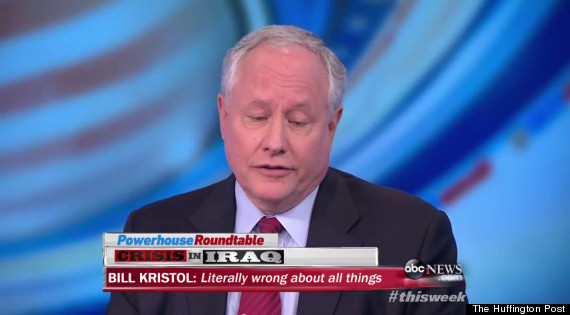
The usual suspects are having a collective orgasm at Obama’s decision to intervene in Iraq. In their view, it proves them right about the Obama retrenchment/surrender/capitulation to terrorism, and has them licking their chops at the prospect of “finishing the job”. Mercifully, the American people are likely to resist their insanity. Here is Bill Kristol pushing for greater involvement:

“If you’re going to get in, get in big and get in decisively now,” Kristol said. “If you go in incrementally, in this way, you don’t have the effect you want to have on ISIS; you don’t have the effect you want to have on bolstering your allies; you don’t have the effect you want to have in the region.”

Repeat after me: a whole new war. Give these fanatics an inch and they’ll be in Baghdad before you know it. Jennifer Rubin encapsulates the emerging neocon narrative we will surely see trotted out on TV and talk radio over the coming days:

Virtually every action or refusal to act has now come back to haunt Obama. Trying to reconcile past mistakes with grudging action is impossible, and yet he refuses to admit error or commit wholeheartedly to a different set of policies. As Bolton puts it, “The problem is not just Iraq, but the entire Middle East where state structures are collapsing and terrorism increasing to fill the vacuum. Thus we have moved from the American Century to the Obama Chaos.”

We should be pleased, I suppose, that he acted in some fashion. Now he needs a new policy team, a coherent policy for the region and a recognition that retrenchment failed and is indeed the cause of many of the horrors we now see. That would require adequately funding the military, taking action to prevent Iran’s hegemonic ambitions and ensuring that non-jihadi rebels in Syria succeed — to name only a few significant policy reversals that would be required. Let’s hope that this is the first indication of an about-face on Obama’s entire foreign policy approach.

The idea that what has been happening all over the Arab Muslim world since the Arab Spring is “Obama’s Chaos” just reveals that the neocons still have no idea that the world is more than America’s plaything. Wolfowitz just declared that the Iraq war had been “won” by 2009 – another sign that they have been chastened not a whit by the destruction and disorder and violence they unleashed more than a decade ago. Conor catches John Podhoretz gloating in a similar vein and rips his argument to shreds:

Alternative history cannot be definitively disproved. There’s no way to know what would be happening now if Obama had left more troops in Iraq.

But if you’ve been wrong about Iraq as frequently as Podhoretz, or the magazine he runs, it is perverse to profess certainty that the war was “all but won” by 2009, that Iraq would now be stable if only the president had listened to you, when of course you have no earthly way of knowing whether that is actually true. Podhoretz’s definition of a war that was all but won required the indefinite presence of U.S. troops. His prior positions on Iraq include a belief that firing Don Rumsfeld in 2006 would definitely lose the Iraq War, as well as the notion that perhaps the U.S. could’ve only won in Iraq by slaughtering Sunni men between 15 and 35.

Danielle Pletka insists that there is plenty we can do without re-occupying Iraq, and amps up the fear to make the case – just as the neocons did with the Iraq war:

What could Barack Obama have done, his few apologists and their libertarian cohort ask. This is not our problem, they insist. We know these isolationists and know-nothings — they’re the ones who said it didn’t matter that Afghanistan was taken over by Osama bin Laden and Mullah Omar. But, they retort, none of this would be a problem if Saddam Hussein and Hosni Mubarak and Bashar al Assad were still firmly seated on their thrones. But of course, those thrones were teetering thanks to the oppressed people of the Middle East, who have noticed that the only parties now talking liberation are the Islamist Shiites and Sunnis from Hezbollah, Hamas and al Qaeda et al.

More than a year ago, Jack Keane and I wrote about what the US could do — none of the straw men’s “boots on the ground” — to stop Assad’s slaughter here. Earlier this year, we wrote about what could — no boots — swiftly cut off IS in Iraq here. These ideas are still relevant today. Remember, Obama’s movement is a lagging indicator of the seriousness of the problem we — yes, we — face in the Middle East. More must be done or the security of the American people will be the next victim.

(Image of “True Chyrons For Bush-Era Iraq War ‘Experts'” from the Huffington Post.)

Why Intervene In Iraq And Not Syria?

Rodger Shanahan distinguishes between the two situations:

There will of course be accusations that Obama is a hypocrite for intervening in Iraq but not Syria. That argument is simplistic and wrong. If the US is obliged to intervene militarily everywhere there is a humanitarian need, it would never stop intervening. Obama said as much in his speech. He is one of the few US leaders to understand the limits of American power.  Moreover, the situation in Syria is far more complex. To have assisted one side would have meant breaching a nation’s sovereignty (no big deal) and potentially assisting the very Islamist forces that pose a security threat to the region and the West (a very big deal). The intervention in Iraq requires Obama to do neither of those things, so the calculus is completely different.

Ryu Spaeth elaborates:

As Obama made clear, this authorization of force has modest goals: 1) to protect U.S. personnel in the Kurdish city of Erbil and 2) to facilitate a humanitarian mission for 40,000 Yazidi Iraqis who are trapped without food or water and face imminent slaughter at the hands of the Islamic State in Iraq and Syria. There is no equivalent situation in Syria with such clear, executable goals.

Furthermore, the Iraqi government is a U.S. ally, as is the regional government in Kurdistan, where the latest action is happening. The U.S. has an interest in bolstering the regime and keeping it together; that is not the case in Syria. While Obama said he would prefer the Iraqi government to take the lead in this endeavor, the U.S.’s hand was forced after ISIS took advantage of gridlock in Baghdad to sow chaos in Kurdistan, which had once been an oasis of stability in Iraq.

Finally, the U.S. is partly to blame for the situation in Iraq. This is what happens when you recklessly invade other countries.

Also, Congress isn’t stopping Obama this time:

Last year, the Syrian government launched a chemical weapons attack that killed thousands of Syrians, crossing a red-line that Obama had previously laid down. In response, the Obama administration began laying out the case for launching airstrikes against positions in Syria, arguing that international norms and the word of the U.S. needed to be upheld. Congress, however, was quick to slam the brakes on that effort, arguing that their authorization was necessary before any new U.S. force could commence. The vote count soon slid heavily against Obama, with only the deal between the U.S. and Russia to remove Assad’s weaponssalvaging the situation. In contrast, Congress has yet to protest the actions, with Speaker of the House John Boehner (R-OH) saying that Obama’s proceeding with airstrikes “is appropriate.”

Obama’s Iraq War Begins

For those just tuning in, the US Navy launched our first airstrike on ISIS early this morning:

U.S. officials tell NBC News that two US Navy FA-18′s dropped two five-hundred pound bombs on ISIS enemy forces outside Erbil this morning. No word on casualties. The two fighter jets flew off the USS George HW Bush aircraft carrier in the Persian Gulf. The Statement by Pentagon Press Secretary Rear Admiral John Kirby: At approximately 6:45 a.m. ET, the U.S. military conducted a targeted airstrike against Islamic State of Iraq and the Levant (ISIL) terrorists. Two F/A-18 aircraft dropped 500-pound laser-guided bombs on a mobile artillery piece near Erbil. ISIL was using this artillery to shell Kurdish forces defending Erbil where U.S. personnel are located. The decision to strike was made by the U.S. Central Command commander under authorization granted him by the commander in chief.”

So who was behind last night’s airstrikes?

The most probable answer is Iraqi Su-25s, manned by Russian or Iranians — or maybe Iraqis.  “The Iraqi government was just as quick to take credit for the strikes as other governments were to deny their involvement and so, combined with the fact that the IAF can launch such operations, it actually looks like they managed to do it on their own,” Khoury told BI. In any case, Iraq’s skies are crowded.

A former high ranking CIA official in Baghdad told Jeff Stein of Newsweek that Turkish jets carried out the airstrikes. “There’s no question about it,” he said, adding that “certainly we are giving them targeting data.”  Stein notes that Turkish F-16s were reportedly patrolling the skies over the area near Sinjar in northern Iraq, where about 50,000 Yezidis are starving after fleeing ISIS militants.

The Pentagon claims to have many options for how it might carry this mission forward:

“We’re talking a very, very permissive operating environment, at least in the air,” said Mark Gunzinger, a former DoD official and now an analyst with the Center for Strategic and Budgetary Assessments in Washington. “We have to be concerned about low-altitude MANPADs, but it’s pretty permissive, so that does open up how they might posture forces in an actual concept of operations.” … It is entirely possible that a sustained campaign would be launched from outside Iraq, relying on long-distance capabilities, Gunzinger noted.

“Since we don’t have a large footprint in country and we don’t have a lot of combat aircraft in country I think anything more than small strikes and raids, if it’s a more concerted effort, will rely heavily on longer-range capabilities,” he said. “This could be a very different kind of an air campaign than we’ve done in the past, depending on the size and duration.”

But Steven Bucci doubts airstrikes will accomplish much on their own:

This is not an adequate policy.  It is a knee jerk reaction that is too little, too late. Using air power alone to “plink” at individual vehicles and pieces of equipment did not work in Kosovo for Bill Clinton, and will not work here.  The policy of “do as little as humanly possible” just so you can get credit is now coming home to roost. This requires a much larger regional response.  ISIS is a regional threat, and it will take cooperation from numerous sources to deal with it.

And Noah Rothman suggests that the odds of further escalation are high:

Regardless of the assurances the president has made to a war-weary public, a report in CBS This Morning on Friday indicates that American military officials are aware of just how comprehensive a military campaign aimed at neutralizing this fundamentalist threat will have to be. “Senior officials describe ISIL forces as swift, effective, and capable of carrying out military mission with quote ‘tremendous military proficiency,’” CBS news reporter Major Garrett reported. “The Iraqi army and Kurdish fighters have been no match for them. Now, from the air, the U.S. will join the fight. Top advisers predict a long, very long military campaign.”

CBS reporter David Martin noted that the humanitarian airlift operation “could foreshadow a much larger military campaign.” He noted that at least 150 American military advisors and an “unknown number of diplomats” remain in Erbil, a city under siege by Islamic State forces.

The End Of Marriage Equality’s Winning Streak?

Dale Carpenter thinks it may be drawing near:

Now that I’ve listened to all three hours, and if oral argument is any guide, I think the Sixth Circuit is likely to reject the claims for same-sex marriage and marriage recognition in a split decision. Most media accounts (see New York Times story here and the Post account here) also characterize the Court’s decision as a toss-up leaning toward rejection of the constitutional arguments for same-sex marriage, with Judge Daughtrey a very likely vote to strike down bans on same-sex marriage, Judge Cook a likely vote to uphold the bans, and Judge Sutton sitting in the middle but mostly critical of the claims. If anything, I’m a bit more confident that the Sixth Circuit will reject the claims than some observers seem to expect.

Ari Ezra Waldman unpacks Sutton’s judicial philosophy:

Judge Sutton is a bit of a wild card. A conservative — he wrote in the Harvard Law Review: “Count me as a skeptic when it comes to the idea that this day and age suffers from a shortage of constitutional rights” — Judge Sutton voted in favor of the constitutionality of Obamacare and does not always follow a party line. His questioning was back and forth, balanced between the sides. A review of his questions and a cursory analysis of some of his writings and decisions suggest that he is primarily concerned with judicial modesty and restraint. He thinks that the federal courts have done too much, creating new rights and reading rights and regulations into the Constitution that do not belong.

Mark Joseph Stern expects Sutton to rule against equality:

At one rather awkward point, Sutton launched into a strange monologue about the gay rights movement’s tactics, one that seemed barely tethered to the merits of the case at hand:

I would’ve thought the best way to get respect and dignity is through the democratic process. Forcing one’s neighbors, co-employees, friends, to recognize that these marriages, the status deserves the same respect as the status in a heterosexual couple. … If the goal is to change hearts and minds … isn’t it worth the expense? Don’t you think you’re more likely to change hearts and minds through the democratic process than you are through a decision by five justices of the U.S. Supreme Court?

These words should be very unnerving for supporters of same-sex marriage. Don’t come to us with your demands for equal protection and fundamental rights, Sutton implied; take your case to the voters instead. Being a legal stranger to your spouse and child isn’t so bad, he suggests, that you need to turn to the federal courts for relief. This reasoning stands in stark contrast to Kennedy’s Windsor opinion, which explained that marriage bans “demean” gay couples and “humiliate” their children. In Kennedy’s eyes, gay marriage bans “degrade” gay people. In Sutton’s eyes, they merely annoy them.


The Road To Baghdad Is Paved With Good Intentions

Beinart recognizes the limits of American power to fix the Middle East but insists that our moral obligation to prevent a genocide in Iraq trumps all:

As I have learned myself very painfully, there is an enormous amount the United States cannot do. It cannot solve Iraq’s political problems. It may not even be able to hold Iraq together. It cannot solve the horror in Syria. It cannot defeat the Taliban. It cannot stop Libya from descending into anarchy. But it can save the people in the Sinjar Mountains, both by dropping supplies to keep them alive, and by bombing ISIS so Kurdish forces can retake the areas nearby. And in so doing, it can stop genocide. Thankfully, Obama is doing just that.

Is there a risk that the U.S. will find itself sucked back into a costly and futile effort to impose our will on Iraq? Perhaps, but everything we know about Barack Obama suggests he will resist that fiercely. And so will most Americans. It’s a risk worth taking, in part because in Iraq today, as in Southeast Asia four decades ago, we are culpable. Were it not for our war, and the anarchy it has bred, the Yazidis would likely not be facing imminent death. The reasons Americans want to turn away from Iraq are precisely the reasons we should not.

Greenwald, on the other hand, is pissed off that we’re intervening, stressing that “humanitarian airstrikes” are always and everywhere a contradiction in terms:

For those who ask “what should be done?,” has the hideous aftermath of the NATO intervention in Libya – hailed as a grand success for “humanitarian interventions” – not taught the crucial lessons that (a) bombing for ostensibly “humanitarian” ends virtually never fulfills the claimed goals but rather almost always makes the situation worse; (b) the U.S. military is not designed, and is not deployed, for “humanitarian” purposes?; and (c) the U.S. military is not always capable of “doing something” positive about every humanitarian crisis even if that were really the goal of U.S. officials?

The suffering in Iraq is real, as is the brutality of ISIS, and the desire to fix it is understandable. There may be some ideal world in which a superpower is both able and eager to bomb for humanitarian purposes. But that is not this world. Just note how completely the welfare of Libya was ignored by most intervention advocates the minute the fun, glorious exciting part – “We came, we saw, he died,” chuckled Hillary Clinton – was over.

Along the same lines, Walt argues that it’s time for us to get the hell out of the Middle East for good:

Some will argue that we have a moral responsibility to try to end the obvious suffering in different places, and a strategic imperative to eradicate terrorists and prevent the spread of WMD. These are laudable goals, but if the history of the past twenty years teaches us anything, it is that forceful American interference of this sort just makes these problems worse. The Islamic State wouldn’t exist if the neocons hadn’t led us blindly into Iraq, and Iran would have less reason to contemplate getting nuclear weapons if it hadn’t watched the United States throw its weight around in the region and threaten it directly with regime change.

So instead of acting like a hyperactive juggler dashing between a dozen spinning plates, maybe the best course is to step back even more than we have already. No, I don’t mean isolationism: What I mean is taking seriously the idea of strategic disengagement and putting the whole region further down on America’s list of foreign policy priorities.

But US interests are also at play here. Rather than genocide, Fisher observes that Obama’s real “red line” for ISIS appears to have been its incursion into Kurdistan:

Invading Iraq’s Kurdish region, it turned out, was Obama’s red line for ISIS. There are a few reasons why. The Kurdish region is far stabler, politically, than the rest of Iraq. (Kurds are ethnically distinct from the rest of Iraq, which is largely ethnic Arab; most Kurds are Sunni Muslims.) The Kurdish region, which has been semi-autonomous since the United States invaded in 2003 and has grown more autonomous from Baghdad ever since, also happens to be a much more reliable US ally than is the central Iraqi government. It has a reasonably competent government and military, unlike the central Iraqi government, which is volatile, unstable, deeply corrupt, and increasingly authoritarian.

It’s not hard to see how a cost-benefit calculation might lead the Obama administration to choose defending just Iraqi Kurdistan over defending all of Iraq from ISIS: the Kurdish region is smaller, it already has a competent military on the ground, it is reliably pro-US, and it can probably be protected at much lower risk to the US. With the rest of Iraq in chaos, the Kurdish region is also America’s last reliable base in the country, so if Erbil falls to ISIS then the US could effectively be out altogether.

And Kenneth Pollack doesn’t buy the arguments against humanitarian intervention:

At least according to the accounts we have received so far, the humanitarian need seems clear and pressing. The United States has the lift capacity to air drop humanitarian supplies and the military capacity to provide at least some degree of air support to the refugees against attack by ISIS fighters. That said, without a corresponding ground force, air power alone may not be enough to prevent a determined assault by ISIS. That is not an argument in favor of deploying ground troops, but neither should it be an argument against employing air power alone. Just because we are not certain to save them does not mean we should not try at all.

Any humanitarian intervention always begs the question, why intervene to help this group and not some other? There are vast numbers of people suffering in the world, so this is always going to be a question that some will ask. My response is that there are some situations where the suffering is acute, danger is imminent, and where there is something that the U.S. can do about it. Those are the cases where they U.S. should unquestionably act, and those criteria greatly diminish the number of eligible cases. I think the immediate situation of the Yazidi and other northern Iraqi minorities are clearly part of that set of cases. Moreover, I think it absurd to allow ourselves to be paralyzed by academic debates over which groups are most deserving of American assistance when there is a clear and pressing humanitarian need that we could be addressing.

Still, it’s not clear that Obama has a strategic plan here:

Retired Gen. Barry McCaffrey told MSNBC’s Chuck Todd he is “dismayed” by President Obama’s strategy in Iraq, and that it demonstrates “muddled thinking.”

“If you’re going to protect refugees, 50,000 people without water and food, you don’t do two F/A-18 strikes on an artillery unit somewhere in the vicinity,” McCaffrey insisted, criticizing Obama’s decision to authorize “pinprick strikes” against ISIL in the Sinjar Mountains, where tens of thousands of Yazidis are trapped as they flee from ISIL terrorists. “It looks to me as if a lot of this is internal U.S. politics to show we’re doing something,” McCaffrey said.

Who Are The Yazidis?

Raya Jalabi profiles the ancient faith community whose ongoing persecution at the hands of ISIS was a major factor driving Obama’s decision to authorize air strikes in Iraq:

The ancient religion is rumoured to have been founded by an 11th century Ummayyad sheikh, and is derived from Zoroastrianism (an ancient Persian faith founded by a philosopher), Christianity and Islam. The religion has taken elements from each, ranging from baptism (Christianity) to circumcision (Islam) to reverence of fire as a manifestation from God (derived from Zoroastrianism) and yet remains distinctly non-Abrahamic. This derivative quality has often led the Yazidis to be referred to as a sect.

At the core of the Yazidis’ marginalization is their worship of a fallen angel, Melek Tawwus, or Peacock Angel, one of the seven angels that take primacy in their beliefs.

Unlike the fall from grace of Satan, in the Judeo-Christian tradition, Melek Tawwus was forgiven and returned to heaven by God. The importance of Melek Tawwus to the Yazidis has given them an undeserved reputation for being devil-worshippers – a notoriety that, in the climate of extremism gripping Iraq, has turned life-threatening.

Under Ottoman rule in the 18th and 19th centuries alone, the Yazidis were subject to 72 genocidal massacres. More recently in 2007, hundreds of Yazidis were killed as a spate of car bombs ripped through their stronghold in northern Iraq. With numbers of dead as close to 800, according to the Iraqi Red Crescent, this was one of the single deadliest events to take place during the American-led invasion. The Yazidis had been denounced as infidels by Al-Qaida in Iraq, a predecessor of Isis, which sanctioned their indiscriminate killing.

A BBC feature explores the Yazidis’ beliefs and customs further:

Their own name for themselves is Daasin (plural Dawaaseen), which is taken from the name of an old Nestorian – the Ancient Church of the East – diocese, for many of their beliefs are derived from Christianity. They revere both the Bible and the Koran, but much of their own tradition is oral. Due in part to its secrecy, there have been misunderstandings that the complex Yazidi faith is linked to Zoroastrianism with a light/dark duality and even sun worship. Recent scholarship, however, has shown that although their shrines are often decorated with the sun and that graves point east towards the sunrise, they share many elements with Christianity and Islam.

Children are baptised with consecrated water by a pir (priest). At weddings he breaks bread and gives one half to the bride and the other to the groom. The bride, dressed in red, visits Christian churches. In December, Yazidis fast for three days, before drinking wine with the pir. On 15-20 September there is an annual pilgrimage to the tomb of Sheikh Adi at Lalesh north of Mosul, where they carry out ritual ablutions in the river. They also practise sacrifice of animals and circumcision.

Listening To The President

Amid the impending flurry of opinions, ideas, regrets, conclusions and arguments that you will greet today, it’s well worth eight minutes of our time simply to listen to what president Obama said last night about the US intervention in Kurdistan yesterday. Here’s what he obviously wants in descending order of importance: security for US personnel in Erbil; no genocide of the Yazidis; and a functional, multi-sectarian coalition government in Baghdad. The first two are achievable in the short term; the last is subject to the profound vicissitudes of the broken state of “Iraq”. Which is to say: we can see no long term clearly right now.

Like most decisions that come down to the president alone, this is a very, very tough one. The reasons to resist being pulled back into any conflict in Iraq are too obvious and manifold to state. But let me note one massive irony: one reason why ISIS appears to have made so much progress is because they are armed with American military equipment, abandoned by the Iraqi army. And the only reason ISIS exists at all in Iraq – and al Qaeda before them – is that the United States so thoroughly broke that country from 2003 on. So the proximate reasons for this American intervention are the unintended consequences of previous American interventions. You can see how global hegemony eventually provides endless reasons for its own perpetuation – and why some of us want to restrain and temper its ambitions.

Another obvious conclusion: the speech last night was very similar to the reasoning behind the ill-fated rescue of Misrata in the Libyan uprising. Again: an allegedly imminent slaughter of civilians. Again: the need to act expeditiously because of fast-moving events on the ground. And we saw how that intervention ended  – in chaos and disorder that has only enabled more slaughter and unrest. If we thought Libya had persuaded Obama that he should not act when he can to save thousands of innocent civilians threatened by murderous religious fanatics, then we misjudged his moral core.

Do I reject that moral core? Of course not. I would not want even the toughest realist in the White House to be unmoved by a possibly imminent mass execution of civilians. And this is not merely a possible mass execution. It’s attempted genocide. That distinction matters to me, and should matter to America. ISIS has now slaughtered countless innocents, as has the government of Assad in Syria. But the possible genocidal attempt to wipe out the entire, ancient Yazidi population makes this more than yet another grotesque incident in someone else’s civil war. Non-interventionism meets its toughest test when it comes to atrocities like these.

Then there is the issue of the Kurds, a feisty, stateless people whose sanity stands in stark contrast to some of their neighbors. They too have endured genocidal attacks in the past  – from Saddam Hussein. They have been staunch American allies for decades and critical to what’s left of any decent future in that part of the world. They are not active participants in the Sunni-Shiite Arab Iraq-Syria civil war. They have played a largely defensive game, with some opportunistic land grabs, while developing their own region in a manner Baghdad seems incapable of more broadly. If Erbil were to fall for lack of ammunition in the short term – because they are being targeted by US-made military equipment – then equalizing that imbalance in the short term seems to the least we can do.

Nonetheless, I remain troubled by this – as I think the president is as well.

The danger of getting sucked into the Iraqi vortex is great. What if air-strikes are not enough? What if ISIS manages to invade Kurdistan – or does unspeakable damage to the dam now under its control? We are talking about a Jihadist force born of a fanatical fusion of a depraved version of Islam with brutality and violence of unlimited scope. What we are now signaling, in other words, is that there are limits to what the United States will tolerate with respect to ISIS’ dominance and power projection. That means we could find ourselves forced to intervene again and again on these lines and for these reasons. Only the president’s fortitude and restraint – or willingness to retreat from the goals he has just set out – can save us. At that point, if the immediate need to save the Yazidis and Kurdistan is behind us, it is absolutely imperative that any further military action be authorized by the Congress. An expeditious act of executive authority is one thing. Another risk of war is something else entirely. And such a decision should not be a president’s anyway. It should be a decision by the American people, through their elected representatives.

My main fear of the intervention is that it might convey to Iraq’s terrible leadership that the US once again will do their hard work for them – and thereby relieve them of the task of constructing a new government, capable of rallying Sunnis, Shiites and Kurds to restrain ISIS. Perhaps the danger is now so great the dysfunction in Baghdad could break – and with indirect American support, a new and more widely legitimate Iraqi government can begin to roll back or at least cauterize the Jihadist onslaught. That’s the optimistic scenario.

But when has an optimistic scenario ever been borne out in Iraq? That is the question. As Barry Ritholtz put it today:

Each time I think I have finally put George W. Bush’s misadventures out of my mind, something comes about to remind us how utterly bereft of reason or intelligence the decision to invade Iraq was. It is likely to haunt the U.S. even longer than the disastrous Vietnam War.