How Much Do Whites Care About Racial Disparities?

New research suggests the answer is “not much”:

America’s criminal justice system disproportionately hurts people of color, particularly black and Hispanic men. Supporters of criminal-justice reform tend to point to that disparity as a good reason to change the system. But as reforms move from proposals to actual bills, the key question is how to persuade the general public that change is needed. A new study suggests that highlighting racism in the criminal justice system is not the answer, and in fact pushes white voters in the opposite direction. Even when whites believe the current laws are too harsh, they’re less likely to support changing the law if they’re reminded that the current prison population is disproportionately black.

Carla Murphy unpacks the study:

A white female researcher went to a train station near San Francisco and asked 62 white voters to watch a video of mug shots of male inmates – before asking them to sign a petition easing California’s three-strikes law. Some watched a video where only 25 percent of inmates were black. Others, where 45 percent of inmates were black. When it came time for signing, most white voters viewing the video with fewer black inmates signed the petition. Those viewing the video with a higher percentage of black inmates, however, refused to sign, “regardless of how harsh participants thought the law was.” … Researchers conducted a separate “real-life” experiment with white New Yorkers around stop-and-frisk. The results were similar to San Francisco’s.

Elizabeth Nolan Brown raises an eyebrow:

“Many legal advocates and social activists seem to assume that bombarding the public with images, statistics, and other evidence of racial disparities will motivate people to join the cause and fight inequality,” said [researcher Rebecca] Hetey. “But we found that, ironically, exposure to extreme racial disparities may make the public less, and not more, responsive to attempts to lessen the severity of policies that help maintain those disparities.”

A good reminder to heed the work of British sociologist Stuart Hall and similar communication scholars: Never assume your audience will take away what you intend for them to take away. Between the producing (“encoding” in Hall-speak) and the receiving (“decoding”) of a message, there’s a lot of space for conscious or unconscious fears and prejudices to meander in.

Jamelle Bouie sighs:

It’s disheartening. But, if I can indulge my cynicism for a moment, it’s also not too surprising. From previous research, we know that – among white Americans – there’s a strong cognitive connection between “blackness” and criminality. “The mere presence of a black man,” note [researcher Jennifeer] Eberhardt and other researchers in a 2004 paper, “can trigger thoughts that he is violent and criminal.”

Indeed, they continue, simply thinking about black Americans can lead people to see ambiguous actions as aggressive and to see harmless objects as weapons. When Michael Dunn saw 17-year-old Jordan Davis and his friends, he perceived a threat, imagined a gun, and opened fire, killing Davis. “I was the one who was victimized,” said Dunn in a phone call to his fiancée before his trial. It’s ludicrous, but it’s not dishonest. Like many other Americans, Dunn sees black people – and black men in particular – as a criminal threat.

Obama The Polarizer

Reid Cherlin remarks that the Obama administration has”managed over six years to accomplish much of what Obama promised to do, even if accomplishing it helped speed the process of partisan breakdown.” Ezra Klein remembers during the campaign when Obama promised to pass legislation by reducing partisanship:

He was half-right.

Obama pushed more change through the political system than any serious observer expected: he passed health-care reform, as well as the largest stimulus and investment package in American history, and the Dodd-Frank financial reforms (which are working better than most realize). He brought the Iraq war to a close and he actually did find and kill Osama bin Laden. There’s much left on his to-do list, but even in places where he’s failed to pass his legislative remedies into law — like immigrant reform and cap-and-trade — he’s used or is using executive actions to make huge strides.

But he didn’t do all this by fixing American politics. He did all this by breaking American politics even further. Obama hasn’t healed the divisions between Democrats and Republicans. Rather, he’s one of the most polarizing presidents since the advent of polling … Obama has brought a lot of change to America. But he’s done it by accepting — and, in many cases, accelerating — the breakdown of American politics. Judged against the rhetoric of his campaign, his presidency has been both an extraordinary success and a complete failure.

The Ebola Outbreak Gets Worse

The World Health Organization (WHO) has upgraded the severity of the crisis:

The World Health Organization has declared the Ebola outbreak in West Africa a public health emergency of international concern on Friday. The organization is encouraging global coordination to prevent the spread of both the disease and of “fear and misinformation,” according to Keiji Fukuda, the organization’s Assistant Director-General. “This is an infectious disease that can be retained,” he said, noting the region’s poor conditions and need for help. “It’s not a mysterious disease.”

Susannah Locke asks, “So what does that actually mean?”:

Technically, it means that the WHO committee thinks the outbreak is a public health risk to other nations and that the outbreak might be in need of an international response. Those are the general criteria for the PHEIC category. This does not, however, mean WHO will go in and fix everything in the Ebola fight. The declaration itself comes with recommended things that various nations should do, but it doesn’t automatically come with funding, gloves, aid workers, or any of the other resources that the exceptionally poor nations with Ebola need to actually do those things.

Abby Haglage makes clear the scale of the problem:

It’s already an unprecedented outbreak, CDC Director Dr. Tom Frieden says, and the number of infected and killed by Ebola will likely soon outnumber all other Ebola outbreaks in the past 32 years combined. According to the CDC, there have already been more than 1,700 suspected and confirmed cases of Ebola in West Africa, and more than 900 deaths—numbers that Frieden later called “too foggy” to be definitive. Ken Isaacs, the vice president of Program and Government Relations for Samaritan’s Purse, painted an even bleaker picture. According to the World Health Organization, West Africa has counted 1,711 diagnoses and 932 deaths, already, which could represent only a small fraction of the true number. “We believe that these numbers represent just 25 to 50 percent of what is happening,” said Isaacs.

On a more cheerful note, Ronald Bailey predicts a future where such outbreaks have been all but eliminated:

Advances in fields like genomics, proteomics, reverse vaccinology, synthetic biotechnology, and bioinformatics are exponentially improving the knowledge of researchers about how pathogens and the human immune system interact. All of the tools involved with identifying pathogens and producing treatments like monoclonal antibodies and vaccines will continue to fall in price and become more ubiquitous. Thus will compounding therapies become ever faster and cheaper. Long, complicated, and expensive clinical trials overseen by hypercautious regulators will no longer be required for validating the safety and effectiveness of targeted, rationally designed therapies. A couple of decades hence, infectious diseases will still strike, but any patient with a fever will be tested, her infection immediately identified, and a personalized treatment regimen crafted just for her will be administered. We may reach a time when epidemics and pandemics are ancient history.

Andrew Asks Anything: Rich Juzwiak, Ctd

Readers continue to comment on our latest podcast, sampled here and here:

I found your talk with Rich Juzwiak to be quite interesting (from my perspective of a straight older male). I have never heard such frank discussion of gay sex, and found it quitejuzwiak-banner-sq reveling in many ways. I was particularly struck with how you characterized the male gay attitude to be primarily masculine (and not necessarily gay at all). It is not something I have every really thought about, but I think you are right—the sort of “serial intimacy” you describe driven by testosterone and male orientation rings true to me, anyway. (You mention how it would be if straights were able to think of having sex with almost any woman they knew as a sort of natural and good thing, and how it would change things. Indeed.)

It made me think that perhaps male gay sexuality was more “natural” than the heterosexual male sexuality, in the sense that it seems truer to the kind of sexual drives a male naturally has! That made me laugh! I can almost imagine some argument (put in appropriately Thomistic form) for this new truth about the “laws of nature”. Certainly the kind of brotherhood you describe seems a great natural good, anyway, and one I can only envy (being, alas, “unnaturally” and firmly fixated on the female of the species).

Another dissents by quoting me:

“We actually talk about the sexual adventurism of gay men – a subculture where no women dish-podcast-beagle-transparentrestrain sexual desire – as an often wonderful thing…” Sorry, but this is pretty offensive to women  and to straight men. As if a woman’s primary role in a hetero relationship is to act as some kind of walking, talking saltpeter. And the men just glumly sit and take it. The subsequent sentence is a better expression of your point -“There may be a measure of mutual respect, friendship, democracy and brotherhood in a sexually liberated gay male world – that is perhaps unavailable to heterosexuals” – but really guys, don’t knock it till you’ve tried it!

Another makes a crucial point:

As a straight man, I have to say: We did it to ourselves. If women restrain sexual desire – and that’s probably fair – it’s because men have shamed them (or much worse) when they didn’t.

Subscribers can listen to the whole conversation here. If you’re not a subscriber yet and want to sign up for as little as $1.99/month, the link is here.

Is The Next Generation Ignorant Of HIV?

hiv_diagnoses

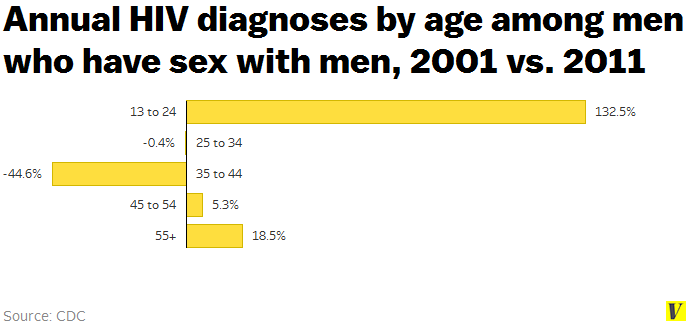
A recent survey found that around a third of US teens between 12 and 17 “don’t realize HIV is a sexually transmitted disease.” Russell Saunders finds it “difficult to know how much credence to give those findings” given that a “2002 study of youth at an urban clinic found that, despite spotty knowledge about STIs as a whole, HIV was identified as such by 91 percent.” Nevertheless, Saunders worries that at risk groups aren’t getting the information they need:

What is truly discouraging are the numbers regarding new HIV infections among men who have sex with men (MSM), the group comprising the largest number of new diagnoses by far. Among MSM aged 13-24 years rates of new infections have actually risen over the past decade, while the overall rate of new diagnoses has dropped by 30 percent. As a gay man standing on the cusp of middle age, I fear that the lessons learned by my generation and the ones that came before are being lost. While medications like Truvada can be used to lower the risk of infection for those engaged in high-risk behaviors, about which I have put my reservations aside, that doesn’t mean attention to lowering those risks isn’t important.

Though my reading of the report is that most teens have a good idea about the health risks they actually face, it remains important to inform adolescents about their risk of infection with HIV. The survey report contains no information about the respondents’ demographics beyond their ages, so it’s impossible to know how many fall into higher-risk groups. For those who do, giving them the information they need to lower that risk remains just as important as ever.

(Chart from Vox)

Back To Iraq: Blog Reax II

Waldman couches the intervention in Iraq in terms of Obama’s foreign policy doctrine, and particularly in contrast to that of his predecessor:

When he ran for president, Obama promised a new approach to military involvement overseas, one defined by limited actions with clear objectives and exit strategies. It was to be a clean break with the Bush doctrine that had given us the debacle of the Iraq War: no grand military ambitions, no open-ended conflicts, no naïve dreams of remaking countries half a world away. Of necessity, that means American military action is reactive. Instead of looking around for someone to invade, this administration has tried to help tamp down conflicts when they occur, and use force only when there seems no other option — and when it looks like it might actually accomplish something, and not create more problems than it solves.

But even though it’s designed to avoid huge disasters, this approach carries its own risks, particularly when we confront situations like the one in Iraq where there are few good options. We can take some action to keep IS out of the Kurdish north, but that might leave them just as strong, with their maniacal fundamentalism still threatening the entire region. IS is a truly ghastly bunch, with ambitions that seem unlimited. Obama said he was acting “to prevent a potential act of genocide.” What if it happens anyway, and we could have done more?

Ezra Klein focuses on how Obama expressed that doctrine in last night’s announcement:

Calling something a “genocide” has a very particular power under international law, because the US is signatory to the Convention on the Prevention and Punishment of Genocide.

The treaty says that “The Contracting Parties confirm that genocide, whether committed in time of peace or in time of war, is a crime under international law which they undertake to prevent and to punish.” The US is one of those Contracting Parties. Obama is justifying these strikes under international law as, in part, an effort to prevent a genocide.

But he’s stopping there. He’s willing to use air strikes to protect Americans and Kurds in Erbil, the capital of Iraqi Kurdistan, and to stop a genocide against the Yazidi men and women trapped in Sinjar. But he’s not willing to go further, at least not barring substantial political change in Baghdad. … Obama doesn’t oppose all wars. But to him, a smart war is a very, very limited war.

For Joe Klein, this marks the start of a new chapter in our seemingly endless war on Islamist terrorism:

Yes, we’re sick of war, sick of the region and particularly sick of Iraq–but, as seemed clear in the days after 9/11, and less clear since, this is a struggle that is going to be with us for a very long time. It doesn’t need to be the thunderous, all-consuming struggle that the Bush-Cheney government made it out to be. It will require a strategic rethink of who our friends and enemies actually are in the region. (As others have suggested, we may find that Iran is part of the solution rather than part of the problem–this is one case where America’s and Israel’s national security interests may diverge). And it will require a far smarter response than our first attempts to deal with Al Qaeda. It will have to be measured, proportionate–an insinuation rather than an invasion, acting in concert with true allies who also understand the threat and are capable of sophisticated covert operations.

Larison weighs in with characteristic skepticism:

As reasons for military action go, these are better than most, but I keep coming to the conclusion that these airstrikes are still a mistake. Many of the usual objections to military action don’t apply here, but a few still do. The airstrikes are being presented as a “limited” response, but it is hard to believe that military action of this kind will continue to be “limited” for very long. It is also taken for granted that military action won’t make things worse, but it is entirely possible that it will.

These airstrikes are at best a stop-gap measure to slow the advance of ISIS’ forces, and to the extent that they are effective they will likely become an ongoing commitment that the U.S. won’t be able to end for the foreseeable future. Administration officials claim that there is no plan for a “sustained” campaign, but now that airstrikes have begun it will be only a matter of time before there are demands for escalation and deeper involvement, and sooner or later I expect that Obama would yield to those demands. Having made the initial commitment and having accepted that the U.S. has a significant military role in Iraq’s internal conflicts, the U.S. will be expected to continue its commitment for as long as ISIS exists, and that will leave the U.S. policing the Iraqi civil war for months and years to come.

Noah Millman also has doubts:

I am terrified by what ISIS represents. I think a case can be made that our top priority for Iraq and Syria should be defeating the group. Logically, though, that likely means accepting an Assad victory in the Syrian civil war and greater Iranian influence in Iraq. And accepting those two outcomes puts us on the opposite side from the major Sunni powers, particularly Saudi Arabia. What else will we have to sacrifice to mollify them? Back when ISIS first came on the scene in Iraq, I argued that we have a moral responsibility to do what we can to ameliorate the situation in Iraq, but also that direct military intervention would likely prove counter-productive. As the situation in northern Iraq gets worse and worse, I stand by both views.

Lexington highlights “a contradiction between the extreme narrowness of the missions handed to American commanders, and the breadth of the crisis that senior American officials are starting to describe in Iraq”:

It is not clear whether Mr Obama and his inner circle consider spiralling instability in Iraq in and of itself a threat to American national security. Iraqi politicians have been wrangling over the creation of a new government for weeks. In a not so subtle nudge, Mr Obama said that more American assistance would be on offer once a new government was in place. …

Critics might also reasonably ask why averting a massacre in Sinjar should prick American consciences now, when so many other towns have fallen to the fanatics of IS without stirring a response from Washington (and when massacres in Syria have triggered a pitiful response from the West). Much of the answer involves recent advances by IS fighters towards Erbil. The Kurds are not just long-standing American allies, their capital has also become an important safe haven for refugees. American officials called Erbil “increasingly threatened” by IS on August 8th.

Though airstrikes alone won’t defeat ISIS, Paul Iddon argues that they can make a difference:

American air-power alone won’t defeat an irregular militia like Islamic State. But it can be effectively used in order to stop movements between the Islamic States’ captured territories as well as seriously hamper their efforts of consolidating their hold and control over those areas. Also coupled with extensive humanitarian aid it will serve to keep the tens-of-thousands of civilians that group displaced alive and in turn help stave off a humanitarian catastrophe. So all in all US air-power if used properly will be a worthy endeavor to help Iraq and especially the Kurds who find themselves and everything they have built over the last few years, under the auspices of American forces, at risk of destruction.

That being said the United States shouldn’t necessarily feel compelled to follow an air campaign up with an extensive deployment of boots on the ground. A decisive air campaign that will give those Iraqi state forces preparing to fight Islamic State time to get their act together and the government to take necessary reform and reconciliation steps to function as an effective governmental institution for the multi-denominational and multi-ethnic and cultural, and imperfectly secular, state which Iraq on the whole broadly constitutes.

On the other hand, Brett Logiurato relays concerns that they might backfire:

Phyllis Bennis, a scholar at the Institute for Policy Studies, progressive think tank, told Business Insider that the decision to launch airstrikes now could undermine the U.S. push for a new, more inclusive government. “The ‘humanitarian’ mission has already crept. T​he return of direct US military engagement will be seen in Iraq in the context of proving US support for the corrupt and discredited prime minister, Nuri al-Maliki, widely blamed for expanding and consolidating the sectarian political system put in place with the US occupation,” Bennis said.

“It will also undermine any possibility that al-Maliki might step down, paving the way for a broader, less sectarian government in Baghdad (the deadline was supposed to be today), since a Maliki administration with the full backing of the US military is hardly likely to give in to public political pressure to step down.”


The Yazidi Rescue: Your Thoughts

DSC02227

A reader writes:

I’ll keep it short. Do I think ISIS would really have killed, directly or indirectly, tens of thousands of Yezidis? As former military intelligence deployed to that exact area and with fairly intimate experience with how takfiris think of Yezidis, yes I do. I really thought that if someone didn’t begin to intervene in a big way, there would be tens of thousands of dead Yezidis by this time next week. Now there won’t be. I kind of don’t give a shit about anything else.

Another writes:

I spent 10 months in 2009-2010 specifically in Sinjar with the US Army. Having never heard of the Yazidi previously I was very interested in learning their background and beliefs and found them all to be easy to get along with and supportive of our presence. And as soon as ISIS started making moves in Northern Iraq, I was very worried that I would wake up one morning to news of Sinjar (an ancient Roman/Parthian/Persian border town that seems to have been traded back and forth multiple times over the centuries) and its Yazidi minority being persecuted or worse.

While I have generally appreciated the coverage of the recent events in Northern Iraq I feel like most people I listen to or read are CAEIPDS0making some large logical and geographical leaps. Sinjar, although previously occupied by the Kurdish Peshmerga, is far from the Kurdish Autonomous Region (some 200 km). Sinjar Mountain itself is a strange anomaly. The area of Western Nineveh is generally flat with small 1 to 2 meter hills that litter some patches. Then seemingly out of no where is a stand alone mountain with the town of Sinjar at its southern base. Comments like “But it will bring jubilation to the terrified thousands on Mount Sinjar, for whom salvation is now coming” are utterly ridiculous. Sinjar Mountain is not connected to the mountains that make up Kurdistan.

Sinjar, the mountain and the religious minorities are an island in the new Sunni ISIS sea. The only way to bring them real relief would be for the Kurds to gain back ground and establish supply lines to Sinjar. I would imagine that would be highly unlikely if Erbil is being threatened. I feel like more reports I have read are mixing the Kurdish and Sinjar parts of the ISIS offensive together. This is lazy and wrong and setting our expectations up for failure. I sadly do not see a good end for the Yazidi near Sinjar. Their only real hope is to get to the Kurdistan region proper. Any US attempts to do anything but drop food and water to the Yazidis on the mountain would take a lot of troops (not just special forces, so real boots on the ground) and I can’t think of a good end state even if we put the troops necessary to hold the mountain.

Another:

Thanks for your thoughtful post.  I just wanted to outline why I am supporting this intervention, while I opposed the inane intervention in Libya (you linked the two).

In Libya there was no genocide occurring.  There was no targeting of minorities. The battle was simple: a naked power struggle.  Second, in Libya we had no ally at stake.  By intervening we actually undermined an ally, as Qaddafi had assisted us post 9/11, removed his nuclear program, and had generally aligned with the West.  We destroyed that and left anarchy.

In northern Iraq the difference is acute. The minorities there will be obliterated, which is the major byproduct of our Iraq intervention in 2003; we have insured the destruction of communities that existed for thousands of years.  Second, the Kurds are an actual ally.  Our interests are aligned.  This isn’t some fanciful ally that McCain imagines exists in Syria or in Western Ukraine.  If we let the Kurds fall, then that would make us look like fools.

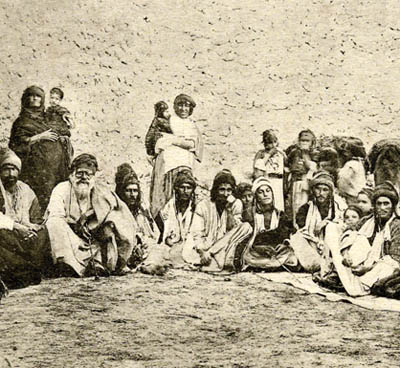
(Photos: the entrance to Sinjar, by a reader; Yazidis on the mountain of Sinjar, Iraq/Syrian border, 1920s. Via Wiki.)

Obama’s Imperial Presidency? Ctd

This week the blogosphere has been debating the legality and advisability of Obama unilaterally legalizing millions of undocumented immigrants. Douthat continues to oppose the idea:

The argument is, basically, there’s nothing really new here, this is just an extension of the way we did things already, and as for that totally sweeping new thing associated with this kind of change but not with pre-existing practice, oh, that’s just a coincidence, it’s the result of longstanding legal norms, we have nothing to do with that, didn’t really even think about it when we made the call, look, a leopard! 

The reality is that longstanding legal precedent (codified in the 1986 immigration reform, I believe, but extending earlier) does indeed allow the executive branch to grant work permits to people who receive deferred action … and that legal authority is, of course, one of the biggest reasons why activists wanted the administration to make a formal deferred-action move, rather than just circulating a memo on enforcement priorities and leaving matters there. There’s nothing accidental or unforeseen or non-central about the DACA/work permit combination, in other words; indeed, DACA explicitly created a new application system for work authorization — which, as Conn Carroll points out, is part of why this change, again supposedly just a codification of existing practice, has actually ended up snarling the system of green card and visa applications for people applying to live and work here through normal channels. And the fact that work permits can be made available once deferred action is invoked is precisely why an action on the scale of DACA — to say nothing, obviously, of the super-DACA currently being floated — represents such an aggressive use of presidential power, approaching a rewrite of the law.

Shikha Dalmia, on the other hand, defends the legality of the actions Obama is considering:

Margaret Stock, a Republican immigration lawyer and a Federalist Society member, notes that such [abuse of office] accusations don’t appreciate that all this is fully authorized by those laws. “The Immigration and Nationality Act and other laws are chock-full of huge grants of statutory authority to the president,” she explains, a point also emphasized by the nonpartisan Congressional Research Service in its 2013 brief. “Congress gave the president all these powers, and now they are upset because he wants to use them. Other presidents have used the same authority in the past without an outcry.” …

In fact, notes Stock, he could go even further and offer asylum to the Central American kids lining up at our borders, instead of sending them back as he has been promising to do. Section 207 of the INA gives him the authority to declare a humanitarian emergency and hand refugee status to all of them – and then some. And this wouldn’t be unprecedented, either.

The United States did this as part of Operation Pied Piper to accommodate fleeing children fromWorld War II and then Operation Pedro Pan in the 1960s to provide a safe haven to Cuban kids.


Putting the legal debate aside, Nyhan wonders “why Mr. Obama would engage in such a move before the election.” He remarks that “a broad executive action could provoke a backlash in the midterm elections that might be avoided with a move just a few months later”:

Given these risks, the politics of pre-election legalization seem inexplicable, creating an opening for elaborate bank-shot theories about Obama’s intentions. The columnist Charles Krauthammer floated a conspiracy theory along these lines Wednesday, suggesting on Fox News that Obama might be trying to “bait Republicans into impeachment as a way to save his party in the midterm elections.”

Such an outcome seems unlikely, but the comment illustrates just how much uncertainty there is over what Mr. Obama is doing or how Republicans — and voters — will react.