
Oakland, California, 9 am
Oakland, California, 9 am
Jordan Weissmann takes note of a Republican movement to “smash the cartel” of college accreditors:
In order for their students to receive federal aid, colleges and vocational programs need to be accredited. The accrediting agencies, which are independent of the government, mostly give their blessing to schools that look an awful lot like traditional institutions of higher education, with brick-and-mortar buildings, well-credentialed faculty, and a nice mission statement. …
“As was the case for airlines, trucking, and telecommunications, higher education needs a deregulatory agenda that breaks down these barriers to entry,” the American Enterprise Institute’s Andrew Kelly wrote in the reform conservative manifesto “Room to Grow.” In January, Lee introduced legislation that would give states a major role in the accreditation process. The bill has nods of approval from potential presidential contenders Marco Rubio, who has his own proposal on the issue, and Paul Ryan, who dedicated a little-discussed section of his anti-poverty plan to “shaking up the accreditation status quo.” The hope is that once Washington breaks the hold of today’s accrediting agencies, new, high-tech approaches to education can flourish.

[Update: Premium tri-blend t-shirts no longer available. 100% cotton versions here.]
Sales for our two premium tri-blend t-shirts have started to taper off, and since we screen-print them in bulk orders to keep the price down (one-by-one digital printing is a more expensive process), we will discontinue our first two designs this weekend. So if you still want one of these attractive premium tees, head here now and place your order no later than midnight Sunday EST. A quick reminder of the t-shirt details:
The first is a light blue one emblazoned with the Dish logo across the chest (see above on the right). Or if you prefer the baying beagle by herself, check out the gray Howler Tee (modeled above on the left). I love the lone howler myself – only other Dishheads will get it. We picked American Apparel t-shirts that use high-quality screen-printing and a higher quality tri-blend fabric that’s super soft, durable, and has a bit of stretch that retains its slim shape. There are sizes for both men and women – no generic “unisex” option this time around, as you insisted. We’ve also lowered the price by half compared with the t-shirts we did a few years ago.
So go here now to grab one before they’re gone for good. But if you’re one of our readers allergic to synthetic fabrics and can only wear 100% cotton shirts, that option will be available for the Howler and Logo designs next week, so hold tight. And the polo shirt – in navy blue or white – will continue to be available. One reader doesn’t care either way:
Is The Dish ever going to post emails from subscribers who do not give a fuck about your tee shirts? No, really. Some subscribers – well, me obviously – are simply not interested in advertising junk on their chests, even blogs.
Readers here, here, and here disagree. One more:
Okay, okay, I love the lone howler design too – not for its super-secret insideriness, but because the simple but attractive design can be appreciated by anyone, without wondering “D?SH?” I think the white-and-tan dog would look fantastic on a blue or brown background (probable on green or yellow, too), but the gray? Meh – it does nothing for me. When you have it on a blue t-shirt (light or dark), I will buy it. I promise. Even if it’s no longer the super-duper mega-quality wonder-shirt you’re constantly threatening to remove forever from our reach.
Stay tuned; we’re rolling out many color options for the 100% cotton shirts next week. And one final note on the higher-quality tri-blends you’ve been ordering: because they are screen-printed in bulk, the ordering process is a bit longer than usual, so we really appreciate your patience. Your shirt is arriving very soon!

“Transmarine” by Carol Moldaw:
An open hull nudging reeds and sand,
she kept to herself the pleasure he provoked,
the undercurrent dimpling as he stroked,
and drifted, slackly moored under his hand.
Turning to him, she let him loose the knot,
drop the rope, and push his foot against
the pier to lift her free. Her muscles tensed;
he took her like a sail the wind had caught
and guided her until she guided him,
and when they were no place that either knew,
where sky and sea and shadow echoed blue,
they plunged—and were knocked back at the world’s rim.
(From So Late, So Soon: New and Selected Poems © 2010 by Carol Moldaw. Used by permission of Etruscan Press. Photo by Nikos Koutoulas)

Silver finds that incumbent Republicans still have plenty of reason to worry about primary challengers:
Between 2004 and 2008, just four of 39 Republican senators running for renomination, or 10 percent of them, got less than 65 percent of the primary vote. This year, five of 10 have fallen below that threshold: not only Roberts, Cochran and McConnell, but also Lindsey Graham of South Carolina and John Cornyn of Texas, who both benefited from running against divided fields.
In fact, the average share of the primary vote received by Republican incumbent senators so far this year is 73 percent. Not only is that lower than 2004 through 2008, when incumbents averaged 89 percent of the vote — it’s also lower than 2010 and 2012, the years when the tea party was supposedly in ascendency, when GOP incumbents got an average of 78 percent.
He concludes that “there’s no evidence the threat from primary challenges has been reduced going forward. It may even still be increasing.” Bernstein isn’t so sure about that:
Think about general elections in districts dominated by one party. Sometimes, the out-party won’t even bother fielding a candidate, and the incumbent will receive 100 percent of the two-party vote. Other times, a certain loser can be found to at least show the flag. Depending on the district, that hopeless candidate might be destined for, say, 30 to 40 percent of the vote. If a systematic change takes place that makes it far more likely for hopeless losers to file in those districts, the average incumbent margin of victory is going to be much lower — but the chances of incumbent victory won’t change.
That might be what’s happening in Senate primaries. Whether it’s campaign finance, or institutional changes within the Republican Party, or some other change, it’s possible that it’s easier to enter races for hopeless losers who nonetheless are capable of running something resembling a real campaign, and therefore of winning a solid share of the primary vote. Without, in fact, making it any more likely that incumbents will lose.
But Waldman asserts that the “Tea Party wins when it wins, and it wins when it loses”:
That’s the magic of an insurgent movement like the Tea Party. A win strengthens it by showing its members that victories are possible if they fight hard enough. And because the movement has organized itself around the idea of establishment Republican betrayal, its losses only further prove that it’s doing the right thing. Furthermore, if ordinary Republicans have to become Tea Partiers to beat Tea Partiers (even if only for a while), the movement’s influence is greater, not less.
Melissa Dahl recounts her week of almost unrelenting positivity:
I decided to, temporarily, quit complaining. No shit-talking for one whole week. I went home and excitedly told my plan to my boyfriend, who laughed at me — a reaction signaling that maybe this was a bigger problem than I’d realized.
My little experiment was inspired by my friend Meena Duerson, who recently did her own seven-day complaining cleanse. “I remember noticing that I was venting a lot both at work, in conversations with friends, and at home with my husband, and it wasn’t cheering me up — it was stressing me out more,” she told me.
Dahl concludes that complaining has its upside:
In the end, my experience ultimately pushed me toward seeing the benefits of a little kvetching, something Robin Kowalski, a Clemson University psychology professor, has argued before. “There’s no doubt in my mind that complaining can serve some very beneficial functions,” she said. “For one, it’s a great icebreaker.” You’d never strike up a conversation with a stranger waiting next to you for a subway about how reliable the trains are running lately, after all. (And, as we’ve recently learned, small talk with people we don’t know is very good for us.) A little bit of negativity has some health benefits, too, as a study published last year found that pessimistic older adults were more likely to live longer, healthier lives.
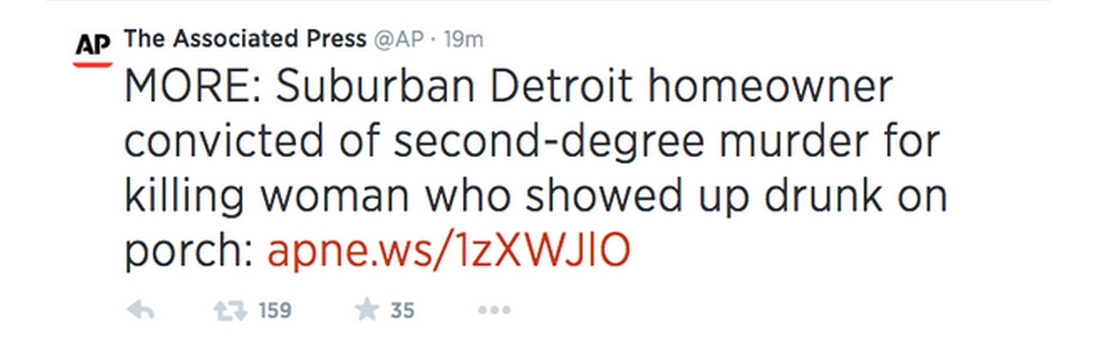
The Associated Press’ tweet (since removed) regarding Theodore Wafer’s conviction in the murder of Renisha McBride has caused an outcry on Twitter, inspiring the #APHeadlines hashtag. Yesha Callahan explains:
AP prides itself on being a respectable news agency, but last night it proved that it had no respect for the 19-year-old, whom Wafer shot after she approached his porch in the middle of the night last November after she crashed her car. Although he said he was “scared” and protecting his property, Wafer was successfully convicted of second-degree murder and manslaughter.
Alexandra Brodsky adds some more context:
As many have pointed out on Black Twitter and blogs: The first tweet, which doesn’t even bother to mention McBride’s name, reduces her to the fact that she’d been drinking, clearly implying that this somehow made the killing complicated, if not acceptable. (Wafer isn’t mentioned either, but his mugshot is replaced with the smiling vision of a suburban homeowner. She is drunk; he has money.)
A sampling from the #APHeadlines feed:
https://twitter.com/elonjames/statuses/497463232563400705
Meanwhile, Joe Coscarelli provides information on the conviction itself:
After less than two days of deliberations, four black and eight white jurors found a Michigan man guilty today of killing an unarmed woman on his front porch last fall, in a case with echoes of the Trayvon Martin tragedy, but now a much different outcome. Theodore Wafer of Dearborn Heights was convicted on all three counts in the shooting of 19-year-old Renisha McBride, including second-degree murder, manslaughter, and use of a firearm in a felony.
Nicole Flatow’s trial recap goes into more detail:
Wafer said in his testimony that he shot the gun right after opening the door and did not get a good look at McBride. He said he could not detect her gender or race; and did not question her in any way before pulling the trigger. But whether or not Wafer was aware of McBride’s race when he shot her, the shooting has generated national attention because of the racial dynamic — McBride was a young black woman, shot by an older white man. The case also revived controversy over expansive “Shoot First” state laws that allow individuals to deploy their guns in self-defense without a duty to first attempt retreat. In this case, Wafer shot McBride seconds after opening the door, and called 911 after he shot her.
In his own lengthy testimony, Wafer conveyed immobilizing fear over who was outside his door that night. While he initially told police after the accident that he deployed his gun by accident, he conceded at trial that wasn’t the truth. He said he didn’t know why he lied at first, speculating that perhaps he was in “denial” about what he had done.
“I wasn’t gonna cower in my house,” he said.
He later added, “she had her whole life in front of her and I took that from her.”
Daniel Altman wants to vote in a Republican president … in 2024:
To be sure, a long reign by Democrats in the White House could eventually spell its own end. Complacency and corruption tend to go hand in hand with prolonged periods in power, even in highly democratic countries, and voters might revolt. I’m not saying this has happened yet — indictments and convictions of high-ranking federal officials are down under Obama versus under Bush — but it might well happen with enough years of any one party at the top. And those years have a way of multiplying in many countries; they can also lead to consolidation of control, as South Africa andArgentina have recently shown.
I would much rather that Democrats’ time in the White House ended because of a strong Republican alternative than because of their own debasement and decay. Hopefully, a worthy Republican candidate — and a more centrist, up-to-date Republican Party — will be able to sway me by 2024.
Emily Shire applauds the Showtime documentary L Word Mississippi: Hate the Sin, which premieres tonight, for presenting an overlooked side of lesbian life in America:
The film – produced by Ilene Chaiken, who also did The L Word – acknowledges that for all the immense good that came from television portrayals of lesbians, these shows have often glossed over the hardships, bigotry, and, most frightening, well-intentioned condemnation that plagues these women in many parts of the country. The immensely strong hold of the Bible Belt culture transcends nearly every aspect of lesbian life in southern Mississippi. Most women interviewed, regardless of age, race, or background have some deep familial connection to church. One woman, BB, is a former pastor who was outed to her congregation before she could even tell her loved ones. Being shamed by her church was tantamount to losing her community and her job.
June Thomas is aghast at the discrimination on display:
“A big problem is the churches,” says Sara, a pregnant lesbian who admits to struggling with pronouns as her physician wife transitions into her husband. Judging from this film, Sara’s assessment is quite an understatement. Over the course of 90 minutes, preachers, parents, and random guys on the street tell these women they’re deranged, depraved, and Hell-bound. It is not, to say the least, a supportive environment. These meddling churchgoers clearly believe they’re fighting for the lesbians’ souls – why else would a mother tell her daughter she is praying for the best relationship of her life to come to an end? But from the outside, at least, all they seem to be doing is messing with their loved ones’ heads. Indeed, many of the lesbians – smart women in loving, stable relationships—try to pray their own gay away. “I don’t want to die a lesbian,” says one.
Do you remember this girl from #Gaza? She is now better. Made me happy to see this. Photo by Mohammed Taletene pic.twitter.com/BKz9JgDNaS
— Diana Alzeer (@ManaraRam) August 8, 2014
The young girl was featured on the Dish here.

