Author: Andrew Sullivan
The GOP vs Pope Francis
Here’s something I didn’t know: a banal Congressional resolution to congratulate Pope Francis on his elevation to the papacy and praise for his “inspirational statements and actions” cannot muster enough bipartisan support to be passed. The reason?
An unnamed Republican backer of the legislation told The Hill newspaper last week that the pope is “sounding like [President Barack] Obama” because he “talks about equality” and he has blasted “trickle-down economics,” a favorite theory of many conservatives and “politically charged,” as the GOP official said. Even though the bill has New York Rep. Peter King, a reliably conservative Republican, as a chief co-sponsor (along with Democrat John Larson of Connecticut, also a Catholic), it has failed to catch on with the GOP. The resolution has 223 co-sponsors altogether, but just 20 are Republicans.
I’ll say this for the Congressional Republicans. They know who they are, and who they oppose.
What’s Your Favorite Place To Read? Ctd

Sending the above photo, a reader answers:
This spot (so I can get high).
Another in Boston:
My favorite place is the MBTA’s Red Line. I get on at Alewife (the end of the line) so I always get a seat, and I read all the way to Downtown Crossing. I’ve been doing this commute for twelve years and I think I’ve read more in this fifth of my life than in the other four-fifths combined.
Another can’t pick just one:
My number one most favorite place to read is in the bathtub. For a while, I had a water-proof protective case for my i-Pad, because I was afraid I would drop it in the tub, but then decided that it was too annoying, so now I just take my chances. So far, so good. A bonus is that, unlike books, which get a little waterlogged just from little drops of water on my hands even when I don’t actually drop the book in the tub, the i-Pad is amazingly impervious to water. My screen often looks like it is quite dirty, though, when in fact, it is just streaked with soap.
My second most favorite place to read is on the train.
I hate commuting, it sucks, but the one good thing about it is that for 70 minutes a day, 35 minutes each way (plus whatever time I am on the train waiting for it to leave) I am stuck sitting in one place, and can read uninterrupted, without guilt that I should be doing something else. I try to sit in the quiet car, all the way in the back where no one bothers me.
Finally, I like to read in restaurants, while I am having lunch on a work day usually. Even when I’m very busy at work, I will usually find time to grab a bite to eat, and will read while I do so. The i-Pad also has increased my reading efficiency in this regard. When I am reading a physical book (which I still do regularly, although not nearly as much as I read on my i-Pad) the book will flip shut if I have to let go to pick up a sandwich or cut something, so I may have to put the book down between bites, or balance a ketchup bottle on it to keep it open. With the i-Pad, I just prop it up, and read hands free.
More reader responses here. Update from another:
I have lots of favorite places to read, but I’m also the mom to 19 month old, so life is not as flexible as it used to be. So right now, my favorite place to read is on my couch, after the boy has gone to bed, with a glass of wine on the side table and the sweet silent hiss of the baby monitor in my ear. It’s heaven when I can stay up late enough to get through a chapter.
I’m loving this thread, which is a nice break amidst all the heartbreak.
Can You Relate?
@JohnLithgow as Lear tonight: amazing. Shakespeare: not good. No stakes, not relatable. I think I’m realizing: Shakespeare sucks.
— Ira Glass (@iraglass) July 28, 2014
Rebecca Mead tut-tuts those who, like Ira Glass, would relate to art rather than identify with it:
Identification with a character is one of the pleasures of reading, or of watching movies, or of seeing plays, though if it is where one’s engagement with the work begins, it should not be where critical thought ends. The concept of identification implies that the reader or viewer is, to some degree at least, actively engaged with the work in question: she is thinking herself into the experience of the characters on the page or screen or stage.
But to demand that a work be “relatable” expresses a different expectation: that the work itself be somehow accommodating to, or reflective of, the experience of the reader or viewer. The reader or viewer remains passive in the face of the book or movie or play: she expects the work to be done for her. If the concept of identification suggested that an individual experiences a work as a mirror in which he might recognize himself, the notion of relatability implies that the work in question serves like a selfie: a flattering confirmation of an individual’s solipsism.
But Freddie suggests that Mead’s concerns about contemporary self-absorption are misplaced:
Selfies are the opposite of solipsism; they are the creation of a perspective that is entirely alien to the person taking them. None of us can naturally see our own face. We build mirrors precisely to get outside of our own perspective. We use the camera to put ourselves in the position of other people. Call that what you’d like, but it isn’t solipsistic.
Complaints that we’re all self-obsessed are evergreen, but I think that they badly miss the point in our current technological moment. Rather than being obsessed with our own point of view, I think we are instead in an era in which we are obsessed with the gaze of others. Yes, we are watching others watch us, and so there’s a second order sense in which we are still the subject of our own drama. But rather than being uninterested in the point of view of others, I think we have constructed an immense digital apparatus to focus on little else.
Meanwhile, Alan Jacobs wonders just how much “relatability” differs from “identification,” asking, “Is wanting the work to be a mirror really so different from wanting it to be a selfie?”:
People, especially young people, used to say, when explaining their dislike of a book, “I just couldn’t identify with it” or “I just couldn’t identify with the characters.” Now they say, “it just wasn’t relatable.” Both of these are just shorthand ways of saying “This work bored me and I think it’s the work’s fault, not mine.” …
I think what the language of relatability and the language of identification typically, if not invariably, connote – and they do this whether used positively or negatively – is weakness of response. And this is why the terms remain so vague, maddeningly so for those of a verbally critical bent. When people really love a work, or really hate it, they enjoy explaining why. When they sorta kinda like it, or sorta kinda dislike it, they say that it was or wasn’t relatable, or that they could or couldn’t identify with the characters. “Relatable” and “identify” are words that ought to come with a shrug pre-attached.
On a skeptical note, Derek Thompson warns, “If you don’t like relatability, you’re going to hate the history of American theater”:
Long Day’s Journey Into Night is nearly autobiographical and, famously, scarringly relatable to any family that has suffered from a form of addiction; Angels in America and The Normal Heart took on the AIDS crisis at the height of the AIDS crisis. A Raisin in the Sun? Death of a Salesmen? These aren’t exactly Mesozoic dramas. The Crucible might be the most famous American play that isn’t about contemporary American life, but as a metaphor for America in the Cold War, its politics couldn’t be any more current for its contemporary audience.
The point isn’t that great art has to be about contemporary life. I’m not sure great art has to be anything. But so much wonderful theater has served, historically, as an exaggerated mirror held up to a country at a specific moment in history that it’s shocking to see a writer blast the idea that “[a play] be somehow accommodating to, or reflective of, the experience of the reader or viewer.” Ira Glass did not invent the idea that great plays ought to reflect their times.
Meanwhile, Alyssa Rosenberg makes sense of “relatability” in light of the politics of representation:
For certain classes of people, consuming mass culture is a constant exercise in empathy. If you’re anything but a straight, white man, action movies are an opportunity to exult in the strength and persistence of people who look nothing like you. Cable television has taken people of all backgrounds into a journey through the troubled mind of the middle-aged man that is well into its second decade.
Demands for “relatable” stories or characters can, in these circumstances, be a cry of “enough!” If traveling into someone else’s mind and experiences through fiction is meant to be morally improving work, we must acknowledge that sometimes that work can be tiring.
Face Of The Day

Justice Manjula Chellur on her way to take oath as the first woman Chief Justice of the Calcutta High Court in Kolkata, Indiaon August 5, 2014. Born on December 5, 1955, Justice Chellur was appointed as acting Chief Justice of the Kerala High Court in November 2011 and was sworn-in as the Chief Justice on September 26, 2012. By Subhendu Ghosh/Hindustan Times via Getty Images.
Anti-Zionism And Anti-Semitism, Ctd
Keating stresses that Europe’s enduring hostility toward Jews is not entirely, or even primarily, in reaction to Israel’s provocations:
A recent Anti-Defamation League survey found that 24 percent of the French population and 21 percent of the German population harbor some anti-Semitic attitudes. A recent study of anti-Semitic letters received by Germany’s main Jewish organization found that 60 percent of the hate mail came from well-educated Germans. So this isn’t just a problem with young, disaffected Muslim men.
After all, the two worst recent incidents of violence against Jews in Europe—the killing of three children and a teacher in a 2012 attack on a Jewish school in Toulouse and the shooting of three people at a Jewish museum in Brussels in May—took place during times when there wasn’t much news coming out of Israel. Continentwide statistics on anti-Semitic incidents leading up to the most recent uptick don’t show much of an overall trend—in Britain, anti-Semitic violence is becoming less common while online abuse is becoming more frequent—or a correlation with events in Israel and Palestine.
Goldblog, meanwhile, remains fixated (quite understandably) on the genocidal ambitions of Hamas, which he takes very seriously:
In 2011, the former Hamas minister of culture, Atallah Abu al-Subh, said that “the Jews are the most despicable and contemptible nation to crawl upon the face of the Earth, because they have displayed hostility to Allah. Allah will kill the Jews in the hell of the world to come, just like they killed the believers in the hell of this world.” Just last week, a top Hamas official, Osama Hamdan, accused Jews of using Christian blood to make matzo. This is not a group, in other words, that is seeking the sort of peace that Amos Oz—or, for that matter, the Palestinian Authority president, Mahmoud Abbas—is seeking. People wonder why Israelis have such a visceral reaction to Hamas. The answer is easy. Israel is a small country, and most of its citizens know someone who was murdered by Hamas in its extended suicide-bombing campaigns; and most people also understand that if Hamas had its way, it would kill them as well.
Previous Dish on anti-Semitism as it relates to Israel and the Gaza conflict here.
ISIS Gains Ground In Northern Iraq
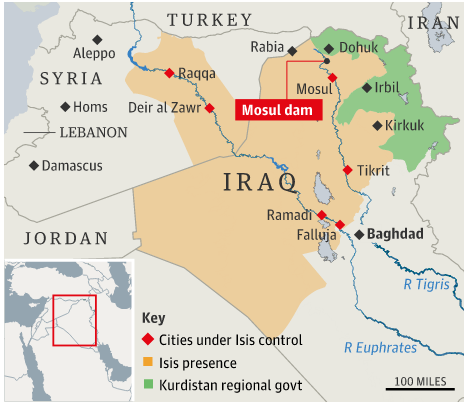
The Islamic State has taken over the town of Sinjar in the country’s northwest, near the Syrian border. Sinjar is the homeland of the Yazidis, a religious minority that Joshua Landis warns is now in grave danger of persecution:
One of the few remaining non-Abrahamic religions of the Middle-East, the Yazidis are a particularly vulnerable group lacking advocacy in the region. Not belonging to the small set of religions carrying the Islamic label “People of the Book,” Yazidis are branded mushrikiin (polytheists) by Salafis/jihadists and became targets of high levels of terrorist attacks and mass killing orchestrated by al-Qaida-affiliated jihadists, following the instability brought about by the War in Iraq.
Today’s IS assault is already bringing about devastating consequences for Yazidis, who make up about 340,000 of Sinjar’s 400,000 inhabitants (this is a high estimate). Many have fled on foot through the desert, without food or water. Others fleeing in cars for Dohuk have been unable to make a clean escape, due to the inability of the roads to accommodate such a large flux of people. Thousands of cars are currently stranded west of the Tigris River.
Andrew Slater also fears for Sinjar’s religious minorities:
By the afternoon of Sunday, August 4, with ISIS in full control of Sinjar, terrified families from the area began their dangerous exodus. The speed with which ISIS engulfed the entire mountain range attests to the large numbers of fighters they brought to bear for this major offensive. Villagers in the Sinjar area gave accounts of girls and young women from their families being abducted by ISIS fighters and carried away. Countless families fled to the mountains above their villages where they are currently surrounded by ISIS controlled areas and are desperately calling friends and family members who escaped, pleading for help. Pictures of families hiding in the mountains have circulated widely on Iraqi social media.
Besides the Sayyida Zainab mosque, ISIS forces were reported to have blown up the Sharif Al-Deen shrine on the Sinjar mountainside, a holy place for Yezidis. The ISIS flag was also raised over the only remaining church in the Sinjar area. Within 24 hours, Sinjar has been transformed from a bustling community into a string of ghost towns.
In its rampage through northern Iraq, ISIS may also have captured Iraq’s largest dam:
Capture of the electricity-generating Mosul Dam, which was reported by Iraqi state television, could give the forces of the Islamic State (Isis) the ability to flood Iraqi cities or withhold water from farms, raising the stakes in their bid to topple prime minister Nuri al-Maliki’s Shia-led government. “The terrorist gangs of the Islamic State have taken control of Mosul dam after the withdrawal of Kurdish forces without a fight,” said Iraqi state television of the claimed 24 hour offensive. Kurdish officials conceded losses to Isis but denied the dam had been surrendered. A Kurdish official in Washington told Reuters the dam was still under the control of Kurdish “peshmerga” troops, although he said towns around the dam had fallen to Isis.
Meanwhile, jihadists affiliated with ISIS and the Syrian jihadist rebel group Jabhat al-Nusra have taken over the Lebanese border town of Arsal, but Zack Beauchamp assures us that this isn’t as scary as it seems:
ISIS’s actions in Arsal aren’t part of a deliberate expansion of the caliphate into Lebanon. Rather, Lebanese forces picked a fight with ISIS fighters who’d been pushed out of Syria. In purely geographic terms, this interpretation of the fighting makes more sense. … Lebanon, down near Damascus in the west, is really far from ISIS’ bases in north-central Iraq and northern Syria. It would be very, very hard for ISIS control territory far away in Lebanon in the same way it controls the caliphate proper.
That said, ISIS’ presence in Lebanon really could be destabilizing all the same. The Arsal fighting alone has already displaced 3,000 people and killed at least 11 Lebanese soldiers. And while ISIS is not trying to seize territory in Lebanon outright (not yet, anyway), the group is ramping up terrorist attacks there. “They’ve been bombing things, trying to get cells in Tripoli [and] Damascus,” Smyth says. “They’ve tried to use these different cells to bomb Iranian and Hezbollah targets there.”
In any case, Keating remarks that these developments are changing the calculus regarding ISIS’s staying power:
A few weeks ago, it seemed unlikely that ISIS could hold out for that long given the sheer number of regional actors it had picked fights with. But it seems like it’s not only holding out, it’s expanding its activities into new areas and taking on new rivals. It’s hard to imagine how it will be contained unless the various forces fighting it can somehow find a way to coordinate. For now, the center of the conflict seems to be the Mosul Dam. Will the prospect of power cuts or catastrophic flooding be enough to get Maliki’s government to work with his Kurdish rivals?
Siddhartha Mahanta notices that ISIS’s recent gains have prompted the Baghdad government to start cooperating with the Kurds:
That massive setback — which the peshmerga claim is a strategic retreat — reportedly led Maliki to back up the peshmerga with air support, as Reuters reported on Monday. “We will attack them until they are completely destroyed; we will never show any mercy,” a Kurdish colonel told the news agency. “We have given them enough chances and we will even take Mosul back. I believe within the next 48-72 hours it will be over.” So while Maliki is making good on his threat to use legal power to seize Kurd-claimed oil, he’s also sending in the planes to back the Kurds just as the myth of their apparent invincibility takes a potentially serious hit. It’s either a shrewd political move or a truly desperate cry for help. Baghdad and Erbil. These days, theirs is a tale of two frenemies.
And Dexter Filkins argues that we should be helping the peshmerga, too:
The militants in ISIS have swept across much of northern and western Iraq, and there is no sign that they have any intention of slowing down. In a surprising—and encouraging—turn, Maliki has apparently ordered the Iraqi Air Force to carry out air strikes to help the Kurds. That said, the Iraqi Army has proved itself utterly ineffectual in combating ISIS. If the U.S. decided to help the Kurds, there would be no guarantee that the Kurds wouldn’t later use those weapons to further their own interests. But what other choice is there? If anyone is likely to slow down ISIS, it’s going to be the Kurds—regardless of whatever they’re planning to do later on.
The Imaginary War On Whites
On Fox News Sunday, Ron Fournier made the rather banal observation that the GOP “cannot be the party of the future beyond November, if you’re seen as the party of white people.” In response, while talking with Laura Ingraham, Republican Congressman Mo Brooks went overboard:
This is a part of the war on whites that’s being launched by the Democratic Party. And the way in which they’re launching this war is by claiming that whites hate everybody else. It’s a part of the strategy that Barack Obama implemented in 2008, continued in 2012, where he divides us all on race, on sex, greed, envy, class warfare, all those kinds of things.
Fournier defends himself:
I do feel compelled to remind Brooks that nothing I said should surprise him, because his party leaders agree with me. If I am part of a war on whites, so is RNC Chairman Reince Priebus and the 2,600 fellow Republicans interviewed for the “RNC Growth Opportunity Book 2013,” the so-called GOP autopsy.
“If Hispanic Americans perceive that a GOP nominee or candidate does not want them in the United States (i.e., self-deportation), they will not pay attention to our next sentence,” the report reads. “It does not matter what we say about education, jobs, or the economy; if Hispanics think we do not want them here, they will close their ears to our policies.” …
What I said is indisputably, if uncomfortably, true. Unless a broader swath of the GOP community learns to accept and adapt to the fact that the United States will soon be a majority-minority nation, the Republican Party is doomed not to lead it. Finally, sir, bury the straw men: Blanket amnesty and wide-open borders aren’t the price for political relevancy. For starters, let’s try compassion, wide-open minds, and compromise.
Chait snickers at Brooks’ comments:
Brooks is characteristically fuzzy on both the motive and the mechanics of the current War on Whites. On the surface, you might find it silly to imagine that the Democrats would antagonize the majority segment of the American public. Democrats definitely need white people (whites supplied 56 percent of Barack Obama’s vote in 2012; nonwhites supplied just 11 percent of Mitt Romney’s votes). White people have other uses for Democrats, like providing campaign donations, filling cabinet roles and Congressional seats, and so on. From a pure strategic standpoint, launching a war on white people would seem like a bad idea.
Steven Taylor adds:
One thing is for sure: Brooks does not understand (or does not wish to acknowledge) the way in which certain factors tend to align (such as race, economic status, and policy preferences) and he, like many conservatives of his ilk, have no self-awareness of how the structure of US historical development might have sorted persons by color into certain economic strata. He certainly lacks a tremendous amount of self-awareness if, in a multi-paragraph manifesto of how there is a “war on whites” he can say “I don’t know of a single Republican who has made an appeal for votes based on skin color.”
In general, I want to say something intelligent and helpful in terms of maybe getting some readers who really don’t get how problematic these views are, but really all I can think are various insults (and the ones in Spanish are the most fun, given the context).
Weigel joins the conversation:
What will the fallout be for Brooks? Nothing—his district, which hugs the Tennessee border, voted by a 2-1 margin for Mitt Romney over Barack Obama. No Democrat bothered to run against him this year. Honestly, there’s less to Brooks’ “war on whites” riff than the headline suggests. Other conservatives, most notably Stanley Kurtz, have described the Obama administration’s urban-focused transportation and energy policies as a “war on the suburbs,” ways to get the people who fled the cities (white people, though that’s not made explicit) to come back in. And the politics of welfare and food stamps have always tracked with opinions about race.
But Brooks wasn’t saying any of that. He tried to coin a phrase—like “war on women”—insisting that accusing Democrats of waging this fight was calling out racism.
Kilgore sighs:
I dunno: it strikes me as entirely consistent with the twisted logic we hear all the time about the only racists being race-card-playing liberals that demonize conservative white folks who are “color-blind” in their hostility to anything black and brown folks deem highly objectionable.
New Shirts: A Big Response From Readers, Ctd
Dish t-shirts and polos available now! Details here: http://t.co/PTmQWcFA6Z pic.twitter.com/e62uHh7kOr
— Andrew Sullivan (@sullydish) July 28, 2014
Just ordered my @sullydish T. I’m going to look so damn smart at the gym.
— Brian Hetzel (@BooHetz) July 31, 2014
Heads up that we will soon discontinue the highest-quality tri-blend version of the t-shirts, so if you are planning to get one, order now before it’s too late! Full details on all of our shirts here. More satisfied customers keep sounding off:
I bought the lone Howler t-shirt as I agreed with your take on the insider-ness of it … plus it avoids the potential awkwardness of a “secret Dish-shake”, that would logically involve either rubbing noses or sniffing each other’s rear ends.
A very reluctant reader:
I won’t be buying a t-shirt. I need you to know that it’s not you. I do this with just about every online T-shirt merchant these days. We fat people, we exist. I ain’t saying this to get sympathy. I run on the treadmill three times a week and look over and say to myself, damn, I’m a sexy man. Thank God for mirrors at the gym! Suits my inner narcissist, so suppressed everywhere else. And I can rock the Growlr/Scruff circuit with the best of them.
Anyway, us fat people, we exist, and we
sometimes like to buy clothing. Shocking, I know, that fat people might want to put on clothes, given how fantastically sexy we are as a collective. Yet for some reason, merchandisers don’t like to provide clothes for us. That “Haters Gonna Hate” t-shirt from BustedTees? I bought the 3X, super excited, only to get a shirt that from other merchandisers would have only been an XL and I now only get to where on Bear Night at Jackhammer, when, you know, I’m trying to be SUPER SEXY.
So, while I’d love to get a Dish shirt for the nights at the club, I won’t be. Because I would like you to know that I encourage people as much as I can to provide me with shirts in sizes I can wear just grocery shopping and not when I’m trying to titillate the chubby chasers. And it breaks my heart that these apparently attractive shirts are being offered in conjunction with a merchandiser that displays zero interest in providing a range of sizes for people with larger bodies. Thanks for all you do, otherwise!
But the two polo shirts – in navy blue and white – actually run larger than the typical shirt, and sizes go up to XXXL. While the reader has concerns over the slimmer flit of BustedTees’ own shirts, which have a similar fit to our American Apparel t-shirts, the polos are made by a different company, Port Authority. We made it so that all sorts of Dish readers – from skinny hipsters to bulky bears, from gym-going millennials to golf-playing seniors – have a shirt option that works for him or her. Speaking of her, a reminder that we have women’s sizes in both t-shirts, rather than the generic “unisex” sizes. And speaking of bears like the one above:
My partner and I recently returned from Provincetown. It was Bear Week. We passed you several times in front of the Wired
Puppy. He had just ordered a Dish Shirt, and I asked, “Wouldn’t it be great if there were something we could have worn ‘every day’ during that week that would let all the Dishheads and fellow bears know who we were?” The tees and polos are a great idea, but we just don’t want to wear the same shirt every day. A hat, on the other hand, with the same logo would be very convenient. Any chance of that happening? We might even buy several.

We’ll consider hats too, but not for a while. Mugs are coming next.
Obama’s Imperial Presidency? Ctd
Yesterday, Eric Posner defended Obama’s legal right to unilaterally legalize large numbers of undocumented immigrants. Reihan counters:
What Posner neglects is that the deferred action contemplated by the Obama administration does in fact represent a departure from current practice, as it would grant a broad class of unauthorized immigrants a work permit. A work permit is a valuable asset that would essentially turn unauthorized immigrants into authorized immigrants for various economic purposes, and it is the desirability of this formal legal status that has served as the impetus for the push for comprehensive immigration legislation.
Very few unauthorized immigrants have access to such work permits. (Seriously, ask anyone: formal legal status in the form of a federal work permit is pretty important to unauthorized immigrants and their allies, and it’s pretty different from de facto non-enforcement. Jessica Vaughan of the Center for Immigration Studies has addressed the extraordinary cases in which deferred action has been used in the past. Think Haitians fleeing the ravages of the 2010 earthquake or foreign students displaced by Hurricane Katrina.) If there were no meaningful difference between today’s semi-official policy towards unauthorized immigrants who don’t commit serious crimes and the status the president (reportedly) intends to offer them, we wouldn’t be having a roiling immigration debate.
I have to say I’m inclined to agree with Reihan on this. Robert Delahunty makes related points:
The White House keeps repeating that the president will be forced to act unilaterally on immigration because of a “do-nothing” Congress. That in itself is an admission the president would be taking action of a legislative kind.
Other presidents have not cast their grants of temporary relief to illegal aliens in such dramatic terms. And Obama himself acknowledged in his first term that he had no constitutional power to take the kind of steps he seems ready to authorize now.
Second, the White House plan will almost certainly include work authorization provisions. But ordering that measure would go beyond mere executive inaction. To confer such legal rights, the president would need a delegation of affirmative authority from Congress. To say that Congress has under-funded its deportation mandates is not enough. Where is this affirmative delegation?
Third and perhaps most important, Posner overlooks a massively obvious fact: a new presidential non-enforcement decision on immigration this campaign season comes against a pattern of repeated refusals to enforce the law in both immigration and other contexts. The administration’s unauthorized postponement last July of the employer mandate in its own health care law is but one of dozens of examples of this pattern.
For me, a critical point is that Obama himself has said before that he did not have the power to do this. It was part of his argument for putting pressure on the Congress. How would he square that contradiction? The legislature does not exist to obey the president – and if not, have him do the work by executive action. I completely understand the temptation. We do not have opposition in Congress; we have de facto nullification of a presidency. Nonetheless, it seems to me that Obama would be giving the GOP a weapon to add a smidgen of credibility to their otherwise absurd case for impeachment. He should resist it.

