Trophy Children, Ctd

The popular thread continues. A fan of participatory awards writes:

I love this reader: “I don’t know, maybe because the world IS unfair and we’re realists and not delusional purveyors of utopian fantasy?” Calm down, buddy. These are children. With children, we (collectively) are absolutely purveyors of utopian fantasy. See: Santa Claus, the Tooth Fairy, all dogs going to heaven, et al.

Another reader:

I don’t understand why so many people assume “all the kids get a trophy” means “the kids who excel get the same recognition as the kids who don’t.” All three of my nieces, who are excellent swimmers, have a stack of ribbons, medals, and awards in their bedroom for their specific accomplishments in the pool. One of them has won awards as swimmer of the year and has recognition for breaking multiple club records.

But I’m glad that the other kids, the ones who are struggling to learn strokes, the ones who are there for the exercise, also get a trophy. Because honestly, they deserve some recognition too, and a bit of a chance to brag to adoring aunts. They finished a season, and in a world of 7:00 a.m. pool practice, that’s not the easiest thing for a 10-year-old. Life is not a zero-sum game, folks.

Another:

The parallel I can think of in adult sports is running a marathon.

In most marathons, everybody who finishes gets a medal. My Boston Marathon medal is one of my proudest possessions. It is a memento of my training and accomplishment – yes, the accomplishment of losing a race to 10,000 people or so.

But another doesn’t see the need for such tokens for anyway:

Why not get rid of trophies altogether? Winners know they won. Talented singers know they crushed it. Nobody needs a trophy or a medal. I’d argue that not handing out trophies at every turn would teach a better lesson – life isn’t about the destination (a trophy), but the journey (working hard, staying committed, having fun). What’s so wrong with playing sports for the sake of playing sports? Or singing for the sake of filling the world with beautiful music? Or studying for the sake of expanding one’s mind?

Another looks at an underlying divide in this debate:

It seems that this debate is a ridiculous argument between two extreme world views: one being that we should only reward excellence and never mediocrity, and the other that we should never reward excellence lest someone’s feelings get hurt. I don’t know of anyone who actually makes the latter argument, but the former seems to be an article of faith for some who get offended whenever they see Everyone Winning a Prize.

I consider both viewpoints to be ridiculous. Growing up, I was the chubby, slow kid who got picked last in sports but who blew out the curve in academics, so I’ve seen this from both sides. There’s nothing inherently wrong in acknowledging participation. Most of the kids who participate in an activity – say, youth soccer – spend quite a bit of time doing it. If the coach buys ’em a $2 trophy for showing up to practices and games, what’s horrible about this? If everyone on the team got an award proclaiming each of them to be the MVP, now that would be silly as hell, but participation awards are for participating: no more, no less. The kids who play organized soccer get them, those who stay home and play with their XBox, don’t.

Now, if recognizing excellence were banned – especially in a competitive context, where excellence is actually demanded – that would be a problem. But the quasi-Randian assertion that participation should not be recognized, and that the spoils should only go to the victor, is to me a bit obnoxious – the sort of vainglorious self-aggrandizement that often comes from those who excel at something (or have children who do) and expect the world and dog to come and kiss their ass. Two of my kids are very good at soccer, but I find the attitude that the weaker kids on the team should be treated like garbage because they don’t score as many goals to be morally offensive. And I make sure my boys know that being assholes to their less-skilled teammates will not be tolerated.


Mourning The Middlebrow

A.O. Scott laments the passing of the Book-Of-The-Month-Club era:

[I]t is hard to look back at the middlebrow era without being dazzled by its scale, complexity and size, and without also, perhaps, feeling a stab of nostalgia. More does not always mean better, but the years after World War II were a grand era of more. … High culture became more accessible, popular culture became more ambitious, until the distinction between them collapsed altogether. Some of the mixing looks silly or vulgar in retrospect: stiff Hollywood adaptations or comic-book versions of great novels; earnest television broadcasts about social problems; magazines that sandwiched serious fiction in between photographs of naked women. But much of it was glorious.

Still, he suggests we live in the shadow of the middlebrow, “even as the signs of its obsolescence multiply”:

The middlebrow is robustly represented in “difficult” cable television shows, some of which, curiously enough, fetishize such classic postwar middlebrow pursuits as sex research and advertising. It also thrives in a self-conscious foodie culture in which a taste for folkloric authenticity commingles with a commitment to virtue and refinement. But in literature and film we hear a perpetual lament for the midlist and the midsize movie, as the businesses slip into a topsy-turvy high-low economy of blockbusters and niches. The art world spins in an orbit of pure money. Museums chase dollars with crude commercialism aimed at the masses and the slavish cultivation of wealthy patrons. Symphonies and operas chase donors and squeeze workers (that is, artists) as the public drifts away.

Tyler Cowen shakes his head:

My view is a lot of people never wanted middlebrow culture in the first place, at least not in every sphere of their cultural consumption. The Internet gave them more choice, they took it, and much of middlebrow culture lost its support base. Consider one area where the Internet still doesn’t play that much of a role and that is theatrical productions. You can watch plenty of theatre on YouTube, but it’s not such a close substitute to seeing the show live. And if you look at Broadway theatre, it seems more relentlessly and aggressively middlebrow than ever before. Ugh, that is why I stopped going.

Who Wants To Tell A Kid He’s Fat? Ctd

A reader writes:

I am an emergency room pediatrician, and your post about reluctance to tell a patient he or she is fat struck home. Overweight and obese children, aside from the well-publicized risks of diabetes, hypertension, and heart disease later in life, are at increased risk for things like injury (because when they fall their weight makes them more likely to be seriously hurt) and delayed diagnosis of appendicitis (because it is much harder to rely on an exam of an obese child, and radiology exams like ultrasound are much less reliable in overweight children.) The same mind-set that says “every kid deserves a trophy” is at work here. Doctors, and perhaps more so parents, are so afraid of harming a child’s self confidence that we refrain from telling the truth.

In addition, remember, most of us work in practices where we are judged on “patient satisfaction,” meaning we have to avoid saying or doing things that might upset parents. I have been cursed at by parents for even suggesting that weight loss might improve there child’s health.

Along the same lines, I’ve had parents walk out of the emergency room when I told them that the biggest risk to their asthmatic child’s health was the parent’s smoking. In some states, mentioning gun safety and risk (gunshot wound being the most likely cause of death after a car accident for most of the pediatric population) can land you in jail. Under Obamacare, hospitals and physicians can be docked pay if their patients aren’t satisfied enough.

Society has come to a place where hard truths are the last thing many want to hear. Most physicians, most of the time, would rather not buck that trend.

Another reader:

Your post struck such a chord for me. I’m the father of two young-adult daughters who are morbidly obese. They were above-average on the height/weight charts pretty much from birth, and compulsive overeating runs through both sides of our family. Our pediatrician was a wonderful person, yet it was clear that she had no training in or comfort level with addictive eating disorders as they relate to children. This is somewhat understandable since research on the psycho/bio-chemical triggers for overeating is still pretty new. But even when we quizzed our pediatrician about the issue and urged her to look into it more, she found that there just isn’t much info out there that will give doctors the comfort level they want before broaching such a volatile subject.

I feel like my wife and I failed our daughters. We couldn’t figure out how to balance being too restrictive with being supportive. We talked with both our daughters about it a lot and made them aware of the issues. But both daughters are morbidly overweight.

Yes; personal choices by the parents and the child matter in childhood obesity, but there are built-in societal causes (high-fructose corn syrup anyone?) and hereditary factors (addiction) that drive these negative outcomes for those with the predisposition. I only hope that pediatric practice will continue to improve its knowledge of this subject so that effective and compassionate interventions can someday become the norm.

The Best Of The Dish Today

My husband has forbidden me from writing any more posts titled New York Shitty. He’s as tired of all that whining as many of you are. But the NYT has come to my rescue. The Times recently asked readers for a reverse bucket list of all the things they’ve experienced in the Big Apple that they never want to experience again. It turns out I’m not alone:

“Disinfecting a phone that’s fallen into a sewer grate puddle,” Francesca Fiore wrote on Twitter. A reader named Ronnie K suggested in a comment on our City Room blog, “Finding a few black specks on your pillow case and a couple of bites on your arms.” Jennifer Fragale offered on Twitter: “Having to move furniture down from a 4th Fl walk up, around the block, and up a 5th Fl walk up.”

Navigating the streets of the city, by whatever mode of transportation, was a particularly rich source of discomfort.

Do you drive? Try “Being stuck in August rush hour traffic behind a garbage truck leaking hot garbage juice, a.k.a. ‘Satan’s Sangria,’ ” Jerome Goubeaux suggested in the comments. You could take a cab instead, or try to. Howard Freeman’s lament almost demands the mournful strum of an acoustic guitar: “Hailing a cab in the rain at 4:30pm, with a broken $5 umbrella.”

Satan’s Sangria. Genius.

Today, there were more questions than answers. Did Israel share what it found by bugging John Kerry’s phone with Russia? (And why on earth was Kerry talking on a non-encrypted phone anyway?) Is a Third Intifada brewing on the West Bank? How much should we spend on the health and longevity of our pets? Did Edward Snowden tip off al Qaeda about US encryption? Was Montaigne an atheist? 

You want an answer? Try the Mental Health Break. That‘s the answer.

The most popular post of the day was “Why Sam Harris Won’t Criticize Israel“. On a program note, Sam and I are going to have a conversation about this subject this week. We’ll post an audio and a transcript soon thereafter. So stay tuned. The second most popular post was “We Tortured. It Was Wrong. Never Mind.”

Many of today’s posts were updated with your emails – read them all here.  You can always leave your unfiltered comments at our Facebook page and @sullydish. 23 more readers became subscribers today. You can join them here – and get access to all the readons and Deep Dish – for a little as $1.99 month. One quickly jumped aboard:

I just thought you should know that it was precisely because of John Oliver’s scathing reader-owlindictment of the native advertising model, and in particular the insane comments by NYT’s Meredith Levien, that by 8:35 pm last night, I cancelled my Times subscription and went looking for an NA-free source of content. Sadly, most search engine results are links to articles about how media outlets are starting NA groups or campaigns. But it took me all of 30 seconds to find your site, which I subscribed to immediately. Thank you for your principled services and your voice in the public discourse, both on TV and in the ether.

If you long-time subscribers want to help spread the word, gift subscriptions are available here. From a Dishhead last week:

I am sitting at the airport in Orlando with my daughter, who is entering 11th grade, on the way to visit my mother in Alexandria, Va.  I am reading the Dish on my phone and she is reading your coverage of Gaza over my shoulder.  I love her, but enough is enough. I just bought her her own subscription.

See you in the morning.

(Photo of Dish subscriber’s Gmail pic used with permission)

Finding Grace In Outer Space

dish_nightsky

Mark Strauss surveys the various ways Christian theologians have considered the possibility of life on other planets, which ranges from panic to an affirmation that God extends his love even to aliens. Here’s one way to explain how the latter might work:

Assuming other beings are self-aware and capable of free will, the very idea of denying them salvation is at odds with the concept of a God who deeply loves his creations. Thomas O’Meara, a theologian at the University of Notre Dame, writes in his book, Vast Universe:

Could there not be other incarnations? Perhaps many of them, and at the same time? While the Word and Jesus are one, the life of a Jewish prophet on Earth hardly curtails the divine Word’s life. The Word loves the intelligent natures it has created, although to us they might seem strange and somewhat repellant. Incarnation is an intense way to reveal, to communicate with an intelligent animal. It is also a dramatic mode of showing love for and identification with that race. In each incarnation, the divine being communicates something from its divine life….Incarnation in a human being speaks to our race. While the possibility of extraterrestrials in the galaxies leads to possible incarnations and alternate salvation histories, incarnations would correspond to the forms of intelligent creatures with their own religious quests.

Meanwhile, Tina Nguyen notices that creationist Ken Ham, of debating-Bill Nye-fame, doesn’t think aliens exist, but that if they did they’re definitely going to hell. He explains his, uh, logic in a recent column:

Now the Bible doesn’t say whether there is or is not animal or plant life in outer space.  I certainly suspect not. The Earth was created for human life. And the sun and moon  were created for signs and our seasons—and to declare the glory of God.

And I do believe there can’t be other intelligent beings in outer space because of the meaning of the gospel. You see, the Bible makes it clear that Adam’s sin affected the whole universe. This means that any aliens would also be affected by Adam’s sin, but because they are not Adam’s descendants, they can’t have salvation. One day, the whole universe will be judged by fire, and there will be a new heavens and earth. God’s Son stepped into history to be Jesus Christ, the “Godman,” to be our relative, and to be the perfect sacrifice for sin—the Savior of mankind.

Jesus did not become the “GodKlingon” or the “GodMartian”!  Only descendants of Adam can be saved.  God’s Son remains the “Godman” as our Savior.  In fact, the Bible makes it clear that we see the Father through the Son (and we see the Son through His Word).  To suggest that aliens could respond to the gospel is just totally wrong.

(Photo of night sky at Yosemite by Waqas Mustafeez)

Raging Against The Small Screen

In a review of a recent show by Neutral Milk Hotel, Grayson Haver Currin griped that frontman Jeff Mangum’s no-photo policy for concertgoers plays like a cynical ploy:

Mangum is attempting to preserve the same legacy of an enigma that turned into a bankable career during his prolonged absence; in an age of instant information and updates, where what you had for breakfast becomes part of your digital identity, can you actually prove that you saw Neutral Milk Hotel without telling and showing your friends? … [T]he unexpected and unfortunate part … is that he’s dictating how those who actively fund him can interact with their own nostalgia, the exact thing he’s been preying on and profiting from for several touring years now. Mangum’s reluctance to be photographed seems less like a savior complex or a production concern than a brilliant financial ruse: If you can’t preserve this experience, then goddammit, you will have to pay for it again and again and again.

Judy Berman doesn’t follow:

I don’t think that logic holds up. If you’re the kind of person whose concert experience is made or broken by the ability to “preserve” it via Instagram, then what do you get out of repeatedly paying to see a band that will never, ever let you do that? If Mangum’s photo ban really were rooted in some master plan to exploit his fans’ memories, you’d hope he’d do a better job monetizing it. Where is the Neutral Milk Hotel Tour 2014 Official “Bootleg” Series? Where is the one band-affiliated photographer who will sell you his shots of each show, with a hefty percentage of the proceeds going right into Jeff Mangum’s pocket? Where are the dumb fan-exploitation schemes like this one?

She sees plenty of advantages in no-photo shows:

At most shows I’ve been to recently, especially the ones where the performers have a significant following, I’ve been practically surrounded by people who’ve had their phones out for the entirety of every set, constantly Instagramming and shooting videos and texting or Snapchatting all of it to their friends. I’m fully aware that you can’t criticize this shit in 2014 without seeming like an out-of-touch Luddite, but so be it. It’s a special kind of terrible to shell out money to see a band you love, only to realize you’ll be watching them through the iPad the guy in front you is holding over his head. I mean, is that dude’s right to spoil the show for me (and everyone else unlucky enough to stand behind him) more important than my right to a clear view of the performance I paid for?

(Video: Jeff Mangum performs an encore at MASS MoCA on February 16, 2013)

Obama’s Imperial Presidency?

Over the weekend, Douthat claimed that “the president is contemplating — indeed, all but promising — an extraordinary abuse of office: the granting of temporary legal status, by executive fiat, to up to half the country’s population of illegal immigrants.” Posner pushes back:

The executive branch spends a lot of time not enforcing laws. Congress has illegalized an enormous amount of activity without giving the president the resources to enforce the laws, so the executive has no choice but to make a list of priorities and devote its attention to law violations that, in its opinion, are the most serious. Thus, the IRS doesn’t audit paupers very often. The Justice Department ignores a lot of anticompetitive behavior that might raise prices a bit but not much. The DEA focuses on criminal syndicates rather than ordinary drug users, although both violate federal law. And so on.

Nearly all of this non-enforcement takes place with implicit congressional acquiescence; once in a while, Congress complains because the president’s priorities are not the same as its own. But the president has no obligation to listen to these complaints.

The Constitution gave him executive power while preventing Congress from compelling the president to act except by issuing the extreme and usually non-credible threat of impeachment. This is the separation of powers. People like Douthat wrongly think that separation of powers means that the president must do what Congress decides. That’s not the principle of separation of powers; that’s the principle of legislative supremacy, embodied in parliamentary systems like Britain’s, which America’s founders rejected.

Beutler finds Douthat’s crowing recklessly premature given that “we don’t know what Obama’s going to do”:

This tendency to assume the legal high ground follows naturally from a political strategy of playing up unilateral executive actions as evidence of presidential lawlessness. It’s tempting and convenient for conservatives to treat these as open and shut cases. But outside the right, it’s best to view their efforts as sophisticated attempts to work the refs rather than as judicious and conclusive interpretations of fact.

Drum weighs in:

As it happens, I think the current Republican obsession with presidential overreach is fairly pointless because their examples are so trivial. Extending the employer mandate might very well go beyond Obama’s powers, but who cares? It’s a tiny thing. Alternatively, the mini-DREAM executive action is fairly substantial but also very unlikely to represent any kind of overreach. Ditto for recent EPA actions.

Presidents do things all the time that push the envelope of statutory authority. To be worth any serious outrage, they need to be (a) significant and (b) fairly clearly beyond the scope of the president’s powers. I don’t think Obama has done anything like this yet, but if Republicans want to test that proposition in court, they should go right ahead. That’s what courts are for.

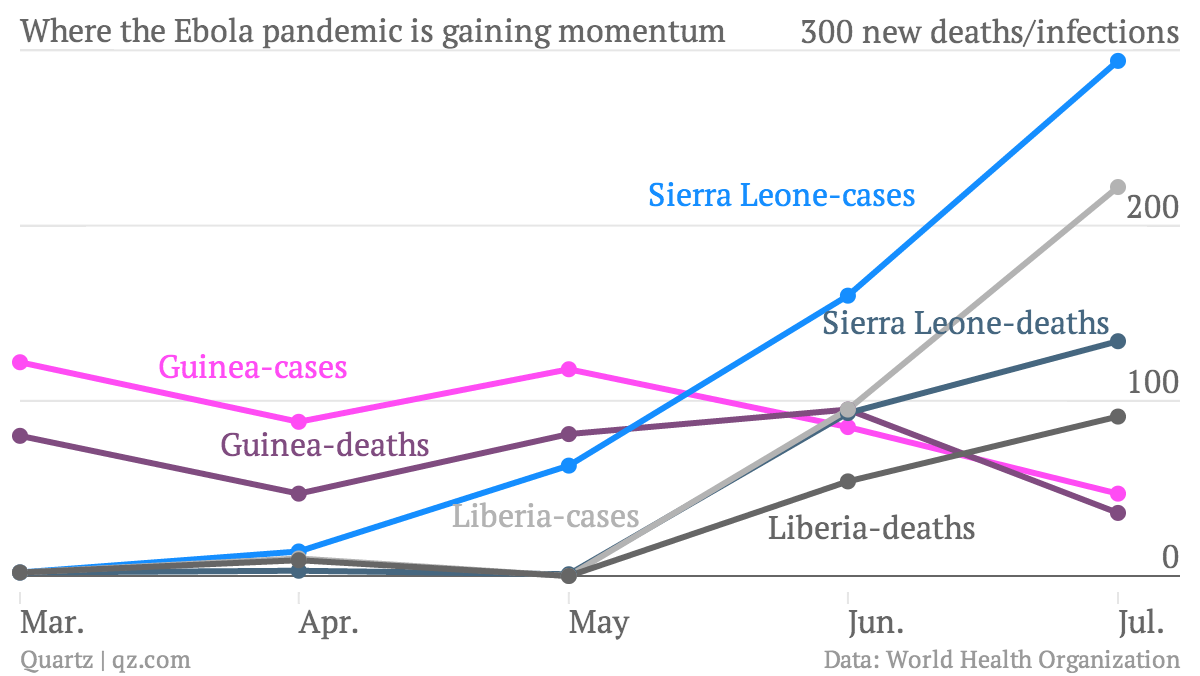
Why Is This Ebola Outbreak Different From All The Other Ones?

where-the-ebola-pandemic-is-gaining-momentum-guinea-cases-guinea-deaths-sierra-leone-cases-sierra-leone-deaths-liberia-cases-liberia-deaths_chartbuilder

Gwynn Guilford looks into it:

[A]s viral public health menaces go, Ebola should be easy to contain. Unlike airborne viruses like, say, swine flu, it’s not exactly sneaky. Ebola is spread only when infected bodily fluids come into contact with someone’s mucus membranes or open cuts. And it tends to broadcast the risk of infection pretty clearly; the symptoms include vomiting, diarrhea and, in some cases, hemorrhaging of mucus membranes. That made Ebola relatively easy to contain when it flared up in remote forests of central and eastern Africa, which are sparsely populated. But this new pandemic is a totally different story …

Why is that?

For one, Sierra Leone, Guinea and Liberia all have dreadful medical infrastructure. Sierra Leone has a single laboratory capable of Ebola testing. Earlier this week, Monrovia, Liberia’s capital, ran out of hospital space to quarantine Ebola patients. And that’s in its biggest city, where infrastructure is most robust. In other parts of Liberia, as well and in Guinea and Sierra Leone, hospitals simply aren’t available, according to data from Afrobarometer, a survey group.

Furthermore, Julia Belluz adds, a shortage of medical workers means many patients are not identified:

Ebola specialists believe one of the key reasons this outbreak has spread so far is because of the shortage of health-care personnel to deal with it: if you don’t have enough people on the ground doing the labor-intensive job of tracing the contacts of positive patients and ensuring they are identified before becoming ill too, each missed case is the new beginning of more human-to-human spread. Those missed cases are what worries Tarik Jasarevic, a World Health Organization worker on the ground in Guinea. He says that because of the geographic dispersal of the current outbreak—the demand for so many specialists in a relatively rare disease over several countries—mobilizing people and getting systems in place to care for everyone is problematic.

The doctors caring for ebola patients are also getting sick and dying:

Since the disease is transmitted through direct exposure to bodily fluids—from vomit to blood and sweat—health-care workers are advised to wear face masks, goggles, gowns and gloves while caring for patients. The trouble is, health workers in the developing-country context—especially those working in some of the poorest countries on earth, where the disease emerged this time—don’t always have access to this protective gear.

It’s important to note that they are also the ones who have died in this outbreak. Of the 60 deaths so far, none involved foreign workers (though two Americans are currently battling the virus, and one is a doctor). Foreign aid agencies such as Doctors Without Borders—which apply stringent precautions for all their health personnel—have never lost members of their teams to Ebola. So the problem this time is as much about size of the outbreak as it is about resources.

Putin’s Anti-Americanism

David Remnick captures how it has grown significantly during Putin’s time in power. Remnick talks at length with former US Ambassador to Russia Michael McFaul:

Although McFaul feels a deep sense of outrage about Putin, he also understood the mind-set of resentment and conspiracy. “I didn’t go to foment revolution,” he said. “I went to take the reset to the next stage. That was my mandate.” He added, “Obama people don’t sponsor color revolutions. Other Administrations had done this. Has the U.S. used covert operations to foment regime change? The answer is yes. I don’t want to get in trouble or go to jail, but has the U.S. supported the opposition to bring about political change? Serbia is a paradigmatic case: direct money to the opposition to destabilize things, and it was successful.” He also cited the overthrow of Mossadegh, in 1953, in Iran, and the support for the Nicaraguan Contras.

“Putin has a theory of American power that has some empirical basis,” McFaul went on. “He strongly believes this is a major component of U.S. foreign policy. He has said it to the President, to Secretary Kerry. He even believes we sparked the Arab Spring as a C.I.A. operation. He believes we use force against regimes we don’t like. . . . By the way, he damn well knows that the government of the Soviet Union used covert support. He worked for one of the instruments of that policy. He really does kind of superimpose the way his system works onto the way he thinks our system works. He grossly exaggerates the role of the C.I.A. in the making of our foreign policy. He just doesn’t get it. Or maybe he does get it and doesn’t portray it that way. I struggle with that: is he really super-clever and this is his psych op, or does he believe it? I think he does believe that we are out to get him.”

Dreher is most interested in Remnick’s “series of interviews with prominent Russian figures in Putin’s sphere.” One passage Dreher is struck by:

The world, for [Aleksandr] Dugin, is divided between conservative land powers (Russia) and libertine maritime powers (the U.S. and the U.K.)—Eternal Rome and Eternal Carthage. The maritime powers seek to impose their will, and their decadent materialism, on the rest of the world. This struggle is at the heart of history. For Dugin, Russia must rise from its prolonged post-Soviet depression and reassert itself, this time as the center of a Eurasian empire, against the dark forces of America. And this means war. Dugin rejects the racism of the Nazis, but embraces their sense of hierarchy, their romance of death. “We need a new party,” he has written. “A party of death. A party of the total vertical. God’s party, the Russian analogue to the Hezbollah, which would act according to wholly different rules and contemplate completely different pictures.”

In other Russian news, Ioffe finds it ironic that Russia is cracking down on any mention of Siberian self-determination:

All these months, Russia has been supporting Russian separatists in Crimea and eastern Ukraine, trumpeting the principle of self-determination. “The right to self-determination is formalised as one of the most important goals of the UN Charter,” said Russian foreign minister Sergei Lavrov before the Russian parliament. “As to Crimea, as you know, its autonomy was restricted several times in the past against the will of the Crimeans. After the armed coup by persons, who seized power in Kiev, actions were undertaken, which even more aggravated the possibilities of the Crimeans to exercise their right to self-determination within the Ukrainian state.”

But, in the Kremlin’s understanding, self-determination begins where Russia ends.