An injured man reacts at the quake-hit area in Zhaotong, China on August 4, 2014. A 6.5-magnitude earthquake hit Zhaotong’s Ludian county on Sunday, killing at least 398 people. By ChinaFotoPress via Getty Images.
An injured man reacts at the quake-hit area in Zhaotong, China on August 4, 2014. A 6.5-magnitude earthquake hit Zhaotong’s Ludian county on Sunday, killing at least 398 people. By ChinaFotoPress via Getty Images.
The terrorist group and its allies appear to have changed their encryption systems in response to the Snowden leaks, according to a new report by the intelligence firm Recorded Future:
The report concludes that “it’s pretty clear” that there is an “increased pace of innovation in encryption technology by Al-Qaeda post Snowden.” The encryption, the report added, “is based on best practice, off the shelf, algorithms.” What’s more, the latest crypto tools follow other crypto programs terrorists have developed following the Snowden leaks. Recorded Future reported in May that three of the tools were created within five months of The Guardian first publishing the Snowden leaks in June 2013.
Though it’s not quite a “smoking gun”, Jazz Shaw urges anyone who thinks Snowden is an unmitigated hero to read the report:
None of this sounds terribly surprising and likely just serves as confirmation that the terrorists are keenly aware of international news headlines and respond to whatever information they can get accordingly. It’s also worth noting – as another analyst in the story mentions – that this isn’t absolute proof of a causal relationship between the two events. It’s possible that they just felt the software was long past due for an overhaul and would have done it anyway. But that’s relying awfully heavily on coincidence.
Of course, the real questions about the Snowden leaks go unanswered in this report. The fact that they upgraded their software is interesting, but what we still don’t know – and may never know, for obvious reasons – is how much other damage was done. How many agents had to be moved around or removed for protection? How many foreign informants supplying us with information were compromised, or simply disappeared? What opportunities were lost which our intelligence agencies clearly can’t talk about in public?
On the other hand, the jihadists’ new crypto might not make much difference:
Whatever the reason, [Bruce] Schneier says, al-Qaida’s new encryption program won’t necessarily keep communications secret, and the only way to ensure that nothing gets picked up is to not send anything electronically. Osama bin Laden understood that. That’s why he ended up resorting to couriers. Upgrading encryption software might mask communications for al-Qaida temporarily, but probably not for long, Schneier said.
“It is relatively easy to find vulnerabilities in software,” he added. “This is why cybercriminals do so well stealing our credit cards. And it is also going to be why intelligence agencies are going to be able to break whatever software these al-Qaida operatives are using.”
Dr. Kent Brantly, a US citizen who contracted ebola in Liberia, was evacuated to Emory University Hospital in Atlanta on Saturday for treatment in a special isolation unit. His colleague Nancy Writebol is also expected to arrive there this week. The usual suspects are busy fearmongering:
But Susannah Locke defuses fears:
Transmission of Ebola will be prevented using standard protocols, and health officials say that the two pose very little risk to the general public. Even if there were some terrible, unforeseen accident with one of these patients, Ebola wouldn’t be likely to spread very far. First, Ebola doesn’t jump from person to person through the air, but through close contact by touching bodily fluids such as sweat, vomit, or blood. The outbreak in West Africa is so severe for a number of key reasons, including a lack of resources, inadequate infection-control measures, and mistrust of health workers. The United States, by contrast, has far better public-health infrastructure. And that makes all the difference.
And Emory is taking every precaution to ensure that those fears aren’t realized:
[Dr. Bruce Ribner, the head of the unit,] went on to explain that Emory would be providing what he called “supportive care,” which consists of “carefully tracking a patient’s symptoms, vital signs and organ function and taking measures, such as blood transfusions and dialysis, to keep him or her as stable as possible.” “We just have to keep the patient alive long enough in order for the body to control this infection,” he explained. In the meantime, Brantly and Writebol will be separated from healthy people by a plate-glass window, and communication with non-medical personnel will mostly happen via intercom and telephone.
So, for now, it seems that Donald Trump and those who share his concerns don’t have much to worry about. At the very least, it seems that the people in charge of handling Ebola’s new American presence are being significantly more careful than the CDC was with that anthrax.
Kent Sepkowitz outlines the logic behind the evacuation:
[W]ith the move, the CDC, or whoever made the decision, is betting that high-tech American care using Ebola-inexperienced medical staff is better than not-so-high-tech care with remarkably experienced staff. This high-low discordance often is seen in tropical medicine. For example, many are taught in medical school that the best place to be treated for severe malaria is not the tertiary care medical palace on the American hill where a case is seen every year or two but the run-down clinic in the local country where malaria is as common as a stubbed toe and the staff knows every trick of the trade.
For Ebola treatment, though, I suspect the decision is correct: Writebol and Brantly are better off here. Much about the disease and its related conditions, called collectively the “viral hemorrhagic fevers,” is not well studied for the very reason a patient is being flown home. The resources simply are not available to articulate and record, to take extra blood, and to perform additional X-rays—all necessary to fully define any disease.
Seasonal Affective Disorder also strikes in the warmer months. Olga Khazan outlines the possible reasons why:
One recent study suggests summertime SAD is caused by allergies, with people reporting worse moods on days the air was thick with pollen. Another theory is that the intense summer light is just as disruptive as winter’s long, cold nights. People might be staying up later in the summer, suspects Alfred Lewy, a professor of psychiatry at Oregon Health and Science University, thus throwing their body clocks for a loop. He told NBC News that he treats summertime SAD patients by suggesting they get early-morning sun and take melatonin, a hormone that promotes sleep. …
And then there’s the simplest explanation: People just can’t stand the heat. Thomas Wehr, a scientist emeritus at the National Institute of Mental Health who first documented SAD, says that when people with warm-weather depression were “wrapped in cooling blankets at night, their temperatures dropped and their symptoms disappeared. As soon as they went outside into the summer heat, their depression returned.”
A reader opens up:
Once I became pregnant, and even more after I miscarried at six weeks, my pro-choice position deepened that much further. If there’s one message I have, it’s this:
The capriciousness of miscarriage lays bare the tenuousness of life at that stage of development. It’s extremely hard to express just how dehumanizing it is to ban the loss of a pregnancy only if the person actually going through the pregnancy has any say in the process.
Something like 10-20% of known pregnancies end in miscarriage (so says the Mayo Clinic), and possibly 50% of undiagnosed pregnancies (according to the March of Dimes). The body rejects an embryo early if something is wrong. Why, when it’s so easy for the body to reject a zygote or embryo, should women be forbidden from jump-starting a process that the body so often does simply as a matter of course?
Why should it be strictly up to the vagaries of chemistry and biology to decide that an embryo, or the environment it would come into, is unfit? Nature’s capable enough to make this decision, but a human being isn’t?
A miscarriage, AKA spontaneous abortion, is both the most natural thing and an incredible betrayal from your own body, in large part because you have no control over it. If you could ban bodies from terminating pregnancies, banning doctors from terminating them might make a tiny bit more sense, at least intellectually. But you can’t, and it doesn’t.
I saw the embryo after it passed. And at that stage, it does not even look like a proto-person. Saying my miscarriage “ended human life” is a big stretch – and I’m the one it unwillingly happened to! I was sad, obviously. But having seen what an embryo looks like at that stage, and how fragile and non-human it is at six weeks, the thought of anyone valuing a reticulated clump of tissue over the experience of an actual living, breathing person infuriates me. At my miscarriage, it was only two steps past ovulation. Some pregnancies are lost so early that a miscarriage is mistaken for a period. People don’t mourn over a lost egg. Mourning the loss of something one or two steps past that so intently that you want to ban anything that induces it is just ludicrous.
After I came back to work after being in the hospital, I told my boss I was doing okay, and that it’s such a common thing – a fact known almost exclusively to only two groups of people: doctors, and people who have had miscarriages. And she said, “No. It’s a big deal.” And I’m like, who the hell are you to tell me whether it’s a big deal or not? I feel the exact way about people who want to ban abortions.
Many more reader experiences in our long-running thread, “The Misery Of Miscarriage“.
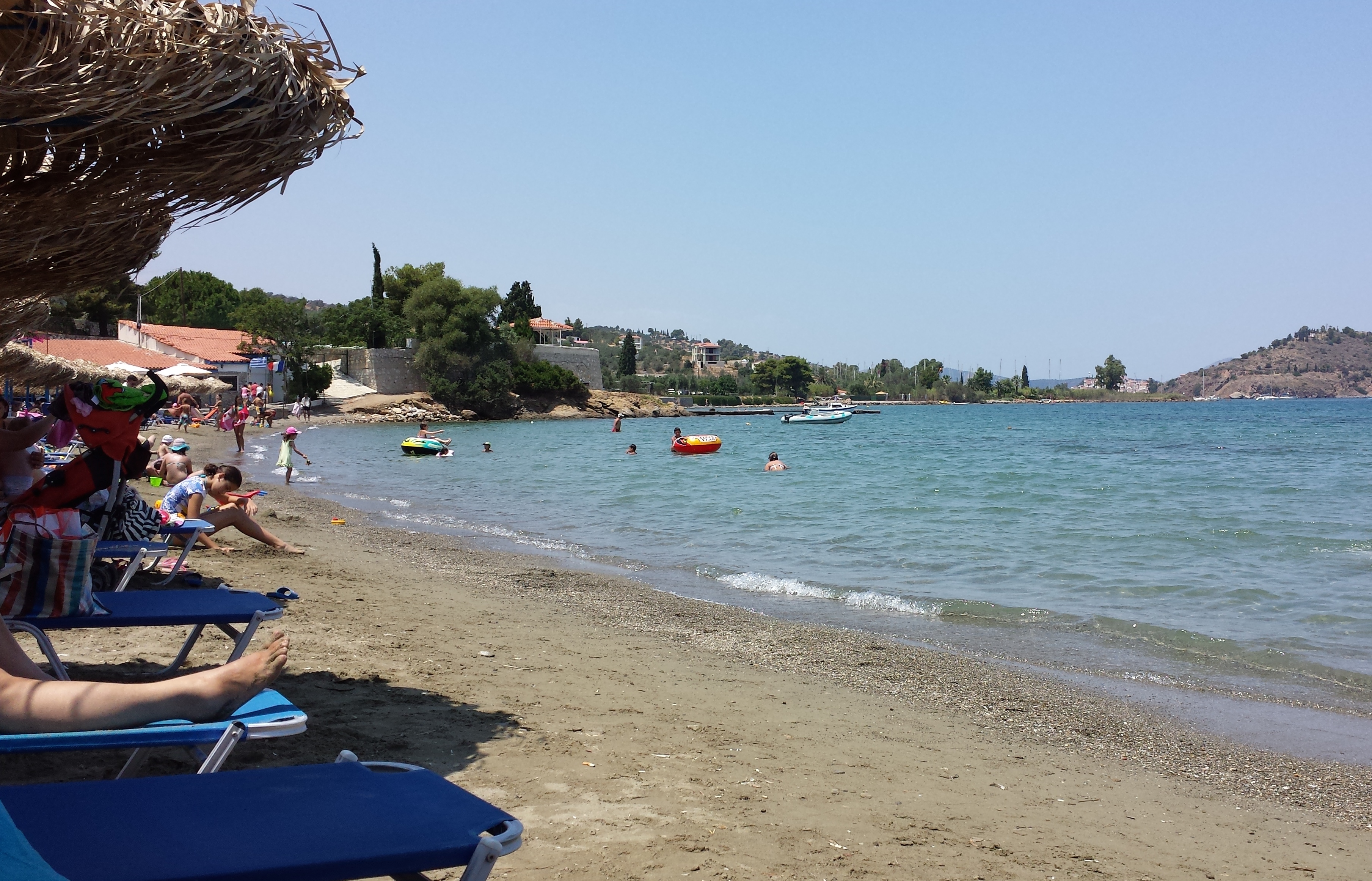
A reader answers the question with the above photo:
The beach. The sound of the waves, an umbrella so I’m not baking in the sun and a good drink. It doesn’t happen enough but that is by far my favorite place to read.
Another:
The sauna. Sounds weird but it’s no contest for me: A good book and a good roast is heaven. It’s perfect for reading poetry, too: in a half-hour you can read three to six poems, take a break to cool off and think about them, then read a couple more.
The only problem is people who come in and decide to have a conversation. Not cool.
And another:
Might I suggest VFYFPTR: View From Your Favorite Place to Read?
A reader welcomes him into the fold:
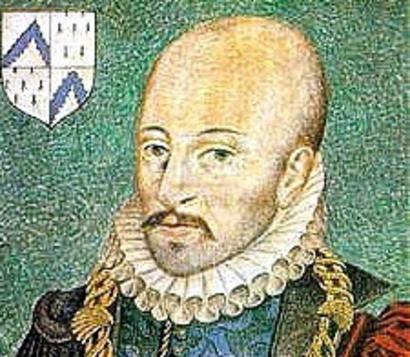
You ask if Montaigne was an atheist or Christian. Montaigne was most certainly atheist, and his atheism, though concealed for obvious concern about the consequences of opposing the opinions of those “stronger in number.” Montaigne’s atheism shines through in his Apology for Raymond Sebond, written in the wake the French Wars of Religion in which thousands were slaughtered in a sectarian conflict.
In his Apology, Montaigne, by placing words in the mouths of others, openly ridicules the promise of heaven and knowledge of divine beings. One example: “The philosopher Antisthenes, as he was being initiated in the mysteries of Orpheus, the priest telling him, ‘That those who professed themselves of that religion were certain to receive perfect and eternal felicity after death,’—’If thou believest that,’ answered he, ‘why dost thou not die thyself?'”
Two more examples from the Apology: “‘Tis Socrates’s opinion, and mine too, that the best judging of heaven is not to judge of it at all.” And: “Nothing is made of nothing, God therefore could not make the world without matter. What! has God put into our hands the keys and most secret springs of his power? Is he obliged not to exceed the limits of our knowledge?”
Montaigne is, of course, cautious, with numerous references to the trial and execution of Socrates for disbelief in the gods, all expressed in a way that undermines any divine authority:
“For that which our reason advises us to, as the most likely, is generally for every one to obey the laws of his country, as was the advice of Socrates, inspired, as he says, by a divine counsel; and by that, what would it say, but that our duty has no other rule but what is accidental?”
Were Montaigne living today and free from the threat of persecution for his beliefs, his detractors would call him a “New” atheist.
Well, since this is a book club, we can now bring on Marshall MacLuhan the author Sarah Bakewell, to address the question. Here’s her response to the email:
Thank you for raising this fascinating topic! It’s one that I puzzled over constantly while writing the book, and I still feel that the answer is open to interpretation. To some extent (as with other areas) it depends partly on what one wants to read into Montaigne, because he is quite capable of pointing us in several different directions at once.
I am an atheist myself and therefore quite inclined to look for an atheist Montaigne. On the other hand, I came to feel that this would be an over-simplification.
By temperament and general world-view, Montaigne was extremely skeptical, and this inclined him towards atheism. But he was skeptical about all claims to a single truth about the world – both religious claims and what we might now call scientific ones. (The modern notion of “science”, let alone “scientific method”, did not exist in his day, which I think is relevant to this debate; it’s dangerously easy to impose our own categories on the sixteenth century).
But “the New Atheism”, as I understand it, is a movement that calls not for the suspension or withholding of belief, but for active opposition to religious world-views. It calls particularly for opposing religion through rational and scientific arguments. This, I think, would have turned Montaigne off, because he was skeptical about the capacity of human reason to give us any certainty about anything at all.
The main thrust of the “Apology for Raymond Sebond” leads in that direction. He sets out to defend Sebond against attacks based on reason, by demonstrating the limitations of reason in general (never mind the fact that Sebond himself was a proponent of “rational” theology). Montaigne emerges in this essay as very much the Pyrrhonian Skeptic – a form of skepticism which casts doubt on the possibility of being certain of anything, even one’s own lack of certainty.
(Also, it seems weird to us, but this kind of Skepticism was quite acceptable to the Church authorities of Montaigne’s time, because it helped to shore them up against Reformists who put more emphasis on rational or privately derived beliefs.)
Having said all this, I always had the impression when reading Montaigne that he was FAR more interested in what went on in this world than anything that might happen in the beyond. He was fascinated by the natural world, by history, by the quirks of human behavior, by social variety – particularly by the beliefs of other cultures, which he seemed to find neither more nor less convincing than those of his own.
I think I’d sum up my impression of Montaigne by saying that he was not necessarily an atheist (still less a New one) – but that he was profoundly, enthusiastically, gloriously secular.
Read the whole Book Club discussion here.

David Kenner takes the pulse of the West Bank, where the Gaza bombings have inspired a wave of recent demonstrations, raising fears of a general uprising:
A massive protest last week seemed to momentarily challenge the conventional wisdom that the West Bank was not ready for another uprising. In the largest West Bank demonstration in decades, thousands of Palestinians marched to the Qalandiya checkpoint, where they clashed with Israeli security forces — at least two Palestinians were killed in the violence, and the shops nearby were gutted by fire. The demonstration showed the undeniable Palestinian anger at the war in Gaza, which has so far claimed over 1,400 Palestinian lives. The dynamics of how it was organized, however, suggest that it may prove difficult to replicate. …
There are still demonstrations in the West Bank, but in the absence of active support by the upper echelons of the political leadership, they have remained relatively small and easy for Israeli forces to disperse. Around midafternoon on Aug. 1, dozens of protesters gathered at Ofer Prison, which holds roughly 1,000 Palestinian prisoners and is a common flashpoint for protests. No Fatah flags were in evidence, though many people who dotted the demonstrations carried Hamas’s green flag.
But eventually, David Shulman imagines, the protest movement may become too big for Israel to manage:
Qalandia was one dramatic event, quickly followed by others in Bethlehem, Beit Umar (where three Palestinians were killed), Husan (two killed), and elsewhere. Even if the army somehow manages to suppress the protests now, the Qalandia march shows us what may happen sometime soon. Those of us who are familiar with the situation in the territories have known for years that the thin veil of stability could be torn away at any moment, revealing the volatile reality underneath; and we have also known, as do the grassroots leaders in the villages and towns, that the Occupation will perhaps end when some form of mostly nonviolent resistance achieves large numbers. Tens of thousands of Palestinians may someday be able to wash over the army’s barricades, no doubt at considerable cost in lives; Israel has no viable answer to such a process. No one should, however, assume that when this happens—a third Intifada—it will be entirely Gandhian in tone. And what begins as peaceful civil resistance can swiftly change its color. It could begin tomorrow, or in a year or two, or five.
(Photo: A Palestinian protester holds an Islamic flag walking towards Israeli forces during clashes in the West Bank town of Hebron on August 1, 2014 following a demonstration against Israel’s military operation in the Gaza Strip and in support of Gaza’s people. By Hazem Bader/AFP/Getty Images)
Michelle Goldberg observes how radical feminists and transgender activists are quarreling over that question:
Trans women say that they are women because they feel female – that, as some put it, they have women’s brains in men’s bodies. Radical feminists reject the notion of a “female brain.” They believe that if women think and act differently from men it’s because society forces them to, requiring them to be sexually attractive, nurturing, and deferential. In the words of Lierre Keith, a speaker at Radfems Respond, femininity is “ritualized submission.”
In this view, gender is less an identity than a caste position. Anyone born a man retains male privilege in society; even if he chooses to live as a woman – and accept a correspondingly subordinate social position – the fact that he has a choice means that he can never understand what being a woman is really like. By extension, when trans women demand to be accepted as women they are simply exercising another form of male entitlement. All this enrages trans women and their allies, who point to the discrimination that trans people endure; although radical feminism is far from achieving all its goals, women have won far more formal equality than trans people have.
Sonny Bunch criticizes trans activists’ harassment of “TERFs,” or “trans-exclusionary radical feminists,” at conferences and online:
As an interested observer with no real horse in the fight – I am neither a radfem nor a trans activist, believe it or not – I do wonder whether or not it’s self-defeating for the transfolk and their allies to behave in such a way. Bullying to gain acceptance, rather than persuading those who do not understand who you are or what you have gone through, is a tactic that could easily backfire on a community that comprises roughly one thousandth of one percent of the population. Then again, perhaps the transfolk have an understanding of how outré their cause appears to the rest of us and believe that persuasion is impossible.
But Mari Brighe slams Goldberg’s piece as “a disturbingly one-sided view of the situation that relies on heavily anecdotal evidence … and ignores the extended campaign of harassment and attack that the the trans community has endured at the hands of radical feminists”:
Let’s start with the numbers. In the piece, Goldberg mentions the names of 14 radical feminist activists (frequently providing physical descriptions), and provides quotes from nine of them — including two from books penned by radfems. In contrast, she mentions and quotes a total of four trans women (zero from books), and two of them are quoted to supporting the radical feminist position. The problem isn’t necessarily that Goldberg appears to side with the radical feminist viewpoint; that’s perfectly within her rights, and perfectly within The New Yorker’s right to print it. The real issue is that Ms Goldberg gives the impression that she’s covering the conflict between the trans rights movement and radical feminism – after all, the piece is subtitled “The dispute between radical feminism and transgenderism”– but gives only passing lip service to the transgender community’s side of this situation.
The problem, as Brighe sees it:
Beyond their work to influence policy in a manner that harms the trans community, trans-exclusionary radical feminists have engaged (and still do) in numerous campaigns of personal harassment against trans women, particularly vocal trans activists. The previously mentioned Cathy Brennan is thought to be connected to some of the ugliest of the harassment, including revealing personal information about trans women (a practice often known as doxxing), as well as contacting doctors, employers, and parents of any individual who dares challenge her or disagree with her. The blog Gender Identity Watch, which Brennan is rumored to be connected with, engages in extensive harassment of trans woman, including posting their “dead-name” (pre-transition name) and pre-transition photos. They also engage in systematic harassment of trans women and trans allies on twitter, most by repeating their same tired rhetoric: “trans women are men” and “penis is male”. They also engaged in an extended harassment campaign targeting Against Me! singer and trans woman Laura Jane Grace. Earlier this year, Tina Vasquez penned a lengthy piece on for Bitch Magazine running down dozens of examples of harassment perpetrated by radical feminists against both trans activists and trans allies, including herself.
Julia Serano adds:
When Goldberg interviewed me for the piece, I talked extensively about TERF attacks on trans people: About the hateful speech I (and other trans women) regularly receive from TERFs on my Twitter feed, blog comments, etc., and how much of it is of a sexualizing nature. I talked at great length about Cathy Brennan, who is notorious for her personal attacks and outing of trans people, her various websites where she engages in smear campaigns against trans women (once again, usually of a sexualizing nature). I mentioned how, after my appearance at a SF Dyke March forum on age diversity and gender fluidity – which was designed to build bridges between trans-positive queer women and those (often of older generations) who are trans unaware, and which resulted in respectful and constructive dialogue on all sides – several TERFs crashed the Facebook page and spewed so much hateful speech that they had to shut the whole thread down.
None of this made it into the story, which will likely lead uninformed readers to presume that trans people are simply mean and out of control, rather than reacting to the transphobia/trans-misogyny/sexualizing comments we constantly face from TERFs.
Meanwhile, Mona Chalabi tries to nail down how many trans Americans there are in the first place:
[C]ounting the transgender population nationally remains a steep challenge. The US Census Bureau doesn’t ask who is transgender, nor do the Centers for Disease Control and Prevention. But even if they did, the responses might not be reliable because some people are afraid to answer, while others disagree on what “transgender” even means. If you see someone cite a statistic about transgender people in the United States, you’re seeing a rough estimate at best.
Gary Gates is an LGBT demographer at the University of California Los Angeles School of Law’s Williams Institute, which studies sexual orientation and gender identity law and public policy. He is responsible for one of the most frequently cited estimates of the transgender population – 700,000, about 0.3 percent of U.S. adults. That figure is based on data from two surveys. One, conducted in Massachusetts in 2007 and 2009, found that 0.5 percent of respondents ages 18 to 64 identified as transgender. The other, done in California in 2003 to look at trends in LGBT tobacco use, found that 0.1 percent of adults in California identified as transgender. Using the surveys to get to the 0.3 percent estimate “takes a lot of statistical gymnastics,” Gates said.
The Dish’s long thread on transgender identity is here.