Putting A Price On Your Pet’s Life, Ctd

Readers lend their perspectives to this post:

There is another lens through which to view expensive and invasive veterinary procedures: 2013-05-199514_33_15__perfectlyclear_0002quality of life. If vets counseled their clients about the chances of treatment’s success and the potential impact on the pet’s remaining life, it may make the wrenching choice to forego treatment easier.  Your dog has cancer?  Sure, Vets ‘R Us can offer chemo and radiation for $10,000, but Fido will be very sick for eight weeks with no understanding of why you are subjecting him to this torturous process and there is only a 30% chance of your beloved pet surviving six months.

But we aren’t even having these discussions about treatment for ourselves, so I hold out little hope it will happen for our pets.

Another is on the same page:

Chemo is awful. It’s painful, draining and generally unpleasant. But as humans, we go into it with an appreciation of our own mortality – yes, this is really going to suck, but it will be worth it if I can get an extra 2, 3 or 10 years out of it to spend with my family. But our dogs and cats have no such knowledge of their mortality. To them, they’re essentially being tortured for no apparent reason. Our lovable, sassy, fat cat has a family history of cancer, and to my wife and I, the only humane option if she falls victim is to put her down gently so she doesn’t suffer.

A few more readers:

Last week I almost sent the Dish an email hoping you would present my difficulty coming to a decision about having an operation on a growth next to my dog’s nose.

It emerged rather quickly in June. So I took her to the vet to see what it was. I didn’t get her usual vet at the two-person clinic; I got the one with whom I have a disconnect. Because the animal can’t verbalize what’s going on, communication with their health professional and you is important.

After a scrape of the skin cells, the vet came to me and indicated that she saw round cells, and with the growth’s “aggressiveness” she recommended excision. Since my dog would be out for this procedure, we should do a dental cleaning and perhaps extraction. She had an estimate in hand, which put the range at $700 to $1000. I left thinking I would move quickly and have this done, but I soon began questioning whether I wanted to put a 14-year-seven-month-old dog through this.

Days later I was able to talk to her regular vet, who framed the situation more realistically: “Do I want to put her through this and gain X amount of time? Or do I see this as the beginning of the end?” I brought my dog back to the vet for x-rays of her lungs (the most likely place for a primary cancer), and there was nothing to indicate something else was going on that would bring her down. My stress over whether to act ratcheted up. If what was on her face was cancer, did I want a tumor to keep growing on her face? Would it enter the bone?

As a freelance writer, I wasn’t able to focus on work. Finally last week, a black piece of skin came off her crusty nose, and I returned to the vet, after a discussion of biopsy … could it be a fungal infection? The vet looked at my dog and said that the original growth had healed nicely and she was no longer concerned. Perhaps it had even been a bee or wasp sting. I was delighted but also an emotional puddle.

In reading David Grimm’s piece, I acknowledge that his topic is one that speaks to a lot of people, but I would like to add another element to the discussion: even if one can afford the cost, is the treatment always something that we want to put our beloved pets through? I had always told myself that I wouldn’t take extreme measures – that I wouldn’t initiate chemotherapy treatments, for example – but this was something that fell short of that and yet could be the first sign of her decline and death. How was I to make the right decision based on her quality of life?

Another considers another calculus:

I understand that there is a sentimental component to the decision to forego a $5,000 operation for your pet, but from a moral standpoint I have no hesitation. Given that there is an oversupply of dogs and cats, putting one down simply means you can drive to the humane society and save another from being euthanized. Sure, it may be more painful for you, but from a broader perspective of the worldwide dog or cat population, and even from a personal karma perspective, you come out even to slightly ahead.

(Photo of a reader’s dying dog from one of our most popular threads last year, “The Last Lesson We Learn From Our Pets“)

What’s Next For Uganda’s Gays?

Last week, a Ugandan court struck down the country’s draconian Anti-Homosexuality Act. Melina Platas Izama gives credit to “the vital role played by concerned citizens and the legal community in Uganda”:

Ten individuals and organizations — including a journalist, professor, doctor, activists and current and former legislators — petitioned the court to repeal the law on the grounds that it was passed illegally, having contravened parliamentary rules of procedure requiring quorum, and that it violated constitutional rights. Their efforts, combined with those of a robust legal team, were integral to the law’s repeal. Their victory demonstrates the power of domestic actors and the courts in promoting social and legal change.

But Uganda might get worse for gays before it gets better:

If we look at attitudes toward homosexuality over time using opinion polls, we find that it can take decades for attitudes to shift. Further, negative attitudes toward homosexuality sometimes increase before they decrease.

In South Korea, for example, one of the countries with the longest record of opinion polling on the topic, opposition to homosexuality, again, as measured by the percentage of respondents who say homosexuality is never justifiable, jumped from 60 percent in 1982 to 90 percent in 1990 before declining again. It’s worth noting that levels of anti-homosexuality sentiment in South Korea in 1990 are nearly the same as those in Uganda today. In South Africa too, anti-homosexual sentiment increased before declining. Meanwhile, in the U.S., opposition has fallen only gradually over time and has yet to dip below 20 percent.

Jay Michaelson fears an anti-gay backlash:

In the case of Uganda, records kept by Sexual Minorities Uganda show that violence against LGBT people has increased tenfold since the passage of the AHA. Add in fiery preaching by anti-gay zealots, often funded by American organizations, and you have a volatile brew ready to explode. Activists worry that this court decision could provide the spark. If the law won’t protect Uganda from Satan, people will have to take up arms themselves.

Hopefully, cooler heads will prevail. There are supportive African (and African-American) clergy calling for coexistence rather than violence. Maybe the Obama administration, instead of merely backpedaling reactively, could support these voices pro-actively as well. Maybe Museveni could call for a period of national reflection. Or maybe, things will continue to get worse.

Previous Dish on the predicament of Uganda’s gays here.

Blogging About Books

Rohan Maitzen revels in it:

Blogging allows for a wonderfully open-ended kind of criticism: there’s no pressure to account for or include everything, no need to position yourself theoretically or as part of a bookclub-beagle-trpre-existing critical argument. You can do any kind or degree of contextualizing or theorizing that you want, of course (it’s useless to generalize about blogging as a form, since there are no rules or norms), but you can also just look directly at the book in front of you and say what you think about it, show what you observe in it. Everything else you know—all your habits of reading and thinking—will affect what you think and see, of course, but for me there has been something very liberating about writing a post knowing that I’m just writing as myself, for other interested readers, not trying to establish anything definitive but rather to offer what I can to the broad conversation about books that the internet enables.

Maitzen goes on to discusses how her academic training in Victorian literature connects with writing for a broad, public audience:

Just as I was starting to blog in 2007, for instance, Cynthia Ozick wrote a piece in Harper’s on the current state of criticism in which she said:

Academic theorists equipped with advanced degrees, who make up yet another species of limited reviewers, are worthy only of a parenthesis. Their confining ideologies, heavily politicized and rendered in a kind of multi-syllabic pidgin, have for decades marinated literature in dogma. Of these inflated dons and doctors it is futile to speak, since, unlike the hardier customer reviewers, they are destined to vanish like the fog they evoke.

Even though I was restless with the pressure I felt to produce increasingly specialized kinds of criticism, comments like these struck me as depressingly (and insultingly!) mistaken. I began to hope that I could use my blog to show that academic expertise is valuable, and that it can be worn lightly and used to further good conversations about literature, which is really what I see as the fundamental purpose of all criticism. Because negative stereotypes about “politically correct idiots” overrunning “lit departments” are pretty widespread, I also wanted to counteract them in my own small way by showing what really happens in at least one person’s classroom: I blog regularly about my teaching, and I’d be surprised if anyone could conclude from these posts that I have “forgotten the text.”

For more, check Novel Readings, Maitzen’s blog about literature.

Hamas Against The World

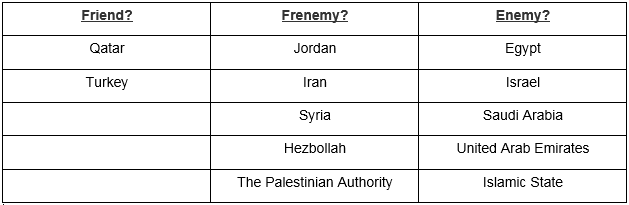
frenemy

This table, drawn up by Adam Taylor, illustrates Hamas’ current relationships with other countries and actors in the Middle East. As you can see, the militant group has few close friends left, and its isolation is a major factor in how the latest Gaza war began and how it might end. In a substantial essay on the origins of the present crisis, Nathan Thrall attributes Hamas’ desperation in large part to the enmity of Egypt’s new leader:

As it became clear that unrest in Egypt wouldn’t lead to Sisi being ousted or to the return of the Brotherhood, Hamas saw only four possible exits. The first was rapprochement with Iran at the unacceptable price of betraying the Brotherhood in Syria and weakening support for Hamas among Palestinians and the majority of Sunni Muslims everywhere. The second was to levy new taxes in Gaza, but these couldn’t make up for the loss in revenue from the tunnels, and would risk stirring up opposition to Hamas rule.

The third was to launch rockets at Israel in the hope of obtaining a new ceasefire that would bring an improvement in conditions in Gaza. … The final option, which Hamas eventually chose, was to hand over responsibility for governing Gaza to appointees of the Fatah-dominated Palestinian leadership in Ramallah, despite having defeated it in the 2006 elections.

Recently, Hamas has been urging Hezbollah to open a second front in Israel’s north, but Robert Beckhusen explains why they shouldn’t get their hopes up:

Not only are Hezbollah’s troops better equipped and have significantly larger rocket stockpiles than Hamas, the Iran-backed militia has all of southern Lebanon to fight from. This gives it space to maneuver, retreat and lay ambushes against advancing Israeli armor. Its rockets also are numerous and deadly enough to force the evacuations of northern Israeli towns, as happened during the 2006 war with Israel.

But Israel could be reckoning that Hezbollah won’t be in any hurry to come to Hamas’s aid. There’s no way Hezbollah can afford to do that as long as it’s fighting in Syria. Right now, Hezbollah is bogged down in fierce warfare against the Al Qaida-affiliated Nusrah Front in the mountainous borderlands of Lebanon and Syria. Hezbollah currently is starving out rebels in the Syrian province of Qalamoun, and launched a new offensive with the Lebanese army this week towards the town of Arsal inside Lebanon.

Torture-As-Execution, Ctd

This is extremely disturbing:

Documents released Friday afternoon in the case of Arizona’s  botched execution of Joseph Wood—who gasped for air and struggled, according to witnesses, repeatedly during the two-hour process—show that  executioners used 15 separate doses of a new drug cocktail before Wood finally died. Lawyers had warned that the combination of 50 milligrams hydromorphone (a pain killer) and 50 milligrams of midazolam (a sedative) was rife with potential problems. (The state also has a long history of failing to follow its own protocol.) The documents suggest they were right.

Ian Millhiser is stuck by the fact that “Wood received 750 milligrams of both drugs”:

To put that in perspective, an anesthesiologist told the Associated Press that patients sedated prior to surgery typically receive no more than 2 milligrams of either drug.

Midazolam is not considered a “true general anesthesia” because patients treated with this drug often retain awareness. Indeed, one anesthesiologist told the Wall Street Journal that the states that use this drug in executions “literally have no idea what they’re doing to these people.”

Karen Siberd MD backs up that anesthesiologist. Sibert declares that there’s “no mystery about why the July 23 execution of Joseph Wood in Arizona took so long”:

The convicted murderer didn’t receive one component of the usual mixture of drugs used in lethal injection: a muscle relaxant. The traditional cocktail includes a drug such as pancuronium or vecuronium, which paralyzes muscles and stops breathing. After anyone receives a large dose of one of these powerful muscle relaxants, it’s impossible to breathe at all. Death follows within minutes.

But for whatever reason, the Arizona authorities decided not to use a muscle-relaxant drug in Mr. Wood’s case. They used only drugs that produce sedation and depress breathing. Given enough of these medications, death will come in due time. But in the interim, the urge to breathe is a powerful and primitive reflex.

This sort of incompetence is all too common. Serwer talks with death penalty expert Austin Sarat about it:

Lethal injections, Sarat said, were more likely than other methods to result in botched executions. In a study of U.S. executions that took place between 1890 and 2010, Sarat said, 7% of executions by lethal injection were botched, compared to 3% for all executions.

Previous Dish on Wood’s botched execution here.


Why The Catholic Hierarchy Will Lose

This is a terrific interview of the embattled Archbishop of Minneapolis and St Paul (he is credibly accused of covering up child-abuse and having inappropriate relations with other men) that is worth watching in full as well as the extract below. But the interaction below truly reveals how morally bankrupt Church teaching on homosexuality is. In fact, even Nienstedt concedes that he understands how the church’s position – that all gays must remain celibate for life – does not make any sense when given the actual lives of actual human beings:

Here’s the transcript of that section:

N: Homosexuals need to lead chaste lives.

L: They need to lead celibate lives?

N: Well, yes.

L: Okay. Does that seem reasonable to you, that we should all lead the lives of priests?

N: Well… um…

L: Tell me, archbishop, why should I lead the life of a priest?

A: Because it is of your nature to, um, express yourself sexually through a committed relationship.

L: I am. I’ve been with the same partner and husband now for 21 years.

And there you have it. Someone who expresses their sexuality through a committed relationship of 21 years has no place in the Catholic church if they are gay. In fact, it seems that the more committed the relationship, the greater the penalty. Gay men and women who have married in a civil ceremony find themselves singled out for discrimination and expulsion. Here’s the latest example via New Ways Ministry:

Colin Collette was the beloved music director at Holy Family Church in Inverness for seventeen years, but lost that job when he became engaged to his longtime partner last week. The couple was traveling in Rome, when Collette’s partner proposed in front of St. Peter’s Basilica, and then they posted the good news on Facebook. The Daily Herald details what happened next:

“On Sunday, after leading the music for all five Masses at Holy Family, Collette said church pastor [Father] Terry Keehan asked him to come to his office. ‘He said, ‘I know this is something you’ve been longing for a long time, and in light of this I’d be happy to accept your resignation,’ ‘ Collette said, recounting what Keehan told him. Collette said at first he considered resigning, but something inside him told him he shouldn’t because he had done nothing wrong. He left Keehan’s office without resigning, but was fired Monday, he said.”

According to Collette, his relationship was never secret and his partner, who is Catholic, was an active member of the parish and known to Keehan. The music director cleared out his office on Tuesday

One reason I veer toward greater religious freedom than many of my fellow gays is that I believe that perhaps it is only through witnessing these extreme injustices and inhumanity that the people of the church will start demanding a change in these practices. These instances tell the world something about Catholicism – its continuing cruelty and disdain for gay people’s actual lives. Many, many Catholics do not think of gay people that way. It’s time their disproportionately gay clergy did the same.

Are Russian Troops In Ukraine?

This embed is invalid

Last week, Buzzfeed reported that Russian soldier Alexander Sotkin (seen above) posted Instagram photos taken within Ukraine:

Instagram’s geolocating tool … is highly accurate. The only plausible way it could have misplaced Sotkin’s photos on the map is if he had used a trick called GPS ghosting to make his iPad think he was elsewhere.

throws cold water on the story:

Sotkin uploaded the first photograph ostensibly showing his location in Ukraine on June 30, after he posted two others complaining about boredom and lack of power for his tablet. The last photo was the one positioned in Ukraine. He tagged all three with #учения2014 which shows that he was on exercises when he snapped those selfies.

Most likely, the varying accuracy of cell tower triangulation meant that his device geotagged his photos with wildly different location coordinates based on whatever tower it could communicate with. At the least, the evidence is nowhere close to being reliable enough to say Sotkin was fighting in Ukraine.

Meanwhile, James Miller fears Russia is preparing to invade Ukraine:

Strong evidence suggests that a Russian-supplied and crewed Buk antiaircraft missile shot down MH17. The missile was deployed to this area in order to defend the road that links the separatists’ positions to each other and to Russia. These towns are so vital to the Russian-backed insurgents that the separatists decided to place their most advanced SAMs in the area to defend against Ukraine’s air force. This also means that the town has become one of the primary goals for both the separatists and the Ukrainian military.

How important is this area to the separatists? Earlier this week a large convoy was spotted moving toward the town. The video of the convoy, labeled “troops from Russia,” shows a large group of heavy armor—mostly BMPs, towed artillery and antiaircraft guns, troops transports… and two Strela-10 advanced antiaircraft systems. All of the vehicles have uniform paint configurations, but those paint configurations don’t match the Ukrainian military’s. These weapons very likely came from Russia.

Mark Adomanis takes a look at Ukraine’s big-picture problems:

There will likely be more deaths before everything is said and done. Just the other day 19 people died and 31 people were injured, and hundreds more have been killed since the violence began. The momentum of the conflict, which at one point seemed to lie with the Russian-backed rebels, has decisively shifted in Kyiv’s favor. The rebels’ most recent comments, accusing the Ukrainians of using chlorine gas, suggest a growing desperation, as do their ever more heated and extreme calls for Russian assistance. It looks as if Ukraine will escape one of the worst possible fates—a “frozen conflict” over a disputed territory, like those between Georgie and Russia or Armenia and Azerbaijan. Minus Crimea, it will be free of any enclaves directly controlled by Moscow.

It’s important, though, not to get too carried away. Even if, as now seems to be the case, Ukraine “wins” the war in the east, it’s in for a long, rough, and dangerous road. Regardless of what foreign policy Kyiv pursues or which agreements it signs with the European Union, there’s nothing that it can do to change Ukraine’s geographic position. And this position exposes it to all manner of direct and indirect Russian pressure, particularly in the economic realm.

Boehner’s Border Bill, Now With Cruz Control

Late Friday night, just before heading home for their August recess, House Republicans passed a bill to address the child migrant crisis. To do so they threw an abattoir of red meat to the right flank – pledging less than a fifth of the resources that Obama says he needs and simultaneously reinforcing deportation for the half a million DREAM Act kids. It won’t pass the Senate, of course, but it gives House Republicans a Potemkin vote they can cite when they face their Hannityed constituents this month. It’s hard to beat Weigel’s wit:

Just one year ago, Republicans were talking about passing their own version of the DREAM Act. Tonight, they put the party on record for the total cessation of Barack Obama’s quasi-DREAM Act. The arc of history is long, but it bends toward Steve King.

And a certain congresswoman from Minnesota, as Chait notes:

A party that began the Congressional term hoping to move left from Mitt Romney’s immigration stance has instead moved toward Michele Bachmann’s. (Bachmann — who, along with Steve King, helped draft the House bill — pronounces herself thrilled.) The party’s new dogma will potentially entangle its next nominee in an even less humane debate than the one that ensnared Romney. At the very least, it has put 216 House Republicans, many of whom will one day seek higher office, on record for a policy most Latino voters consider disqualifying. The aye votes include potential 2016 presidential candidate Paul Ryan, who is not likely to be greeted by friendly mariachi bands any time soon.

It is understandable that the party’s Congressional wing, based mostly in safe, deep-red districts, has failed to craft a national strategy for its 2016 candidate. But the House’s course of action has fallen well below “unhelpful” and instead verges on outright sabotage. How do they think this is going to work out for them?

Why the change of heart? A political system so gerrymandered and a country so demographically sorted no Republican need persuade a single Latino this fall in order to get re-elected. Nate Cohn elaborates:

Hispanic voters are all but absent from this year’s most competitive Senate battlegrounds. … Hispanic voters will have even less influence over the composition of the House, which is all but assured to remain in Republican hands. The clearest illustration of the extent to which the House G.O.P. is insulated from Hispanic voters is this: The party easily held the House in 2012, even though Republicans won only 30 percent of the Hispanic vote for Congress, and even though Hispanic turnout in that presidential year was higher than in a midterm election.

The reason is simple. In districts held by House Republicans, Hispanics represent only 6.7 percent of eligible voters. The Hispanic share of eligible voters is nearly as low in the House battlegrounds, 7.4 percent. Most of those Hispanic voters are only in a few districts; the G.O.P. could afford to lose them given their healthy edge in the House.

But Cillizza argues that their PR problem is bigger than that:

This is the latest in a string of incidents in which Republicans have been their own worst enemy — often because they simply can’t get out of their own way. Given their dismal approval ratings, the best way for Republicans to handle almost every issue — including this one — is to make as few waves as possible. Stay out of the news. Let President Obama do the heavy lifting on what the funding level ends up as. This issue is a no-win politically — people don’t like the idea of kids being shipped back to dangerous places but also don’t love people coming here illegally or spending billions of dollars that may or may not solve the problem.

And yet, Republicans found a way to make the story all about them in the dying days of this session of Congress. It’s remarkable — and not in a good way.

Cool Ad Watch

A full-page ad from Sunday’s NYT:

leafly ad

Jesse Walker comments:

The most striking thing about the ad is that it isn’t striking at all. It would be easy to flip past this quickly without recognizing that it’s about cannabis—and even if you do pause long enough to see what’s being advertised, the idea of an ad for a marijuana review site in The New York Times just doesn’t sound all that bizarre anymore. That’s when you know a social revolution is succeeding: when it starts to feel banal.