Should Salaries Be Secret?

Bouncing off the Abramson story, Salmon speaks out against keeping salaries confidential:

Very few people like to talk about how much money they make — especially not people who earn a lot of money. Since companies tend to be run by people who earn a lot of money, the result is a culture of silence and secrecy when it comes to pay. Such a culture clearly served the NYT ill in this case. If the salaries of senior NYT management had not been a closely-guarded secret, then Abramson would not have been shocked when she found out how much Bill Keller made before her, and Arthur Sulzberger would not have reacted badly to Abramson’s questions about pay.

Indeed, secrecy surrounding pay is generally a bad idea for any organization. Ben Horowitz has the best explanation of why that is:

it can’t help but foment poisonous internal politics. But there are other reasons, too. For one thing, secrecy about pay is bad for women, who are worse at asking for raises than men are. If men secretly ask for raises and secretly get them, while women don’t, then that helps to explain, at least in part, why men end up earning more than women.

Matt Bruenig thinks this secrecy “is only true for people who earn a lot of money, as well as those who may not make that much money but still find themselves in that high socioeconomic status milieu (e.g lesser-paid writers)”:

In conversations among those in upper class professions, I’ve noticed that once the job and employer are identified, the next questions are about how they like it and what kinds of things they do. In conversations among those in lower class professions, after the job and employer is identified, most of the time the next question is about what the pay and benefits are. When jobs aren’t self-actualizing and don’t confer status, that’s all they are about.


Putting The Culture In Agriculture

The Economist highlights research suggesting that agricultural techniques are the reason “psychological studies conducted over the past two decades suggest Westerners have a more individualistic, analytic and abstract mental life than do East Asians”:

The West’s staple is wheat; the East’s, rice … Before the mechanisation of agriculture a farmer who grew rice had to expend twice as many hours doing so as one who grew wheat. To deploy labour efficiently, especially at times of planting and harvesting, rice-growing societies as far apart as India, Malaysia and Japan all developed co-operative labour exchanges which let neighbours stagger their farms’ schedules in order to assist each other during these crucial periods. Since, until recently, almost everyone alive was a farmer, it is a reasonable hypothesis that such a collective outlook would dominate a society’s culture and behaviour, and might prove so deep-rooted that even now, when most people earn their living in other ways, it helps to define their lives.

A research team “gathered almost 1,200 volunteers from all over China and asked them questions to assess their individualism or collectivism”:

There was a striking correlation … with whether it was a rice-growing or a wheat-growing area. This difference was marked even between people from neighbouring counties with different agricultural traditions. His hypothesis that the different psychologies of East and West are, at least in part, a consequence of their agriculture thus looks worth further exploration.

A Country That Would Kill To Host The World Cup

Jeremy Stahl watched ESPN’s E:60 documentary on Qatar’s World Cup preparations and is appropriately outraged. According to one source in the documentary:

Sharan Burrow, the general secretary of the International Trade Union Confederation, is quoted in the ESPN documentary as saying that at current rates, 4,000 people will die to make the 2022 World Cup a reality. A March ITUC report said that 1,200 migrants have already died in the four years since the tiny, oil-rich Gulf State was awarded the World Cup in a shady and stunning decision …

All of these abuses are possible because of the nation’s kafala employment system, which has been aptly described as modern-day slavery. Through kafala, employers are allowed to confiscate a migrant’s passport and withhold exit visas, effectively preventing that person from leaving the country.

Qatar claimed as recently as this Tuesday that not a single person had died while doing work for the World Cup. The contention rests on the fact that the hundreds who have died on infrastructure and construction efforts were working on “non-World Cup projects.” Despite these assertions, Qatar and FIFA seem to have realized that a humanitarian crisis of this scale is disastrous, at the very least from a publicity standpoint. On Wednesday, Qatar announced reforms intended to abolish the worst provision of kafala, specifically the one tying workers’ exit visas to employers.

Christa Case Bryant takes a closer look at the reforms announced this week:

Because the new worker guidelines apply only to World Cup sites, and stadium work is still in the very beginning stages, less than 200 workers are governed by those standards. But Farah al-Muftah, chairwoman of the Supreme Committee’s Workers’ Welfare Committee, says meetings are now under way to establish common standards that would be more broadly applied. “By us going for unified worker welfare standards, you’re covering a huge majority of workers involved in the building of World Cup sites and the country’s infrastructure,” she says.

The Qatar Foundation, which is building another one of the stadiums and was previously involved in major projects such as Georgetown’s campus here, has also been pioneering new standards and inspection regimens. “There’s an acceleration of evidence that this is being taken very seriously,” says Gerd Nonneman, dean of Georgetown University’s School of Foreign Service in Qatar, whose campus was built without a single casualty.

Nathalie Olah notes that the entire oil-fueled Gulf construction boom has had a tremendous human cost, borne mainly by these South Asian laborers:

Saudi Arabia’s human-rights record is notoriously lousy. Since November of last year, it’s been reported that 250,000 migrant workers in the country have been arrested and deported under the violation of labor and residency laws, even though “these restrictive laws are part of a labor system that leads to rampant human rights abuses.” In February, Human Rights Watch wrote a letter to President Obama urging him to address the issue with King Abdullah during his March visit. Nobody seems to have heard anything since, so I’m assuming he ignored that envelope.

In a series of interviews that the NGO carried out with those who’d been detained and forced to leave the country, they discovered that migrant workers—consisting, in the most part, of Indian, Pakistani, Bangladeshi, and Nepalese people—had also been deprived of food and water. However, due to limits imposed by the government, it is almost impossible to access those living and working inside the country.

Our Outdated Immigration System

Tori Marlan discovered that “the rules that determine what babies can become citizens seem to be butting up against the modern circumstances under which Americans are having babies.” One example:

In Montreal, no official asked if my daughter came from my own egg because for heterosexual couples a genetic connection is usually presumed. That doesn’t hold true for same-sex couples.

After Laura Fielden, a U.S. citizen who lives in Spain, applied for citizenship for her daughter, an official asked for a hospital report to determine who was the mother. “I’m one of the mothers,” Fielden told the official. But her Spanish wife had been the one to give birth. Early in February, Fielden’s daughter was denied U.S. citizenship because the child didn’t have a genetic or gestational connection to her American parent.

Lisa Lynch, an American who lives in Montreal, also had to account for the circumstances of her daughter’s birth. But Lynch had a different outcome: After receiving an embryo transplant, Lynch’s Israeli wife gave birth to their daughter in Montreal. When Lynch applied for citizenship she was told her child had to be genetically American. “But my child is genetically American!” she told them. As it happened, an American couple had donated leftover embryos to the couple, and Lynch had the records to prove it, including receipts from the California clinic that had shipped the embryo to Montreal. “The consulate was sort of taken aback,” she says. Officials told Lynch they might need DNA proof from her donors; the couple was ready to comply.

Seeing Yourself At The Zoo

Evolutionary psychologist David Barash considers one reason why people enjoy observing animals:

screen-shot-2014-01-31-at-11-43-33-amOne of my earliest research projects as a graduate student in zoology at the University of Wisconsin was titled “Who Watches Who at the Zoo?” I sat in front of a naturalistic exhibit of a family group of lion-tailed macaque monkeys (adult male, adult female, a juvenile and an infant) and pretended to watch them while, in fact, recording the conversations among zoo visitors about the monkeys. The results were quite clear: men focused on the ‘other’ adult macaque male (“Look at that big guy!”), women paid particular attention to the adult female, as well as the infant (“Look, honey, there’s the mommy and her baby!”), while children looked especially at their simian counterpart (“How cute, there’s a tiny little monkey!”). One plausible explanation is that people, at least some of the time, look at animals – non-human primates in particular – as reflections, albeit distorted, of themselves.

Recent Dish on zoos here and here.

(Macaque portrait from the “Behind Glass” series by Anne Berry)

States Still Execute The Mentally Disabled

Lane Florsheim explains how they get away with it despite a 2002 Supreme Court ruling, which found “that executing intellectually disabled individuals violated the Eighth Amendment’s ban on cruel and unusual punishment.” She writes that most “states have opted to use the clinical definition of intellectual disability” but “a number of states have established their own definitions, so that prisoners who test as intellectually disabled in one state could be eligible for execution in another”:

Texas, for example, uses a set of guidelines known as the Briseño factors, which consider whether people who knew the individual as a child think he was intellectually disabled and “act in accordance with that determination”; whether the individual carried out formulated plans or conducted himself impulsively; whether the individual can lie effectively; and whether his offense required forethought, planning, and complex execution, among other considerations. The Briseño factors, which were written by the Texas Court of Criminal Appeals, ask Texas citizens to compare the inmate to the character of Lennie from Of Mice and Men. “Most Texas citizens might agree that Steinbeck’s Lennie should, by virtue of his lack of reasoning ability and adaptive skills, be exempt [from execution],” they read. By implication, an individual who seems less impaired than the fictional character would not be exempt. The Briseño factors are not recognized by a single clinical or scientific body.

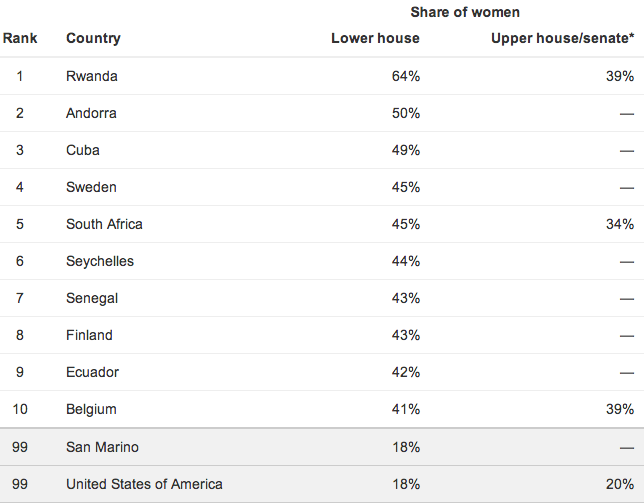
Where The Female Leaders Are

African countries:

Women In Politics

But Leonardo Arriola and Martha Johnson find that the “growth of women in African governance has not necessarily translated into real influence”:

Previous scholarship has shown that women around the world typically receive appointments to less prestigious, more “feminine,” ministerial portfolios like women’s affairs, which are rarely launching pads for greater authority. This remains true in much of Africa. Based on data from 43 African countries between 1980 and 2005, we find that women are significantly less likely than men to receive high prestige appointments in areas such as finance or defense. Women are more likely to be found in medium prestige portfolios like education, which may have sizable personnel and resources but little influence, or low prestige portfolios like culture with small budgets and narrow constituencies.

Update from a reader:

Thanks to your post, I am led to the full list and find where China stands. China’s ranking (61st with 23.4% women in the “single house”), while low, masks the true disparity that is appalling. The people’s congress is known to be the rubber-stamp chamber anyway. Two other statistics could be more telling. Among the officials at or above the provincial and ministry ranks, 11% are women. There are two women in the current politburo of 25, or 8%.

Thirsty, Thirsty Almonds

They use 10 percent of California’s water:

This year, farmers have to make important decisions—and it often comes down to money. If given a choice between keeping fruit trees alive (which take years to mature and can bring 10 times more money per acre), or planting rows of vegetables that live only a few months, that’s a no-brainer if you’re trying to maximize profit. This year, farmers are fallowing vegetable fields and scrambling to save high-dollar fruit and nut orchards. The result is counterintuitive: In the midst of the worst drought in half a millennium, the most water-intensive crops are getting priority.