The History Of Animal Names

This embed is invalid


Stephen Messenger provides a lesson:

[B]y the 8th century BC in ancient Greece, animals with names began to be recorded in literature. The most famous example perhaps is Odysseus’ faithful hound Argos, whose name means “swift foot,” in Homer’s Odyssey. Other classical texts reveal names of horses, bulls, cows, and even elephants owned by hellenistic kings. In Ancient Rome, personal names for animals abound, given to trusty dogs, horses, and others, and were often chosen from mythology — suggesting that by then animals held a lofty place in the lives of their owners. These non-humans were no longer just animals. Indeed, they were our friends.

Frank Abbott, in his book Society & Politics in Ancient Rome, writes of ancient epitaphs found written in honor of pets. One dog, named Patricus, received this tribute from his grieving owner, revealing a rare early sentiment of love for an animal:

“My eyes were wet with tears, our little dog, when I bore thee (to the grave)… So, Patricus, never again shall thou give me a thousand kisses. Never canst thou be contentedly in my lap. In sadness have I buried thee, and thou deservist. In a resting place of marble, I have put thee for all time by the side of my shade. In thy qualities, sagacious thou wert like a human being. Ah, me! What a loved companion have we lost!”

(“Dogs of NYC” map by WNYC)

Facebook’s Spending Spree

Felix Salmon links Zuckerberg’s decision to acquire WhatsApp back to its “stroke-of-genius” decision to go public in 2011 and conquer the mobile market through acquisitions:

Zuckerberg knew, circa Facebook’s IPO, that his company was not good at mobile: it didn’t have the problem solved. And he knew that asking his existing corps of engineers to turn their attention to mobile would probably not work. But the good news was that he was now running a public company, with lots of cash, and a highly-valued acquisition currency in the form of Facebook stock. …

Facebook bought Instagram for $1 billion in 2012 not because the product was particularly great, but because the product was insanely popular. The same when he offered $3 billion for Snapchat. Sometimes, lightning strikes. And while Facebook is happy writing its own mobile apps in the hope that lightning will strike them, it knows better than to count on such a thing happening. If you want to be certain that hundreds of millions of people are using your mobile products, the only way to do that is to buy mobile products which hundreds of millions of people are using.

Peter Yared sees another rationale for Facebook buying WhatsApp. Tapping into people’s mobile contacts:

Facebook had already acquired the ability to have a unilateral, aspirational follow capability akin to Twitter with its Instagram acquisition. WhatsApp offers a social network of 450 million users that are intimately connected with each other by phone numbers. With this acquisition, Facebook now controls the intersection of all three kinds of social graphs: casual acquaintances, aspirational following, and intimate relationships. And that’s worth quite a premium.

Meanwhile, Timothy Lee worries that the culture of acquisition might stifle creativity:

It’s always hard to prove what might have been. But it’s helpful to imagine what the world would be like if Google had been acquired by Yahoo in 2002. Suppose that Yahoo had pledged to allow Google to operate independently from its parent company, continuing to build the world’s greatest search engine. There’s every reason to think that in this parallel universe, Google would dominate the search business as much as it does in our own.

But it’s hard to imagine Google’s founders being able to pursue the wide range of new products that the Mountain View giant has pursued over the last decade. Yahoo already had a mail client in 2004, so Yahoo probably would have vetoed the creation of Gmail. Similarly, Yahoo management would have been reluctant for Google to release Google Maps to compete with Yahoo Maps.

How Scientific Is Astrology? Ctd

Hubble view of star-forming region S106

A reader face-palms:

I know you try to give a fair hearing to all reasonable sides, but come on! Now you’re posting astrology apologetics? The first writer provides nothing more than an elaborate appeal to authority – but they are educated and really smart! – the second puts forward an irrelevant pet theory about the weather, and the third is straight-out personal anecdote and confirmation bias interpreted through science-y sounding words. Defending your preferred superstitious woo by distancing yourself from the more egregious practitioners’ claims, as the first does with newspaper horoscopes, may be an effective PR tactic, but it doesn’t replace the need for actual evidence through methodologically sound testing.

Another writes, half-jokingly, “I’m a professional astronomer, and my union card comes with a rider that says I must bash astrology so as to keep the purity of astronomy”:

One of your readers said that there is a “high level of professionalism in the field” of astrology. I don’t really have a problem with things like astrology, alchemy, and tarot being used as a tools for inspiration; however one gets to creativity is one’s own muse. Telling other people that astrology can help them understand their world they are living in, though, is usually a sign that someone hopes to make money, probably off of you. I’d call it metaphor, disguised as a technology; practitioners since Ptolemy have used technical difficulty to give a gloss of credibility to charlatanism.

Another reader:

So your Professional Scientist’s supportive theory on astrology is based on weather, particularly amount of daily light and temperature, for the birth months on the Zodiac. I sure hope the science that employs him isn’t climatology. Two words for him: hemisphere and latitude. Once you take those two things into account, any reliability on a birth month tied to daily light and temperature is blown away. A Leo birthday in the Northern Hemisphere gets warm summer days. In the Southern, not so much. A Capricorn born above the 49th parallel gets those short colder days and long dark nights, but even for one born in the same hemisphere but just farther south, the days are still nice and long – and even warmer as the equator nears. Don’t even get started on the higher parallel Capricorns in the Southern Hemisphere. That little tilt-of-the-axis thing destroys any “weather-related” planetary or cosmic commonality for birth month experience, even at the “sort of” level the scientist postulates.

Another makes an crucial point:

Some readers seem to be failing to make a distinction between “how scientific” astrology is and “how useful” it is – both important and interesting questions, but which are also frequently confused in theistic arguments.

As for how scientific, we pretty much have to say not at all. Astrology shares a lot in common with old-school psychotherapy/analysis in that regard. Both appeal to an intense human compulsion to put things in narrative context, to spot patterns (regardless of whether they appear by chance), and of course, to be self-involved. There’s also a tendency of the general public to be confused about what makes something “scientific” – complex-looking diagrams like the one attached to one of your reader emails seem to convince people that something valid must be going on.

But as for how useful astrology is, it’s definitely not as open-and-shut a question. Getting that level of therapeutic attention, spiritual introspection/mindfulness training, and possible perspective adjustment – to say nothing of entertainment – could well be a net benefit in people’s lives.

Kevin Drum, who’s been following the reader thread, offers an illustrative story:

A friend of mine at work – very smart, very grounded, very educated – was also very deeply into astrology. It was mostly a subject of good-natured banter in the office, and she knew perfectly well that almost none of us were believers. Including me, of course. But then I saw her at work a couple of times, and came to the same conclusion as Sullivan’s e-mailer. She was, basically, a good counselor. She was empathetic, a good listener, and provided pretty good advice. It so happened that she used astrology as a way of organizing her thoughts, but as near as I could tell, that was just incidental. She believed it, and it gave her a useful framework to work from, but it didn’t really mean anything beyond that. She would have been a good counselor whether she was reading star charts, reading palms, or reading out of the DSM-5. Astrology gave her confidence, and that in turn gave her clients confidence. Regardless of whether it was true, that fact made it useful.

Another reader offers, “It would be interesting to see the intersection (particularly amongst the young) between the non-belief in traditional religion or God and giving credence to astrology”:

Could this be an example of the religious impulse being displaced or transferred into something else? Both astrology and religion (Christianity or whatever) require some belief in a patently irrational set of assumptions that allow for reality to be better understood. But where religion stresses faith and a greater mystery, practices like astrology and tarot operate as a kind of “answered prayer” with direct consequences on the present and the future at some metaphysical level. In short, pure magical thinking. It’s this displaced impulse that’s interesting – I see in a lot of my friends a rejection of religion in any traditional form, yet a deep yearning for some sort of greater meaning. When it’s the wonders of nature, that’s one thing. But when it’s astrology, or aliens have visited, or, at its worst, the conspiracy theory du jour, it’s rather disturbing. To me it implies a deep failure of recognizing the hard facts of reality and a simultaneous failure of imagination.

More readers debate the topic on our Facebook page. The above image was highlighted by Sara Barnes:

With the use of a relatively simple photography technique, Italian artist Haari Tesla has reduced the cosmos to a microscopic level. Her series, Illuminated Code From Space, is experimentation in tilt-shift manipulation. By digitally adjusting the depth of field, contrast, and adding a gradient, Tesla has managed to transform photos of nebulae, galaxies, and supernovae into microorganisms. It’s incredible to look at these images and realize that they are actually photos of the largest place we know, rather than of something so small it can’t be seen with the naked eye.

Check out more of Tesla’s work on her website and Behance page.
Faces Of The Day

South and North Korea Resume Family Reunions

South Korean Park Yang-Gon meets with his North Korean brother Park Yang-Soo during a family reunion after being separated for 60 years in Mount Kumgang, North Korea on February 20, 2014. The program, which allows reunions of family members separated by the 1950-53 Korean war, is a result of recent agreement between Koreas which had been suspended since 2010. By Park Hae-Mook-Korea Pool/Getty Images.

House Of Tax Breaks

The producers of House Of Cards are demanding more tax credits from Maryland, where the show is filmed, and threatening to move production out of the state if they don’t get them:

Maryland reimbursed Media Rights Capital $11 million for season one of House of Cards; season two saw the state up that figure to $15 million. But officials haven’t yet increased Maryland’s annual TV and film tax credits enough to keep the money flowing for season three. That’s likely to happen at some point, but what’s not clear is whether the new number will be enough to keep House of Cards in Maryland. In a letter to [Governor Martin] O’Malley, Media Rights Capital’s Charlie Goldstein said, “I am sure you can understand that we would not be responsible financiers and a successful production company if we did not have viable options available.”

Liz Malm calls this a “political ploy” and urges states to stop competing to attract Hollywood producers:

Film production only creates temporary jobs, and companies can leave at the drop of a hat. The Maryland Film Office estimated that House of Cards Season 1 “resulted in local hiring of 2,193 Maryland crew, cast, and extras” but it’s pretty clear based on the letter above that companies can bolt the second they get a better deal. And those jobs aren’t available once filming wraps up.

Programs do not “pay for themselves” as is often touted. Proponents will argue that increased economic activity will create enough new tax revenue to make up for the initial loss of revenue from the credit. That’s not true. In fact, film tax incentives are a net loss to states, and there are plenty of studies demonstrating this.

Ed Morrissey doesn’t buy the state’s numbers:

Supposedly, this created 6,000 jobs and inflated the economy of Maryland by $250 million, according to economic data supplied by the state’s economic development office to the Post’s Jenna Johnson. I find those numbers incredible … in the most literal sense of the word. One season of a television show aired exclusively by Netflix created a quarter of a billion dollars in economic activity in a single year? What were the 6,000 jobs created by a television series in one season? The budget for the series is $3.8 million per episode, which includes salaries that get spent elsewhere than in Maryland. The first season ran 13 episodes, which puts the total production investment for Season 1 at $49.4 million. If even half of that got spent in Maryland, I’d be surprised, thanks to the star salaries involved — but it if did, Maryland is claiming a 10:1 multiplier factor. That’s utter nonsense.

Alyssa explains why the show isn’t shot in DC itself:

The District of Columbia doesn’t offer tax incentives to film and television productions. And complex jurisdictional and permitting issues make it hard for crews to get even good establishing shots of landmarks like the Capitol Dome. As a result, none of the current crop of political hit shows films in the District itself. House of Cards and HBO’s Vice Presidential comedy Veep film in Maryland. Showtime’s CIA thriller Homeland shoots in Charlotte, North Carolina, and overseas–I once told Homeland showrunner Alex Gansa that if the show had staged a bombing in the actual Farragut Square, rather than the wide-open park that substituted for it, Homeland would have been able to claim a lot more casualties. FX’s period drama The Americans, which is set in the District and Washington suburbs, films in Brooklyn, where production of its first season was interrupted by Hurricane Sandy. Scandal mocks up its images of Washington, but films on the West Coast.

The Rational Side Of Mental Illness

As Lisa Bartolotti notes, some psychological disorders make people less prone to cognitive biases:

Madness and irrationality may seem inextricably related. “You are crazy!” we say, when someone tells us about their risk-taking behavior or their self-defeating actions. The International Classification of Diseases (ICD-10) and the Diagnostic and Statistical Manual of Mental Disorders (DSM-5) describe people with depression, autism, schizophrenia, dementia, and personality disorders as people who infringe norms of rationality. But not all people diagnosed with a mental disorder behave irrationally, and not all people who behave irrationally are diagnosed with a mental disorder.

There is evidence that people with a diagnosis of schizophrenia, depression, or autism are, in some contexts, more epistemically rational, that is, more responsive to evidence and more likely to form true beliefs, than people without any psychiatric diagnosis. People make more accurate predictions when they are depressed, because the statistically normal way to make predictions is characterized by excessive optimism. People with autism score higher in social interaction games (such as Prisoner’s Dilemma) and are more logically consistent than control participants when making decisions involving possible financial gain, by not responding to emotional contextual cues in the same way as controls. People with schizophrenia are also less vulnerable to a statistically normal but irrational tendency to gamble when faced with a certain loss.

Map Of The Day II

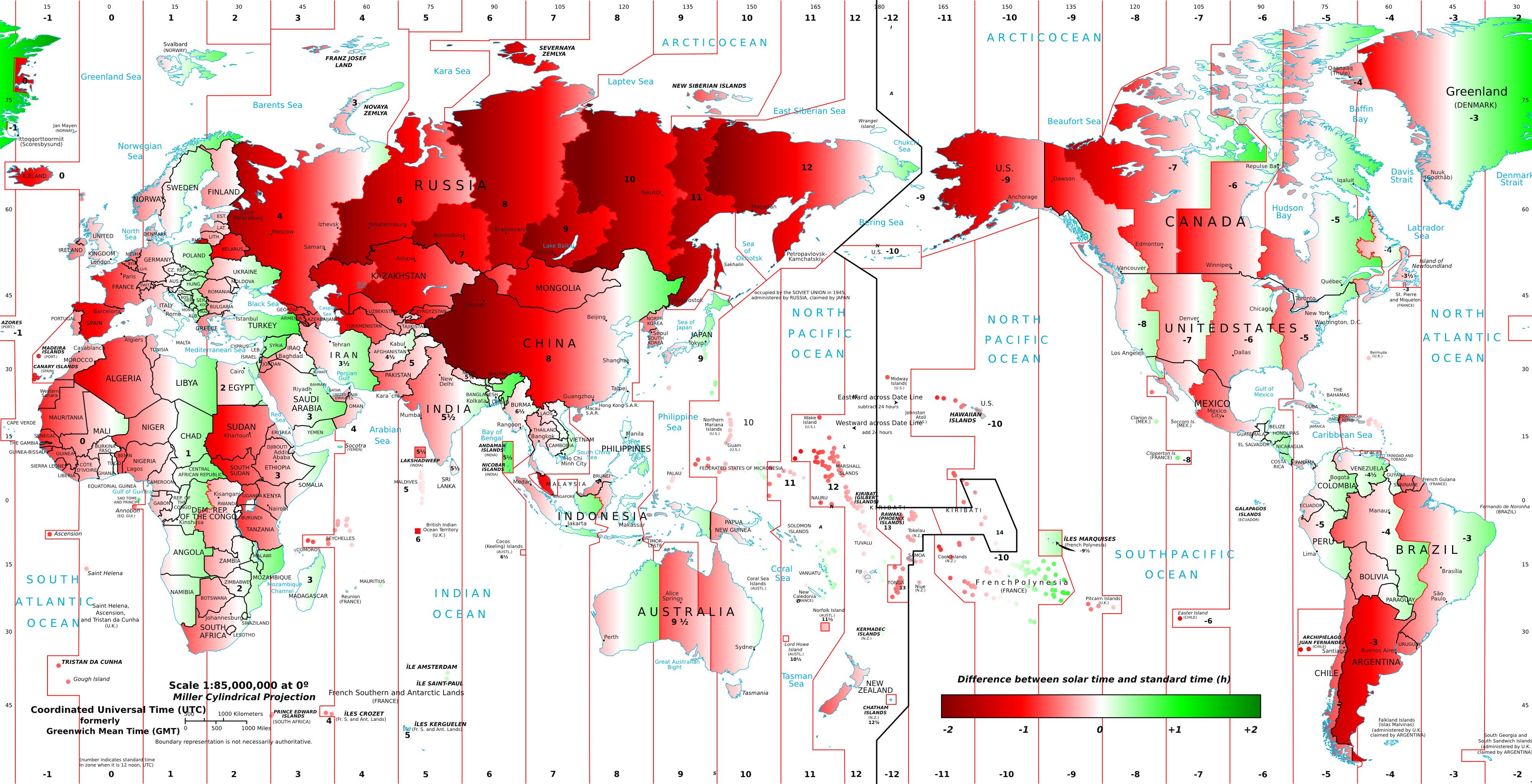
Solar Time Map

Keating passes along a timezone map:

The map above, created by math blogger and Google engineer Stefano Maggiolo (click here for a full-size version), shows the difference between clock time and “solar time”a schedule in which the sun is at its highest point in the sky at exactly 12 noon.

For whatever reason, more of the world seems to be a little bit like Spainthe sun rises and sets later in the day than it shouldthan the other way around. The “late” places are shown in red, the “early” places in green. The deeper the shade, the more off the time is.

Forget Governing, We Have Elections To Win

Alec MacGillis argues that both Christie’s Bridgegate and the maybe-scandal emerging around Scott Walker, whose aides did campaign work on government time, reflect the grip of the “permanent campaign” on our political culture:

This mindset has been with us for a long time, but it’s creeping ever outward, further back into the calendar and further down into lower and lower levels of office. It’s bipartisan—we know, for one thing, that the Obama administration all but shut down the rule-making process in late 2011 and all of 2012 so as not to cause any election-year troubles for itself, a decision that likely contributed to the bungled Obamacare rollout.

But it’s not hard to imagine why the mindset seems to have taken particular hold among Republicans, whether on the Hill or in Trenton or suburban Milwaukee. If you’re in government but philosophically anti-government, it’s all the more natural to let the governing be set aside for the sport of the permanent campaign. It’s easier, the goals are clearer, and it’s more fun.

Here’s the gist of the Walker story:

The release of 28,000 pages of documents connected with two criminal investigations involving former aides has put Governor Walker in an uncomfortable spot. … The documents, released Wednesday, showed how, in 2010, aides to then-Milwaukee County Executive Walker worked on his gubernatorial campaign while doing their government jobs, which is against the law. In all, six aides and allies were convicted, including two for doing campaign work on county time. Walker was never a target of investigation and has denied wrongdoing.

In addition, a new investigation launched by prosecutors in five Wisconsin counties is believed to be under way into whether his recall campaign in 2012 illegally coordinated with outside groups. In Wisconsin, people connected with such an inquiry – called a “John Doe investigation” – are generally not allowed to discuss it in public.

Philip Klein thinks the liberal press is grasping at straws:

Given that investigators who had access to these documents for years and heard testimony from hundreds of witnesses found no wrongdoing by Walker, it was unsurprising that the document release turned out to be a dud. Of course, this didn’t prevent headlines attempting to create the specter of scandal surrounding Walker where there is no evidence of one.

The Worst Place In America To Rent

6177086220_015235d125_b 2

Forget the West Village. In Williston, North Dakota, a 700-square-foot one-bedroom will set you back $2,394, the highest rate in the US for such “entry level apartments”:

In Williston, a city on the edge of the Bakken Oil Fields, the population has doubled in the last five years, from 14,700 in the 2010 census to over 30,000 people today. The growth is akin to the way the Gold Rush quickly urbanized parts of California in mid-1800s. In fact, so many people are moving to the area to work for oil companies that so-called “man camps” made from temporary structures were built over the last few years to keep up with demand. … The housing shortage is so dire that people are living in their cars and the homeless population has swelled 200 percent over the last year. Since there are no official homeless shelters, churches apply for temporary permits to help house the thousands of workers who come seeking employment. A $35-million housing incentive fund was introduced in 2011 with the hope of subsidizing the cost of new, affordable housing. Unfortunately, the fund was depleted late last year.

Previous Dish on the Bakken boom here and here.

(Photo by Flickr user Karendesuyo)