Crystal Myth

Sullum flags a new report debunking some drug-war hyperbole about methamphetamine:

Despite all the talk of a “meth epidemic,” the drug has never been very popular. “At the height of methamphetamine’s popularity,” [Columbia neuropsychopharmacologist Carl] Hart et al. write, “there were never more than a million current users of the drug in the United States. This number is considerably lower than the 2.5 million cocaine users, the 4.4 million illegal prescription opioid users, or the 15 million marijuana smokers during the same period.” Furthermore, illicit methamphetamine use had been waning for years at the point when Newsweek identified “The Meth Epidemic” as “America’s New Drug Crisis.”

Although methamphetamine is commonly portrayed as irresistible and inescapable, it does not look that way when you examine data on patterns of use. Of the 12.3 million or so Americans who have tried it, according to the National Survey on Drug Use and Health (NSDUH), about 1.2 million (9.4 percent) have consumed it in the last year, while less than half a million (3.6 percent) have consumed it in the last month (the standard definition of “current” use). In other words, more than 96 percent of the people who have tried “the most addictive drug known to mankind” are not currently using it even as often as once a month. A 2009 study based on NSDUH data found that 5 percent of nonmedical methamphetamine consumers become “dependent” within two years. Over a lifetime, Hart et al. say, “less than 15 percent” do.

The Modern Way To Kill Freedom

Steinglass wants us to “understand the nature of the threat to freedom we’re seeing these days, in Ukraine and around the world”:

Viktor Yanukovich is a democratically elected president who has used his powers to eliminate liberal-rights safeguards and jail political opponents on dubious charges. He has reinforced his political position by building cronyistic relationships with powerful business figures. In this system the state creates economic rents and awards them to favoured business interests, who in turn buttress the state’s political power, all while maintaining the trappings of democracy. In other words, Ukraine looks a lot like Russia or Egypt; more significantly, it looks like other states that are in the early stages of similar threats to liberal democracy, such as Turkey and Hungary. The enemy of liberal democracy today is more often kleptocracy, or “illiberal democracy” (as tiger-mom Amy Chua put it in her book “World on Fire“), than ideological totalitarianism. The threat is less obvious than in the days of single-party states and military dictators. But it ends up in the same place: economic stagnation, a corrupt elite of businessmen and politicians, censored media, and riot police shooting demonstrators.

A Historic Douche

No, not Thomas Edison. This:

unnamed

Robert Sorokanich explains:

Chrysalis Archaeology, an intrepid team of NYC archaeologists we spoke with last year, discovered the hygiene device in late 2010 on the north side of City Hall. But the hollow cylinder with small holes at the top made of some kind of animal bone wasn’t immediately recognized. It was only recently that archaeologist Lisa Geiger discovered the device’s actual intended use, as she told DNAinfo:

“I was working as a docent at the Mütter Museum in Philadelphia, and came across a back archive of what they called vaginal syringes,” said Geiger, 28. “These were glass or brass, and from later in the 1800s, but all of a sudden, I made the connection.”

Chrysalis Archaeology’s got a phenomenal blog post discussing the discovery and its place in feminine hygiene history.

Rubio’s Fall From Grace

Chait reflects on it:

Everything Rubio touches has turned to shit. The cumulative humiliations have transformed the former party savior into a figure himself in need of saving. How did it all go so badly? The Rubio Plan had sounded clever in the abstract. The premise, as Krauthammer had explicitly laid out, was that the party could jettison a single-issue position [on immigration] while holding fast to its cherished anti-government bromides. (“No reinvention when none is needed,” urged Krauthammer. “Do conservatism but do it better.”) Krauthammer may have been right that Republican elites would more willingly, or even eagerly, toss aside their fear of illegal immigration than revise their cherished anti-­tax, anti-spending dogma. But broadening the party’s economic message has turned out to be easier.

Republicans have delivered a series of well-received speeches advocating new proposals for health care, tax reform, and the like, softening the harsh plutocratic message they projected with Paul Ryan and Mitt Romney. None of this has prevented them from continuing to wage a campaign to immiserate the poor by cutting food stamps, ending unemployment benefits, and denying Medicaid to the uninsured. When you don’t need to grapple with specifics or difficult trade-offs, writing speeches with uplifting themes is extremely easy.

Passing immigration reform, on the other hand, is hard. It requires writing bills. Conservatives liked the sound of Rubio’s immigration plan, but it could not survive legislative contact with the enemy. Compromising on immigration means handing a legislative accomplishment to Obama, a taboo that dwarfs any ideological commitments. And so Rubio was cast in a role nobody could play. The party elders who thought they were enlisting him as the Republican savior were instead making him its martyr.

Cool Ad Watch

A little smug but really clever way to get your competitors to advertize for you:

Update from a reader:

DHL actually had nothing to do with that advert that you embedded – the video was a result of an internal creative competition held by German advertising agency Jung von Matt.  There is an original German version, though the English version is the one that has gone viral. DHL is thrilled with the free publicity, and the message is very much in line with what the company believes about itself, but DHL was as surprised as anyone to see these videos when they were first uploaded on YouTube.

(Hat tip: Tastefully Offensive)

Killer Cannabis?

Helen Thomson assesses research suggesting that cannabis was the only possible cause of death in a handful of cases:

Benno Hartung of University Hospital Düsseldorf in Germany and his colleagues conducted post-mortems on 15 people whose deaths were linked to cannabis use. To rule out other factors that might have contributed to death, such as alcohol use or liver disease, they performed numerous tests, including an autopsy, a toxicology exam, genetic tests and histological analysis of all organs. “It’s a diagnosis of exclusion so you have to rule out all other possibilities,” says Hartung.

Two of the deaths could not be attributed to anything but cannabis intoxication. Both were men who died of cardiac arrhythmia – when the heart beats too quickly or slowly. The team surmises that this was triggered by smoking cannabis. Both men had enough THC – an active chemical in cannabis – in their blood to suggest they had taken cannabis within hours of death. Neither had a history of cardiovascular problems or channelopathies – diseases that increase the risk of heart problems by affecting ion channels. “We did every test we could,” says Hartung.

But zoom out for a second. We’re talking two alleged deaths out of how many millions and millions of joints that have been passed around? Late last month, David Nutt, a former chief drug advisor to the UK, voiced skepticism about one pathologist’s ruling that cannabis was the cause of death for Gemma Moss:

I cannot begin to understand the pathologist’s certainty that cannabis killed Gemma Moss, but neither do I wish to contradict him outright. Taking any amount of cannabis, like all drugs, like so many activities, puts some stresses on the body. Cannabis usually makes the heart work a little harder and subtly affects its rate and rhythm. Any minor stress on the body can be the straw that breaks the camel’s back, the butterfly’s wingbeat that triggers the storm. Ms Moss had suffered with depression, which itself increases the risk of sudden cardiac death. It is quite plausible that the additional small stress caused by that cannabis joint triggered a one-in-a-million cardiac event, just as has been more frequently recorded from sport, sex, saunas and even straining on the toilet.

Exactly. The need to find some kind of terrible fate for the responsible pursuit of pleasure has been a Puritan fixture for aeons. In this particular case, they’ve come up completely empty.

What’s With The Lame Obamacare Horror Stories?

Glenn Kessler looked at the facts behind the latest Americans For Prosperity anti-Obamacare ad (above), which tells the story of Obamacare “victim” Julie Boonstra:

The claim that the costs are now “unaffordable” appeared odd because, under Obamacare, there is an out-of-pocket maximum of $6,350 for an individual plan, after which the insurance plan pays 100 percent of covered benefits. The Blue Cross Blue Shield plans in Michigan that appear to match Boonstra’s plan, as described in local news reports, all have that limit.

Meanwhile, Boonstra told the Detroit News that her monthly premiums were cut in half, from $1,100 a month to $571. That’s a savings of $529 a month. Over the course of a year, the premium savings amounts to $6,348—just two dollars shy of the out-of-pocket maximum.

He gives the ad a preliminary rating of two Pinocchios. Kevin Drum asks the obvious question:

[I]f this is the best AFP can do, does that mean that no one is truly being harmed by Obamacare?

Hell, I’m a diehard defender of Obamacare, and even I concede that there ought to be at least hundreds of thousands of people who are truly worse off than they were with their old plans. But if that’s the case, why is it that every single hard luck story like this falls apart under the barest scrutiny? Why can’t AFP find someone whose premiums really have doubled and who really did lose her doctor and who really is having a hard time getting the care she used to get?

Sargent is hardly surprised:

The broader GOP strategy is explicitly all about building a national narrative populated only with wrenching horror stories — people who have lost coverage and seen premiums soar, and, now, desperately ill people who have seen their lives disrupted — thanks to the heavy handed big government recklessness all these Dems stand for. In this narrative, people who have had their lives improved by the law and are now enjoying health coverage for the first time — and the security and peace of mind that accompany it — simply don’t exist, and indeed, Republicans have actively discouraged such stories from coming into being. Meanwhile, many of the horror stories are turning out to be hyped, bogus, or distorted. But they will have huge sums of money behind them. And scrutiny of them will be met with charges of insensitivity to the victims.

“Subhuman Mongrel” Ctd

This embed is invalid


Nugent apologizes – although it took some prodding for him to do so directly to the president. Then this:

Nugent said he apologizes “for using the streetfighter terminology of ‘subhuman mongrel’ instead of just using more understandable language, such as ‘violator of his oath to the Constitution’.”

That is not “streetfighter terminology”. It’s the rhetoric of white supremacists. And it was extremely understandable language – directed straight at racist bigots. My full take here.

AZ’s Discrimination Bill: Not Just Bad For Gays

Refuse Service

Even the Anti-Defamation League is freaked out by the anti-gay bill that passed the Arizona state House yesterday and is now headed to Governor Jan Brewer’s desk:

Under Arizona’s law, the ADL says, a business owner could refuse to hire someone of a different religion, an employer could refuse to pay men and women an equal wage, or a cab driver could refuse a fare to a house of worship different from their own, as long as they say doing so would “substantially burden” their excercise of their religious faith.

Bill Konigsberg says the bill opens up new forms of discrimination:

That which is already prohibited (not hiring a person because of their race, for instance), remains prohibited. That which is NOT prohibited (you can decide not to hire me, or you can fire me, because I am gay) remains that way. And now, because of this bill, a new form of discrimination will be allowed: exclusion.

As an openly gay person, this bill terrifies me. Imagine walking into a local restaurant and being told you had to leave because they don’t want to serve people “like you.” If Governor Jan Brewer signs this into law, that will become a real possibility every time I walk into a business. I’ve heard people say, “Well, just don’t walk into that business.” That’s a lot easier to say than to live.

Burroway points out that the law creates a special right:

It also adds a new element of discrimination into the law: atheists would have no grounds to claim protection for refusing to serve gay people in a restaurant or rent to Latinos or hire Jews. This law and others like it carve out a special privilege available to religious people only.

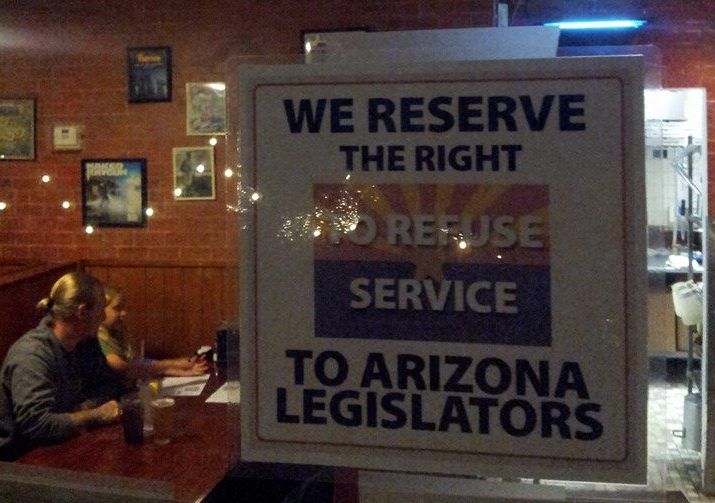
One Arizona business is already highlighting the absurdity of the bill, as seen in the photo above:

Rocco’s Little Chicago Pizzeria, a locally-owned pizza/pasta/wings restaurant in Tucson, Arizona, wants bigoted state lawmakers to know that if they’re going to legalize discrimination in the Grand Canyon State, they’d better be prepared to receive a taste of their own medicine. Shortly after last night’s vote, the restaurant took a stand for equality by posting this photo to their Facebook page. The caption: “Funny how just being decent is starting to seem radical these days.”

The Dish sounded off on this and other discrimination laws here, and explored the “religious liberty” argument here.