When Pot Is A Problem, Ctd

NSFW, because Bob Saget:

A reader makes a great point:

Since we’re on to the topic of “marijuana as a gateway drug”, I’d like to bring up an argument I almost never hear, and have no idea why: Isn’t it possible that marijuana acts as a gateway drug for some people because they buy those other drugs from the same guy? I’m sure a lot of people have gotten the Amazon-sales pitch from their pot dealer (“If you like marijuana, you might also enjoy … “). I have never been tempted, but if I wanted to try cocaine or mushrooms, etc., I would probably just ask the guy I buy pot from. My guess is that legalizing marijuana and putting it in pharmacies would limit people’s access to harder drugs for this very reason.

Another opens up about his addiction:

The main reason I would give for being “ashamed” about 20 years of smoking marijuana almost daily and eventually entering rehab is not what you might think.

It’s not that it destroyed my marriage, curtailed my career, and repeatedly saw me leave my small children at home sleeping alone while I was out replenishing my supply.  Even though my habit had me do all of these things, plus steal amounts from friends, withdraw socially and thankfully only almost cause several car wrecks, by far the most embarrassing thing about being a marijuana addict has been having to tell people that my addiction was “only” marijuana.

Despite a growing acceptance in Alcoholics Anonymous of those whose substance abuse was not primarily alcohol, I would get pushback from some members when I’d tell them I only used to get drunk when I ran out of pot.  I tried meetings at Narcotics Anonymous, and the junkies and meth heads literally laughed when I’d introduce myself as a drug addict and later reveal my details.  Unlike the “tragedy” of other addictions, mine was received more like a story about locking my keys in the car.

I am in favor of legalization. I only hope that as marijuana’s acceptance grows, the truth becomes more well-known that while it may be less harmful than many other intoxicants, it is far from harmless, its aura of benign innocence is misleading, and its damage can be as deep as its more sinister siblings.

Read the whole thread here, here, and here.

Getting The Rich To Help The Poor

A Pew poll found that it’s popular to raise taxes on the rich to expand the safety net. Sargent takes a closer look:

The key here is that the question does not ask whether we should raise taxes on the rich to pay down the deficit, as many other polls do. Respondents are asked if we should raise taxes on the rich to expand the safety net as a way to reduce poverty, and a majority says Yes — far more than saying the best way to help the poor is by cutting taxes on the job creators. Independents agree with this by 51-36. Only Republicans favor lowering taxes on the job creators over taxing the rich to expand programs for the poor, by 59-29.

Yglesias raises an important distinction:

The danger for liberals to keep in mind is that voters are less persuaded that the government can do something useful to reduce inequality than they are that the government should do something useful.

People are accustomed to the idea of a mass public that’s “ideologically conservative and operationally liberal”; in other words one that hates “big government” but loves programs such as Medicare and Social Security. On inequality you could see the reverse happen, where people favor bold action to tackle inequality but are skeptical that specific programmatic ideas are workable or will be implemented correctly.

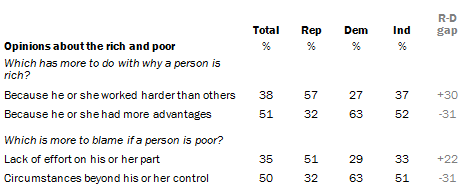
Emily Badger focuses on what the poll had to say about the causes of wealth and poverty:

partyThe belief that people are poor more through their own lack of effort than their circumstances is widely held by large segments of the population, including 51 percent of Republicans, and 46 percent of people in the highest income group (which is not that high). If you fall into this category, then it clearly doesn’t make sense for society to try to solve a problem that it had little hand in creating.

This difference is important, although the survey question itself feels unsatisfying. I’d love to see a survey that gets much more specific about what those circumstances might be: If a child born into poverty remains poor as an adult, how much do you believe failing schools, neighborhood crime, and poor job access contributed to that outcome? I wonder if the answer would change for some people if the concept of “circumstances” weren’t quite so abstract, if it weren’t posed simply as the alternative to personal responsibility. Surely Obama is choosing his words very carefully right now.

Relieving Jordan’s Burden

JORDAN-US-SYRIA-REFUGEES-KERRY

Referring to the toll of the Syrian refugee crisis, Kori Schake argues that “the ally of America in the greatest need at the moment is Jordan”:

The United States is the largest international donor to Syrian refugee efforts. But a much larger and more diversified inflow of aid to Jordan is urgently needed and long overdue. The United Nations provisionally estimates that the cost to Jordan of hosting Syrian refugees will be $3.2 billion in 2014. The United States needn’t be the provider of that aid, but drumming it up from others is something it can and should do.

And here is where the Obama administration could perhaps make a virtue out of the catastrophe that is its Middle East policy, harnessing the newfound willingness of unlikely partners in the region to productive effect. The U.S. government should develop a strategy for raising not just that $3.2 billion but also providing political, economic, and other assistance to the government of Jordan, webbing it into regional cooperation made possible by allies worried about U.S. policies. The approach should expand from the refugees themselves to also having lines of operations for affecting Jordan’s own people and also supporting the government of Jordan.

It should increase trilateral U.S.-Israeli-Jordanian efforts on water sharing and security, folding other regional allies in to fund and share Jordan’s burdens. Jordan should also be given a starring role in Palestinian peace talks, both to reward its support for Israel but also to help in managing its domestic Palestinian population — if a peace deal is reached, Jordan will be a major beneficiary.

(Photo: An aerial view shows the Zaatari refugee camp near the Jordanian city of Mafraq, some 8 kilometers from the Jordanian-Syrian border, on July 18, 2013. The northern Jordanian Zaatari refugee camp is home to 115,000 Syrians. By Manel Ngan/AFP)

The Other Way To Win Endorsements

Steinglass suggests Christie would have been better off trying to buy Democratic support:

Had Mr Christie offered to build Fort Lee a couple of new on-ramps to the George Washington Bridge after receiving an endorsement, political junkies might have chuckled a bit, and that would have been about it. Mr Christie could have strewn budgetary gifts from Ridgewood to Cape May in exchange for cross-party endorsements and never suffered more than a few raised eyebrows.

But Mr Christie had a very limited supply of such budget goodies to hand out. Why? Because he’s Chris Christie! He’s a Republican governor who has made his reputation by slashing New Jersey’s budget. His party has spent 30 years locking itself into an ever-more-rigid ideological commitment to shrinking the size of government. So Republicans have almost nothing in the way of positive inducements to get Democrats to collaborate these days.

Shame Therapy

Julie Beck examines the power of shame in medical care:

The new study looked at both a group of college students and a general population of adults. Participants self-reported how many times they’d felt shame while interacting with a doctor, described their most recent such encounter, and filled out the State Shame and Guilt Scale. They also reported whether they thought the doctor was intentionally shaming them; whether the condition in question got better, worse, or was unaffected by the incident; and how they reacted—by avoiding, lying, or trying to improve. …

The key difference that the study found between those who were inspired to change based on the shameful experience and those who avoided, lied, or otherwise reacted negatively was a person’s ability to distinguish between himself and his behavior. Those who saw that the doctor was condemning their behavior were more likely to make efforts to improve, and those who felt that they themselves were being attacked were more avoidant in their reactions. “Patients who think ‘okay, I engage in some unhealthy behaviors but this doesn’t mean I’m a bad person’ are more likely to be motivated to change those behaviors,” says lead researcher Christine R. Harris.”

(Video NSFW, because Louis CK)

Who Wants To Shrink Medcaid?

Jonathan Bernstein listens to what Republican candidates for governor in states that expanded Medicaid are saying about it:

Nada. Zip. Nothing. None of these Republicans is pledging to repeal the Medicaid expansion put in place by a Democratic governor. Indeed, most of them don’t mention Obamacare at all, and only one even mentioned health care. I’m sure that most — if they want to win a Republican nomination! — would support Obamacare repeal, if asked. But that’s different from making repeal an actual priority.

He thinks this supports the view that “where it’s in place, Medicaid expansion is here to stay.” Sargent believes the expansion could benefit Democrats in red states:

The Medicaid expansion, as an issue, is kind of taking on a life of its own, independent of Big Bad Obamacare. In Louisiana, Senator Mary Landrieu has aggressively criticized the rollout of the law, but has also attacked Republicans for refusing to implement the Medicaid expansion. In Georgia, Dem Senate candidate Michelle Nunn has called for fixes to the law while also saying the state should expand Medicaid, which 57 percent of Georgia voters support, according to a recent poll. Democrats are attacking GOP governors over it, too, particularly in the bid to oust Florida Governor Rick Scott.

Drum thinks the issue could resonate:

Pushing for Medicaid expansion in the holdout states could turn out to be a solid populist issue for Democrats this year. The argument is simple: It’s free medical care and it doesn’t cost the state anything. Who’s against that? We’ll find out later this how well that argument works.


She’s Already Dead, Let Her Rest In Peace

[Updated with tweet at 5.45 pm]

Marlise Munoz’s baby is not doing well:

“According to the medical records we have been provided, the fetus is distinctly abnormal,” the attorneys [for the Munoz’s husband] said. “Even at this early stage, the lower extremities are deformed to the extent that the gender cannot be determined.” The attorneys said the fetus also has fluid building up inside the skull and possibly has a heart problem.

Emily Bazelon pleads for the state of Texas to respect her and her husband’s wishes:

Marlise remains hooked up because the hospital is misreading Texas law. NYU bioethicist Arthur Caplan laid this out last week, explaining why the hospital is misinterpreting the law (and also why that law must be unconstitutional). “The fact that the fetus apparently has significant abnormalities shows just how awful, misguided and cruel the Texas law is,” he emailed me Thursday morning.

“The uncertainties about the pregnancy—damaged fetus, almost no cases of trying to bring a 14-week-old to term in this circumstance, what he the dad is able to cope with, his dead wife’s wishes about wanting to have a child if she cannot parent, the massive costs involved and the impact of a tragic outcome on his other child—they point clearly in the direction of who should be making the decisions and who should have been making them all along. Not the hospital, not the legislature, not pro-life or pro-choicers—the husband.”

Toobin takes a look at how anti-abortion ideology feeds into this tragedy and that of brain-dead California teenager Jahi McMath:

McMath’s family has no apparent politics; they are simply grieving. But their cause has been taken up by the anti-abortion movement, especially those members of Terri Schiavo’s family who sought to keep feeding her years after her brain activity ceased. As in the Schiavo case, the effort is to expand, or at least confuse, the definition of “life.” Brain death, though defined slightly differently throughout the country, has been accepted as actual and legal death for decades. There is no controversy about McMath’s status; the doctors and the coroner agree. Dr. Heidi Flori, a critical-care physician at the hospital, said in a declaration, “Mechanical support and other measures taken to maintain an illusion of life where none exists cannot maintain that illusion indefinitely.”

Earlier Dish on Munoz here.

The Return Of Tax-Cut And Spend?

When Republicans eventually retake the White House, Chait expects them to follow Bush’s example of fiscal recklessness. Douthat sees another way forward:

[T]he Bush playbook and the Tea Party playbook do not exhaust the options for the right.

The signal fiscal failure of the Bush era was not a willingness to spend more money in some areas (defense, education, foreign aid, prescription drugs) while cutting tax rates overall; it was the failure to successfully pair the rate cuts and new spending with the kind of tax and entitlement reforms that would have left the country on a sounder footing for the long term. (If the Medicare Part D expansion had been combined the reforms to Medicare the Bush White House originally wanted, if the push Social Security reform hadn’t gone nowhere, and if tax reform hadn’t died along with the rest of Bush’s second term ambitions, then the entire Bush agenda would have made more fiscal sense.)

So the question for our (still-hypothetical) future era of Republican governance is whether the right can combine a shift away from austerity-only policymaking with a continued commitment to the kind of entitlement reform proposals that the House G.O.P. has rallied around over the last few years. That’s the test: If you can introduce Ryan-style premium support for Medicare and do a real cleanup of the tax code, there’s room to experiment with a larger child tax credit or stronger work supports or payroll tax cuts or what-have-you without blowing out the deficit.

And Suddenly, The Door Just Gives Way, Ctd

Mark Herring, Virginia’s new Attorney General, declared yesterday, as I noted in passing, that he will no longer defend the state’s same-sex marriage ban:

Lyle Denniston observes that this is “the first time that the top legal officer in a state in the South had begun supporting same-sex marriage under the Constitution.” What happens to the case challenging Virginia’s ban:

While the constitutional challenge goes forward, Herring said, state officials responsible for enforcing it will continue to do so, and its validity will be defended in court by private lawyers for county clerks in Norfolk and Prince William County.  Those clerks would have a legal right to appeal if the ban were struck down, he added. Herring said that he and other state officials will continue to work to ensure that the case moves forward to a final decision as “a fair and proper vehicle” for the constitutional test.

Weigel looks at how Virginia has changed since it passed its ban:

In 2006, 57 percent of Virginia voters approved the Marshall-Newman Amendment, adding the definition to their Constitution. Since then, lots of Virginians have, like Herring, changed their minds. As of six months ago, only 43 percent of Virginians opposed gay marriage—a 14-point swing. So Virginia’s one of those states that’s probably ready to wave in gay marriages, but can’t, because an older and more conservative electorate locked and bolted the door. Back in 2006, this was seen as a boon for Republicans. And now it’s left Republicans defending a pretty unpopular position.

Dreher is disturbed:

Whether you are for or against gay marriage, it ought to bother you that a state attorney general asserts a right not to defend the state constitution. What if a majority of Virginia voters had approved same-sex marriage, but Mark Herring were a gay-marriage opponent, and refused to defend the law against a court challenge from marriage traditionalists?

Josh Israel finds precedents:

Herring’s immediate predecessor, Ken Cuccinelli II, also refused to defend laws he deemed unconstitutional. Last year, one of his spokesmen noted, “If the attorney general’s analysis shows that a law is unconstitutional, he has a legal obligation to not defend it.” Indeed in 2009, Cuccinelli himself said in a debate, “I will not defend what I, in my judgment, deem to be an unconstitutional law.” “If I determine it not to be constitutional,” he explained then, “I will not defend it. My first obligation is to the Constitution and the people of Virginia.”