A Wish List For Wall Street

by Dish Staff

Michael Lewis created an amusing one. Near the top of it:

No person under the age of 35 will be allowed to work on Wall Street.

Upon leaving school, young people, no matter how persuasively dimwitted, will be required to earn their living in the so-called real economy. Any job will do: fracker, street performer, chief of marketing for a medical marijuana dispensary. If and when Americans turn 35, and still wish to work in finance, they will carry with them memories of ordinary market forces, and perhaps be grateful to our society for having created an industry that is not subjected to them. At the very least, they will know that some huge number of people — their former fellow street performers, say — will be seriously pissed off at them if they do risky things on Wall Street to undermine the real economy. No one wants a bunch of pissed-off street performers coming after them.

The Whole Sontag

by Dish Staff

Reviewing the new documentary, Regarding Susan Sontag, J. Bryan Lowder argues that it demonstrates how much of her swagger was a “carefully (and wisely, for a woman in a man’s trade) crafted façade, behind which lived and wrote a person who, despite the kind of career most writers can only dream about, felt as inadequate as the rest of us”:

That Sontag harbored such self-doubt can almost feel offensive—such as when a confidant reveals to the director that, after publishing the remarkable book On Photography, Sontag could only worry that it wasn’t as good as Walter Benjamin’s work.

But if you can get past that initial bristling response, Kates’ documentary offers fascinating and crucial insight into the psychology and motivations of one of the previous century’s greatest, and most mercurial, thinkers. Indeed, the film is so attentive to Sontag’s personal life, so committed to pushing past her decades-long PR campaign, that at moments it felt like a violation. But then, there’s something important about placing the kind of person who is more-than-willing to pronounce upon everyone and everything else under a similar scrutiny, something irresistible in regarding the critic, the figure whose job description is to regard the rest of the world.

And what does Kates see when she looks at Sontag? For one thing, she discovers a woman whose sexuality clearly informed her orientation to culture and who yet declined to directly come out as queer (some oblique textual gestures aside). Though the film is not exactly angry about this omission, it refuses to respect it, dedicating a considerable portion of the run-time to interviews with Sontag’s many female partners and lovers.

The Economist‘s Y.F. has more on Sontag’s sexuality:

While on a fellowship at Oxford in her early 20s, Sontag made her first trip to Paris, where in the 1950s so much of America’s avant garde seemed to find a natural home. Harriet Sohmers Zwerling, the writer’s first lover, accompanied her to France and recounts that the day before they were due to host an expat party she punched Sontag in a jealous rage. At the party, noticing Sontag’s bruise, Allen Ginsberg asked Zwerling, “Why’d you hit her, she’s younger and prettier than you.” Zwerling replied, “That’s why.” Sontag possessed a magnetism that even in their moments of greatest candour the film and the people in it—some of them deeply hurt by her—seem unable to withstand.

While much has been made of Sontag’s desire to remain private about her sexuality, she also wrote about it often and gave it an enshrined place in her life and intellectual development. Wayne Koestenbaum, a writer, wryly sums the situation in the film: “Does the author of ‘Notes on Camp’ have to come out?” The film takes us through her experiences as a very young undergraduate in Berkeley and San Francisco in the late 1940s, discovering the area’s underground queer culture and her own place within it. “Everything begins from now…I am reborn,” she writes, “I have been given permission to live…” Of its connection to her writing she observed, “My desire to write is connected to my homosexuality. I need the identity as a weapon to match the weapon that society has against me. I am just becoming aware of how guilty I feel being queer.”

How Much Would It Cost To Make Higher Education Free?

by Dish Staff

Andrew Ross calculates it:

Several estimates are now in circulation, and Robert Samuels’s 2013 book Why Public Higher Education Should Be Free presents the most detailed proposal. According to the most-recent calculations of Strike Debt, the debt-resistance group I work with, the cost would be relatively modest. The federal loan program is propped up by a motley assortment of subsidies and tax exemptions that amount to tens of billions of dollars. Strip these away, along with some other unjustifiable subsidies (GI Bill benefits and Pell Grants that are gobbled up by fraudulent for-profit colleges) and the cost to the government of public college would be as low as $15 billion in additional annual spending. That is little more than a line item in the defense budget, and a small price to pay for meeting the challenge of the 21st-century knowledge economy.

Tough In Advertising

by Dish Staff

Christie Thompson flags findings on the impact of judicial campaign ads:

A growing body of research suggests that soft-on-crime attack ads may be changing how judges rule on criminal cases. In the American Constitution Society’s study of state-supreme-court races, Emory University law professors Joanna Shepherd and Michael Kang concluded that the more TV ads aired, the less likely individual justices are to side with a defendant. The impact was fairly small but statistically significant, showing that doubling the number of TV ads in a state with 10,000 ads increased the likelihood of a vote for a prosecutor by an average of about 8 percent. … Previous studies have found that Pennsylvania judges handed out longer sentences as an election approached, and that Kansas judges chosen in partisan elections gave harsher punishments than those who kept their seats in nonpartisan retention elections.

Same-Gender Schooling, Ctd

by Dish Staff

Back in 2007, Andrew had this to say on the subject:

It’s always been a good idea, especially for boys. … The only way to ensure gender equality is to base it on a firm grasp of gender difference. In today’s educational world, a blank slate theory about human nature leads to boys’ being short-changed.

But Katie J.M. Baker cites new data running against that view:

A recent comprehensive study of 1.6 million students in grades K–12 from 21 nations found no advantage to single-sex schooling. It also found that single-sex schooling reinforces negative stereotypes, as did an oft-cited 2011 report published in Science, “The Pseudoscience of Single Sex Schooling.” Any benefit from single-sex education, the authors say, are from variables like discipline policies or parent engagement. Single-sex schooling “looks like a quick fix for low-income kids, but it’s all junk,” said Diane Halpern, Dean of Social Sciences at Minerva Schools at Keck Graduate Institute and former president of the American Psychological Association, as well as the lead author of the 2011 study. “Data simply doesn’t support that this is a superior way to teach.”

An Actual War On Women, Ctd

by Dish Staff

The Islamic State’s “Research and Fatwa Department” is circulating a pamphlet on what the jihadis are allowed to do to the thousands of women and girls they have captured and enslaved in their rampage through Iraq and Syria:

Much of the pamphlet talks about ISIS’ policy on having sexual intercourse with a female slave, something that the group cites the Quran to justify. “If she was a virgin, he (the owner) can have intercourse with her 1(355)immediately after the ownership is fulfilled,” ISIS explains. “If she was not a virgin, her uterus must be purified (wait for her period to be sure she is not pregnant.)”

There are other rules as well, like that two men who co-own a captive can’t both have sex with her and that a man can’t have intercourse with his wife’s slave. As to girls: “It is permissible to have intercourse with the female slave who hasn’t reached puberty if she is fit for intercourse,” the document reads. “However, if she is not fit for intercourse, he (the owner ) can only enjoy her without intercourse.”

An English translation of the evil document, via MEMRI, is available here. Jamie Dettmer notes how many women ISIS is believed to have kidnapped:

According to Nazand Begikhani, an adviser to the Kurdistan regional government and researcher at the University of Bristol Gender and Violence Research Center, ISIS has kidnapped more than 2,500 Yazidi women. Yazidi activists, meanwhile, say they have compiled a list of at least 4,600 missing Yazidi women, seized after they were separated from male relatives, who were shot.

The women were bussed, according to firsthand accounts of women who have managed to flee, to the ISIS-controlled cities of Mosul in Iraq and Raqqa in Syria, and chosen and traded like cattle. Kurdish authorities in northern Iraq say they have freed about 100 Yazidi women. In October, ISIS justified its enslavement of the women—and of any non-believing females captured in battle—in its English-language digital magazine Dabiq. Islamic theology, ISIS propagandists argued, gives the jihadis the right, much in the same way that the Bible’s Ephesians 6:5 tells “Slaves, obey your earthly masters with fear and trembling.”

Katie Zavadski finds some perspective on the ghastly situation:

The pamphlet may be part of a response to a recent condemnation of the group by Islamic scholars from around the word, according to UMass Lowell security studies professor Mia Bloom. Instead of engaging with centuries of Islamic theological debates, ISIS is reverting to seventh-century norms, at which point “women would have fallen under the rubric of war booty.”

She also doesn’t rule out the possibility that some foreign fighters might find these guidelines attractive. “Maybe they think that this is a recruiting tool,” she says, for frustrated men from abroad. But Bloom worries that this cycle of sexual violence will be difficult to stop. “They are creating a very perverse incentive system,” she says, noting the uptick of domestic violence complaints in postwar Serbia.

Previous Dish on the Islamic State’s barbaric view of women here.

Cruz Missile Misfires

by Dish Staff

Ted Cruz did Harry Reid a big favor on Saturday, demanding a vote on Obama’s immigration EO that backfired in a big way. Allen McDuffee explains how his shenanigans gave the Dems everything they wanted for Christmas and then some:

Reid and his Republican counterpart, Minority Leader Mitch McConnell, had worked out an agreement Friday to hold a vote on the spending package on Monday. But Cruz’s last-minute procedural maneuver to demand a vote on immigration scuttled that deal and forced senators to stay in Washington for the weekend. Not only did the immigration vote fail by a wide margin, 74-22, but the maneuver allowed Democrats to advance a slate of two dozen Obama nominees to executive branch positions faster than they otherwise would have proceeded. The nominations include Tony Blinken as deputy secretary of state, Dr. Vivek Murthy as surgeon general, Sarah Saldana as head of Immigration and Customs Enforcement and Carolyn Colvin to lead the Social Security Administration.

The “cromnibus” spending bill, meanwhile, passed 56 to 42, with 24 Republicans supporting it. Cruz’s buddies on the right are less than thrilled. Jennifer Rubin, for one, rips the junior Senator a new one:

Consistently rejecting useful and conservative legislation because of small infirmities is not the behavior of a leader dedicated to accomplishing important things, and it suggests Cruz is grossly unsuited for the Senate, let alone higher office. Imagine if he ran a state — or the country — without super-majorities of Republicans. Things would be worse than they are now. Rigidity of mind and contempt for opponents in a president have resulted in paralysis and nastiness for six years, so why repeat the experience? And really, if Cruz could find some other way to get attention, get his face on TV and get money out of gullible hard-right voters, don’t we think he’d take it?

Matt Lewis urges conservatives not to hold back from criticizing radicals like Lee and Cruz:

[T]he larger problem is that if conservatives are afraid to say “the emperor has no clothes,” then we will continue rewarding the wrong things, which means conservatives will continue losing. Is it wise to look the other way? It doesn’t do much good to pretend that the touchdown counts for your team when it was scored in the wrong end zone, but what if even after watching the game film, we still decline to tell our star player he cost us the game? This raises a question: Who cares more about something, the guy who ignores its faults or the guy who wants to address them?

Drum, meanwhile, neeners:

I’m sure the NRA is thrilled. Ditto for all the Republicans who were apoplectic over the nomination of Tony Blinken as deputy secretary of state. And megadittoes—with a megadose of irony—for Cruz, Lee, and all their tea party buddies who objected to confirming Sarah Saldaña to head Immigration and Customs Enforcement. Their objection, of course, was meant as a protest against Obama’s executive order on immigration. Now, thanks to a dumb little stunt that was pathetic even as an empty protest against Obama’s immigration plan, they’re going to lose an actual, substantive protest against an Obama immigration nominee. Nice work, guys. But I guess it’s a nice big platter of red meat that plays well with the rubes. With Cruz, that’s all that counts.

Jonathan Bernstein compares the cromnibus fight to last year’s shutdown battle, in which Cruz also played a key role:

Of course, part of normal bargaining involves a certain amount of brinkmanship and part of deliberate shutdown politics can involve claims that the other side is “really” responsible for the breakdown. The process goes off the rails when it includes excessive demands, backed up by ultimatums, that are far outside what appears to be the normal range of bargaining. Demanding a repeal of Obamacare (or “defunding”) despite a solid Democratic majority in the Senate and a Democrat in the White House is of a different order than a fight about a relatively small provision of Dodd-Frank, or the other policy riders added to the current funding bill.

In any case, it was clear from the beginning of last year that the radicals were more interested in the principle of blackmail than they were in the fate of any particular hostage. Indeed, most of the drama of the government shutdown involved Republicans flailing around looking for a good demand they could make for the shutdown they had already engineered.

Congress Doubles Down On Ukraine

by Dish Staff

The “Ukraine Freedom Support Act”, authorizing both lethal and non-lethal aid to Kiev in its ongoing conflict with pro-Russian separatists, passed both houses of Congress late last week to little fanfare:

The current legislation authorizes $350 million worth of weapons, defense equipment and training for Ukraine over three years. Lawmakers dropped a key provision in the original bill that would have taken the rare step of giving major non-NATO ally status to Ukraine, Georgia and Moldova. Senate aides said the provision was removed at the 11th hour in order to ensure final passage.

The measure hits Russia’s defense and energy sectors, punishing companies like state defense import-export company Rosoboronexport. It requires Obama to impose conditional sanctions on the defense sector should Russian state-controlled firms sell or transfer military equipment to Syria, or to entities in Ukraine, Georgia or Moldova without the consent of the governments in those nations. The rule is aimed at helping stem the flow of weapons from Russia across the border into eastern Ukraine, where Washington and Kiev accuse Moscow of fomenting separatist unrest.

The bill does not require Obama to provide lethal aid, however, and the White House has no plans to do so – at least, not yet. Russia, predictably, lashed out in response to the bill, which it called “openly confrontational” and akin to blackmail. Emma Ashford calls it counterproductive:

Arming Ukraine will escalate tensions with Russia, but it will do little to help the Ukrainian army – which is corrupt and in dire need of reform – to combat the insurgency in its Eastern regions. The bill ties the hands of diplomats, requiring that Russia ceases “ordering, controlling… directing, supporting or financing” any acts or groups which undermine Ukrainian sovereignty before sanctions can be lifted. The INF treaty stipulation [directing the President to hold Russia accountable for its violations of the Intermediate Nuclear Forces Treaty] is also dangerous, raising tensions, and increasing the possibility that both Russia and the U.S. could withdraw from the treaty.

Unfortunately, the provisions in this bill will make it all the more difficult to find a negotiated settlement to the Ukraine crisis, or to find a way to salvage any form of productive U.S.-Russia relationship. No wonder congress didn’t want to debate it openly.

Larison agrees:

As it is, the passage of this legislation was the wrong thing for Congress to do. If Obama doesn’t want to contribute to making things worse in Ukraine, he should veto it. Signing such a bill into law will just goad Russia into more aggressive behavior and will set up the Ukrainian government for another fall. There is no American interest that justifies this contribution to the conflict in Ukraine. It is an unfortunate marriage of the desire to be seen as “doing something” and the knee-jerk impulse to throw weapons at every problem.

Doug Bandow fears that the bill “offers a belligerent foretaste of what to expect from the incoming Republican Senate”:

The legislation’s chief sponsor was Sen. Bob Corker (R-Tenn.), slated to become chairman of the Senate Foreign Relations Committee. His earlier proposal, “The Russian Aggression Prevention Act of 2014,” was even more confrontational, providing for greater sanctions on Russia, more military aid for Ukraine, and intelligence sharing with Kiev; conferring “major non-NATO ally status” on Georgia and Moldova as well as Ukraine; expanding “training, assistance and defense cooperation” with Azerbaijan, Bosnia and Herzegovina, Georgia, Kosovo, Macedonia, Moldova, Montenegro, and Serbia, as well as Kiev; mandating non-recognition of Russian annexation of Crimea; and subsidizing energy development in Georgia, Moldova, and Ukraine. As chairman he is likely to encourage equally misguided military meddling elsewhere.

Ukrainian President Petro Poroshenko, meanwhile, announced the first 24-hour period without a casualty since a ceasefire went into effect in early September. According to a new UN report, 4,707 people have been killed in the fighting, including 1,357 since the ceasefire was agreed.

The Bush Dynasty Won’t Die

by Dish Staff

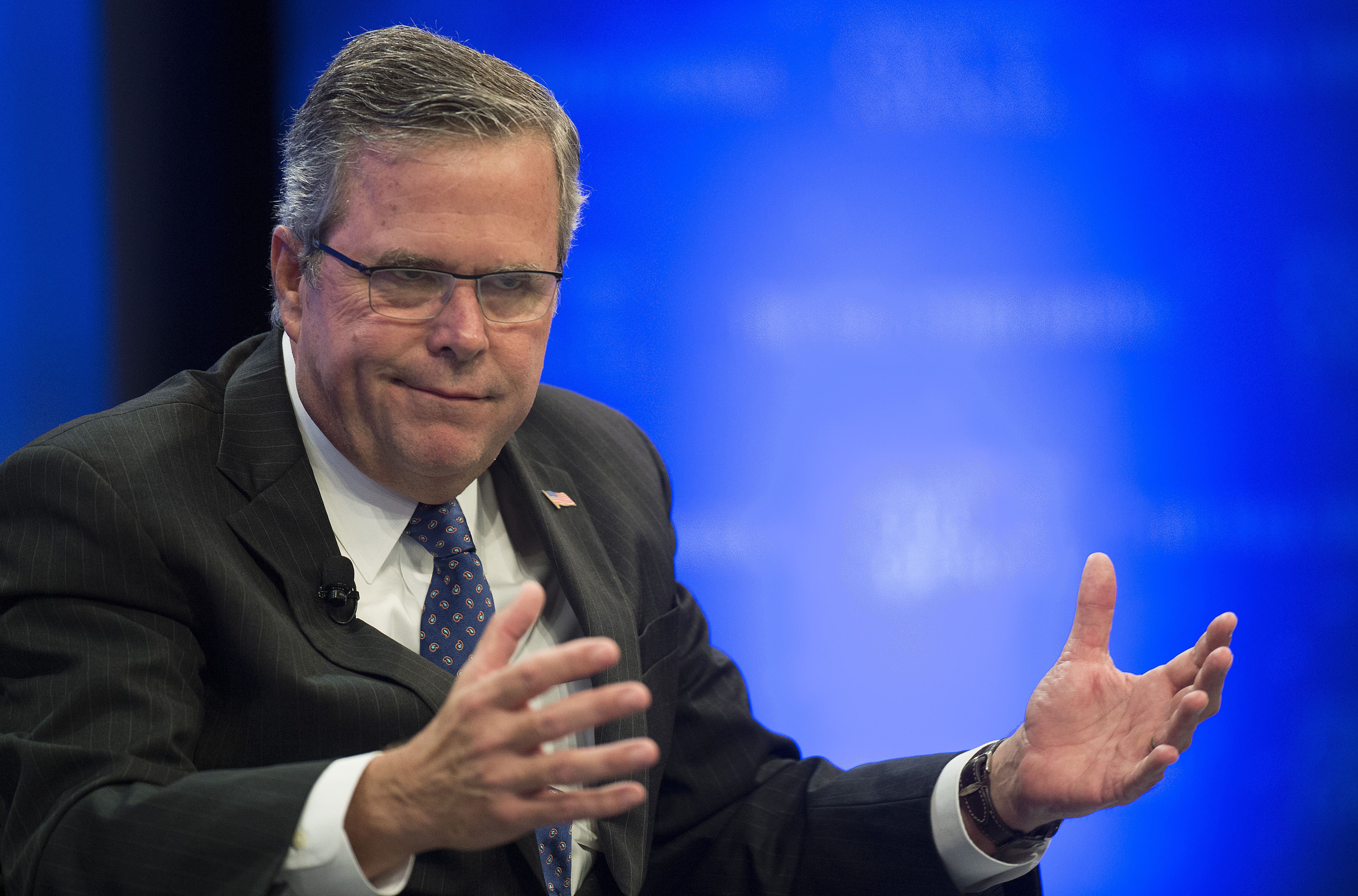
US-ECONOMY-CEO-BUSH

It sure sounds like Jeb Bush is going to throw his hat in the ring:

The big political news over the weekend is that it looks like Republican Jeb Bush is moving closer and closer to a presidential bid in 2016 — after announcing he would release 250,000 emails from his days as Florida governor, as well as release a new book. (You’re usually not taking these actions if you’ve decided AGAINST a presidential run, right?) Folks, this isn’t someone simply dipping his toes into the presidential waters; it’s someone who’s bouncing up and down on the diving board. More than anything else, Jeb’s moves are a signal to Republican donors and campaign staffers that he’s going to probably run.

Dougherty is against the idea:

Nominating Jeb Bush is an implied admission that the GOP cannot put together a post-Reagan presidential coalition without this one family.

It would mean advertising that the party that just put together an impressive, across-the-board electoral comeback in 2014, and that has performed unusually well in gubernatorial races several cycles running, is bereft of talent and must rely on an older brand — one that people tired of twice. Republicans should reject these assumptions about their party, no matter how desperate eight years out of the White House has made them.

The last few years have been ones of experimentation for the party. There is the libertarian-inflected Rand Paul; there are Chris Christies and Scott Walkers who promise dramatic confrontations with public bureaucracy. There is the family-friendly wonkery of Sen. Mike Lee of Utah. If people want to try Bushism again, they should at least have the decency to demand that Marco Rubio’s face be stretched over that political zombie’s head.

Larison reminds everyone that Jeb is as hawkish as his brother:

Everything Bush has said publicly on the subject confirms that he agrees with his party’s hard-liners on most issues, and he has never said anything that would suggest the opposite. As a domestic policy “centrist,” Bush’s ability to break with the party significantly on foreign policy is greatly reduced. Like many relative moderates, Bush overcompensates for his “centrism” on domestic policy by endorsing failed and confrontational policies abroad. For their part, quite a few movement conservatives are willing to forgive all kinds of heterodox views on many other issues so long as the “moderate” candidate fully embraces hawkish interventionism. That probably won’t be enough to win the nomination, but it will make the quality of the debate during the nomination contest that much worse.

Allahpundit doesn’t trust Jeb:

Is he running because he has a conservative vision, the odd Common Core or immigration heresy aside? Or is he running because the wingnuts are threatening to wrest the nomination from the donor class and someone with clout needs to step up and punch them in the face? Why would any tea partier turn out in the general election for a guy who took that approach with them, however successfully, in the primaries?

Jennifer Rubin disagrees with this framing:

The right wing, at least its loudest spokesman and crankiest bloggers, have decided Bush is going to snub them, run against the right and imitate Jon Huntsman, who seemed to delight in insulting conservatives. I have explained why I think this is mistaken. However, the challenge for Bush is to define what it means to be “conservative,” and not accept the notion that conservatism demands shutting down the government, rejecting a pathway to legalization (the MSM and right-wing often mischaracterize him as pushing a pathway to citizenship) and eschewing school standards. (Again, Bush contrary to the right-wing hecklers supports Common Core — or higher individualized standards).

And Husna Haq shows how much of a drawback Jeb’s last name could be:

While 73 percent of CEOs may favor a Bush candidacy, many Americans have indicated that they’re ready for fresh candidates and names – even Jeb’s own mother, Barbara Bush, who famously said last year that America “had enough Bushes.” An NBC/Wall Street Journal poll indicates that two out of three Americans (69 percent) say they agree with Barbara Bush.

(Photo: Former Florida Governor Jeb Bush speaks during the Wall Street Journal CEO Council in Washington, DC, on December 1, 2014. By Jim Watson/AFP/Getty Images)