The Quality Of Mercy, Ctd

Cory Booker Marries Same Sex Couples As NJGay Marriage Law Goes Into Effect

In the Brendan Eich affair, it seems to me, there are, beneath the fury and the name-calling, two core narratives in conflict, and they are driven by two different approaches to politics. For the sake of argument, let’s call one a progressive vision and the other a liberal one. Here’s Jon Lovett making a fundamentally liberal point:

The trouble, I think, is when ostracizing a viewpoint as “beyond the pale” becomes not an end but a means to an end; that by declaring something unsayable, we make it so. It makes me uncomfortable, even as I see the value of it. I for one would love homophobia to fully make it on that list [of impermissible opinions], to get to the point where being against gay marriage is as vulgar and shameful as being against interracial marriage. But it isn’t. Maybe it will be. But it isn’t. And kicking a reality-show star off his reality show doesn’t make that less true. Win the argument; don’t declare the argument too offensive to be won. And that’s true whether it’s GLAAD making demands of A&E or the head of the Republican National Committee making demands of MSNBC.

The bottom line is, you don’t beat an idea by beating a person. You beat an idea by beating an idea.

Then there is another approach, in which creating a progressive culture in which some things are unsayable is the whole point of the exercise. Here’s a piece by J. Brian Lowder with that perspective. Money quote:

Tim Teeman wrote on Friday that “the ‘shame’ axis around homosexuality has positively shifted from those who are gay to those who are anti-gay.” He may be right about that, but speaking personally, I am not interested in shaming anyone; it would be enough for me if those people who are so ignorant or intransigent as to still be anti-gay in 2014 would simply shut up.

This is not a minor disagreement. It’s a profound one. One side wants to continue engaging the debate. The other wants one side to shut up. I think you also see this difference in the responses to Jon Chait’s new piece on race in the age of Obama. Progressives see the scale of the historically-loaded injustice that African-Americans face every day and cavil at any attempts to minimize or qualify the iniquity of those on the right who still deploy its rhetorical codes. Liberals still insist on some fairness, on not jumping to conclusions about an entire party’s or a single person’s racism, on seeing that human beings are not so simple as to be reduced to such ideas as “hate”, on maintaining some kind of civil discourse which right and left can engage in, which eschews too-easy charges of bigotry.

One seeks to get to a place where a conversation ends. The other seeks never to end the conversation, and, in fact, gets a little queasy when any topic is ruled out of bounds in a free society.

Maybe if we can appreciate both traditions, we can see the underlying forces behind this debate more clearly. My own instincts on the gay rights question have always been classically liberal/small-c conservative/libertarian. I think hate is an eternal part of the human condition, and that ridding oneself of it is a personal, moral duty not a collective, political imperative. I never want to live in a society in which homophobes feel obliged to shut up. I believe their freedom is indivisible from ours. Their hate only says something about them, not me. I oppose hate crime laws for those reasons. And my attachment to open debate means constantly allowing even the foulest sentiments to be expressed – the better to confront them, expose them and also truly persuade people of the wrongness of their views – rather than pressuring them into submission or silence. Others have a different vision: that such bigotry needs extra punishment by the state (hence hate-crime laws), that bigots need to be constantly shamed, and that because of the profound evil of such thoughts, social pressure should be brought to bear to silence them. More to the point, past sins have to be recanted and repented before such bigots are allowed back into the conversation.

This is a very old fault-line in civil rights movements, and it’s amazing that the gay rights movement has been able to keep these divisions at bay as we fight for basic equality. That may now begin to change, if only because an entire generation has now grown up having deeply internalized their self-worth, and are thereby rightly all the more affronted by those still resistant to it. I understand that entirely, and am glad for this shift in consciousness – especially since I spent much of my adult life trying to bring it about. It’s wonderful for me to read young gay writers insist on their non-negotiable and full equality in terms of marriage – if only because I tried to make that case decades ago to a great deal of bewilderment and dismissal from many. This is indeed great news, as Frank Bruni noted. And, when couched in positive, constructive terms, it has won more converts among more straight people than most of us ever dreamed of.

But liberalism, for me, is not a means to a progressive end. It is an end in itself.

It seeks to guard against groupthink and social pressure as dangerous threats to freedom of thought and of the individual. It aims to protect the rights of bigots as well as the targets of their bigotry. At any one point, that can seem grotesquely unfair. And it is. It is and was deeply unfair that, in order to enjoy some simple basic rights, we gays have had to explain ourselves to the world, listen to our very lives being debated as if we were not in the room, have our lives and loves traduced and distorted and picked over by people who treat us as pawns in a political game or an intellectual exercise. But, you know what? We had no choice if we were to move forward. And, boy, have we moved forward through this difficult process.

I’m not taking this position because – to count some of the milder terms thrown in my direction in the last few days – I have internalized homophobia, I want to leverage others’ suffering for web traffic, I have never done anything to advance gay equality, I am a hypocrite/privileged white male/barebacker/Uncle Tom, and on and on. I’m taking this position because it is my honestly thought-out view. It’s laid out in Virtually Normal, which is emphatically not a progressive book. And it’s because I am also convinced that a liberal approach to politics will lead to – and has led to – more actual justice and a deeper changing of minds.

We have not won the debate this past decade or so because we have constantly exposed others’ hatred, or racked up the number of people we can condemn as homophobes. We have won because we have made the positive and reasoned case for our equal dignity and rights. We have won because we have engaged, not ostracized. And we have won more definitively because of it. How much better to have allowed this free debate to continue and to have actually genuinely changed people’s hearts and minds than to have tried to impose a settlement on the unwilling and unpersuaded, and then demanded they shut up. And this is what I would try to say to my progressive gay friends: if you really want the full justice you rightly believe in, stop trying to close down a debate which we are winning and in which we still have many people to persuade. Of course there’s bigotry and ignorance out there. But calling everyone who disagrees with you a bigot rules out a chance to persuade them, drives them further into a defensive crouch, and prevents us winning the argument in the long run.

If the liberal approach had so demonstratively failed, it would be one thing. But, in this case, it has demonstratively succeeded – perhaps more than any recent social movement. We shouldn’t forget how we got here. Or believe that somehow suddenly different tactics cannot still take this debate in a different direction. They can; and if we are not careful, they will.

(Photos: Getty Images)

The Quality Of Mercy

hounding-of-a-heretic-SD

Thank you for the hundreds and hundreds of emails about the Mozilla-Eich affair. My readers overwhelmingly disagree with me for a host of reasons. But I have to say that this time, the more I have mulled this over, the more convinced I am that my initial response to this is absolutely the right one. And not just the right one, but a vital one to defend at this juncture in the gay rights movement.

So let me concede all of the opposing arguments that have been deployed to defend the public shaming and resignation of Brendan Eich. To recap those points: This was not the “gay left” as such, but the “techie straight left” more broadly. Sure (I’ve been to San Francisco). He wasn’t fired; he resigned. Undisputed. Mozilla is not your usual company. Obviously not. Being CEO is different than being just a regular employee and requires another standard. Sure. It doesn’t matter because we’re all marching toward victory anyway. Well, probably. This was a function of market forces and the First Amendment. You won’t get me to disagree about that.

So why am I more convinced that what just happened still matters, and matters a lot? I think it’s because these arguments avoid the core, ugly truth of what happened. Brendan Eich was regarded as someone whose political beliefs and activities rendered him unsuitable for his job. In California, if an employer had fired an employee for these reasons, he would be breaking the law:

1102. No employer shall coerce or influence or attempt to coerce or influence his employees through or by means of threat of discharge or loss of employment to adopt or follow or refrain from adopting or following any particular course or line of political action or political activity.

Now Eich was not in that precise position. He resigned as CEO under duress because of his political beliefs. The letter of the law was not broken. But what about the spirit of the law?

The ability to work alongside or for people with whom we have a deep political disagreement is not a minor issue in a liberal society. It is a core foundation of toleration. We either develop the ability to tolerate those with whom we deeply disagree, or liberal society is basically impossible. Civil conversation becomes culture war; arguments and reason cede to emotion and anger. And let me reiterate: this principle of toleration has recently been attacked by many more on the far right than on the far left. I’m appalled, for example, at how great gay teachers have been fired by Catholic schools, even though it is within the right of the schools to do so. It’s awful that individuals are fired for being gay with no legal recourse all over the country. But if we rightly feel this way about gays in the workplace, why do we not feel the same about our opponents? And on what grounds can we celebrate the resignation of someone for his off-workplace political beliefs? Payback? Revenge? Some liberal principles, in my view, are worth defending whether they are assailed by left or right.

I’m then informed that opposition to marriage equality is not just a political belief. It’s a profound insight into whether someone is a decent moral person or a bigot. And this belief is also held with absolute certainty – the same absolute certainty of righteousness that many Christianists have.

Let me just say I’ve learned to suspect anyone with absolute moral certainty, whatever position they take. My last book, The Conservative Soul, was precisely an argument against such certainty on the right. What it does is extinguish the space for people to think, change their minds, entertain doubt, listen, and argue. It is absurd to believe that a third of the country recently “hated” gay people and now don’t. It’s incredibly crude to posit that you’re a bigot to oppose marriage equality in 2013, but not in 2008. I remember this argument being used by the hard left when they opposed marriage equality in the 1980s and 1990s (and, yes, they did so then and they were not bigots either). The majority hates us, and will never be persuaded, we were told. Stop your foolish crusade! And yet a decade and a half later, so many minds have changed. So why on earth would we seek to suddenly rush this process and arbitrarily declare that all those we have yet to persuade are ipso facto haters?

And one ugly manifestation of absolute certainty in near-theological movements is their approach to dissidents. Dissidents in these absolutist groups are outlawed, condescended to, pressured, bullied, lied about, trashed, slandered, and distorted out of any recognition. In this case, a geeky genius who invented Javascript and who had pledged total inclusivity in the workplace instantly became the equivalent of a Grand Master in the Ku Klux Klan. And yes, that analogy was – amazingly – everywhere! The actual, complicated, flawed human being was erased by thousands who never knew him but knew enough to hate him. Because that’s all they need to know. No space was really given for meaningful dialogue; and, most importantly, no mercy was given without total public repentance.

I’m sorry but I’m not less disturbed by this manifestation of illiberalism today than I was on Thursday. I’m more so, especially given the craven, mealy-mouthed response of so many to it (yes, Frank, you buried the lede). Read this astonishing post from Mozilla’s Mark Surman. Eich may have been “one of the most inspiring humans that I have ever met” and “a true hero for many of us” but that was not enough:

Many calm and reasonable people said “Brendan, I want you to lead Mozilla. But I also want you to feel my pain.” Brendan didn’t need to change his mind on Proposition 8 to get out of the crisis of the past week. He simply needed to project and communicate empathy. His failure to do so proved to be his fatal flaw as CEO.

Surman says this despite the fact that Eich himself wrote the following:

Here are my commitments, and here’s what you can expect:

  • Active commitment to equality in everything we do, from employment to events to community-building.
  • Working with LGBT communities and allies, to listen and learn what does and doesn’t make Mozilla supportive and welcoming.
  • My ongoing commitment to our Community Participation Guidelines, our inclusive health benefits, our anti-discrimination policies, and the spirit that underlies all of these.
  • My personal commitment to work on new initiatives to reach out to those who feel excluded or who have been marginalized in ways that makes their contributing to Mozilla and to open source difficult. More on this last item below.

I know some will be skeptical about this, and that words alone will not change anything. I can only ask for your support to have the time to “show, not tell”; and in the meantime express my sorrow at having caused pain … I am committed to ensuring that Mozilla is, and will remain, a place that includes and supports everyone, regardless of sexual orientation, gender identity, age, race, ethnicity, economic status, or religion.

And this was not enough. I’m sorry but Surman is full of shit – as, I might add, is his profoundly intolerant company. Eich begged for mercy; he asked to be given a fair shot to prove he wasn’t David Duke; he directly interacted with those he had hurt. He expressed sorrow. He had not the slightest blemish in his professional record. He had invented JavaScript. He was a hero. He pledged to do all he could to make amends. But none of this is ever enough for Inquisitions – and it wasn’t enough in this case. His mind and conscience were the problem. He had to change them or leave.

A civil rights movement without toleration is not a civil rights movement; it is a cultural campaign to expunge and destroy its opponents. A moral movement without mercy is not moral; it is, when push comes to shove, cruel.

For a decade and half, we have fought the battle for equal dignity for gay people with sincerity, openness, toleration and reason. It appears increasingly as if we will have to fight and fight again to prevent this precious and highly successful legacy from being hijacked by a righteous, absolutely certain, and often hateful mob. We are better than this. And we must not give in to it.

Brendan Eich And Hillary Clinton

Some of the very same people who have jumped up and down with delight as Brandon Eich lost his job will doubtless be backing Hillary Clinton for president in 2016 if she runs. The “Ready for Hillary” ranks are crowded with gay men – and good for them. But it’s worth US President Bill Clinton (l) in picture taken 16considering some consistency here. If it is unconscionable to support a company whose CEO once donated to the cause against marriage equality, why is it not unconscionable to support a candidate who opposed marriage equality as recently as 2008, and who was an integral part of an administration that embraced the Defense Of Marriage Act, signed into law by Bill Clinton? How do you weigh the relative impact of a president strongly backing DOMA – even running ads touting his support for it in the South – and an executive who spent $1000 for an anti-marriage equality Proposition?

Hillary Clinton only declared her support for marriage equality in 2013. Before that, she opposed it. In 2000, she said that marriage “has a historic, religious and moral context that goes back to the beginning of time. And I think a marriage has always been between a man and a woman.” Was she then a bigot? On what conceivable grounds can the Democratic party support a candidate who until only a year ago was, according to the latest orthodoxy, the equivalent of a segregationist, and whose administration enacted more anti-gay laws and measures than any in American history?

There is a difference, of course, between Brendan Eich and Hillary Clinton. Eich has truly spoken of the pain he once caused and owned up to it:

I know some will be skeptical about this, and that words alone will not change anything. I can only ask for your support to have the time to ‘show, not tell’; and in the meantime express my sorrow at having caused pain.”

Has either Hillary Clinton or Bill Clinton ever expressed sorrow that they hurt so many lives, gave cover to some of the vilest homophobes, and credentialized themselves with some on the right by rank homophobia in the 1996 campaign? Not to my knowledge. They have regretted what they did but never taken full moral responsibility for the hurt and pain they caused.

My view is that the Clintons are not and never have been bigots.

They’re human beings in changing times who had good intentions and sometimes failed to live up to them. The same with Brandon Eich, a man with infinitely less power than the Clintons but who nonetheless did the wrong thing. The same with vast numbers of Americans who haven’t yet been persuaded by the winning arguments of those of us who have campaigned for marriage equality for decades.

Human beings are complicated and flawed – gays as well as straights; and a liberal civil society does not attempt to impose on all of them a single moral code, or consign large numbers of them to the “bigot” category because they may be laggards in a civil rights cause. That way lies madness. And the end of a liberal and tolerant society. If you can forgive the Clintons, you should be able to forgive Eich. And have a little magnanimity and restraint before you snatch moral defeat from the jaws of political victory.

(Photo: US President Bill Clinton in picture taken 16 October 1996 in San Diego gets a hug from his wife Hillary after the presidential debate with Republican candidate Bob Dole Shiley Theater. By Mike Nelson/AFP/Getty Images.)

Dissents Of The Day

OLYMPUS DIGITAL CAMERA

Among the scores of upset readers rattling the in-tray:

I’m going to disagree with you, quite strongly, about the resignation of Brendan Eich. While I agree that he is certainly entitled to his point of view, and to take actions in support of that point of view, he is not entitled to face no consequences from those actions. That’s all this is: consequences. If he truly has the strength of his convictions, he will consider this a necessary sacrifice. Were I to loudly proclaim a belief in the inherent inferiority of other ethnicities than my own, and take actions to enshrine that belief into law, would I not reasonably expect to face consequences?

He’s not going to prison; he just has to find a new job. For someone with his abilities, that should not be difficult. I just imagine it will be done more quietly this time.

As I said last night, of course Mozilla has the right to purge a CEO because of his incorrect political views. Of course Eich was not stripped of his First Amendment rights. I’d fight till my last breath for Mozilla to retain that right. What I’m concerned with is the substantive reason for purging him. When people’s lives and careers are subject to litmus tests, and fired if they do not publicly renounce what may well be their sincere conviction, we have crossed a line. This is McCarthyism applied by civil actors. This is the definition of intolerance. If a socially conservative private entity fired someone because they discovered he had donated against Prop 8, how would you feel? It’s staggering to me that a minority long persecuted for holding unpopular views can now turn around and persecute others for the exact same reason. If we cannot live and work alongside people with whom we deeply disagree, we are finished as a liberal society.

Another reader:

Eich certainly has his right to free speech. Where the line should be drawn (Supreme Court decisions notwithstanding) is when somebody’s speech becomes action – in this case, donating to Prop 8. Monetary support to reduce fellow citizens to second-class status should not be enshrined as “protected speech.” He can say what he wants, of course, but we can also say, publicly, that we don’t want to directly fund that sort of politics (since our money given to the company goes to the CEO’s salary).

What if an employee went to a demonstration that his company found objectionable? Would that be a reason to fire him? What we have here is a social pressure to keep your beliefs deeply private for fear of retribution. We are enforcing another sort of closet on others. I can barely believe the fanaticism. Another reader:

There is not a single mainstream company in the world today that would endure a CEO who donated to a neo-Nazi organization, or the KKK, or for a referendum to make interracial marriage illegal.  If he were to apologize later, or say it was a mistake, then he might survive.  But to be defiant in his support for blatantly anti-Semitic or anti-black causes?  No one would survive this. In making our case for marriage equality, we have set the right to marry for homosexuals on the same level as the right to marry inter-racially.  This means that the public will respond to those who oppose it just as they would to those who fought to prevent my parents from marrying. And rightly so.

A little history lesson. Not so long ago, many in the gay community itself – including large swathes of its left-liberal wing – opposed marriage equality. I know, because I was targeted by them as a neofascist/heterosexist/patriarchal “anti-Christ”. Yes, I was called precisely that in print for being a conservative supporter of marriage equality and for ending the ban on openly gay people in the military. And I’m talking only a couple of decades ago. And now, opposing marriage equality is regarded as equivalent to the KKK? And neo-Nazis? Another reader tries to catch me in a double standard:

So let me get this straight: It’s perfectly ok to spend money supporting legislation that causes actualdirect harm to gay people, but when Alec Baldwin calls someone names, he should be fired?

I never called for Baldwin to be fired – just that his rank use of homophobia while threatening violence made his claim to be a liberal preposterous. I was calling out hypocrisy. I never campaigned for Baldwin to be punished for this – just that liberals stop defending him as a campaigner for civil rights. The next reader probably has the strongest dissent of them all:

You wrote, “Eich did not understand that in order to be a CEO of a company, you have to renounce your heresy!” Andrew, you are seriously misreading this. Mozilla is not just any company; it’s the subsidiary of a non-profit, the manager of an open-source project, part collective and part community, and only thrives because the community cooperates, delivering applications, helping out by contributing code, and donating money. A key qualification for a CEO of such a company is that he or she not alienate the community, and Eich simply did not meet that qualification (the board screwed up in hiring him, clearly). I hardly think you’d see the same kind of fireworks if, say, he had been appointed CEO of Oracle.

This is more akin to an opponent of gay marriage being appointed CEO of a company that depends on gay or gay-friendly customers or stakeholders. A public radio station in a gay-friendly metro is a good example. So it’s more like, “in order to be a CEO of an organization dependent on certain stakeholders, you must not offend them.” Seriously, this is news?

And CEO is not just any job; Eich was CTO of Mozilla for many years with nary a peep. But a CEO personifies the company, and the standards are different. Eich then compounded the mistake by eliding the discussion every time he was asked about it. He could have stood by his personal beliefs but drawn a distinction between those and how he intends to isolate them from his ability to lead Mozilla. He could have shown a bit of empathy towards the people victimized by Proposition 8 (many of whom are his customers, employees and partners) without recanting his personal belief (Rarebit, one of Mozilla’s partners that pulled out of the store, has a good take on this here).

He could have done many things, but he was too proud to give people even a fig leaf of an acknowledgment. Instead, he stonewalled, and more insultingly, he wrapped himself in the mantle of tolerance (the whole stuff about Mozilla’s “culture of inclusiveness”), essentially saying, “If you’re really tolerant, you must tolerate my intolerant views and continue to interact with the organization I lead just as before.” Please. He’s entitled to his views, but he’s not entitled to people’s cooperation.

In order to be a CEO of a company, you must be able to lead it. Clearly he couldn’t, because too many people, both employees and external stakeholders, simply would not follow him. He was pushed out because he could not do the job he was hired to do.

Really? Here’s what Eich said last month: “I know some will be skeptical about this, and that words alone will not change anything. I can only ask for your support to have the time to ‘show, not tell’; and in the meantime express my sorrow at having caused pain.” There is not a scintilla of evidence that he has ever discriminated against a single gay person at Mozilla; he was dedicated to continuing Mozilla’s inclusive policies; he was prepared to prove that the accusations against him were unfair, and that his political views would not affect his performance as CEO. But this was not enough. He had to be publicly punished for supporting a Proposition that is no longer in effect. This is absolutely McCarthyism from an increasingly McCarthyite left. Another reader makes a distinction:

Gay activists didn’t run him out.  I really think you are wrong on that.  Sure, some of the usual suspects piped up.  But that wasn’t what did it as far as Mozilla goes.  It was young and down-for-the-cause straight people.  There’s been a very radical, very recent shift in critical mass and majority opinion (especially among tech people, young people) that opposing gay marriage is immoral.  This supportive/progressive/tolerant/well-intentioned straight majority does not hesitate (although it should) to equate gay rights issues with race based civil rights issues.  The gay marriage issue has tapped into a moral consciousness.

After all these years of ducking whenever someone starts talking about morals, the gays are now on the winning side of that conversation.   And I think this moral shift is so new that we don’t see it yet.  And so I don’t share your disgust that Eich quit.  He lost the respect of the co-workers and colleagues he was supposed to lead due to something than runs deeper than a mere political point of view.  This was a moral position.  And a growing number of reasonable average people just can’t abide homophobia anymore.  It wasn’t an angry rump of gay activists that did him in.

Yes, it was broader than that. It was a coalition of those, gay and straight, who do not believe that people with different views than theirs’ should be tolerated in a leadership position. It’s a reminder of just how closed-minded and vicious so much of the identity-politics left can be. One more reader:

Morality has always been about keeping society on the same page. If you violate the the norms, then you are shamed and ridiculed. The ultimate “victory” of the gay rights movement will be that those discriminating against homosexuals will be ridiculed and isolated as bigots. Ultimately we can only hope that the best values win out, and that we will always find outcasts in society that share our values, should our values violate the norm.

There you have the illiberal mindset. Morality trumps freedom. Our opponents must be humiliated, ridiculed and “isolated as perverts”. I mean “bigots”, excuse me.

Orwell wept.


Update: More unfiltered feedback at our Facebook page.

The Hounding Of A Heretic, Ctd

It turns out that Eich might have saved his job had he recanted, like all heretics must. But given the choice of recanting, he failed. Hence the lighting of the fires:

Throughout the interviews, it was not hard to get the sense that Eich really wanted to stick strongly by his views about gay marriage, which run counter to much of the tech industry and, increasingly, the general population in the U.S. For example, he repeatedly declined to answer when asked if he would donate to a similar initiative today.

Instead, he tried to unsuccessfully hedge those sentiments and, perhaps more importantly, did not seem to understand that he might have to pay the inevitable price for having them. Thus, something had to give — and it did.

He did not understand that in order to be a CEO of a company, you have to renounce your heresy! There is only one permissible opinion at Mozilla, and all dissidents must be purged! Yep, that’s left-liberal tolerance in a nut-shell. No, he wasn’t a victim of government censorship or intimidation. He was a victim of the free market in which people can choose to express their opinions by boycotts, free speech and the like. He still has his full First Amendment rights. But what we’re talking about is the obvious and ugly intolerance of parts of the gay movement, who have reacted to years of being subjected to social obloquy by returning the favor. Reihan notes the use of the word “integrity” about Mozilla:

Let me restate Swisher’s observation: had Brendan Eich decided to apologize — had he decided to say that he had come around on the issue, and had he added that his donation to the Proposition 8 campaign was a profound mistake that he would regret for the rest of his life, and which he will atone for by making a large donation to one of the organizations pressing the case for same-sex civil marriage — he could have spared himself all of this trouble. So while Mitchell Baker talks about protecting the integrity of Mozilla, she might spare a word or two for the integrity of Brendan Eich, or rather she and her colleagues might reflect on it.

This is a repugnantly illiberal sentiment. It is also unbelievably stupid for the gay rights movement. You want to squander the real gains we have made by argument and engagement by becoming just as intolerant of others’ views as the Christianists? You’ve just found a great way to do this. It’s a bad, self-inflicted blow. And all of us will come to regret it.

The in-tray is inundated with your dissents, which we will air in full tomorrow, since it will some time to find the strongest counterpoints. Only a small percentage of emailers are as disgusted as I am:

This really frightens me. Eich may well be wrong – very wrong, in fact – but he has a right to his opinion, and the fact that the Internet threw a hissy fit certainly doesn’t justify firing him. There’s no freedom of speech if you can’t be employed while holding your opinion. And he even made it clear that he wasn’t going to change any of Mozilla’s benefit policies or the like! This wasn’t going to affect anybody in any way. This is entirely about his right to hold his opinion.

This is particularly depressing to me because the tech industry has generally been fairly open-minded. I wouldn’t have expected this from them.

Another reader:

Thanks much for posting that. It makes me glad I popped 50 bucks for the subscription. For a brief time there, I thought I was the only one arguing the case against intimidation tactics. I was actually called a “Quisling” by one self-righteous ninny in another blog’s comments section for saying that the use of intimidation is a bad strategy in pursuing SSM and gay rights.

I’m sure you’ve been called much worse, as have I, but that really got to me. I’ve been fighting for SSM almost as long as you have. And now that we’ve got it, and I’m married, I find it deeply disturbing to see this sort of nonsense spewing out of the left. I used to think epistemic closure was mostly a problem for the right. I’m coming to know how deeply wrong I was.

One more:

I don’t spend my money at Chik-fil-A because I don’t like the idea of it being funneled into an anti-equality organizations. I don’t buy Barilla because their CEO explained that they don’t make their products for me, which I assume means they don’t need my money. I don’t watch Duck Dynasty because – well, I never did. But this is a horse of different color. I don’t want to be party to purges and I sure as hell don’t want to give the likes Sarah Palin the satisfaction of an “I told you so” moment. Snap out of it people! We’re winning! We don’t need to do this!

The Hounding Of A Heretic

The guy who had the gall to express his First Amendment rights and favor Prop 8 in California by donating $1,000 has just been scalped by some gay activists. After an OKCupid decision to boycott Mozilla, the recently appointed Brendan Eich just resigned under pressure:

In a post at Mozilla’s official blog, executive chairwoman Mitchell Baker confirmed the news with an unequivocal apology on the company’s behalf. “Mozilla prides itself on being held to a different standard and, this past week, we didn’t live up to it,” Baker wrote. “We didn’t act like you’d expect Mozilla to act. We didn’t move fast enough to engage with people once the controversy started. We’re sorry. We must do better.”

The action comes days after dating site OKCupid became the most vocal opponent of Eich’s hiring. Mozilla offered repeated statements about LGBT inclusivity within the company over the past two weeks, but those never came with a specific response from Eich about his thousands of dollars of donations in support of Proposition 8, a California ballot measure that sought to ban gay marriage in the state.

Will he now be forced to walk through the streets in shame? Why not the stocks? The whole episode disgusts me – as it should disgust anyone interested in a tolerant and diverse society. If this is the gay rights movement today – hounding our opponents with a fanaticism more like the religious right than anyone else – then count me out. If we are about intimidating the free speech of others, we are no better than the anti-gay bullies who came before us.

Update: A continuation of my stance here and my response to dissenting readers here.

Meep Meep Watch

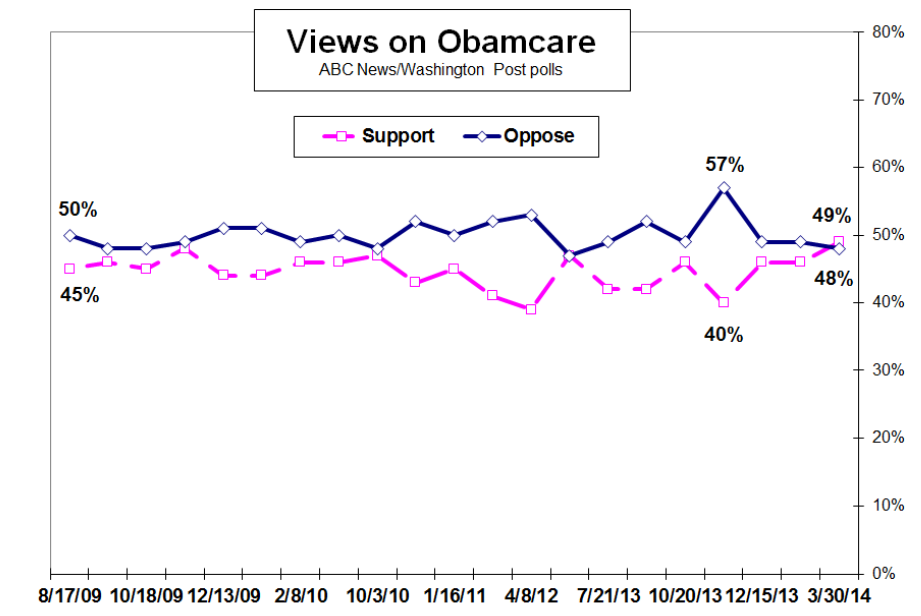
Yesterday, an ABC/WaPo poll registered a “new high” for Obamacare support:

ACA Support

The Fix summarizes the poll numbers:

Overall, 49 percent support and 48 percent oppose the health-care law in the new poll, hardly changed from January (46-49 support-oppose) but clearly better than November, when 40 percent expressed support and 57 percent were opposed.  The growth in support has been concentrated among those who “somewhat” support the law, with strong opponents still outnumbering strong supporters by a 36 to 25 percent margin.

Democratic support has surged to a record-tying 76 percent, jumping 11 percentage points since January to the highest level since March 2010, immediately after the law was passed. Currently at 78 percent , Republican opposition has outpaced Democratic support by double digits in nearly every poll over the past two years, but in the latest survey they are within three percentage points.

Other polls are not-so-encouraging, which is why the poll of polls shows little movement. But Allahpundit wonders whether this is the start of a trend:

Specifically, what if it’s true that the law has become a bit more popular with Democrats now that it’s kinda sorta in range of its original goal of seven million enrollments if you squint real hard and ignore things like nonpayment of premiums and the age mix of America’s many new O-Care risk pools? The better the polling gets, especially among independents, the more reluctant some Republicans in Congress will be to support full repeal later.

Last fall, I argued that Obama’s presidency, already historic in significant ways, would become as influential as Reagan’s if two things happened: if the ACA stuck and American entered an era of near-universal healthcare; and if the negotiations with Iran led to an end of sanctions and a controlled Iranian nuclear capability. Both would be generational game-changers – one in domestic policy, the other in foreign affairs. I’ve also long argued that Obama’s entire presidency makes no sense if you try and judge it by its ability to spike the polls in any given news cycle.

So where are we? Too soon to tell on Iran. But after a clear, self-inflicted disaster – the website’s debut – we’ve seen a classic Obama pattern. The fail is replaced by a dogged, persistent, relentless attempt at repair. I’d argue that the competence behind the repair of the site and the revival of the ACA’s fortunes has been as striking as the original incompetence. And we do not and should not judge a president by his mistakes; the critical judgment is in how he responds to those mistakes. As Dick Cheney might put it, the results speak for themselves:

In 2017 there will be, according to the CBO, 36 million Americans newly covered by ACA through exchange policies or Medicaid. That’s a huge number of voters. You have to live in Foxland to think that any great number of these will see themselves as victims of coercion rather than beneficiaries of a terrific entitlement. The second reason comes from the ramshackle, Heath Robinson (Am.E: Rube Goldberg) nature of the Act. This makes it so hard to understand what is going on. More important, it means that any remotely feasible replacement will also be hugely complicated. Simple repeal and reversion to the status quo ante will be as as unacceptable to the electorate as single-payer.

Worse, the Republicans are now in the position of nit-picking, cold-water dousing and general negativity that tends not to wear well over time. Once again, it seems to me, they have misjudged this president’s long game.

All they have now are scare stories and a narrative that simply cannot include the fact that millions more people have irrevocable health insurance than did before Obamacare. They do not have an alternative to offer the 36 million people whose health insurance would be disrupted or ended if repeal took place. Their current strategy – backed by endless propaganda – might yet work this fall. But the more it works this fall, the less it is likely to work thereafter. If the GOP regains the Senate, it seems to me that the case for a Democrat in the White House in 2018 will be much stronger, if only to protect the country from far right over-reach.

Now look at the economic forecast: the IMF is predicting growth of 2.8 percent this year and 3 percent in 2015, easily the best performance among Western economies. We may see further declines in unemployment. This does not seem to me to be compatible with declining support for Obama and his record. In fact, I’d be surprised – barring, of course, any number of game-changing events – if Obama’s approval ratings were not ticking up by the summer.

We’ve been here so many times before with this president – when he seems temporarily becalmed, inert, unable or unwilling to seize every moment. But over the long run, you see the virtues of persistence, relentlessness and pragmatic advance. The opes he once inspired may be dimmed or dashed right now; but in the cold light of day, they shouldn’t be. Like the slow, excruciating accumulation of delegates in the epic 2008 primary campaign, Obama never puts it away until he puts it away. But it’s coming. And more and more people are beginning to see it.

Toward A Reckoning On Torture

abugrahib4_gallery__470x3750.jpg

So we are approaching the moment when we will have some measure of understanding of the scale and breadth and severity of the war crimes authorized by the last administration. We don’t – infuriatingly – have the full Senate Intelligence Committee report on the Bush-Cheney torture program, but we are beginning to get clues and assessments from people who have actually read the report. That means we should be careful in jumping to conclusions. But, so far, we’re seeing why the CIA has done all it possibly can to keep their war crimes hidden from public accountability.

That avoidance of accountability was not just to the American people, but also to their representatives. The report, we’re told, shows how the CIA deliberately conflated intelligence breakthroughs secured by ethical intelligence work and by torture. Here’s one example:

One official said that almost all of the critical threat-related information from Abu Zubaida was obtained during the period when he abuse184_3.jpgwas questioned by Soufan at a hospital in Pakistan, well before he was interrogated by the CIA and waterboarded 83 times. Information obtained by Soufan, however, was passed up through the ranks of the U.S. intelligence community, the Justice Department and Congress as though it were part of what CIA interrogators had obtained, according to the committee report.

“The CIA conflated what was gotten when, which led them to misrepresent the effectiveness of the program,” said a second U.S. official who has reviewed the report. The official described the persistence of such misstatements as among “the most damaging” of the committee’s conclusions.

This is not terribly surprising. Once a constitutional republic has decided to adopt torture, the gravity of the decision makes it a necessity for those inflicting it to prove it worked. But of course, it doesn’t work – which leads to lies and misrepresentations to insist that it did. In turn those lies help perpetuate the torture. In almost all torture regimes, this tight epistemic closure is routine.

There are also hints and guesses of further barbarism. We find, for example, that torture methods well-documented in the Bush-Cheney war on terror can be combined for particular sadism. And so freezing prisoners to near-hypothermia is documented elsewhere in the war, as is waterboarding. But these can be put together! Hence:

At the secret prison, Baluchi endured a regime that included being dunked in a tub filled with ice water. CIA interrogators forcibly kept his head under the water while he struggled to breathe and beat him repeatedly, hitting him with a truncheon-like object and smashing his head against a wall, officials said. As with Abu Zubaida and even Nashiri, officials said, CIA interrogators continued the harsh treatment even after it appeared that Baluchi was cooperating.

The perpetuation of the torture beyond any intelligence needs is also a feature of torture regimes. Once prisoners have been completely dehumanized – blindfolded, stripped, frozen or beaten, strung from shackles that force them into excruciating crucifixion-style stress positions – they become easy prey for pure sadism. This is human nature. When CIA officials have been given the green light to do as they want with prisoners, to experiment with various torture techniques with a guarantee of being beyond the reach of the law, the worst will always happen.

What’s truly encouraging about the report is that it apparently has exhaustive records on every single tortured prisoner, and the intelligence they did or did not provide. It could offer some real finality. And then it will offer this democracy a choice. When war crimes have been committed so brutal and foul, so horrifying and sadistic, so useless and immoral, are we simply going to say: no one will ever be held accountable? No one who ordered this will ever face sanction?

That is the second reckoning that this country will have to make. I wish I had confidence that we will not again simply decide to look away. What I do know is that a democracy that does look the other way is no longer a democracy.

Et Tu, Josh?

Every now and again, it’s perhaps worth revisiting the entire definition of journalism. In my view, it is writers and editors attempting to tell the truth about what’s happening in the world to readers every day or more frequently. A journalistic institution that lasts builds a trust between its editors and readers so that no one is in any doubt about the sincerity of the enterprise, its freedom from outside interference, or its integrity as a form of communication.

Screen Shot 2014-03-28 at 6.29.44 PMMy concern with “sponsored content” in vast swathes of online media – from the New York Times to Time Inc. and Buzzfeed – is simply that, by deliberately blurring the distinction between advertising and editorial, it must necessarily undermine this integrity and cast a doubt over that trust. It violates the core integrity of any journalistic institution to treat the prose of commercial interests as the equivalent of the prose of editors and writers – or to blur the lines between the two, by presenting commercial speech in extremely similar formats to editorial speech.

Am I being too purist? All I can say is that my position was once held by every journalistic institution you can think of only a few years ago. Back then, advertising was a revenue model that was self-explanatory, clearly differentiated from any article, and if it could in any way be confused with an article would have the word “Advertisement” attached to it. It was also assumed that the editor would know no specifics of the advertiser. The reader of a magazine knew that what appeared in its pages was written entirely by journalists and guided by editors. That is not purism. It is the basic ethical code of journalism as we have known it for decades.

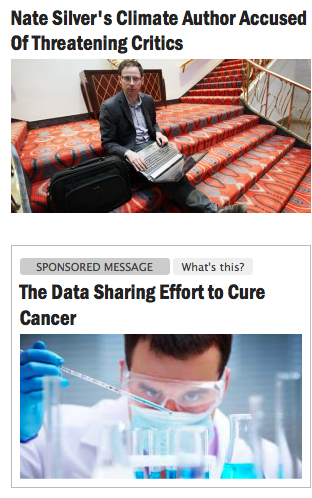
And so we come to the deeply depressing news that Josh Marshall’s TPM has joined the throng. In introducing the series – a completely new step for TPM – Josh didn’t address the obvious glaring issue. Instead he wrote a post that doesn’t sound like him, and in fact reads like a p.r. press release:

Today I’m really excited to announce that we’ve launched a very cool new section to our popular Idea Lab vertical called Idea Lab: Impact, which is being sponsored by the Pharmaceutical Research and Manufacturers of America. I’ve wanted to take Idea Lab in this direction for some time. Idea Lab focuses science, cutting edge technology, the tech industry and the economics, policy and politics that surrounds those issues and sometimes on the gizmos we all use everyday. Idea Lab: Impact will have a different focus. How is science and applied technology affecting real human lives?

I.e. “The Data Sharing Effort To Cure Cancer.” Which was the first article in the new “vertical”. Which was written by a Phrma corporate flak.

On Friday, Josh responded to some brutally effective takedowns by Henry Farrell (it’s worth reading the entire debate, including the comments where Josh participated). His argument is that these are advertisements and are clearly labeled as such, but include text like an article because, well, er:

Our advertisers are policy focused and thus tend to have more complex arguments. They’re not just selling soap or peanut butter. There’s only so much of those arguments you can fit into a picture box or a video. They want room to make fuller arguments, lengthier descriptions of who they are and what they do, as you would if you were writing an editorial – in text, going into detail.

But they could do all that in a traditional advertisement: in their own font, attached to a real article, in their own color, with their own branding. We’d all know what it is. But this is not what Josh has offered them. He has offered them the appearance of being an article in TPM, and that offer is precisely and solely what makes sponsored content ads worth more than the others. If it were clearly an ad, that w0uld defeat the purpose of the enterprise, which is to blur that difference. So there is something inherently corrupting and unethical about this arrangement.

To quote E.B. White, stating the obvious, when discussing mere sponsorship of an article written by a journalist in Esquire in 1975:

Sponsorship is attractive to the sponsor himself, who, for one reason or another, feels an urge to penetrate the editorial columns after being so long pent up in the advertising pages. These temptations are real, and if the barriers were to be let down I believe corruption and abuse would soon follow.

That’s what all this is: an invitation to advertisers to penetrate the editorial columns. TPM and Josh, of course, are laggards in this. The betrayal of basic journalistic ethics by Time Inc. and the New York Times are far greater evils. I am focusing on TPM today because I’ve always thought of it as a sister site to the Dish, started just a short while afterwards, and imbued with the same spirit of independence. It’s not a desperate dinosaur grabbing one last stream of revenue in a panic. It’s a successful new media site that has actively decided to embrace this development with both hands. The news that they have done this has hit me like a sucker-punch to the gut.

TPM, after all, was an ethical model for online advertising and very successful at it. They accepted network ads blindly, wisely refusing to remove any for political reasons, because if they picked one ad over another, they’d be giving away their independence, and implicitly endorsing what were simply ads. But now, Josh absolutely picks advertisers over others, and thereby endorses Phrma, a controversial group whose activities might seem somewhat alien to Josh’s liberalism. In the past he could just say: heck, they’re an advertiser. An agency sends them our way and they pay the rent. Now, he has to own his endorsement of Phrma, and his integration of their propaganda into the core fabric of his magazine. As indeed he does:

This isn’t just something I’m comfortable doing or willing to do. I’m glad to do it. Because it allows me to continue funding what I believe is a great news organization, keeping it growing and expanding.

Compare that with E.B White:

The sponsorship principle seemed to challenge and threaten everything I believe in: that the press must not only be free, it must be fiercely independent — to survive and to serve.

Today, TPM is a little richer and a lot less independent. They chose the money over the principle. But there are some things money should never buy.

Manipulated For The Greater Good?

Screen Shot 2014-03-27 at 10.43.02 AM

Nitsuh Abebe pulls the curtain back on Upworthy’s editorial process. On the site’s mission:

Much of Upworthy’s content does feel like reality TV. A lot of it also feels like advertising. This isn’t an accident; the site’s built, tactically and deliberately, to appeal to what skeptics once called the lowest common denominator. Its choices are the ones you’d normally associate with a race to the bottom—the manipulative techniques of ads, tabloids, direct-mail fund-raising, local TV news (“Think This Common Household Object Won’t Kill Your Children? You’d Be Wrong”). It’s just that Upworthy assumes the existence of a “lowest common denominator” that consists of a human craving for righteousness, or at least the satisfaction that comes from watching someone we disagree with get their rhetorical comeuppance.

In some respects, Upworthy does represent a slight paradigm shift in the constantly churning world of writing and the web. It’s really about producing writing or visuals or videos that people want to share. Their contribution to the evolution of the web, like Buzzfeed’s, is honing and finessing and mastering the tricks and techniques of getting people to share Upworthy items on their Facebook pages. One reason so many of the posts are indeed shared, as the piece points out, is not just the very catchy formulaic headlines (already expiring from over-use) but, more importantly, that they are not strident or edgy or in any way discomfiting. That way, the posts can be attached to a Facebook feed as a way of expressing your identity, of solidarity with the disadvantaged, of the appearance of caring. It really is a beautiful circle, designed, of course, to make shitloads of moolah at some point by dominating the sharable content that has become much of our common reading material.

But here’s the thing: is crafting “content” for sharing the same thing as writing or journalism? Here’s my basic test.

Does the writer of the piece select the topic because he or she believes it sincerely to be worth writing about? And does the writer want the piece to be read for its point rather than merely passed around to maximize revenues and traffic? Upworthy rather brilliantly collapses its business rationale – nothing but “evergreen standards like ‘Human rights are a good thing’ and ‘Children should be taken care of’” that will be easily shared – and its journalistic rationale – i.e. we want to make the world a better place by being nice to children, puppies, etc. The reason why it’s hard to be completely cynical about Upworthy is that the content, if anyone reads it, is so, well, uplifting. But of course, that’s the real, deep cynicism behind it.

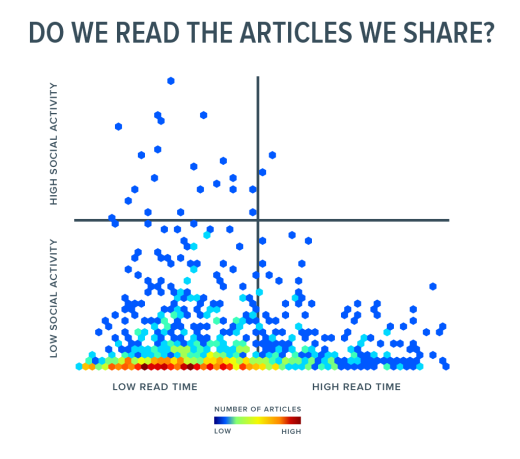
Next month, we’re told, Upworthy will unveil its monetization strategy. So at some point, we’ll see exactly what it’s about: the money or the writing? But it’s vital to recall what Tony Haile, CEO of Chartbeat has discovered, illustrated in the chart above:

A widespread assumption is that the more content is liked or shared, the more engaging it must be, the more willing people are to devote their attention to it. However, the data doesn’t back that up. We looked at 10,000 socially-shared articles and found that there is no relationship whatsoever between the amount a piece of content is shared and the amount of attention an average reader will give that content.

When we combined attention and traffic to find the story that had the largest volume of total engaged time, we found that it had fewer than 100 likes and fewer than 50 tweets. Conversely, the story with the largest number of tweets got about 20% of the total engaged time that the most engaging story received.

So Buzzfeed and Upworthy are really about sharing for money than reading for interest. We may be evolving into a web where everything is shared and nothing is actually read. And journalists are leading the charge.