The night’s discussion between me and Hitchens several years’ back (see here for context) continues:
H: One can’t be neutral about religion. One can’t just say it’s wrong — one has to say it’s a wicked thing to desire. I mean, why would anyone want it to be true that one was subject to permanent round-the-clock supervision, surveillance, and possibly even intervention, all of one’s waking and sleeping life? And one couldn’t escape it by dying.
It’s worse than any kind of totalitarianism; it means you’re absolutely held as property, that you have no autonomy, that you throw yourself permanently on the mercy of somebody. That is the description of the servile condition; that’s why both Islam and Christianity were both perfectly adapted, and still are in many ways, to feudalism or absolute monarchy, which of course is one of feudalism’s counterparts.
A: But the kind of Christianity that Jefferson espoused—
H: He had no Christianity.
A: Well, he constructed his own Bible.
H: Yes, but only by snipping out, or razoring out, every single supernatural or immoral claim. It left him with, as you know, a very slender volume. And even that he didn’t dare to publish. And I think that if he had been in a position where he did dare to publish – and this is after his retirement from public life – if he felt free to say what he freely thought, I’m confident that he would’ve been at the least, or most, a deist. No more than. Certainly not a subscriber to any one monotheism. And in his braver moments, I think it’s very clear from his correspondence and his reflections that he’d had the experience of being an unbeliever and had not been able to forget it.
A: But a lot of people of faith have had that experience.
H: Of unbelief? Of course. There’s a famous prayer, “Lord, I believe, help thou my unbelief.” It’s an old paradox, in this case a Christian one.
A: There’s also this, that if you strip religion of dogma, i.e. its big empirical truth claims…If one understands mystery to be the core of it — in other words that one is worshipping something one cannot understand, which requires a certain letting go of it — its best expression is something like ritual. Wordless. Then it’s reconciliation to immortality.
H: Then you end up where Simon Blackburn — a professor of philosophy at Cambridge, author of a very good recent study of Plato. He puts it: religion is fossilized philosophy, it’s philosophy with the questioning left out. It’s something that becomes instated and no longer subjected to any further philosophical inquiry. Well, why would that be, from any point of view, a desirable thing?
A: No, because philosophy doesn’t help you live.
H: It’s the only thing that helps one live.
The reflection on why — well, philosophy’s three main reflections or questions are 1) why are we here , 2) what would be justice? and 3) what, if we can answer those two questions, would be a just city or just republic? One can be a philosopher and maintain that those are imponderables…
A: And may also say that discussing them and understanding them does not make it easier to live.
H: By no means, but it’s not supposed to be.
A: No, it’s not supposed to be, its goal is its own sake.
H: Religion’s is to make it easy.
A: Religion is the practical impulse, it is how do we live, how do we get through the day knowing that we could die tomorrow, knowing that we are mortally—
H: But how does the belief that Jesus was born of a virgin help you to do that?
A: That particular belief may not.
H: I would say cannot. It obscures the view of the question. It negates questioning because it depends upon certainty and upon acceptance of unbelievable evidence with no reasoning. It’s a corruption of the whole idea of having a mental process or an inquiring mind.
A: No, it’s a recognition that at some point there are some things that are beyond our understanding and an acceptance of that. And there is a content to that acceptance that can vary from faith to faith.
H: Well now you remind me of what Dr. Johnson said to somebody, I forget who it was, who said, “well I’m willing to admit the existence of the external world,” and Johnson said, “Well you’d better!” For someone to say, “yes, I accept that there are some things that can’t be known or accept that some things are impossible to know” — yeah, well they should! What choice do they have? The choice they have offered by religion is not to accept, and to say, “No, actually, we know. We know there was a creation moment. We know why it was, we know what was intended by it. We know that its reigning deity knows what we should eat, how we should mutilate our genitalia…”
A: It can be. But there are differences in degree and kind in religious experience. The kind of thing you’re talking about I would understand as a fundamentalist version of religion. But I absolutely refuse to believe that is the only form of religion imaginable, or the only form of religion that actually exists, or the only form of Christianity that exists.
To be continued.
(Photo: Manganese oxide dendrites on a limestone bedding plane from Solnhofen, Germany. Via Wiki).
After watching How To Survive A Plague, Josh Barro identifies why ACT UP was so successful:
ACT UP activists weren’t just angry about national apathy and inaction on AIDS; they also had specific demands and constructive ideas about how the government and drug companies could do better. Unlike a lot of protest movements, once they got to the stage where the targets of their protests said, “I’m listening. What do you want me to do?” they had concrete answers.
A few things you see ACT UP demanding (and getting) in the movie are: hospital policies that don’t discriminate against AIDS patients; more funding for AIDS research; lower prices for AZT, the first effective anti-AIDS drug; a faster drug approval process, recognizing that 10 years of effectiveness trials didn’t serve the interests of people on the verge of death; and allowing HIV- positive people not enrolled in drug trials to take experimental drugs at their own risk, the so-called parallel track.
Yes, but this somewhat distorts one of the key nuances and virtues of the movie (my review here).
There were two sides to ACT-UP: the drama-laden, spectacle-creating, brilliant rage-filled actions against an indifferent government versus the pragmatic, step-by-step laser-sharp emphasis on actually creating change in the ways Josh describes. The latter group became Treatment Action Group or TAG. The film exposes these rifts – rather subtly (which makes it much more interesting than agit-prop. At the time I feared the over-the-top dramatics could undercut our message; in retrospect, not so much – especially since those protests and the expression of that anger helped keep people alive. But it was the meticulous grasp of the science, the trial process, the FDA and the NIH that really helped accelerate the process and organize it. That was done by often maligned young white males – like Harrington and Staley and Gonzales – and it made a real difference.
What we sometimes forget, however, is that there never was some miracle drug the government had that was somehow being withheld. There never was a chance to launch a Manhattan Project against a retrovirus that had not even been identified when so many started to die. No one had ever stopped a retrovirus in human history before – and HIV remains the only one. This meant really hard research, using fast-accelerating technology to bring about a revolution in treatment and quality of life.
In retrospect, as the film demonstrates, the first wave of anger was totally unjustified and completely pointless. The science simply wasn’t there – and science takes time. The second wave of anger combined with relentless engagement with the drug companies and FDA was what made a difference. Yes; make a stink. But also: be ready to take yes for an answer, to leave grudges behind, to focus almost manically on the prize and do your best to ignore everything else. Not easy. But by some strange alchemy – and the courage that comes out of terror – it was accomplished. Or else that last sentence would never have been written and this blog would not exist.
Alex Gibney’s new documentary on the child-rape epidemic in the Catholic Church that raged for decades (and maybe centuries), Mea Maxima Culpa, debuted tonight on HBO. I’ve watched it twice. It is both an inspiring testament to faith and truth – as well as a devastating indictment of pride, power, and lies. The former come from four boys who attended St John’s School for the Deaf in Milwaukee in the 1970s. The latter comes from the Vatican and everyone in its power structure then and ever since. It really is a story about how the real church finally stood up to a hierarchy that has betrayed us and committed crimes of such gravity and magnitude they beggar belief.
The story begins as long ago as 1974 when four boys put fliers on the windshields of the cars in the parking lot of the church run by the man who raped them. They simply said “Wanted” with the priest’s name (the more explicit flyer in the video above came later). Instead of being listened to, the kids were disciplined. Eventually, in Murphy’s psychiatric record, Gibney finds Father Lawrence Murphy confessing to raping over 200 boys over a long period of time. He raped them in their dorm rooms; he raped them in the confessional, using the small window as a glory hole and granting absolution based on rape or masturbation. The detail I cannot quite recover from is that he picked out for abuse those deaf boys who had parents who could not use sign language – so that even if the boys had the courage to say what had happened to them, their parents would not understand. It’s things like that that simply chill you, haunt you, force you to confront the pre-meditated, profound assault on human souls that the Catholic Church, from the Pope on down, enabled, perpetuated, and lied about for so long – and still hasn’t been held fully accountable for.
And what this documentary proves beyond any reasonable doubt (like Gibney’s examination of the Bush-Cheney administration’s decision to torture prisoners in “Taxi To The Dark Side”) is that all of it was known throughout the hierarchy for decades. There is even a network of Church-operated “psychiatric” clinics for serial child rapists that don’t use traditional psychotherapy or report criminals to the cops or sequester the rapists from the public (let alone defrock them). These clinics simply enforce spiritual discipline and then recycle the priests to rape more children. We know from public documents that as far back as the 1940s, pedophile priests were showing up at these centers. Father Gerald Fitzgerald founded the order. And he was not yet corrupted by the Vatican’s insistence that no scandal ever become public and no priest sacrificed for the sake of mere children. As early as 1947, he is writing letters to his superiors about the problem:
“I myself would be inclined to favor laicization for any priest, upon objective evidence, for tampering with the virtue of the young, my argument being, from this point onward the charity to the Mystical Body should take precedence over charity to the individual, […] Moreover, in practice, real conversions will be found to be extremely rare […] Hence, leaving them on duty or wandering from diocese to diocese is contributing to scandal or at least to the approximate danger of scandal.”
Or in 1957, this letter to his Bishop:
“We are amazed to find how often a man who would be behind bars if he were not a priest is entrusted with the cura animarum (guardian of souls).”
The systematic rape of children was then obviously not a function of some kind of major cultural shift in the 1960s and 1970s, although that era might have sent a permissive signal to the global network of child rapists the Vatican was already hiding and enabling. It has been a core problem with the “celibate” priesthood in the US for decades, and every single bishop and every single Pope knew it. Fitzgerald personally met with Pope Paul VI to try and get him to act. Yes, the good folks in the church tried to do something as early as the 1950s and were stopped in their tracks … by the Vatican. The number of souls violated by child-rape in the coming decades would not have happened if all the Popes since Paul VI had acted with more moral sense than most maximum security murderers. (Even the worst prisoners regard child-rapists as the lowest of the low. Popes? Not so much). We’re not talking about priests who are drunks, or priests who fall in love, or break their vows in fallible, victimless ways; we’re talking here about priests committing one of the most heinous felonies imaginable: the systematic rape of children using the authority of the Church as cover.
John Paul II emphatically cannot be somehow removed from this picture. He personally protected one of the worst offenders, Marcial Maciel, who was a serial rapist, drug trafficker, bigamist and rapist of his own son. In fact, John Paul II elevated Maciel to the highest honors of the church – backed by the theocon wing of the American church, from Richard John Neuhaus to Bill Bennett and Mary Ann Glendon. They all adamantly denied that Maciel was anything but a living saint – and he was never prosecuted, merely allowed a gentle retirement from running his order, The Legion of Christ, which continues.
Joseph Ratzinger, when he was Archbishop of Munich, personally signed off on sending a priest to therapy, after that priest had raped several children, never notified the police, never told the parents of the children at the parish the priest was then assigned to, and because of this negligence, was, in my view, complicit in the rape of several more children before the priest was finally caught, arrested and sent to jail. Let me repeat that: the current Pope enabled and abetted the rape of children – and his only way out was to blame a lower official, who subsequently said he’d been pressured. More than that, no one else in the church knows more about this long record of child-rape than Ratzinger. From 2001 onwards, all cases of child rape or abuse were ordered to be sent to his personal office, the Congregation for the Doctrine of the Faith. And all of it had to be kept completely hidden from the outside world. In the words of Hans Kung, Ratzinger’s former modernizing ally in the Second Vatican Council,
Ratzinger himself, in a letter on “grave sexual crimes” addressed to all the bishops under the date of 18 May, 2001, warned the bishops, under threat of ecclesiastical punishment, to observe “papal secrecy” in such cases.
He knew everything – and had the goods on every Cardinal, in whose dioceses thousands of complaints had been filed. And one wonders why it was a surprise he was elected Pope. When you’re the J Edgar Hoover of the Vatican, who is going to challenge you?
If those of us are asked why we still believe in the salvation of Christ in the Catholic community, in the midst of all this, we do not have a good answer. All we can say is that we are, in some ways, trying to live in a parallel church, finding those many, many good priests who have been unfairly tarred by the pedophile brush, and living by one simple moral standard that the Pope himself does not agree with and has not done: if you find out someone is raping children, you call the cops.
But, for me, the most powerful moments in the documentary come from one simple fact. The four primary victims are deaf. They are grown men now and when they express themselves on film, they do so with sign and sounds of anguish and grief. One of the victims, now dead, sat down in front of a video camera and laboriously recounted every single act of abuse Father Murphy committed against him. He knew he was dying, and wanted to leave a record of the crimes and the corruption. Then in the most riveting raw footage of the film, he goes to confront the mass-rapist, whose crimes were by then beyond the statute of limitations. He finds him in the backyard. He signs and yells as coherently as a deaf person can; the priest seems utterly unmoved, telling the man he serially raped that “That’s all over now.” And disappears into his modest house, with a deaf-house-cleaner who had previously worked at St John’s. In the Catholic Church, mass rapists get retirement homes with maids. She confronts the rape victim. She keeps asking him: “Are you a Catholic?” He keeps replying that this has nothing to do with Catholicism and everything to do with rape. She just comes back at him with rapid-fire repetitions of “Are you a Catholic?” “Are you a Catholic?” “Are you a Catholic?”
It’s a good question.
I can hear my devout Irish grandmother – who also worked as a cleaning lady for priests, scrubbing her floors day after day till they looked like glass – asking the same question whenever I questioned ecclesiastical authority. It’s a question that simply tells you: do not disobey a priest; do not malign a priest; do not question a priest. And it is that deference, that lingering, profound subservience to the priestly office that also allowed this to happen. Where, after all, were the nuns at St John’s School? Did they seriously not know what was going on? Where were the parents of the deaf boys, when they warned them about Father Murphy as early as 1974? Where are we now as a church if we vaunt one of the biggest enablers of child-rape, John Paul II, to the status of sainthood without a thorough investigation of these matters?
For me, Jesus must always be with the victims. He is the victim. When a priest rapes a child, Jesus is raped. When an archbishop covers up the crime, Jesus is raped. When successive Popes are told of the problem and assign total secrecy to it and fail to prevent future abuse of children, Jesus is raped. And there is a particularly appropriate ending to the tale of Father Murphy: faced with the possibility of a church trial for a canon law crime which has no statute of limitations – abusing the sacrament of reconciliation by raping children as absolution, he appealed to Pope Benedict XVI himself. And this Pope granted him a reprieve because of failing health. We have the documents to prove all this. Many argue – and it is undeniable – that this Pope has done more than any predecessor to investigate the horror. But he did so only as the abuse stories began to break into the open and his first response was to blame the media. This quote is from 2002 when Ratzinger was head of the CDF:
In the church, priests are also sinners. But I am personally convinced that the constant presence in the press of the sins of Catholic priests, especially in the United States, is a planned campaign, as the percentage of these offenses among priests is not higher than in other categories, and perhaps it is even lower. In the United States, there is constant news on this topic, but less than one percent of priests are guilty of acts of this type. The constant presence of these news items does not correspond to the objectivity of the information or to the statistical objectivity of the facts. Therefore, one comes to the conclusion that it is intentional, manipulated, that there is a desire to discredit the church.
Again, you notice one thing: his first priority then and now was to protect the institution, not protect the children. This is not an old story either. Just last week, the former Cardinal of Los Angeles, Roger Mahony, was stripped of his duties for enabling and abetting the rapes of countless children. This was proven by key documents finally pried out of the church’s hands by a legal case. What we need access to is the entire Vatican archive of priestly sex abuse of children. But perhaps, case by case, we will begin to understand better the nexus of authority and accountability that made this global conspiracy to hide and abet rapists so durable and so horrifying.
There was a slogan in the years of AIDS. It was Silence = Death. What is unforgettable about this documentary is that the loudest voices come from the most vulnerable of all – deaf children who are now deaf adults. The loudest voices were those who could not speak. If I have hope for my church – and I sincerely believe Jesus will never finally abandon us, however corrupt and sinful we become – it is because of this fact. The power of the powerless is what helped stop this mass violation of the souls of children. The change came not from the top, which remains foully corrupted, but from the very margins of the margins: the consciences and courage of those who could not hear evil until it was upon them, but who were surrounded by it. And spoke up. As children. And, then, as adults.
When will the rest of us do the same? When will we Catholics insist in the prosecution of this Pope and this hierarchy for what can only be called – given its duration and gravity and sheer scale – a crime against humanity. When will we lose the deference to a clerical elite that has become its own self-perpetuating clique of sexual dysfunction, that has lost even the most basic moral authority, that even now refuses to hold itself to account.
What, one wonders, would Jesus do? My answer to that ultimately unanswerable question is simple: listen to the survivors. Even those who can only speak in silence and sign:
So the last shall be first, and the first last: for many be called, but few chosen.
The one thing we decided very early in designing the site was to make it work better for you. Some of that is what you don’t see. There are no ads. There is no banner clutter or promos from our host site. We’ve tried to keep the old design as much as possible – with some homage to the early site colors as well. The Dish should automatically re-size to whatever device you are on – to make it more readable.
On the right column, we have both my recent longer posts “Keepers” and an archive of them. We also have for the first time a list of Reader Threads, which will proliferate in due course, also with an archive (featuring my favorite ever on late-term abortion).
Speaking of archives, check the new one out. I have given a sharp dagger for anyone who wants to make me look foolish – so have at it. But seriously, they now go all the way back to 2001. Then there’s the new search engine, which is light years’ better than poor man’s version of Google we had before. Again: just try it out. You’ll find every post in reverse chronological order on any subject you can imagine. We also moved the bookstore to its own separate page.
The blog is also now unending: you can scroll down indefinitely if you so wish, and the read-on button should also be much quicker. We’ve tried to make the whole site as simple, clean and easy as possible to navigate, search, read and watch. It’s inevitable that we’ll have some glitches today. Please be patient with us. At the same time, we sure hope you will send us more suggestions, criticisms, ideas and tweaks (the new email address is andrew@andrewsullivan.com). This experiment is just beginning and we need you to make it better.
Oh, and subscribe! Just click the red button in the upper-right corner of the Dish, above the howling beagle.
Here we go again. Was Ed Koch gay and did his closet inhibit him from faster action on HIV and AIDS? I only met him once, when Marty Peretz invited me along for a dinner party at Koch’s apartment. As I recall, there were no women at all, I was the only goy, almost no one else got a word in edgewise and the evening ended with Koch actually demanding we sit and watch his speeches on the TV. In other words, not quite as gay as the Vatican, but sheesh.
Perhaps it’s better to see how Koch approached the subject. He saw it in two ways: about sexual behavior alone and about privacy. In that way, he was, in fact, quite typical of many in a generation of gay men his age, who defined their orientation understandably but entirely in terms of sexual freedom and protection from government scrutiny and prosecution. But AIDS, of course, ripped that sub-cultural eco-system apart. Of course, no one – straight or gay – is entirely defined by their sexual orientation. But it’s a core part of your personality – and Koch was simply too old, too self-loathing, and too prickly to change. Here’s the money quote when he was asked about it:
What do I care? I’m 73 years old. I find it fascinating that people are interested in my sex life at age 73. It’s rather complimentary! But as I say in my book, my answer to questions on this subject is simply “Fuck off.” There have to be some private matters left.
Of course they do. And I sure don’t want to know about Ed Koch’s sex life, if he had one. But the plain fact of your orientation is not the same as the details of your sex life. And when you are such a public figure and single and your city is grappling with an epic health crisis among gay men, it does become other people’s fucking business – especially if he was inhibited from a more aggressive response because of not wanting to seem gay.
His opponents certainly knew his vulnerability, hence the infamous “Vote For Cuomo. Not The Homo” posters that cropped up over New York City in an election campaign. Hence the weird first election campaign dalliance with a beauty queen he never had a relationship with. And this is not how a straight guy would react in a public meeting on the AIDS crisis:
One of the few peeks into Koch’s psyche comes from a former adviser, who says Koch was very worried someone would interrupt an AIDS forum (hosted by the New York Post, for the record), and accuse him of being gay.
After the forum, Koch complains of a headache and suffers a stroke, making for just one of the many crises in his third term.
A straight guy would never have proposed the following classified ad either, when prompted by New York magazine:
“White Male, 70-something former C.E.O. and practicing attorney. Have belatedly concluded that everyone, straight or gay, needs a
partner in life. How’m I doing?”
History will judge that. And so will the souls of countless gay men, who perished as their mayor panicked.
Yes, we are still being hosted by the Beast’s servers. But as of today, we are our own independent entity, and over the coming weekend, the site will migrate to a new URL and a newish ad-free design (our creed is “very gradual change you can believe in”). By Sunday at midnight, we should have the new meter in place – so those of you who have already signed up need only enter your username and password. If you’re worried about your bookmark, don’t be. Whatever bookmark you have – from the days of http://www.andrewsulivan.com onwards – will automatically redirect to the new site.
The chances are there will be some glitches.
We have tried very hard to prep for as smooth a transition as possible, but there are unknown unknowns, as someone once noted. So please be patient as we move. I want to thank all my former colleagues at Newsweek and the Beast for their support and work in helping us transition – and for all they did for us for the last couple of years. Tina Brown made this launch possible, by giving us the resources to keep this operation afloat, adding two paid interns and one new editor, and then seeing the logic of independence and wishing us all the best. Without that, we wouldn’t have the Dish we are now launching. One personal thing: Tina was a wonderful, demanding editor, a truly class act, and a humane, sensitive person. I wish an often jealous press corps would see that truth. In the last six months at the Beast, we also saw our traffic rise to an average of 1.8 million unique readers a month. Our pageviews increased by around 40 percent in two years. That’s a hell of a ski-jump to launch off.
Chris, Patrick, and Chas have really been amazing this past month as well (though they amaze constantly). This was truly a team effort. I simply do not have the skillset to start and run a small business – but they mastered it for me. And of course, your extraordinary generosity and support drove all of this. Two words: thank you.
I’m a respecter of the Second Amendment, its role in America’s revolution and founding, its cultural and historical meaning across a newly conquered continent where the rule of law did not exist for vast areas for long periods of time. And I’m basically for much of the relatively obvious stuff we can now do: end the gun show loophole, increase resources to the ATF, ban some magazines and assault weapons, take the NRA down a few notches, etc.
But one thing about the victims of guns does tend to get lost: the clear majority of deaths by gun are suicides. Among the over-20s, 60 percent of gun deaths are from suicides, compared with 37 percent for homicides.
Maybe I should have known this, but it came as a surprise. The majority of gun deaths in America are self-inflicted. Some pro-life Catholics have reached the conclusion that murder and suicide are not Christian values and that preventing them if we can by gun control is a Christian duty. I think the argument is much more complex when it comes to homicide – and, given the ubiquity of guns in America, I can see the argument that widespread gun-ownership for self-defense can actually protect life by deterring crime. I can also see the argument that owning a gun may help you defend the lives of your own family if attacked – although its roots in Jesus’ teachings are precisely zero.
But what if high levels of gun ownership make death in your own family more likely? Is there evidence that high gun ownership is related to higher levels of suicide? There is. A study of seven New England Northeastern states (pdf) with varying gun laws and suicide rates came to this conclusion:
The strong and positive correlation between firearm prevalence and suicide was accounted for by substantially elevated firearm suicide rates in states with higher levels of firearm ownership. This association held for the population as a whole and for every age group. By contrast, aggregate rates of nonfirearm suicides in states with higher firearm ownership did not differ across the seven states.
One key reason is that of all methods of suicide, guns are by far the most effective in actually killing you:
Of all suicide attempts, suicide by firearm accounted for only 5%, while poisoning/cutting/piercing accounted for 85%. However, the fatality rate for attempts varies wildly. Overall, 13% of all attempts were successful, while 91% of gun attempts were successful and only 3% of the poisoning/cutting/piercing attempts were fatal. Suffocation/hanging (6% of all attempts) was successful 80% of the time.
A bigger follow-up study came to the same conclusion:
Almost twice as many individuals completed suicide in the 15 states with the highest levels of household firearm ownership (14,809) compared with the 6 states with the lowest levels of household firearm ownership (8,052). For each age group and for both sexes, there were close to twice as many suicide victims in the high-gun prevalence states, a finding that was driven by differences in firearm suicides (i.e., nonfirearm suicides differed little). Overall, people living in high-gun states were 3.8 times more likely to kill themselves with firearms.
It seems to me that this is one piece of evidence that having fewer guns in American houses would lead to far fewer successful suicide attempts. As the authors note:
If 1 in 10 individuals who attempted suicide with firearms in 2002 were to have attempted with drugs instead, the number of suicides in the United States would decrease by approximately 1,700 suicides per year.
That’s a lot of life. It’s worth recalling too how many veterans have killed themselves with their own guns:
Veterans commit suicide at a rate that is twice the national average. In fact, the annual military death toll from suicides has for several years exceeded the number killed on the battlefields of Iraq and Afghanistan.
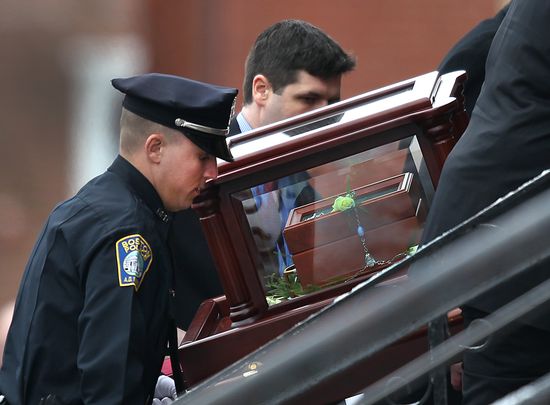
(Photo: A Boston Police officer was one of the pallbearers who helped carry the cremated remains of Hamilton police officer Kenneth Nagy at a funeral mass held at St. James Roman Catholic Church. Nagy committed suicide after a shooting in Beverly of a Beverly police officer who worked with his wife. By John Tlumacki/The Boston Globe via Getty Images.)
This is a first sentence only a teenage anarchist could write:
The police do not exist to protect the individual. They exist to cordon off the crime scene and attempt to apprehend the criminal… Violence by firearms is most prevalent in big cities with the strictest gun laws. In Chicago and Washington, D.C., for example, it is only the criminals who have guns, the law-abiding populace having been disarmed, and so crime runs riot. Cities of similar size in Texas, Florida, Arizona, and elsewhere, which leave the citizen the right to keep and bear arms, guaranteed in the Constitution, typically are much safer.
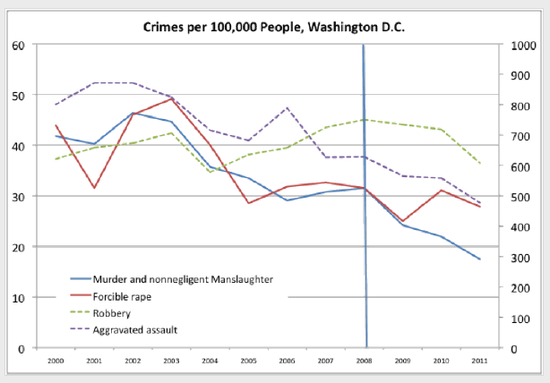
Look: for over two decades I lived on a street corner in DC actually named after a gang. I recall four people being shot dead in my alley or on the sidewalk outside during that time. I have regularly heard gunshots at night. And the police did protect me. By patrols, by check-points, by klieg-lighting at night, by conversations and consultations, they kept the neighborhood safer. Not safe, but definitely safer. Can they be there every time someone might get mugged? No. Do far fewer people get mugged now than they did a decade ago because of police work, among other things? Abso-fucking-lutely. That is what they exist for: to prevent crime, not just bring criminals to justice in the afermath. And in DC, over the last couple of decades, a new city emerged:
You will see in Mamet’s imaginary dystopia, this is a city in which “crime runs riot.” But every category of crime is down over the decade – with murder down almost a half in ten years. But how does it compare with comparable cities in Texas, Florida and Arizona – which Mamet cites as key evidence? First up: it’s worth noting that the FBI discourages simple ranking of cities by crime, for all sorts of reasons extrapolated here. So I will not throw this data out there, as Mamet did, without that caveat. Checking the numbers, however, for last year you find that in terms of aggrevated assault per 100,000 people, Miami and Houston have a rate of 361 and 329 respectively (third and fourth in the nation after Detroit and Baltimore. Chicago weighs in at 222 and DC at 154.
Robberies? The allegedly Marxist regimes in Chicago and DC clock in at fourth and tenth. That might seem to buttress Mamet’s point until you see that Miami and Houston are at fifth and sixth as well and that Phoenix and Dallas are not far behind.
Murders – which may be in Mamet’s mind, the most important thing that guns deter – has seen a resurgence in Chicago this year. But its rate per 100,000 (6.8) in a crime wave is still not that far from Miami/Fort Lauderdale’s (6.1). As for DC, compared with cities in Arizona, Florida and Texas, which Mamet cites, the numbers per 100,000 residents are these: Houston (5.4), Phoenix (4.9), Tampa (4.7), Dallas-Fort Worth (4.5) and DC (4.4). Again, I would reiterate that these are very crude numbers – but they do rebut the claim that cities in Texas, Arizona and Florida “are much safer” than Washington DC or Chicago. Four Three out of the top ten cities for crime are in Florida, Arizona and Texas.
As for Mamet’s claim that “there are more than 2 million instances a year of the armed citizen deterring or stopping armed criminals”, the evidence, so far as we can glean, seems to come from a 1993 study by Gary Kleck, which is also contained in this 1995 paper (pdf) by Kleck and Gertz, which finds 2.5 million annual “defensive gun uses” by individuals each year. This puts defensive gun use at about five times the frequency of criminal gun use. But another study (pdf) by McDowall and Wiersma criticized the Kleck results by noting that “defensive gun uses” were not defined by actual use of guns in self-defense, but by claims of deterrence by people carrying concealed guns. Which may account for the difference between that datapoint and the National Crime Victimization Survey, which found that “gun offenses exceeded protective incidents by more than 10 to 1.” That’s not another slightly different result; that’s a different universe from Mamet’s anarchist mindset.
I’m not making an argument for or against gun control here. I’m just trying to show that Mamet’s broad generalizations are empirically wrong and need to be corrected.
I just read a post on National Review arguing that Christianity is in part about armed self-defense and the Second Amendment. I kid you not. Christianity is now apparently compatible with the gun lobby. For some reason, this particular statement from Jesus – one of the most famous in all of human history – doesn’t appear in the post:
You have heard that it was said, “An eye for an eye and a tooth for a tooth”. But I tell you, Do not resist an evil person. If someone strikes you on the right cheek, turn to him the other also. And if someone wants to sue you and take your tunic, let him have your cloak as well. If someone forces you to go one mile, go with him two miles.
You have heard that it was said, ‘Love your neighbor and hate your enemy.’ But I tell you: Love your enemies and pray for those who persecute you, that you may be sons of your Father in heaven.
The great drama of the Passion requires absolute nonviolence in the face of even immense injustice. Not only did Jesus not resist the violence done to him, he refused even to offer a word of self-defense in front of Pilate. When Peter used a sword to cut off the ear of one who had come to arrest Jesus in Gethsemane, Jesus’ response is unequivocal:
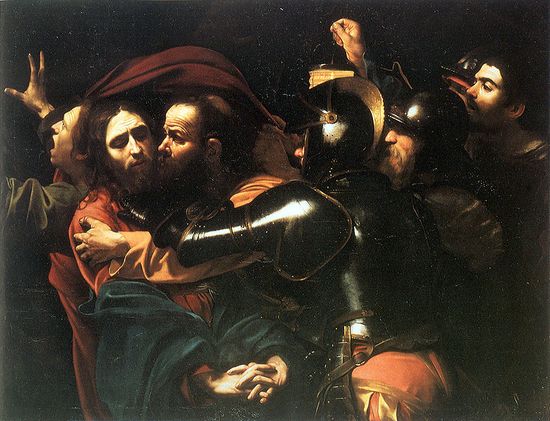
While he was still speaking, Judas, one of the Twelve, arrived. With him was a large crowd armed with swords and clubs, sent from the chief priests and the elders of the people… Jesus said [to Judas], “Do what you came for, friend.” Then the men stepped forward, seized Jesus and arrested him. With that, one of Jesus’ companions reached for his sword, drew it out and struck the servant of the high priest, cutting off his ear.“Put your sword back in its place,” Jesus said to him, “for all who draw the sword will die by the sword.
He then heals the wound created in self-defense. The whole point of Christianity, on a personal level, is a refusal to use violence even in self-defense and even when one’s own life is threatened. For centuries, this radical nonviolence was celebrated by the church in its canonization of martyrs who chose to be mauled alive by animals than submit to the civil order’s paganism. Martyrdom was the first and ultimate form of nonviolent resistance to injustice and, like the Christian-rooted civil rights movement or Gandhi’s campaign for independence, it was precisely this staggering refusal to defend oneself, the insistence on being completely disarmed, that changed global consciousness. It was what made Christians different. It’s what made Martin Luther King Jr different. To use Jesus as an advocate of armed self-defense is almost comical if it were not so despicable.
I can see much more worldly arguments for physical self-defense, course; it is at the core of the modern Hobbesian and Lockean model for Western civilization. In a fallen world, there is also a case for just war (but one that Aquinas had to come up with, for Jesus was uninterested). Machiavelli went even further – but there is a reason he is associated with evil, and remains one of Christianity’s greatest intellectual foes. And I can see David French’s point about defending one’s family. But here’s another news alert to the allegedly Christian right: so far as we can tell from the Gospels, Jesus disowned his family in public in his teens and abandoned them on his ministry, telling his disciples to abandon theirs – and their entire source of income – as well. Jesus, we are told, said the following words – outrageous today, unimaginably heretical in its time:
If anyone comes to me and does not hate his father and mother, his wife and children, his brothers and sisters—yes, even his own life—he cannot be my disciple.
This man is now a symbol for “pro-family” and “pro-gun” Republicanism. And yet he had no property to defend, no wife to protect, no children to keep safe, no house to live in. He never carried a weapon and rebuked his friends when they used one against a mob armed with clubs and swords about to arrest and torture him to death. He was homeless, completely dependent on the good will, shelter and food of others. He was, as today’s Republicans would say, a “taker”. But of course, it is in giving that you receive in Christianity. Jesus inverted the entire maker-taker paradigm. So no, congressman Ryan, you cannot be a disciple of Ayn Rand and Jesus of Nazareth. In any way whatsoever.
In my view, Jesus should not be dragged into any of our current policy debates. The issue of gun control in this country at this time is complex and worth debating in civil and secular terms. I think we can make things a little safer, but given the ubiquity of guns and the Constitution of the US, I wouldn’t expect much that doesn’t end up making things even worse. Bishops who pontificate on this in political contexts are equally violating Jesus’ apolitical spirit.
But when Jesus’s example is used to defend violence, to celebrate self-defense, to find ways to look away from the mass murder of children, beware. Jesus’ response to unspeakable violence was unconditional surrender and yet more still:
Father, forgive them; for they know not what they do.
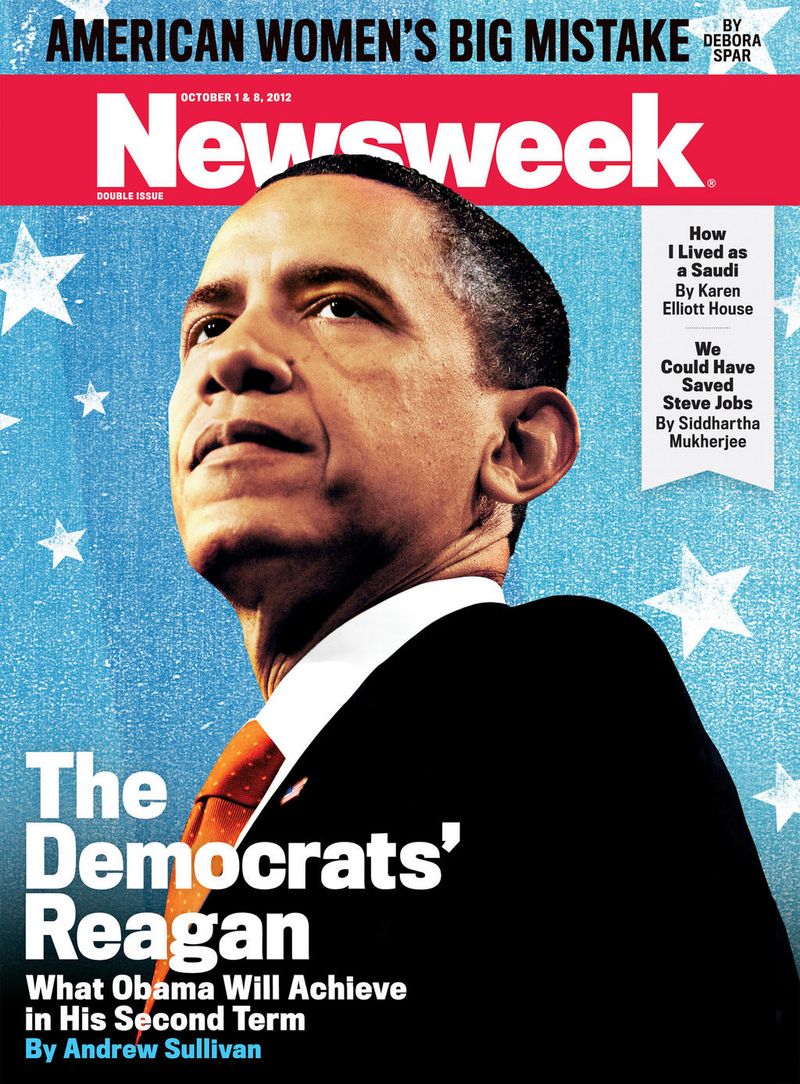
Douthat concedes that, in a certain respects, “Obama is already more like Reagan than he is like any other recent president of either party.” But much could change:
Reaganism’s ascendance wasn’t sealed by his re-election, let alone his first inaugural: It took 1988 to consolidate the rightward shift and 1994 to really ratify it. For now, Obama still awaits his George H.W. Bush (hey, Biden!) and his Newt Gingrich — and for that matter, he awaits his Clinton, because there’s a sense in which declarations of victory are less telling than statements of surrender. The moment when you knew that the age of Reagan would be remembered as a lasting political epoch didn’t come when Reagan declared that government is the problem in 1980; it came sixteen years later, when a Democratic president felt the need to open his re-election campaign with the Reagan-esque promise that “the era of big government is over.” In the same way, the clearest vindication of Obama’s presidency, if such a vindication comes, will probably take the form of a Republican president who sounds uncannily (if reluctantly) like him.
All those caveats are correct. But culture and timing also matter, in my view.
The first Reagan Inauguration had a real sense of a new cultural and psychological beginning. The hostages were freed, the “revolution” was begun, taxes were swiftly cut with Democratic support (the Dems were still a diverse party then even if the Republicans are not now). Yes, Reagan then plummeted in the polls in a Fed-induced recession – below Obama’s trough – before using Keynesian reflation as a spur to growth (and the first shoots of what is now our massive debt).
Obama’s first Inauguration was the same cultural-historical breakthrough; two new generations are bonded with him and three against the GOP; universal healthcare is as profound a change as permanently lower tax rates; ending the wars in Iraq and Afghanistan will also allow for a peace dividend if the Pentagon and GOP don’t stand in the way. These years look likely to cement the integration of gay people in America and the beginning of the end of marijuana Prohibition. They also show a shift toward reining in the excesses of conservative hubris – unfunded wars and entitlements, abuse of capitalism, and reckless adventurism abroad. Reagan was also unimaginable without Carter. And I think Bush-Cheney’s legacy will very soon seem far, far worse than Carter’s.
Yes, at some point he has to win over the other side, which takes time. From Thatcher’s first four years to Blair was an eternity; Ditto Reagan to mid-Clinton. But have you noticed the fizzling of the anti-gay rhetoric from the GOP in the campaign? Do we have a potential Republican defense secretary who will treat Israel as a critical ally rather than as a 51st state? Can you imagine Bobby JindalMarco Rubio endorsing women in combatbefore Obama’s re-election?
Obama has yet to have an Iran-Contra. But he has also yet to have a Reykjavik. No one with any good sense and historical understanding will predict anything with confidence. But I think our first black president, who saved us from the economic fate of Europe and Britain, who legislated healthcare for all, who changed politics and campaigning for good through the web, and who is slowly watching his political foes crumble – from Netanyahu to Cantor … well, he may eclipse Reagan at some point. May. If Iran turns on his watch and democracy stabilizes in Egypt, the game is over. But he has been history from the get-go.


 The Dish
