
African-Americans And Prohibition Of Weed

A Medical Marijuana Operation In Colorado Run By Kristi Kelly, Co-Founder Of Good Meds Network

The latest poll on legalization of marijuana from ABC News shows an even split – 49 to 48 percent – by Americans on the subject – not a clear majority as some other recent polls have found (Gallup’s in particular). That’s still a record high for the ABC poll, which has the benefit of identical wording over time: “Overall, do you support or oppose legalizing the possession of small amounts of marijuana for personal use?” Support has doubled since the mid-1980s.

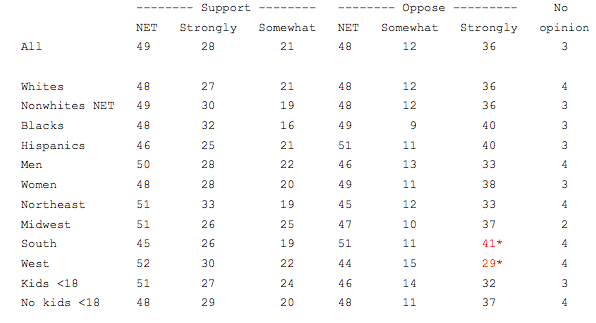
But what’s interesting to me about the poll is its internals. They’re really surprising to me. I asked ABC News for the full data and here it is:
Screen Shot 2014-01-17 at 12.18.19 AM

So one of the most powerful arguments for legalization of marijuana – that Prohibition grotesquely singles out African-Americans for criminal enforcement and spares whites – carries no more weight among African-Americans than it does among whites. Of those African-Americans who feel strongly about the subject, 40 percent oppose legalization and only 32 percent support it. Overall, there’s no statistically significant difference between whites and blacks on this. I’d be fascinated to hear from readers why they think this might be so. It seems on the surface that social conservatism is outweighing civil rights. But I’m genuinely baffled.

The second most striking thing is that having kids in the home doesn’t seem to change views much.

So that’s another perhaps lazy assumption debunked in this poll – that “protecting kids” works either for or against legalization. Even what you’d imagine would be a big regional split – between the West and the South – is pretty much a damp squib. The West favors legalization 52 – 44; the South opposes it by a similar margin. The only statistically significant variation in the regional polling is between the South and the West among those strongly opposing legalization. It’s 41 percent in the South and only 29 percent in the West. That makes more intuitive sense. But the South is far closer to the rest of the country on pot than on gays.

So what factor is statistically significant? It’s age:

Americans 65 or older are half as likely to approve of legalization as are those age 18 to 64 – 27 vs. 54 percent. And 59 percent of the elderly disapprove strongly. Support peaks among 18 – to 39 – year-olds, at 59 percent , including 37 percent who strongly support the idea.

This, in other words, is an issue like marriage equality or president Obama’s base of support. It’s generational. The young cannot see the logic behind criminal prohibition of a pleasurable plant much less dangerous than alcohol or tobacco. The old retain the attitudes and the fears of the past. Perhaps, over time, the young will become more like the old. But the huge shift in favor of this over the last two decades, like the huge shift in favor of marriage equality, suggests precisely otherwise. They all suggest a new, saner, more tolerant America is out there, waiting for one recalcitrant faction of one particular generation to die.

(Photo: Matthew Staver for the Washington Post via Getty Images)

Where Are Obama’s Scandals? Ctd

Waldman searches, again, and comes up empty:

There are three possible explanations for the lack of a major scandal in the Obama administration. The first is that something truly horrific has gone on, but as of yet it hasn’t been discovered. The second is that the scandals we know about haven’t been fully investigated, and will eventually yield more wrongdoing than we currently understand. And the third is that the administration has not, in fact, committed any horrible crimes. Which seems most likely?

That isn’t to say that they haven’t made plenty of mistakes, because they have. And there are three years left in Obama’s term, so you never know—maybe someone will discover that he’s having an affair with Jennifer Lawrence, or that Valerie Jarrett is a mole for the Yakuza, or that those FEMA concentration camps are real. But there’s also the chance that he’ll end his term without any major scandal, which would be quite something.

Previous Dish on Obama’s scandal-free status here.

Playing A TV Cop In Real Life

Terrence McCoy exposes the sloppy police work encouraged by the reality cop show The First 48:

In Detroit, city police shot a 7-year-old girl in the head in a bungled attempt to catch a suspect on The First 48. In Houston, another man was locked up for three years after cops wrongfully accused him of murder within the first 48 hours. And in Miami, according to a New Times examination of court records, at least 15 men have walked free of murder charges spawned under the program’s glare. Despite it all — sloppy crime scenes, rushed arrests, ruined lives — The First 48, which has now reached its 13th season, is as popular as ever. Millions of Americans tune in to every new episode, and with ratings as seductive as these, who cares about a few botched investigations?

Balko worries about the effect these shows are having on public perceptions:

The premise of “The First 48″ presents its own unique set of problems, mostly the implied pressure on the departments to meet the 48-hour deadline. But more broadly, reality cop shows tend to emphasize all the ass-kicking, name-taking aspects of police work, with little emphasis on community service. (“Cops,” the longest running police reality show, was actually one of the more accurate portrayals of the job.) Over the long term, that raises some interesting and troubling questions about what a generation raised on these shows thinks about police work, and about what sorts of personalities will be attracted to a career in law enforcement based on the way the job has been portrayed on TV. Most police departments also retain the right to veto what footage gets on the air, so viewers often see a revised, cleaned-up sort of “reality.”

When Does A Thought Become A Crime?

In a report on “Cannibal Cop” Gilberto Valle, who was convicted of conspiring to kidnap, rape, and kill half a dozen women, Robert Kolker considers the tangled relationship between thought, action, and the law:

While thoughts haven’t always been protected from prosecution (as the witch hunts and red scares and political detentions of many eras demonstrate), there was a time, more than a century ago, when even attempted crimes like theft and murder and kidnapping weren’t considered criminal activity: If you tried to pick someone’s pocket and there was no money in the pocket, then you couldn’t be prosecuted. When attempted crimes first became criminalized in the early 1900s, Supreme Court Justice Oliver Wendell Holmes urged caution, asserting that for the defendant to be convicted, “[t]here must be dangerous proximity to success.”

That standard weakened in the sixties, when a new set of guidelines called the Model Penal Code – a successful effort by the legal community to standardize the criminal code across the nation after a century of inconsistent case law –replaced the idea of proximity with that of a “substantial step.” For law enforcement, this was a happy coincidence: As violent crime became a more common reality, the police could use a suspect’s state of mind to justify an arrest, as long as that suspect also took at least some real action.

What’s changed in recent years are the tools used to detect intent—namely, a person’s online activity.

“We’ve always said you can’t punish for thoughts alone, but now we really know what the thoughts are,” says Audrey Rogers, a law professor at Pace University who has taught the Valle case in class. Since 9/11, the government has used the monitoring of ­electronic communication to bring more than 200 prosecutions against people suspected of providing material support to terrorist organizations. “You expand the definition of a crime by extending it to this sense of what might happen in the ­future,” says Georgetown law professor David Cole.

What’s also changed, perhaps, is the scale of certain crimes – not just 9/11 but Columbine, Aurora, and Sandy Hook—and the way technology has emboldened many to think that anyone with ill intent might be stopped before snapping into action. In 2009, the FBI was reading Najibullah Zazi’s e-mails to Al Qaeda and picked him up before he ever built a fully workable bomb. Just last month, in Arizona, police traced threatening e-mails to a 15-year-old who turned out to own 100 rounds of ammunition; he didn’t own a gun, but after his arrest, police said they’d learned he had researched how to make an explosive device but was unable to procure the parts. And then there are the scores of To Catch a Predator-style stings.

But as far as the Cannibal Cop, it should be noted that he left behind plenty of real-world evidence of his intentions; he “looked up potential targets on a restricted law enforcement database, searched the Internet for how to knock someone out with chloroform, and showed up on the block of one woman after agreeing to kidnap her for $5,000 for a New Jersey man.”

The Absolutism Of AA

Brian Palmer explores how proponents of chemical therapies for alcoholism conflict with the abstinence-based approach of support groups like Alcoholics Anonymous:

Many patients and doctors have grumbled for years about the religion inherent in the Alcoholics Anonymous process: Half of the 12 steps involve God or “a Power greater than ourselves.” In recent years, however, the complaints have turned scientific. Some doctors who specialize in treating alcoholism have leveled a pair of accusations against the organization. First, they claim that AA has obstructed the spread of medications to treat alcoholism. Second, they claim that the group stubbornly resists evidence that some alcoholics are better suited to a life of moderate drinking than to complete abstinence. Domenic Ciraulo, chairman of the Department of Psychiatry at Boston University School of Medicine and an advocate of the medication and moderation approach for some alcoholics, said in 2010, “We have nothing against AA, but they have something against us.” Writing in the Washington Post earlier this year, National Institutes of Health clinical researcher Markus Heilig attacked AA’s “uncompromising” philosophy of “once an alcoholic, always an alcoholic.”

The Physics Of The Flying V

Scientists have figured out how and why birds stay in formation:

[F]lying in a V isn’t just about staying in the right place. It’s also about flapping at the right time. As each bird flaps its wings, the trail of upwash left by its wingtips also moves up and down. The birds behind can somehow sense this and adjust their own flapping to keep their own wings within this moving zone of free lift. “They trace the same path that the bird in front traced through the air,” explains Portugal. Imagine that a flying ibis leaves a red trail with its left wingtip as it moves through the air. The right wingtip of the bird behind would travel through almost exactly the same path. “It’s like walking through the snow with your parents when you’re a kid,” says [Steven] Portugal. “If you follow their footprints, they make your job easier because they’ve crunched the snow down.”

This is a far more active process than what Portugal had assumed. “We thought they’d be roughly in the right area and hit the good air maybe 20 percent of the time,” he says. “Actually they’re tracking the good air throughout their flap cycle. We didn’t think they could do that. It’s quite a feat.”

Thinking About Brain Death

Noting that “it appears that Marlise Muñoz has never been declared dead,” Gary Greenberg explains how brain death is determined:

A doctor can’t always determine whether the brain is truly dead. The diagnosis is made the old-fashioned way: by careful observation. A doctor checks to see whether the eyes are responsive to light or touch; she pricks the nailbeds to discern whether the pain registers; she tests muscle reflexes; she determines whether the buildup of carbon dioxide triggers spontaneous breathing if the ventilator is shut off; and she may use an electroencephalograph to detect electrical activity in the brain. (However, even a dead brain may produce some voltage.) If all the findings are negative, then the declaration is made.

Even then, the doctor can be wrong. Patients declared dead have begun to breathe on their own, after the machines were withdrawn; organ donors have shown signs of life, even as their organs were being removed; and, in at least one case, the harvest was aborted and the patient eventually went home, neurologically impaired but decidedly alive. And there are cases, well-known among transplant doctors and ethicists, in which people have taken home “dead bodies” that have gone on to live for long periods. In one case, a three-and-a half-year-old boy whose brain was destroyed by infection was taken home by his mother, who cared for him for twenty years in her basement before he finally died, from cardiac arrest, in 2004. Evidently, the body does not always fall apart in the absence of its maestro.

Recent Dish on the Muñoz case here, here, and here.

The Best Of The Dish Today

dt.common.streams.StreamServer.cls

And there you have it from the Salt Lake Tribune. Utahns – I repeat: Utahns – are now equally split – 48 – 48 – on marriage equality for gay couples. More to the point: in the wake of a judicial ruling holding that Utah’s ban on civil marriages for same-sex couples was unconstitutional, only 52 percent of respondents backed the state’s appeal, with 40 percent opposed and 8 percent unsure. That’s a very evenly divided state. It will be harder, after these results, to argue that the state court’s mandating marriage equality is a grotesque act of “judicial tyranny.”

The revolution, in other words, is not decelerating; it’s accelerating. And in the red states now.

In other news, we discovered the following about Benghazi:

Various versions of the talking points do not suggest the White House edited them to cover up references to Al Qaeda or to manufacture evidence of a protest.

So the entire campaign against Susan Rice was a pack of lies. Can we just repeat that so that McCain and Butters can get it into their thick, pomaded heads?

I pondered the new document on human sexuality by a group of leading German theologians – prompted by Pope Francis’ invitation to a new dialogue on the family in modernity. This poem by William Stafford stopped me in my tracks the way all great poems should. Christie is doing just fine; we gamed out the looming marijuana legalization battles; and we kept you up to date with the progress so far of the Dish’s renewals.

The most popular post of the day was our renewal results post; runner-up was “And So It Begins …?” on the church, change, and sexual morality.

See you in the morning.

The Dish, Year 2: Where Are We So Far?

[Re-posted from earlier today]

Sorry for the delay in reporting back our results. It’s been a draining week. But here’s where we are. As of this morning, this is the new graph:

Screen Shot 2014-01-16 at 12.21.13 PM

You can see that in our first week of last year, we brought in a staggering $427K. In the first two and half days of our first week this year, we have brought in $300K. We’ll find out by Sunday what the final first week tally is to be able to compare it properly with last year. And we won’t really be able to assess where we are compared with last year until the end of February, when all current subscriptions will have expired. But that’s where we are as of now.

We’re all a little blown away by the response. I was popping Xanaxes a couple days ago. What if no-one renewed? We had no idea this year as we had no clue last year. All we had was faith in you. I have also spent enough time working for magazines to know that a renewal revenue number already at 72 percent after two days – and two weeks before any subs actually run out – is truly rare. It’s unheard of in howler beagle publications just one year out of the gate. We knew you were a special kind of readership. But we didn’t quite realize how special until now. Renewals are an acid test, just as sustaining a business is more instructive than starting one.
The stat that leaps out from the data, as I said yesterday, is the average subscription price. As you know, anyone can become a Dish subscriber – and get full access to everything, including Deep Dish – for as little as $1.99 a month or $19.99 a year. If you haven’t yet subscribed at all, [tinypass_offer text=”do it here”] in two minutes! But we also made the subscription a Radiohead-style “pay-what-you-want” above that minimum. And you did. Our average subscription in the same period last year was $31. This year, it was $38. In some weird inversion of capitalism, we didn’t raise the price – but you did! I asked for maybe $5 more, and on average, you gave us $7. That makes a big difference when you add it all up. We can’t tell you how grateful we are.

But on the less bright side, the actual number of subscriptions we’ve renewed is down considerably from the new ones we gained last year. Yes, there are still two weeks to go before subs actually expire, and weeks after before lapsed subscribers find there is content they can’t get to. And, yes, last year, we were in an emergency and asked for immediate help just to stay alive. But right now, we’ve only converted slightly more than half of all our total subscribers from last year into stable, auto-renewing subscribers (18,000 out of 34,000). (The reason our revenues are holding up is the increase in subscription price.) We hope to get that proportion up by the end of March – because we need to. Yes, auto-renewing subscriptions are far more valuable than one-off donations. And we’re only two and a half days in. But that’s a big drop, and if we don’t do considerably better by March, we’ll have to do some tough restructuring.

So it’s a great start – but by no means is our future secure. The only way we can get there is if those of you who haven’t yet subscribed at all – and there are 30,000 of you who have used up all your read-ons but are still free-loading – decide to sign up. It’s only $1.99 a month or $19.99 a year – and takes just a couple of minutes to do. Just click [tinypass_offer text=”here”]. And it can only happen if those of you who have already subscribed renew in much larger numbers than we have gotten so far. If all of you did that, we could get past the turbulence phase of the take-off and dish-staff-thumbhead for smoother air.

I should repeat, of course, that everything I’ve said here is based on just two days or so of data. It’s highly distortive and may well change – for the better or worse. All we can say is that we’re immensely grateful for the extraordinary commitment of our renewing subscribers so far. For a subscriber to choose to renew at a much higher rate is the greatest vote of confidence any magazine can have. We intend to do everything we can to deliver a Dish to our renewing subscribers that is more than worthy of your extraordinary commitment.

I know it’s tiresome to read these posts rather than the regular Dish, but I also know you understand why it’s necessary and vital nonetheless. So, if you haven’t subscribed yet, and have been feeling a little guilty for the past year, please take a couple of minutes to [tinypass_offer text=”subscribe”]. It’s only $1.99 a month, after all, or under $20 a year. Just click [tinypass_offer text=”here”]. And if you are a subscriber and haven’t yet gotten around to renewing, please stop for a second this lunchtime and take a moment to renew. It’s as simple as signing up in the first place; again, it’s only $1.99 a month or $19.99 a year. Just click here. If you can match our current average of $38, we’d be over the moon. If you can’t, we totally understand, which is why we’ve kept the minimum price the same as last year.

We really are trying to create something new here: the first solely online, reader-supported, ad-free site on the web. Think of the precedent that would set for online journalism. We’re getting there … but we still have a long way to go. So please renew here and keep us alive. And thanks again.

For everything.

Update from a reader, who brings up another big way to support the Dish:

What if I’ve already renewed my subscription for the base price of $19.99 but decide to contribute more money later, or give the gift of the Dish to someone else?  Is there a way to do that?

That link is here, and you can set your gifting price at whatever amount you wish, $19.99 or above.