First, Putin Came For The Gays

Jamie Kirchick, like Glenn Beck, wants to widen the debate over “Russia’s anti-gay crusade scapegoating a vulnerable minority”:

Nearly every mention of the legislation passed last summer refers to it as “anti-gay.” Yet the words “gay” or “homosexual” do not appear anywhere in the law’s text. While it’s true that the law’s intention is to limit positive (or even neutral) discussion of same-sex relations, the real problem is that it constitutes an assault on the fundamental free speech rights of all Russians, not just gay ones. Rather than highlight the anti-gay nature of the law, activists in the West would do far better to criticize it first and foremost as a violation of freedom of expression. In this way, they can appeal to the vast majority of Russian citizens who, as polls make clear, are not nearly as approving of homosexuality as Westerners.

The case to be made to these Russians is that, while they may find homosexuality distasteful and scorn gay people as neighbors (don’t even think about proposing equal marriage rights), they ought to be able to discuss these matters in an atmosphere of openness, free from the Soviet-era fear that they could be jailed for expressing an unpopular opinion. For if the Kremlin can ban positive references to homosexuality today, it can just as easily ban negative references to Putin tomorrow.

What Happens To Utah’s Marriages?

Toobin wonders:

During this long journey through the judicial system, the same-sex couples who married while it was legal to do so in Utah will find their unions in a kind of netherworld. They are not suddenly divorced, but it’s not clear what will happen if they now try to obtain the kind of government benefits that married people normally receive. Can they file joint state tax returns? Can they obtain health-insurance benefits as spouses? Can they be treated as spouses when they seek to visit one another in the hospital? Further litigation on this question is possible. (After Proposition 8 ended California’s first, brief experiment with marriage equality, in 2008, that state’s Supreme Court upheld the legality of the same-sex weddings that took place while they were legal.)

Noah Feldman asks similar questions:

Right now in Utah, some people are in a marriage limbo. They have married since the district court ruling, and now their unions are recognized by the federal government, too (one presumes) under Windsor. If the state ban is reinstated, what then? They will be unmarried (maybe) under Utah law. Will they be federally unmarried, too? It’s not an abstract question, since they might not be able to get married in other states that recognize gay marriage since they aren’t residents of those states. In short, we may be facing citizens who are married in no state but are married federally.

Mike Dorf notes that “the Supreme Court could have–and should have–resolved this question with its order”:

It could have added a couple of lines specifying that these marriages either are or are not to be treated as valid in the interim.  My own view is that, even if the Court was right to stay the judgment with respect to Utah same-sex couples who haven’t married yet, it should have said that the already-married 900+ couples should be treated as legally married pendente lite.  After all, part of the rationale for staying the judgment is to avoid having couples marry but then be told that their marriages are invalid.  That rationale doesn’t apply to the 900+ because declaring their marriages void pendente lite inflicts the very harm that a stay is meant to avoid.  But even if the Court disagreed with me about that point, it could have said so expressly, rather than leaving Utah citizens and the state uncertain about the legal status of their marriages.

I don’t know why the Court didn’t expressly resolve this issue but I have a pretty good guess: I suspect that the Justices could not achieve unanimity on this point and so they compromised on an ambiguous ruling.

Fired For Taking His Medicine

Following a company drug test, Brandon Coats lost his job because he tested positive for marijuana:

“I’m not going to get better any time soon,” paraplegic plaintiff Brandon Coats told reporters after his 2010 firing by Dish Network was upheld in a precedent-setting Colorado Court of Appeals case last April. “I need the marijuana, and I don’t want to go the rest of my life without holding a job.” As the Denver Post reported, Coats alleged he was illegally fired by the cable company Dish Network for using medical marijuana to mitigate muscle spasms. (Coats was fired three years before Colorado voters legalized recreational marijuana use; his case rested on the state’s Medical Marijuana Amendment, which went into effect in 2009.) Dish did not respond to Salon’s Thursday morning inquiry.

“If Mr. Coats can’t win this case, then nobody can,” Coats’ attorney Michael Evans told Salon. “He’s about as bad as you can get in terms of physical disability … He was a great employee, and they admit that he was never impaired [at work] … He was following all of the laws.”

Now that regreational marijuana is legal in Colorado, Andrew Cohen anticipates more stories like Coats:

Coats has a legal right to ingest cannabis for medicinal purposes but no legal right to have his employer recognize that right in a way that provides him with a reasonable remedy.

In this way his case and his cause have forced state and local officials to confront another one of the truths that surrounds this story. It is not just another court fight over the rights and responsibilities of employers and employees, although it surely is that, as well. It’s also about figuring out a way for the law to account fairly for the different rates at which alcohol and marijuana leave the human body. Alcohol comes and goes in a matter of hours or days. THC can stay for weeks.

And that means, for now anyway, a Colorado employee can get drunk as a skunk on a Saturday night and have no fear on Monday of losing her job to a drug test so long as she shows up sober and ready to work. And it means that the employee’s coworker cannot have even a puff of pot on that same Saturday night without fearing that a subsequent drug test will cost her a job, even if she also shows up sober and ready to work on the following Monday. That’s a patent inequality that is as easy to explain as it is difficult to justify: a “zero-tolerance” drug policy that employers conveniently apply to some lawful drugs but not to others.

What Should The GOP Do About Jobs?

Michael Strain outlines a jobs agenda for the right. Among his many heterodox ideas:

Conservatives should … consider some creative reforms of the unemployment-insurance system. Giving unemployed workers a modest cash bonus when they secure employment has been shown to be effective in shortening the length of unemployment spells, and, if targeted at workers who have a high probability of exhausting benefits, it can actually save the taxpayers money in the long run. It seems implausible that a re-employment bonus would have a large effect on long-term unemployment, but evidence suggests that it would help in addressing shorter unemployment spells.

There is also some evidence that giving out lump-sum unemployment benefits may be preferable to the current system of weekly checks. Under traditional unemployment insurance, a worker forgoes his unemployment benefit by taking a job. Lump-sum unemployment insurance may be beneficial because it would mitigate the weekly-check system’s incentive to delay starting a job. With lump-sum unemployment benefits paid, say, every month rather than every week, a worker who got a job at the beginning of a pay period could take in both unemployment compensation and a paycheck for that month. If this gets workers off unemployment faster, then the program could save money over traditional unemployment insurance.

There’s a hell of a lot there worth pondering and thinking through. What’s thrilling about it is its final break with the 1970s and 1980s – and a creative response to the actual problems of today combined with the lessons of the last five years. Tomasky’s response:

I liked the essay and even agreed with a respectable percentage of what Strain had to say. But reading it was far more infuriating than reading something by a conservative and disagreeing with every syllable, because articles like Strain’s refuse to acknowledge, let alone try to grapple with, the central and indisputable fact that the contemporary Republican Party—his presumed vehicle for all this pro-jobs reform—has opposed many of these initiatives tooth and nail.

Yes, of course. But you have to start somewhere. These things take time and instead of pissing on writers thinking outside certain orthodoxies, why not encourage them? Pierce also dismisses the article, along with my recent post on the Pope and the GOP:

The problem, of course, is that not a single policy proposal in the piece has a snowball’s chance in hell of passing the House Of Representatives as that body is currently constituted.

That is because the House Republican caucus remains thoroughly wedded to the economic snake-oil introduced into the national bloodstream by the sainted Ronald Reagan in 1980. Until the Republicans abandon supply-side economics as the phantasmagoria it always has been, there is no hope for the kind of reform Strain seems to be advocating.

We can see the same self-annihilation in Andrew Sullivan’s little cock-a-doodle-doo regarding how the pope’s recent pronouncements on economic justice have discomfited the economic royalists for whom Reagan’s policies opened the door. … Who was it that nailed the Laffer Curve to the doors of the cathedral? It was Ronald Reagan — and, elsewhere, Maggie Thatcher — and I don’t recall any great howls of Papist outrage from Sullivan back then, when everything the pope condemns today was just winding into its political strength.

In 1979 and 1980, I was sixteen and seventeen. The top rate of tax in my country was close to 98 percent. The government owned almost every major industry. The economy was crippled by abuse of union power. A once-great country was reduced to something nearing Eastern Europe. I believed then and believe now that reforming that socialist over-reach (yes, in Britain it sure was socialist), reigniting entrepreneurialism, cutting taxes, and facing down the Soviet empire were all important advances in my home country and, to a lesser extent, in the US. But even in my early 20s, I opposed deficits and deficit spending – I was much more a Thatcherite than Reaganite. Indeed, Thatcher never bought the Laffer curve. But my broader point is that times and circumstances change. I don’t believe that FDR’s policies would have been appropriate in the 1950s, for example; I don’t think that the economic problems in 1980 are in any way comparable to the economic and social problems we face today.

Pierce, of course, needs no understanding of any particular set of circumstances, no grip on the contingent issues that emerge over time, no need to judge any specific situation to judge what might be the best set of options. For him, doctrinaire liberalism is the only option now, then and for ever (just as his foes on the ideological right see Reaganomics as some kind of eternal truth). I find that far more disturbing intellectually than the ability to absorb new data, new facts, and adjust to new policies. That’s what Levin and Ponnuru and Strain and Wehner and Gerson are doing. I wish them all the very best, and the Dish will do what we can to air the debate and encourage fresh thinking. We need a viable conservative party in America. Right now, we only have a sub-moronic populist rabble.

Young Catholics Revolt, Ctd

Something quite contagious is happening at Eastside Catholic School in Sammamish, Washington. A well-liked vice-principal was fired recently (Dish coverage here) not because he was gay but because he married his partner. In a spectacular and revealing twist, the vice-principal, Mark Zmuda, claims that in his discussions with the school’s president, he was told he could be re-hired if he divorced his husband:

“Apparently the fact that I have a same-sex partner and (am) having a same-sex marriage . . . they are against that,” Zmuda said during the 16-minute interview conducted by Catrina Crittenden, one of his former students. “But I also thought another teaching they were against was divorce. I’m a little shocked that was even on the table to have me keep my job. They also offered for me to have a commitment ceremony if I were willing to get a divorce.”

What does it say about the twisted, absurd view of homosexual persons that the Catholic Church should demand that they divorce their spouses as a condition of working for a Catholic organization? It tells you so much. What the church is saying by this is that homosexuals should be punished for constructing stable, committed relationships of mutual care and support. If they stay single or have some kind of down-low commitment ceremony, all will be ignored.

No wonder then that another staffer at the school has now come out:

Stephanie Merrow is a theater and dance teacher who runs workshops with local companies like Cornish College of the Arts and Village Theater. She is currently choreographing her second musical for Eastside Catholic School in Sammamish. As she told The Ron and Don Show on Monday, Merrow is also gay, and planning a wedding with her partner of five years.

“I will be showing up for work tomorrow (Tuesday) with a big rock on my hand that I got from my fiancé, Jenny,” she announced during a call-in segment on KIRO Radio.

Go read the story and see if a school is insane for firing such dedicated professionals simply for committing to another human being for life. The Pope recently warned against treating a diverse society, and a diverse catholic community, with such hostility or misunderstanding that the church delivers a “vaccine against faith.” Here’s what I know. Eastside Catholic should be proud of itself for attracting such gifted teachers and for producing a young student body able to stand up for the marginalized and persecuted. It should be ashamed for the way it is treating all of them.

John Rizzo’s Decision To Commit A War Crime

The former CIA lawyer claims he could have prevented the agency from torturing people. Why he didn’t:

I couldn’t shake the ultimate nightmare scenario: another attack happens, and Zubaydah gleefully tells his CIA handlers he knew all about it and boasts that we never got him to tell us about it in time. All because at the moment of reckoning, the Agency had shied away from doing what it knew was unavoidable, what was essential, to extract that information from him. And with hundreds and perhaps thousands of Americans again lying dead on the streets or in rubble somewhere, I would know deep down that I was at least in part responsible. In the final analysis, I could not countenance the thought of having to live with that.

Psychologically, you can understand this dynamic. I think it explains a lot about how men like Rumsfeld and Cheney adopted the methods of the Communist Chinese in torturing prisoners under American control. But Rizzo knows better. The very premise is wrong. Both one internal CIA review and the Senate Intelligence report found that the resort to torture helped our intelligence gathering not one bit – which is why, of course, both reports remain unavailable for public perusal and study and, if they do come out, will probably have John Brennan’s massive Sharpie blocking out the actual totalitarian-style horrors the US succumbed to.

Besides, torture in all the gruesome varieties deployed by George W Bush across every single theater of the war is relevant to the top lawyer at the CIA for one reason: to judge if they are legal or not. That’s all Rizzo should have concerned himself with. And they were of course illegal – outlawed most categorically in every single form by Ronald Reagan in the UN Convention Against Torture. The language of that legally binding treaty allows for no nuance, no wiggle room, and certainly no EITs. Some choice quotes:

Torture means any act by which severe pain or suffering, whether physical or mental, is intentionally inflicted on a person for such purposes as obtaining from him or a third person information or a confession … No exceptional circumstances whatsoever, whether a state of war or a threat or war, internal political instability or any other public emergency, may be invoked as a justification of torture.

How does a lawyer defend openly breaking such a law? Why hasn’t he been disbarred? And this “lawyer” was knee deep in overseeing and authorizing the torture of the most brutal kind:

Rizzo traveled with David Addington, the Vice President’s chief of staff; William Haynes, General Counsel of the Department of Defense; and Michael Chertoff, then the head of the Criminal Division of the Department of Justice, to consult with officers at the Guantanamo Bay detention camp in late September 2002. One week later, a CIA lawyer told personnel with the military intelligence interrogation team at Guantanamo that, “if the detainee dies, you’re doing it wrong.”

Again, I do not know why a war criminal like this – a man who destroyed the rule of law when his job was to uphold it – is still treated with anything but horror in this country’s elite.

And, of course, you see his own defense of the indefensible with the usual diversion (one used by David Gergen in a recent debate on AC360 Later): Rizzo says he finds it “ironic” that it “is far less legally risky, and in many quarters considered far more morally justifiable, to stalk and kill a dangerous terrorist than it is to capture and aggressively interrogate one.” When you put it like that, of course he’s right. But if you change “aggressively interrogate” a prisoner with “torture”  prisoner, as Orwell would note, it reads differently.

As a brief reminder, here’s what such “aggressive interrogation” meant, under the authority of General Stanley McChrystal in the US torture Camp Nama:

[The prisoner] was stripped naked, put in the mud and sprayed with the hose, with very cold hoses, in February. At night it was very cold. They sprayed the cold hose and he was completely naked in the mud, you know, and everything. [Then] he was taken out of the mud and put next to an air conditioner. It was extremely cold, freezing, and he was put back in the mud and sprayed. This happened all night. Everybody knew about it. People walked in, the sergeant major and so forth, everybody knew what was going on, and I was just one of them, kind of walking back and forth seeing [that] this is how they do things.

But Rizzo, having given the green light to these moral outrages, doesn’t expect torture to return:

I can’t imagine the Agency ever again coming close to running detention facilities or engaging in any sort of even mildly coercive interrogation practices. Given the enduring controversy over the legacy of “waterboarding” and “black sites”—the widespread vitriol generated by the popular 2012 film Zero DarkThirty is but one example of this phenomenon—I can’t see any president ever reopening that can of worms. What’s more, no CIA director in his or her right mind would ever let the organization go down that path again. To do so would be beyond folly. I don’t think even another catastrophic 9/11-like attack will change that.

I would respectfully predict that future presidents will not only continue to be in the business of killing, but will double down on it. And that the CIA will salute the commander in chief and be in the middle of it, without hesitation or resistance.

One small point. In just war theory, it is permissible to kill an enemy combatant in self-defense in wartime. There is no justification in just war theory for capturing a human being and torturing him. It is always and everywhere evil.

Previous Dish on Rizzo’s new book is here and here.

(Thumbnail image: Project on Government Oversight)

The View From Your Window Contest: Winner #186

vfyw_1-4

What a reader sees:

Flat roofs, no visible vegetation, laundry hung to dry, crenellations, a hint of fortifications, a glimpse of the sea and harbor, and what appear to be bronze shields displayed here and there, and a general Mediterranean feel?  Easy. Acre, in the 13th century, either looking north from the Genoese Quarter, or west from the Venetian Quarter. Either that, or 1st century CE Roman Ostia.

Another gets with the times:

I have no idea where exactly this is but it looks like what I remember from my room in Athens, Greece when I was there 13 years ago staying at the Hotel Stanley over New Years with my giant college marching band, the James Madison University Marching Royal Dukes.  The band has continued to be both enormous in size and successful most recently leading the Macy’s Thanksgiving Day Parade.  So my official entry is that is was taken from the 4th floor of the Hotel Stanley, looking toward the Aegean Sea to the south west early one winter morning.

Another:

Qawra, Malta. Surely that’s it.

Another:

This is an especially fun one because of contradictory clues. Satellite dishes facing us mean we’re facing away from the Equator, out to a beach that appears to be open sea. Not a minaret in sight: instead, the style of church towers signal a Catholic country of lower to middle income, and the light and architecture feel unsuited to snow.

But practically no cities this dense meet those two clues. North coast of Spain? Montevideo? When I ran out of time I was poking around Lima, Peru, so that will have to be my guess. Please publish at least one response from a satellite-dish geek explaining whether the vertical inclination of satellite dishes is some signal of latitude. Thanks!

Another satellite-dish geek:

I had a very tough time with this one, but feel I’ve got a reasonable guess.

First impression is of a coastal town in the developing world. The disparity in general crappiness quotient between the buildings on the left vs. right half of the photo is striking, and suggests an area that has seen a recent-ish influx of money (probably as a result of being coastal and thus of interest to tourists). The general appearance reminded me of coastal towns in Arab countries, but the absence of visible minarets threw me off the scent for a while.

A couple of additional clues looked promising: a stylized “N” is barely visible on one of the satellite dishes and there appears to be some writing on one of the walls. I searched in vain (for a long time) for some satellite service provider whose name starts with N and whose logo looks similar to the one I saw on the dish in our picture. No luck, which sucks because a clue like that could have really helped pin the location down.

Instead, the best I could do was to play with the filters and contrast and tease out what appears to be Arabic numbers (2487) on a wall, which at least would seem to confirm we’re in the Middle East. So after lots of searching satellite company web sites and playing with the photo, I came back to my first impression: Arab coastal town. In the course of searching satellite dishes, I’d come across other photos from Tunisia that looked quite similar, including lots of the square chimneys you see in our photo. So I chose a Tunisian coastal city, more or less at random: Sousse.

Another Tunisia guesser:

It looks like this picture was taken before sunset on a dry northern coast.  Africa seemed to be the best bet.  There are an abnormal number of blue doors and window shutters in the picture, and (according to the intertubes) Tunis is known for its blue windows and doors.  So, Tunis it is!

Another:

I really want this VFYW to be in Oman.  Several people have wrongly guessed Oman the past few months.  I lived in Oman and really like Oman.  I honestly don’t recall whether hanging laundry to dry in publicly visible areas was socially acceptable or common so that tempers my hope.  I am virtually certain this isn’t Muscat where I lived and I doubt it’s Sur so that kinda leaves Salalah as the only city big enough to have such a neighborhood.  So that’s what I’m going with.

Another moves in the right direction:

My best guess is that this is just outside Beruit, in an area called Jnah.  Jnah is in the state/region of Mont-Liban, Lebanon.  It is near Beirut Rafic Hariri International Airport, and I’m hoping some of those specs in the sky are commercial planes, which would be the correct flight path out of that airport.

Another gets on the right continent:

I can’t place this, and don’t have the time today to dig for it, so I’ll guess the first thing that comes to mind: Algiers, Algeria.  Rocky coast, chaotic looking neighborhood with run-down buildings. Reminded me of the great movie Battle of Algiers.

The view reminded another reader of a different film:

The photo reminds me a lot of Matt Damon running across the rooftops in Tangiers in The Bourne Ultimatum, so that’s what I’m going with.

Tangiers was a popular guess:

The large building in the photo looks to me like he Hotel Continental in Tangiers, right next to the Ancient Medina. The architecture looks like the architecture throughout Morocco, and the building placement works with the sea in the background of the image! In fact, this photo appears to have been taken from the Grand Mosque of Tangiers, which is located very near to the the Hotel Continental. Gosh I hope I am right …

Right about the country, but too far north. Many readers correctly guessed Morocco:

It definitely looks Arabesque, while being somehow Western. And while others would go for the obvious and say Casablanca. I know you’re trickster, so this is Rabat, Morocco.

Another gets closer:

The white houses, the rusty satellite dish, the clothesline, the density, the ocean view and the lack of church steeples all remind me of Casablanca, Morocco. I lived there for about a year and would do all of my internet browsing (including reading the Dish) up on the roof where the internet connection was strong. Is this Avenue Lalla Yacout from the rooftop terrace of the Majestic Hotel?

Another closer still:

The low buildings, flat roofs and coastal sprawl all suggest the eastern Mediterranean – and there is an arabic feel – but I don’t see anything built up like in Israel or Lebanon – maybe it’s Morocco? I’ll go with Asilah though I suspect that tower (is that what it is?) in the background will be a dead giveaway for someone.

Several readers nailed the correct city:

Essaouira, Morocco. Spent four days there last March. Water is pretty cold but didn’t stop us from swimming in the ocean at 4am after drinking with Canadians from Manitoba (they basically were traveling with a mobile bar).

Another:

I’m virtually certain it is Essaouira.  I have a very similar photo I took while there a couple of years ago.  I pretty sure I know more or less where it is in town.  Unfortunately, I don’t have the Google Earth skills to pinpoint the exact location.

Another gets the right street in Essaouira:

I believe this week’s VFYW Contest picture was taken from one of the Dar 91 guesthouses on Rue Chbanat in Essaouira, Morocco. I’ve never been to Essaouira (only visited Rabat, Marrakesh, and Casablanca briefly in college), but the coastline looked familiar enough that Essaouira was the second city I looked at (after Agadir was a bust). By chance I recognized details of the large, long white building near the waterfront in Bing Maps’ imagery of the city (which is interestingly better than Google’s here), and then it was just a matter of getting the look angles right to find the site of the photo. In the image, the blue doors look like the Ancien Cinéma Rif, which led me to believe the image was taken from somewhere on Rue Chbanat nearby. Dar 91 seemed the more realistic place for one of your readers to stay in the area!

A former winner nails the correct building and suite:

This week’s view is taken from the Riad Chbanate, located at 179 Rue Chbanate Essaouira 44000 Morocco, looking northwest toward the Atlantic. Blue shutters and white buildings – that was enough for me to get lucky, again!  After Mykonos, Essaouira (formerly Mogador) was the second place I took a serious look at after an image search turned up some promising hits.

The large newer-looking rectangular building on the right of the frame and rocks off the shore served as helpful aerial landmarks.  The rose-petaled Riad Chbanate looks to be the right riad!  From what I gather the view photo came from either a roof terrace common area or possibly the Chbanate Superior Suite. Confirmed by guest photos posted on TripAdvisor:

vfywcontest-essaouira-ta

Thanks again for a fun trip overseas!

Chini leaves no doubt:

When I was eight years old we went to Epcot Center and had dinner at the Marrakesh restaurant in “Morocco.” That’s about the closest I’ve ever gotten to the country in this week’s view and shockingly it didn’t help my search one bit. Nevertheless, this was a nice contest to start the new year with; not too easy, not too hard.

This week’s view comes from the old medina of Essaouira, Morocco. The picture was likely taken from the Chbanate Suite on the top floor of the Hotel Riad Chbanate, and looks almost due north along a heading of 352.08 degrees. Attached are an overhead view, a picture from inside the room, and a shot of the same view taken when the suite was just a roof terrace:
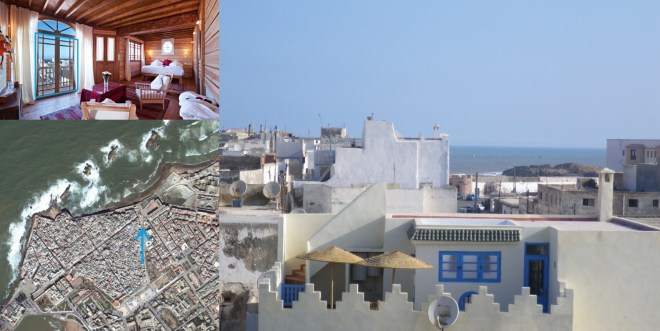
VFYW-Essaouira-Chini

Another star player also nailed it:

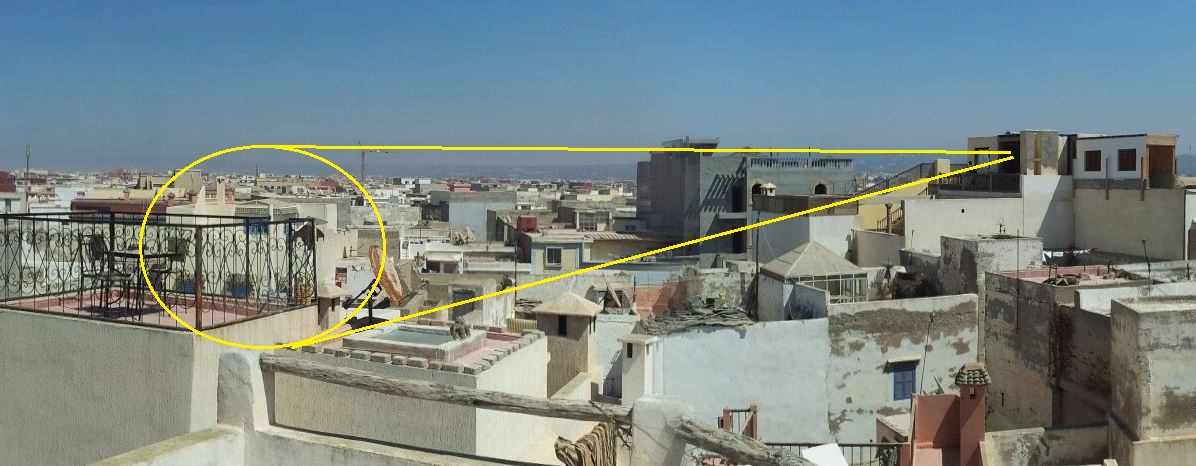
I was pretty confident that it was Morocco as soon as I saw the picture, but were it not for the long building close to the shore, I doubt I would have been able to pinpoint the town. This one is from Essaouira, Morocco, looking NNW toward the ocean. A rooftop panorama shows the unique building in the picture and where I think it was taken, which looks like it was under construction at the time:
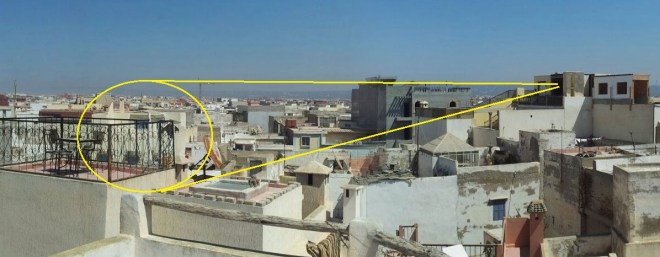
ess_rooftop

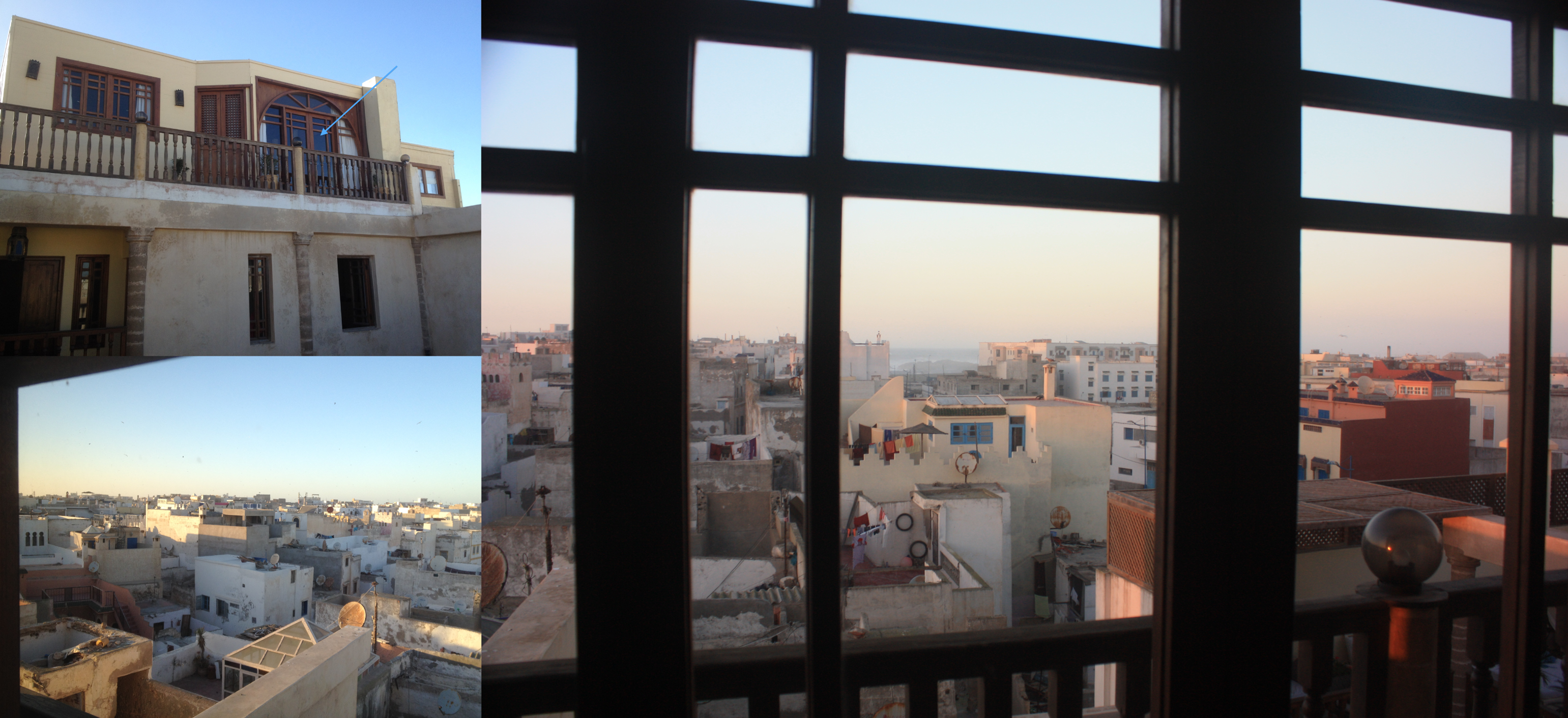
I think it was taken from the Riad Chbanate hotel, from the Chbanate Superior Suite on the 4th floor – the website confirms that this suite was recently opened. The hotel is at 179 Rue Chbanate, 44000 Essaouira, Morocco. In the website’s photos of the suite and some traveler photos you can find the same view.

The tie-breaker goes to the reader who has participated in the most contests by far:

The photograph was taken from the Chbanate Suite at the Riad Chbanate, likely from the doors leading on to the porch. I was given a hint by a previous contest winner as to the city. His guess was off, but I found the rectangular building and worked back from there. Google Maps didn’t show much other than the Cinema Rif, which has a photograph online. And guess what? It’s visible in the window view, curved roof and all. (Finding old cinemas in the States on Google Maps by looking for curved roofs is an old pastime of mine; that site is very informative and shockingly poorly-designed.) Anyway, the nearest hotel to there is the Riad Chbanate (corner of Rue Chbanat and Rue Moulay Ismael), and the view from the Chbanate Suite (or perhaps the rooftop terrace, although it seems to lack windows) shows the same view as the VFYW submission, so going on the “these are usually taken from hotels” corollary, that’s where it is. (Also, this photo. And people seem to speak highly of the hotel on TripAdvisor.) Looks like a nice place to stay!

From the submitter:
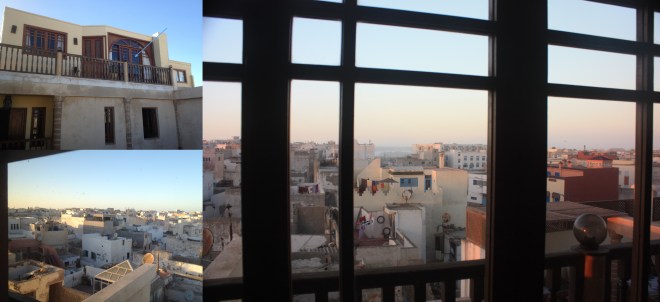
Essaouira-window

Morocco is a tough country for VFYW since most of the traditional buildings have windows looking out into internal courtyards and not into the streets, so there won’t be so many images of the right window. These photos were all taken a week ago from the same window in a room at the top of a small riad hotel in the coastal city of Essaouira. The hotel is called Riad Chbanate, has only 8 suites and is located just inside the fortified walls of the medina. The suite we had was a recent addition built on the roof and so very light with great views over the city skyline. The correct window: Chbanate Suite, 4th floor (5th US) of Riad Chbanate, 179 Rue Chbanate, Essaouira, Morocco.

Essaouira is only a couple of hours west of Marrakech and is a more laid back, welcoming place. Good for seafood, windsurfing and a mild climate.

(Archive)
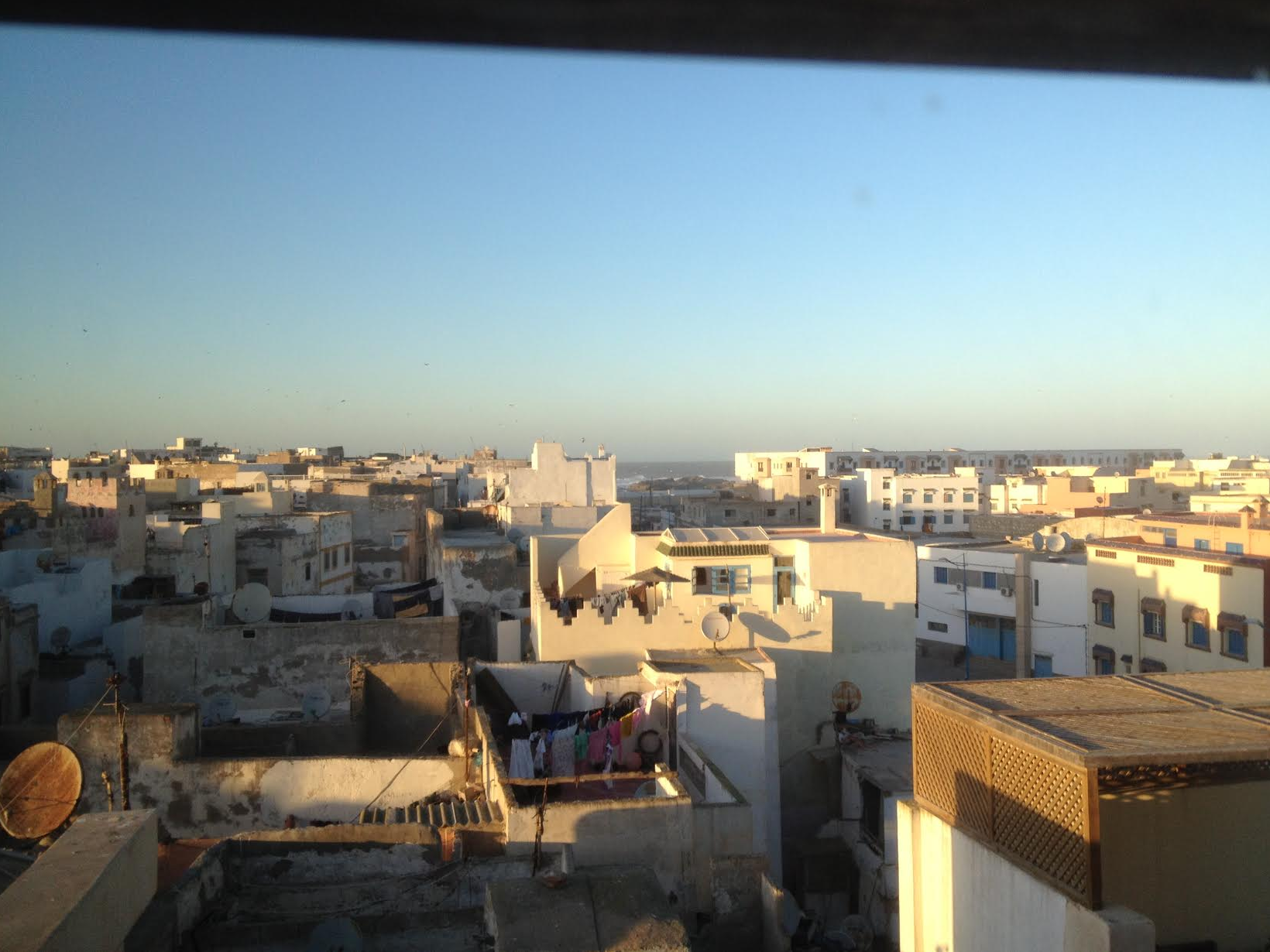
Exit Cheney, Far, Far Right

Former Vice President Dick Cheney is int

The end of Liz Cheney’s misbegotten act of arrogance and entitlement (trying to unseat a well-liked Senator Mike Enzi) may well be the end of her political career. I can’t see how she wins Wyoming back after this opportunist debacle. But it also appears plain that the reason cited is a genuine one – some crisis in her family – and she deserves some privacy and time to deal with it, and support for putting family first.

But can we please, please find a way to limit the role of pure nepotism in American politics? I know it’s as old as the republic, but it’s just one of those weird, strange things in a country of well over 300 million people, with a robust and rowdy political scene, that it picks the sons and daughters or wives of previous pols and just keeps running them, like mini-royals. It’s even worse in Liz Cheney’s case because much of her agenda is designed (like much of her father’s classless public eruptions these past five years) to maintain a legacy for the former vice-president that isn’t just presiding over the worst national security breach since Pearl Harbor, losing two wars at massive expense, and committing blatant war crimes and bragging about them.

I don’t think the voters of Wyoming should have their Congressional representation hijacked to protect one of the worst vice-presidents in history from getting the historical obloquy he so richly deserves. I’m sorry if that sounds cruel. But I’m not proposing to mock-bury Cheney in a tiny box or string him up like a carcass in an abattoir to make his very existence a living hell. That’s his mojo – and his daughter’s.

(Photo: Former Vice President Dick Cheney is interviewed by his daughter Liz during the 2011 Washington Ideas Forum at the Newseum in Washington, DC, October 6, 2011. By Jim Watson/AFP/Getty Images.)