Reality Check

Pew Marijuana

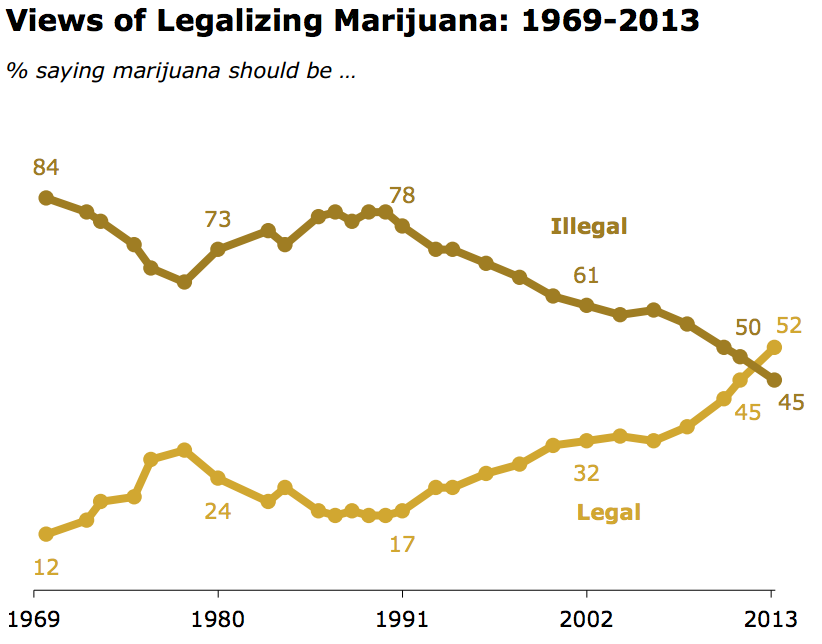
Who says we live in a polity in which empiricism and common sense are always outweighed by ideology and culture war? Here’s CNN’s latest polling on pot, which closely shadows Gallup’s and Pew’s (see above):

Fifty-five percent of those surveyed thought using pot should be legal, according to a CNN/ORC International poll released Monday night, compared with 44 percent who said it should not be. Among those aged 18 to 34, support was 67 percent to 32 percent, and for those 35 to 49 years old, it was 64 percent to 34 percent.

More details:

The biggest change indicated by the poll reflected the number of people who said smoking pot is morally wrong. In 1987, 70% said it was, making it a sin in the minds of more Americans than abortion or pornography. Now, that number has been halved – just 35% today said smoking marijuana is morally wrong.

My own view is that this is because more people have had experience with pot-smoking, have looked at the actual data and science behind it, know the enormous medical possibilities of the plant, and can’t quite muster up the (racially tinged) hysteria that kept it illegal in the first place. Plus: loads of people have at least tried it, and they haven’t become raving lunatics, as some of the more zealous Prohibitionists would have you believe. Allahpundit ponders the massive age gap:

It boils down, I think, to experimentation.

Fifty-two percent overall told CNN that they’d tried marijuana in the past. Even among the 50-64 age group, 56 percent copped to having tried it. Among seniors, just 21 percent did. That’s not surprising but it is revealing. The taboo against weed was much stronger before the 1960s, when seniors came of age. They didn’t try it, they accepted that it was banned for a good reason, and those opinions stuck. For just that reason, I’d be curious to see an even deeper subsample showing the split on this issue between younger and older Republicans specifically. GOP voters remain opposed to weed on balance but I suspect that’s more a function of the party skewing older than some firm ideological principle that Republicans of every age adhere to. In fact, when asked whether smoking weed is morally wrong, Republicans now split at a razor-thin 50/49. Given that seniors tilt heavily towards the “immoral” view, it can only mean that younger Republicans disagree.

If I were advising Republicans professionally (currently I do it out of the goodness of my heart), I’d tell them to embrace marriage equality and the end of marijuana prohibition. There are respectable conservative arguments for both (hey, Buckley was for the latter long before it was cool) – and they’d be the first conservative positions the Millennial generation might actually hear and agree with.

A Sign Of The Times

https://twitter.com/jetpack/status/420135305820131328
We are all perfectly aware of the terrible pressures on the media industry right now. We’ve all but lost the physical thing we used to sell entirely. Advertizers have so many other options. Readers are used to reading for free online (however economically nuts that is for media); and newspapers are in free-fall. Any sane person would expect some radical experiments in getting the whole thing to work again. What I didn’t fully expect was the sheer speed and totality of the editorial surrender to the business side; and the almost rapacious move toward handing over the very fonts and headlines and by-lines to advertizers and p.r. merchants as if there were no real difference between writing to sell something and writing because it’s true and your opinion or product of independent reporting. After all those speeches and papers and conferences and J-School lectures, the media jumped immediately into an area once deemed verboten, and rolled around like Cartman in Kyle’s money.

In a rare exploration of this in mainstream media (which is busy become mainstream p.r.), the Guardian’s Emily Bell takes stock:

This week the New York Times unveils a new website design. Part of it will be a new native advertising push, with posts clearly labelled “paid post” and bearing a blue line of demarcation. In a detailed memo timed perfectly to coincide with the holiday break, its publisher, Arthur Sulzberger Jr, told staff that the new native advertising platform for the organisation would be digital and very clearly marked. It followed an announcement a month earlier by Time Inc., that the magazine publisher would dramatically increase the amount of native advertising it carries. The question that the FTC is concerned with is that of transparency in the mind of the consumer. Is it clear where funding for programmes and articles is coming from?

Separating the church of editorial from the state of advertising is more difficult in digital media; everything is necessarily melded together more closely, and the context or “furniture”, which is hard to miss in a newspaper or during a broadcast, is stripped away as files zip round the web. The anxiety over transparency is understandable, particularly when it comes to vulnerable markets and toxic products, like loan companies, insurance schemes, lobbying and gambling products.

Two question marks hang over native advertising, which will become more significant this year.

For the producers it is the longevity of the trend. At the moment the curve of enthusiasm for the approach, and ignorance about its benefits or impact, are both at a high, which is the point at which companies make money. This is unlikely to last.

For the consumer it is the issue of transparency. It is easy to become very exercised by the potential of native advertising for good and ill. It is arguably a relatively benign part of a much more embedded trend.

Every person and institution can now make their own messages and potentially have as much impact as the largest corporation. The occlusion of motive is becoming more problematic in many areas of communication, but at least in native advertising there is an identifiable commercial transaction. When CBS’s primetime current affairs show 60 Minutes recently ran an exclusive interview with Amazon boss and new newspaper owner Jeff Bezos, it pitched him no hard questions and allowed him to demonstrate his potty scheme for deliveries by drone. This was not advertising, but nor was it really journalism; the access the programme gained reduced its appetite for inquiry and analysis. Advertising is everywhere, as fluid and malleable as the streams it inhabits. And increasingly there will be no lines, blurred, blue or otherwise.

The NYT public editor is already sensing the blurred lines. From her assessment of a NYT advertizer using a manipulated A.O. Scott tweet without his permission:

This is not native advertising. However, on the very week that native advertising is scheduled to begin in The Times, this episode does give one pause about keeping the lines between editorial content and advertising perfectly clear and well-defined.

A reader chimes in:

Perhaps this would be of interest in light of the Dish’s recent interest in “native advertising”: In David Foster Wallace’s famous 1994 essay in Harper’s, “Shipping Out” (later re-titled A Supposedly Fun Thing I’ll Never Do Again in the book of the same name), the author wrote about the pernicious effect of advertising posing as art – not for its threat to journalistic ethics, but for the psychological effect it has on those exposed to it. In the brochure for the luxury cruise on which he is about to embark, Wallace found an experiential essay written by the late author and former director of the Iowa Writer’s Workshop, Frank Conroy:

Conroy’s “essay” appears as an inset, on skinnier pages and with different margins than the rest of the brochure, creating the impression that it has been excerpted from some large and objective thing Conroy wrote.  But it hasn’t been. The truth is that Celebrity Cruises paid Frank Conroy up-front to write it, even though nowhere in or around the essay is there anything acknowledging that it’s a paid endorsement, not even one of the little “So-and-so has been compensated for his services” that flashes at your TV screen’s lower right during celebrity-hosted infomercials.

And below Wallace expounds the real dangers of this “essaymercial”:

In the case of Frank Conroy’s “essay,” Celebrity Cruises is trying to position an ad in such a way that we come to it with the lowered guard and leading chin we reserve for coming to an essay, for something that is art (or that is at least trying to be art). An ad that pretends to be art is—at absolute best—like somebody who smiles at you only because he wants something from you. This is dishonest, but what’s insidious is the cumulative effect that such dishonesty has on us: since it offers a perfect simulacrum of goodwill without goodwill’s real substance, it messes with our heads and eventually starts upping our defenses even in cases of genuine smiles and real art and true goodwill. It makes us feel confused and lonely and impotent and angry and scared. It causes despair.

The Premium On Legal Weed, Ctd

Some Colorado marijuana activists are unhappy about the high taxes and onerous regulations:

Sullum continues to worry about the price of legal pot:

The problem, as I explained last month, is that the short-term supply of legal marijuana is fixed. All that’s available is repurposed medical marijuana, which was grown under a six-plant-per-patient quota. Demand will continue to exceed supply at least until marijuana from the first plants officially grown for the recreational market is harvested this spring. The high prices are exacerbated by new taxes: a 15 percent excise tax, plus a special 10 percent sales tax. Denver, which is where three-quarters of the marijuana stores are located, is imposing its own special sales tax of 3.5 percent. All of that is in addition to standard sales taxes, which in Denver total 8 percent.

Black-market dealers do not collect any of those taxes, of course. Nor are they burdened by Colorado’s regulations or cultivation limits. The upshot is that prices for legal marijuana are, counterintuitively, higher than prices for black-market marijuana—a situation that critics of the hefty taxes imposed by Colorado and Washington have been predicting for months.

Earlier Dish on marijuana prices here, here, and here.

No Flying Cars Yet, Ctd

Isaac Asimov’s predictions from 50 years ago have gone viral. Brian Merchant pushes back on them:

Taken as a whole, Asimov’s vision for 2014 is wildly off. It’s just that ’Genius predicted the future 50 years ago’ makes for a great article hook. Asimov does hit a couple of his predictions pretty close to home: He ballparked the world population (6.5 billion); he anticipated automated cars (“vehicles with ‘robot brains’”); and he seems to have described the current smartphone/tablet craze (“sight-sound” telephones that “can be used not only to see the people you call but also for studying documents and photographs and reading passages from books.”)

But he also thought we’d have a colony on the moon, be living under a global population control regime, eating at multi-flavored algae bars, and letting machines prepare us personalized meals. Most divergent of all, he believed that increasing automatization of labor would spawn not inequality or joblessness, but spiritual malaise.  … Asimov imagined that humanity would decide to distribute the wealth accrued by the automatons, and the problem wouldn’t be lost capital for workers, but lost meaning. Of course, in reality, it’s both—and therefore a much, much bleaker scenario.

Jerry Coyne points to the Internet as something Asimov didn’t see coming either:

[T]he world is becoming plugged in in a way Asimov simply couldn’t predict. When you walk down the street in an industrialized country, or ride in a plane or train, notice how many people are using their cellphones, iPads, iPods, or computers. Google Glass, the wearable computer, is next. This is the way the whole world will go. (My theory is that eventually the entire Earth will resemble New York City.) Connectivity has brought tremendous advantages: think of the ability to access information at your desk instead of a making a laborious trip to the library. And electronic journals and instant publication have markedly sped up the progress of science. Well, perhaps we won’t be as bored, but we may lose the skills of interpersonal communication.

Asimov made many other predictions. In general I think he did pretty well—certainly better than I would have—but it’s remarkable how many other people got stuff wrong, usually predicting a more technologically advanced or ideologically repressive society than we have now. Remember Nineteen Eighty Four (written in 1949), or The Jetsons cartoon series, which supposedly took place in 2062?

A Winter Wonder

dish_snowflake

Photographer Alexey Kljatov captures the delicate intricacies of snowflakes:

Kljatov has outlined his technique on his personal blog, where he explains the technical issues he faces as he shoots on the balcony of his home. ”Not every snowfall brings good-looking crystals, and many shots will be discarded later because of bad focusing or uninteresting subjects,” he told Hyperallergic. “When I started to shoot snowflakes five years ago, I couldn’t imagine how different and unusual they looked. With the naked eye we usually see only big crystals, 5 mm and bigger, and most of them just one type, stellar dendrites. But [the] most unusual and interesting crystals [are the] medium and small ones, 1–4 mm, and even smaller,” he said.

(Photo by Kljatov, whose Flickr album is here)

Better Wages Can Trickle Up

Adam Davidson argues (NYT) that better paid, better treated employees reap more benefits for their employers:

The success of Costco, Trader Joe’s, QuikTrip and Mercadona, Spain’s biggest supermarket chain, indicate, [business professor Zeynep Ton] argues, that well-paid, knowledgeable workers are not an indulgence often found in luxury boutiques with their high markups. At each of the aforementioned companies, workers are paid more than at their competitors; they are also amply staffed per shift. More employees can ask customers questions about what they want to see more of and what they don’t like, and then they are empowered to change displays or order different stock to appeal to local tastes. (In big chains, these sorts of decisions are typically made in headquarters with little or no line-staff input.) Costco pays its workers about $21 an hour; Walmart is just about $13. Yet Costco’s stock performance has thoroughly walloped Walmart’s for a decade.

Along the same lines, Daniel Gross explains why Henry Ford doubled his employees wages in 1914:

Ford was playing a deeper, longer game. The Ford Motor Company was in the business of building an expensive durable good. The first cars he had built in number, the 1903 Model N, cost about $3,000, and so were accessible only to that era’s one percent. Henry Ford recognized that the automobile would be more successful as a volume business than as a niche product. “I would build a motorcar for the great multitudes,” he proclaimed. Through relentless innovation, vertical integration, and the obsessive development of an assembly line, Ford had already managed to bring the cost of the Model T, the first democratic car, down to about $500. And the company was moving about 250,000 cars a year. But per capita income was only $354 in 1913. The U.S. didn’t have a developed consumer credit industry. People paid for things with the wages they earned and their savings.

So this was Ford’s theory: Companies had an interest in ensuring that their employees could afford the products they produced. Put another way, employers had a role to play in boosting consumption. While paying higher wages than you absolutely needed to might lower profits temporarily, it would lead to a more sustainable business and economy over time. If the motorcar was going to be a mass-produced product for typical Americans, not a plaything for the rich, Ford would strive to pay his workers enough so they could afford the products they worked on all day.

Previous Dish coverage of Walmart’s labor practices here, here, and here.

The Psychos Of Cinema

Vaughan Bell quotes from a recent study that identified the “most accurately depicted psychopaths” in Hollywood films:

Among the most interesting recent and most realistic idiopathic psychopathic characters is Anton Chigurh in the 2007 Coen brothers’ film, No Country for Old Men.

Anton Chigurh is a well-designed prototypical idiopathic / primary psychopath. We lack information concerning his childhood, but there are sufficient arguments and detailed information about his behavior in the film to obtain a diagnosis of active, primary, idiopathic psychopathy, incapacity for love, absence of shame or remorse, lack of psychological insight, inability to learn from past experience, cold-blooded attitude, ruthlessness, total determination, and lack of empathy. …

In terms of a ‘successful psychopath’, Gordon Gekko from Wall Street (1987) is probably one of the most interesting, manipulative, psychopathic fictional characters to date. Manipulative psychopathic characters are increasingly appearing in films and series. … For the past few years, with the world economic crises and some high-profile trials (such as the Bernard Madoff trial), the attention of the clinicians is more focused on ‘successful psychopaths’, also called corporate psychopaths…. Films and series presenting characters such as brokers, dishonest traders, vicious lawyers, and those engaged in corporate espionage are emerging (e.g., Mad Men, The Wire) and are generally related to the global economy and international business. Again, we see a strong parallelism between what happens in our society and what happens in film.

Dead, But Still Breathing

The sad case of 13-year-old Jahi McMath, who suffered brain death after complications from a botched tonsillectomy, has renewed the debate over brain death and whether her family has the right to keep her on feeding tubes and ventilators when there is no hope of recovery. Michael Byrne discusses how resistant people are to the idea that a brain-dead person is really, truly dead:

[D]eath is not obvious, or necessarily obvious. In fact, you can very neatly be dead and alive at the same time, in a sense. If, for example, if all of your brain dies except some of the autonomous stuff in the brain stem, you can go on breathing and “living” while having forever forfeited the ability to have a thought, let alone interface with the world. This is post-death. Faux-life. People confuse post-death with life because not only do you still have the body there in front of you, but it does stuff. The body reacts to its environment just the same. This doesn’t mean, however, the brain is enlisted in the activity because the body does plenty of things reflexively without ever bothering with the brain, like shrink from pain or heat. So post-death can sometimes even do a pretty decent impression of life, though you really need to be properly alive to feed yourself or, indeed, have thoughts.

The truly frightening thing in the case of Jahi McMath is that it’s not thoughts that seem to matter to the family. “I believe in God, and I believe that if he wanted her dead, he would have taken her already,” Nailah Winkfield, the girl’s mother, told the New York Times. “Her heart is beating, her blood is flowing. She moves when I go near her and talk to her. That’s not a dead person.” It’s a lower standard for life than it might first seem.

Surgeon Soumitra Eachempati explains how attitudes like Winkfield’s result in a shortage of transplantable organs:

The best chance for a successful organ transplant comes from either a living donor or from organs belonging to an individual declared deceased by brain death. Living donors can only surrender a kidney—and in relatively few cases—a portion of their liver. The patient declared cardiac dead has organs that are sub-optimal due to loss of blood flow to the organs. Most of the successful transplanted organs in the world are from patients declared brain dead.

Organs from brain death represent the overwhelming resource for the livers, hearts, lungs, and pancreases transplanted in the world to victims of such diseases as congestive heart failure, pulmonary hypertension, cystic fibrosis, and diabetes. The major limiting factor precluding donation of these potentially harvestable life-saving organs is refusal of organ donation by families of patients declared to be deceased by brain death criteria. Importantly, organ donation rates vary by country, race, and ethnicity.

Different studies have tried to ascertain why families would refuse the donation of organs even though the demise of their loved one is both imminent and irreversible.  Some families may not consider organ donations for religious reasons while others may have misperceptions as to how the body of their loved ones will be handled. Others still simply lack consensus among family members to make a decision in a timely manner. The most common factor, as is the case with the McMath family, is refusal to accept the criterion of brain death as finality for their loved one. In the case of Jahi McMath, the late child’s heart is reportedly spontaneously beating as her organs are being kept alive by a ventilator and other circulatory support.  Her mother has said she hopes for a “miracle” and that she is not convinced her child is dead because the heart is beating.  Her words and actions clearly indicate that she recognizes cardiac death as finality but not brain death despite the fact that both are clinically and legally recognized as such.

The Fittest Americans

dish_fitnessmap

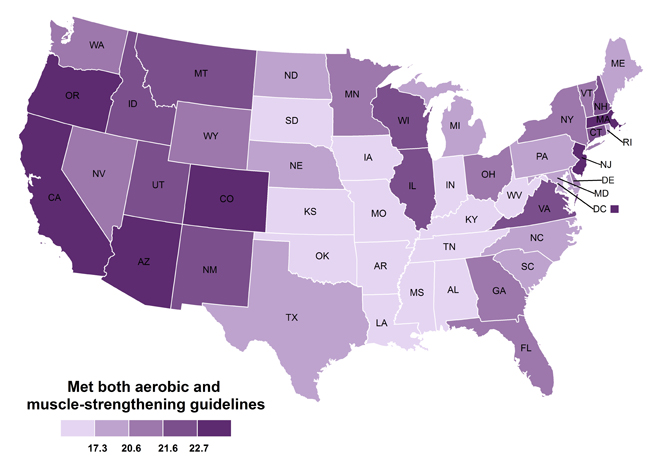
Researchers mapped exercise patterns by state:

You might think people would exercise more in warmer, sunnier states. But that’s not the case. [Martin Prosperity Institute analyst Charlotta Mellander] found a negative correlation (-.38) between yearly average temperature and exercise across the 50 states. Exercise levels also correspond to wealth and affluence, with substantial positive correlations to both income (.65) and wages (.64). States where people exercise more are also more highly educated, with a significant correlation (.68) to the share of adults who are college graduates. And exercise levels are higher in states with more post-industrial economies, as participation was highly positively correlated with the share of knowledge, professional and creative workers (.51) and negatively correlated with the share of blue-collar workers (-.65).

Fitness participation also tracks the nation’s red/blue divide, being positively associated with the share of Obama voters (.51) and negatively associated with Romney voters (-.53). Exercise also hews closely to America’s religious divide. People in more religious states exercise less (the correlation between religiosity and exercise is -.69).

Divorcing Your Family, Ctd

Many readers discuss the wrenching decision to cut off a family member for good:

My mother is a borderline personality. She sees people as either wholly evil or wholly saintly, and her views can switch like lightning. Her rage is terrifying, unpredictable, and targeted, à la Mommie Dearest. After yet another very difficult Thanksgiving, I decided I was going to “divorce” her, since all the years and all the other techniques I had tried hadn’t eliminated the abuse.

The only complication has been her relationship with my siblings; she is the only topic my sisters and I cannot speak frankly about. They not only tolerate but refuse to acknowledge behavior that they would label domestic abuse if our significant others did it. Our mother married a manic-depressive man who also refuses to acknowledge his own disorder and take prescribed treatment. At what point does one decide that the mentally ill do not deserve the position of power they’ve taken for themselves?

Another reader:

Just today I had a conversation with a coworker about this very same issue. We both have sisters who are (or have been) in desperate need of help. In my case, one of my sisters developed some mental health issues that prevented her from being able to maintain a job.

She was never out of control or completely dysfunctional; she just found it impossible to keep a job. As a result, she struggled financially for years. Our parents helped her out for some time, largely because my mother needed to know that her grandchild – my sister’s daughter – always had a roof over her head. When that grandchild turned 18 and moved out, our mother no longer needed to help. We made one last-ditch effort to reach out to my sister as a family and she bit our mother’s head off, blaming all of her troubles on our her.

After our last effort failed, my sister moved out-of-state. The family has had almost nothing to do with her since. I think every once in a while about reaching out to her, to make sure she’s okay, but then I think of what the last 30 years have been like – again, nothing that’s really, really bad, but just bad enough – and I don’t reach out. Why should I open up myself and maybe the rest of the family to all of that again?

Another:

I won’t get too detailed because I doubt you want to read a ridiculously long email, but in short, she forged a document or two, manipulated the family court system – with which she was very familiar, having worked as a sort of social worker in the county courts – and wove a web of lies in an effort to gain primary custody of my 10-year-old sister and to extract maximum financial pain from my disabled father. This was an extremely difficult time, as I was 17, applying for college (as the first in the family to go), and not mature enough to deal with the almost sociopathic way that my own mother just invented memories – both recent and not-so-recent – out of thin air to justify her actions.

Bottom line: you just can’t get over some stuff people do. Especially when they not only do really bad things but never admit to having done anything wrong – and then insist that you are the bad person for not agreeing. In the end, I couldn’t have that sort of poison in my life, so I had to make a choice if I was to ever have healthy relationships and a healthy psyche.

Another:

I was adopted as an infant. The emphasis on blood kin is perplexing to me even now that I have a biological child, because for most of my life family has been other than biological in nature. Perhaps the blood fixation is simply a human prejudice.

That said: Who cares? If someone is dangerous, indifferent or simply too big of a pain in the ass to engage with regularly, why does it make a difference if they are family? You wouldn’t, I would hope, put up with such nonsense from people who weren’t related to you, right?