An Eye On Crime

A new study shows that the “pupil of the eye in a photograph of a face can be mined for hidden information, such as reflected faces of the photographer and bystanders.” What this could mean for law enforcement:

The researchers say that in crimes in which the victims are photographed, such as hostage taking or child sex abuse, reflections in the eyes of the photographic subject could help to identify perpetrators. Images of people retrieved from cameras seized as evidence during criminal investigations could be used to piece together networks of associates or to link individuals to particular locations. By zooming in on high-resolution passport-style photographs, Jenkins and co-researcher Christie Kerr of the School of Psychology, University of Glasgow were able to recover bystander images that could be identified accurately by observers, despite their low resolution.

Megan Garber explains how it’s done:

First, you have to zoom in (really, really zoom in) on images of eyes—since, as Jenkins notes, “a face image that is recovered from a reflection in the subject’s eye is about 30,000 times smaller than the subject’s face.” Then you have to enhance those zoom-ins to isolate the faces—the “bystander images“—that the human subjects’ pupils contain. But even if you do that, the question remains: Are the pupil-mirrored images, given their small size and curvature, even discernible as faces? If the reflection in the eyes is someone other than yourself, can you make out who it is?

To test that, the researchers presented a series of pixellated faces—an average of only 322 pixels each—as part of a face-matching task they administered to subjects. The subjects who were unfamiliar with the bystanders’ faces were able to match the pixellated faces to the standard images of them with 71 percent accuracy; when they were familiar with the faces (if the pixellated face belonged to, say, Barack Obama), they performed with 84 percent accuracy.

(Hat tip: Kottke)

Losing The Afghanistan PR Battle

New research suggests that the Taliban’s brutality alone isn’t enough to turn the public against them:

Counterinsurgency theorists (well, most of them) have argued that winning “hearts and minds” is a key, if not the key, to victory — or at least what passes for victory in these settings. Now, new research shows that just how hard winning hearts and minds can be.  Afghans who experience violence at the hands of NATO forces become less supportive of these forces and more supportive of the Taliban.  But Afghans who experience violence at the hands of the Taliban don’t react nearly as strongly against the Taliban. …

These findings carry several implications for understanding the dynamics of violence in Afghanistan today. Hoping that Afghans will turn away from the Taliban in disgust at civilian casualties, for example, is unlikely to be a viable strategy, at least among Taliban supporters. According to UNAMA’s data, the Taliban have been responsible for at least 80 percent of civilian casualties since 2008. Yet this victimization is unlikely to have the same meaning, or political impact, as (much rarer) ISAF civilian casualties. Concluding that efforts to influence attitudes are hopeless would be equally mistaken, however. We found suggestive evidence, for example, that small, targeted assistance programs among those harmed by ISAF managed to reverse much, though not all, of the outflow of support to the Taliban. On the other hand, massive district-level aid programs that sought to stoke feelings of gratitude among recipients hardly budged individuals’ views of ISAF, especially among those victimized by its forces.

The Best Of The Dish Today

780px-Magi_(1)

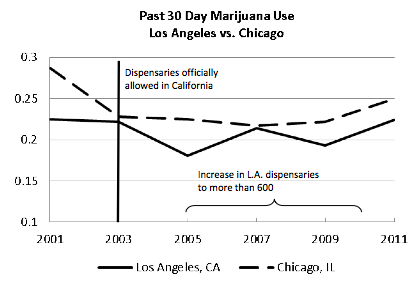
Since the marijuana debate is now in full force, I thought I’d add some more data to the mix. I think it’s pretty damn obvious that making marijuana legal, as in Colorado, will increase usage. Making marijuana more widely available, as with medical marijuana, especially in the wild and crazy regulatory scheme of California, would also do the same. That’s my general sense. And we’ll get some decent data soon enough. But there is data comparing California’s drug use after its medical marijuana took off with other states with no such provisions – and the results are rather mixed:

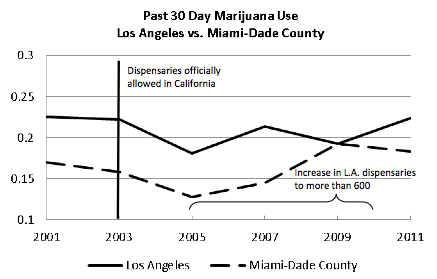
Screen Shot 2014-01-06 at 7.19.23 PMNot much to worry about there. Here’s a comparison with Miami:

Screen Shot 2014-01-06 at 7.20.41 PMMiami caught up in 2009, but then faded. Los Angeles, more to the point, barely has any more marijuana use in 2011 than in 2001. This is from the Mark Anderson study I referred to earlier today.

I guess my point is that this may be more of a non-event than we anticipate – again, a bit like marriage equality. And also like marriage equality, federalism is our friend here. I wonder too how big a disincentive for kids to smoke pot will be the sight of their parents going to their favorite store and picking out their preferred strains of CBD/THC and the like. There’s nothing like parental approval to kill off the thrill of the illicit. Maybe, finally, pot will become uncool.

In other matters today, we asked why dogs walk around in circles before they take a dump; why the Freedom Tower has such a disappointing spire; whether the GOP will come to support extending unemployment benefits; and how conservatism can jettison excessive ideology and return to pragmatism.

The most popular post was the Dish’s Correction Of The Decade; next up was a take-down of TED talks. And don’t forget the revolt of the Catholic school kids.

See you later tonight on AC360 Later and in the morning.

(Mosaic: Basilica of Sant’Apollinare Nuovo in Ravenna, Italy: The Three Wise Men” (named Balthasar, Melchior, and Gaspar). Detail from: “Mary and Child, surrounded by angels”, mosaic of a Ravennate italian-byzantine workshop, completed within 526 AD by the so-called “Master of Sant’Apollinare”, and photographed by Nina Aldin Thune.)

The Racial Injustice Of The Drug War

Marijuana Arrests

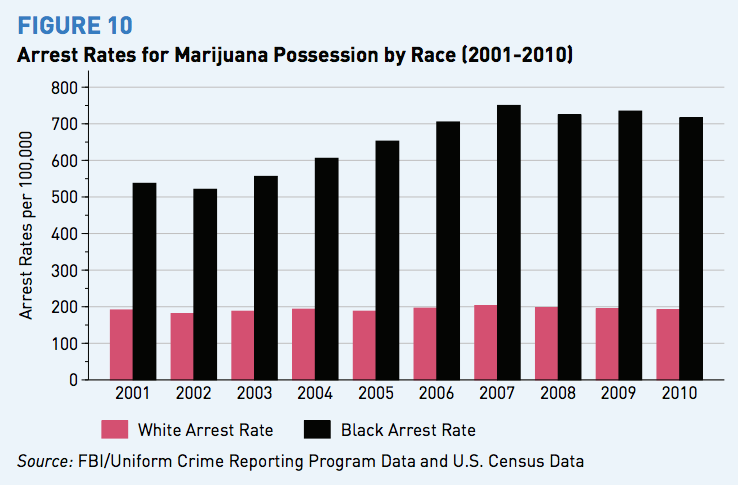
Serwer passes along the above chart on marijuana arrests:

Although marijuana use among blacks and whites is about the same, according to a 2013 report by the ACLU, blacks are almost four times more likely than whites to be arrested for marijuana possession. This startling graph from the report tells the story … As Michelle Alexander notes in her book, The New Jim Crow, the consequences of being convicted of felony marijuana possession can be far more dire than the sentence itself. Former offenders can find themselves deprived of professional or driver’s licenses, educational aid, food stamps, public housing, their right to vote, and they may find themselves fired and unable to find new employment, having been marked by society as little more than a criminal. For blacks caught up in the system it can compound the already considerable effects of ongoing racial discrimination.

Goldblog, in a hilarious and humane column, gets this core issue:

The disparity in arrest rates between white and black pot-users is the most interesting aspect of this debate.

Federal statistics show that in 2010, blacks were almost four times as likely as whites to be arrested on possession charges. For most whites, pot was long ago de facto decriminalized. This double standard is one of the most obvious reasons I know for moving toward comprehensive decriminalization. One might argue that the double standard could be dealt with by enforcing possession laws more stringently in white communities. But good luck with that. In reality, here on Earth, that isn’t going to happen, mainly because whites in power would never allow their children to be exposed to the criminal justice system in that way.

Conor reframes the debate:

There are times when locking human beings in cages is morally defensible. If, for example, a person commits murder, rape, or assault, transgressing against the rights of others, forcibly removing him from society is the most just course of action. In contrast, it is immoral to lock people in cages for possessing or ingesting a plant that is smoked by millions every year with no significant harm done, especially when the vast majority of any harm actually done is born by the smoker.

That there are racial disparities in who is sent to prison on marijuana charges is an added injustice that deserves attention. But if blacks and whites were sent to prison on marijuana charges in equal proportion, jail for marijuana would still be immoral.

I couldn’t agree more. So far, now that the debate has finally crept away from the blogosphere and into the boomer pundit organs, the debate has not been exactly even, has it? The Prohibitionists have got close to nothing in their defense.

The Beat Of A Different Drummer

Killian Young captions the inspiring short film Drummer Wanted:

Rick Abbott, bandmate of drummer Dean Zimmer, says their band has opened for Thin Lizzy, Foghat and Styx. But Zimmer is no ordinary drummer. Zimmer has arthrogryposis, a rare congenital disorder that makes it difficult to move his joints, according to the Los Angeles Times. Despite being restricted to a wheelchair, Zimmer pursued his dream to be a drummer. In fact, due to his limited range of motion, his drumming style maximizes efficiency.

Marijuana Moderation

Sullum points out that Brooks “cannot possibly justify the arbitrary distinctions drawn by our drug laws, even if you share his paternalistic premise”:

As I point out in my book Saying Yes, the same could be said of any enjoyable activity that can be carried to excess. Drinking is the most obvious example, but any pleasure can be the focus of an addiction that crowds out more meaningful aspects of life. That is not an argument for abstinence, let alone abstinence enforced by law. It is an argument for temperance, in the original sense of the term.

After announcing his own pot use, Joe Klein makes related arguments:

I am not proselytizing for weed here, although it does seem to have strongly salutory effects for people suffering from a variety of maladies, from glaucoma to post-traumatic stress. I am proselytizing for moderation in all things.  Our societal reaction to marijuana use has not been moderate. It has been extreme, ridiculous and costly. We should be spending our time and money on other, more pressing issues. It is good to know that sanity seems a rising tide.

There are three ways to deal with cannabinoid-induced pleasure: prohibition, excess, and moderation. The proper conservative response to a substance already widely used, barely harmful but dangerous for kids is to regulate it away from minors, and encourage moderation. It’s really not that hard once you get rid of the fear.

Does The Cold Give You A Cold?

The answer is more complicated than you think:

Meanwhile, as temperatures continue to plummet nationwide, Andrea Anderson reviews research on the correlation between cold weather and violence:

[M]ost real-world studies suggest assaults—and many other crimes—wane in winter months and during cold snaps when temperatures dip below what is considered comfortable in a given climate. There are exceptions, including crime spikes in December and January, although researchers tend to attribute those to confounding circumstances such as the holiday season rather than the cold and more hours of darkness.

Such real-life patterns point to cold’s potential for curbing crime and reflect some of the difficulties associated with trying to study crime triggers in a controlled setting. Unlike the lab, for instance, where scientists get final say over the temperature, people at large in the world are typically at liberty to add a layer or two. Experts also note that it is generally easier to get back to a comfortable body temperature when it gets nippy than when it is excessively hot.

Previous Dish on the effects of cold weather here, and on the connection between weather and crime here.

Obamacare’s Silent Success

Medicaid expansion:

If expanding Medicaid is so much easier, why was the administration so intent on focusing on the exchanges — and, for that matter, why were exchanges needed in the first place?

To Drew Altman, president of the Kaiser Family Foundation, this exposes a core reality of U.S. health-care politics. “Republicans don’t like entitlement programs, and Democrats want to portray the ACA as mostly a marketplace solution based on private insurance and not another expansion of a government program,” he says, “so neither side wants to emphasize the ACA’s success enrolling people in Medicaid even though it may be the law’s biggest achievement so far in terms of expanding coverage.”

This has left both the Obama administration and Republicans in a tight spot.

The White House can’t really tout the Medicaid expansion because it’ll revive fears on the right that Obamacare is really a stealthy effort to create a single-payer health-care system, and it’ll arouse criticism on the left that the administration should have expanded Medicaid to all. As for Republicans, they can’t admit the Medicaid expansion is going well because doing so is dangerously close to advocating a single-payer health-care system. The exchanges, marred by their troubled introduction, are also a problem as they are a Republican idea, enshrined in Representative Paul Ryan’s health-care bill.

Scheiber believes that the Medicaid expansion could pave the path to single-payer:

[T]here will likely be millions of white working-class voters on Medicaid in the coming years. (Even in some conservative states, like Arkansas, Kentucky, and West Virginia.) Once that happens, something tells me Republicans will become more charitably-disposed to the program.

Then there’s the likelihood that, one day soon, especially if Medicaid becomes more generous, the working-class person who makes 175% of the poverty level will look at his working-class neighbor making 130% of the poverty level and think, wow, his health insurance seems a lot better than my private Obamacare plan. How long can it be before most people earning 175% or 200% of the poverty level are allowed to buy in, too?

Suderman disagrees:

Scheiber’s theory … overlooks how tough passage of Obamacare was in the first place—and how much support the administration had to get from health industry stakeholders in order to eke out a legislative victory. Single payer would be even tougher. Moderate Democrats who were nervous about Obamacare the first time around would be even less likely to support single payer, especially given how the law cost Democrats at the voting booth. And there’s no way that doctors, insurers, hospitals, and other major health industry groups would play nice with a single-payer push. Quite the opposite: Even beyond the insurers, much of the industry would see single-payer as a de facto nationalization of the health system, and they would fight the transition with everything they could muster.

Drum’s view:

I think Medicaid expansion is great, but unlike a lot of lefties, I also think it’s a dead end. It’s not going to lead to single-payer, and it’s never going to be a template for future health care reforms. The marketplaces, despite all their problems, have far more potential to eventually lead to health care coverage for all. I think they also have more potential to produce delivery reforms down the road and to rein in cost growth. For that reason, I’m OK with the Medicaid expansion staying under the radar. That’s a fine place for it.

The UI Battle

David Freddoso opposes extending unemployment insurance (UI), claiming that North Carolina proves it doesn’t help:

In July, North Carolina became the first state to end extended unemployment benefits altogether. As John Hood notes in the Carolina Journal, the number of employed in the state jumped by 39,000 between July 1 and Nov. 30, after standing still for the entire first half of the year. The state’s unemployment rate had taken more than two years to come down by 1.5 points to where it was in June (8.8 percent). Between July 1 and Nov. 30, it declined by roughly that amount (to 7.4 percent). During that same period, about 26 percent fewer workers were dropping out of the workforce each month than had been previously.

That’s at least enough to conclude that the world didn’t end. It may even suggest an upside to returning benefits to their normal duration. In a market with few good jobs available and long-term unemployment benefits, it was rational for earnest job-seekers to hold out for something better than what was there. But when the issue is forced, some job is better than no job at all. The supposed “new normal” is a permanently less dynamic economy. In that context, extended benefits are just adding months before people have to accept the disappointing, lower-paying jobs that eventually await them anyway. Nobody wants it to be that way — it just is.

Pethokoukis looks at the national numbers and argues for more relief efforts, not fewer:

The Long Emergency that is the US labor market continues, meriting both an extension on emergency benefits and UI reform that would be pro-work such as (a) giving unemployed workers a modest cash bonus when they secure employment; (b) paying jobless benefits monthly so workers who get a job at the beginning of a pay period could take in both unemployment compensation and a paycheck for that month; (c) temporarily reducing or eliminating the capital-gains tax on new business investment; (d) relocation subsidies to the long-term unemployed to finance a good chunk of the costs of moving to a different part of the country with a better labor market; and (e) significantly lowering the minimum wage for the long-term unemployed for at least the first six months after the date they begin work at their new job, and coupling that lower minimum with an expanded Earned Income Tax Credit or with wage subsidies exclusively available to the long-term unemployed.

Ryan Cooper contends that even the best conservative ideas on unemployment aren’t dealing with the real problem:

The basic analytical error here is ignoring the idea of aggregate demand. “Reforms” on labor supply might help some individual people get a job somewhat faster, but they won’t increase the total number of jobs.

If the problem is unemployed people who won’t get off their hind ends to hustle for work (“structural” unemployment), then you would expect to see persistent vacancies and rising wages in some industries due to a skills mismatch between job openings and the unemployed. This is what you find in countries like South Africa which really do have massive structural unemployment. But in the US, we don’t see anything like this.

Employment is down across the board (with a few tiny exceptions, like North Dakota) and job seekers outnumber job openings 3-1. There just aren’t enough jobs. This realization: that otherwise well-qualified people who are trying their level best to find work and can’t do it, leads you inexorably to a basically Keynesian view of depressions. The problem is not enough spending, and the solution is more spending. Private, public, doesn’t matter, “You just fling resources in the general vicinity of the problem.” The vast majority of conservatives, needless to say, refuse to believe this, and their supply-side tinkering is just not even close to big enough to make a dent in unemployment even if all their ideas are right.

Sargent wonders whether Republican Senators from high-unemployment states will vote for a new UI extension bill:

The unemployment rate in Illinois (Senator Mark Kirk’s state) is 8.7 percent; in Tennessee (Bob Corker and Lamar Alexander) it’s 8.1 percent; in Arizona (John McCain and Jeff Flake) it’s 7.9 percent; in Georgia (Saxby Chambliss and Johnny Isakson) it’s 7.7 percent; in Ohio (Rob Portman) it’s 7.4 percent; and in Pennsylvania (Pat Toomey) it’s 7.3 percent. In many of those states, tens of thousands of people have already been cut off, according to stats compiled by Ways and Means Dems. [Rhode Island Senator Jack] Reed said many of who have lost benefits are “desperate,” and said he thought other Senators understood this. “Many of them are middle aged, have worked for a long time, and have found that it’s difficult to find jobs,” Reed said. Fellow Senators, he added, “are sensing back home, through editorials and newspaper stories, that these aren’t people who are enjoying collecting $300 or $400 per week. These are people who worked for decades. The reality is not this hypothetical where everybody will get a job.” But there’s still no indication Republicans will vote accordingly.

George Zornick weighs in:

Alas, many of those very senators are already on the record against an extension. Many of those states are deep, deep red—so even though polls show substantial, bipartisan support for extending the emergency unemployment program, and though many local media outlets are aggressively covering the issue, the senators in question have little to fear. There are certainly enough senators remaining who might deliver the needed ‘yes’ votes—say, someone like Republican Mark Kirk in Illinois, which is a blue state with a high level of long-term unemployment. And maybe that will work. But if it doesn’t, there are larger perils for the Republican party—Democrats are reportedly ready to once again embrace economic populism as a campaign message this year, and if Republicans block a meager benefit extension for those hardest hit by the recession, they play into Democratic hands. That should worry all GOP Senators regardless of where they’re from. Voting against a benefit extension may not hurt Senator Jeff Sessions too badly in Alabama, but it may do real damage to his chances of being in the majority at this time next year.

GOP rhetoric on the issue seems to be evolving:

“I’ve always said that I’m not opposed to unemployment insurance, I am opposed to having it without paying for it,” Sen. Rand Paul (R-Ky.) said Sunday on ABC. Rep. Peter King (R-N.Y.) likewise said Sunday on CBS that he could back an extension if Democrats agreed to vague compromises like easing “burdensome regulations.” And Boehner, too, has said he would be open to an extension with some conditions.

Democrats, meanwhile, are going on the offensive to keep the issue in the spotlight and put pressure on Republicans. Framing the debate as being between one party favoring benefits for the needy, and the other party opposing those same benefits, they think, is a winning campaign argument. Decrying a do-nothing GOP caucus at the same time would only be an added bonus. Then again, Republican calls for compromise could be little more than pre-election posturing. Blocking unemployment benefits out of hand probably won’t sit well with voters. But by blocking those benefits while claiming to back said benefits if paired with compromises, Republicans could deflect some of the blame from themselves, passing it along instead to everyone’s favorite scapegoat: Dysfunctional Washington.