Why Are There Fewer Abortions?

Birth Rate Single Women

This should be cause for major celebration on the pro-life side. Elizabeth Nolan Brown highlights a new CDC report finding that the abortion rate in the US fell steadily from 2002 to 2011, reaching its lowest level since Roe v. Wade was decided in 1973:

Overall, there were 13.9 abortions per 1,000 women in 2011, down 5 percent from 2010. There were 219 abortions performed per 1,000 births, down 4 percent from the previous year. Analysts say the decline has less to do with abortion restrictions passed in various states than with the recession and an overall decline in pregnancies and birthrates.

Pointing to the chart above, Frum advances a theory to explain this decline. The increasing acceptance of single parenthood, he argues, has encouraged more unmarried women who become pregnant to carry their pregnancies to term:

Women who already have one or two children outside marriage may continue to choose abortion as a way to avoid a third or fourth. As the Guttmacher Institute notes, 61 percent of women who have abortions are already mothers. But the urgency of having an abortion to terminate a first pregnancy has clearly faded, as single parenthood has become the norm for non-affluent Americans of all races.

This is the fascinating irony of the pro-life movement. The cause originated as a profoundly socially conservative movement. Yet as it grew, it became less sectarian. Women came to the fore as leaders. It found a new language of concern and compassion, rather than condemnation and control. Most radically and decisively, the movement made its peace with unwed parenthood as the inescapable real-world alternative to abortion.

Max Ehrenfreund agrees with Frum’s analysis, but isn’t sure the pro-lifers had that much to do with it:

That might be giving the conservative movement too much credit. Public attitudes about abortion have held steady in recent years, even as the rate of births to unmarried mothers has continued its steep climb. It looks as though unmarried women are making decisions about pregnancies more or less on their own. Whatever the explanation, Frum’s conclusion seems sensible: the best way to get people to create and stay in families is with policies that make raising a family genuinely easier.

A Less Deadly Form Of HIV?

There’s new evidence of it:

Rapid evolution of HIV, the human immunodeficiency virus, is slowing its ability to cause AIDS, according to a study of more than 2,000 women in Africa. Scientists said the research suggests a less virulent HIV could be one of several factors contributing to a turning of the deadly pandemic, eventually leading to the end of AIDS.

This has long been thought likely (I covered it on the Dish in 2005). Viruses do better the longer their hosts survive. But it’s fascinating to see it proven – and to marvel at the speed of natural selection. Of course, the usual suspects years ago – specifically the New York Times – were warning us that the virus was mutating into something much worse – remember super-AIDS? That merely goes to show that projecting morals onto viruses is a foolish game. Jason Koebler unpacks the study:

“Theory predicts, all other things being equal, that infections causing new epidemics will reduce in virulence over time because pathogens require host survival to transmit,” [Oxford University researcher Philip] Goulder wrote.

None of this is to say that HIV, left untreated, is going to be harmless anytime soon. But it does appear as though the virus is evolving in that direction—and more quickly than would be expected naturally, thanks to antiretroviral therapies. … Already, roughly 1 in 300 infected people are able to keep HIV in check, indefinitely, at undetectable levels, without any therapy at all. These people are called “​long-term nonprogressors.” In a few years, that number could go up to 5 or 10 percent, Goulder said. “Over tens of decades, maybe the majority of people will be able to control it without treatment,” he added.

Clare Wilson also reads through the research:

One reason for the change could be the growing use of HIV drugs, says Goulder. People with the most virulent form of the virus get sick sooner and start drug treatment. This reduces the level of the virus in their blood and sexual fluids almost to zero, so they are unlikely to pass it on. This means that a more aggressive virus is less likely to be transmitted.

“It’s a benefit of therapy that nobody thought of,” says Goulder. “That’s another reason to provide it.”

Which is yet another reason why the most important thing to do with HIV is to get as many people in the vulnerable populations onto PrEP, and as many infected people on serious meds. Jason Millman outlines how far we have to go on that:

[F]or the first time in the past year, the number of HIV patients who started receiving medication was greater than those newly infected with the virus, according to the ONE Campaign. … However, diagnoses attributable to male-to-male sexual contact saw increases for nearly every group, with those 13-24 years old recording the largest increase (133 percent) of any group. Of the 1.2 million Americans who had HIV in 2011, just 40 percent said they were seeing a medical professional for the virus and 37 percent had a prescription, the CDC revealed last week. Just 30 percent of those infected the virus under control.

That’s completely unacceptable. And we gay men need to find a way to reach the most vulnerable among us.

Walking While Black, Ctd

Readers add further nuance to the viral video we posted:

Thank you for updating your post with the sheriff’s comments.  (And since the person in question was originally identified as “light-skinned”, it’s not clear that being black was ever the issue.) Pontiac, Michigan is a city where the County sheriff patrols because there is no longer a local police force. A parent from our kid’s school was shot dead while minding his shop. For awhile, it was normal, driving through Pontiac, to have to sit in one’s car while the car in front of you executed drug deals with people on the street.  It is a place that was at one point, quite literally, lawless.

In that video, a shopkeeper, having been robbed more than once before, called the sheriff when something looked suspicious, and the sheriff came.  Once there, he was calm and respectful, and did his job responsibly.  In Pontiac, that is just absolutely awesome.

Another points to a 2009 incident in which Bob Dylan was similarly stopped by cops and asked for his ID:

Not all neighborhoods like people walking about.

It’s like there’s something wrong with you. Why don’t you have a car? Why are you walking? In the place I grew up – very blue-collar burbs – people simply did not walk. Then I moved to NYC, and since that time I never want to live in a neighborhood where you can’t walk. All people should feel comfortable to walk down the street, hand in pockets or whatever, but the guy in the video was right to note the absurdity of the person who made the call in the first place. At least the guy and the officer were able to discuss it without anything horrible happening.

Another notes a website we’ve featured before:

While I appreciate your sentiment that “more black men need to bring their cell-phones to these police interactions,” you should note that recording police puts the people with the recording devices at risk. There’s a great website called PhotographyIsNotACrime.com that has documented literally hundreds of incidents of police abusing, arresting or assaulting people who have tried to exercise their First Amendment rights to record or photograph the police. If black men started routinely recording interactions with the police, then that would escalate the risk to those black men.  Just to pick three stories from the last few days – here, here, and here. (Those are literally the top three non-Ferguson stories from the “recording the police” category as I type.)

Another pans out:

I think we’re missing a drama that accentuated part of the issue over the last few days. I’m a 60-year-old engineer visiting San Antonio on business. Last week, as you may know, a white guy shot up downtown Austin, targeting the Mexican consulate, the US courthouse and the Austin PD building before being killed by police. Today I was having lunch with a coworker who lives in Austin and had been visiting Philly last week. When I mentioned the shooting to him, he hadn’t heard of it, even though he LIVES in Austin.

In the last few years, over a dozen white, right-wing anti-government terrorists have targeted police officers resulting in the deaths of over 10 cops. Yet this is so invisible even people living in Austin don’t know about it. When I mentioned this to a buddy of mine, a white conservative cop, he waved it away saying criminals killed more cops than white terrorists have.

It’s obvious the blinkers are on, EVEN AMONG COPS. Yes, criminals kill cops, but can you imagine the outcry if a dozen cops had been killed by Muslims? The St Louis Police Officer’s Association demands an apology from football players for raising their hands in sympathy with the Brown family, but where is the outrage against the Republican officeholder who said she’d kill government officials who “tried to take away her rights”? Where is the outrage against the NRA that enables military weapons to be openly sold in the US (and they get around this by saying weapons like the AR15 aren’t “military”.)

Cops ARE being targeted by the right. Cliven Bundy was proof. He was a hero until his racism was too strident even for the right. Yet the cops still ignore the threat posed by right-wing terrorism and, instead, shake down black US citizens who walk with their hands in their pockets in the winter.

The President Backs Body Cams … And Not Much Else

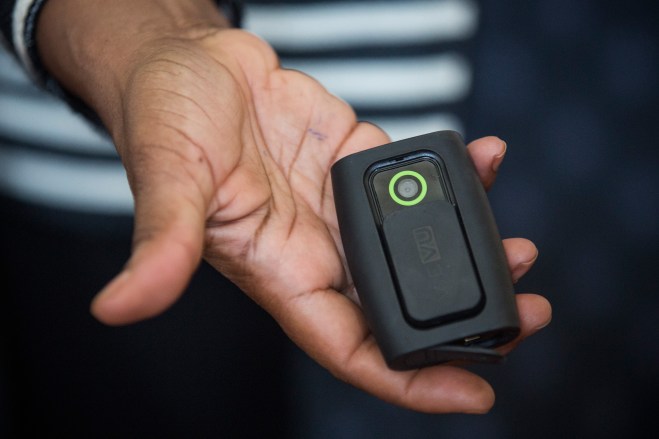
New York City Public Advocate Displays Police Wearable Cameras

Zeke Miller details Obama’s planned executive orders:

President Barack Obama is preparing to issue an executive order to calling for additional oversight of various federal programs which provide military surplus equipment to local law enforcement agencies, senior administration officials said Monday, but will stop short of banning the transfer of heavy gear to police forces. …

Obama will also announce a three-year $263 million package to increase the use of police body-worn cameras and expand local law enforcement training. The program, modeled after a similar program for bullet-proof vests for officers, would provide $75 million over three years for the “Body Worn Camera Partnership Program.” Administration officials said it would provided a 50 percent match for body-camera purchases by state and local agencies, enough for 50,000 new cameras. Officials said they hope to secure about $70 million in funding for the effort as part of a government funding deal that must be reached in the coming two weeks.

George Condon Jr. views the announcement as yet another example of Obama’s “trademark caution”:

He was cautious about the use of surplus military equipment by domestic police forces, promising to make it more transparent so it can be studied. He was cautious on police behavior, promising to work with Congress to pay for more body cameras to be worn by cops on the street. He was cautious about the Justice Department’s role, announcing that the outgoing attorney general will “convene a series of these meetings all across the country.” And he was cautious in falling back on that most familiar of Washington responses—a task force to further study the situation.

Scott Shackford is skeptical that the president is really committed to de-militarizing the police:

The White House promised to study police militarization in the wake of how various law enforcement agencies in Ferguson, Missouri, responded to the peaceful protesters, not just the aggressive or criminal ones. What comes out of the report is a call for better documentation and transparency, and an easily supportable demand that local governments must actually review and authorize acquisition of the “controlled property” military equipment (guns and vehicles) by law enforcement agencies.

What the report doesn’t recommend is scaling back the programs in any notable or significant way. It appears as though the White House is trying to have it both ways on police militarization, calling for reforms without having to tackle the issues surrounding whether it’s actually necessary.

Trevor Timm is more blunt:

Obama said he wants to avoid building a “militarized culture” in police departments, yet his White House report claims all the militarization programs are “valuable” to law enforcement, without going into any detail of where that value has actually been shown. For example, when was the last time a local police officer drove over a fucking mine? Why would neighborhood cops ever need Mine Resistant Ambush Protected Vehicles (MRAPs) that were meant to protect soldiers against IEDs in Iraq? The White House’s four months of “research” into federal funding simply does not venture to explain. Nor does it explain any use for any of the Pentagon’s weaponry now in the hands of our local police.

Emily Badger argues along the same lines:

[B]y calling for local police to receive more training — including on civil rights and civil liberties — when they receive military-style equipment, the review leaves unasked the question Obama’s own earlier comments seemed to raise: Is it even a good idea to give it to them?

Joshua Brustein focuses instead on the body cams fund, which could “almost double the number of cameras in use in the country”:

The White House’s support of cameras isn’t a surprise. In the days after Brown was shot, a petition on WhiteHouse.gov in support of legislation requiring all state, county, and local police to wear cameras gathered nearly 155,000 signatures. Roy Austin of Obama’s Domestic Policy Council posted an official response that described years of work by the administration to advance the use of body-worn and dashboard cameras. Police departments have long been coming around on cameras, but progress is slow. Adopting police cameras requires thousands of independent agencies coming to terms with thorny privacy and accountability issues.

Jim Bueermann, president of the Police Foundation, says that the biggest barrier is cost. The White House will match the spending of local and state agencies who decide to buy cameras, mirroring a similar federal program that has led to the purchase of over 1.1 million vests for law enforcement agencies. The money won’t come without strings attached: Bueermann expects a requirement that every officer in participating departments wear a camera at all times while in the field.

Rich Lowry recommends a different reform:

The most needful reform in Ferguson and surrounding communities, per the excellent reporting of Radley Balko of the Washington Post, is the end of the obnoxious and parasitic practice of squeezing revenue out of residents with fines from traffic and other petty offenses. This creates an incentive for police to hassle motorists and is especially burdensome to poor residents. Because this issue is exceedingly local and dull, almost no one talks about it.

(Photo: New York City Public Advocate Letitia James displays a video camera that police officers could wear on patrol during a press conference on August 21, 2014 in New York City.  By Andrew Burton/Getty Images)

Obsessed With Being Obsessed

Willa Paskin wonders why it’s not enough simply to like something anymore:

[A]dults used to obsess about things in a more steadfast manner, by having long-term interests known as hobbies. (Whatever happened to those?) Or they obsessed with downright stately occasionalness, when something out there really gripped the nation. Now we are engaged in a near-constant cycle of being “totally obsessed” with a cultural object (“obsessed” is the term of art on social media) and perpetually on the lookout for that next binge-experience. Why are we getting hysterically excited about very good but not hugely original cultural products seemingly every other month? Why have we turned into compulsive obsession-seekers?

As with nearly every aspect of contemporary life, the Internet has a lot to do with it. The Internet’s default mode is obsession. Nothing worth thinking or talking or writing about—nothing not worth thinking or talking or writing about, for that matter – gets thought or talked or written about in moderation. At the start, products like Serial or True Detective feel as though they are made inescapable not by their obvious and overwhelming clickiness – like, say, pictures of Kim Kardashian’s derriere – but by the force of good taste. There are things on the Internet that happen to us, but these are things that, initially, feel as though we made “happen.” And yet, at a certain point, the frenzy surrounding these beloved objects achieves the same level of inescapability as those naked pictures. Someone out there surely feels as annoyed by all the Serial coverage as someone else feels about Kim Kardashian’s tush. They have both become the latest obsession of “the Internet,” and you can either get on board yourself or get put on board, eyes rolling.

Platonic Procreation, Ctd

A reader remarks on a recent post:

Long before Michael Woodley theorized it, the link between asexuality and genius was covered on Seinfeld, when George Costanza’s girlfriend had mononucleosis and couldn’t have sex with him for six weeks. The result, as you may recall, was that George dedicated all of that time and energy once used to think about women and sex to thinking about other things and became … a genius!

Another goes on a bit of a rant:

I’m going to call BS on the evolutionary psychology idea that asexuals devote more of their brain away from sex. That is an incredibly self-serving idea; it simultaneously flatters the person who says they are too smart for sex and absolves them from having to engage with the cognitive complexities (and potential failures) of an intimate relationship or coupling.

I am certain there are asexuals, but I don’t think they are asexual because their brains are eugenically superior by dent of conscious intervention on the part of the asexual in question.  There are definitely a few geniuses who are asexual, but the idea that most geniuses are asexual is absurd. There are probably an equal number of dumb asexuals and smart asexuals.  Humans simply do not have that granular level of control over their own hormones – and if you think you do, that’s just a sad cognitive illusion and you are deluding yourself.

Geniuses are just the extreme end example of this.  Their brain is so great and everyone else’s brains are so puny their ineptness in relationships must be because their brain is so great, omg, in fact, their ineptness is actually EVIDENCE their brain is greater!  It’s a beautiful unbreakable feedback loop of self-serving delusion. Like Fox News.

I dated a very brilliant woman in college whom as best I can tell from Facebook now identifies as asexual.  She had her own set of background and baggage she prefers to believe she is above, and she would love the theory that she was just so smart her body wasn’t interested in sex.  Her body was interested in sex, but as she would often assert she would eventually mentally clamp down hard on any sexual response she felt when we were making out because she didn’t want to lose control (and she would get scared at her own non-conscious responses to physical intimacy, in my opinion).

I respected her boundaries, and while we explored each other moderately, we never went very far – which was fine, considering we were eighteen and it was a first relationship for both of us.  I think our relationship was a positive growing experience for both of us, but she never got comfortable with the idea that her body had a mind of its own.

Personally, I think this whole evo-psyche explanation is an extension of Smart Kid Syndrome.  Smart Kids have everything relating to school come so easily to them that they never learn how to struggle through something that is new and initially incomprehensible and requires a long time investment of repeatedly failing before its no longer impossible. On top of that, Smart Kids are subjected to an unending geyser of addictive exclamatory over-the-top praise about how SMART and brilliant they are.  Every time they make a minor achievement, they’re given a hit of that addictive praise for something that required a minimal input of effort; this has a huge downside, when something is not effortless their output is not amazing and they don’t get praised and they don’t get the endorphin rush they’re used to getting every time they complete something.  And when they try hard and put in tons of effort the praise they get is not commensurate to their immense effort, it’s the same praise they get for doing something that took minimal effort.

The natural response to this is anything that does not come as easily as schooling is derided and diminished as “stupid”.  This is exacerbated when the “stupid” thing is widespread or popular and the Smart Kid feels that they are missing out on something or being deliberately excluded.  But the fault cannot be the self, no, it must be the “other” exterior to the self that is at fault.

Do you see how seductive this line of thinking is?  “I’m smarter than everybody else therefore I’m better than everybody else, how come they can get dates or play sports when I am so much better and smarter?  It’s because X are so stupid or X are so shallow” etc.

No it is not.  It is because X made the effort, X tried to have a relationship, X invested years in learning sports skills.  It isn’t that asking a girl out is hard, or taking that long anxiety ridden path towards a first kiss is difficult, nope, according to the smart kid it is the entirety of society being stupid.  How dare they achieve success in something and win praise for something the smart kid is scared of confronting and failing at?  There’s nothing worse than failing, you don’t get your hit of endorphins from a geyser of praise when you fail, so the best strategy is to avoid at all costs situations where failure is likely to recur.

Previous Dish on asexuality here. Update from a reader:

Asexual here (I’ve written into the Dish about it before), and I’m calling bullshit on “asexual people are smarter because they don’t think about sex.” I actually had someone say this to me on OKCupid (I’m open about being asexual, as well as trans), and was totally caught off guard by it, it was a bizarre idea and not something I would have ever thought up on my own. I shared it with other asexual friends and they found it similarly laughable. No, I don’t think about sex, but just because I think about different things than different people doesn’t mean I’m thinking about smarter things. I’m sure I fill that brain space with plenty of frivolous things, as do my friends. Not to say that I don’t think about smart things, but I don’t even remotely feel like I do that more than other people, and I’m certainly not a genius.

Dirty Cops Around The World

Charles Kenny highlights the harm they do:

In countries including Uganda, South Africa, Mexico, Thailand, Nigeria and Indonesia, more people pay a bribe to a policeman every year than to any other government service provider including health professionals, teachers, utility workers, the judiciary or tax and land records officers. Police are the most common or second most common bribe recipients in 38 out of 107 countries that Transparency International surveys.

And, according the same organization, “seven percent of Americans who say they had contact with police over the last year report paying a bribe.” What can be done?

When it comes to straightforward corruption in rich and poor countries alike, paying a bribe to a police officer should be decriminalized (to encourage reporting) while receiving a bribe should be automatic grounds for being sacked and incarcerated. And in the many countries where large numbers report paying bribes to policeman, the solution may be to reduce the number of police officers. Even in the U.S., where corrupt cops are the exception, the police in cities like Ferguson would be far more effective without the officers that are financed by fines, because that would reduce the pressure to put predatory officers on the beat.  A cop’s job is to serve and protect.  We shouldn’t pressure them to fleece and intimidate.

The Best Of The Dish Today

We don’t seem to have finished discussing Ferguson, so one more thought. I agree with those who argue that the police’s interaction with young black men is, in too many cases, riddled with bias and far too quick to use lethal force. But I agree with others that the Michael Brown case is not the case with which to make that argument. And the liberal reflex to turn it into a synecdoche is a troubling one for reasons John Judis lays out:

Liberals took the decision by the grand jury to symbolize, or stand in for, the greater injustice of the Ferguson and of the American criminal justice department.  But in fact the reverse occurred. They projected the larger injustice of the system onto the grand jury’s ruling.

I’m reminded of the case of Matthew Shepard, where the need to project the injustice of violence against gay men onto one complicated case blinded people to a more interesting and complex reality. Michael Brown did not deserve to die, any more than Matthew Shepard did. But that doesn’t mean both are perfect victims, unalloyed by all the flaws that flesh is heir to; or that their deaths illustrated pure random homophobia or pure racism. And this need for perfect victims is of a piece with a church of liberalism in which there is only one way to be good – a member of a minority – and only one sin – prejudice. All churches need saints and martyrs. But liberalism – no more than conservatism – should never be a church. It’s as dangerous to civil politics as Christianism.

A reader notes how this church’s doctrines are increasingly enforced – and sinners punished – on social media:

Many of us mocked the Tea Party in its seemingly religious quest to root out “RINOs” and its dedication to finding ever more fringe and lunatic conservative causes, but something similar seems to be happening to liberals. Looking at the weekly outraged Facebook posts and blog articles of friends, colleagues, and commentators, I see the purpose of the liberal conversation as increasingly being the enforcement of a shared set of ideals and the rooting out of those among us who might disagree with them. We’re building an echo chamber in which dissenting voices are first drowned out and then excluded. This isn’t about building forums for debate with like-minded souls – it’s about dividing the world into The Righteous and The Wicked.

And the Wicked will be fired from their jobs as well!

Today, we covered some other topics: Israel’s latest lurch toward disenfranchising its non-Jewish citizens; Chris Christie’s enduring cruelty; Chris Rock on the left’s war on comedy; and the prospect of fine wines from Sweden. Plus: dogs who can’t fetch; and Obama’s uptick in approval.

The most popular post of the day was Listening; next up: Why Doesn’t Ferguson Happen Abroad? A reader has an addendum to that post, and it is the case of the police shooting of Mark Duggan in north London in 2011, prompting the Tottenham riots. A good primer on the case can be found here.

Many of today’s posts were updated with your emails – read them all here.  You can always leave your unfiltered comments at our Facebook page and @sullydish. 19 more readers became subscribers today. You can join them here – and get access to all the readons and Deep Dish – for a little as $1.99 month. Gift subscriptions are available here. Dish t-shirts are for sale here and our new coffee mugs here. One happy customer:

Just got mine! It’s big, solid. I can feel the quality!

Another new owner:

dog with beagle mug

My ten-year-old rescue mutt (border collie/Labrador?) is enjoying our new beagle mug.

Happy AIDS Day and see you in the morning.

New Dish New Media Update

The monthly report card is due. Revenue remained pretty solid last month at $30.5k:

Screen Shot 2014-12-01 at 1.30.12 PM

The monthly pattern for revenue seems to echo 2013, with a decline in the summer months and an upsurge in the fall, leading to $26.5k in November 2013:

Screen Shot 2014-12-01 at 1.36.21 PM

So we’re up a bit year-on-year. The comparison, as of yesterday, is $814k for the first eleven months of 2013, versus $934k for the first eleven months of 2014, a 15 percent year-on-year increase. Traffic is also relatively steady: at 714,000 unique readers this month, for 5.2 million pageviews, about average for the last six months, but lower than when we had just initiated the pay-meter.

The number of subscribers edged up a bit this month to 30,264 but remains in the 30,000 range we reached at the end of the summer. All in all, a very gradual growth on a very solid base. We’d like to be growing more, and we’ve been brainstorming how and what that would entail – probably an upgrade from our current very amateur but viable business model. But I’m cognizant of what David Carr told Lucia Moses today:

This was a big year for new media startups. How sustainable are they?

What would happen if you took away all the exits and people had to make a living off existing CPMs?  It would be pretty bloody.

We’re currently making a living off no CPMs. Know hope.