No Latin Mass For These Latin Masses

Michael Paulson discusses a new Pew survey showing the Catholic Church on the decline in Latin America, where evangelicals have made major inroads in recent years:

PR_14.11.13_latinAmerica-overview-18A sweeping new survey, conducted by the Pew Research Center, finds that 69 percent of Latin American adults say they are Catholic, down from an estimated 90 percent for much of the 20th century. The decline appears to have accelerated recently: Eight[y]-four percent of those surveyed said they were raised Catholic, meaning there has been a 15-percentage-point drop-off in one generation. The findings are not a total surprise — it has been evident for some time that evangelical, and particularly Pentecostal, churches are growing in Latin America, generally at the expense of Catholicism. But the Pew study, which was conducted by in-person interviews with 30,000 adults in 18 countries and Puerto Rico, provides significant evidence for the trend, and shows that it is both broad and rapid.

The region remains home to over 40 percent of the world’s Catholics, but the trend is unmistakeable. Adam Taylor adds:

Their reasons for leaving one Christian church and joining another are complicated:

Across the region, the report found, more than 80 percent of former Catholics who had joined the Protestant church did so because they were seeking a “personal connection with God,” while 69 percent said they enjoyed the new style of worship at their new church. Fifty-eight percent said they had converted after the church reached out to them, the report noted. Pew’s report also points to a smaller, yet still considerable, number of people who don’t profess a religion — the “unaffiliated.” These people tend to be younger than Catholics and Protestants and don’t necessarily see themselves as agnostic or atheist: Most just have “no particular religion,” the report notes.

Peter Blair illustrates how the selection of Pope Francis was partly to stem the tide:

[I]t’s possible to read much of Francis’s papacy so far as an attempt to appeal to Catholics and former Catholics in his home region. The friendly, personable style of communication, his closeness with evangelical leaders both before and after his election as Pope (Argentine evangelicals said Francis was “an answer to our prayers” upon his election), his forthright attitude towards the Devil, even his lukewarm or perhaps hostile attitude to Pope Benedict’s liturgical reforms—all of this is consistent with an attempt to stem a growing defection to Protestant churches.

Dissents Of The Day

Several readers push back against this post on the escalating US involvement in Iraq:

I watched that Daily Show interview, and I came away with the sense that Samantha Power basically won the exchange, and that Jon Stewart came off as obsessed with how the media has framed ISIS, rather than how the US government has seen the threat and dealt with it. The point that you think was Stewart’s strongest – that the rhetoric of ISIS being some sort of comic-book super villain who threatens our very existence is overblown – is simply beside the point in the real world. Power agreed with that point but also pointed out that ISIS still represents a real regional threat and a level of terrorist organization and military capacity we haven’t had to deal with before. Stewart agree with that, which basically makes his existential point moot.

It’s not as if the US can only fight “existential threats”. We can also fight significant regional threats, to keep them from every getting to that existential level.

It doesn’t matter if they never would anyway; they are still something that needs to be dealt with. And the lack of any ability of the regional powers to get their act together on their own to deal with ISIS is itself a strong argument for our involvement. The question left hanging as to why they can’t get their act together is of course important, but it’s also hard for a diplomat to honestly answer in public without offending the very people we are trying to get to work together. Power made oblique mentions of the sectarian issues involved, and that’s probably enough to point to the answers there. But the mere existence of those problem is itself a compelling reason for US involvement. Without us, for whatever embarrassing reasons, the regional powers wouldn’t get together to effectively fight and contain ISIS. So that in itself answers the question of why we need to get involved.

So, Stewart lost, and the fact that you think he won tells us all we need to know about why your view is losing this argument in general, on both sides of the aisle in Congress and in the Obama administration. You and Stewart are focused on vague “existentialist” arguments that the actual policy-makers are not terribly concerned about. Though one can always find a scary hyped quote from Butters to make fun of, it’s not how the actual policy is coming about.

Another reader:

I love the blog, love what you’re doing, loyal subscriber. But dude, you are overreacting on the ISIS front. You dropped the ball on the Iraq invasion and so did I, but you’re missing it here as well.

1) Was ISIS capable of taking Saudi Arabia, that’s the defining question. There’s almost certainly a strong 5th column for ISIS in the KSA, you’ve got long, desert borders, a Saudi military with no real combat experience, and ISIS would only have to take Mecca.

2) What would be the fallout from an ISIS take over in Saudi Arabia? Would the world’s economy be better off? Would Iran be more or less likely to create a nuclear weapon? How about our security when a major oil producer is an overt sponsor of terrorism?

3) If the threat is real, and serious, then how best to handle it? First, you want to use the minimal necessary force to contain the threat. In a crisis the first thing to do is stop it getting worse, right? Do you go storming in guns blazing? Well, sure, you could, but then you’re just reinforcing the passivity, the weakness of most local forces. You’ve taken on the responsibility and deprived the locals of same. How is that a good idea?

4) But you still want ISIS contained. So you do the minimum necessary: air power and a trickle of arms. You don’t take over, you just make sure your side doesn’t quite lose. Everything else is on the backs of the locals, so they are forced to step up, to mature.

5) ISIS is in a geographical box. The Kobani failure destroys their aura of invincibility. Contain, degrade, leave them to be nibbled to death by Kurds, Iraqis, Jordanians.

I think Obama’s got this. I think he’s right and you should re-examine your assumptions.

One more:

As will likely be pointed out by others, the great hole in your argument about the current US involvement in Iraq is this: “the decision to re-start the Iraq War last August.” Because as you correctly pointed out, the US invaded Iraq in response to 9-11 – despite the two having no connection at all – created the Sunni insurgency, and destroyed our moral authority by embracing torture.

But the US isn’t “re-starting” anything. We’re not invading a country under false pretenses. We are not creating a new insurgency. We are not operating prisons in Iraq (much less sites of torture). Instead, before last August, there was already a war going on – a Sunni jihadist war with Bathist/Alawite Syria, Shiite Iraq, and Sunni Kurdistan. Obama is not starting this war; he’s helping out two of the sides, Sunni Kurdistan and Shiite Iraq.  If Obama had done nothing, the war would still be going on.

And from a strictly selfish perspective, over 6500 Americans have died in Afghanistan and Iraq. But not one has died during this current war – because the US isn’t doing any fighting on the ground, and is not an occupying power.

But hey, Obama restarted the Iraq War. It’s exactly the same as what Bush did. That is a convenient thing to argue for someone immensely frustrated with the region, but it isn’t very true.  Just like conflating it with Vietnam. Really? But I guess we should just abandon the Kurds and let jihadist roam free, because of what Bush did and what you supported in 2003.

Quote For The Day

“It may be tempting to embrace the violent power of the state as the solution to ideas and expression you find hateful and ugly. But I promise you: the day that the United States bans hate speech, such a law will be invoked against a pro-Palestinian activist, to pick one example. I promise. That is inevitable. Whether the elites that so credulously embrace the notion of empowering the police state to squash harassment like it or not. And it may be tempting to embrace the coercive power of large corporations to limit speech online. But I promise you: that power will also be used against you by your antagonists, who are opportunistic and learn quickly.

Lefty Twitter might be obsessed with policing language. But they won’t actually get to do the policing themselves. Instead, they will hand that work off to the same broken institutions and corrupt authorities that they themselves have diagnosed as broken and corrupt. And that is one of these fundamental, existential paradoxes within contemporary left-wing orthodoxy today: simultaneously recognizing that we live within structures of intrinsic, intentional inequality and injustice, and yet forever ready to abandon that skepticism towards those structures when it seems convenient to do so, ” – Freddie deBoer.

A National Eating Plan? Ctd

A reader exclaims:

Look! We almost had a national food plan – it got to the white paper stage.

Another reader:

This is a topic in which I am extremely interested and see the many challenges. In my mind, it is a fact that we are harming our health, the planet, animals, and the economy with the current SAD (Standard American Diet). So many places to go with this it’s hard to be succinct. First off, I agree with Bittman, Pollan, et al on the goal they are trying to achieve, but I have issues with the means. Anything like a “National Food Policy” coming from Obama will be derided immediately as nanny-state-ism by half the country. But there are pieces I think he should address anyway:

The corn and soy subsidies have got to stop. Why is our gov’t subsidizing the thing that is making us sick and costing us billions in health care costs (maybe trillions if you factor in other costs to the economy)? And while we’re at it, I have ZERO problem with government taxing heavily sugar-laden “foods”.

Food safety: Get the pesticides and chemicals out of our food (and our personal care products, while you’re at it). Most of the 80,000 the chemicals used in the US today have not been suitably tested by the EPA and these are creating tremendous hidden health and environmental  issues.

Regulations for meat producers for both food safety and animal rights should go forward. It SHOULD make meat more expensive and that’s OK. We should be eating much less meat anyway, so let the higher prices reduce consumption so it’s a win-win.

But secondly, maybe what these writers are really trying to achieve is this: get people talking about these issues to raise awareness. Maybe the government isn’t the sole answer to all these interrelated problems, but we can’t get the market to adjust unless people understand the problem and want to make changes.

Maybe Glenn Beck can help: I just read that he has health issues (an autoimmune disease) which he is treating with diet and lifestyle changes. Hopefully he’ll become a source for all his viewers on the benefits of healthy eating and lifestyle. We really need someone like him (i.e. from the other side of the aisle) to support this discussion to reach all those who say “keep your gov’t hands off my Big Gulp”.

Love, love, love that you have brought this issue to your website. Would love to see more.

Update from a reader with more:

In regard to your skepticism regarding the Pollan-Bittman reworking of national food policy, I would like to call to your attention an effort to actually do that, just not in a direction P-B would likely deem appropriate.

Rather than ever more micromanagement of the national diet, with longer lists of “bad” foods and shorter lists of “good” foods, my (small, non-profit, moms-in-sneakers) organization, Healthy Nation Coalition, is calling for a scaling back of the Dietary Guidelines for Americans so that they are focused on the acquisition of adequate essential nutritional (at one time the sole focus of federal dietary guidance).  Rather than continue a (failed) effort to prevent chronic disease through avoiding foods (eggs, whole milk, butter, gasp, even meat) that are wholesome and nourishing and expanding the recommendations to include views on sustainability (despite the fact that, as far as I can tell, no farmers sit on the Dietary Guidelines Advisory Committee), we think it would be a good idea if federal dietary recommendations stuck to clear, science-based advice that the public could actually use.

There’s been some media attention paid to this angle recently as well, and we think the folks in Washington might be ready to listen to an alternative to P-B.

Another:

Your reader asked: “The corn and soy subsidies have got to stop. Why is our gov’t subsidizing the thing that is making us sick and costing us billions in health care costs (maybe trillions if you factor in other costs to the economy)?” Easy answer: because these crops are grown primarily to beturned into meat at torture factories, and the government is devoted to heavily subsidizingAmerica’s extreme over-consumption of meat.

Subsidized fossil fuels are turned into artificial fertilizer; artificial fertilizer is turned into further-subsidized corn and soy; corn and soy are turned into meat – all in an extremely cruel, inefficient, and polluting process. We are eating fossil fuel products, and about half of the nitrogen in our bodies came from fossil fuels. It is outrageously unsustainable, but it is the only way to provide such vast quantities of cheap meat.

Gruberism And Our Democracy

In general, I tend to agree with Tyler Cowen that off-the-cuff remarks by academics at conferences should not be vulnerable to political use and abuse. We need spaces where we can riff and think out loud without being held responsible for every phrase. But then again, this is 2014, where nothing anyone has ever said or written can be forgotten if you have a dogged web researcher to root it out. And when those remarks come from someone who helped design and write the ACA, and speak to the way in which it was constructed and sold to the public, it’s a legitimate gotcha.

Of course, a large amount of what Gruber said is hardly unusual in Washington. Gaming the CBO scoring, framing the pros and cons in deceptive ways, making it easy for congressmen to vote for something without being hit by 30-second ads in the next election cycle: all this is part of messy governance. But Gruber’s remarks about the stupidity of the American electorate are so typical of a certain Democratic mindset they’re worth unpacking.

And as we noted earlier, Chait makes the point that Gruber really means ignorance rather than stupidity:

Very few people understand economics and public policy. This is especially true of Obamacare — most Americans are unaware of the law’s basic functions or even whether their state is participating. Since people know so little about public policy in general and health-care policy in particular, they tend to have incoherent views. In health care and other areas, they want to enjoy generous benefits while paying low taxes and don’t know enough details to reconcile those irreconcilable preferences. Gruber’s error here is that, by describing this as “stupidity” rather than a “lack of knowledge,” he moves from lamenting an unfortunate problem both parties must work around to condescending to the public in an unattractive way.

I actually think this makes it worse. The only reason Americans are ignorant about the ACA is that they were never clearly told what it was designed to achieve and how it would work. The debate was had among elites, using often technical language – who really knows what a vague “public option” means, for example? – and then sold to the public with either blanket reassurances (if you have an insurance policy, you can keep it) or terror stories about a government take-over (which it wasn’t). The reason for this failure by both sides to lay out the actual plan in ways anyone could understand was political. Neither side wanted a free-wheeling debate with unknown consequences; one was aiming for passage (something never achieved before), and the other was rooting for failure (for rank partisan reasons). Neither side was really interested in a real debate about the pros and cons.

This remains a huge disservice to democracy and it helps explain why our elites are so despised. I mean: why couldn’t Obama or leading Democrats actually make the simple case: we’re going to give subsidies to the working poor to get private health insurance and force insurers to take anyone regardless of pre-existing conditions. We’re going to make this affordable for the insurance companies by mandating that everyone get insurance, thereby including more young, healthy people in the risk pool to offset the costs of the sick. And we’re going to make sure that insurance is better than in the past, and is not subject to lifetime caps or getting booted off the minute you get sick.

That wasn’t that hard, was it?

Most people understand that there are trade-offs in life; most people have insurance of one sort or another and are cognizant of how insurance works – the bigger the pool the better. And to my mind, the trade-offs are worth it. If someone were willing to explain the ACA in simple, clear and honest terms, I think most Americans would back it. What’s maddening is that American politicians never speak this way. A proposal is either all honey or all vinegar. And each side assumes that that’s the only kind of argument Americans are prepared or able to understand. So, it isn’t really ignorance that’s the problem – because that can be fixed. It really is a cynical assumption of most Americans’ stupidity.

The Republicans are shameless in their deployment of this – tax cuts always good! no trade-offs ever! – but so too are the Democrats. There really is a mentality out there that sees politics as finding a way to deceive voters to give them what they need but for some inexplicable reason don’t actually want. They really do treat people as if they were stupid. If some smidgen of honesty could be used against a politician in a sound-bite, he’d prefer bullshit. The most obvious example was Obama’s categorical pledge that no one with insurance would ever be forced to change – even though the minimal benefits of an ACA plan were greater than those in many existing private sector plans. You can call this a lie – which it was – or you can call it a cheap dodge to get what you want with a little flim-flam. But no one would ever have said such a thing if they had bothered to make the good faith argument that change for the better requires some trade-offs, that some will benefit and others may take a hit. Obama pledged to be that kind of honest, straight-talking president. Often he is. On the most important domestic policy achievement of his presidency, he wasn’t.

I support the ACA; but I cannot support the kind of politics that made it happen. And I refuse to believe that a democracy has to operate this way for change to occur. Gruber’s arrogance and condescension are just meta-phenomena of this deeper dysfunction. Someone needs to treat Americans as adults again before this democracy can regain the credibility it so desperately needs to endure.

Hadassah Rodham Clinton?

U.S. Hosts Israeli-Palestinian Peace Talks

If she’s elected, Aaron David Miller predicts that the second President Clinton will bring a quick thaw to American-Israeli relations:

Given the lack of competition, unless he stumbles badly, Netanyahu may well outlast Obama. And that brings us to the matter of Hillary Clinton. Those of you looking for a new sheriff in town — one who is willing and able to teach those Israelis a lesson, cut them down to size, and make it clear to them as Bill Clinton, who exploded in frustration following his first meeting with Netanyahu in 1996, did when he said, “Who’s the fucking superpower here?” — best lay down and lie quietly until the feeling passes.

That’s not Hillary Clinton.

Indeed, she conceded in her book Hard Choices that she was never comfortable playing the bad cop with Netanyahu to Joe Biden’s more even-tempered good cop. And yet, she has some natural advantages that would help mitigate some of the gratuitous tensions that have made an already tough relationship tougher and perhaps lay the groundwork for more productive cooperation. Should she become president, on one level, better ties with Israel are virtually guaranteed.

But while a more accommodating White House would be a boon to Netanyahu’s government, Larison stresses that it won’t exactly be good news for anyone else:

Miller’s main argument is that Clinton will probably manage the relationship with Israel more successfully than Obama has. That could be true, but it is worth noting that in practice this “better” management will be little more than endorsing and backing whatever the Israeli government does. Obama has occasionally, briefly put a little bit of pressure on Israel to maybe modify its most obnoxious policies ever so slightly, and the relationship is at its lowest nadir in twenty years and Obama is reviled for his supposed “hostility” to the country. The Bush approach was to enable and excuse almost everything that the Israeli government did or wanted to do, and Clinton seems interested in imitating Bush’s example.

(Photo: Israeli Prime Minister Benjamin Netanyahu talks to U.S. Secretary of State Hillary Rodham Clinton during the first day of direct trilateral negotiations about a Middle East peace plan in the Benjamin Franklin Room at the Department of State on September 2, 2010. By Alex Wong/Getty Images)

Singles And Onlies In China

Alexa Olesen explains why having only one child remains so common in China, despite the retracted policy:

China’s state-run news service Xinhua published an article Nov. 10 with the headline: “Why aren’t we seeing the expected baby boom?” The news agency said it had sent reporters fanning out in four provinces to ask why eligible couples were hesitating.

The respondents fell into three general categories:

those afraid to have a second kid, those who don’t want to, and those who just can’t decide. Among the “afraid” group was a 32-year-old IT worker in the rust belt city of Shenyang in northeast China who said he thought it would be too expensive to have a second child. “It’s easy to have another one, but it’s hard to raise them,” said the man who was only identified by his surname, Zhang.

Another man, surnamed Wang from Yantai, a coastal city in eastern China’s Shandong province, said it would be too exhausting to have another child and he was perfectly happy to just have his daughter. He was in the “don’t want” camp. Wang also told Xinhua he didn’t see anything wrong with raising an only child. “Our generation is all only children, and we’re doing just fine,” he said.

Representing the undecided camp was Wan Yan, a 36-year-old university lecturer who said she felt she was probably too old for a second child but hadn’t ruled it out yet. “If we can’t give the second child the best of everything, it would be very hard to commit to having another one,” she said.

Previous Dish on China’s child policy here. Meanwhile, Ben Richmond describes the country’s Singles Day holiday, comparing it with Black Friday:

It’s a young holiday, thought to date back only to 1993, when Nanjing University students picked November 11—11/11 is four singles, see?—as a sort of “anti-Valentine’s Day” where single people could buy things for themselves.

While, to me, that sounds like pretty much every day for a single person, it has blown up in China thanks to the backing of Alibaba. Since 2009 the ecommerce giant has used Singles’ Day as an excuse for a big one-day sale in order to get people buying stuff in their online Tmall—and it’s caught on. It took just 17 minutes of Singles’ Day for Alibaba to record a billion dollars in sales, according to CNBC. It took just an hour and eleven minutes to top $2 billion. According to Forbes, by just after midnight Beijing time, Alibaba was reporting that sales reached $9.3 billion, a 60 percent increase in revenue over just a year ago.

Alison Griswold adds:

The craziest thing about Singles Day is that its huge sales so far have been almost entirely driven by Chinese shoppers. What Alibaba is looking to do now is grow Singles Day from a Chinese phenomenon to a global one—an expansion that’s all the more important after Alibaba debuted on the New York Stock Exchange in mid-September. That IPO rang in as the biggest ever in the U.S. and investors across the world are watching closely to see if Alibaba can maintain its breakneck pace of sales growth.

Previous Dish on Singles Day here.

In GOP Shutout, Were Dem Voters Shut Out? Ctd

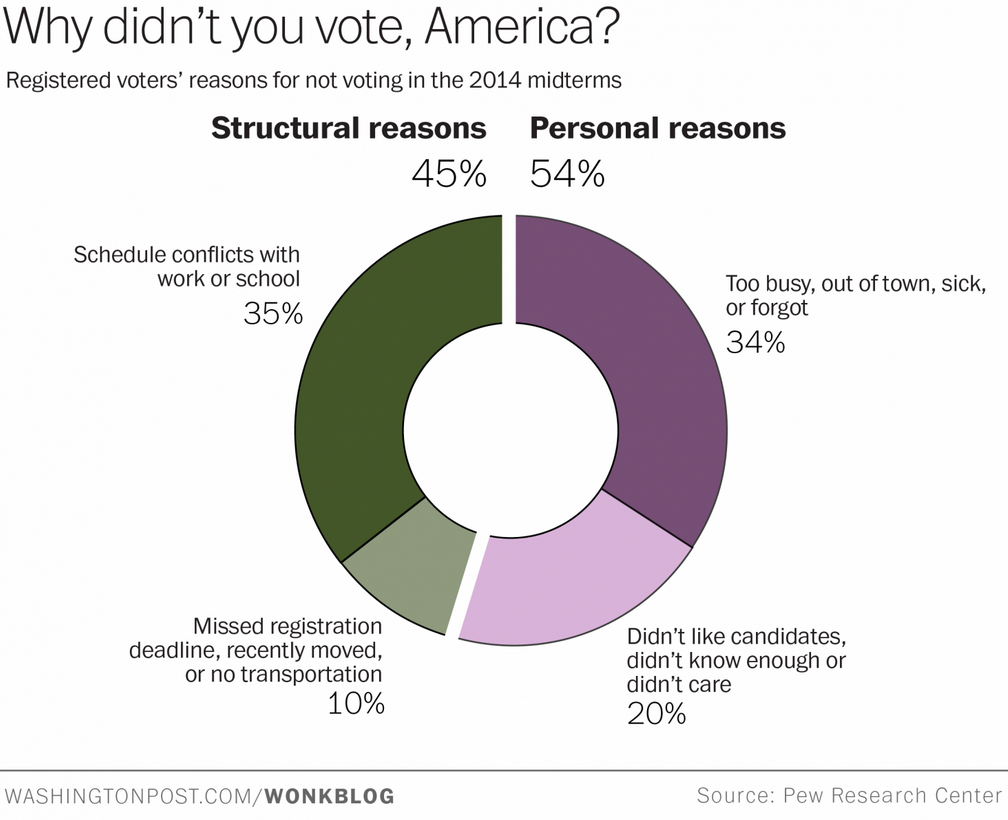
Why Not Vote

Christopher Ingraham passes along the above chart on Americans who didn’t vote:

Republican vote-suppression efforts have already received plenty of attention, and rightfully so – it’s an embarrassment that one political party sees a smaller electorate as the path to victory. But voters turned back at the polls represent at best a tiny fraction of the 10 percent who didn’t vote for technical reasons. Pew’s numbers suggest there’s a lot of work to be done to help the 35 percent of voters who couldn’t accommodate a trip to the polling place in their work or school schedules.

Frank Barry dismisses Wendy Weiser’s claim that voter restrictions suppressed so much Democratic turnout last week as to influence the outcomes of some close elections:

Weiser’s argument has been picked up by other voting-rights advocates and pundits, but it falls apart upon closer scrutiny. Even with seven fewer days, early voting in North Carolina increased this year compared with 2010 — by 35 percent. Statewide turnout also increased from the previous midterm election, to 44.1 percent from 43.7 percent. Even if turnout was lower than it would have been without the new voting law — something that’s impossible to establish — it was still higher than it had been in four of the five previous midterm elections, going back to 1994. In addition, based on exit polls and voter turnout data, the overall share of the black vote increased slightly compared with 2010.

Rick Hasen, an expert on election law, says he’s skeptical about Weiser’s analysis, and rightly so. When voting-rights advocates fail to include any balancing points in their discussion of the election, they undercut their credibility and give ammunition to Republicans who suspect that they are mostly interested in electing Democrats.


“Libidinal Pathology”

Any writer who wants to tackle touchy subjects in this day and age will be subjected to constant and often colorful insults, attacks, smears, ad hominems and general abuse. I’m used to it and don’t whine. And so I am resigned to the fact that any post or essay I might write will be condemned at some point (whatever its subject) because of my support for the Iraq War (despite countless mea culpas, including a whole e-book), or for the sentence in 2001 about a potential “fifth column” (for which I have also apologized), or for asking for some minimal documentation of the story of Sarah Palin’s astonishing fifth pregnancy (for which I see no reason to apologize), or for doubting that gender, sexual orientation or ethnicity can be entirely explained by social constructionism. And look, this is fair enough. I had my say; people also get to have theirs’ about what I wrote. Just because you’ve apologized for something doesn’t mean others have to accept it.

But one meme that crops up eternally whenever the left side of the spectrum wants to take a whack is my alleged sexual hypocrisy from as far back as 2001. A recent Gawker piece – after ticking off the usual accusations that I’m a racist, a misogynist, etc. – prompted the following reader comment:

Anyone remember when he was criticizing gay men for their “libidinal pathology” while posting ads for himself on a bareback sex site?

I do!

Except I wasn’t. That phrase – which appeared in countless articles asserting my hypocrisy – comes from Love Undetectable. It’s used in a section on circuit “rave” parties in the gay male world, and the debate they provoked in the 1990s. Here’s the full context of that phrase, and you can judge for yourself whether I was “criticizing gay men for their ‘libidinal pathology'”:

Slowly the proliferation of these events became impossible to ignore, and the secrecy that once shrouded them turned into an increasingly raucous debate on the front pages of newspapers across the country. Despite representing a tiny sub-subculture, and dwarfed, for example, by the explosion of gay religion and spirituality in the same period, the parties seemed to symbolize something larger: the question of whether, as AIDS receded, gay men were prepared to choose further integration, or were poised to leap into another spasm of libidinal pathology.

I am not criticizing gay men for “libidinal pathology” at a circuit party. I am describing a “raucous debate” about the possibility of them signifying the revival of such a thing. My own actual answer to that question was the following:

What these events really were about, whatever their critics have claimed, was not sex … what replaced sex was the idea of sex; and what replaced promiscuity was the idea of promiscuity, masked by the ecstatic high of drug-enhanced drug-music.

It also makes little sense for me to be slamming circuit parties for “libidinal pathology,” when I am describing my attendance at one – and not as a reporter but as a participant. In fact, the section is a celebration in part of unabashed gay sexuality:

What would the guardians of reality think, I remember asking myself, if they could see this now, see this display of unapologetic masculinity and understand that it was homosexual … [I]t was hard not to be struck, as I was the first time I saw it, by a genuine, brazen act of cultural defiance, a spectacle designed not only to exclude but to reclaim a gender, the ultimate response to a heterosexual order that denies gay men the masculinity that is also their own.

As to circuit parties as a whole, I have long gone to them, and, as you can see if you actually read what I wrote, celebrated them as one way I found liberation in a dark time. I met my husband at that very same party a decade later. I went to one last year. Yes, in that essay, I was trying to understand them in the AIDS era and to explain them to an outside world – and I was prepared to address some of the issues around them, including the very issue of promiscuity itself that hovered around the AIDS question. But the notion that this proves I was a sexual Puritan is ridiculous. A reviewer even lamented that in the book, “Sullivan drones on and on about his sexual encounters.” Well which is it: am I boring you with an account of my own promiscuity or condemning others for it?

Another sentence was routinely hauled out to condemn me for hypocrisy and pops up from time to time. Here is Richard Goldstein’s phrase of accusation:

[Sullivan] considers gay marriage the only healthy alternative to “a life of meaningless promiscuity followed by eternal damnation.”

Again, go check the original context. It’s from the same book. It comes from a section where I am impugning the idea of “hate the sin, love the sinner” and the failure of the churches to offer moral direction of any kind to gay men, leaving us for millennia vulnerable to, yes, sexual pathologies born out of desperation or the need for relief from the contradictions of our lives. Here’s the full passage:

If you teach people that something as deep inside them as their very personality is either a source of unimaginable shame or unmentionable sin, and if you tell them that their only ethical direction is either the suppression of that self in a life of suffering, or a life of meaningless promiscuity followed by eternal damnation, then it is perhaps not surprising that their moral and sexual behavior becomes wildly dichotic; that it veers from compulsive activity to shame and withdrawal; or that it becomes anesthetized by drugs or alcohol or fatally distorted by the false, crude ideology of easy prophets.

It’s clear from this passage that I am actually criticizing those who hold the belief that Goldstein and countless others ascribed … to me! You can watch the debate at the New School in 2002 where I directly confronted Goldstein about this … and he had nothing to say in his own defense, as the very lefty crowd discovered to their shock and mounting anger. I could go on. In the same book, I wrote explicitly about my own first experience of sex without rubbers with another survivor of HIV and a good friend. So in a book published in 1998, I recount details about my many sexual encounters and also unprotected sex with another man with HIV … and yet three years later I am a hypocrite for doing exactly the same things.

To be sure, the essay was about finding a way between no sexual boundaries and more humane ones for gay men. It does contain an implicit critique of compulsive sex – but in the context of my own experience of it. It revealed things about the gay subculture that are not usually told to heterosexuals or a general reader. It’s a raw book, written in a much more fraught time for the gay community. But it was also a memoir that placed myself in the middle of that struggle – and not above or outside it. And yes, I used terms like “hairy-backed homos” which critics took to be condemnatory – when it was anything but (as any Dishhead surely knows by now)! And, yes, arguing for marriage equality was also about ending the psychic wounds that led so many gay men into such painful places for so long. My only criticism of promiscuity per se was Randy Shilts’: when the AIDS epidemic first showed up and there was resistance to shutting down bathhouses. And Randy got slut-shamed as I was for taking what now seems like an honorable, brave and prescient stand.

Then the alleged irresponsibility. We know for certain that one of the most effective ways of curtailing HIV transmission is what we now call sero-sorting – i.e. HIV-positive men having sex only with other HIV-positive men. I was an early proponent and practitioner of it – as an informed act of responsibility. For this act of responsibility, I was hauled out to be condemned and humiliated and accused of rank hypocrisy.

This is a very old story but also a very old lie. It rests on misrepresentations of what I wrote and what I believe. Every now and again, since it is a lie that won’t die, it is perhaps necessary to remind people of this.

(Sidebar image by Marc Love)