In GOP Shutout, Were Dem Voters Shut Out?

Juan Thompson claims that voter suppression tactics were at least partly responsible for the turnout trouble among Democrats last week:

In Georgia … nearly 40,000 new voters mysteriously vanished from the rolls, possibly due to scrubbing by a controversial software system known as Crosscheck. Turnout was only 34%, which is down six percentage points from 2010.

Over the past two years Raphael Warnock, leader of Atlanta’s historic Ebenezer Baptist Church, worked with the New Georgia Project to register some 80,000 new and mostly black voters. New Georgia Project’s efforts was the state’s largest voter registration drive in 50 years, according to reports. “It’s a fundamental, basic American right to vote”, Warnock told me. Such thinking explains why he was so angry when half of those new voters failed to appear on the rolls this fall. “The Georgia Secretary of State’s office had no explanation at all as to where those voters went”, Warnock explained.

A person in the Georgia Secretary of State’s office declined comment (after alerting me to the fact that “the election’s over”). But earlier this year, that same office accused the New Georgia Project of voter registration fraud. In the end only 50 questionable forms were found. Georgia, it must also be noted, is one of 27 states using the controversial software Crosscheck to weed out supposed voter fraud.

Wendy Weiser of the Brennan Center for Justice even suggests that new restrictions may have suppressed enough votes to turn some close races:

In the North Carolina Senate race, state house speaker Thom Tillis beat Senator Kay Hagen by a margin of 1.7 percent, or about 48,000 votes. At the same time, North Carolina’s voters were, for the first time, voting under one of the harshest new election laws in the country — a law that Tillis helped to craft. Among other changes, the law slashed seven early voting days, eliminated same-day registration, and prohibited voting outside a voter’s home precinct — all forms of voting especially popular among African Americans. …

Some numbers from recent elections suggest that the magnitude of the problem may not be far from the margin of victory: In the last midterms in 2010, 200,000 voters cast ballots during the early voting days now cut, according to a recent court decision. In 2012, 700,000 voted during those days, including more than a quarter of all African-Americans who voted that year. In 2012, 100,000 North Carolinians, almost a one-third of whom were African-American, voted using same-day registration, which was not available this year. And 7,500 voters cast their ballots outside of their home precincts that year.

Naomi Shavin’s early tally of calls into the Election Protection Hotline also painted a picture of an unusually problematic election:

The hotline handles calls from voters who need to know if they’re registered, find their assigned polling locations, and report difficulties in their attempts to vote. Yesterday, the national hotline had taken over 16,000 calls by 8 p.m., with 3.5 hours to go until polling ended. (By comparison, the hotline received 12,857 calls all day on Election Day in 2010.) Texas, Georgia, and Florida seemed to be experiencing a particularly problematic Election Day. The hotline took roughly 2,000 calls from each of those states. Chris Melody Fields, the manager for legal mobilization and strategic campaigns at Lawyers’ Committee for Civil Rights Under Law, said that the call center received hundreds of calls from Georgia yesterday morning aloneso many, in fact, that calls had to be rerouted to call stations for other states.

Meanwhile, True The Vote’s new fraud-reporting smartphone app only turned up a grand total of 18 reported irregularities and just one claim of voter impersonation in the entire week leading up to the election.
Quote For The Day

“I hope you don’t have friends who recommend Ayn Rand to you. The fiction of Ayn Rand is as low as you can get re fiction. I hope you picked it up off the floor of the subway and threw it in the nearest garbage pail. She makes Mickey Spillane look like Dostoevsky,” – Flannery O’Connor.

From The Journal Of Dubious Studies

Jordan Pearson discusses one novel way to spot faked research:

Previous research has shown that patterns of language can be good indicators of deceit in fields outside of science. A 2003 study that asked participants to write untruthful statements in several experiments on topics like abortion legislation found that liars tended to use less adjectives while also playing up the affective dimension of their argument by using positive superlatives. Other studies have found that liars have trouble approximating the proper amount of genre-specific terms to use in their writing, as was the case in a study analyzing fake hotel reviews, whose authors’ underuse of spatial dimensions flagged their reviews as fraudulent.

[Cornell PhD candidate David] Markowitz and [colleague Jeffrey] Hancock discovered that [disgraced Dutch professor of social psychology Diederik] Stapel’s fraudulent papers conformed to these findings in non-scientific contexts. “Stapel also wrote with more certainty when describing his fake data, using nearly one-third more certainty terms than he did in the genuine articles,” the authors wrote. “Words such as ‘profoundly,’ ‘extremely,’ and ‘considerably’ frame the findings as having a substantial and dramatic impact.”

Additionally, they discovered that Stapel overused scientific jargon (what the researchers deemed to be genre-specific), indicating that he had trouble estimating the right amount to use in order to make his accounts seem truthful. He also used far fewer adjectives in his fraudulent papers than in his truthful ones.

The SJWs Now Get To Police Speech On Twitter, Ctd

Last night, a reader wrote:

It looks like the fears mentioned in your post have already come to pass; @nero, the Twitter account of Milo Yiannopoulos, a writer for Breitbart, is currently suspended. I am no fan of the guy – he is trans-phobic, but not violently or inappropriately so. I am sure his account will be re-enabled shortly, but that this group was able to get his account shut off not for harassment, but for wrong-think, is disturbing. I’m really liberal/left leaning, but nothing gets me foaming at the mouth more than crap like this. This does a ton of harm to the Women’s Rights movement, turning off people like me who would normally support it wholeheartedly.

Gawker’s Tom Scocca accuses that reader and me of the following:

What really matters is not the stalking and abuse that has taken place, but the hypothetical danger that feminists will seize power as authoritarian censors, burning Beethoven and establishing anti-masculinity brainwashing camps.

No. Try again, Tom. As I’ve now written many times – and did in the post Scocca links to – I actively support suspending abusive, stalking tweeters or those threatening violence. I just worry that some are using this to advance a left-feminist ideology through censorship of journalists. I would imagine a Gawker writer might be sensitive to journalists’ being censored on Twitter because of saying politically incorrect things. Apparently not. Easier to throw a few tired, ancient cheap shots at yours truly than see if I’m actually onto something here. Another reader notes some non-harassing tweeters have also been suspended recently:

Gone are the accounts of Mykeru, a critic of feminism within the Atheist-Skeptic movement, as well as Janet Bloomfield, Social Media Director of A Voice for Men. Their accounts also disappeared in the past three days. Thunderf00t, another prominent critic of feminism within the Skeptic movement, had his account suspended for close to a month. None of these accounts were abusive or harassing. The only thing they had in common was that they were all critical of feminism.

Or critical of a particular strand of contemporary left-feminism. It looks as if Thunderf00t has had his Twitter account suspended because he linked to YouTube videos critical of Anita Sarkeesian. @nero’s account just went back online, but did WAM get it suspended in the first place? Here’s evidence they did:

We’ve asked WAM if they did or did not report @nero for suspension. No word back as of yet. And what threats or stalking or harassment did @nero engage in to merit the brief suspension? Drum roll:

Yiannopoulos apologized for that sexist swipe against @redlianak:

So it looks like he had already been held accountable for his shitty words in the best way – public embarrassment, not Twitter censorship. And the tweeter who bragged of getting Yiannopoulos banned was quite clear why of another reason: @nero opposed marriage equality, and is therefore allegedly homophobic (especially because he’s gay). So the standard for banning people from Twitter is now homophobia. And why not? If homophobic speech oppresses someone, it must be forbidden, right?

Let me know if you’ve been suspended for ideological reasons – and not for harassment or stalking or threats of violence. And if you know of a Twitter account that has been rightly suspended for actual threats to individual women, ditto.

Europe’s Other Secessionists

In the face of staunch opposition from the Spanish government, which declared the act unconstitutional, some 2.3 million residents of Catalonia turned out on Sunday to vote in a non-binding referendum on independence from Spain. Over 80 percent voted “yes”:

Because the straw poll did not contain the electoral guarantees of a true referendum, and was organized and promoted entirely by pro-sovereignty groups, it was largely expected that those opposed to independence would not turn up to vote (and indeed, the percentage of returns against both statehood and independence was a mere 4.5%; an additional 10% voted in favor of statehood—meaning greater autonomy within a federal-style system—but rejected independence). If yesterday’s poll is indeed an accurate reflection of what Catalonia could expect in a binding referendum with greater electoral guarantees and a high level of participation, then somewhere between 40 and 50% of the total eligible population would vote in favor of independence.

Bershidsky interprets the vote as a message to Spanish Prime Minister Mariano Rajoy, who “has consistently refused to deal with the political, rather than the legal, side of the issue”:

Rajoy has signaled his willingness to negotiate with the Catalan government, but only from a position of strength. That’s no way to approach a region where close to 2 million people are unhappy with the way they are being governed from Madrid. Spain is the only European country where people feel a stronger regional than national identity, according to the World Values Survey. That makes centralization a bad idea. The best option for the Spanish government is to go back to the 2006 Statute of Autonomy, which was passed by the parliament and approved by 2.5 million Catalan voters — but then emasculated in 2010 by the Constitutional Court. By granting Catalans exactly as much independence as they have always asked for, that would effectively put an end to the secession movement.

Diego Muro also urges Madrid to listen:

Madrid’s approach has been needlessly adversarial. Rather than resist Catalan’s aspirations, the Spanish government should welcome its commitment to a democratic process. After all, Spain has a long history of nationalist groups―most notably the Basque nationalist group ETA―turning to terrorism, rather than the ballot box, to pursue their goals. Madrid has chosen to portray its disagreement with Catalonia in legalistic terms. But the crux of the matter is a political problem: how to accommodate the region’s aspiration for independence within Spain’s existing national framework. The sooner the Spanish government recognizes the true nature of the problem, the sooner it can restore calm throughout the country.

The Bloomberg View editors believe Catalans would opt for union in the end, provided Rajoy abandons his disdainful approach to their concerns:

The first step to persuading Catalans to stay in Spain would be to map out a legal, constitutional route to giving them their say. Catalonia’s proposed secession would be even more fraught with risk than was Scotland’s. It would carve away about 20 percent of Spain’s economy, compared with 8 percent for the U.K. Investors in Catalonia’s bonds certainly believe independence would be at least as bad for the region as for the rest of Spain. So in a real campaign, in which voters are confronted with the realities of assuming up to 200 billion euros ($250 billion) of Spanish debt, the case for unity should be winnable.

Love’s Labor Win?

Tyler Cowen highlights a paper that suggests union membership is a boon to marriage. From the paper’s abstract:

Over the past five decades, marriage has changed dramatically, as young people began marrying later or never getting married at all. Scholars have shown how this decline is less a result of changing cultural definitions of marriage, and more a result of men’s changing access to social and economic prerequisites for marriage. Specifically, men’s current economic standing and men’s future economic security have been shown to affect their marriageability. Traditionally, labor unions provided economic standing and security to male workers. Yet during the same period that marriage has declined among young people, membership in labor unions has declined precipitously, particularly for men.

In this article … union membership is positively and significantly associated with marriage. We show then that this relationship is largely explained by the increased income, regularity and stability of employment, and fringe benefits that come with union membership.

One In Twenty Arrests Are For Pot

Marijuana Arrests

Ingraham reviews new FBI data:

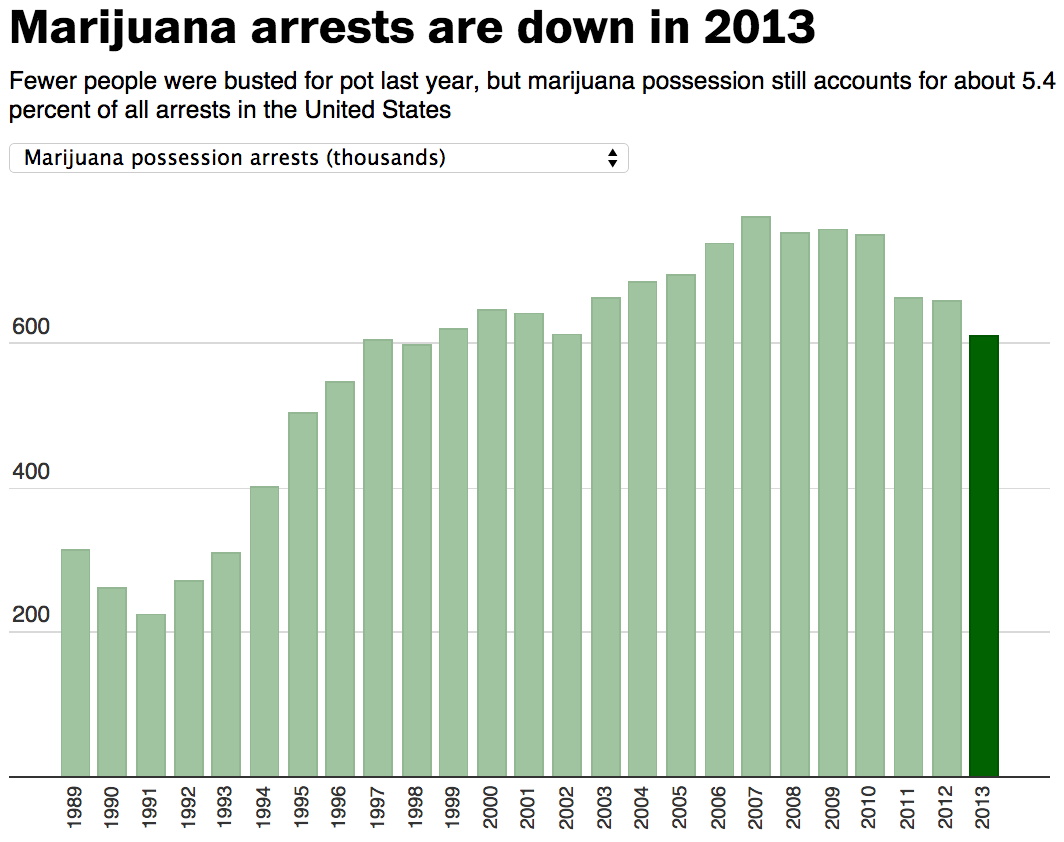
The total number of arrests for all offenses continues to drop sharply, from a high of 15.3 million in 1997 to 11.3 million in 2013. But marijuana possession arrests have not declined at the same rate – these arrests accounted for 1.6 percent of all arrests in 1990, but make up 5.4 percent of all arrests today. Moreover, arrests for all drug offenses made up a record share – 13.3 percent – of total arrests this year. Drug violations represent the single largest category of arrests tracked by the FBI. As NORML notes, if we assume ACLU’s conservative estimate of a cost of $750 for each marijuana possession arrest, it means that states spent more than $450 million on these arrests in 2013 alone.

Sullum examines the big picture:

The peak year for marijuana arrests was 2007, when there were about 873,000, three times as many as in 1991. The number fell to 848,000 in 2008, rebounded to 858,000 in 2009, and has been declining since then. Contributing to that trend, Colorado and Washington last year stopped arresting people for possessing less than an ounce of marijuana, as required by legalization measures that voters approved in 2012. Prior to that change, Colorado police were arresting about 10,000 people for marijuana possession each year. The annual number in Washington was about 6,000. Marijuana possession arrests in New York City, which peaked at more than 50,000 in 2011, also fell last year, from 39,218 to 28,644.

The downward national trend should continue. Washington, D.C., decriminalizedmarijuana possession last spring, and [yesterday] the NYPD announced that it will further reduce arrests of cannabis consumers, beginning later this month.

Matt Taylor explains the forthcoming NYC policy:

Starting next Wednesday, November 19, possession of 25 grams or less of pot—even in public view—will no longer get you cuffed and brought downtown by the cops. Instead, police will begin issuing criminal court summons, or desk appearance tickets, requiring guilty parties show up in front of a judge at a future date. The bad news for pot lovers is that smoking the stuff in public will still be sufficient to earn you a night or two in jail. And since many New Yorkers—especially young men of color—fail to show up when issued desk appearance tickets, this isn’t exactly a game-changer when it comes to the war on drugs in America’s largest city.

Matt Schiavenza hears from skeptical drug policy experts:

“It’s not decriminalization,” said Joanne Naughton, a former NYPD officer and member of Law Enforcement Against Prohibition, or LEAP. “People will be summoned into a criminal court to answer to criminal charges.” If those summoned fail to appear in court, judges could issue arrest warrants.

Kenneth P. Thompson, the Brooklyn District Attorney, is another skeptic. Thompson, who stopped prosecuting marijuana possession charges earlier this year, argued that a ticket and court summons would cause additional complications. Because summons without an arrest warrant don’t receive prosecutorial review, violators may not have access to full legal oversight and won’t automatically be appointed a lawyer. “These cases will move forward even when due process violations might have occurred,” Thompson said.

The GOP’s Firewall In The House

Nate Cohn measures it. Democrats now need 32 seats to retake the House:

The Republicans hold only 28 seats in districts that were carried by Mr. Obama. Many of these seats would fall to the Democrats in an anti-Republican year. The 12 newly elected Republicans who won seats in districts carried by Mr. Obama in 2012 are particularly vulnerable; many of these freshman Republicans could lose re-election in 2016.

Yet Democrats will have a struggle to win all of the seats held by Republicans that voted for Mr. Obama in 2012. The benefits of incumbency will allow many of these Republicans to defy even the most inhospitable conditions. And some of these Republicans, like Dave Reichert of Washington or Frank LoBiondo of New Jersey, are survivors of the 2006 and 2008 waves.

He concludes that “a Republican president is probably a prerequisite to a Democratic House.” 

Cohn, whose polling and demographic analyses are usually top notch, might be right this time, assuming that Republicans make no mistakes and Democrats keep shooting themselves in the foot. The last round of redistricting certainly gave Republicans a boost, and their expanded control of state legislatures may give them a head start on the redistricting that will take place after the 2020 census by boosting their likelihood of retaining control of those chambers. The expanded control at the state level also means that Republicans will produce more experienced candidates for the House and Senate over the next few years, which is one reason why some Democrats pointed to that outcome as the worst news from Election Night.

Still, history cautions against Republican optimism and Democratic despair. As we have seen over the last 20 years, it’s usually folly to assume that parties can avoid overreach and scandal for very long. Turnout in this wave election was historically low, which argues against learning any significant lessons on demography and sustainability. Unlike 1994, Republicans did not run on a unifying national platform; they relied instead on deep dissatisfaction with President Obama and Democratic leadership in the Senate that refused to check his perceived abuses. That parallels 2006 most closely, which means that the one mandate Republicans can claim would be to force Obama to work with the GOP on their terms, as voters either turned out to oppose Obama or didn’t bother to turn out in his support. That mandate could mean an even higher risk of overreach, although the lack of electoral consequences for last fall’s government shutdown suggests voters are very fed up with the White House.

A Pro-Life Election? Ctd

Olga Khazan discusses what the failure of “personhood” ballot initiatives in last week’s election – in contrast to Tennessee’s successful constitutional amendment paving the way for more restrictions on abortion – reveals about the split between the “incrementalist” and “absolutist” wings of the pro-life movement. While voters can’t stomach the radical changes the absolutists are demanding, that’s cold comfort to Kat Stoeffel, who argues that the incrementalists are in some ways a greater threat to abortion rights:

Rather than offering sweeping amendments for a hypothetical post-Roe future, [Target Regulation of Abortion Providers laws] revoke abortion access piecemeal, starting now. … Part of the insidiousness of TRAP laws is that they are so tedious they fly under the radar of all but the most dedicated pro-choice advocates. But another part of the problem is that TRAP laws don’t frighten the voter who is indifferent to abortion but also has the resources to navigate restrictions. She’s free to think, But I’d still be able to get one if I needed to and skip voting this year, as young people (who are traditionally pro-choice Democrats) disproportionately opted to do this year.

How does this play out? Based on the belief that he had an obligation to give a fetus a chance for life, a judge in Washington, D.C., ordered a critically ill 27-year-old woman who was 26 weeks pregnant to undergo a cesarean section, which he understood might kill her. Neither the woman nor her baby survived. In Iowa, a pregnant woman who fell down a flight of stairs was reported to the police after seeking help at a hospital. She was arrested for “attempted fetal homicide.” In Utah, a woman gave birth to twins; one was stillborn. Health care providers believed that the stillbirth was the result of the woman’s decision to delay having a cesarean. She was arrested on charges of fetal homicide. In Louisiana, a woman who went to the hospital for unexplained vaginal bleeding was locked up for over a year on charges of second-degree murder before medical records revealed she had suffered a miscarriage at 11 to 15 weeks of pregnancy.

Jessica Grose, meanwhile, pleads with her fellow left-feminists to stop describing the midterms as “bad for women”, as it’s a bit condescending to the millions of women who voted for Republicans like “combat veteran and hog castrator Joni Ernst in Iowa, black Mormon Mia Love in Utah, and youngest woman to ever be elected to Congress Elise Stefanik in New York”:

It’s not just candidates that women disagree on. It’s the issues themselves. Let’s take access to abortion, which is seen as a pivotal “women’s issue.” According to the Washington Post, polling over the years has shown that there’s actually not that much difference between men and women’s views on abortion. And women may be more supportive of restrictions on late-term abortions than men are. Particularly in this election, issues like the economy and security have outweighed social issues among all voters. Which is to say, though the right to choose is incredibly important to people like me and Ann Friedman, it’s not as important to a good portion of the female electorate.