The Greatest Show In Your Butt

Martha C. Nussbaum advocates forgoing anesthesia for colonoscopies, arguing that the painless procedure is worth being awake for:

Yesterday I saw my appendix.

It was pink and tiny, quite hard to see, but how interesting to be introduced to it for the first time. In for a routine colonoscopy (my fourth, on account of a family history), I refused sedation as I always do, and I had the enormous thrill of witnessing parts of myself that I carry around with me every day, but never really know or acknowledge. I chatted with my doctor about many things, including the various justices of the Supreme Court, the details of my procedure, and, not least, the whole question of sedation and anesthesia. He told me that 99 percent of his patients have either sedation or, more often now, general anesthesia, since that is increasingly urged by the hospitals. (In Europe, he said, about 40 percent refuse sedation.) He listed the costs of this trend: financial costs that are by now notorious, lost workdays for both patient and whoever has to drive the patient (whereas a non-sedated patient needs no caretaker and can go right back to work), lost time for nurses and other hospital staff, and, of course, the risks of sedation and the even greater risks of general anesthesia.

And, I’d add, the loss of the wonder of self-discovery. You are only this one body, it’s all you are and ever will be; it won’t be there forever; and why not become familiar with it, when science gives the chance? I began refusing sedation out of a work ethic; I continued through fascination.

Our Outstanding Student Loans

StudLoans2

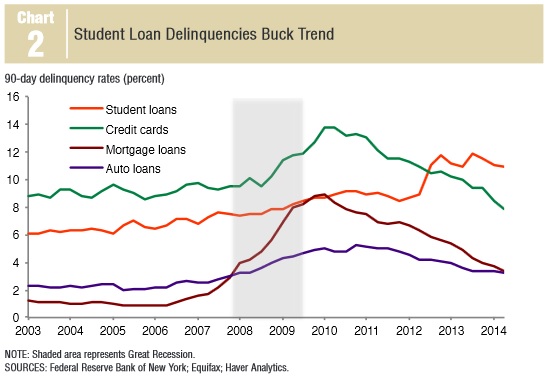
J.D. Tuccille flags a report from the Dallas Fed, showing that America’s student loan delinquency rates are still high, even as we get other forms of household debt under control:

Unshockingly, while defaults decline for credit card debt, mortgages and auto loans, they’re on the rise for student loans. “At 10.9 percent, the second quarter 2014 delinquency rate on student loans was more than three times that of mortgages and auto loans, and more than 3 percentage points higher than the rate of serious delinquencies on credit cards.” Apparently, young grads with overpriced sheepskins and no decent jobs in the offing have trouble meeting the tab.

And they’re certainly not about to take on mortgages. John Aravosis points to another new study estimating the impact of student debt on the housing market:

8% fewer homes will transact than normal in 2014, purely due to student debt. … Our conclusion is that 414,000 transactions will be lost in 2014 due to student debt. At a typical price of $200,000, that is $83 billion per year in lost volume.

Meanwhile, an analysis from Pew shows that more students of every class background are graduating college in debt today than 20 years ago:

In the early ’90s, only among graduates from low-income families did a majority of graduates finish college with student debt. Now, solid majorities of graduates from middle-income families (both lower-middle and upper-middle) finish with debt, and half of students from the most affluent quartile of families do the same. … Among recent college graduates who borrowed, the typical amount of cumulative student debt for their undergraduate education increased from $12,434 for the class of 1992-93 to $26,885 for the class of 2011-12 (figures adjusted for inflation). The increase in the median amount of debt by newly minted borrowers between the class of 1992-93 and the 2011-12 varied somewhat by the graduates’ economic circumstances. But regardless of family income, the typical amount owed at graduation increased about twofold over this time period.

Where’s Kim Jong Un?

Isaac Stone Fish analyzes the significance of the North Korean leader’s month-plus-long disappearance:

Setting aside for now the impossible question of where Kim has gone — Pyongyang’s state-run media say he is sick, though he could also be under house arrest, dead, on vacation, or simply bored of appearing in public — North Korea is arguably much more stable with Kim at the helm. (First, the eternal caveat when writing about North Korea: The country is more opaque than an eye afflicted with cataracts, so much of what I’m writing is speculation.)

The most dangerous thing about North Korea is its unpredictability. Because we know so little about what Pyongyang wants, or why it does what it does, it’s difficult to prepare for contingencies.

… Much of the burden of an imploding North Korea would fall on the backs of North Koreans, but the country’s collapse could also destabilize northeast China by sending hundreds of thousands of refugees across North Korea’s northern border — and allow rogue elements in North Korea to sell nuclear material to enemies of the United States.

William Pesek elaborates on the China angle:

[W]hat’s most intriguing about North Korea these days are signs China is fed up with Kim’s antics and may be tightening the financial screws. Concrete evidence is hard marshal, of course; Beijing keeps a tight lid on its machinations at home, never mind its relationship with Pyongyang. But whereas former Chinese President Hu Jintao maintained a working relationship with his North Korean counterpart Kim Jong Il, who died in December 2011, China’s current leader Xi Jinping has been decidedly cool toward Kim the younger.

And Joshua Keating focuses on the timing:

Kim’s absence also comes at a critical moment. North Korea sent a surprising and unprecedented high-profile delegation, including Kim’s two closest aides, to Seoul last weekend, and the two sides have agreed to resume reconciliation talks. This is a major shift after months of aggressive rhetoric from the North Korean side.  This resumption of talks could be a sign that something serious has changed behind the scenes in Pyongyang. Or, less excitingly, as unnamed U.S. officials suggest to Reuters, it could simply be “diplomatic tactics by Pyongyang, aimed at dividing and weakening international pressure over its nuclear weapons program and human rights record as well as propaganda for domestic consumption.”

Split Decisions On Voter ID

imrs

Opponents of voter ID requirements scored two court victories this week against controversial laws in Wisconsin and Texas:

On Thursday, the Supreme Court issued an emergency order blocking a voter ID law Wisconsin Gov. Scott Walker signed in 2011. The court cited no reason for its move, which is common for emergency orders. Voting rights advocates challenging the law had charged that if it were in effect in November it would “virtually guarantee chaos at the polls,” the New York Times reported, as the state would not have enough time to issue IDs and train poll workers before the election. There are about 300,000 registered voters in Wisconsin who lack an ID. Most of them are black or Hispanic. Also on Thursday, a federal trial court in Texas struck down that state’s voter ID law, ruling that it overly burdened minority voters, who are less likely to have a government-issued ID, and as such violated the Voting Rights Act. More than 600,000 registered voters in Texas lack appropriate IDs.

But North Carolina voters weren’t as lucky:

Voters in North Carolina will not have access to same-day registration or out-of-precinct voting in this midterm election, after the U.S. Supreme Court on Wednesday blocked an appellant court order to stay parts of a sweeping voting law that voting-rights advocates say could leave many voters disenfranchised come November.

Richard L. Hasen make sense of these ruling:

Sometimes (as in Wisconsin) the Supreme Court has been protecting voters; at other times (as in Ohio and North Carolina) it appears to be protecting the ability of states to impose whatever voting rules they want.

But there is a consistent theme in the court’s actions, which we can call the “Purcell principle” after the 2006 Supreme Court case Purcell v. Gonzalez: Lower courts should be very reluctant to change the rules just before an election, because of the risk of voter confusion and chaos for election officials. The Texas case may raise the hardest issue under the Purcell principle, and how it gets resolved will matter a lot for these types of election challenges going forward.

Waldman tells Democrats not to count on the courts to strike down voter ID laws:

[W]e shouldn’t be encouraged by the Wisconsin ruling: it doesn’t imply that the Court believes these restrictions are unconstitutional, only that it would be a mess to have them take effect just a few weeks before the election. It’s a narrow question of election procedure.

It would be going too far to say that Democrats should just abandon all court challenges to these voting laws. You never know what might happen—by the time the next major case reaches the Supreme Court, one of the five conservatives could have retired. But the only real response is the much more difficult one: a sustained, state-by-state campaign to counter voting suppression laws by registering as many people as possible, helping them acquire the ID the state is demanding, and getting them to the polls. That’s incredibly hard, time-consuming, and resource-intensive work—much more so than filing lawsuits. But Democrats don’t have much choice.

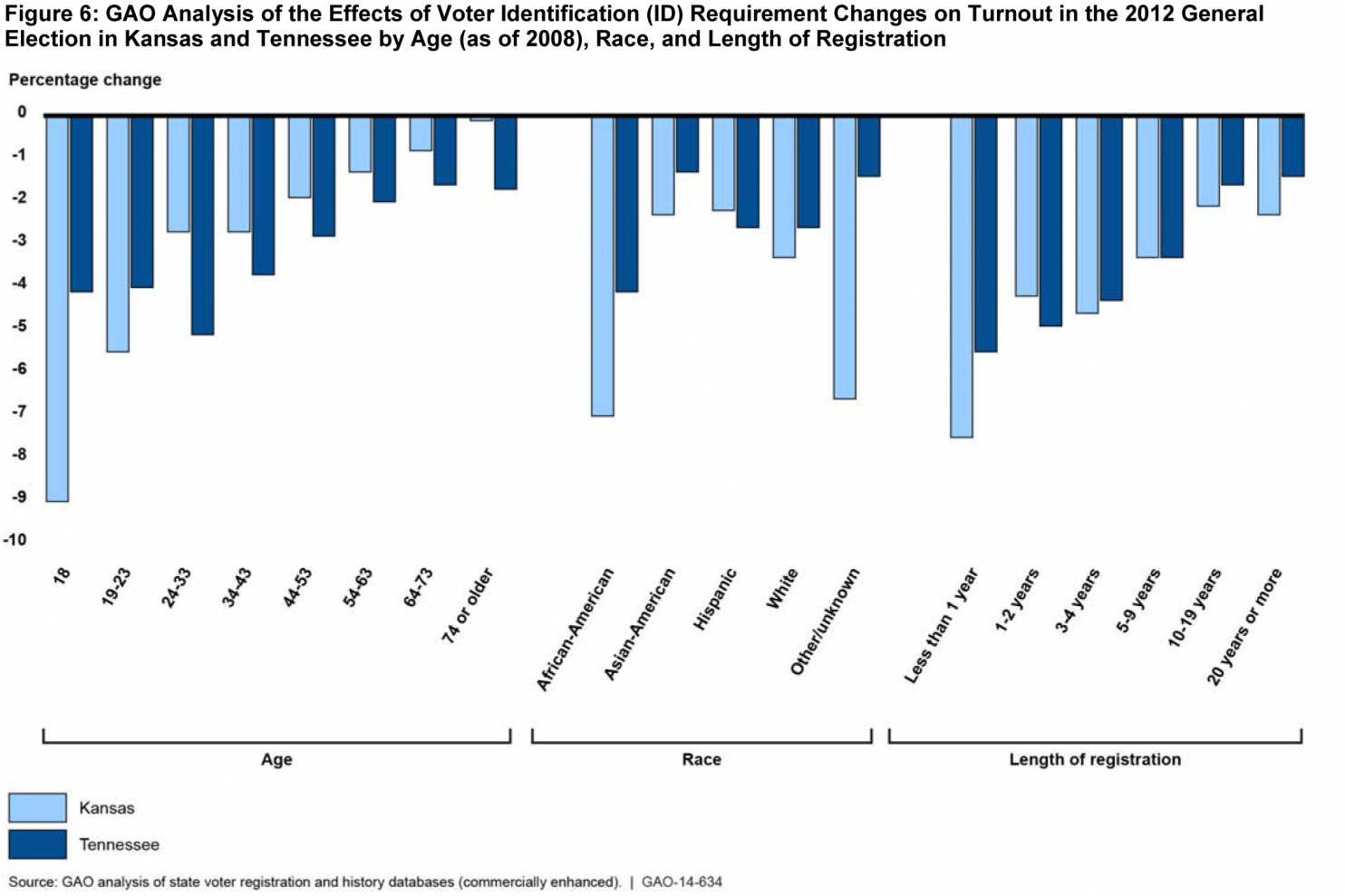
Referring to the above chart, Philip Bump outlines the Government Accountability Office’s findings about the effects of the Kansas and Tennessee voter ID laws, which had significant impacts on turnout in 2012, especially among young and minority voters:

According to data from the states (here and here), turnout dropped 5.5 percentage points overall in Kansas and 4.5 percent in Tennessee. With registered voter pools of about 1.77 million and 4 million, respectively, that means that 34,000 Kansans and 88,000 Tennesseans likely would have voted if the new laws weren’t in place. The effects of the change weren’t evenly distributed. … Young people, black people, and newly registered voters were the groups that were more likely to see bigger drops in turnout. Sixteen percent of voters in Kansas in 2012 were under the age of 30, according to exit polls. In 2008, the group comprised 19 percent of the vote. That change wasn’t entirely due to voter ID, of course, but the GAO report suggests it played a part.

The Business Of War

Justine Drennan counts the costs of the campaign against ISIS so far:

[E]ach U.S. “strike” against the self-proclaimed Islamic State can involve several aircraft and munitions and cost up to $500,000, according to Todd Harrison, an expert with the Center for Strategic and Budgetary Assessments, a Washington-based defense think tank. Harrison said the cheapest possible strike could cost roughly $50,000 — assuming a single plane dropping one of the cheaper types of bombs. … But using his $500,000 upper estimate, Saturday’s strike missions alone cost as much as $4.5 million. And those figures don’t even include the intelligence, surveillance, and reconnaissance flights necessary to scope out targets ahead of strikes, which have helped make even the low-level campaign against the Islamic State hugely expensive. The Pentagon revealed on Monday that it has spent as much as $1.1 billion on military operations against the Islamic State since June.

But this war, among others, is great news for the companies that make those planes and bombs:

Led by Lockheed Martin Corp. (LMT), the biggest U.S. defense companies are trading at record prices as shareholders reap rewards from escalating military conflicts around the world.

Investors see rising sales for makers of missiles, drones and other weapons as the U.S. hits Islamic State fighters in Syria and Iraq, said Jack Ablin, chief investment officer at Chicago-based BMO Private Bank. President Barack Obama approved open-ended airstrikes this month while ruling out ground combat.

“As we ramp up our military muscle in the Mideast, there’s a sense that demand for military equipment and weaponry will likely rise,” said Ablin, who oversees $66 billion including Northrop Grumman Corp. (NOC) and Boeing Co. (BA) shares. “To the extent we can shift away from relying on troops and rely more heavily on equipment — that could present an opportunity.”

Meanwhile, Julia Harte and R. Jeffrey Smith flag a report by Conflict Armament Research, which “indicates that the Islamic State’s relatively newly-formed force has had little difficulty tapping into the huge pool of armaments fueling the conflicts in Iraq and Syria.” The group, the report shows, has gotten its hands on arms and munitions manufactured in 21 different countries, including, of course, the American equipment taken from the retreating Iraqi army. Now that the Pentagon is preparing to send more arms to the Iraqis and Syrian rebels, the jihadists are licking their chops:

On Sept. 18, Congress passed a law authorizing the Defense Department not only to re-equip Iraqi forces that lost territory and abandoned their weaponry to IS, but also to provide arms to “appropriately vetted elements of the Syrian opposition.” …

The Islamic State, meanwhile, has said it welcomes fresh opportunities to get its hands on additional Western-supplied munitions. “Look how much money America spends to fight Islam, and it ends up just being in our pockets,” says Abu Safiyya, the narrator of an Islamic State propaganda video uploaded to YouTube on June 29. Gesturing at a Ford F-350 truck parked in an Iraqi police base captured by the extremist militants over the summer, Safiyya said, “They will lose in Syria also, God willing, when they come. We will be waiting for them, God willing, to take more money from them.”

Stalker Stories

Alyssa Rosenberg doubts that the new show Stalker is really, as its creator Kevin Williamson claims, about raising awareness of the problem:

It turns out that one of the main characters on the show, a new detective assigned to the Los Angeles police department’s stalking investigations unit (Dylan McDermott), likes to do a little extracurricular creeping around himself. The message of “Stalker” is split: Stalking can be a hideous, brutal crime, but it is also a spicy little detail that can be used to give a character an exciting frisson of darkness. The National Center for Victims of Crime was so outraged by the show that Michelle Garcia, director of the organization’s Stalking Resource Center, wrote to CBS president and CEO Les Moonves to express her dismay.

Meanwhile, Emily Maloney confesses to having been one of those rare female stalkers:

Not stalked. Researched, I preferred to say. I knew where [my psychiatrist] lived and how many children she had. When she got a divorce, and the kids’ names and ages appeared in the court records, I felt a tingle of glee, just for knowing, which made me feel a little sick. My heart sped up as I scrolled through those records or ones from the county recorder’s office online. Available for anyone to see, I told myself. Public records. …

According to Robert Muller, Ph.D., professor of psychology at York University, and the author of Trauma and the Avoidant Client, there are five kinds of stalkers.

They are overwhelmingly male, lack skills to negotiate basic social interaction, and frequently stalk their victims as an act of revenge. The victims are overwhelmingly female, like my psychiatrist. The types include, in order of ascending creepy magnitude: rejected suitors, intimacy seekers, socially incompetent stalkers, resentful or revenge seekers, and predatory stalkers. Most stalker fantasies include intimacy or violence. They’re mostly of average to above average intelligence, tend to be well-educated, and just over a fifth of them stalk due to mental illness or related factors; the rest do it for anger, retaliation, or control, and they are incredibly good at rationalizing away inappropriate behaviors. Women are far less likely to stalk; when they do, it’s with the hope of increased intimacy, erotomania, or a hope for friendship. Maybe that one was me.

A Baltic Breakthrough For Gay Rights

Yesterday, Estonia’s parliament passed a law recognizing same-sex civil unions and allowing gay couples to adopt each other’s children:

Estonia is the first country of the former Soviet Union to recognize same-sex partners—though, as [Estonian President Toomas] Ilves also noted on Twitter, the label of “first former Soviet republic” downplays the fact that Estonia has been independent for almost 25 years. The law is remarkable not because of the country’s past, but because of the reality of its political present: Neighboring Russia has been using anti-LGBTQ propaganda to stir up anti-Western, anti-EU sentiment in Eastern Europe. In some cases, that worked to turn people against the West. In others, it has worked to turn people against LGBTQ rights: Georgia, for example, passed an EU-friendly anti-discrimination law in May, but only after the government made the law less enforceable and offered to change the constitution to state that marriage is between a man and a woman.

But Russian pressure did not work in Estonia, despite Kremlin lobbying. (Judging from that lobbying, there are those in Moscow who would like us to continue to think of Estonia as a “former Soviet” state.)

Russian pressure is, however, working to suppress LGBT activism in Russia itself, as Keating discovers while checking on the effects of the ban on “homosexual propaganda” that went into force last summer:

Andrei Obolensky, chairman of the LGBT rights group Rainbow Association, told me: “We used to do a lot of film screenings as a form of education, but now we can’t show a film unless it gets a certificate from the state confirming that it can be publicly shown. A lot of smaller places that could show films will not allow it in their facilities anymore.” He continued, “Police will attend some our events to check passports.” The event could be shut down if underage attendees were present. Local authorities will also “refuse permits for any kind of rally or to register any organization.”

Obolensky also said that even liberal opposition groups are sometimes reluctant to associate themselves with the gay rights cause and that “many Russian journalists don’t like to cover LGBT questions. They fear being punished by this homophobic law.” He also noted that the movement has been hurt by an increasing number of activists choosing to emigrate.

Make Orwell Proud, Ctd

Readers keep the submissions coming:

A few years ago when my grandpa died, the caretakers told us, “His vitals are absent.” It took a couple more minutes of conversation for us to realize they meant “he died”.

Another:

I don’t know if this qualifies as “disguising the core reality“, but the phrase that was uttered while I was giving birth to my daughter was “non-reassuring fetal heartbeat”.  I had a C-Section six minutes after I first heard it. Perhaps the emotion of the moment makes it rankle more that it ought to, but it just sounds like BS, and when I repeat it, it’s always in the slick voice of a TV ad announcer.  “Do you suffer from embarrassing bouts of poorly timed non-reassuring fetal heartbeat?  Then you should try … “

But another reader has sympathy for such cases. He quotes a previous reader:

While visiting a friend in a mental hospital, I witnessed a grieving husband ask a doctor about the long-term prognosis for his suffering wife. All the doctor could do was prattle on about the different “medicinal modalities” (i.e. drugs) they were utilizing to try to stabilize her. As the husband looked on helpless and dumbfounded, I wanted to punch the doctor.

Jargon can be off-putting, obfuscating, and infuriating for the layperson. But for the user, jargon can be a source of comfort and a delayer to give time when one doesn’t know what to say or how to frame bad news. I certainly don’t know if the above physician was obtuse or just unsure of how to proceed. In the moment, we certainly must sympathize with the patient and her family. Stepping back, it doesn’t hurt to realize that the doctor may deserve some empathy as well.

(Just subscribed, btw. I love the Dish and I’m glad to be in a position to support it now!)

Others turn to Orwellian language in the environmental realm:

Here’s one for you: “incidental take” – basically the “collateral damage” of the wildlife world.  It’s a term used in a wide variety of state and federal contexts, most notably in regulations governing the U.S. Endangered Species Act and the Marine Mammal Protection Act (see here or here for examples), to refer to the “unintentional, but not unexpected” killing or injury of an endangered species, say, by cutting down a forest where an endangered bird lives or draining a wetland which is also home to an endangered frog.  You get the gist.

Another reader:

From the obscure world of cleaning up Superfund hazardous waste sites (where I spend my time when not reading the Dish), I offer my favorite Orwellism. It’s called “monitored natural attenuation” which is gov-speak for “we’re not going to do anything.”

Mind you, doing nothing at a Superfund site is not necessarily a bad thing.  Heavily contaminated sites are hideously complicated and expensive to clean up, and sometimes when the contaminant has spread deep into the ground or laterally beneath a building or a water body, there are simply no feasible means to go after it.  And often, the contaminant isn’t doing any harm to people or animals anyway. The Superfund process even has a formal requirement to examine the “No Action Alternative” when selecting a remedy for a site.

But of course, no one wants to acknowledge that they’re not going to to anything, and it is nearly unheard of for the No Action Alternative to be chosen. Thus the need to rebrand inaction.  The “natural attenuation” phrase refers to the hope that if the problem is ignored it will go away by itself. As you might suspect, this is seldom the case.

Another:

I wish I had a photo of the nasty square of fenced-in dirt – no bigger than 10’X10’ – at a campground in northern California.  This prison-like “amenity” was (and perhaps still is) called the “Dog Freedom Area.”

Another looks to the farm at length:

I would like to nominate some more Orwellian terms. First are “cage free” and “free range.” These terms are designed to invoke images of idyllic pastures but such operations are almost always giant sheds crammed with animals living in their own waste, and the burning ammonia that that waste produces. There is a small trap door at one end that is sometimes unlocked for a short period; it leads to a small outdoor cage. Very few of the inmates will ever step out into that cage, but they are “free range” because they technically had “access” to the outdoors. Chickens held in such facilities, either for meat or eggs, have their beaks partially burned off so they do not harm each other in the overcrowded conditions. Other animals may have their tails cut off so they don’t get chewed due to overcrowding. Almost all animals from “cage free” and “free range” facilities never see the sky or set foot on natural earth. Their lives are non-stop torture. Here is an excellent short video of Jonathan Safran Foer talking about the “lie” of the term “free range”; here is a quote by him in the NY Times:

“Free range,” “cage free,” “natural” and “organic” are nearly meaningless when it comes to animal welfare.

It doesn’t get much more Orwellian than the terms “cage free” and “free range.” “Grass fed” is another Orwellian term from the animal agriculture industry. It means that an animal was fed grain (usually corn). Yes, the opposite of what one would expect. The animals start on grass and are “finished” (fattened) on grain. The grass-fed part may be in a pasture or in a CAFO; the grain-finished part is almost always in a CAFO. From a beef producer:

. . . grass fed is currently being used in reference to any animal that . . . was fed a grass-based diet prior to grain finishing . . . .

Orwell would be especially proud of the meat, egg, and dairy industries.

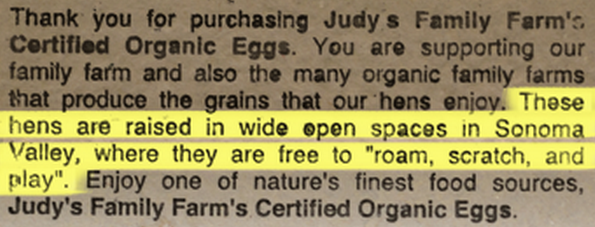
If you would like some Orwellian graphics, see this law suit. From the egg carton at issue:

unnamed (2)

unnamed (4)

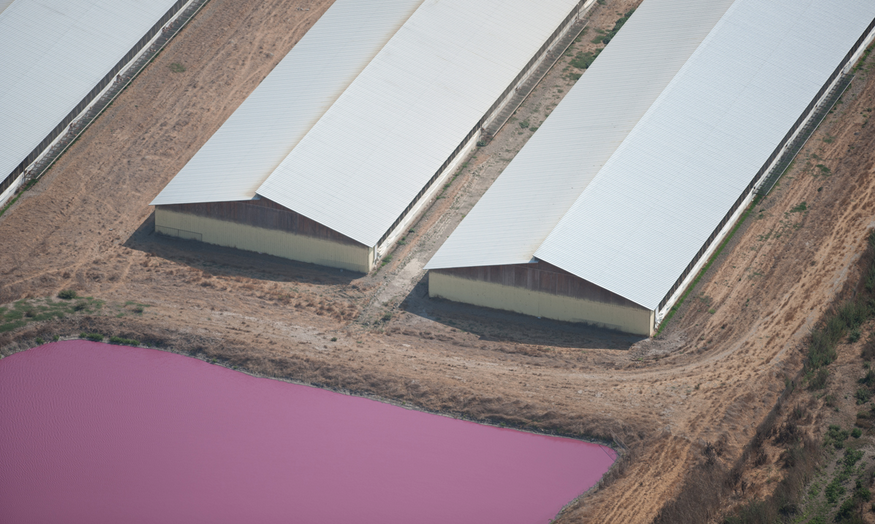
A picture of the sheds (“farm”) where the hens are held:

unnamed (5)

The egg company settled the case, agreeing to change its advertising and pay a fine. It put a statement on its website:

We would like to take a moment to respond to the controversy surrounding some of our egg cartons.  As you may know, an Animal Legal Defense Fund member is suing us, claiming that we have misled consumers into thinking our eggs were produced in open pastures because our carton depicts a boy and girl on the carton interacting with a hen and some of her chicks. The boy and girl were drawn in an outdoor setting, so their claim is that we are somehow telling our customers that all of our hens are raised outdoors.

The cover on our organic egg carton is an artist’s interpretation of us growing up on poultry farms.  . . .

The inside of the carton also says that our hens are free to scratch, roam and play in wide open spaces. Steve wrote this when we created the carton in 1996. Steve is a farmer, not a technical writer, and he was making the comparison between caged birds and our cage free hens . . . .

. . . this lawsuit claims that all of our customers have been duped into thinking that the eggs were produced outdoors and wouldn’t have purchased them otherwise. We wholeheartedly disagree. We believe our customers are more intelligent than that . . . .

We strongly believe our customers are intelligent enough to understand the statements on our egg cartons, and to appreciate the cage free environment in which we house our hens . . . .

Their customers are too smart to fall victim to their deceptions. That’s why they buy their eggs. I think they make Orwell proud. The Cornucopia Institute’s Egg Scorecard (based upon best practices and ethics) gives this company a zero out of a possible 2200 points. This producer is very typical of organic, cage-free egg companies; it just had the misfortune of being in the same region as the Animal Legal Defense Fund’s headquarters.

The reader follows up with more:

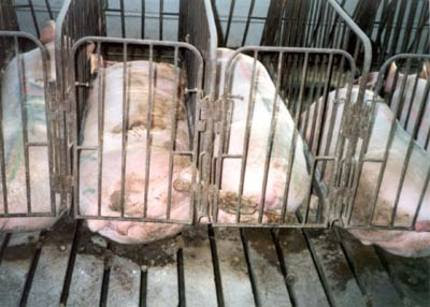
The pork industry uses the term “Individual Maternity Pens”:

Individual maternity pens (IMP) house sows during the most vulnerable duration of their pregnancy. IMPs protect sows from other animals.

Sort of sounds like a nice private room at a hospital. This is what they look like:

unnamed (5)

This is what the National Pork Producers Council said about them: “So our animals can’t turn around for the 2.5 years that they are in the stalls producing piglets. I don’t know who asked the sow if she wanted to turn around….”

A Win For The Right To Go To School

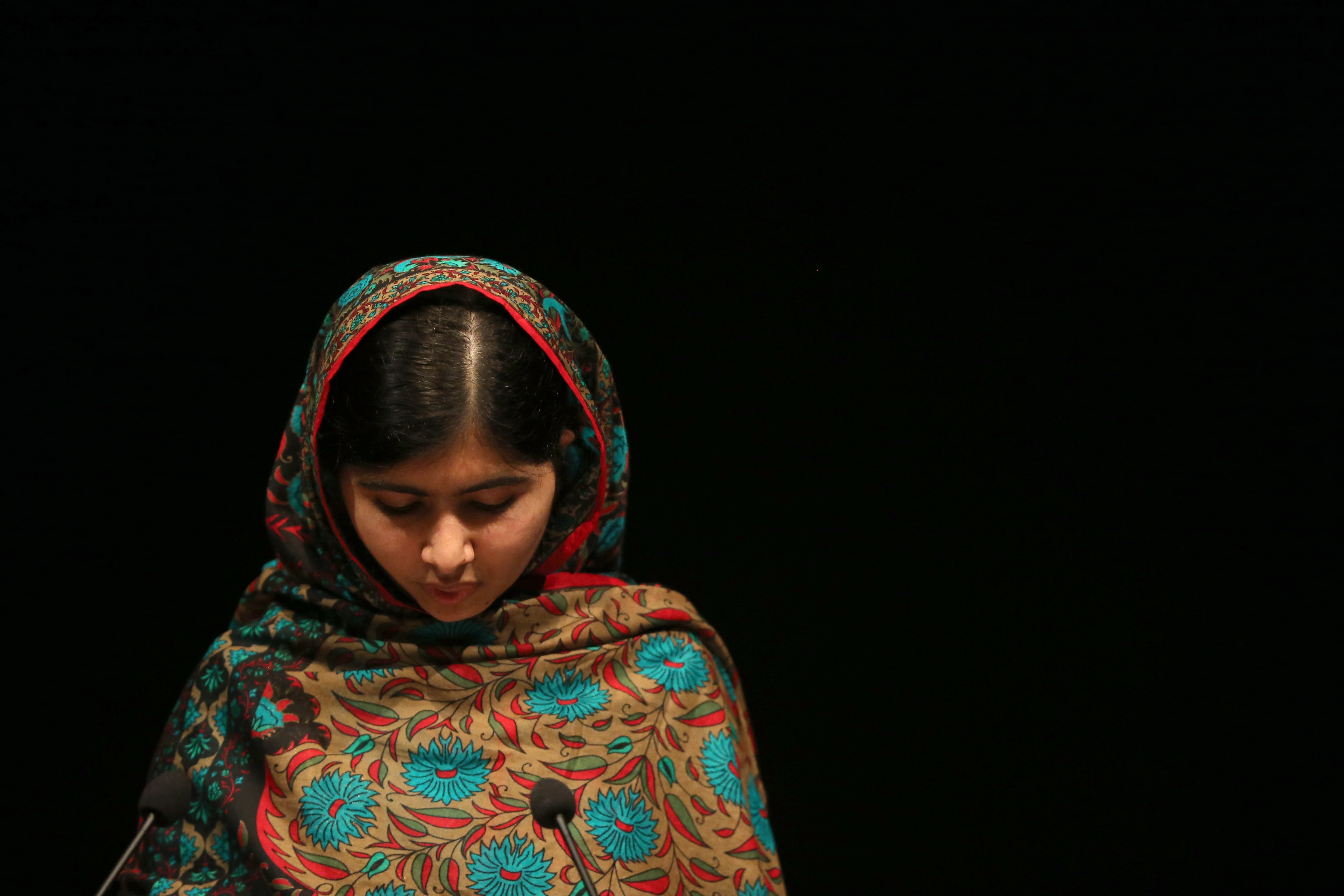
Malala Yousafzai Wins Nobel Peace Prize

Dashiell Bennett introduces 2014’s Nobel Peace Prize winners, Malala Yousafzai and Kailash Satyarthi:

Satyarthi is the founder and head of the Global March Against Child Labor, a large conglomerate of aid groups, trade unions, and other activists working to rescue children from forced labor and other economic exploitation, and to ensure that those who are can receive an education.

Yousafzai became a global icon in 2012, when a Taliban gunman boarded her school bus and shot her in the head in an attempted assassination. (Thursday was the second anniversary of that incident.) Just 15 years old, she was targeted because she had written for the BBC about life under the Taliban, and in particular, highlighted their attempts to bar girls and women from attending school. She survived the shooting (though she continues to have a fatwa against her) and has gone on to become an international spokesperson for childhood education and a symbol of the struggle against Islamic extremism.

Now 17, she is the youngest Nobel laureate ever, and the first to be born in Pakistan.

Max Ehrenfreund highlights the obstacles to school attendance in certain locales:

Eric Edmonds, an economist at Dartmouth College and an expert on child labor, compared a family’s choice to send a child to school in the developing world to an American college graduate’s choice whether not to pursue a master’s degree. Both are considering the cost of schooling, whether they can afford to stop working for a few years, and how much they think an education will benefit them, as well as cultural expectations. “I think that decision is really a lot like the decision that a typical Indian family feels with their 10-year-old son or daughter, and it’s not a one-dimensional decision,” he said.

In some cases, the scant wages a child brings in are so important to a family that sending the child to school is out of the question. “The value of a little bit of income on the household on the margin of subsistence can be quite high,” Edmonds said. In other families, a child must stay at home to take care of the livestock and her younger siblings while her parents work.

Valeria Criscione turns to the politics that may be behind the committee’s selections:

The decision to honor children’s rights this year skirts the current thorny debate over the independence of the five-person committee, which is selected by Norway’s parliament.

Critics have complained that the current makeup of the committee – comprised of Norwegian political veterans like Mr. Jagland, a former Labor prime minister – hamstrings its ability to award the prize. They say that  prevents the committee from tapping other Peace Prize nominees who could prove problematic for Norway’s foreign policy interests, such as Russia’s opposition newspaper Novaya Gazeta or US whistleblower Edward Snowden.

Norway is still reeling from the decision in 2010 to award the Peace Prize to Chinese dissident Liu Xiaobo. The Chinese retaliated by stalling bilateral trade talks with Norway and cooling diplomatic relations.

Chris Allbritton explains why the choice is controversial in Pakistan. He finds that in “the darker regions of the Pakistan social media space, reaction was as scornful as it was celebratory, with many dredging up old theories that Malala was a plot by American, Indian or Israeli intelligence agencies to defame Pakistan”:

The tendency to see plots and enemies behind every tree is a common trait of the English-speaking Pakistani middle class, which is overwhelmingly conservative, nationalistic and suspicious of the West. Non-Muslims, foreigners, anyone embraced by the United States (such as Malala) and even minority religious sects in Pakistan are all seen as agents of foreign powers.

(Of course it doesn’t help that sometimes the suspicions are right. A Pakistani doctor who helped find Osama bin Laden was working for the CIA. The drones bombing the tribal area, angering many, are run by the Company. India really does intrigue against Pakistan in the same way Pakistan plots against India. This part of the world wasn’t referred to as the board for the Great Game by Kipling for nothing.)

Ashley E. McGuire “hope[s] that [Yousafzai] can become a sort of rallying point for feminism”:

If there is such a thing as first world problems, there most certainly is a first world feminism. Critics of Emma Watson’s feminism speech argued that she squandered a good opportunity to talk about violence against women by dragging in first world problems like girls not succeeding in sports. I’ve written three different posts now about five different celebrities, Taylor Swift, Lena Dunham, Emma Watson, Beyoncé, and Emily Ratajkowski all embracing feminism and the cacophony of definitions they have offered. But in almost every case, violence against women comes up. Emma Watson probably got the most mileage on the topic, as she was specifically speaking for a new UN campaign about violence against women around the world.

But it is interesting to note that gender violence remains a baseline for women still clinging to feminism. Conservative feminist writer, Christina Hoff Summers, wrote last year that if we are going to save feminism and ever make it something that women can rally around together, we need to get back to non-first world problems faced by the majority of women not living in peaceful democracies like the United States.

Joshua Keating warns that Malala fandom can take an unsavory turn:

There is something irritatingly smug and condescending about some of the coverage of “the bravest girl in the world.” It was a particular low point when, on The Daily Show, Jon Stewart said “I want to adopt you” to a young woman who’s spoken very publicly about the support she’s received from her father—a pretty brave guy in his own right.

But that’s our problem, not hers. My guess is that someone’s who’s comfortable telling the president of the United States to his face that his military policies are fueling terrorism isn’t going to let herself be reduced to a cuddly caricature. And in any case, it was probably wise for the Nobel committee to pair the very young global celebrity with a relatively unheralded activist with years of work behind him.

And Amy Davidson argues, “It is past time to stop seeing Malala as simply the girl who survived, as a symbol”:

She is a girl who leads: who addressed the United Nations on her sixteenth birthday; who amazes Jon Stewart and asks Barack Obama about drones. (Watch her U.N. speech for a view of her matchlessly inspiring presence, and also for her words against violence.) She was so young when the Taliban set out to assassinate her. The gunmen targeted her—they shouted her name—because she had written on a blog for the BBC about how girls should go to school. They shot and injured the girl she was sitting with, too. In the days that followed, hundreds of people lined up outside the hospital where doctors were trying to save her, offering to donate blood. She would eventually be brought to a Pakistani military hospital and then airlifted to Birmingham, England, for specialized surgery. Looking at what Malala has accomplished since the day she got on that bus, one can imagine, someday, people lining up outside a polling station, to vote for her.

(Photo: Malala Yousafzai speaks during a press conference at the Library of Birmingham after being announced as a recipient of the Nobel Peace Prize, on October 10, 2014 in Birmingham, England. By Christopher Furlong/Getty Images)