Too Few Cooks In The War Room?

In an account “based on interviews with more than 30 current and former U.S. government officials”, David Rohde and Warren Strobel depict the Obama administration’s national security decision-making as an overly centralized affair, with the White House and the president’s inner circle taking control of decisions normally delegated to the Pentagon or the State Department:

In some ways, Obama’s closer control and the frequent marginalization of the State and Defense departments continues a trend begun under Bill Clinton and George W. Bush. But under Obama, the centralization has gone further. It was the White House, not the Pentagon, that decided to send two additional Special Operations troops to Yemen. The White House, not the State Department, now oversees many details of U.S. embassy security—a reaction to Republican attacks over the lethal 2012 assault on the U.S. consulate in Benghazi, Libya. A decision to extend $10 million in non-lethal aid to Ukraine also required White House vetting and approval.

On weightier issues, major decisions sometimes catch senior Cabinet officers unawares. One former senior U.S. official said Obama’s 2011 decision to abandon difficult troop negotiations with Baghdad and remove the last U.S. soldiers from Iraq surprised the Pentagon and was known only by the president and a small circle of aides.

WTF, Turkey?

Jonathan Schanzer wonders if it isn’t time to review Turkey’s NATO membership in light of its lackluster support for the coalition war against ISIS:

Turkey’s stock as a Western ally is plummeting. Ankara stubbornly resists joining the coalition unless it broadens its fight to topple Syria’s Bashar al-Assad. Turkey’s 200 or more F-16 fighter jets sit idle as the Islamic State makes alarming gains across Syria and Iraq. This stands in sharp contrast to other Muslim world allies – including Saudi Arabia, Bahrain, the United Arab Emirates, Qatar and even Jordan – that have taken part in the aerial campaign against the Islamic State. Turkey’s absence is conspicuous. It’s the only NATO ally among these Muslim world partners. To be clear, the fight against the Islamic State is not a NATO mission, but it serves as a reminder of how little Erdogan’s regime has done to help preserve order in the Middle East.

Larison rejects Turkey’s conditions for participation, particularly its demand that the war’s objectives expand to include regime change:

If Turkish support comes at the price of having to fight both sides in Syria, the price is far too high.

It is understandable that the Turkish government doesn’t want to bear the brunt of a ground war in Syria, since there has long been strong opposition in Turkey to the government’s Syria policy and even greater opposition to Turkish involvement in the war, so the administration would be wise not to expect a large Turkish commitment to the war in any case. Turkey is trying to use the war against ISIS to keep pursuing the misguided goal of regime change in Syria that it has pursued for the last three years without success, and the U.S. would be irresponsible to indulge them in this any more than it already has.

Max Fisher explains why Ankara’s demand for a buffer zone won’t fly:

Here is what makes buffer zones, or safe zones, or humanitarian corridors so dangerous: once you have American/British/French/Turkish troops occupying a little sliver of Syria that’s surrounded by ISIS or by Assad forces, it’s all but inevitable that those troops will come under attack. The war in Syria is deeply chaotic and the factions disorganized; it would only be a matter of time. Open fighting between the foreign occupation forces and ISIS or Assad forces could spiral out of control all-too-easily, possibly leading to all-out war. The odds are just very low that we could put American (or British or French or Turkish) troops in the middle of the Syrian civil war and somehow keep the mission contained to protecting a tiny buffer zone.

This may well be why the Pentagon is saying that the buffer zone option is not “on the table.” The exposure to risk and to mission creep is likely just too high.

One of the reasons why the Turks have been reluctant to rescue the Syrian border town of Kobani is that they are loath to help out fighters affiliated with the Kurdistan Workers’ Party (PKK), an independence movement in Turkey. But Nick Danforth and Daphne McCurdy argue that Ankara’s goals and the PKK’s aren’t as incompatible as they seem, especially since the PKK has significantly moderated its separatist aims:

The real opportunity for the Kurds today is not, as many pundits excitedly predict, that they finally have a shot at complete independence. Instead, they finally have the good sense and intellectual foundation to pursue much more modest but pragmatic goals. While the heroic defense of Kobani has won the PKK and PYD a new wave of Western support, Kurdish leaders would do well to remember that their evolution from Stalinism to liberalism has also been crucial to this newfound legitimacy. …

The real question now is whether the AKP and PKK can find common ground. Here is where the nightmare of the Islamic State is instructive. Much has been made about how the AKP wants to replace an old-fashioned version of Turkish nationalism with that of a religious community built around the Muslim idea of the Ummah. So does IS. But when you compare the vision of post-nationalism the AKP spent the last decade promotingbreaking down regional borders through free transit, low tariffs, and trade promotionit sounds a lot more compatible with the PKK’s newly endorsed secular post-nationalism than the savagery of IS.

Berivan Orucoglu points to another reason why Turkey remains more concerned about Assad than ISIS:

Another factor that distinguishes Turkish attitudes toward the Islamic State from those of the West is the refugee crisis. Two years ago, then-Foreign Minister Ahmet Davutoglu famously predicted that Assad would lose power within weeks. He also said that Turkey would be able to accept no more than 100,000 refugees before it would have to take drastic action. Today Assad is still in power, and Turkey is hosting 2 million refugees. The U.S.-led airstrikes have triggered a new influx of people fleeing the war: Almost 100,000 Syrians have fled to Turkey as of Sept. 23. The refugees are not only a huge burden on the Turkish economy, but are also tearing at the country’s social fabric. In many towns the influx of Syrian refugees has brought serious demographic changes, triggering conflicts between the locals and the refugees.

But in Sinan Ülgen’s view, Erdogan’s approach to the Syrian conflict isn’t helping to solve that problem:

By prioritizing the removal of Mr. Assad and expending a huge amount of political capital to convince its partners of the necessity of regime change, Ankara is also losing an opportunity to mobilize international support for its ballooning refugee crisis. Turkey is now host to more than 1.4 million Syrian refugees, with government spending reaching $3.5 billion. Just a week ago, 138,000 Syrian Kurds sought refuge in Turkey, a number surpassing the total number of Syrian refugees accepted by the 28 European Union member states since the beginning of the conflict in 2011.

Yet despite the growing social and material cost of hosting the refugees, Turkey has been unable to mobilize international support for a more equitable sharing of the refugee crisis burden.

Are Approval Ratings Overrated?

During his defense of Obama’s presidency, Krugman argued that approval ratings are no longer a good indicator of a president’s quality:

Obama has a low approval rating compared with earlier presidents. But there are a number of reasons to believe that presidential approval doesn’t mean the same thing that it used to: There is much more party-sorting (in which Republicans never, ever have a good word for a Democratic president, and vice versa), the public is negative on politicians in general, and so on.

Cillizza agrees:

What polarization is in the process of doing — and I’ve had this conversation with Democratic and Republican pollsters — is redefining how we look at the traditional success markers of any president.

Sixty percent-plus approval ratings — unless they come at the very start of a presidency or in the wake of a national disaster or tragedy — are things of the past for as long as the current partisanship gripping the country holds on. Given how vast the gap is between how the two parties view the right next steps for the country — not to mention how negatively they view the other side — it’s impossible to imagine a president enjoying any sort of broad (or even narrow) bipartisan support for any extended period of his or her presidency.

Increasingly, there are two political countries in the U.S.. One, a liberal one, is governed by Barack Obama. The other lacks a clear leader but views itself as at war with Obama’s America.  And, there’s no reason to think that if, say, Florida Republican Sen. Marco Rubio gets elected president in 2016, things will be any different. Rubio will be president of a conservative America. The liberal America will see itself in diametric opposition to that America.

My thoughts on Krugman’s article are here.

Dissents Of The Day

sykes_picot_by_FT

Freddie deBoer emails the Dish:

I find it disappointing that you have not once, in your series of posts on Islam, significantly reflected on 100+ years of American murder, destruction, destabilization, support for dictatorship, and stealing of resources as radicalizing factor in the Muslim world. The constant arguments of the type “well, Christianity doesn’t have a radicalism problem” completely ignores that the Christian world has not been subject to a century-long campaign of aggression and mistreatment by America. There can be no hope for moderation among a people who have been subjected to constant injustice since before either of us was born. Since World War I, there has never been a time when the United States has not been directly and destructively influencing the greater Muslim world. That has radicalized many Muslims. And it is a failure of basic moral principle to be a citizen of a country that is participating in a destabilizing, radicalizing, moderation-undermining campaign against the members of a religion and to turn around and ask why they are not more moderate.

If there is a cancer in the Muslim world, then America’s behavior is the carcinogen. I wrote about this history here.

Sam Harris will never, ever genuinely and meaningfully interrogate the history of American injustice against Muslims. It’s simply too contrary to his enormous prejudice. But you can. And according to the most basic moral principles – that’s Western principles, by the way, Christian principles and secular alike – your responsibility is your own country. In democracy, your job is your own country. So clean your own house before you tell a billion other people how to clean theirs.

Another reader is on the same page as Freddie:

While I found your comments regarding Islam’s relationship to modernity far more reasonable than Maher’s, I was nevertheless troubled by the lack of historical context that informs them.

Reading your post, it’s as if Western colonialism and imperialism never happened. Both you and Maher speak as if modernity is some unmitigated good. But modernity is both liberalism and imperialism. It is the gradual empowerment of women and gays and also the subjugation of foreign cultures in the name of “progress”. It’s true that certain elements of Christianity (and all religions) have had difficulty adjusting to modernism. But it simply will not do to say that Christianity and Islam have the same relationship to modernism. Negri understood this in Empire:

The new anti-modern thrust that defines fundamentalisms might be better understood, then, not as a premodern but as a postmodern project. The post-modernity of fundamentalism has to be recognized primarily in its refusal of modernity as a weapon of Euro-American hegemony–and in this regard Islamic fundamentalism is indeed the paradigmatic case. In the context of Islamic traditions, fundamentalism is postmodern insofar as it rejects the tradition of Islamic modernism for which modernity was always overcoded as assimilation or submission to Euro-American hegemony.

This should not stop us from calling out the brutality toward women and other types of barbarism that we see being justified in the name of Islam (or any ideology). But if you’re going to talk about how large segments of Islam are, on some level “behind” the modernization of other religions let’s acknowledge how our oh-so-modern Western society is in many ways responsible for the distrust that so many Muslims have of “modernism”.

How another puts it:

It cannot be ignored that the Middle East is a broiling mess in large degree because the West made it so, not because of Islam. The West found and exploited oil in the region. The West carved up the territory in ways that made sense only to the colonizers. Outright colonization ended only with installation of Western-friendly, oil-pumping despots who enriched themselves while feeding their people religion as a substitute for agency. Western Jews emigrated to escape Western brutality and the West granted their desire for an ancient homeland there. It is indeed rich to hear Westerners decry Islam as the proximate cause of dysfunction in the area while absolving ourselves of any role.

There is also a bunch of great dissent over at our Facebook page. One reader there:

I believe Andrew’s central hypothesis is flawed, or at least mis-stated. If there is a causal relationship between Islam and a propensity for violence, then we should be able to observe that Muslim populations are more likely to be committing acts of violence. Just imagine the opposite case – what if we could assess the actions of all Muslims for all of history, and compare that to the behavior of all Christians, Hindus, Buddhists, atheists, and people of other faiths, and the net result was that people who were Muslim were no more likely to commit acts of violence than anyone else. Would there be a “trouble with Islam” if there is no difference in actions?

We can test his hypothesis in several ways, and by doing so we can better understand what specific trouble there may be with Islam. First, looking at the intrinsic nature of Islam from the time of the Koran – as often noted, for much of history practitioners of Islam were no more prone to violence than other groups. Even in the past 100 years, if you look at which nations have killed the most people, it is clear that Muslim nations are not high on the list. In fact, if you even look since 9/11, the greatest number of people who have been killed were Christians at the hands of other Christians in Congo. I recognize that US national interests and media coverage have been much more focused on the significantly smaller number of killings in the Muslim world, but if the premise is that Islam causes a greater level of violence than other religions, why doesn’t that show up in the numbers?

I would agree that in the past 10 years, the greatest worldwide killing has been committed by Muslims – first Iraq and then Syria. But if the hypothesis about the problem with Islam is limited to the past 10 years, then it is less about Islam per se and more about current extremist movements within Islam. And if he could make that clarification, his hypothesis is more accurate and thus would eliminate perceptions of bigotry from liberals such as myself.

Furthermore, with a more accurate hypothesis, we could also look more clearly at what the true root cause of the problems are and thus generate a better list of potential corrective actions. I have three alternative hypotheses that I find plausible, although I do not yet have adequate data to confirm them, but each of the three would suggest different possibilities for resolution. (1) Resource deprivation – Jared Diamond’s asserted in Collapse was that this was a major contributing factor to instigating the Rwanda genocide; the violence in Syria was preceded by an unprecedented drought that drove over 70% of the agrarian population into the cities in the 18 months before the violence began; (2) Youth – many of the areas with the greatest level of violence also have the youngest populations – I was surprised to discover for example, less than half the current population in Gaza was even alive when Hamas won the election back in 2006; (3) Wealth inequality – Since 1972, the Middle East has had an exceptional level of wealth imbalance between the Saudis and similar small, oil-rich Gulf states as compared to the Arab street in Egypt, Damascus, etc. At the same time, since the early 1970’s, those wealthy Arab states have increased their funding for Islamic extremists. It is at least a plausible hypothesis that directing public animosity at the US and Israel through Islamic extremism is a way to distract people living on $2/day from from neighbors buying Lamborghinis on a whim. If this seems like a prosaic rational for extremism, remember that Slobodan Milosevic started inciting ethnic hatred in the former Yugoslavia because he was a second rate politician facing poor polling data and a weak economy, and he needed a distraction.

I am not sure yet that any of these three alternative hypotheses are true – but if they are, they each suggest approaches to address. If the problem is intrinsically with Islam as a simplistic reading of Andrew’s hypothesis suggests, then it starts sounding like the only solution would be conversion (or in some other formulations, something like the 30 Years War and a major subsequent maturation of Islam to become an adult religion). It is in all of our interests to diagnose the problem accurately, and thereby be able to see with more clarity the potential solutions.

More unfiltered feedback from readers on this Facebook post as well. A sample:

I know you don’t view “those countless Muslims and Muslim Americans whose faith is real and deep and admirable” as outliers in their own faith, but the logical conclusion of yours and Harris’ argument leads to exactly just that conclusion. Extremism and fanaticism simply don’t occur in a vacuum, nor are they inbred characteristics. You use the example of Saddam, a murderous crypto-fascist who presided over a state you have now argued countless times *should never have existed to begin with* as an example of the unique and innate violence of Islam as though there were a different scenario whereby such a state could ever exist without massive coercion.

Sure, you’re free to criticize a current manifestation of any religion, but the manifestation you cite is still so marginal, and sits so far outside the lived experience of the vast majority of the worlds Muslims (90% of whom aren’t even Arab). A religiously observant Muslim in Michigan is as confused and as troubled by the rise of ISIS as you are yet you would find that person morally culpable for that very thing. The Ku Klux Klan enjoyed greater sanction among mainstream Protestants, not just in the South, at the height of their powers, and yet we (perhaps you, not Harris) look upon these movements as self-serving aberrations of Christian doctrine and not manifestations of them.

Maybe a lot of those “countless” Muslims you described are tired having to apologize to the Sam Harrises and Bill Mahers of the world (the latter of whom seemed either unwilling or unable to engage with Muslims living in the US in his film, Religulous). They are tired of having to shoulder collective responsibilities for monsters that were not of their own making. Islam doesn’t explain the Assads, nor does it explain why Saudi Arabia was given carte Blanche to arm the rebels in the first place, nor does it explain Erdogan’s vaguely neo-ottoman revanchism, nor does it explain most of the West’s encounter with the Arab World since WWII. And that is really what we’re talking about here (the prototypical Muslim we have in mind is rarely ever African-American, Malaysian, or even Iranian).

I don’t think you’re assessment is bigoted, just incredibly blinkered. And you’re free to believe the Ayaans and Irshads of the world hold the key to unlocking a new pluralistic era in Islam, but good luck finding any (even Progressive) Muslims who agree with you on that.

The above map is “the Sykes-Picot treaty that carved up the Middle East”. Its voxplanation:

You hear a lot today about this treaty, in which the UK and French (and Russian) Empires secretly agreed to divide up the Ottoman Empire’s last MidEastern regions among themselves. Crucially, the borders between the French and British “zones” later became the borders between Iraq, Syria, and Jordan. Because those later-independent states had largely arbitrary borders that forced disparate ethnic and religious groups together, and because those groups are still in terrible conflict with one another, Sykes-Picot is often cited as a cause of warfare and violence and extremism in the Middle East. But scholars are still debating this theory, which may be too simple to be true.

Hong Kong Heats Up Again

Demonstrators returned to the streets in droves today after the government abruptly cancelled talks with the protest movement:

Crunch negotiations between protesters and Beijing-backed city officials were slated for Friday, but fell apart Thursday after the government pulled out, blaming student leaders for attempting to escalate demonstrations. The decision deepened the political crisis convulsing the Asian financial hub, with the failure of talks expected to reinvigorate mass rallies that have paralysed parts of the city for nearly two weeks. …

Sunny Lo, a political analyst at the Hong Kong Institute of Education, said the government was spooked by a promise from pro-democracy lawmakers Thursday to disrupt the workings of the government in the city’s parliament, known locally as LegCo, in a show of support for protesters. “This is not a good sign now. The temperature is rising both inside and outside LegCo,” he told AFP. “If (the) Occupy Central movement drags on for a few more weeks I’m afraid police action would be inevitable. It would just be a matter of time,” he added.

In a roundup of expert opinion on the current situation, George Chen doubts that Occupy Central is coming to an end anytime soon:

By all means, we are now seeing the protest movement becoming a very long-term political struggle in Hong Kong. I’m not talking about two months or three months. You may see fewer protesters blocking the roads by the end of the year but the Occupy Central movement means a new era for Hong Kong — we will see more on-and-off protests, of a large or small scale, around the city, and for different causes. It is unfortunate to see Hong Kong becoming a less happy and more divided society. It’s even more unfortunate to see that the governments in Beijing and Hong Kong perhaps haven’t really realized what Occupy Central means for Hong Kong. Simply labeling it an “unlawful” event won’t be helpful at all to end the crisis.

Kang Yi expects the government’s decision to backfire:

I talked to a few people shortly after the government called off the scheduled meeting. While some of them supported the movement and others claimed to be neutral, they all perceived the government’s move in a negative way, criticizing it for “being hypocritical” and “throwing its weight around.” The government’s flip-flop may incur a strong feeling of aversion among citizens. Also, Carrie Lam may have misjudged the situation by commenting that “the number of protesters has seen a decline.” In an era where the Internet’s public sphere has flourished, online mobilization can be accomplished swiftly. People could come back to the street at any time.

And Allen Carlson advises the demonstrators to bide their time and let the authorities keep making mistakes:

For now, I would tell them to do nothing. If the rug is being as unceremoniously pulled out from beneath the talks as now appears to be the case, it is the Hong Kong government and Beijing that will look to all as incredibly disingenuous, clumsy, and uncompromising. In other words, this has the potential to be a public relations disaster for the government. Anything the protesters do, in terms of taking to the streets, would only, for the time being, undermine the crystal clear nature of such a blundering move. This being said, once the dust settles the protesters will be in a stronger position to make their case to the people of Hong Kong and the rest of the world about the legitimacy of their concerns and misgivings about a government that they no longer trust.

The Bloomberg View editors advocate a compromise:

To get anywhere, both sides have to climb down from their stated positions. Protesters should temper calls for Hong Kong Chief Executive Leung Chun-ying to resign; an investigation into payments he received from an Australian company could accomplish that for them. Their central demand — that the Chinese government allow future candidates for chief executive to be nominated directly by the public — is no less a nonstarter. For their part, Hong Kong officials must stop tonelessly insisting upon Beijing’s formula for the elections, which allows for only two to three candidates, each of whom must be approved by a 1,200-member nominating committee that is stacked with Beijing loyalists. The city’s leaders should focus on expanding what little wiggle room this framework allows.

The Trouble With Islam, Ctd

A few further thoughts. First off, another blast of contempt for the kind of warped mind (former Marxist David Horowitz’s) that can produce a piece of excrescence like this, and for the kind of degenerate magazine (National Review) that would actually publish it. The complete conflation of ISIS with American Muslims is so foul, and the use of such hatred for further religious warfare abroad so perilous, one has to hope it was a piece of high-trolling. But it isn’t. Horowitz and Geller are the most vicious of McCarthyite bigots, and need to be exposed and countered at every turn.

Second, a recommendation of this piece by M. A. Muqtedar Khan. This is a vital point:

Muslim scholars have tried to counteract the threat [of violent extremists] but their biggest error in doing so is that they limit their condemnation to political extremism without also condemning the theological extremism that underpins it. For example, when Islamic leaders condemn acts of violence against intellectuals or minorities after accusations of blasphemy, they do not condemn the scholars who give fatwas of blasphemy or takfir (excommunication). They also do not refute the theology that supports use of such vigilantism.

Many Islamic groups condemned both Boko Haram and ISIS as un-Islamic. This is a welcome development. But they did not also condemn the Salafi theology that underpins the literal and shallow understanding of Islamic principles that inform groups such as ISIS. It is like trying to treat the symptoms while allowing the cause to metastasize. So even if Boko Haram and ISIS are dealt with, new groups will take their place.

You have to deal with the theology or you are not really dealing with the problem at all. And yes, there is a problem today. Fareed notes:

In 2013, of the top 10 groups that perpetrated terrorist attacks, seven were Muslim. Of the top 10 countries where terrorist attacks took place, seven were Muslim-majority. The Pew Research Center rates countries on the level of restrictions that governments impose on the free exercise of religion. Of the 24 most restrictive countries, 19 are Muslim-majority. Of the 21 countries that have laws against apostasy, all have Muslim majorities.

I think the apostasy question is the core one. It’s an area where one version of Islam – far too popular in many Muslim-majority countries – is simply at odds with any basic understanding of human freedom.

Read all of our recent debate on Islam here.

The Earthquake In Britain

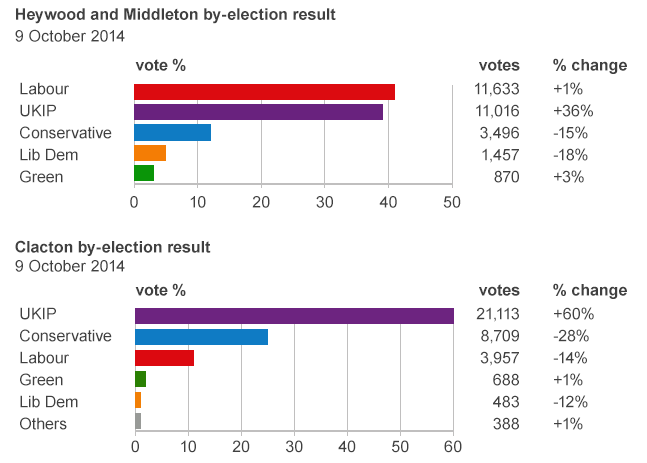
Two by-elections, only months before the next general election, have sent tremors through Britain’s major political parties. The United Kingdom Independence Party (UKIP) just won one seat from the Tories in the south and very nearly toppled a safe Labour seat in the north. The southern seat was won by its previous MP, a talented and highly intelligent conservative reformer, Douglas Carswell, who defected from the Conservatives to UKIP. You can see the damage to the Tories here:

Screen Shot 2014-10-10 at 12.34.36 PM

This is populism fueled by the failure of the establishment to respond to the needs of the voters outside the London bubble. Here’s a flavor of what’s going on as penned by a Newsweek reporter on the campaign trail with Farage:

Walking at his side as he toured the streets, I’d expected him to be greeted, at least occasionally, with a salvo of abuse. Instead he was received – everywhere – with an enthusiasm verging on euphoria … A woman approaches Farage, who is wearing his trademark blazer and tie. Heavily tattooed and in her late twenties, she doesn’t look like a natural Ukip supporter. She shakes his hand.

“How do you feel,” he asks, “about the other parties?” “Wankers,” she replies.

Alas, the party is also fueled by xenophobia and bigotry. To say that this part of the profile hit me like a ton of bricks would be an understatement:

Today,” Farage adds, “if you’re an Indian engineer, say, your chances of admission are limited. Ukip want to control the quantity and quality of people who come.” “Quality? How do you define quality people?” “It’s simple. That Latvian convicted murderer shouldn’t have been allowed here.” “So quality means people without a homicide conviction?” “Yes. And people who do not have HIV, to be frank. That’s a good start. And people with a skill.”

Farage has not backed down from associating murderers with people with HIV, and that says a lot about the underlying attitudes that have fueled his rise. Carswell, mercifully, refused to endorse the idea, preferring to emphasize a skills-centered immigration system, as in Australia.

So in Britain, we have the meteoric rise of a party fueled by popular dissatisfaction with the major parties, fueled by xenophobia, and border paranoia, and obsessed with the issue of immigration. The question to my mind is when this kind of combination finds a tribune in America. Ted Cruz, anyone?

In Defense Of Gordon College, Ctd

Several readers comment on the controversy over Gordon’s policy on homosexuality:

This is clear bigotry. The college can believe anything it wants, but the organizations that set up “accredited” requirements can also be free to set their own requirements.  Being accredited is not a right; it’s a privilege.

Orthodox Christian teachings on sexuality are not ipso facto bigotry. Intolerance of others’ sincere views comes closer to that definition. Another reader fisks me:

Gordon alum here, who has been working for LGBT acceptance at Gordon for many years, and to this day. You’re so wrong. And it’s so disheartening to be thrown under the bus.

“They key issue here, it seems to me, is whether the college’s orthodox views about sex are being fairly implemented.”

What are you trying to say? The Gordon administration’s view is that “homosexual practice” is inherently sinful. Straight students can and do get married (inadvisably young, perhaps) and have sex; gay students would be expelled for doing so. How can such a policy be “fairly implemented”?

“And the college – which implemented its own review of this policy – seems attuned (see the last sentence) to the problems for gay students in such a setting.”

That is false. If you take the time to read the stories of actual Gordon students and alumni, you will find that LGBT students experience hate speech, anxiety, depression, suicidality, and everything else you would expect from a campus that declares homosexuality to be sinful, and promotes ex-gay therapy to its students.

I’m wondering if the source of our disagreement is that you might simply not realize that gay marriage is not recognized by the college. Here is the policy at issue, that bans “homosexual practice”. Not “homosexual practice outside marriage”. Any “homosexual practice”. It’s lumped in with theft and drunkenness, as things that “will not be tolerated”.

Still want to defend Gordon College?

Absolutely. Do I agree with them? Not at all. Did I agree with the Boy Scouts with their previous ban on gay kids? No. But one principle of liberalism is that you can profoundly disagree with someone while accepting their right to do as they see fit according to their conscience. Yes, marriage is barred by the college for gay kids, while heterosexual marriage (and thereby sex) is allowed. That is, in a very limited way, a double standard of sorts – if with respect to college kids, an uncommon one. But is my reader really arguing that an orthodox Christian college should therefore have to repudiate its own religious doctrines or not get accreditation? That simply shreds any concept of religious liberty. It removes any possibility for the college evolving on this issue on Christian terms – the kind of thing that Matthew Vines is working on. It would put countless religious institutions beyond the pale. I’m sorry but that is not what I think a liberal society should mean.

As for this notion that I am throwing my fellow gays under the bus.

This is not the first time I have been accused of this, and I’m sure it won’t be the last. All I can say is that I have spent a lot of my life countering the theology and the politics of homophobia and that this is my sincere belief about what a free society means. I’ve been consistent from the get-go on this – just check out Virtually Normal. I am not going to change my mind because it makes me highly toxic and beyond-the-pale in the gay community at large. I understand that and have long accepted it. Another points to practical evidence of a double standard at Gordon:

You wrote that it is important to know how Gordon College treats homosexual physical encounters vs those of straight couples. As I suspect the college doesn’t keep track exactly, I can say this: boy, do Gordon College boys throw some amazing parties and have plenty of premarital sex.

As a student in Boston in the mid 2000s, and a native Bostonian, I knew students at many of the colleges in Eastern Massachusetts. I knew one boy, whom I played ice hockey with, who went off to Gordon, as his parents wanted him straightened out after being minimally troublesome in high school. It wasn’t long before he realised how easy it was to get to Salem from Gordon, and Salem State is a great school for parties. A small chunk from my high school ended up at Salem State, and it was a good place for my old hockey team to meet up. The hockey boys from Gordon that my friend now knew would come down to Salem and effectively co-host parties. And these were crazy affairs, which I have a hard time describing, simply because it was rather the point to drink to blackout.

Anyway, the Gordon boys had no problems with the typical college amorality, and you were just as likely to find a Gordon boy having random hookup sex on one of the futons as you were to find a boy from Salem State, Endicott, UMass, or anyone else who happened to be in town from Boston, a short train ride away. Sometimes the Gordon boys snuck girls back into their dorms to spend the night. My old friend got caught with a girl in his room, and while he had to apologise, it didn’t seem like a big deal. The schools seemed to take a policy of “try and keep it off campus”, but there were never any consequences for anyone I knew who engaged in all sorts of sexual acts on and off campus … but always between opposite sex partners.

The problem with Gordon College is less to do with the students, by the way, and more to do with the fact they want to turn away any openly LGBT job applicants. Massachusetts has long been against intolerance in this way – there’s a reason Catholic adoption agencies left the state – and it doesn’t surprise me at all that targeting intolerant educational bodies that receive federal funding has occurred. Can we seriously say the federal government should be backing a college that wants a policy of straights-only? I guess ultimately if that’s what the federal government does, that’s one thing, but Massachusetts has been ahead in many other ways, and I hope it continues to push for progress and a higher standard of equality.

How To Explain The World

Funny or Die channels the post-college know-it-alls at Vox:

After spending the past few weeks reading these Wikipedia articles in all of my spare moments I feel dumber and more discouraged than I did before. Human societies are complicated and when assessing history it is all to easy to assign causation after the fact. But when it comes to really be able to draw any meaningful lessons about how to improve in the future, things are less certain. We seem to be doomed to repeat our mistakes for all time.

So, why is shit so fucked in the Middle East? Because humans live there and humans are really good at fucking shit up. Will shit be fucked forever? Probably. But maybe if we collectively take a breath and let the sins of our fathers and mothers be forgiven, we can change the eternal return of the same fucking shit [cue [Aimee Mann’s “Wise Up.”]]

Okay. Now time to go read some Wikipedia pages about something that doesn’t depress the fuck out of me. I think I’ll start with pallas’s cats.

Update from a reader:

I fear that search for a non-depressing subject by turning to Wikipedia’s article on Pallas’s cats will be undercut as soon as he reaches this sentence: “It is negatively affected by habitat degradation, prey base decline, and hunting, and has therefore been classified as Near Threatened by IUCN since 2002.”