ISIS Murders Another American

by Jonah Shepp

https://twitter.com/Max_Fisher/statuses/506866837955813376

News broke today that ISIS has made good on their threat to behead kidnapped journalist Steven Sotloff, when a video of the murder appeared on social media:

A masked figure in the video also issued a threat against a British hostage, a man the group named as David Haines, and warned governments to back off “this evil alliance of America against the Islamic State”, the SITE monitoring service said. The purported executioner appeared to be the same British-accented man who appeared in an Aug. 19 video showing the killing of American journalist James Foley, and it showed a similar desert setting. In both videos, the captives wore orange jumpsuits. “I’m back, Obama, and I’m back because of your arrogant foreign policy towards the Islamic State, because of your insistence on continuing your bombings and … on Mosul Dam, despite our serious warnings,” the man said. “So just as your missiles continue to strike our people, our knife will continue to strike the necks of your people.”

For those who must have the details, the Wire provides a fuller account of the video, including Sotloff’s last words, in which he is forced to lament that he is “paying the price” for the US intervention in Iraq. Much as I’m convinced that Sotloff’s murder will do nothing for the jihadists but shock and disgust the world even more than their past atrocities already have, that’s not much comfort to his poor mother.

Our Microbes, Ourselves

Ed Yong reviews the first results from the Home Microbiome Project, which seeks to “map” the ecologies of microbes we carry with us wherever we go. What researchers learned after analyzing six weeks’ worth of participants’ swabs from around their homes:

[I]t rapidly became clear that each home has a distinctive microbiome, which comes largely from the people who live in it. Light switches and doorknobs look like hands. Floor looks like feet. Kitchen countertops look like skin. We turn our homes into microbial reflections of ourselves.

This happens quickly. As soon as we move into a space, we inject microbes into it, and those bugs colonise the area within 24 hours. One of the young couples demonstrated this in the starkest way:

at the start of the study, they were staying in a hotel. After they moved, their new home was microbially indistinguishable from the hotel room. “People always say, “Ewwwww, someone else was in this room and it has their microbes all over it.” That’s irrelevant,” says [researcher Jack] Gilbert. You are constantly overwriting the microbes in the world around you with your own. When you move house, your microbial aura moves too.

Yong shares why Gilbert decided to welcome a new addition to his family – a shelter dog named Captain Bo Diggley – after seeing the study’s results:

Dogs supercharge the flow of microbes between people and their homes. If two people share a house, they also tend to share their microbes, and couples do so more than mere roommates. But if there’s a dog around, that traffic surges. Dogs also increase the microbial diversity of a home by bringing in bacteria from the outside world. In a world where the presence of bacteria is equated to filth and squalor, some people might see that as a bad thing. Gilbert saw it as a plus. We need microbes to help train our immune systems and to ensure that they develop properly. “We wanted to make sure that our kids had that capacity,” he says.

An Actual Fight Over Democracy

by Jonah Shepp

The crises in the Middle East and Ukraine are frequently described in ideological terms, as battles between freedom and tyranny, liberal democracy and illiberal authoritarianism. The latest piece in this vein is from Lilia Shevtsova, who calls Russia “an advance combat unit of the new global authoritarianism, with China acting as its informal leader and waiting in the wings to seize its own opportunities”. I think this argument may give both Russia and China too much credit, especially as the informal leader of the new global authoritarianism is feeling threatened by a pro-democracy protest movement in Hong Kong. Evan Osnos looks in:

On Sunday, the Beijing government rejected demands for free, open elections for Hong Kong’s next chief executive, in 2017, enraging protesters who had called for broad rights to nominate candidates. China’s National People’s Congress announced a plan by which nominees must be vetted and approved by more than fifty per cent of a committee that is likely to be stacked with those who heed Beijing’s wishes. … Hong Kong’s growing activist network, known as Occupy Central (named after the city’s downtown) has increasingly alarmed leaders in Beijing, and they now describe the activism as a brush fire that could sweep over the mainland. In a piece published on Saturday, the People’s Daily, the Communist Party mouthpiece, hinted about foreign agitators “attempting to turn Hong Kong into a bridgehead for subverting and infiltrating the Chinese mainland. This can absolutely not be permitted.”

Osnos analyzes the situation as a competition between nationalism and globalism; his analysis is instructive, but at a time when political thinkers are worrying themselves over the possibility that the Western model of liberalism is in decline or failing to gain traction in the developing world, this long-simmering conflict looks to me like the most clear-cut test case of liberalism vs. authoritarianism in the world today.

When the 25th anniversary of the Tiananmen Square massacre came around in June, Hong Kong stirred. And as Isaac Stone Fish points out, the Hong Kong protests point to the PRC’s bigger-picture problem of containing the demand for democracy, which people tend to like and want to keep once they get a chance to try it out:

Beijing could crack down on Hong Kong, but it needs to be careful not to push too hard — that risks alienating the majority of Hong Kongers who aren’t bothered by the status quo. More importantly, Beijing is very wary of the message communicated to Taiwan, the self-governing island of roughly 23 million people claimed by China. For decades, Beijing’s paramount foreign policy goal has been the reunification of Taiwan to the mainland. Probably the most likely way for that to happen would be a situation similar to Hong Kong — whereby Taiwanese would enjoy significant autonomy and a wide range of political freedoms. But the more Hong Kongers suffer, the more difficult it will be for the CCP to make the case that Taiwanese should voluntarily join the mainland.

Noah Feldman also sees the decision as a message to Taiwan:

The latest Hong Kong development strengthens the case for taking the risk of promoting independence. China is signaling that it will not democratize even at the margins during Xi’s leadership. That means nationalism — Xi’s “Chinese Dream” — will continue to be an important source of legitimacy, and that in 10 years, China will probably only be closer to insisting that Taiwan become Chinese.

And Rachel Lu connects it to Hong Kong’s declining economic clout relative to the mainland, which is highlighted in a new report:

In taking a hard-line stance against granting true democracy to Hong Kong, the Chinese government has made clear to the rest of China — as well as Taiwan, which Beijing considers a rogue province — that threats of civil disobedience will not lead to political concessions. The central government probably also believes that it can now cast a menacing shadow over Hong Kong with its increasing economic weight. The report by Trigger Trend does not appear to be commissioned by the Chinese government, but the report’s conclusions have been widely publicized in mainland media and align nicely with the central government’s unspoken message to Hong Kongers: The special administrative region is no longer very special.

I have little background in Chinese politics or history, so I have no expert insight to render here, but even from casually following the news out of China, one has to wonder how tenable the status quo is. Capitalism has won the day, as it has in most of the world: does liberalism necessarily follow? It certainly hasn’t done so everywhere, but what’s interesting to me about China is that there are about 30 million people in Taiwan and Hong Kong who have long since proven that liberal democracy can speak Mandarin. In other words, one can’t credibly say that China is culturally indisposed toward democracy, as is often said (unfairly, I think) of Russia, Iran, and the Arab world. Of course, the legacy of Maoism and the past half-century of history bear heavily on the politics of the mainland, but it’s entirely possible that a free China could emerge in the long run, provided a catastrophic war doesn’t derail everything.

In any case, again, it’s certainly worth watching. China’s political trajectory has huge implications for American foreign policy (and indeed, for the entire world) in the coming decades. Which brings me to a couple questions I’ve had in the back of my head for a while and would like to pose to the collective brain that is the Dish readership: 1) what do you think of the prospects for democracy in China? and 2) given the choice of an ascendent Russia and an ascendent China, which should the US prefer? My off-the-cuff answer is “obviously China”, but I’d be curious to hear what you all think. E-mail me your ideas at dish@andrewsullivan.com. I’ll revisit these questions later this week, hopefully with some brilliant insights from the inbox.

Report: Andrew Cuomo Did Unsavory Thing Everyone Already Suspected He Did

by Alex Pareene

New York Governor Andrew Cuomo Gives Annual State Of State Address

It’s not a perfect measure of partisan leaning, but according to the 2012 election results, New York is more Democratic than California and Minnesota, two states where Democrats control the entirety of the state governments, and where things have not yet completely collapsed in a morass of welfare handouts and tax hikes. So it’s a bit strange that the Republican Party controls the New York state Senate, the body where, traditionally, liberal legislative priorities have gone to die. It’s stranger when you learn that New York voters did actually give Democrats the majority in the Senate in 2012, at which point a coalition of state Senate Democrats known as the Independent Democratic coalition broke off from the party and formally allied with the GOP. Thus, the longtime state Senate Republican majority – the majority that had successfully thwarted nearly every liberal policy push made by the previous two Democratic governors – was preserved.

Andrew Cuomo likes to paint himself as the governor who saved New York from the political dysfunction that typified state politics during the reigns of his predecessors, David Paterson and Eliot Spitzer. Cuomo is the man who forced the sclerotic state legislature to finally act on marriage equality, criminal justice reform, and gun control. You would think that such a governor would prefer to work with Democratic majorities in both state legislative bodies, because, you know, those are all Democratic party priorities that Republicans (mostly) oppose.

You would be wrong. Blake Zeff (full disclosure: he’s my former editor) has a story at Capital New York that confirms what most observers of New York politics already suspected: Cuomo was instrumental in forging the alliance between the IDC and the GOP, because he never actually wanted his own party to wield real power in Albany:

When the coalition was created, Cuomo spoke with IDC leader Jeff Klein to offer advice on how to publicly sell the arrangement and move it forward. According to multiple sources, the governor advised the leaders of the new alliance to emphasize “progress on key issues,” such as campaign finance reform, stop and frisk and increasing the minimum wage. (The conference would use just that language in its announcement, and later release a minimum wage report that February and campaign finance plan in April.)

To move the arrangement forward, the governor and Schwartz would talk directly to Republican leaders and Klein. To help make the coalition work, the governor regularly spoke (by phone and in person) with GOP deputy majority leader Tom Libous, who was effectively Cuomo’s go-to person in the Republican Senate conference. GOP majority leader Dean Skelos was also involved in the discussion, and the governor would talk often in particular with top Skelos aide Robert Mujica. Meanwhile, another top administration official, Joe Percoco, was dispatched to deal with the Senate Democratic conference to try to assuage their concerns even as the governor helped their rivals.

Why would Cuomo do this?

In part because Cuomo’s method of “getting things done” is actually a very old fashioned one, with a rich history of use in New York in particular: It involves shady back-room dealing, obsessive secrecy, strong-arming of opponents, and frequent outright dishonesty. (Spitzer did try similar tactics, but his fatal flaw was that he fought state Republicans instead of governing with – and like – them.) The IDC, then, has been extremely useful for Cuomo. The alliance allows him to push through legislation that liberals would balk at if they held power in the Senate, and the coalition also makes a convenient scapegoat for the times when Cuomo is unable – or, more likely, unwilling – to advance a particular liberal cause.

Cuomo, understand, is a ’90s vintage pro-corporate “New Democrat” – he’s still that Clinton-era DLC type who blames his party’s failings on traditional liberalism – and he is attempting to maintain power in a state where the Democratic Party is, mostly, to the left of the national party, especially on economic issues. But Cuomo believes the key to his own political future rests on appealing to right-leaning whites, because he assumes he won’t have to do anything in particular to win the votes of liberal, black, and Latino New Yorkers. And he seems to just genuinely dislike liberals, period. (See: his not-at-all subtle undermining of New York City mayor and economic populist Bill de Blasio.)

Cuomo is running for reelection this year, and he sort of belatedly realized that he may have a bit of a problem with the state’s liberals. So rather than risk an unpredictable three-way race, he negotiated himself the support of the left-wing Working Families Party. (He then promptly announced plans to undermine them by founding an unasked-for new political party, for women.) As part of his agreement with the WFP, Cuomo agreed to finally denounce the GOP-IDC alliance. He did not do so with much enthusiasm. This is the very alliance that thwarted Cuomo’s much-touted women’s equality and campaign finance bills, and the governor was still unwilling to publicly go on the record and say that he thought his own political party should control the state Senate:

Cuomo finally condemned the alliance, under pressure, after he was given a choice this spring by the Working Families Party between publicly calling for the IDC to caucus with Senate Democrats and losing WFP’s endorsement and ballot line to Fordham Law professor Zephyr Teachout, who he now faces in the primary. At first the governor resisted the demand, with two sources saying he initially refused to include it in a video he recorded for WFP delegates at the party convention in late May. But ultimately he blinked and made the deal, saying in the video, “the Senate has been a problem” and “we must change the leadership of the Senate.”

Cuomo can’t seem to wrap his mind around the crazy idea that maybe the easiest way to get things you support passed is to help elect people who also want those things to pass, instead of people who don’t support those things but are open to being bribed or threatened into changing their minds.

After the convention, Zephyr Teachout, Cuomo’s challenger for the WFP nomination, launched a Democratic Party primary campaign. The election is Tuesday, September 9. There’s a decent chance Cuomo will be forced to ditch the very conservative running mate he selected, which would be funny.

The Gun Lobby’s Allergy To Any Gun Control

by Dish Staff

Last week, a nine-year-old firing an uzi accidentally shot and killed her instructor. Matt Valentine identifies pro-gun advocates critical of “putting a submachine gun in the hands of a slight nine year old” but he has “yet to hear any prominent gun rights advocates call for a change to the law—even to prohibit behavior they consider foolish and dangerous”:

To suggest a new regulation, no matter how reasonable, would be wholesale defection from the party line. The NRA tells us that gun laws are worse than useless. Criminals won’t obey them, so new laws “only punish lawful gun owners,” according to Executive Vice President Wayne LaPierre.

Which regulations is he talking about? Take your pick—the NRA’s Institute for Legislative Affairs uses that language, “punishment for law-abiding gun owners,” to describe dozens of proposed state and federal laws, from background checks to magazine capacity restrictions to safe storage laws—even to laws banning the transfer of ammunition to people who aren’t authorized to have guns. The same rhetoric has been used by gun-friendly politicians and pundits for years. “Bad guys don’t follow the laws,” Sarah Palin said after the Aurora, Colorado, theater shooting. “Restricting more of America’s freedoms when it comes to self-defense isn’t the answer.”

That line of argument has always been a tautological black hole, but it seems an especially inadequate rationale for opposing a law prohibiting children from using fully automatic weapons.

Amy Davidson sighs:

The same political forces that gather around gun rights are those railing against government in any form, even the kind that involves keeping children and their gun instructors, or other teachers, safe. We are left not only with lax gun laws but shake-and-bake shooting ranges. This is part of the explanation for why talking to the gun lobby about “common-sense regulations” never seems to go well. They are drawing on, and stoking, a view that presumes the foolishness of regulations. It is sad and telling that the only department left to look into Vacca’s death is the state equivalent of the Occupational Safety and Health Administration—regularly derided by Republicans—and that it’s unlikely to be able to do much at all.

Chart Of The Day

by Dish Staff

GOP Foreign Policy

The GOP is getting more hawkish:

Less than a year ago, just 18 percent of GOPers said that the United States does “too little” when it comes to helping solve the world’s problems, according to a Pew Research Center poll. Today, that number has more than doubled, to 46 percent. Over that same span – from November to today – the percentage of Republicans who say the United States does “too much” has dropped from 52 percent to 37 percent, and those who say the United States does about the right amount has declined from 26 percent to 14 percent.

Fight Ebola, Increase Hunger

by Dish Staff

A couple weeks ago, Laurie Garrett advocated for a stronger response to the outbreak. Yesterday, Adia Benton and Kim Yi Dionne called out Garrett for fear-mongering:

In her recommendations, Garrett often draws on her experience reporting on the Ebola epidemic in 1995 in Zaire (the work that won her a Pulitzer Prize). During this outbreak, Zaire’s ruler, the notorious Mobutu Sese Seko, isolated Kikwit, the affected region, with military force to keep people from leaving the city of 400,000 people. Honestly: Is Mobutu’s a model of health governance we want to repeat? Under his militarized quarantine, prices of food escalated, and people were deprived of common household goods. There is growing evidence that this is happening in Sierra Leone, Liberia and Guinea.

Indeed, it appears that steps intended “to prevent the disease’s spread have hampered both food production and caused prices to soar”:

The Ebola outbreak is causing food harvests to dwindle in West Africa, the U.N.’s Food and Agriculture Organization said Tuesday. After infecting and killing more than 1,550 people across five countries, the disease has also put food supply “at serious risk,” with the F.A.O. issuing a special alert for Liberia, Sierra Leone, and Guinea, the three countries most heavily affected by the outbreak.

Elizabeth Barber has more details:

“Even prior to the Ebola outbreak, households in some of the most affected areas were spending up to 80% of their incomes on food,” Vincent Martin, head of an FAO unit in Dakar, Senegal, said in a statement. “Now these latest price spikes are effectively putting food completely out of their reach.”

The View From Your Window Contest: Winner #220

by Chas Danner & Chris Bodenner

VFYWC-220

A reader sees the Far East:

Aberdeen Fishing Village, Southern edge of Hong Kong Island, China.

A much more detailed entry:

My guess is that this a view of the Mediterranean coast of Peniscola, Spain. Several factors lead me to draw this conclusion. The piece of land appears to be a peninsula because part of it juts out farther than the rest, creating two inlets of water. The water is almost certainly the salt-water ocean, as indicated by the crashing waves and decreasing water level on the shoreline. The leaves of the trees in the center and top left corner of the image suggest there are palm trees, which do, in fact, grow in Peniscola.

Peniscola has a peninsula and the Serra D’Irta mountain range behind it. The intense blue of the water and golden color of the sand in the image very closely resemble the colors of the coast of where the Mediterranean Sea borders Spain. The architecture of the buildings along the coast – the salmon colored rooftops and white stone – are also extremely similar in appearance to images of buildings on the coast of Peniscola. In comparing an image of the Peniscola peninsula to this view, the architectural style of buildings, mountain range, and vegetation including palm trees in the two photographs appear to be very similar. One difference, however, is that the view from the window has more vegetation such as heavy tree growth and fewer houses. I believe the photographs were taken from different angles and in different points along the coast. The view from the window is more distant from the main hub of houses, possibly closer to the mountains and more isolated.​

Another finds a loophole:

You’ve ruined every one of my Saturdays for over a year now with your obscure locales, wild goose chases and Google Street View shenanigans.  But finally, I can say with absolute certainty where this photo is located – my balcony:

View from your window

Yee-haw, gimme my book.

Another reader is thinking the south of France:

I took one look at that picture and the words from a song in the early-1960s British Musical Stop The World – I Want To Get Off popped from my lips:

Give me half a chance
In the South of France
To make my pitch
And I’ll be dirty, rotten, stinkin’ filthy rich.

Of course I’m probably whole continents off from where this actually is, but now I should get out the vinyl and listen to the original cast recording for the first time in decades since it’s going to be going through my head all afternoon anyway.

A whole continent off, sadly. An eagle-eyed player notes an essential clue for amateur hotel reviewers:

Wherever it is, they are automatically going to lose a star on Trip Advisor.  Why can’t building staff take care of all those annoying dead bugs in webs on the outside of the windows?

Another finds the view within:

Green mountains, white beaches, palm trees … I’ve never been there but this is how I imagine the Caribbean Sea.

Wrong coast. Another try:

Catalina Island, California.

Wrong country, but the following reader nails the right one:

santa cruz huatulco

In April our cruise ship docked at the port of the Pacific beach resort village of Santa Cruz Huatulco, Oaxaca State, Mexico.  The coast line there has several small bays, each with a cluster of resort hotels and condos.  Every thing looks new and fresh and clean, all perfect for the comfort of the turista.  I couldn’t make an exact match from the Google satelite images, but my educated guess is the Huatulco coast.

A few other readers guessed Acapulco, but the following reader remembers the view, even after four decades and the march of Mexico’s progress:

There are some immediate dead giveaways that this view is of the Pacific coast of Mexico: the vaguely Moorish, white-stucco hotel turrets, the white-painted trunks of the palm trees, the golden sand, the nearby mountain range, the banana trees, the little turista-jaunt boats anchored just off shore, and the multiple bays. We are looking at the Tesoro Manzanillo resort in Manzanillo. I have no idea from what window.

But allow me a Dishian digression. In 1970, while on Christmas break from college, I drove with two other girlfriends from San Antonio down the Gulf Coast, stopping in Veracruz and then on through the Isthmus of Tehuantepec to Oaxaca. We foolishly scored grass everywhere we went, bought embroidered blouses, got very tan, drank fresa con leche, dallied with cute boys, and endured the rudimentary toilets of Pemex stations all to the soundtrack of the recently released Plastic Ono Band:

Ah, youth. In Oaxaca we asked the locals where we should go on the West Coast that was beautiful but not touristy. “Manzanillo,” they said. Four years later Las Hadas opened, the prototype for all other Moorish-turreted Manzanillan resorts and put the little fishing village on the map. Asi es la vida.

A previous winner notes:

Manzanillo hosts the fleet of Mexico’s Navy Region 6 and the city is home to the only statue of Snoopy outside the United States. Both of which, sadly, are in the opposite direction from this view out of Villa Las Cumbres.

Another reader:

This is the first contest where I recognized the subject of the photo. Years ago my wife and I traveled to the state of Colima, in which Manzanillo is located, to visit her sister. She arranged a two-night stay for us at Las Hadas Resort, also on the Peninsula de Santiago, where we enjoyed very inexpensive accommodations in exchange for sitting through a hard-sell time share “opportunity”! Las Hadas, being the location for the Blake Edwards film “10” which popularized white-girl cornrows, showed that film nightly in the guest rooms.

Meanwhile, Chini figures that many were frustrated by this week’s view:

Between the holiday and US Open tickets I was hoping for a quick hunt this weekend and we got just that. Unfortunately, it probably made some view-hunters miserable. Finding this view is all about using small clues to locate an otherwise generic resort. If you did it right (as I’m guessing a ton of folks did) this one was a near insta-find. But if you misinterpreted them you could spend hours searching Hawaii, Indonesia or the like.

This week’s view comes from the shores of Manzanillo, Mexico:

VFYW Manzanillo Bird's Eye Marked - Copy

The pic was taken next to a potted plant at the top of a staircase in the main hallway of the Villa Las Cambres bed and breakfast and looks north by northwest along a heading of 332.75 degrees over Ascencia harbor.

Another has a pic of that potted plant:

I spent a good amount of time Saturday afternoon scanning the coast of the Dominican Republic, Haiti and Jamaica. Eventually I gave up on the Caribbean because most of the large resorts didn’t really have fishing boats close in, and there weren’t that many places with mountains that large close to the sea.

I switched my focus to smaller peninsulas along the Pacific coast of Mexico, and a few minutes later found the Santiago Peninsula in Manzanillo, Mexico. We are looking down at the Tesoro Manzanillo resort from a rental house called Villa Las Cumbres. Helpfully, they have a Facebook page with quite a few photos.

Along the top floor (just inside the front door?), there are two large windows:

cumbres_1

A view from the street level provides a view through the right window, which is close but too far right.

cumbres_2

So that leaves us with the left window. I tried to find a decent exterior view, but the best I could get is a crop of a wide angle Panoramio photo from way, way down on the beach:

long-view1

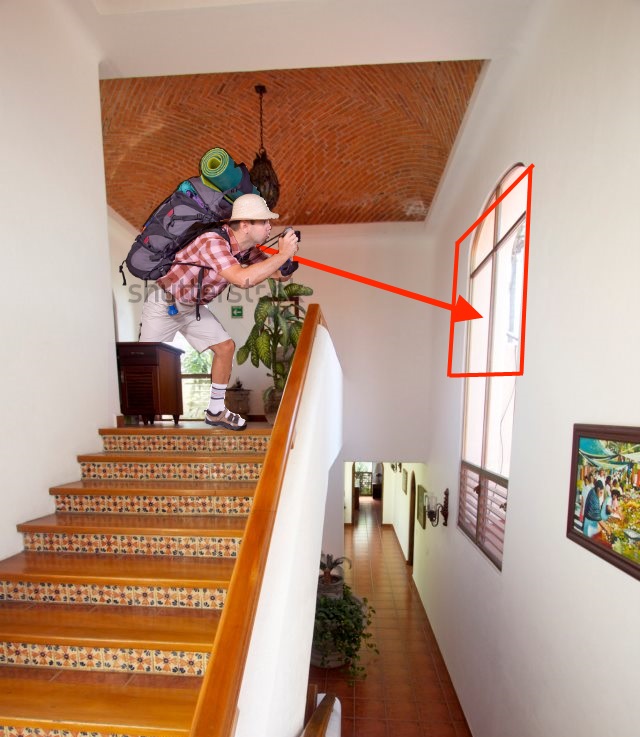
This week’s picture was taken by someone standing on the landing, through the window highlighted below. Quick and dirty Photoshop reenactment created with help from Shutterstock:

vfywc_guy

Good contest – not so hard to find the location, but getting the window was a bit tricky because the geography made street view useless.

This week’s winner was last week’s runner up and another veteran player from our list of long-suffering Correct Guessers:

This week’s picture was taken in Manzanillo, Mexico, from the northwest side of Villa Las Cumbres B&B (43 Avenida de los Riscos). Here is the window, on the 2nd floor:

villa-las-cumbres-ext

A tough one, at least for me. It was fairly easy to tell that this was probably some tropical
American country; the obvious clue to follow afterwards was the hotel in Moorish-Mediterranean style in the bottom right corner of the picture, but for some reason it took me nowhere at first. A Tesoro – “treasure”– so is named the resort – a little hard to unearth.

From the view’s submitter, a contest veteran himself:

I was pleasantly surprised to see my window submission show up as this week’s contest. I don’t get to travel much, and when I saw this view I knew it would make a good contest.

Here’s some more detail about the location: The shot was taken from the entry hall of a rental vacation home at Avenida de los Riscos 43, Manzanillo, Mexico. The property is also called Villa Las Cumbres (House of the Summits). Every year, we take a trip with my kids and my brother’s kids to a beach somewhere, usually Oregon, Washington or Texas. We call it the “Cousins’ Trip” and this year we splurged and went out of the country to Manzanillo. I’d never been to the Pacific coast of Mexico before and it was breathtaking. We managed to luck out and find this house that sleeps 10 on AirBnB the day before and the views were spectacular.

villa

Above is a shot of the house from the beach, with the window highlighted. My only regret is that I have to wait until next week to solve a contest.

(Archive: Text|Gallery)

Expatriatism

by Jonah Shepp

150823_520563634238_3137000_n

As a child and teenager, I attended one of those New York City magnet schools that you read about from time to time, such as when an alum tentatively proposes to shut them all down. Accordingly, I share an alma mater with some notable individuals. The year I graduated, our commencement ceremony attracted a moderate crowd of local paparazzi on account of our guest speaker: Cynthia Nixon, class of ’84. In terms of pure star power, we had outdone the class of 2002, whose distinguished alumnus had been Elena Kagan, at the time merely the first female dean of Harvard Law School. Yeah, that kind of high school.

But celebrity aside, Nixon’s address to our class was actually more insightful than I, at 17, had expected. After the customary platitudes about lifelong friendships and school pride, she got to the point, which she summed up in four words: “Get out of here.”

Now what she meant by this was that if we lived our entire lives in New York, we’d limit the expansion of our minds much more than we realized. Growing up in an international megacity, it’s easy for native New Yorkers to fool ourselves into thinking that we are citizens of the world simply because the world has moved in down the block. The thrust of Nixon’s address to us was that this was a fallacy, and that if we really wanted to get some perspective on how unusual our metropolitan upbringings had been, we ought to spend some time not just traveling but living outside the city, and if we had the chance, outside the country as well.

Four years later, after finishing college in the opening act of the Great Recession with no prospects or plans for the future, I took advantage of a random opportunity and got out of here. Specifically, I moved to Jordan, where I lived for the better part of the next several years. For those who say you can’t learn anything from Hollywood, let me tell you something: Cynthia Nixon was right.

Living abroad, especially in a milieu so different from that of my childhood, did for me what no amount of formal education could: it challenged me to look at myself, America, and the world, from the standpoint of a foreign Other; and revealed the limits of my ability to inhabit that standpoint. It complicated my narrative of history and showed me how incredibly privileged I was to be an American citizen, starting with the fact that most people can’t just up and decide to move to another country for a while.

Probably the most significant impression Jordan made on me was how it guided the evolution of my views on the Israeli-Palestinian conflict. Jordan bore the brunt of both the 1948 and 1967 Palestinian refugee crises and at least 50-60% of its population is of Palestinian origin (or rather, was; the Syrian crisis has increased Jordan’s population by 10 percent). In any case, a majority of the friends I made in Jordan are of Palestinian descent, and it’s harder to deny people’s rights or historical narratives when you actually know them. I’ve written at length elsewhere about what it was like to live there as an American Jew, and I’ll likely touch on this again in a separate post this week, but the moral of the story is that people’s world views are always and everywhere shaped by experience, and it is always worth considering how someone arrived at an opinion before holding them in judgment over it, even if I don’t share it, and even if I believe it to be objectively incorrect. This is a skill I find lacking in the most polemical of the opining class, and not only in discussions of Israel and Palestine.

I also got a good firsthand look at how incredibly lucky I am to be an American. A US or EU passport remains an object of envy around the world, even among people who care little for American or European culture or values. There’s an awful lot to be said here, most of it obvious, but it bears remembering that the accident of my birth on American soil holds open doors for me that remain shut to the majority of the world. My experience of expatriate life was completely different than those of the vast majority of emigrants, who leave their countries because they have to, not because they want to. And needless to say, living in a country that does not quite have a free press, free speech, or free religion made me all the more appreciative of what America does right. These are privileges worth checking from time to time.

More broadly, I think the experience of living abroad showed me the extent to which the culturally progressive, “when you’re cut, you bleed” attitude toward people of various races and religions—the notion that we are all fundamentally the same—is true, as well as its limits. We are not all the same. Culture matters; it is as much a product of history as anything else that matters. But the human condition is a general state of affairs. A major feature of that condition today is the city, with its attendant poverty, crowding, crime, pollution, and traffic. These problems take a variety of shapes: Amman’s unemployment problem is very different in its origins and expressions than that of Caracas or Harare or Los Angeles, but the problem is fundamentally the same, and endemic to large cities. And global events like the Great Recession really are felt everywhere, in similar ways.

My point is that those who are fortunate enough not to live in failed states or active warzones (and let’s not forget about the millions who are), are worrying from day to day about the same things: rent, bills, food, family disagreements, lovers’ quarrels. When we pay attention to world events, we think of them first and foremost in terms of how they affect us directly. This narrow perspective is a natural result of the parochial concerns that rule our day-to-day lives, but a little appreciation for how universal those concerns are (that is to say, empathy) can go a long way toward broadening the individual perspective, softening prejudices, and healing enmities, which is the only way to permanently end wars.

I arrived at all these insights, such as they are, in the same way: simply by standing in another person’s shoes. That’s why I think my time as an expatriate strengthened my conviction, which I call humanism, that empathy is a sufficient cause for ethical action.

So now I put the question to you, dear Dishheads. I know by the views from your windows that we have readers from Denver to Dushanbe, and I know you didn’t all start out where you ended up, so to those of you who live or have lived outside the country of your birth: what motivated you to do so and how did the experience change you? Perhaps you haven’t lived abroad but have moved from, say, rural Kentucky to San Francisco, or vice-versa: a bigger change of scenery than crossing some international borders. I’d ask you the same question. Migration has always had a significant hand in history; in a global economy, that role is even greater. What has it meant to you? Email me your thoughts at dish@andrewsullivan.com.

(Photo: The view from my window—OK, balcony—in Amman, Jordan, by my roommate Matt, who was slightly better about taking pictures than I was.)

One Cheeseburger With A Side Of Zoloft

by Dish Staff

David Robson surveys the latest findings suggesting that “fatty, sugary diets are bad for the mind, as well as the body”:

[A]round 2010, three landmark papers caused more doctors to sit up and take notice. One took place in southern Europe, where doctors were charting the transition from the traditional Mediterranean diets, full of seafood, olive oil and nuts, to the fast food served in the rest of the West. Besides studying the risks of heart disease and diabetes, the scientists also looked at the 10,000 participants’ mental health. The differences were striking; those who lived almost exclusively on the traditional Mediterranean diet were about half as likely to develop depression over the period as those eating more unhealthy food – even when you control for things like education and economic status.

Around the same time, psychologists examining UK civil servants – in the famous ‘Whitehall’ studies – found exactly the same pattern; over the course of five years, people who regularly indulged in processed, high-fat and high-sugar foods were about 60% more likely to develop depression over the same period. Then Jacka confirmed the results with a further 1,000 Australian volunteers. Finally, the ball started rolling. “Over the following years we’ve seen an exponential growth in the number of studies,” says [Felice] Jacka. Perhaps the best evidence came this year from the lab of Frank Hu at Harvard University, who directly traced the contributions of certain diet patterns with levels of cytokines, and depression; sure enough, foods rich in olive oil, leafy vegetables and wine reduced inflammation, and slashed the risk of depression by about 40%, compared to the ‘pro-inflammatory diet’, which includes sugary drinks, processed grains and red meat.