Celebrities: They Sext Like Us

by Dish Staff

https://twitter.com/fmanjoo/statuses/506577527070916608

The Internet is atwitter over a number of celebrities’ phones getting hacked for nude photos. Jessica Valenti urges the curious to look elsewhere for titillation:

There’s a reason why the public tends to revel in hacked or stolen nude pictures. It’s because they were taken without consent. Because the women in them (and it’s almost always women who are humiliated this way) did not want those shots to be shared. If Jennifer Lawrence was to pose naked on the cover of Playboy, for example, I’m sure it would be a best-selling issue. But it wouldn’t have the same scandalous, viral appeal as private images stolen from her phone. Because if she shared nude images consensually, then people wouldn’t get to revel in her humiliation. And that’s really the point, isn’t it? To take a female celebrity down a notch? (We have a term for when this is done to non-celebrity women: “revenge porn.”)

Jessica Roy pens a modern-day J’Accuse:

To be clear, it’s not just the hacker who’s guilty here.

It’s also the fault of administrators and vocal male users of platforms like 4chan and Twitter that cling to misinterpreted notions of the First Amendment to excuse the systematic harassment of women online, who blatantly favor the protection of misogynist hate speech over the well-being of women. It’s the fault of people who tweet the photos or users who re-upload the cache of images to sites like Imgur with no regard for the victims (and make no mistake — the women in these photos are victims).

And it’s the fault of those who actively seek out those photos, who link to them on blogs or upvote them on Reddit or even run a simple Google search for them. You, too, are complicit in perpetuating the cycle of abuse, shame, and sexual violence that women are forced to fight against every day.

But Ben Popper notes that for millennials, there’s nothing unusual about having this sort of content on one’s phone to begin with:

According to a recent study from the Pew Research Center, 44 percent of teens reported sending or receiving a sexually explicit text, or sext, a jump of nearly double the 26 percent who reported doing so in 2012. The number of users among all age groups who say they have received a nude photo is now one in five, compared to 15 percent two years ago. A separate study from Purdue University found that among 21 year olds, 80 percent had sent or received a sext and 46 percent had sent a nude selfie. A report from the security firm McAffe found half of adults surveyed had used their mobile device to send and receive “intimate content” and half of those kept the images and texts stored on their phones.

And keep in mind that the number of people who could be photoshopped into a compromising image is 100%.

Sheep Solves Drone Debate

by Alex Pareene

screen-shot-2014-09-02-at-10-37-54-am-e1409669204890Hello, Dish readers. Andrew is recovering from his time on The Playa (I’m told he and Grover Norquist are in adjacent hyperbaric chambers in an unmarked warehouse somewhere in Reston – hopefully one of them will find time to submit a “view from your chamber” photo before the week’s end). I’m Alex Pareene, formerly of Salon and Gawker, currently part of First Look Media, Pierre Omidyar’s well-funded effort to destabilize eastern European states and keep Glenn Greenwald occupied with something other than collecting dogs and arguing with eggs on Twitter.

It has been some time since I’ve blogged, in the traditional sense, so forgive me if I seem a bit rusty. (If I recall correctly, this is when I ask readers to “hit up my tip jar” and/or buy me things on Amazon, right?) Because it is that terrible first day back at work for most of us, I say we ease back into things. We’ll get to police militarization, the sudden media ubiquity of for-some-reason-not-disgraced Bush-era warmongers, and the unsurprising amorality of Andrew Cuomo later. For now, something easier to process: Drones.

Some members of the so-called liberal media say they love drones. Here’s a video (via Motherboard) they hope you don’t watch:

Where do you fall on the drone debate? Make sure to tune in to CNN’s THE LEAD WITH JAKE TAPPER, where today Jake will host a lively debate between Martha Stewart and an angry ram that will settle the issue once and for all.

(Image: A drone critic)

Michael Sam Loses His Spot

by Dish Staff

Sam was cut from the Rams over the weekend. Eric Edholm examines the situation:

Sam was unclaimed by the other 31 NFL teams and remains a free agent, with no teams offering a practice squad spot — despite those rosters increasing this season from eight to 10 players per team — with nearly every slot around the league believed to be filled. Does this mean Sam’s NFL shot has passed him by? Not necessarily. He had three sacks in the preseason, none of them gifts, and didn’t play poorly otherwise. Sam put some decent tape out there to be considered. But he is what he is: a left defensive end who likely can’t hold up for three downs in the NFL and has little to no special teams value. Still, there are teams that value pass-rush specialists, and it’s surprising that he hasn’t been brought in, even for a look.

Michelle Garcia somewhat blames bigotry:

Did the Rams cut Michael Sam out of sheer homophobia? I doubt it. But it was homophobic reasons that got him to such a precarious position in the first place.

While the Rams were able to at least push this dream of having an out player a little further, and he was given a platform to show the entire league that he has potential for the pros, at the end of the day, the Rams did not have any use for him — they already had a nearly-full slate of defensive linemen, minus the one spot that undrafted rookie Ethan Westbrooks now has. And when 31 other teams had the chance to pick Sam up, it seems none of them needed him (and according to Outsportsat least six teams could probably use his talents right now).

Update from a reader along those lines:

I’ve been an avid football fan for years and I’m also very sympathetic to Michael Sam. I can say with a fairly high degree of certainty that he wasn’t cut because of homophobia. Furthermore, I don’t think his personal situation had much of an impact on his status.

Michael Sam’s biggest problem is that he is best-suited to a 4-3 defensive scheme. Over half the teams in the NFL rely on a 3-4 defense, where Sam really doesn’t have the skill set to perform well. Furthermore, he does not excel in special teams. Players who aren’t stars and aren’t sure-fire starters need to also perform well in special team play. Very few teams can afford the luxury of putting a guy on their roster who doesn’t fit their defensive scheme and who doesn’t play special teams. I suspect when teams start to suffer injuries and start needing bodies on their rosters, then you’ll see Sam picked up by another team.

Another sports fan from the inbox:

This is most keyed-into-the-NFL reality reaction I’ve seen to the Michael Sam story. The writer, Rick Telander, was in an NFL camp after his college days at NU and got cut.  He knows whereof he writes.

Cyd Zeigler is confident that the Rams’ cutting of Sam was “just a hiccup”:

Many in the LGBT community are lashing out at the NFL today, claiming homophobia. It’s understandable. Gay men have been told for decades they’re not good enough to play football, they’re not welcome in the locker rooms. Some of those messages have even reverberated in 2014. While the Rams’ decision wasn’t based on homophobia, it’s hard not to afford gay men a little foot-stomping at this latest rejection.

You know who isn’t lashing out? Michael Sam. He knew this was always a possibility, part of the cold business that is the NFL. A coach is your mentor and father-figure one day. The next afternoon he gives you a pink slip. Sam understands this is not the end, but rather another opportunity to prove his doubters wrong, earn his spot at the very top of his profession and take his rightful place in history.

Regardless of what happens to Sam, Scott Shackford expects a gay NFL player soon:

Even if Sam isn’t ultimately the first out player, I give it a year, tops. The media may have gotten weird about him, but polls and public reaction to Sam show that an athlete’s homosexuality isn’t the big deal it would have been, say, a decade ago.

Photos With Depth

by Dish Staff

tautochronos series

Leslie Tane features the delightful work of Michel Lamoller, who “takes multiple photographs of the same place at different times, then prints and layers them, physically carving them into one image, sculpting two-dimensional space into three-dimensions”:

By then photographing the transformed image Lamoller returns the work to two-dimensions, playing with space and volume, echoing the compression of time and place in his work. The deconstructed figures in the resulting photographs are a visual reminder that people are always changing and never fully revealed.

Margaret Rhodes connects the series to Lamoller’s previous projects:

Tautochronos evolved from an earlier series of Lamoller’s, called Layerscapes, that applies the same technique to landscapes and cityscapes. It’s not nearly as personal as Tautochronos, which is dotted with Lamoller’s personal acquaintances (and sometimes shot in their own homes or bedrooms), but both “come from a more personal wish to describe this happening of two things at the same time in one place,” he says. Like much of Lamoller’s work (he’s also created trompe l’oeil collages of banal objects like power outlets), they have a heavy Surrealist slant, and look like x-rays and camouflaged characters all at once.

“The ‘Great Man Theory’ At Its Most Frightful”

by Dish Staff

Andrew Heisel read more than 600 Amazon customer reviews of Mein Kampf, and came away disturbed:

Again and again, reviewers praise Hitler as “one of the most powerful men in history,” or “the greatest mover in history.” He was a “man of strong principles, discipline and good organizational skills,” and overcame poverty “to create the worlds largest empire.” Try to set aside your negative feelings for a moment and appreciate the impact: “Greatness is not measured by good or evil. Greatness is. Fascist or not, Hitler was a great leader.” The praise is qualified, but the tribute paid to morality often feels trivial alongside the esteem. Hitler “did some bad things,” one of the above says. Although he “crossed that line and spiraled into madness” and “evil,” says another, he was “wonderful leader.” Few leaders, offers another, have “matched the depth of his dedication, evil though it was.” They see that he’s a “monster” just like many of the other reviewers; they just don’t think it’s worth dwelling on instead of the positive takeaways.

Some would suggest this discourse is the effect of relativism, and there’s some of that in there, but I think, more than that, it is the value-neutral language of enterprise, where what matters most is getting things done—having an impact, being a “mover.” It’s a language that reveres action, power, and profit as goods in themselves and overlooks the ethical failings of those with power. With mere achievement as your focus, you can whittle away the details until Hitler has an affinity with Jesus. It’s the “Great Man Theory” at its most frightful. If you accomplish so much, you become beyond judgment, become simply History.

The Economics Of Superhero Flicks

by Dish Staff

Erika Olson recommends Harvard Business School professor Anita Elberse’s Blockbusters: Hit-Making, Risk-Taking, and the Big Business of Entertainment:

Her statistics-driven approach shows that no matter what facet of the entertainment industry you’re talking about – and no matter how contrary to common sense it may seem – those who make the biggest financial investments in a select few products are actually taking the least risky path to success. Perhaps that’s why 40 (!!!) big-budget superhero movies will be hitting theaters between now and 2020. Or why 1998 was the last year that stand-alone (versus sequel/trilogy/universe) films made up the majority of an annual “top-ten highest-grossing movies” list. In 2011, the entire top 12 were franchise titles.

Now, as Scott Tobias of The Dissolve recently pointed out, it’s not like “blockbuster” always equates to “awful.” But for anyone who still enjoys – or wants to make – an indie or otherwise original film, Elberse’s findings are important to understand.

Kicking The Torture Habit

by Dish Staff

In an interview about her new book, Mainstreaming Torture, Rebecca Gordon unpacks the way she uses virtue ethics to show why we should resist the use of torture:

The torture that I am concerned with is institutionalized state torture – the kind of organized, intentional program carried on by governments. It’s not Jack Bauer saving Los Angeles on 24. It’s not some brave person preventing a ticking time-bomb from going off by torturing the one person who can stop it. We must stop thinking of torture as a series of isolated actions taken by heroic individuals in moments of extremity, and begin instead to understand it as a socially embedded practice. A study of past and present torture regimes suggests that institutionalized state torture has its own histories, its own traditions, its own rituals of initiation. It encourages, both in its individual practitioners and in the society that harbors it, a particular set of moral habits, call them virtues or vices as you prefer. …

I think that my approach to the ethical problem of institutionalized state torture is based on a more accurate representation of what torture is. If torture were simply a set of isolated actions, then consequentialist or deontological approaches might be adequate for judging each act. Torture is, in a sense, more than the sum of individual actions, each of which can be assessed de novo, weighed by an ethical calculus of costs and benefits, or through the mental testing of the effects of universalizing a maxim. Actions create habits. We become brave, as Aristotle says, by doing brave acts. And, in the case of allowing other people to be tortured as the price of an illusory guarantee of our own personal survival, we become cowards by doing cowardly ones.

I think that most of the time in real life, people act first and identify their reasons for acting later. If most of the time we act out of habit, shouldn’t those habits be good ones?

Where The Drivers Drive You Away

by Dish Staff

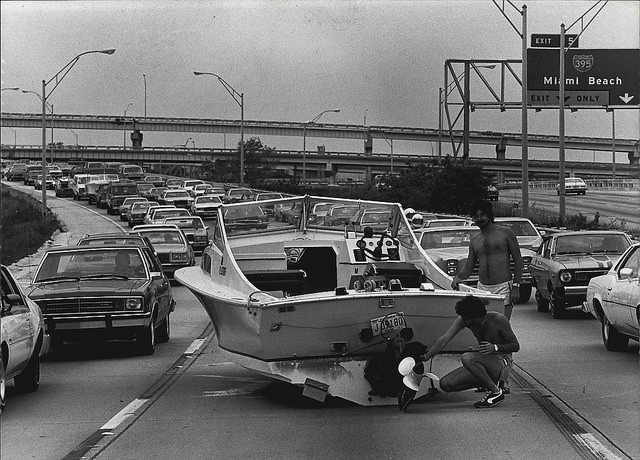
dish_trafficinmiami

Brian Palmer determined the worst places to drive in the US:

No. 5: Baltimore. Baltimoreans just can’t keep from running into each other. They were outside the top 10 in fatalities, DWI deaths, and pedestrian strikes, but their rate of collision couldn’t keep them out of the top five overall.

No. 4: Tampa, Fla. Tampa doesn’t do any single thing terribly, but it is consistently poor:

18th worst in years between accidents, fifth in traffic fatalities, tied for 11th in DWI fatalities, and 10th in pedestrian strikes. If the city had managed to get outside the bottom half in any individual category, Tampa residents might have avoided this distinction.

No. 3: Hialeah. The drivers of Hialeah [Florida] get into a middling number of accidents, ranking 11th among the 39 candidates. But when they hit someone, they really mean it. The city finished third for fatalities. They also have a terrifying tendency to hit pedestrians.

No. 2: Philadelphia. Drivers in the city of brotherly love enjoy a good love tap behind the wheel. Second-places finishes in collisions and pedestrian strikes overwhelm their semi-respectable 16th-place ranking in DWI deaths.

No. 1: Miami. And it’s not even close. First in automotive fatalities, first in pedestrian strikes, first in the obscenity-laced tirades of their fellow drivers.

So basically avoid Florida. Update from a reader:

Finally an article that supports what I have been saying for years: Miami has the worst drivers. I’ve driven in Thailand, Taiwan and China, to name a few of the most stressful ones in Asia, as well as Paris, Barcelona and Madrid in a right-hand drive car, and Chicago, Philadelphia and Los Angeles. But Miami is by far the worst. How on earth some of the drivers get their licenses I will never know – perhaps they don’t.

Last year I was stopped in a parking, and in the 10 minutes I was there, I witnessed three fender benders and saw two people nearly knocked over. And no, none of them were due to the weather. Seems to me the major element is the combination of laid back island mindset mixed with American hustle and a whole lot of FU.

Another notes:

I am not defending Florida drivers here; I live in the middle of the state, and was surprised not to see Orlando on the list. But this is a reprint of a year-old article based on data from at least the year before that. And if you link to the Allstate survey that prompted the reprint (which we’ll discredit because it doesn’t fit the desired conclusion), it ranks three Massachusetts cities in the top four (the other city being Washington, D.C.). But, hey, nobody ever misses a chance to take a shot at Florida.

At least it’s refreshing to have a city-comparison post on the Dish where Andrew isn’t talking shit about NYC.

(Photo of boat blocking traffic on I-95 in Miami via Flickr user That Hartford Guy)

Letting Students Hit The Snooze Button

by Dish Staff

A new report indicates that science agrees with teenagers everywhere – school should start later:

Seeing the mounting evidence, the American Academy of Pediatrics [last week] released a new policy statement recommending that middle and high schools delay the start of class to 8:30 a.m. or later. Doing so will align school schedules to the biological sleep rhythms of adolescents, whose sleep-wake cycles begin to shift up to two hours later at the start of puberty, the policy statement says. The conclusions are backed by a technical report [pdf] the academy also released yesterday, “Insufficient Sleep in Adolescents and Young Adults: An Update on Causes and Consequences,” which is published in the September 2014 issue of Pediatrics.

The “research is clear that adolescents who get enough sleep have a reduced risk of being overweight or suffering depression, are less likely to be involved in automobile accidents, and have better grades, higher standardized test scores and an overall better quality of life,” said pediatrician Judith Owens, lead author of the policy statement, titled “School Start Times for Adolescents.”

The debate over whether to start school later has run for years, but a host of new studies have basically put it to rest. For one thing, biological research shows clearly that circadian rhythms shift during the teen years. Boys and girls naturally stay up later and sleep in later. The trend begins around age 13 or 14 and peaks between 17 and 19. The teens also need more sleep in general, so forcing them to be up early for school cuts into their sleep time as well as their sleep rhythm, making them less ready to learn during those first-period classes.

“The Lingering Stain Of Slavery”

by Dish Staff

slavery-610

Stephen Mihm studies it at length:

In 2002, two economic historians, Stanley Engerman and Kenneth Sokoloff, published an influential paper that tried to answer a vexing question: why are some countries in the Americas defined by far more extreme and enduring levels of inequality—and by extension, limited social mobility and economic underdevelopment—than others? The answer, they argued, lay in the earliest history of each country’s settlement. The political and social institutions put in place then tended to perpetuate the status quo. …

Harvard economist Nathan Nunn offered a more detailed statistical analysis of this “Engerman-Sokoloff hypothesis” in a paper first published in 2008. His research confirmed that early slave use in the Americas was correlated with poor long-term growth. More specifically, he examined county-level data on slavery and inequality in the United States, and found a robust correlation between past reliance on slave labor and both economic underdevelopment and contemporary inequality. He disagreed with Engerman and Sokoloff’s claim that it was only large-scale plantation slavery that generated these effects; rather, he found, any kind of slavery seemed to have begotten long-term economic woes.

Nunn also offered a more precise explanation for present-day troubles.

In Engerman and Sokoloff’s narrative, slavery led to inequality, which led to economic underdevelopment. But when Nunn examined levels of inequality in 1860—as measured by holdings of land—these proved a poor predictor of future problems. Only the presence of slavery was a harbinger of problems. “It is not economic inequality that caused the subsequent development of poor institutions,” wrote Nunn. “Rather, it was slavery itself.”

This finding was echoed in a study by Brazilian economists Rodrigo Soares, Juliano Assunção, and Tomás Goulart published in the Journal of Comparative Economics in 2012. Soares and his colleagues examined the connection between historical slavery and contemporary inequality in a number of countries, largely in Latin America. The authors found a consistent correlation between the existence—and intensity—of slavery in the past and contemporary inequality. Moreover, this relationship was independent of the number of people of African descent living there today. As Soares said in an interview, “Societies that used more slavery are not more unequal simply because they have relatively more black people.”

The question, then, is how exactly did slavery have this effect on contemporary inequality? Soares and his colleagues speculated that limited political rights for slaves and their descendants played a role, as did negligible access to credit and capital. Racial discrimination, too, would have played a part, though this would not explain why whites born in former slaveholding regions might find themselves subject to higher levels of inequality. Nunn, though, advanced an additional explanation, pointing to an idea advanced by Stanford economic historian Gavin Wright in 2006.

In lands turned over to slavery, Wright had observed, there was little incentive to provide so-called public goods—schools, libraries, and other institutions—that attract migrants. In the North, by contrast, the need to attract and retain free labor in areas resulted in a far greater investment in public goods—institutions that would, over the succeeding decades, offer far greater opportunities for social mobility and lay the foundation for sustained, superior economic growth.