Wining And Opining

by Dish Staff

Charles Simic muses about the best philosophy to take toward wine:

I remember a story about President Nixon habitually guzzling rare vintage Bordeaux during state dinners without sharing it with his guests, having it poured into his glass by a trusted servant from a bottle wrapped in a white napkin to conceal the label. A part of me understands his reluctance to share. As Jesus said, “Do not give what is holy to dogs, and do not throw pearls before swine, lest they trample them under their feet.” But when it comes to wine I can’t follow our Lord’s advice. I would die of shame in my own eyes were I to open a long-treasured bottle of wine when there’s no one at home, decant it into a decanter, let it breathe for a while before pouring it into a glass, swirl it a bit and, raising it to the light, gaze at it lovingly, then take that first, never to be forgotten sip. Drink of the best stuff, is my advice, because you never know what tomorrow may bring, and do so in the company of friends.

Simic also links the grape to the birth of philosophy as a discipline:

Years ago I read in a work of some Byzantine historian the claim that Greeks became philosophers once they started watering their wines. Before they did that their wines were so high in alcohol that one was good for nothing after drinking them, except to pick up a shield and a spear and look for someone to have a fight with. Then one day a miracle occurred. A little rain fell into the wine cups left outdoors by a party of friends and when they returned to resume their drinking and tasted the watered wine they were astonished by how pleasant it was to drink and how clear their heads were afterwards. The news of their discovery spread far and wide and in no time there was a philosopher in every village in Greece.

A Poem For Monday

by Alice Quinn

John_Dryden,_Poet_and_Playwright_(3959224502)

From the anthology, Tudor Poetry and Prose, which I praised last week, I relish the following passage about lyrics from song-books of the time:

Singing seems to have been almost universal in Elizabeth England. The countryside, the street corner, the cottage, and the tavern rang with ballads, rounds, catches . . . . The craftsman’s shop was ‘a very bird-cage’ says [Thomas] Dekker, and [Thomas] Deloney in his Gentle Craft writes that every journeyman shoemaker had to be able to ‘sound the trumpet, or play upon his flute, and bear his part in a three-man’s song, and readily reckon up his tools in rhyme.’ Among the educated, singing was a necessary social accomplishment. The breeding of a man who could not join in the song after supper, reading his part at sight, was in question.

Songs were also a staple of plays. Here’s one of my favorites by the Restoration poet John Dryden (1631-1700), born after Elizabeth’s reign and so beyond the compass (but not the influence) of the period celebrated in the anthology, appointed Poet Laureate in 1668, and buried in Westminster Abbey near Chaucer in what later became known as Poets’ Corner.

“Song for a Girl,” from Love Triumphant, by John Dryden:

1
Young I am, and yet unskill’d
How to make a Lover yield:
How to keep, or how to gain,
When to love; and when to feign.

2
Take me, take me, some of you,
While I yet am Young and True;
E’re I can my Soul disguise;
Heave my Breasts, and roul my Eyes.

3
Stay not till I learn the way,
How to Lye, and to Betray:
He that has me first, is blest,
For I may deceive the rest.

4
Cou’d I find a blooming Youth,
Full of Love, and full of Truth,
Brisk, and of a jaunty mean
I shou’d long to be Fifteen.

(Portrait of Dryden by James Maubert, circa 1695 , via Wikimedia Commons)

A Double Negative

by Dish Staff

Ivan Kreilkamp entertainingly tears down the practice of titling polemics “Against [X]”:

The crankily oppositional intellectual journal N+1 has made a regular diet of “Against [X]” in the past decade: “Against Exercise,” “Against the Rage Machine,” “Against Reviews.” The formula’s quality of brashly counterintuitive overstatement is well suited to twenty-first-century online publishing. When someone throws down the gauntlet against something as seemingly benign, necessary, or positively good as interpretation, happiness, exercise, or young-adult literature, who can resist taking a peek? Here lies a problem with “Against [X].” Its contrariness can seem contrived or ginned up for effect, aiming, with an excess of self-congratulation, for a outraged or scandalized response: Yes, folks, I’m dismissing happiness itself in a two-word title. Can you handle it?

But the contemporary manifestations of the form can appear weakly liberal when considered within the longer history of this genre. For the early “Against [X]” polemics by the likes of Augustine, Athanasius, or Tertullian (“Adversus Marcionem”), nothing less than the fate of the Church was at stake; their scorching blasts were designed to shore up correct orthodoxy against a heretical enemy whom they aimed to drive into exile. The contemporary, post-Sontagian polemics adopt a posture of provocation in faintly echoing such forebears, but they are, in their hearts, pluralistic, and in fact suggest only a slight revision in perspective. Lawrence Lessig isn’t really against transparency, of course: rather, his claim is that “we are not thinking critically enough about where and when transparency works, and where and when it may lead to confusion,” and so on.

Faces Of The Day

by Dish Staff

dish_fotdmonsep1

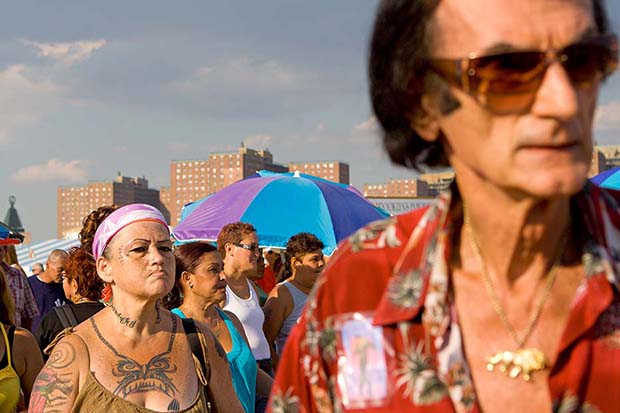
Photographer Laura Glabman emails us the background on the above pic:

That party took place exactly 5 years ago, Labor Day weekend on the boardwalk at Coney Island in 2009. I happened to be walking by this group of partiers and I wound up staying for two hours photographing them. By the time I left they were hugging and kissing me goodbye. These people loved the camera and they loved to dance. I took about 300 photographs that day and I really enjoyed how uninhibited they were and how much fun they were having. The late afternoon light was perfect and so was the music.

See more work from the series here. Update from a reader:

I know that guy! His name’s Tony Ferrante, he cuts my hair at New Street Barbershop right near Wall Street. He was on “America’s Got Talent” and every summer he goes to Coney Island every weekend to dance on the boardwalk. He’s like 78 but he still LOVES dancing and is in good shape. There are a couple of videos of him on Youtube, and the audition tape is especially tight. Here he is just chilling on the boardwalk.

I don’t know if he uses e-mail but, the next time I go there, I will show him that he was on the Dish.

(Hat tip: Jenna Garrett)

Confessions Of A BBQ Critic

by Dish Staff

“Since Texas Monthly named me the nation’s first and only full-time barbecue editor in March 2013,” Daniel Vaughn sighs, “my health has been a topic of international discussion”:

My job requires that I travel from one end of the state to the other eating smoked brisket, one of the fattiest cuts on the steer. And I can’t forget to order the pork ribs, sausage, and beef ribs. Of course my diet is going to raise eyebrows. Including those of my doctor. During one of my semiannual visits to see him, when my blood work showed an elevated cholesterol level, he gave me a scrip for statins and a helpful catalog of high-cholesterol foods to avoid. First on the list? Beef brisket. Second? Pork ribs. When I told him about my role as barbecue editor, he just said, “Maybe you could eat a little less brisket.” I promised to focus more on smoked chicken, but the pledge was as empty as the calories in my next order of banana pudding. …

All jokes aside, I do understand the long-term perils of my profession. I’ve taken those statins religiously for several years, and I’m doing my part to keep the antacid market in business. But I’m usually more worried about the acute health concerns I face. I judged the “Anything Goes” category at a cookoff in South Texas and spat out a submission mid-chew that featured some severely undercooked lobster tails. At a barbecue joint in Aubrey, I took a bite of beef rib that I had reasonable suspicion to believe had been tainted with melted plastic wrap. And the most gastrointestinal discomfort I’ve ever had came from the 33 entries of beans I judged in one sitting at an amateur barbecue competition in Dallas.

But my health is my concern. To anyone who asks if I’m worried about an early grave, I just say I’ve pre-humously donated my body to barbecue.

Let’s just hope he doesn’t start hawking cholesterol medication. As one chef put it regarding Paula Deen’s dubious deal with diabetes meds:

God In The Hands Of American Sinners

by Dish Staff

In an interview about his new book, Our Great Big American God, Matthew Paul Turner dissects the problems with an all-too-Americanized God, our habit of “affecting, reimagining, shaping, and changing God’s story”:

God was never meant to be a nationalized deity. The very idea that God would showcase geographical favorites or advance the kingdom of one at the expense of another or several others goes against many of Jesus’s basic teachings. Moreover, our relationship with God has caused a large majority of America’s Christians to posses an elitist attitude or worldview, at times even imperialistic. Rather than humility, mercy, and redemption, God seems to have made us controlling, know-it-alls, materialistic, and far too certain of what God thinks about political, social, and spiritual issues.

Throughout our history we’ve branded God into a deity that works for us, one that mixes well with American values, one that agrees with our wars, and one who not only adheres to our way of life, in many cases, our way of life is God’s ideal, which we often suggest is one of the reasons he blesses us with prosperity. The biggest issue perhaps is that many of us are so comfortable with our American God, so certain of his ways, that to believe that we might be wrong is impossible.

In an excerpt from the book, Turner explores the complex legacy of Jonathan Edwards, the theologian and preacher most famous for his hellfire and brimstone sermon, “Sinner in the Hands of an Angry God,” and whom he identifies as one of the key influences on the American understanding of the divine:

Jonathan Edwards changed the story of America’s God. He changed how the people of his time engaged God, editing a theology that was often portrayed harshly and dogmatically. He made strides to shape it with words into an almost beloved relationship between a grandiose God and a broken and depraved American heart. His words set the stage for what would become a steady foundation for America’s God to revolt against the Old World and bring about revolution. Historian Perry Miller suggests that America’s Enlightenment began and ended with Jonathan Edwards. And Edwards played a most defining role in bridging the space between Puritanism and what would eventually become American evangelicalism.

It was Edwards’s talent as a writer that, on one hand, makes him unforgettably important to so many still today. Preachers like John Piper, Tim Keller, Mark Driscoll, and others wouldn’t have much to write or preach about without Edwards dedicating the majority of his existence to literally emoting his version of John Calvin’s God onto the page. But it’s that same talent, that profound ability to create rich imagery with sentences and paragraphs, that would ultimately backfire on him. Rather than his gift becoming defined by his thoughts on God’s glory or God’s beauty, Edwards’s words helped to Americanize God’s hell, turning this country’s doctrines about fire and brimstone into HELLTM, an idea that would eventually become a method for introducing millions to God.

His thoughts on the future of this American God:

We’re beginning to see conservative and progressive ideas about God morphing together. We’re seeing younger Christians shift their ideas about God’s thoughts on homosexuality, and other social justice issues. We’re seeing, perhaps, more understanding of how God come to be. On the flip side, there’s this Tea Party God: they’ve dug in their heels, and created this God. It’s like they’re saying, ‘You didn’t like our evangelical God? OK, then wait until you get to know our Tea Party God!’ In some ways, this God is an asshole.

But again, what you’re seeing — is it God that you’re seeing or just reflections of people? We change, and God changes with us. We should be careful about what our actions and words suggest about God. Rather than forcing God to be in politics, or to be the middleman on social issues, we should bring God back to our communities, and invite everyone to the table.

Dogs vs Cats: The Great Debate, Ctd

by Dish Staff

Henri Cole cites Rilke’s thoughts on the age-old divide:

Look at the dogs: their confident and admiring attitude is such that some of them appear to have renounced the oldest traditions of dogdom in order to worship our own customs and even our foibles. It is just this which renders them tragic and sublime. Their choice to accept us forces them to dwell, so to speak, at the limits of their real natures, which they continually transcend with their human gazes and melancholy snouts.

But what is the demeanor of cats?—Cats are cats, briefly put, and their world is the world of cats through and through. They look at us, you say? But can you ever really know if they deign to hold your insignificant image for even a moment at the back of their retinas. Fixating on us, might they in fact be magically erasing us from their already full pupils? It is true that some of us let ourselves be taken in by their insistent and electric caresses. But these people should remember the strange, abrupt manner in which their favorite animal, distracted, turns off these effusions, which they’d presumed to be reciprocal. Even the privileged few, allowed close to cats, are rejected and disavowed many times.

Montaigne’s take:

“When I play with my cat”, he wrote, “who knows if I am not a pastime to her more than she is to me?”

He borrowed her point of view in relation to him just as readily as he occupied his own in relation to her. And, as he watched his dog twitching in sleep, he imagined the dog creating a disembodied hare to chase in its dreams – “a hare without fur or bones”, just as real in the dog’s mind as Montaigne’s own images of Paris or Rome were when he dreamed about those cities. The dog had its inner world, as Montaigne did, furnished with things that interested him.

Meanwhile, Jessica Love ponders why dogs are “so good at reading our nonverbal cues—so much better, even, than chimpanzees and bonobos, to whom we’re more closely related”:

Researchers now believe that dogs’ ability likely evolved during domestication, probably due to selective breeding. There’s some disagreement about whether our own ancestors were selecting for communicative skills specifically (perhaps to create better hunters, retrievers, or herders), or whether this prowess was merely a by-product of selecting for something else, like tameness.

But though the sensitivity dogs exhibit is truly impressive, it nonetheless falls short of what humans—even very young ones—are capable of. Infants will communicate information to their adults when they know that it is of interest to the caregivers; dogs will only do so if they are the ones interested. Young children also pick up on information conveyed to a third party; dogs, not so much. And a brand new study finds that two-year-old humans are much better than dogs at gauging from a situation whether a communicative signal is unintentional (and thus ignorable).

Meanwhile, the cat—mere feet away from a tuna treat, and despite the best efforts of an insistent pointing hand—does nothing.

Thoughts from Andrew and Dish readers here.

A Founder Left Behind By The Left

by Dish Staff

640px-Alexander_Hamilton_portrait_by_John_Trumbull_1806

Christian Parenti advises liberals to look to Alexander Hamilton for inspiration, not Thomas Jefferson. He especially praises Hamilton for his far-reaching economic insights:

Hamilton was alone among the “founding fathers” in understanding that the world was witnessing two revolutions simultaneously. One was the political transformation, embodied in the rise of republican government. The other was the economic rise of modern capitalism, with its globalizing networks of production, trade, and finance. Hamilton grasped the epochal importance of applied science and machinery as forces of production.

In the face of these changes, Hamilton created (and largely executed) a plan for government-led economic development along lines that would be followed in more recent times by many countries (particularly in East Asia) that have undergone rapid industrialization. His political mission was to create a state that could facilitate, encourage, and guide the process of economic change — a policy also known as dirigisme, although the expression never entered the American political lexicon the way its antonym, laissez-faire, did.

Parenti goes on to suggest how an appreciation of Hamilton might connect with a pressing contemporary issues – climate change:

Even today, Hamilton’s ideas about state-led industrialization offer much. Consider the crisis of climate change. Alas, we do not have the luxury of making this an agenda item for our future post-capitalist assembly. Facing up to it demands getting off fossil fuels in a very short time frame. That requires a massive and immediate industrial transformation, which must be undertaken using the actually existing states and economies currently on hand. Such a project can only be led by the state — an institution that Hamilton’s writing and life’s work helps us to rethink.

Unfortunately, many environmental activists today instinctively avoid the state. They see government as part of the problem — as it undoubtedly is — but never as part of the solution. They do not seek to confront, reshape, and use state power; the idea of calling for regulation and public ownership, makes them uncomfortable.

(Portrait of Hamilton by John Trumbull, 1806, via Wikimedia Commons)

The Disparities In Dining Out

by Dish Staff

Screen Shot 2014-08-29 at 1.42.10 PM

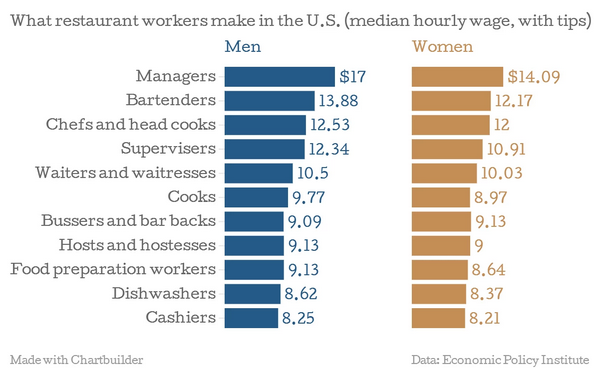
Roberto Ferdman flags a report that reveals gender wage gaps in the restaurant industry, even when tips are accounted for:

The median hourly wage paid to women is less than it is for men in all but one of the eleven jobs surveyed in a report by the Economic Policy Institute. In some cases, the gap is slight—for cashiers, dishwashers, food preparation workers, and hosts and hostesses, it’s a matter of cents. But in others, including supervisors and bartenders, the difference is well over a dollar. For managers, the highest earning occupation, the disparity was nearly three dollars per hour.

“This is what we identify as pay discrimination,” said Valerie Wilson, an economist at the Economic Policy Institute. “The work women are doing is being valued at less than the work men do in the same job.” Women, however, aren’t merely being paid less to do the same job—they’re being paid less and less compared to men as they move up in the ranks, too. Some of the highest earning occupations—managers, bartenders, and supervisors—are also the ones with the largest gender pay gap.

Drum adds his two cents:

There are other reasons besides gender for pay gaps, and the EPI report lists several of them. Whites make more than blacks. High school grads make more than dropouts. Older workers make more than younger ones. You’d need to control for all this and more to get a more accurate picture of the gender gap.

But in a way, that misses the point. There are lots of reasons for the gender gap in pay. Some is just plain discrimination. Some is because women take off more time to raise children. Some is because women are encouraged to take different kinds of jobs. But all of these are symptoms of the same thing. In a myriad of ways, women still don’t get a fair shake.

But that’s not to say that the business is especially kind to men, either. Tom Philpott pulls some other salient findings from the EPI report, which paints a grim portrait of restaurant workers overall:

Restaurant workers’ median wage stands at $10 per hour, tips included—and hasn’t budged, in inflation-adjusted terms, since 2000. For nonrestaurant US workers, the median hourly wage is $18. That means the median restaurant worker makes 44 percent less than other workers. Benefits are also rare—just 14.4 percent of restaurant workers have employer-sponsored health insurance and 8.4 percent have pensions, vs. 48.7 percent and 41.8 percent, respectively, for other workers. …

As a result, the people who prepare and serve you food are pretty likely to live in poverty. The overall poverty rate stands at 6.3 percent. For restaurant workers, the rate is 16.7 percent. For families, researchers often look at twice the poverty threshold as proxy for what it takes to make ends meet, EPI reports. More than 40 percent of restaurant workers live below twice the poverty line—that’s double the rate of nonrestaurant workers.