The popular thread continues, beginning with reader-love for one particular John Cheever short story:
I have returned to the work of John Cheever—especially “The Death of Justina”—more than that of any other author in my reading life. He is so alert to the spiritual potentialities of life and yet so understanding of our failure to fulfill them. The world he writes about  is decidedly fallen yet can be illuminated by sudden flashes of grace—as real and rare as lightning strikes.
I guess you’d call “The Death of Justina” a serious comedy about death that touches on chaos, commercialism, nasty bosses, zoning, the necessity and challenges of loving America, and, last but not least, morticians: “The priest was a friend and a cheerful sight, but the undertaker and his helpers, hiding behind their limousines, were not; and aren’t they at the root of most of our troubles, with their claim that death is a violet-flavored kiss? How can a people who do not mean to understand death hope to understand love, and who will sound the alarm?”
Of course, with this story, it is Cheever who sounds that alarm.
He can be heard reading it (rapidly, with his faux Brahmin accent) here.
A second reader on the same Cheever story:
For me, it keeps coming back to Cheever. (And, Thorton Wilder, but perhaps that will be another entry.)
There are better Cheever passages than this, but I’ve been obsessing about this story for a while now, so here it is – from “The Death of Justina,” in the Collected Stories.
“We buried Justina in the rain the next afternoon. The dead are not, God knows, a minority, but in Proxmire Manor their unexalted kingdom is on the outskirts, rather like a dump, where they lie in an atmosphere of perfect neglect. Justina’s life had been exemplary, but by ending it she seemed to have disgraced us all. The priest was a friend and a cheerful sight, but the undertaker and his helpers, hiding behind their limousines, were not; and aren’t they at the root of most of our troubles, with their claim that death is a violet-flavored kiss? How can a people who do not mean to understand death hope to understand love, and who will sound the alarm?”
How can a people who do not mean to understand death hope to understand love, and who will sound the alarm? Indeed.
The story continues – an advertising executive keeps writing a commercial for “Elixircol, the true juice of youth.”
“I went from the cemetery back to my office. The commercial was on my desk and MacPherson had written across it in grease pencil: Very funny, you broken-down bore. Do again. I was tired but unrepentant and didn’t seem able to force myself into a practical posture of usefulness and obedience. I did another commercial. Don’t lose your loved ones, I wrote, because of excessive radioactivity. Don’t be a wallflower at the dance because of strontium 90 in your bones. Don’t be a victim of fallout. When the tart on Thirty-sixth Street gives you the big eye does your body stride off in one direction and your imagination in another? Does your mind follow her up the stairs and taste her wares in revolting detail while your flesh goes off to Brooks Brothers or the foreign exchange desk of the Chase Manhattan Bank? Haven’t you noticed the size of the ferns, the lushness of the grass, the bitterness of the string beans, and the brilliant markings on the new breeds of butterflies? You have been inhaling lethal atomic waste for the last twenty-five years and only Elixircol can save you.“
Another reader offers more praise for Joyce’s “The Dead”:
I first read “The Dead” in high school after my grandfather gave me a weathered book of selected James Joyce works. Gabriel Conroy’s no good, very bad Christmastime party has the feel of nearly every one I’ve attended. You can feel winter’s draft against buttoned coats through the pages, and it takes little effort on my part to understand the awkward dance of Gabriel’s anxiety and confidence. The final passage where Gabriel is looking over his sleeping wife has to rank among the most beautiful in the English language. I pick a cold night to read it around Christmas every year. It reminds me of my grandpa and all the past Christmases that have turned into shades.
This reader also points to a favorite short story:
A short story by Jorge Luis Borges, which he referred to as perhaps his best work, has stayed with me for almost 4 decades. In my opinion, “The South” is not only the most perfectly crafted short story ever written, it is an amazing examination of the complete relativity in which we live every moment of our lives. A relativity which is only realized at certain rare points when events and thoughts crystalize in unexpected ways.
The arc of the story is relatively simple. Dahlmann, a proud Argentine of German descent, obtains a copy of the Thousand and One Nights. In his eagerness to read it, he rushes up the stairs to his apartment gashing his head on an open door. He develops a fever which requires an extended and awful stay at a sanitarium where he is subjected to horrible procedures. When finally better, he leaves Buenos Aires for a convalescence at his ranch in the South.
When Dahlmann finally arrives by train at a small town near his ranch, he goes to the local general store to arrange for transport to the ranch and have a bite to eat. Some local farm workers are drinking and begin to toss small spit balls of bread at him while he reads. He ignores them, but when he gets up to leave the shopkeeper addresses him by name and tells him to ignore the drunks. Since he has been identified, Dahlmann feels compelled to confront the drunks – one of whom hurls insults at him and draws a large knife. The shopkeeper protests that Dahlmann is unarmed. An old peasant suddenly sends a knife across the floor which Dahlmann instinctively picks up. He prepares to leave the store even though he knows nothing about knife fighting.
The last lines of the story cannot be summarized. They are as powerful a statement of the basic relativity of our perception of our lives and the human condition as I have ever read.
“They went out and if Dahlmann was without hope, he was also without fear. As he crossed the threshold, he felt that to die in a knife fight, under the open sky, and going forward to the attack, would have been a liberation, a joy, and a festive occasion, on the first night in the sanitarium, when they stuck him with the needle. He felt that if he had been able to choose, then, or to dream his death, this would have been the death he would have chosen or dreamt. Firmly clutching his knife, which he perhaps would not know how to wield, Dahlmann went out into the plain.”
Another reader writers:
I studied literature, philosophy & comparative religions in college, yet the passage I turn to again and again is by an astrophysicist, of all people: Carl Sagan’s Pale Blue Dot. It is a humanist statement, one of both hope and sadness. He uses our scientific knowledge to inspire a better, more compassionate understanding of each other, showing how the two great disciplines of science and humanities can inform each other. Being reminded of the tininess of earth is like a Total Perspective Vortex – thoroughly humbling. I’ve had the chance to hear Neil deGrasse Tyson recite it live, and it was just as moving. Thankfully, Sagan read it for the audiobook.
Another recommends Anne Morrow Lindbergh’s Gift from the Sea, which the reader first read at age 20, and keeps returning to:
As I grow older, it resonates differently. But it always feels meditative.
“With a new awareness, both painful and humorous, I begin to understand why the saints were rarely married women. I am  convinced it has nothing inherently to do, as I once supposed, with chastity or children. It has to do primarily with distractions. The bearing, rearing, feeding and educating of children; the running of a house with its thousand details; human relationships with their myriad pulls–woman’s normal occupations in general run counter to creative life, or contemplative life, or saintly life. The problem is not merely one of Woman and Career, Woman and the Home, Woman and Independence. It is more basically: how to remain whole in the midst of the distractions of life; how to remain balanced, no matter what centrifugal forces tend to pull one off center; how to remain strong, no matter what shocks come in at the periphery and tend to crack the hub of the wheel.”
This love story, inextricably connected to a favorite novel, is pretty wonderful to read:
One text that I have returned to many times is Wuthering Heights by Emily Brontë. As a young, closeted gay man growing up in a small coastal New England town in the late 70s–early 80s, I was often stricken with a terrible fear that I would never know true love. Or even love of any kind. Wuthering Heights is a rather depressing book where things end badly for just about every character in it, but the all-consuming, haunting love that Catherine Earnshaw had for Heathcliff took my breath away and gave me hope that maybe someday, I too would feel a love like that.
I must have read my tattered paperback copy a dozen times in the course of a few years. And then one day, I met Peter. At 23 years of age, I now knew exactly the kind of love that Emily Brontë had painted in words. Hard, crushing, devastating love that made it difficult to breathe at times. And Peter returned that love. As young romances often go, it only lasted around two years with Peter moving to the West Coast for a job he couldn’t turn down. In the aftermath, I was a shell of myself for a long time. But I had felt it. I had experienced what Catherine Earnshaw had experienced, and I figured that even if that kind of love was only a once-in-a-lifetime phenomena, it was worth every hot, bitter tear I shed missing him. To this day, Peter and I are still friends. I don’t believe anyone can ever forget that a love of that intensity and we find ways to hold on to it, even long after it’s gone and there are thousands of miles between us.
And as it does, life went on. A few more relationships — the longest at 14 years — was tremendously comfortable and we’re still best friends after amicably going our separate ways. But suddenly finding one’s self single at the age of 48 years is a bit disconcerting, to say the least. However, it did give me a lot of time to reflect, remember and to eventually revisit an old friend named Catherine Earnshaw. After about a year of being a suddenly single middle-aged man, I found my old tattered, yellowed, paperback copy of Wuthering Heights up in the attic and immersed myself back in a time when I thought love was something ethereal and entirely unattainable. This time around it had a completely different effect. The wishing, the longing, the intense wanting that I felt at 23 had been replaced at 48 with a quiet, dull ache of loss — and gratitude. Gratitude that I had not only experienced an all-consuming love once many years ago, but also a warm, supportive, comfortable love that helped me become the man I am today.
I hadn’t read that book in 25 years and returning to it was like running into an old friend. What I did not expect was that like having read Wuthering Heights at 23, suddenly, there was Patrick. He had already been right in front of me for four years as a friend. Frankly, I thought he had absolutely no interest in me, especially because I had been in a long-term relationship for the first three years of our friendship and because well, he’s ridiculously adorable and I thought I simply didn’t have a chance with him. Then one Sunday afternoon over beers, he blurted out something that I could not get out of my head. So I asked him what he had meant by that comment the next time I saw him, and he just said it plainly, sweetly, and with a smile that could melt an iceberg.
That was a year and a half ago and I am crazy, madly in love with him. It is the same hard, crushing, devastating love that makes it difficult to breathe that I felt at 23. And Patrick returns that love. I had truly resigned myself to the belief that a love like that could only happen once in a lifetime but Patrick has taught me that it can, and does, happen more than once. With marriage equality spreading across the country, it’s just a matter of time until we can be legally married in our state of residence. Not long after that day comes, I plan on doing what Catherine was never able to do; marry him and make that love last for the rest of their lives.
Thanks for bringing back such memories by asking what novels, poems or stories have been our companions along life’s way. It’s been a hell of a journey so far and with Patrick as my companion, the future looks pretty darn bright.
Another reader writes:
Michael Chabon has a way with words, but this quote from The Yiddish Policeman’s Union is the one I like best. It reflects one of the  best Jewish traditions, in which we thank God for daily miracles, things like the sun coming up, the earth being beneath our feet, being able to move, and reflects the miracles we need, the basic human kindness, the realization that we each of us have divinity in us. In the context of the novel though, it also reflects how as humans, we quash that divinity through violence driven by greed and ideology:
“There was something in Mendele. There was fire. This is a cold dark place Detectives. A grey, wet place. Mendele gave off light and warmth. You wanted to stand close to him. To warm your hands, to melt the ice on your beard. To banish the darkness for a minute or two. But then when you left Mendele, you stayed warm, and it seemed like there was a little more light, maybe one candle’s worth, in the world. And that was when you realized the fire was inside you all the time. And that was the miracle. Just that.”
Here’s another poetry selection:
I completely agree that literature is therapeutic. The poem I always go back to in difficult times is “The Laughing Heart” by Charles Bukowski:
your life is your life
don’t let it be clubbed into dank submission.
be on the watch.
there are ways out.
there is a light somewhere.
it may not be much light but
it beats the darkness.
be on the watch.
the gods will offer you chances.
know them.
take them.
you can’t beat death but
you can beat death in life, sometimes.
and the more often you learn to do it,
the more light there will be.
your life is your life.
know it while you have it.
you are marvelous
the gods wait to delight
in you.
After a particularly bad breakup, when I had just moved to a new country, away from all of my family and friends, I remember repeating to myself there are ways out/ there is a light somewhere to get through the day. Works pretty well.
Another reader writes:
A Prayer for Owen Meany by John Irving is a perennial re-read for me. This passage well summarizes my own anxiety each year during Lent (and Irving gets away with four semicolons in one paragraph):
“I find that Holy Week is draining; no matter how many times I have lived through his crucifixion, my anxiety about his resurrection is undiminished – I am terrified that, this year, it won’t happen; that, that year, it didn’t. Anyone can be sentimental about the Nativity; any fool can feel like a Christian at Christmas. But Easter is the main event; if you don’t believe in the resurrection, you’re not a believer.”
Here’s a heartfelt note from a Tolkien fan:
My go-to book is The Lord of the Rings. It’s been a lifeline when I needed it most.
I first read it at age 12. I was a fat, awkward, unfeminine girl transplanted in mid-semester from a small, urban parochial grade school to a concrete block suburban middle school. It felt like being sent to prison. I desperately wanted to escape. So I read, voraciously, everything I could possibly get my hands on. And then I found my dad’s paperback copy of The Lord of the Rings. I devoured it in one  sitting, plowed through all of the appendices (including the ones on runes, Tengwar script and calendars), then immediately started again at the beginning.
I didn’t want to leave Middle-earth.
I loved the book’s sense of adventure. I imagined the rural charm of the Shire, the vastness of the empty kingdoms of the North, the cosiness of the Last Homely House, the grandeur of the forests. I already was familiar with the tortured ugliness of Mordor and the Dead Marshes. They were the industrial landscape of the Rust Belt (where I live) and served as a bleak point of contact between my world and Tolkien’s. The One Ring became my metaphor for the suffocating social conformity that kids specialize in creating. Orcs were far more straightforward opponents than catty, clique-y middle school girls.
Life got much better after I hit high school. I made friends, slimmed down, went to college, started a career, got married, had children. But I kept returning to The Lord of the Rings, re-reading it and listening to the BBC’s wonderful radio adaptation every few years. And my understanding of it changed.
What strikes me now is the novel’s sadness. Loss underpins the entire story. The old order ends in war and flame; although the good guys win, much is lost and the world is forever diminished. Death haunts the story, climaxing in the departure of the Last Ship into the West. This understanding of loss helps me deal with death and loss in my own life, most recently that of my dad — the one who introduced me to The Lord of the Rings in the first place. It has been a touchstone for how to handle grief — “I will not say, do not weep, for not all tears are evil.” I can’t help crying every time I read Frodo’s word to Sam at the very end: “I tried to save the Shire, and it has been saved, but not for me. It must often be so, Sam, when things are in danger: some one has to give them up, lose them, so that others may keep them.”
Beyond that, the Lord of the Rings has led me to sympathize with the underdogs and value the little people, the unlikeliest ones. It’s made me extremely wary of those who seek power at the expense of others. It’s showed me the importance of friendship and the small pleasures of life. And it’s taught me the value of mercy and kindness. I’ve tried my best to pass these values on to my children. There are far worse ways to live your life than following the advice of wizards and Hobbits.
Another reader joins the Marilynne Robinson fan club:
I love this topic. As a literature professor, the number of texts that I’ve lived with for years and through major life changes is considerable. Often something will happen and I’ll find a sentence or a fragment of a description rattling around in my head that  seems a fitting commentary–but I’ll have no immediate recollection of where it came from. I’m in my 30s and so didn’t grow up memorizing poems and speeches from Shakespeare and that kind of thing, as people once did, but at this point I might as well have. Sometimes I think what a loss it is that our culture no longer has that kind of shared textual intimacy.
If I had to pick one work outside my own area of scholarly expertise that both haunts and consoles me, it would be Marilynne Robinson’s Housekeeping. Here’s one passage:
“Cain murdered Abel, and blood cried out from the earth; the house fell on Job’s children, and a voice was induced or provoked into speaking from a whirlwind; and Rachel mourned for her children; and King David for Absalom. The force behind the movement of time is a mourning that will not be comforted. That is why the first event is known to have been an expulsion, and the last is hoped to be a reconciliation and return. So memory pulls us forward, so prophecy is only brilliant memory–there will be a garden where all of us as one child will sleep in our mother Eve, hooped in her ribs and staved by her spine.“
Keep up the good work! I always have mixed feelings when Andrew goes on vacation, but I’m loving all four of the Dish’s guest editors this time around.
Another read writes:
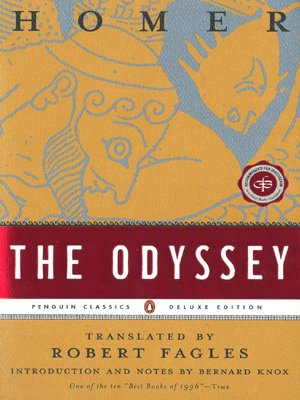
Reading has been a crucial part of the way I understand the world since before I can remember. I honestly don’t remember learning to read. I’ve always read. Trollope’s Barchester Towers, Bronte’s Shirley, and all the Austens are no surprise, perhaps, for a middle class white baby boomer woman. They help me understand who I am. But I reread Orhan Pamuk’s My Name is Red because it helps me understand a completely different way of imagining perfection and the sacred. But to choose just one, I will always come back to the Odyssey, and the Robert Fagles translation for preference.
I read it first as a child, in love with the Greek gods. It’s a fabulous adventure story. Now I read it in amazement for the characters. It was conceived before almost everything in our culture that has shaped us, before Christianity, before reading and writing, before democracy. It is on the very far edge of who we are, and yet, I intimately recognize those characters, relationships, hopes and fears. The main characters are wonderful but even the minor ones reach out to me across the millennia. Who hasn’t met Nestor, the garrulous boring old geezer repeating all his favorite stories, surrounded by his loving family and embarrassing the hell out of them in front of the guests at the family gathering? Menelaus and Helen are the original celebrity couple, tied to each other by self-interest and despising the other, snarking and sniping in their luxurious hall, amid a fug of bitterness and misery. Competing for attention from the assembly, they create their hell together. The swineherd is another one. Tied to memory and grief but with a very pragmatic foot in the moment, he slips easily between the past and the present, the memory of the dead king, and the need to get a pig down to the hall in good time.
I can’t even really express why the recognition of those characters as the people I meet and know every day gives me such comfort. But it does. To recognize them from across the far side of human culture, I feel anchored to some baseline of humanity, in spite of all the tumult in between us.
And this seems like a good note to end on, at least for today:
Thanks for this thread. I love and often recommend A Prayer for Owen Meany by John Irving as a great meditation on faith, reason and doubt. I re-read it this summer and it brims with sly good humor, jeremiads on the corrosive effect of war on US culture, and odd yet essential set pieces, such as an armadillo without its front paws. It also juxtaposes Frederick Buechner’s graceful theology with conversations by 10 year-olds about rating the breasts of the mothers in their small New England town. The opening lines draw one in:
“I am doomed to remember a boy with a wrecked voice. Not because of his voice, or because he was the smallest person I ever knew, or even because he was the instrument of my mother’s death, but because he is the reason I believe in God. I am a Christian because of Owen Meany.”
I also love it because it speaks to the Christian I’d like to be but am not. Or better put in a quote from Leon Bloy in the foreword: “Any Christian who is not a hero is a pig.”
Read the entire thread here.






 The Dish