How Do You Solve A Problem Like Vladimir?

by Dish Staff

Russian President Vladimir Putin Visits Samara

Jeffrey A. Stacey and John Herbst argue that the international community needs to do more to combat Putin’s aggressive behavior:

The time has come for the West to make a decisive move to counter Putin’s irregular war against Ukraine. The Russian president has introduced a perilous new norm into the international system, namely that it is legitimate to violate the borders of other countries in order to “protect” not just ethnic Russians, but “Russian speakers” — with military means if necessary. Putin has notoriously threatened to annex Transnistria, the Russian-speaking territory of Moldova, inter alia. The Putin Doctrine represents a serious transgression of the status quo that has guaranteed the continent’s security since the end of World War II; moreover, it violates the most essential tenet of the post-1945 international order.

They recommend a comprehensive approach to increase the cost of Putin’s meddling in Ukraine, including “even tougher economic sanctions; military armaments to Ukraine; and an updated NATO strategy.” But Eugene Rumer thinks the situation may be hopeless:

With force off the table, the West’s response to Putin’s actions in Ukraine has been sanctions and more sanctions. They have failed to dissuade and deter Russian support for the separatists. Yet, the West is threatening more sanctions if Russia attacks. Albert Einstein supposedly described insanity as doing the same thing over and over again and expecting different results.

The West can double down on sanctions and threaten more of the same, but the result is also going to be the same. The United States and its allies have made it clear that Ukraine is not as important to them as it is to Russia. Russia is prepared to go to war for it. They are not. It is tempting to say that all parties need to talk and reach a reasonable, mutually acceptable compromise. But it looks less and less likely or feasible at this stage of the conflict. Kyiv senses victory and appears poised to go for it. Putin fears defeat and is not prepared to accept it.

Masha Gessen is chagrined at how far Putin’s lies have gotten him so far:

Bald-faced lying is the one tactic Putin has used consistently through the six months of his Ukrainian incursion. It works every time, precisely because he and his Western counterparts are playing by different sets of rules: Every time, the West has to accept Putin’s version of events until it can be disproved beyond a reasonable doubt, and even then he gets to claim any area that remains gray.

He got to annex Crimea before his assertion that the Russian military was not there was exposed as the lie it was. Because his claim that the Russian military is not in eastern Ukraine has not been definitively disproved, Western media and politicians continue to call the fighters “separatist rebels” or “pro-Russian” or “Russian-backed separatists.” We all know that these are armies formed and armed by Russian military and intelligence officers, but we know this the same way we know the “humanitarian convoy” is a lie: without being able to prove it. So the strongest term Western media or politicians have applied to these fighters is terrorists, which is not strong enough—calling these people terrorists defines them as nonstate actors. Nor is the suggestion that Russia should be labeled a state sponsor of terrorism strong enough. Russia is not sponsoring other people’s terrorism; it is waging an illegal war against a neighboring country.

(Photo by Sasha Mordovets/Getty Images)
A Jury Of Whose Peers?

by Dish Staff

Tomasky examines the potential jury pool in the Michael Brown case:

Now let’s get to the matter at hand in Ferguson: criminal justice. The specific issue is this that juries in the United States are drawn from county-wide population pools. This means, as the criminologist William Stuntz has observed, that people from large counties with exurbs and farms are often sitting in judgment of urban kids…. Will a St. Louis County jury be likely to look sympathetically upon Michael Brown? Quite unlike the two-thirds black Ferguson, the county is 70 percent white.

Alex Tabarrok reads through a study on the racial composition of juries:

The authors have data on the race, gender, and age of each member of the jury pool as well as each member of the ultimate jury. The authors also know the race and gender of the defendant and the charges. What the authors discover is that all white juries are 16% more likely to convict black defendants than white defendants but the presence of just a single black person in the jury pool equalizes conviction rates by race. The effect is large and remarkably it occurs even when the black person is not picked for the jury. The latter may not seem possible but the authors develop an elegant model of voir dire that shows how using up a veto on a black member of the pool shifts the characteristics of remaining pool members from which the lawyers must pick; that is, a diverse jury pool can make for a more “ideologically” balanced jury even when the jury is not racially balanced.

Ken White worries that the release of the robbery video will bias a jury against Michael Brown:

Whether or not they released the surveillance video in response to a public records request, as they claim, the Ferguson Police Department undoubtedly knew that the news would reach the pool of prospective jurors in any criminal or civil case against Officer Wilson, telling them facts that they might not hear in court. They knew that the media would run with the story, and that the media would run with it multiple times: first to report it, then to ask why the police released it, and possibly a third time in a mock-self-critical analysis of whether they were played. The effect in the public’s mind is to emphasize the point Mike Brown was a robber, with the subtext so he probably had it coming. …

I don’t care that Mike Brown apparently robbed the convenience store. I don’t give a shit if Mike Brown was a career thug or a saint destined for a Rhodes scholarship. The question is the same: did Officer Wilson him have cause to believe that Mike Brown posed a serious physical threat at the moment Wilson pulled the trigger?

Everyone has rights, or nobody has rights.

Mental Health Break

by Dish Staff

Bird songs for Burning Man:

Christopher Jobson explains:

Australian artist Andy Thomas creates what he describes as “audio life forms,” specifically 3D animations that respond to audio input. For these latest pieces he used archival bird recordings from the Netherlands Institute for Sound and Vision (in addition to one of his own recordings) to create these new digital sound sculptures that animate in different ways in reaction to the songs of each bird. Thomas uses more software tools than we could reasonably share here, but you can learn a bit more over on his website.

Can Double-Blind Peer Review Be Reformed?

by Freddie deBoer

Peer review, the vetting of academic writing by subject-matter experts, is an essential element of academic progress. But the peer review process is also dysfunctional, sometimes out-and-out broken– and that brokenness stems from the well-meaning ideals peer review is meant to protect.

Gabriel Rossman wrote a fantastic piece illustrating the difficulties with peer review, and I highly urge you to read it if you are at all interested. I think Rossman is perfectly right in arguing that it’s the self-same people who complain about peer review as authors who often turn around and exemplify its worst tendencies when reviewing. As a peer reviewer myself, I try to always place myself in the position of the author, and in particular, I try never to review an article by thinking about what I would have done differently, but rather to ask if there are glaring theoretical holes, methodological errors, or problems with presentation. Far, far too much peer review becomes a matter of reviewers telling you what you should have done rather than making the work you did write better. As Rossman writes,

Rather, fixing peer review has to begin with you, the reviewer, telling yourself “maybe I would have done it another way myself, but it’s not my paper.” You need to adopt a mentality of “is it good how the author did it” rather than “how could this paper be made better” (read: how would I have done it). That is the whole of being a good reviewer, the rest is commentary.

But the particular problems with how peer review happens are less important than the basic structural problem. The fundamental issue is this. Peer review, at the vast majority of credible journals, is built on a double blind system. In order to ensure that a big name academic’s big name doesn’t get inferior work published, and so that reviewers can respond honestly without fear of retribution from people with disciplinary and institutional power, neither author nor reviewer knows the other’s name. That’s a sound idea, but it has a perverse effect, particularly given how important publishing is to an academic career. Reviewers and editors have enormous power to make or break careers; one major journal article could mean the difference between launching a professional career and having that career die on the vine. And with no knowledge of who exactly is responsible, we’re left with unaccountable power, which is never a good idea even when people are trying their best and mean well.

Though I’m talking about peer review, it’s also worth saying that this can apply to the whole academic publishing process. You might know the names of the editors you’re working with, but going public with complaints, in the event those complaints are fair and warranted, could be disastrous if you aren’t established or tenured.

For the better part of a year, I’ve been wrestling with an onerous, deeply unpleasant review process at an established journal. All editing, of course, is to some degree an unhappy business. But I’ve gotten peer reviews, even for rejections, that have been smart, fair, sympathetic, and constructive. This is not one of those times. The initial reviews were actually quite positive, though they came months after submission. I made those changes without complaint. Since then, there have been additional requests for changes again and again, each time separated by a period of months. I’ve made those changes to the best of my ability, but the requests have sometimes been unclear, rude, or worse.  These changes have been, at times, plainly contradictory of previous requests, in the most direct and unambiguous sense. It’s frequently unclear what requests for changes are coming from the peer reviewers and which are coming from the editors, or if the peer reviewers are even still involved in the process at all. At some point it became clear that I was being edited by several different editors and that these editors were not communicating with each other. I would receive questions, answer them, and get the same questions again, months later. And so on.

Is it possible that I’m just wrong, about everything, and they’re just right? Sure. But the fact is that if I was right even hypothetically, there would be no way for me to fix the problem. I don’t know who the reviewers are, so there’s no way to expect individual accountability. And as someone who lacks the benefit of employment, tenure, or prestige, speaking out publicly about the journal by name would be professional suicide. Even this missive, in and of itself, is likely to be seen as violating proper academic decorum, even though there’s no way to tell what journal I’m talking about. Under those conditions, how could we expect fairness or accountability? I think a lot of peer reviewers do a great job, and for no money. So do most journal editors, who if they are paid, are paid a pittance in most fields. It’s a lot of work. But I don’t know how to deal with problems with peer review and editing when the professional stakes are so high, the personal accountability so low, and when notions of collegiality and respect prevent people from making complaints like this one.

What makes all of this worse is that the double blind system was designed as a bulwark against the corrosive effects of power imbalances. The whole idea is that an unknown graduate student should have the same chance to publish in the biggest journals as the most respected academic celebrity. But that tenured prof can write books, publish research on his or her own web site, and be sure to receive respect and fair process from editors. Younger academics need to have their work vetted if they want to build a career, and they have to do so without complaining. The right to register grievance when grievance is warranted should be available to everyone, but the current structure of academic publishing makes that right unavailable to the most vulnerable.

I’m still plugging away on the article, but the communication has become so acrimonious that I’ve never represented the article on any of my professional documents and have essentially written off ever seeing the piece get published. Which is a shame, because I think it’s a good piece, as the reviewers did, to say nothing of the dozens of hours I’ve spent over the past year writing, researching, and revising the piece. That time represents a major opportunity cost at a critical juncture in my work and my life. And with the review process at many journals being so slow, it’s not reasonable to expect that I could withdraw the piece, get it published elsewhere, and get appropriate credit for it in time for it to help me on the job market.

Are you an academic who’s been caught in review hell? Are you a peer reviewer or editor who thinks your role is misunderstood? Or am I just full of it? Write in to dish@andrewsullivan.com and let the Dish know.

(Thumbnail Photo by Nic McPhee)

Don’t Call Him Our Boy In Baghdad

by Dish Staff

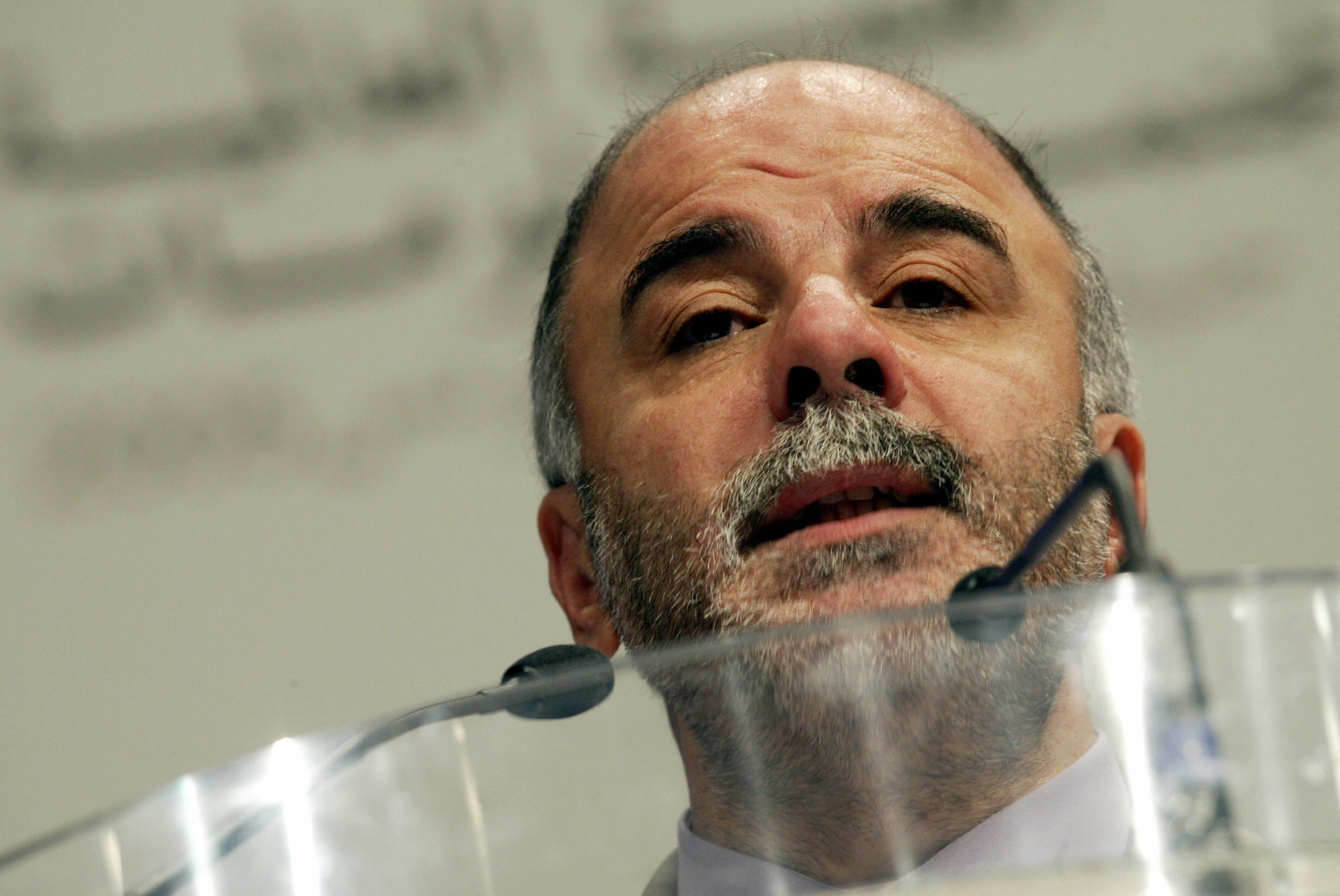
Iraqi Minister of Communication Haider a

David F. Schmitz hopes the US government has finally learned a thing or two from its experience at trying and failing to manage clients like Nouri al-Maliki and won’t make the same mistakes with his successor, Haider al-Abadi. There’s a broader lesson to be learned here, he argues, about the limits of our superpowers as a superpower:

Now that Iraq has a new leader who is said to be an amiable technocrat without Maliki’s overriding partisan agenda, can the United States escape its past as a poor puppeteer? Can Washington find a way to help Abadi rather than hinder him, empowering his government to take on the Islamic State without seeming to dictate its choices ? The Obama administration says it supports Abadi because it wants to see the democratic process upheld, and there is nothing wrong with this position. There’s no reason to think the Obama administration, no matter how many hundreds of advisers it sends or airstrikes it launches, will have any more success than the Bush administration did in stabilizing Iraq, because the underlying problem remains: It’s almost possible to get a foreign leader to do what is best for you, rather than what he believes is best for him, no matter how much money you throw his way or how hard you twist his arm.

The United States can still play a positive role, but instead of the business of building puppets, we should be more in the business of cultivation—helping good leaders to grow. Success in Iraq or Afghanistan can only come if an indigenous force and leader emerges with local support, and then only if the United States doesn’t demand that they reflect the will of Washington and the goals of the United States in all of their actions and policies.

Christopher Preble is on the same page. Abadi’s problems are many and daunting, he writes, but making them our problems won’t help solve them:

Abadi will need to find a way to form an inclusive coalition government, one that protects the rights of Sunnis and appeases the Kurds’ desire for autonomy, while maintaining support from Iraqi Shiites. This is a tall order. … Americans should wish Iraq’s new leader well, but policymakers should resist the urge to try to micromanage political events in Iraq. Even the appearance of U.S. influence over Abadi will undermine his legitimacy and thus could be counterproductive. Besides, it isn’t obvious that U.S. action—and only U.S. action—is essential to turning things around in Iraq.

Taking a closer look at those problems, Martin Chulov argues that bridging Iraq’s sectarian divide will be Abadi’s most daunting challenge:

Abadi has told followers his first job as prime minister will be to convince those Sunnis who have endorsed Isis in its attempt to establish a caliphate across Syria and Iraq that an Iraqi nation within its current borders remains a better option. Regional and Iraqi officials have encouraged Abadi to start by revitalising the demoralised national military and overhauling state institutions that have been co-opted by warlords and political blocs over the past decade. Many barely function. Abadi also aims to revive relations with Sunni Arab neighbours, including Saudi Arabia and the Gulf States, which boycotted Maliki’s government for close to seven years. Maliki, in turn, had accused Riyadh of bankrolling extremism in Iraq.

“He was such a divisive, polarising figure,” said one senior Saudi official of the ousted leader. “A new start was essential to even beginning to sort out this mess.”

But Ghaith Abdul Ahad resists the temptation to blame Maliki, and only Maliki, for running Iraq into the ground. At least to some extent, the problem is structural:

Maliki was not alone in his corruption, nepotism and oppression. In Iraq’s national unity government, ministries run by Maliki’s opponents are as corrupt as ministries run by his allies. Yes, he dominated the army, but every other party and sect had its own share of positions that were sold to the highest bidder. Detainees were freed by bribing officials who belonged to different parties. Ministers who publicly opposed Maliki never left his government because it generated so much wealth and power. Iraq’s division into fiefdoms, where each party greedily consumed its spoils, has created a country in which an oligarchy of a few thousand ministers, government officials, generals, militia commanders and all those people blessed with much-sought-after green zone badges – Sunnis, Shias and Kurds – have a monopoly on resources, leaving the rest of the nation with nothing much but the blame game.

Meanwhile, Ali Hashem spotlights Iran’s role in Abadi’s designation as prime minister, which suggests the level of interest with which Tehran is engaging the Iraq crisis:

During the weeks of talks, Iran’s secretary of national security, Adm. Ali Shamkhani, led the Iranian efforts on the ground. He visited Iraq on July 18 and met main leaders in Baghdad, Najaf and Erbil. Shamkhani was given a green light from Khamenei to try to end the crisis at any price. He was aware that the situation isn’t the same as before: Iran is no longer defending its regional security borders, but rather its direct borders; the Islamic State (IS) is now in Diyala, which borders Iran; and the last city that fell under IS control is Jalawla, less than 40 kilometers (25 miles) from the Iranian border.

In Tehran, the murmurs that Shamkhani will oversee the Iraq file have gotten louder. This is an indication that Iran is about to adopt a new policy, given Shamkhani’s historic relations with the Gulf countries and Iraq, his wide experience in dealing politically with regional conflicts and his closeness to Khamenei, all without ignoring the fact that he’s an Iranian of Arab origins.

(Photo: Haider al-Abadi by Jean-Philippe Kziazek/AFP/Getty Images)

Suffocating Protestors Since 1914

by Dish Staff

https://twitter.com/aterkel/statuses/501191846920740864

Anna Feigenbaum provides a brief history of tear gas. Her bottom line:

In the 100 years since it was first developed, tear gas, advertised as a harmless substance, has often proven fatal, asphyxiating children and adults, causing miscarriages, and injuring many. The human-rights organization Amnesty International has listed tear gas as part of the international trade in tools of torture, and Turkey’s medical association has condemned it.

Yet while tear gas remains banned from warfare under the Chemical Weapons Convention, its use in civilian policing grows. Tear gas remains as effective today at demoralizing and dispersing crowds as it was a century ago, turning the street from a place of protest into toxic chaos. It clogs the air, the one communication channel that even the most powerless can use to voice their grievances.

In this way, tear gas offers the police a cheap solution for social unrest. But rather than resolve tensions, it deepens them. This week in Ferguson, police fired tear gas into people’s backyards, set it off near children, and launched it directly at journalists.

Getting Medieval On Ebola?

by Dish Staff

With regards to containing the outbreak, Stephen Mihm describes a medieval approach called “cordon sanitaire” that’s currently being used in Liberia, Guinea, and Sierra Leone:

The problem, then as now, is the logistical challenge of completely eliminating any movement in or out of a large territory. One critic, writing in the 1880s about cholera outbreaks in Europe, observed that officials could “close every railroad line and every Alpine wheel route,” but refugees “would improvise a hundred footpaths through the mountains to find a way home.”

Moreover, the use of a cordon sanitaire in the past, while ostensibly aimed at restricting the movement of people, often had the opposite effect. In the Egyptian cholera epidemics of the late 19th century, imperial administrators used the cordon sanitaire, only to find that it panicked the populace. Many people fled the area out of fear that they would perish if left behind.

The practice can, notes Mihm, even cause further deaths: “It is perhaps not surprising that by the late 19th century many people came to denounce the practice as a relic of the Dark Ages.” Meanwhile, Dr. Philip Rosoff questions the use of experimental drugs:

If you read the WHO release on the ethics of using these drugs, they emphasize a couple of points: it should be okay to use them, but informed consent should be gotten. That seems to be self-evident but I’m not sure what informed consent means under situations of such desperation when a drug that’s never been used in people is held out as a life saver.

And he adds that this type of scenario makes good science unlikely:

[T]he WHO talks about collecting data but that’s going to be almost impossible to do. It’ll be impossible to decide whether it’s effective or not because it’s not going to be used under controlled circumstances. When people get better, we’ll have no idea whether it was because people are using the drug, or if somebody dies after getting the drug you don’t know whether it’s the disease or the drug. Because these patients are so sick, it may not be possible to detect side effects that you could under more controlled circumstances.

And then there are the entirely fake treatments, like Garcinia Cambogia powder, being marketed to the paranoid. Michael Byrne notes a silver-based dietary supplement which may have already scammed its way into Nigeria:

Of particular concern is a product called NanoSilver, sold by the Natural Solutions Foundation. The product is basically a solution of tiny silver particles, and purports to be something of a cure-all for infections of any stripe. Silver has demonstrated antimicrobal properties and, in the hands of the supplement industry, this can only mean that it treats whatever disease is handy. And while indeed silver is effective in surface antibiotic applications—as a disinfectant coating for medical devices, or a antimicrobal protectant utilized around public spaces—it is also fairly toxic to humans. And despite the howling chorus of natural heath boosters (just Google “silver particles cure”) the concept hasn’t really been shown to cure or treat anything once it’s inside the human body.

Previous Dish coverage of the Ebola outbreak here.

To Bind Up The Nation’s Wounds

by Matthew Sitman

US-CRIME-RACE-POLICE-SHOOTING

I noted in my introduction earlier today that I don’t usually write about politics, that I prefer, especially when things get bad, to retreat into literature and poetry. This was my impulse when news of what happened in Ferguson first flickered across my screen – to my shame, I just wanted to avert my gaze. And I managed to do just that for a day or two, until it couldn’t be ignored, and it shifted from a “local story” to the topic that completely dominated my Twitter feed and Facebook page, almost to the exclusion of everything else. Ferguson, Missouri, was “just a place,” as the New York Times put it, until, suddenly, it wasn’t. That phrase gets more chilling every time I read it.

In what I’ve read about the killing of Michael Brown and its aftermath, certain issues have been front-and-center, with the widespread evils of entrenched racism and the militarization of the police being the most prominent. But I’ve also noticed something else going on, which is that more and more people seem to believe that Ferguson reveals something quite damning about America itself, that it points to deeper, systemic issues that go far beyond one killing in one town – that the disregard for black lives in America is a sin that undermines so much about what we like to believe about our country, and our hopes for its future. James Poulos gets at this well:

Americans—in and out of my Twitter feed—have begun to grasp that hideous possibility: that America has manufactured a violent and predominantly black permanent underclass, subjected to our malignant paranoia about crime, living slow-motion death sentences in ghettos from which no amount of presidential hope, change, or lecturing can release them.

Even more important, Americans have begun to understand that the scourge-ification of this underclass is inseparable from the realization of our worst collective nightmare—the scourging of America itself, the ruin of the promise of America that still strikes us in our gut as providential. The widespread belief, still largely subconscious or at least unspoken, that America is breaking, and that we deserve the suffering ahead.

He then turns to Lincoln to further develop this thought:

“Fondly do we hope,” Lincoln said in his Second Inaugural, “fervently do we pray, that this mighty scourge of war may speedily pass away. Yet, if God wills that it continue until all the wealth piled by the bondsman’s two hundred and fifty years of unrequited toil shall be sunk, and until every drop of blood drawn with the lash shall be paid by another drawn with the sword, as was said three thousand years ago, so still it must be said ‘the judgments of the Lord are true and righteous altogether.’”

We do not want this to be true. This is what we fear: that America, despite its brilliance and its progress, is inescapably complicit in the sin of slavery and racism, bearing a moral debt that cannot be repaid but in suffering and blood—as such debts are paid so routinely around the world which we pride ourselves, however rationally, on standing so far above.

I think it has to be clear by now that we do bear that moral debt and are complicit in the ongoing sin of racism and white supremacy, even if too few of us are willing to admit it, and what I found compelling about Poulos’ essay is that he points beyond policy questions to the deeper moral issues involved. I certainly hope the killing in Ferguson leads to policy changes, especially when it comes to the militarization of our police forces. With Freddie, I also hope that the protests in Ferguson are the first stirrings of “dragging the police back under community control.” But these reforms won’t really be enough, even if they do help. Ferguson is about more than a few police officers with big guns behaving badly.

What we need, in other words, is what Ta-Nehisi Coates described in his recent essay on reparations:

What I’m talking about is more than recompense for past injustices—more than a handout, a payoff, hush money, or a reluctant bribe. What I’m talking about is a national reckoning that would lead to spiritual renewal. Reparations would mean the end of scarfing hot dogs on the Fourth of July while denying the facts of our heritage. Reparations would mean the end of yelling “patriotism” while waving a Confederate flag. Reparations would mean a revolution of the American consciousness, a reconciling of our self-image as the great democratizer with the facts of our history.

Beyond policy fixes is the necessity of a “national reckoning” with the reality of racial injustice in this country. More white people like myself should care about the criminalization of black men apart from when it’s trendy to mention it on Twitter. What I am concerned about is what happens after the situation in Ferguson is “resolved.” And I don’t see how we can really have that national reckoning apart from the ways Coates lays out in his essay, addressing the full breadth of the way blacks have been marginalized, punished, and plundered throughout our history. We can take away the police’s military equipment, but we also need “a revolution of the American consciousness.” The question we face is not just “Why do the police in Ferguson have that equipment?” but “Why did they turn those arms against black people?” Beneath policy debates lurks the problems of the human heart, and the hate and indifference residing there.

All this is another way of saying we need repentance, real repentance. I do not accept that the only way forward is through “suffering and blood.” To invoke the prophetic tradition both Lincoln and Poulos are leaning on, repentance can forestall the anger of the Lord. As the writer of the book of Jonah proclaimed, “When God saw what they did and how they turned from their evil ways, he relented and did not bring on them the destruction he had threatened.” And so if we’re going to revisit Lincoln, it’s worth mentioning the call that closed his second Inaugural address:

With malice toward none, with charity for all, with firmness in the right as God gives us to see the right, let us strive on to finish the work we are in, to bind up the nation’s wounds, to care for him who shall have borne the battle and for his widow and his orphan, to do all which may achieve and cherish a just and lasting peace among ourselves and with all nations.

Let us turn from our evil ways and repent, and bind up the nation’s wounds as best we can. Read Ta-Nehisi Coates’ essay, if you haven’t already, and consider, as TNC suggests, supporting John Conyer’s congressional bill, H.R. 40. Keep tweeting about Ferguson, sure, but when your social media feed reverts to pictures of cats and snarky one-liners, remember what we saw and felt this last week. And one other thing: I want to hear from Dish readers about concrete ways they hope to “finish the work we are in” in the weeks, months, and years ahead. Write to me at dish@andrewsullivan.com with ideas and suggestions about how to do this, how you plan on being more than a spectator who simply waits to tweet about the next killing and the next protest.

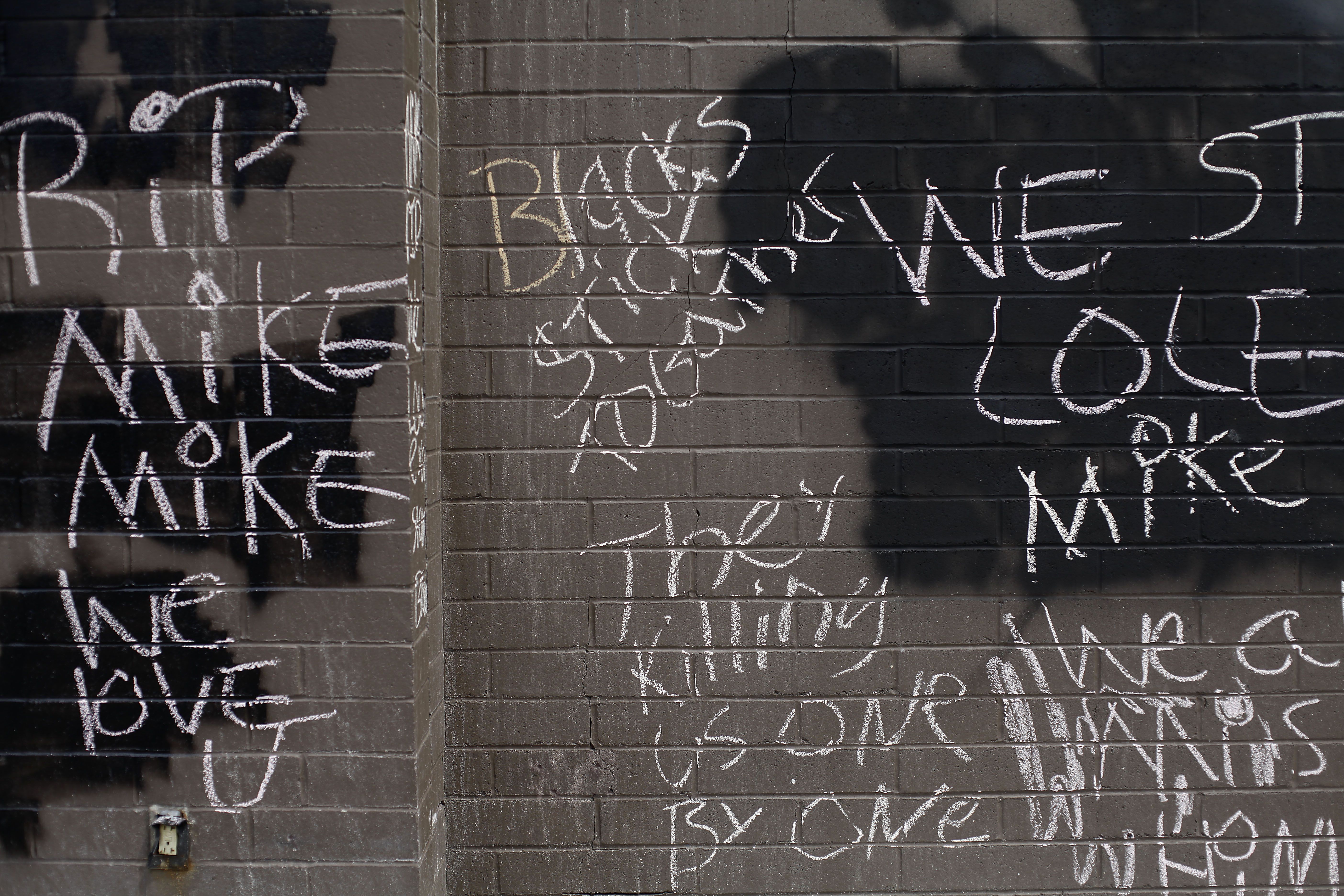
(Photo: Demonstrators wrote messages while protesting on August 15, 2014, the shooting death of 18-year-old Michael Brown in Ferguson, Missouri. By Joshua Lott/AFP/Getty Images)

Perry Gets His “Gate”

by Dish Staff

On Friday, a grand jury in Travis County, Texas indicted governor Rick Perry on charges of abuse of official capacity and coercion of a public servant after he threatened to veto funding for a government oversight program, allegedly to pressure the Democratic DA who ran it into resigning, and subsequently made good on the threat:

A special prosecutor spent months calling witnesses and presenting evidence that Perry broke the law when he promised publicly to nix $7.5 million over two years for the public integrity unit run by the office of Travis County Democratic District Attorney Rosemary Lehmberg. Lehmberg was convicted of drunken driving, but refused Perry’s calls to resign. … The unit Lehmberg oversees is the same that led the investigation against former U.S. House Majority Leader Tom DeLay, a Texas Republican who in 2010 was convicted of money laundering and conspiracy to commit money laundering for taking part in a scheme to influence elections in his home state.

The emerging consensus among legal and political commentators is that the indictment is entirely specious. Eugene Volokh lays out the many reasons why:

[T]he Texas Constitution expressly reserves the veto power to the governor. The governor is entitled to decide which laws he “approv[es]” and which he disapproves — without constraint from the legislature, or from county-level district attorneys. The legislature certainly can’t make it a crime for the governor to veto its appropriation bills; that would deny the governor the power that the Texas Constitution gives him.

Nor can the legislature make it a crime, I think, for the governor to veto its appropriation bills as an attempt to influence some government official’s behavior — behavior that is commonplace in the political process, and that is likewise within the governor’s exclusive power to decide which bills to give his “approval.” To be sure, the legislature can make it a crime for the governor to accept bribes in exchange for a veto; but there the crime is the acceptance of the bribe, not the veto itself.

Chait calls it “unbelievably ridiculous”:

The prosecutors claim that, while vetoing the bill may be an official action, threatening a veto is not. Of course the threat of the veto is an integral part of its function. The legislature can hardly negotiate with the governor if he won’t tell them in advance what he plans to veto. This is why, when you say the word “veto,” the next word that springs to mind is “threat.” That’s how vetoes work. The theory behind the indictment is flexible enough that almost any kind of political conflict could be defined as a “misuse” of power or “coercion” of one’s opponents. To describe the indictment as “frivolous” gives it far more credence than it deserves. Perry may not be much smarter than a ham sandwich, but he is exactly as guilty as one.

But Alec MacGillis argues that the charges, though unlikely to hold water, are illustrative of how Perry operates:

[R]egardless of how strong the charges against Perry are, it is worth noting how fitting they are. Put simply, the case against Perry points to an aspect of his political persona that is well known in Texas but has too often been overlooked in the national portrayal of Perry. On the national stage, Perry is alternately depicted as a hardened ideologuethe states’ rights gunslinger who openly flirted with secessionand as a bumbling buffoon who watched his high-octane 2012 presidential campaign flame out in a moment of debate-stage befuddlement. Both of these caricatures miss Perry’s essence. As I argued in a 2011 profile of him for this magazine, Perry is both more conniving and less ideologically-motivated than the national perception of him would have one believe. He is, at heart, a political operator and a striver who has wielded the many levers of power available to him as governor of the second largest state less to advance a coherent conservative agenda than for his own aggrandizement and that of his cronies.

But then, he’s not the only one. The indictment itself is a crystal-clear case of politics in the courtroom, as the Bloomberg View editors lament:

This would be ordinary partisan tit for tat, except that a law enforcement office is involved. Political disputes should be resolved in political venues — legislative bodies and public debates — not in criminal courts. If Perry’s veto is an abuse of power, then the state legislature could impeach him, as it did Texas Governor James “Pa” Ferguson nearly 100 years ago. Impeachment, however, is entirely unnecessary: The legislature could simply vote to override Perry’s line-item veto. For failing to do so, should the entire legislature be indicted? Of course not. Perry is guilty of partisan behavior, not felonious conduct.

Ross Ramsey raises the question of how the indictment might affect Perry’s ambitions in 2016:

This job is ending, but the governor is at the beginning of his next run for office, and the indictment is national news, like Chris Christie’s bridge. The governor’s supporters blame Democratic politics — Travis County is liberal, and the prosecutors are hard on Republicans, they say — but this is catnip for other Republicans. Perry isn’t competing with Democrats, but with other Republicans for the chance to compete with the Democrats.

Maybe his lawyers can get the indictment snuffed before there is a trial. Maybe there will be a trial, and a jury will find nothing criminal has taken place. Meanwhile, the governor and others are already haunting Iowa, the home of the first presidential primaries almost two years from now. This indictment could be to the Perry presidential campaign what a sewer leak is to the opening of a new restaurant: The food might not be the diners’ strongest memory of the meal.

But Harry Enten and Walt Hickey cast some doubt on that suggestion:

A lot of reporters and pundits will spend the next several weeks trying to answer that question, but the truth is we won’t know for quite some time. It looked like Perry would have had a difficult time capturing the nomination even before Friday’s indictment. According to recent polls by NBC/Marist, Perry was at 7 percent in Iowa and 5 percent in New Hampshire. His Iowa numbers are especially depressed from where he was polling when he first declared his candidacy in 2012.

Perhaps more importantly, Perry’s repeated gaffes in 2012 would have made it difficult for the GOP establishment to support him again in 2016. As we’ve noted in the past, establishment support (or at least a lack of opposition) is key to winning a Republican primary. It’s one of the reasons Newt Gingrich lost in 2012. The establishment wants to nominate electable candidates. Perry’s past missteps and misstatements may have rendered him unacceptable to Republican power brokers.

Dish Shirts: 100% Cotton Tees Are Here!

by Chris Bodenner

Howler-9color

We are sold out of the screen-printed tri-blend t-shirts we launched last month, but Dish polos are still available – in navy blue and white. When we released our premium tri-blends, a reader wrote:

Shirts do look beautiful, congratulations and hope you sell a lot because I am a big fan of your blog.  I will unfortunately be abstaining because I am allergic to polyester and can only buy all natural fibers – cotton, all linen or rayon mix, etc.

Another had a similar concern:

Please consider finding a really soft 100% cotton shirt (for purists as well as those of us with sensory issues).

We took those considerations to heart and are now offering a 100% cotton version of both t-shirt designs – the Howler (seen above) and the Logo, seen below next to the navy Polo:

shirt-combo

Both the Logo and Howler versions of our 100% cotton t-shirts come in nine different colors: White, Navy Blue, Light Blue, Royal Blue, Red, Kelly Green, Asphalt, Teal, and Brown. So go here if you’d like to purchase a Howler shirt in one of those colors or go here for a Logo version. And both designs still come in men’s sizes and women’s sizes – no unisex.

Another big thanks to Jerzy Shustin and everyone else at BustedTees for hosting our shirts. As always, we welcome your feedback in the inbox: dish@andrewsullivan.com.