Stephen T. Fomba, who grew up poor in Sierra Leone, suggests it:
I didn’t mind growing up this way, for I didn’t mind work and did not know what I did not have. But I hated having to make these walks barefoot because we could not afford shoes. The injuries were too much. I sustained burns from the hot ground and rocks; wounds from sharp stones, thorns, and even broken bottles; infections from unknown bacteria; and various ailments—red skins, open sores that took very long to heal, fevers. Even when hurt or ill, I had to keep walking, often as many as 20 miles a day, usually under a hot sun.
We rarely think about the perils of walking barefoot. But according to one widely cited estimate, some 300 million children on earth don’t have shoes. Many illnesses and infections come from the ground, caused by stepping on sharp objects or touching saliva, blood, or bodily fluids. And it’s not merely those who can’t afford shoes who have to go barefoot; many millions of people around the world own poor quality shoes, but have to be careful not to overuse them to avoid early wear and tear. Shoes are for special occasions.
Blair Glencorse and Brooks Marmon instead focus on the “clear link between this governance failure and the current health crisis”
In places where governments are so rarely willing or able act in the interests of their citizens, we can begin to understand why the disease continues to disseminate. Health services, which barely exist in many places, are shunned because the unsanitary conditions of hospitals and heath centers have made them hubs for the spread of the virus. Many hospital staff — already underpaid and ill-equipped — have become victims themselves. Foreign health workers sent to help are ignored and even chased away by scared locals. A group of Liberians explained to us recently that they think Ebola is a ploy by the government to steal even more money from Western donors.
As a result, the Ebola challenges are now evolving into larger problems of instability in the region. Economic activity has ground to a standstill as borders have closed, movement is restricted, and flights are canceled. This is happening in countries where up to 50 percent of the population already earns less than 50 cents a day. Mistrust, misunderstandings, and ill-will are growing as people continue to die.
Laurie Garrett, who “was in the Ebola outbreak in Kikwit, Zaire (now the Democratic Republic of Congo) in 1995,” lends her perspective:
How long will this state of siege last? Recent statements from WHO, MSF, Samaritan’s Purse, and other institutions leading the fight alongside the governments warn the world that it will be at least six months, and quite possibly a year, before Ebola can be defeated. Despite all the brouhaha here in the United States and Canada about application of experimental drugs and vaccines never clinically tested for safety or effectiveness to the African crisis, this siege will end not with magic bullets, but smart, heroic strategies that find infected people swiftly, place them behind cordoned quarantine barriers, and bury the dead rapidly after their demise without families’ contact or viewing. Yes, it is heartless and can seem cruel, but strategic isolations, coupled with vast urban campaigns of capture of the infected constitute the only hopes for ending the state of siege.
The ongoing protests and civil unrest in Ferguson, MO, is in many ways a long simmering set of problems brought to a boil. Most acutely, there’s the perfectly justifiable anger and resentment from a black population that, 50 years after the Civil Rights Act, still struggles to overcome centuries of entrenched and systemic racism. Black America’s status as a permanent underclass is baked directly into the foundations of our economic and social system, and piecemeal reforms have proven utterly inadequate to the task of fixing the problem. In particular, the criminalization of black young males makes angry conflict with police inevitable. Under such circumstances, the surprise isn’t that protests and civil disobedience have broken out in Ferguson. The surprise is that it doesn’t happen more often.
Beyond the racial dynamics, there’s the growing public realization that the police in America are out of control. It’s a problem that only we, the broad public, can fix. And we are responsible for fixing it because we’re all to blame.
If I sat down to summarize even a year’s worth of police misconduct and brutality, it would take hours and hours. Those of us who follow the news closely know that outrageous behavior by the cops is a daily occurrence. Sites like Gawker and journalists like Radley Balko have spread word of this misconduct regularly, but all it usually takes is a brief visit to Google News. And people, finally, are starting to notice. When even National Review is running a piece like “It’s Time for Conservatives to Stop Defending Police,” you know that the issue is becoming too acute to ignore. What the American poor have been experiencing for decades has become too obvious for affluent America to ignore.
Like so many of our national problems, our deep, perpetual problems with police behaving badly stems in part from 9/11 and the post-9/11 world.
I don’t want to oversell this; certainly, we’ve been living in a culture of deference towards police for far longer. But as we did with the presidency, the military, the intelligence services, and soldiers, we responded to 9/11 by buffeting our police officers with obsequious respect and endless displays of extreme gratitude. We feted them at football games and through parades in their honor. We plastered stickers celebrating them on our cars. We exhorted each other to “thank a first responder today.” We set about to create a culture of unwavering, unquestioning, credulous support for our police, and that has everything to do with today’s problems.
None of this should be surprising. In times of crisis, people often retreat to militarism, nationalism, and extreme respect for authority. This is part of why an aggressive foreign policy is so counterproductive; every time we rattle our saber at Iran, for example, we empower the theocracy and the establishment government and hurt the resistance. Our showy disdain for Russia, the way we layer disrespect on their displays of national pride and celebrations of their history– like we did during Sochi– only causes them to embrace Putin and his narrative more. You might find that foolish, but we did the exact same, affixing flags to our cars and writing our national security state a blank check in the form of the PATRIOT Act and similar legislation. And we told the cops, more or less explicitly: you can do whatever you want. The results are unsurprising.
After all, when you give any group carte blanche to do what they want, and make it clear that you will support them no matter what, how can you be surprised when they abuse that generosity? It’s human nature: people who are subject to little or no review will inevitably behave badly. No group can be expected to police itself; that’s why the foundation of our democracy is the separation of powers, the way in which different parts of government are expected to audit each other. Ultimately, though, the most important form of audit comes from the people themselves. Only the citizenry can ensure that our systems remain under our democratic control, and this function is especially important concerning the conduct of those who have the capacity to legally commit acts of violence– and to define for themselves what acts of violence are legal, whether those definitions are official or merely ad hoc. Well, we have abdicated that responsibility, and in that vacuum, misconduct, brutality, and corruption have rushed in. The problem is endemic. I don’t believe that all cops are bad, or even the majority, but I also don’t believe that this is a “few bad apples” problem. A few bad apples could not cause a problem as widespread and constant as the one we’re witnessing now.
You may not agree completely with the protesters in Ferguson. You may find their tactics unhelpful or misguided. But you should recognize: they are the front lines in a long-overdue process of reversing this problem and slowly dragging the police back under community control. It’s going to be an enormous task, one that has to occur on both the national and the local level. The acrimony and recrimination that will attend this project will be enormous, as the “law and order” brigades deride those working to rein in the police as radical, soft on crime, or worse. But we have to do it. This problem will never fix itself. The police cannot be expected to reform themselves. And since we as a people had a hand in creating these conditions, it’s our responsibility to change them. If you find the size of the task daunting, you need only think of the alternative, an ever-more unaccountable and entitled gang of men with guns and batons. Or think about an 18 year old black body, lying for four hours in a Missouri street.
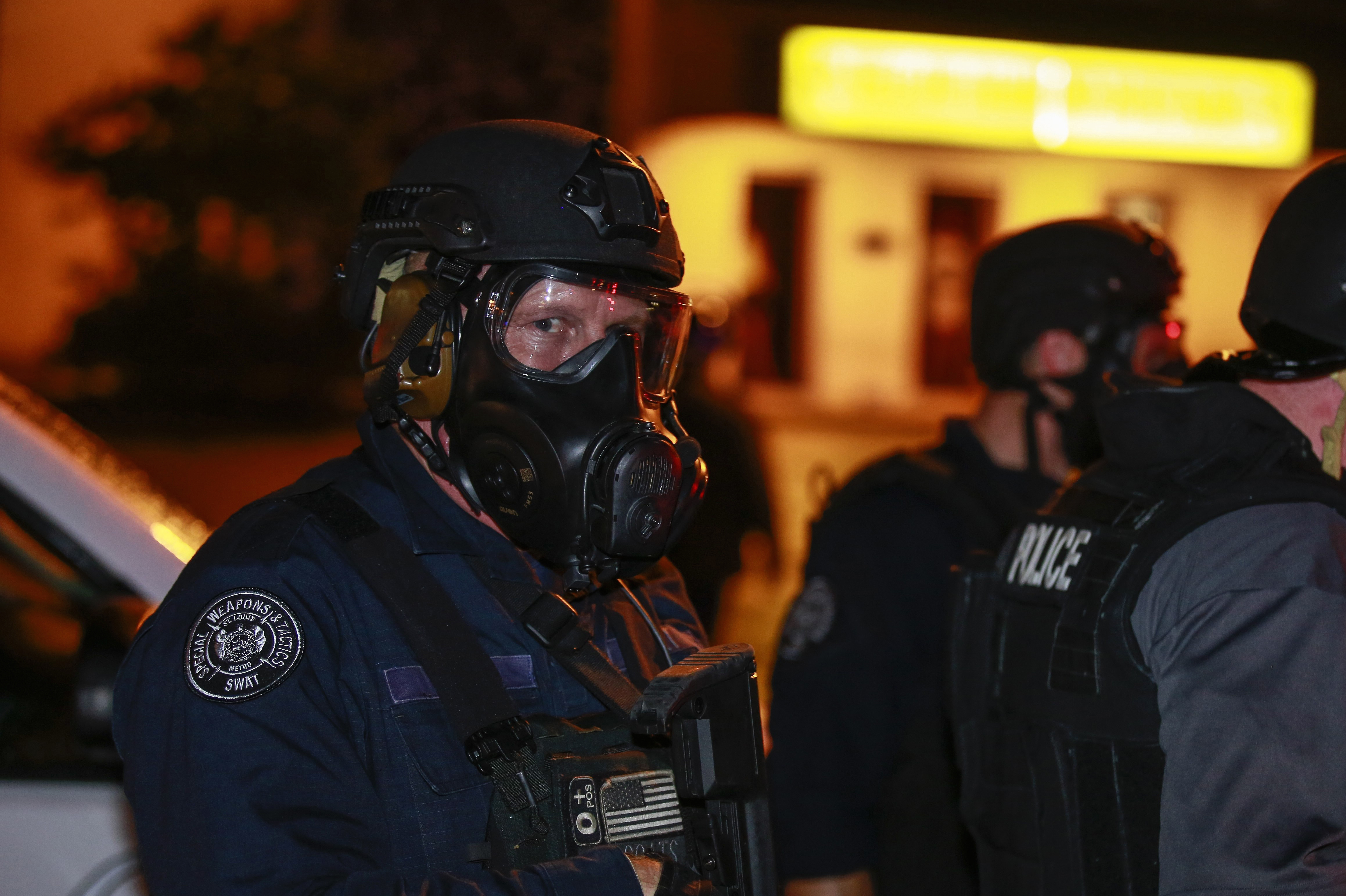
(Photo: Police forces intervene protesters, who took to the streets to protest the killing of Michael Brown on August 17, 2014. U.S. Missouri State Governor Jay Nixon Saturday declared a curfew and a state of emergency in Ferguson, a suburb of St. Louis. By Bilgin Sasmaz/Anadolu Agency/Getty Images)
Hey Dish readers – I’m Matt, the Dish’s literary editor and, this week, guest-blogger. Most of my work usually appears on the weekends, especially Sundays, so I tend to be responsible for the posts about religion that readers seem to either love or hate, and my deepest interests lean much more toward theology, poetry, and literature than politics. That means writing more about politics over the next few days will be a bit of an adventure for me. Usually I find politics, and the way we argue about politics, terribly depressing, which provides a lovely excuse to retreat into old books. I hope this lack of immersion in punditry gives me a fresh perspective on the events of the day while guest-blogging, but I suspect Dish readers will let me know if it doesn’t.
Prior to joining the Dish team two years ago, I was a Ph.D. student at Georgetown University studying political theory, but I never finished my doctorate, making me something of an academic refugee. My research interests mainly concerned the relationship between political thought and theology, with a particular focus on the Reformation. I won’t bore you with too much more about that, but the questions that led me to that topic still are what I think about the most. Above all, I’m fascinated by religion’s place in the modern world, and I’m drawn to writers who examine that subject with verve and creativity. To that end, I have an essay, coming out very soon in Deep Dish, on the poet Christian Wiman that explores his approach to Christianity.
I grew up in a small town in rural central Pennsylvania, and neither of my parents and none of my grandparents went to college. This means that I always remind myself what a privilege it is to spend my days reading and writing and thinking about books. I hope my enthusiasm and gratitude for getting to do so is apparent during my week of guest-blogging.
In the wake of Robin Williams’ death, Steven Stack reviews research on suicide contagion:
[T]here have been more than 100 empirical investigations of copycat suicide. A review of 419 findings from the first 55 investigations showed that only 35.8 per cent documented an increase in suicide after media coverage. Given that most evidence is not consistent with a copycat effect, a search for the conditions under which a story may elicit imitative suicides has been a key theme in this work.
The most important factor distinguishing studies that report a copycat effect from the ones that do not is whether or not a celebrity is involved. In particular, copycat effects are most likely to be reported in work focused on two distinct types of celebrities: those in politics and entertainment. The analysis of those 419 findings found that studies based on either or both of these subtypes were 5.27 times more likely to report an increase in suicides following coverage.
But he theorizes that “Williams’s gender could conceivably prevent a record number of copycat deaths”:
The more Williams’s suicide is discussed, if all else is equal, the greater the odds of a copycat effect. It is, however, doubtful that the impact will be as great as that of Monroe or Choi. They killed themselves at the peaks of their careers and popularity. In addition, the review of 419 findings in 55 studies determined that research that focuses on female suicide rates was 4.89 times more likely to find a copycat effect than other research.
Margot Sanger-Katz explains how to ethically cover suicides:
Few of the experts’ recommendations make much sense in the case of Mr. Williams. Studies suggest avoiding repetitive or prominent coverage; keeping the word suicide out of news headlines; and remaining silent about the means of suicide. “How can it not be prominent?” [professor Madelyn] Gould said.
Experts also say articles should include information about how suicide can be avoided (for instance, noting that the National Suicide Prevention Lifeline is available 24 hours a day at 800-273-8255).
They also recommend avoiding coverage that describes death as an escape for a troubled person.
So how should journalists report on suicides? The public interest is best served by simply reporting that a person has died by suicide, with no additional details provided. If that’s too much to ask, then at least such details should not be placed in headlines or featured in a way that calls attention to them. This guidance is found in many ethicalstandards for journalists.
Williams’ suicide has also prompted a lot of constructive journalism about suicide prevention. I am all for that: suicide prevention is one of my research areas. But the most important thing to do is to find more effective treatments for the cause of many suicides: depression. And to find these treatments we need to be conducting more mental health research.
A reader response to Hecht’s video is here. More Dish on suicide contagion here.
Last July, I attended the Council of Writing Program Administrator’s annual conference in Normal, Illinois. While there, I watched a keynote address given by Duane Roen, a vice provost and professor at Arizona State University. Roen’s speech addressed the great need for academics and scholars to be publicly engaged, to share their work with a general audience and to endeavor to make the work we produce in our universities more accessible to the public. Roen referenced Nicholas Kristof’s famous (or notorious) column complaining that academics are too cloistered, our work too obscure to be of use to the general public. At the time, I and others complained that Kristof’s perspective was willfully narrow, failed to recognize a whole host of academics who make their work public every day, and ignored structural economic reasons for why academics can’t or won’t engage publicly. But Roen’s speech made clear that, despite these real reservations, we must continue to press ourselves to be more engaged, accessible, and open in our teaching and our research. Whether the perception that we are inaccessible and secluded from public life is fair or not, that perception must be combated through rigorous public engagement. Roen discussed academics who had, he felt, done an exemplary job of making their work available to a wider audience, and laid out the many benefits of this type of scholarly work.
Roen was the perfect figure to deliver such an argument, given his long history as a leader and mentor within the WPA world. The night before his speech, my friend Marcy and I talked with Dr. Roen at length at a gathering for graduate students, and I was struck by his warmth and approachability. This, too, is a form of public work, engaging with early-career academics and making them feel like part of the scholarly conversation. I was happy to see that Roen’s speech displayed the same friendliness and openness.
But while I felt energized by Roen’s keynote, I also felt concerned. I had noticed that all of the academics Roen listed were late career, and enjoyed the benefits of both tenure and prominence. During the Q&A, I asked Roen about the dangers of engaging publicly as a grad student or untenured academic, given that public speech tends to be political speech. Roen admitted that the question for the untenured was complicated, and advocated a cautious approach. Afterwards, several other faculty members in the audience addressed the question, and argued that grad students should not fear political engagement. Why would someone want to join a department, one asked, if that department had such little regard for intellectual and political freedom that it wouldn’t hire someone with controversial views? I felt encouraged by that support. But it’s also the case that, after I spoke, I was approached over the course of the next day by perhaps a half dozen grad students, who confided in me that they, too, feel constrained in what they can say, and fear speaking out in public about issues of controversy. They appreciated the support of the faculty in attendance, as I did, but said that with the academic job market as demoralizingly competitive as it is, they could not help but feel pressure to keep their opinions to themselves. They want to engage publicly, but the risks seem to outweigh the rewards.
These questions have taken on particular salience recently. Dr. Steven Salaita, a Palestinian-American scholar who studies indigenous history and post-colonialism, had a tenured job offer rescinded by the University of Illinois at Urbana-Champaign, thanks to a series of tweets he had sent regarding Israel’s brutal assault on Gaza. To make matters even worse, Salaita had already resigned his tenured position at Virginia Tech, as his appointment at Illinois had already been confirmed. Adding insult to injury, Cary Nelson, a professor in the department Salaita was to join and the former president of the AAUP faculty union, vigorously defended the school’s decision, despite being a self-identified defender of academic freedom. (In fact, Nelson has displayed such intimate knowledge with Salaita’s tweets that it is fair to ask whether he had a hand in the decision.) I wrote a letter to UIUC’s chancellor to protest, as did many others, and as Corey Robin has documented at length, a great number of academics and public figures have condemned this action. (Robin’s blog, in general, has been an indispensable resource in covering this story.) But while I hope and pray that Salaita lands on his feet in a secure tenured job, the damage to academic freedom has been done no matter what the outcome: the millions of academics observing this situation, particularly those who are in the precarious position of being untenured—the vast majority—cannot help but be less likely to speak out on matters of controversy. Those at UIUC who are responsible for this decision are culpable for this chilling effect on free political and intellectual expression.
Nelson’s performance throughout this controversy has been an embarrassment to himself and to his university. He has made it clear that his objection is not procedural but rather based largely on his personal rejection of Salaita’s politics. He has stated, for example, that “he doesn’t consider Gaza under occupation,” which is absurd, and anyway should be totally irrelevant to whether or not Salaita should have been fired. Nelson has taken the typical tack of representing Salaita as anti-Semitic, despite the fact that Salaita has said (in the self-same medium) “My stand is fundamentally one of acknowledging and countering the horror of antisemitism,” ” I believe that Jewish and Arab children are equal in the eyes of God,” “I refuse to conceptualize Israel/Palestine as Jewish-Arab acrimony. I am in solidarity with many Jews and in disagreement with many Arabs,” among other things.
What little procedural defense of Salaita’s firing Nelson was able to muster involved the notion of “collegiality.” As many have pointed out, Nelson himself has not always been a champion in this regard himself, referring to another academic in print as a vampire bat, among other outbursts. Beyond the palpable hypocrisy of Nelson’s take, there is the simply unworkable division between expression and tone. Arguments about tone are perennially utilized to forbid ideas that are controversial or disliked; there is no meaningful distinction between the two. Too often, notions of collegiality and tone become a catch-all complaint that cannot be independently verified. Would Malcolm X be able to serve in Nelson’s university? Would Eugene Debs or Jane Addams or Larry Kramer?
Someone once wrote that “claims about collegiality are being used to stifle campus debate, to punish faculty, and to silence the free exchange of opinion by the imposition of corporate-style conformity.” That man was Cary Nelson. I would like very much for Dr. Nelson to grapple with this: when smart and committed young academics tell me that they are too afraid of the potential professional consequences to speak out publicly, as they have often, it is people like Nelson who are partially responsible. His conduct has directly and deeply damaged our sense of a right to intellectual freedom.
Earlier this year, I got myself in some trouble with my fellow leftists when I asked whether we might take pause at the firing of Mozilla CEO Brandon Eich. I felt no personal sympathy for him, none at all, and I said so. Eich is a rich and powerful person, and I strongly disagree with his opposition to gay marriage rights in California. But I was disturbed at how casually my liberal friends disregarded his claims to free speech rights. “The first amendment doesn’t guarantee you the right to keep your job! It just means that the government can’t come arrest you for expressing unpopular views!” And yet consider what that attitude means. If workers have no expectation at all to the right to hold political views their employers don’t like, how do they enjoy basic democratic political rights at all? In a world in which you need a job to provide for your own material security, the notion that employers have the right to fire you for holding unpopular political views means that you have no right to hold unpopular political views. Indeed: in such a world, the only people who maintain the ability to hold unpopular political opinions are the independently wealthy. How that could be considered a liberal or progressive outcome, I have no idea, and yet those who self-identify as members of the broad left were the most aggressive in ridiculing my questions. Though they and I have little regard for Eich, the fact remains that rights must be universal if they are rights at all, and the procedural precedent set by Eich’s dismissal was, I thought, at least worth discussing.
Under labor conditions in the university system as brutal as we’ve faced, and with the cost of controversy as high as ever, how can academics and professors feel free to work through controversial and unpopular ideas, which is a necessary part of our work? Some defended the Eich firing by pointing out that, as a CEO, he had a special responsibility to be the public face of the company. Eich’s job, in this telling, was in part to be uncontroversial, and he failed in that task. Perhaps that’s true. But for us as academics, having and expressing controversial ideas is our job. A professoriate that feels that it cannot express impolite opinions is a professoriate that has no ability to cast new light on the human condition, no ability to truly grapple with the essential questions that confront the human race. Nor can they engage publicly if they are so busy teaching a huge course load as adjuncts that they have no time in which to research and teach, let along expand their work to the public sphere. My friend Anthony Galluzo, a brilliant Americanist, has written publicly about academics and research before, and I’d like to read more. But he’s been constrained, as so many other bright academics are, by his need to teach an unsustainable course load to survive. There is no way in which we can build the kind of public outreach we are asked to in a context where so many academics are so overworked and underpaid– and no way, incidentally, those academics can be the kinds of teachers they need to be.
All of this might seem like inside baseball, an obscure conversation had by members of a small, unusual industry. But the conditions that academics face are in fact not that different from those of everyone else. After all, it is not merely academics who have a responsibility to undertake public, political work, but all of us who are democratic citizens. By the most basic political philosophy of democracy, citizens are not required merely to vote and leave the debates to the politicians, but must actively engage in the messy work of self-governance. That means that they must feel free to express themselves politically without fear that their boss will fire them, leaving them unable to provide for themselves or their family. In a world where poor job quality, insufficient hours, insufficient pay, ever-expanding corporate rights and protections, sharp reductions in unionism, and the threat of automation all diminish the negotiating power of workers, controversial political engagement becomes a risk few can afford to take. Economic insecurity becomes political insecurity.
In the academic world, there is simply no alternative to reinvesting in the human resource that is the professoriate, expanding the ranks of those who enjoy the protections of tenure. It is possible, even in a context in which we are finally taking the necessary steps to rein in the increase in tuition. Because universities have been so profligate in the recent past, building dorms and gyms and dining halls beyond all sense and employing an army of administrators whose work is tangential to the academic enterprise, there is ample room to cut while still restoring the professoriate, particularly if states decide to reinvest in their public universities, which have been the envy of the world. We must make the choice as a society to privilege teaching and research over fancy buildings and expensive amenities. A commitment to hiring more tenure-track faculty from the ranks of our contingent labor and graduate students will improve undergraduate teaching, as overworked adjuncts teaching five or six classes a semester to make ends meet cannot possibly reach their peak potential as educators, through no fault of their own. It will also revitalize our research mission, and it will empower scholars to do the controversial, political work that is such an essential part of the life of the mind.
In the broader societal view, we must recognize that we have endured four decades of declining workplace conditions for millions of Americans. Flat-lined real wages, periods of high unemployment, and the general casualization and deprofessionalization of our labor force have left us not merely a less prosperous and humane society, but a less free, less democratic one as well. Our people cannot perform their role as citizens in a working world where they have no leverage and no negotiating power. To restore civic participation and public life, we must restore our unions and reinvigorate collective bargaining rights, strengthen our social safety net, and transition to a system of market socialism through a guaranteed basic income. Then, workers of all stripes, academic or otherwise, will enjoy the ability to engage politically without fear that they will go hungry if they say the wrong things. In the end, the projects to improve humanitarian outcomes, to increase personal liberty, and to revitalize deliberative democracy are one and the same.
New research suggests you’re better off chatting up fellow commuters than staying mum:
The investigation began with rail and bus commuters travelling into Chicago. Dozens of them were recruited into one of three conditions – to engage in conversation with a stranger on the train, sit in solitude, or simply behave as they usually would. Afterwards they mailed back a questionnaire in which they answered questions about the experience. Their answers were compared to the predictions made by other commuters, who instead of fulfilling one of these three conditions, imagined what kind of experience they’d have had if they’d taken part.
The returned questionnaires showed it was those commuters who were instructed to strike up conversation with a stranger who’d had the most positive experiences (sitting in solitude was the least enjoyable, with behaving as normal scoring in between). Surprisingly perhaps, chatting with a stranger didn’t come at the cost of self-reported productivity. These findings contrasted starkly with the predictions made by the commuters who imagined taking part – they thought that being asked to engage with a stranger would have been the least enjoyable of the three conditions. [Researchers Nicholas] Epley and [Juliana] Schroeder said this provides evidence of a “severe misunderstanding of the psychological consequences of social engagement”, thus providing a clue as to why, despite being social animals, we so often ignore each other.
Hey guys, my name is Freddie deBoer, and I’m very happy to be filling in for Andrew this week.
For five years (exactly), I wrote a blog called L’Hote, which I named as a joke based on the fact that before I started blogging, I was a commenter on other people’s blogs. (L’hote, in French, means both the host and the guest.) For about a year or so now, I’ve been blogging under the title Interfaces of the Word at my professional website. I write about everything and anything, but I write a lot about education and education reform, professional writing and journalism as cultures, and artificial intelligence. I have also written for n+1, Jacobin, The New Inquiry, and a bunch of other places.
I’m an academic, from an academic family. My father was a professor and his father was a professor and his…. I’m currently a fourth year student and doctoral candidate at Purdue University, in the Rhetoric and Composition program. My academic work occupies the overlap between composition studies, applied linguistics, and education, with a focus on assessment and testing, second language learning, and program administration. If I’m pressed to name my field, I sometimes say educational linguistics, sometimes literacy education, and sometimes just composition. I’m not really caught up on labels. I care about writing, I care about language, and I care about teaching and researching both. That’s my field.
I consider myself a quantitative researcher, and a lot of my work involves corpus linguistics, computerized textual processing, and statistics. At the same time, I value qualitative, historical, and theoretical work as well. What I’ve gained from studying rhetoric and composition generally, and at Purdue’s program specifically, is freedom– immense freedom to define my own interests, my own methodologies, and my own path. I’m currently writing a dissertation on the Collegiate Learning Assessment+, a standardized test of college learning that is being adopted here at Purdue. My dissertation involves testing and assessment theory, empirical evaluation of piloting results, the history and rhetoric of the higher education assessment movement, and other issues, which suits my interdisciplinary interests very well. (I hope to write a post about the test for you guys this week.) I’m on track to graduate this coming May on a four year plan, and the academic job market is rushing up at me in the coming months.
I’m also a socialist, from a socialist family. In that, I mean that I believe in an economic system based on a societal obligation to secure basic material security for all of its people, and that this responsibility cannot be fulfilled by reforming capitalism. My personal preference is for the implementation of a system of market socialism through the vehicle of a universal basic income. What comes after that, I can’t say, but it should stem from the recognition that economic outcomes are the product of forces beyond the control of the individual, and that the market will never deliver moral outcomes unless it is forced to by society. I also reject the ideas of religion, intrinsic sexual identity, patriotism, and empire.
I have a cat, named Suavecito, and a dog, named Miles, who are both crazy in very different ways. You can see my neurotic dog and my sociopathic cat in the picture above.
I also have a reputation. Because I believe in being direct, and I like to fight, and more I believe it’s our democratic responsibility to fight. So when you think I’m wrong, write me an email, and let’s argue. I’m looking forward to it, and I’m grateful for the opportunity.
I am writing to say that I will miss Elizabeth Nolan Brown and Phoebe Maltz Bovy when their guest-blogging tenure is over. I am sure there are plenty of laments thrown your way about their female- and youthful-centric topics, but I have to say that the Dish has turned into a far more interesting version of Jezebel this week.
I am by no means a libertarian, save in one area: feminism. And as such, I have agreed with pretty much everything Ms Brown has written on the matter. I was bobbing my head throughout her piece on prostitution. And I loved how Ms Bovy takes a seemingly superficial topic like fashion and spins it toward an essay on cultural appropriation.
So thank you for inviting them this week, and you can be sure that I will seek out their blogs to read more of their writing.
It’s been a joy having them on the blog this week. And Phoebe will continue her role as a Dishtern, so you may see her writing again soon. For more on the two women, check out their intros. Read all of Phoebe’s posts here and all of Elizabeth’s posts here.
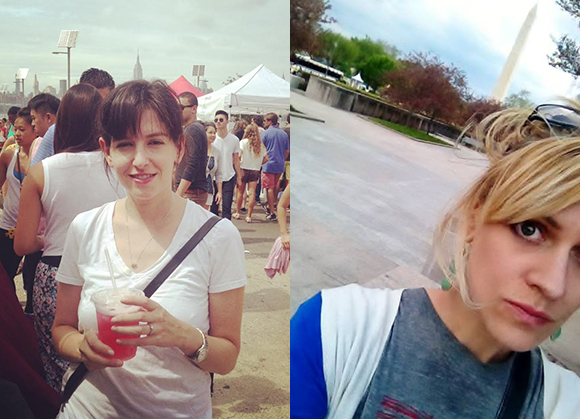
(Photos: Phoebe on the left, Elizabeth on the right)
I have been involved in student affairs at a college campus in some capacity for over twenty years. I have some, not a lot of, experience with sexual assault investigations. Police should always be notified, and it is their job to conduct investigations according to their established procedures. These types of investigations are not the purview of academic institutions. On this we agree.
However, to suggest that academic institutions have no role is mistaken. All colleges have their policies regarding sexual assault and, while the police may not have enough evidence to bring charges, they can determine that a policy has been violated and that this violation merits sanction. Just because the police may not be able to gather the necessary evidence does not mean that institution cannot address the matter for common good of the college community.
You make a persuasive case for the limited impact (if at all) of abstinence programs of many sorts. However, simply providing the instruction about how to have sex is not enough. Young people also need to learn and understand how the male and female bodies work. For males it is often easy to attain physical pleasure. For females it is often not easy. Failure to understand this important difference risks contributing negatively to the emotional dimension of sexual relationships that we too often refuse to discuss.
Another expert on the subject:
I am a college student affairs administrator and work at a private university in the US. I have worked directly for about a decade with the issues you brought up in your recent post on sexual assault on college campuses. In my current role, I serve as a “Deputy Title IX Coordinator” (a title that is becoming more frequent on campuses nationwide) where I have the responsibility of overseeing our investigations into reports of sexual assault (in addition to sexual harassment, partner violence and stalking, which all fall under the same policies and regulations) as well as the staff that are responsible for investigations and adjudicating cases, should they get to that point. As I am at a smaller, private institution, this is just one of the hats I wear as part of my position (which also include oversight of all student conduct issues and other student affairs initiatives).
There are a few points that you brought up that I’d like to respond to. Obviously, I can only speak from my own experience, but I have issues with the perceived assumption that colleges are acting in bad faith.
Speaking as a student affairs professional, those of us in this line of work are doing it precisely because we enjoy working with students. We see them at their best and at their worst, after exceptional achievements and after terrible traumas. In any sexual assault allegation, I have been tasked with investigating, adjudicating or overseeing, and my first concern has been student welfare (of all parties). And the professionals I work with conduct their duties to the best of their abilities. Incidents are not “kept quiet” for PR purposes, as we have an obligation to the parties to protect their privacy (though there are exceptions which may trigger community notification of an incident).
Also, unless the victim has requested it, universities cannot involve law enforcement outside limited exceptions. I don’t see why we’d want to change this. It’s important to keep that decision with the victim and give them the opportunity to make their own decision.
In situations I’ve been involved with, none of the students who have been dismissed/expelled for sexual assault have ever been charged with crime. This fact in no way shakes my confidence that the university did the right thing in each situation. Our campuses were safer without those students, something I say unapologetically. What I don’t understand is why people are shocked that these disparities happen. In conversations with colleagues at my current institution, they can go back almost 20 years and note that not a single sexual assault allegation a student has brought to the local police has resulted in a charge, never mind a conviction (we do not have a sworn police department on my campus and rely on the local PD when an arrest has to be made). Yet people are surprised when the university is asked to take steps, or why a victim feels more comfortable discussing these issues with a college administrator or counselor who will actually listen and provide options, as opposed to getting poor treatment at the local PD (of which I have plenty of stories).
Which leads to another area of disagreement: the belief that if something is a crime, then it should only be dealt with by law enforcement. Putting aside the assumption of law enforcement expertise in incidents of sexual violence that I do not share, colleges and universities deal with students who commit crimes all the time. Underage alcohol possession is a crime. Two roommates who get into a fistfight is a crime. Someone stealing a video game from a residence hall room is a crime. Giving alcohol to minors is a crime.
The list goes on an on, and universities have been dealing with these issues for decades and longer. What makes sexual assault different? Is it the discomfort for all involved? I know plenty of universities, especially “elite” universities, would like to get out of the sexual assault response business because it’s unpleasant, but why would a university provide all sots of services and assurances of a safe community but just stop at sexual assault? Keep in mind that this obligation to address student behavior is not a new thing, and has been supported by state and federal courts for decades. There is even a professional association for student affairs professionals who do this work, the Association for Student Conduct Administration. I’d like to direct you to an oft-cited federal court opinion from the 1960s that other courts cite as a foundation for this obligation, the General Order on Judicial Standards of Procedure and Substance in Review of Student Discipline in Tax Supported Institutions of Higher Education. It says in particular:
The discipline of students in the educational community is, in all but the cases of irrevocable expulsion, a part of the teaching process. In the case of irrevocable expulsion for misconduct, the process is not punitive or deterrent in the criminal law sense, but the process is rather the determination that the student is unqualified to continue as a member of the educational community. Even then, the disciplinary process is not the equivalent to the criminal law process of federal or state criminal law. For, while the expelled student may suffer damaging effects, sometimes irreparable, to his educational, social, and economic future, he or she may not be imprisoned, fined, disenfranchised, or subjected to probationary supervision. The attempted analogy of student discipline to criminal proceedings against adults and juveniles is not sound.
I can agree, however, that the web of regulations is becoming incredibly difficult to navigate, particularly at smaller institutions that do not have separate offices that handle diversity and equity, regulatory compliance, etc. I have become the de facto compliance officer on my campus, because I have a good knowledge of our obligations, speak about them effectively, and my pre-higher education background. While you listed many of the federal mandates universities are dealing with (Title IX, VAWA, the Clery Act, FERPA, etc.) and one that may come our way if it makes it through the legislative meat grinder (CASA), keep in mind that several states have individiually enacted their own laws (for many of the same political reasons your post assigned to the feds). At least four states that I know of have either enacted or are looking to enact their own legislation (CA, CT, NJ, and NY). This, plus proposed increased enforcement, makes our jobs much more difficult. I’ve been involved in an OCR investigation. It’s an incredibly difficult experience, and when OCR sets up shop, it makes it almost impossible to do your actual job, because of the amount of time and amount of data they demand.
Sorry for the long-winded response, but while I cannot write from the perspective of a survivor or an accused student, I can definitely write from the perspective of someone who is part of this issue, and being asked to administer it. Thank you and Andrew. As a long-time reader, this provides a good reminder to renew my subscription.
Thomas Frank bemoans the tendency of his fellow liberals to yuck it up over Jon Stewart’s jokes about conservatives, congratulating themselves on their enlightenment, while missing “a substantial chunk of political reality ourselves.” He points to the example of a recent Russell Sage Foundation study that median household wealth in the United States fell by 36 percent in the 10-year period ending last year:
Now, you can blame the risible, Ayn Rand-reading Tea Party types for this if you like, and you can also blame the George W. Bush Administration. They both deserve it. But sooner or later you will also have to acknowledge that there are two parties in this country, not just one; that the Democrats held significant power during the period in question, including (for much of it) the presidency itself; and that even when they are not in the White House, these Democrats nevertheless retain the capacity to persuade and to organize. For a party of the left, dreadful news like this should be rocket fuel. For the Dems, however, it hasn’t been. Why is that?
Well, for one thing, because a good number of those Democrats have not really objected to the economic policies that have worked these awful changes over the years. They may believe in the theory of evolution—hell, they may savor the same Jon Stewart jokes that you do —but a lot of them also believe in the conventional economic wisdom of the day. They don’t really care that union power has evaporated and that Wall Street got itself de-supervised and that oligopolies now dominate the economy. But they do care—ever so much!—about deficits and being fiscally responsible.
Bring up this obvious point, however, and you will quickly discover what a dose of chloroform the partisan style can be. There’s a political war on, you will be told; one side is markedly better than the other; and no criticism of the leadership can be tolerated. Instead, let’s get back to laughing along with our favorite politicized comedians, and to smacking that Rick Santorum punching bag.


 The Dish