A Breakdown In Kabul?

by Dish Staff

The agreement John Kerry brokered to resolve the Afghan presidential election crisis is looking shaky today after Ashraf Ghani announced that he would not necessarily agree to share power with his rival Abdullah Abdullah if an ongoing audit of the vote showed that Ghani had won:

Ghani said the winner will appoint the loser “by decree” as a chief executive to serve “at the discretion of the president.” Abdullah has demanded more authority if he loses. Ghani also said Tuesday that although he “hoped” the audit of 8.1 million votes could be done in time to have the new president attend a NATO summit in early September, no inauguration date has been set because of “technical uncertainties” with the slow-going ballot review. He said both he and Abdullah will attend the summit, considered key to winning new foreign aid for the ailing Afghan economy. …

Ghani was careful Tuesday not to claim victory. But he spoke in a distinctly presidential tone as he laid out a wide-ranging policy agenda for the next government, including banking and anti-corruption initiatives as well as the rights of women and Taliban prisoners.

Representatives of the Ghani and Abdullah camps were scheduled to start a round of meetings today to hash out the technical details of the agreement. Omar Samad examines the potential pitfalls and what it will take to overcome them:

The contentious issues that are outstanding and still need to be ironed out are: 1. Planning for the upcoming transfer of power and identifying the new government’s priority challenges and collaborative frameworks. 2. Agreeing on a national governance agenda, drawing from the two sides’ respective electoral platforms and programs in sectors such as security, economy, foreign affairs, and social services. Figuring out unresolved issues should be left to professional advisory groups that could also involve non-partisan figures.

3. Defining the parameters of power sharing as part of a unity government structure. The two sides will need to step away from a zero-sum option, show flexibility and use creative methods to clearly define the authority of the president and the newly proposed post of chief executive. Models from other countries can used if applicable to the Afghan context.

But Jim White rolls his eyes:

With 15 negotiators on each side, I would expect that the first week or two of the negotiations will resolve such crucial issues as the shape of the table and the length of the breaks between sessions. They might also want to make a “no punching” rule, as there appears to have been another fight today while ballots were being reviewed.  It’s hard to see how Kerry could make a third trip to put the power sharing back on course since the first two have been such spectacular failures.

Thomas Scherer isn’t optimistic that the two men, each of whom believes himself to be the elected president of Afghanistan, will work things out in the end:

Why have the candidates continued to fight? There was almost certainly fraud on both sides as supporters took advantage of Afghanistan’s insecurity and institutional deficits and found varying ways to “rock the vote.” However, the mere presence of fraud rarely matters; the fraud must be great enough to change the results. The preliminary results of the June 14 run-off show Ghani ahead with 4.5 million votes to Abdullah’s 3.5 million, about 56 percent to 44 percent. Does Abdullah really believe that he can overcome a million-vote difference?

I argue, with a couple assumptions, that Abdullah can reasonably believe that he can still win. As such, the parties will continue to fight over every vote and escalate when necessary, further threatening the stability of Afghanistan. This high-stakes game of electoral chicken will likely continue until the two sides collide or until the United States, desperate for some semblance of stability, can persuade a candidate to accept defeat.
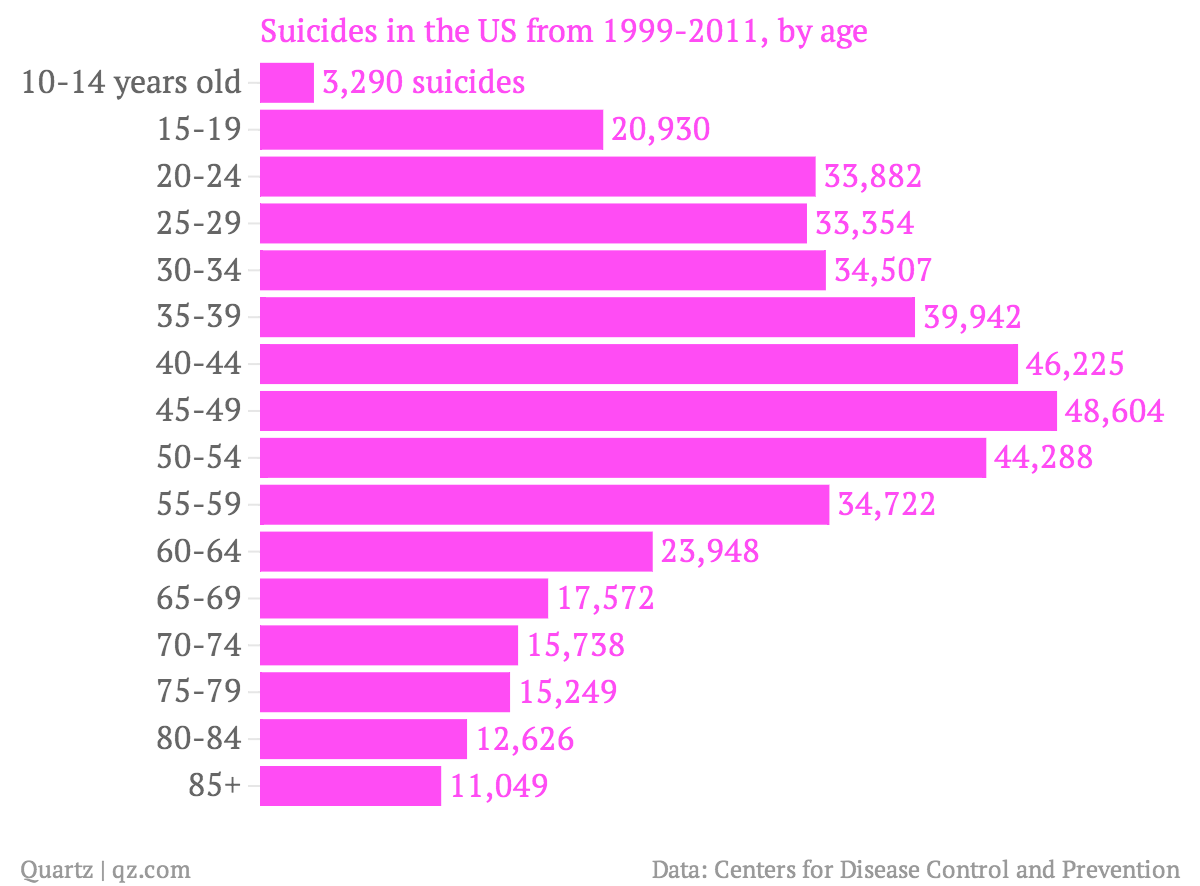
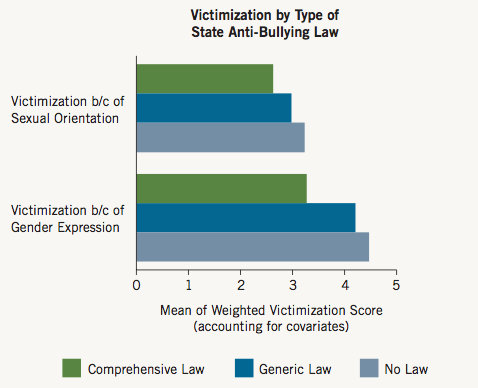
Chart Of The Day

by Dish Staff

Suicides

Sonali Kohli breaks down the demographics of suicide:

Though suicide awareness and prevention efforts in the US are largely targeted toward either teens or the elderly, Williams represents a demographic of the country—middle-aged, white, male—with an increasing incidence of suicide. Suicide occurrence in the US is most common among middle-aged people. Between 1999 and 2011, more than 48,600 people between the ages of 45 and 49 committed suicide, compared with 20,930 teens between the ages of 15 and 19.

A Cure For Ebola? Ctd

by Dish Staff

Yesterday the World Health Organization determined that it is “ethically sound” to administer promising but unproven Ebola treatments on a wide scale, countering earlier criticism that one such treatment, the experimental antibody therapy ZMapp, had been made available exclusively to Westerners. The Liberian government has announced that it will be administering the drug to two afflicted doctors in the country, but as Josh Lowensohn notes, it remains unclear just how much medicine will ultimately make it to West Africa:

Supplies of the drug have also dwindled due to difficulties producing it, though Canada today said it would donate 800 to 1,000 doses of the drug to be used in aid efforts. A separate drug called TKM-Ebola, which is also developed in Canada, could end up being used as well after getting a nod from the US Food and Drug Administration last week to restart human testing of the drug on those who are already infected.

Peter Loftus notes ominously, “The maker of the experimental Ebola drug that was given to two infected Americans said Monday that its supply has been exhausted after the company provided doses to a West African nation [presumably Liberia]”:

Mapp Biopharmaceutical Inc. said in a brief online statement it had complied with every request for the drug that had the necessary legal and regulatory authorization. The company said it provided the drug, called ZMapp, at no cost in all cases. San Diego-based Mapp didn’t name any countries that requested the drug and didn’t release additional details.

Alexandra Sifferlin considers how health officials will make the tough decisions about administering the drugs:

[N]ow the question is: With not enough to go around, who gets them? That’s ultimately at the discretion of the countries themselves, and before that happens, there’s a waiting period as the WHO formulates another panel of technical experts to create guidelines for the best use of these drugs. Some of the questions they will try to answer are: At what stage of the disease are the drugs or vaccines effective? Are they effective at the beginning of the disease or at the later stages? What are the safety issues related to the drugs? What’s the efficacy of the drug—do 30 percent of people respond or 50 percent?

“It think [who gets the drugs] is one of the most difficult questions to answer,” says Dr. Abha Saxena, the coordinator for the global ethics team at WHO. “There is a limited supply and there is a lot of demand. But who gets it is contextual, it will depend upon on the country, the situation, and they type of drug that will eventually go forward into either trial or compassionate use.” The panel will meet by the end of this month.

Meanwhile, Amanda Taub suggests that “most of the people Ebola kills may never actually contract it”:

New, worrying information from Sierra Leone suggests that damage from the disease may go far beyond deaths from the Ebola virus itself. Rather, Ebola is claiming more victims by damaging already-weak local health systems and their ability to respond to other medical problems, from malaria to emergency c-sections. The ebola-driven rise in deaths from those other maladies may outpace the deaths from ebola itself.

The effect of the loss of services may be severe. Even before the Ebola outbreak, Sierra Leone was ranked the seventh-worst country in the world for maternal and child mortality. In 2012, the aid group Save the Children reported that 18 percent of children in Sierra Leone did not survive to age 5, and one in 25 women died of childbirth or pregnancy-related causes. If these fears prove correct, those numbers may be about to get much worse.

Egypt Is Led By A Mass Murderer

by Dish Staff

That’s the conclusion of a Human Rights Watch investigation into the killings of at least 817 and probably over 1,000 Egyptians during the dispersal of pro-Morsi demonstrators from Rabaa al-Adawiya Square a year ago tomorrow. The massacre, HRW contends, was deliberate, premeditated, and readily qualifies as a crime against humanity:

The 195-page investigation based on interviews with 122 survivors and witnesses has found Egypt‘s police and army “systematically and deliberately killed largely unarmed protesters on political grounds” in actions that “likely amounted to crimes against humanity”. The report recommends that several senior individuals within Egypt’s security apparatus be investigated and, where appropriate, held to account for their role in the planning of both the Rabaa massacre and others that occurred last summer – including Abdel Fatah al-Sisi, Egypt’s then defence minister and new president. As head of the army at the time, Sisi had overall responsibility for the army’s role at Rabaa, and has publicly acknowledged spending “very many long days to discuss all the details”.

HRW’s executive director Kenneth Roth, who was refused entry into Egypt for “security” reasons when he arrived in Cairo on Sunday to present the report’s findings, further details the role of Sisi:

There is every reason to believe that this was a planned operation implicating officials at the very top of the Egyptian government. Interior Minister Mohamed Ibrahim was the lead architect of the dispersal plan. His immediate supervisor, in charge of all security operations, was Abdel Fattah al-Sisi, who was then defense minister and deputy prime minister for security affairs and is now Egypt’s president. In discussions prior to the dispersal, senior Interior Ministry officials spoke of anticipating thousands of deaths. The day after the slaughter, Ibrahim said it had all gone exactly according to plan, and later gave bonuses to participants.

The Rabaa dispersal was part of a pattern of cases across Egypt in which security forces used excessive force, including killing 61 participants at a sit-in protest outside the Republican Guard headquarters on July 8, and another 95 protesters near the Manassa Memorial in eastern Cairo on July 27.

But don’t hold your breath waiting for Sisi to be referred to the International Criminal Court. Owen Jones is outraged that the brutality of the Egyptian regime gets little press in the West, even as the US and UK funnel vast amounts of money, weapons, and other support to Sisi:

Too little has been said about Egypt’s human rights crisis. More than 40,000 people were detained or indicted in the first 10 months after the coup and, according to Amnesty International, the regime is usingmethods of torture from “the darkest days of the Hosni Mubarak era”. With “rampant torture, arbitrary arrests and detentions”, there has been a “catastrophic decline in human rights”. There have been claims of rape against male political dissidents; the use of electrocution, including on prisoners’ testicles; and in one case, a hot steel rod was inserted in the anus of a dissident who later died. …

Egypt is in the grip of a violent tyranny that brooks little dissent. And just as the west is complicit in Israel’s attack on Gaza, it equally shares some responsibility for the actions of Egypt’s regime. The question is surely, how many more corpses until we start holding those responsible to account?

Read the Dish’s extensive coverage of last summer’s bloodshed in Cairo here.

Did Snowden Tip Off Al-Qaeda’s Cryptographers? Ctd

by Jonah Shepp

Not by a long shot, Glenn Greenwald and Andrew Fishman answer, hitting back forcefully at the report claiming that al-Qaeda overhauled its cryptography in response to the Snowden leaks. To begin with, they point out that Recorded Future, the intelligence firm that issued the report, has deep and longstanding financial ties to the US intelligence community and as such cannot be considered an independent referee. Furthermore, another Snowden document reveals that al-Qaeda already knew about Western intelligence agencies’ surveillance technologies and how to get around them, long before Snowden came into the picture:

The Recorded Future “report”—which was actually nothing more than a short blog post—is designed to bolster the year-long fear-mongering campaign of U.S. and British officials arguing that terrorists would realize the need to hide their communications and develop effective means of doing so by virtue of the Snowden reporting. … But actual terrorists—long before the Snowden reporting—have been fixated on developing encryption methods and other techniques to protect their communications from electronic surveillance. And they have succeeded in a quite sophisticated manner.

One document found in the GCHQ archive provided by Snowden is a 45-page, single-spaced manual that the British spy agency calls a “Jihadist Handbook.” Though undated, the content suggests it was originally written in 2002 or 2003: more than 10 years before the Snowden reporting began. It appears to have been last updated shortly after September 2003, and translated into English by GCHQ sometime in 2005 or 2006. … So sophisticated is the 10-year-old “Jihadist Manual” that, in many sections, it is virtually identical to the GCHQ’s own manual, developed years later (in 2010), for instructing its operatives how to keep their communications secure[.]

Greenwald and Fishman also stress that the report offers no evidence to support a causal link between the Snowden leaks and al-Qaeda’s recent crypto upgrades:

Critically, even if one wanted to accept Recorded Future’s timeline as true, there are all sorts of plausible reasons other than Snowden revelations why these groups would have been motivated to develop new encryption protections. One obvious impetus is the August 2013 government boasting to McClatchy (and The Daily Beast) that the State Department ordered the closing of 21 embassies because of what it learned from an intercepted “conference call” among Al Qaeda leaders

This speaks to an infraction we in the media are frequently guilty of: lending greater weight to new information when it feeds into a pre-existing narrative, regardless of whether that new information is credible on its own merits. Officials in the government and the intelligence community have spent the past year crying to the press that Snowden’s revelations have weakened America’s defenses against terrorism by revealing our tradecraft to our enemies. Spooks are not wont to provide proof for such claims, because the evidence always seems to be classified, but “if only we knew what they knew”, we’d see that they were right. And it requires no great leaps of logic to intuit that al-Qaeda and its allies, who clearly know a thing or two about the Internet, might have come across the Snowden leaks and used them to their advantage.

So that narrative, underpinned by intuition but not hard evidence, became conventional, at least on one side of the surveillance debate. There was a demand for proof of that received wisdom, and when something purporting to be that proof came to light, the product was delivered to the market with all due speed. And giving people tools to support the opinions they already hold, rather than distinguishing truth from propaganda, is the core business of much of today’s clickbaity media. That’s a serious problem.

On the other hand, the full impact of these leaks won’t be clear for some time, and the question of whether and to what extent they exposed us to new threats is not conclusively settled, so Snowden and Greenwald can’t claim vindication any more surely than their critics can call them traitors and terrorists. But the broader point, that Snowden shouldn’t be convicted of treason in the court of public opinion solely based on accusations and innuendo, stands strong. We’d do well to remember that the next time we come across “evidence” like this.

Quarantine As A Civil-Liberties Issue

by Dish Staff

Three American missionaries who worked with Ebola patients in Liberia were immediately placed under quarantine when they returned to the US Sunday. Geoff Manaugh and Nicola Twilley mull over the legality of such a move:

The legal theorist Jennifer Elsea has drawn parallels between the rights of the quarantined and those of American citizens who have been deemed “enemy combatants.” Both medically quarantined subjects and detained terrorist suspects are examples, Elsea’s work suggests, of how the rights of citizens can be put on hold for indefinite periods of time. If being held in a state of quarantine is legally comparable to being held as a prisoner at Guantánamo Bay, is quarantine something we should trust to protect us, or is it something we actually need protection from?

The A.C.L.U. has argued that trading liberty for security in the event of a pandemic is not only undesirable but also constitutionally dangerous and unnecessary. … In 2007, Barry Steinhardt , an A.C.L.U. spokesman, emphasized that, “in the vast majority of cases, sick individuals are the first to want proper medical attention and need no encouragement or state coercion to voluntarily isolate themselves.” As we have seen in the cases of Andrew Speaker and the West African victims of Ebola, however, such rational and altruistic responses to involuntary quarantine are by no means universal. Active resistance does occur, and when it does it poses extraordinary problems of control.

Do Anti-Bullying Laws Work?

by Dish Staff

LGBT_anti-bullying_laws

German Lopez finds reason to think so:

It’s possible that some of these numbers reflect more tolerant environments in certain states. If a state legislature has the political support to pass laws that protect LGBT students, the state’s residents might be more likely to take action against anti-gay or transphobic discrimination regardless of the law.

But Eliza Byard, executive director of GLSEN, says her organization’s research controls for those factors. She points out that her group found better reports from LGBT students in Arkansas and North Carolina, two states that aren’t traditionally associated with LGBT-friendly environments, after they passed comprehensive laws protecting LGBT students.

Just Another Ceasefire, Or Something More? Ctd

by Dish Staff

J.J. Goldberg passes along news from the Israeli press that Israeli and Palestinian negotiators have come close to reaching an agreement on a long-term Gaza ceasefire during Egyptian-brokered talks in Cairo. He relays the reported terms of the agreement: on the Israeli side, these include a halt to hostilities, Israeli control over border crossings between Gaza and Israel, and PA control over payments to public workers in Gaza. The Palestinian delegation is demanding an expansion of the coastal waters open to Gaza fishermen, the opening of the Rafah crossing into Egypt, and an expansion of amount and variety of goods Israel transports into Gaza. Other demands appear to have been set aside for the time being:

The Palestinians have agreed to drop for now their demands for a Gaza seaport and reopening of the Dahaniya airport in Gaza. Israel and Egypt had opposed the opening of a Gaza seaport out of fear that Hamas would use it to import weapons. Israel’s position is that it will not agree to opening a Gaza seaport until agreement has been reached on a verifiable, enforceable disarmament of Hamas and demilitarization of Gaza.

For the present, Israel is said to have dropped its demand for demilitarization of Gaza. There was never any chance that Hamas would agree to it, and as such it would require a complete reconquest of Gaza and defeat of Hamas. That, as the heads of the Israel Defense Forces warned the cabinet last week, would require a massive operation that would devastate Gaza and lead to Israel’s complete isolation internationally.

Yishai Schwartz expects these negotiations to come to nothing and the war to end in a stalemate, as neither party is willing to compromise much:

Given the incompatibility of the sides’ respective goals, it’s clear that negotiations are a bit of a farce. In the short term, Hamas seeks an arrangement that expands its legitimacy at the expense of the Palestinian Authority; Israel seeks to weaken Hamas and enhance the authority of the Palestinian Authority. Hamas seeks rearmament; Israel seeks demilitarization. In the long term, Hamas seeks Israel’s dissolution and replacement with an Islamist state. Israel seeks a reliable normalcy for its citizens, and is currently deeply divided over whether it wants, needs, or can even afford the creation of a Palestinian State. These objectives are simply not reconcilable. …

Instead, both sides will likely resign themselves to some sort of renewed modus vivendi that is only slightly less terrible than the status quo. Israel and Hamas will agree to a partial weakening of the blockade in exchange for a nominal effort at demilitarization.

In the meantime, activists are organizing another flotilla of boats to run the Gaza blockade. Dish alum Katie Zavadski can guess how that will turn out:

Like the one in 2010, this flotilla will come from the IHH Humanitarian Relief Foundation, a Turkish NGO, complete with very concerned activists from 12 countries. The group, part of the Freedom Flotilla Coalition (which describes itself as “a grassroots people-to-people solidarity movement composed of campaigns and initiatives from all over the world working together to end the siege of Gaza”), told Reuters that this is being organized “in the shadow of the latest Israeli aggression on Gaza.”

Of course, since the seven-plus-year blockade of Gaza is a handy bargaining chip for Israel, we can already tell you how this will likely go: Tensions will flare as the ship(s) near Gaza, refusing to be inspected by Israeli forces. Eventually, the IDF will raid them. There may be casualties. And inevitably, the “humanitarian mission” will set back peace talks even further because this will be touted as another show of Israeli aggression.

ISIS And The Islamist Menace

by Dish Staff

Alex Massie contends that ISIS’s peculiarly evil worldview puts us at odds whether or not we choose to be:

Make no mistake, we may not consider ourselves at war with ISIS but they most assuredly reckon themselves at war with us. And with anyone else who does not share their murderous corruption of Islam. The world has rarely been short on horror but there is something especially horrifying about ISIS. If heads on pikes won’t convince you, what would be enough to persuade you this is an evil that must be confronted? And if not confronted today it will have to be confronted eventually. Because these are not people and this is not a worldview that will be content to carve out territory and then, once it has established its base, live quietly and peacefully ever after.

In the end, all the wrangling about cause and effect and who started what and who is to blame this or that becomes a form of dissembling dithering. In the end we are responsible. Not so much on account of the unforeseen consequences of past blunders but because we – the United States and its NATO allies – have the power, the equipment and the opportunity to do something about it.

David Rothkopf identifies the threat of radical Islam as “the principal source of threat to our interests, the stability of the region, and to our allies.” He argues that the US’s Middle East policy should address this threat holistically, rather than on a case-by-case basis:

While the conditions and specific upheavals in each state in the Middle East are, as noted earlier, different, it is this battle that is responsible for the greatest amount of today’s unrest and violence. Whether it is Ansar al-Sharia in Libya or the Muslim Brotherhood in Egypt, Hamas in Gaza or al-Nusrah Front in Syria, al Qaeda in the Arabian Peninsula, or the Islamic State struggling to establish its caliphate, it is clear today that extremist Islam is emerging as a threat so broad that it must be seen in its totality to be contended with.

Further, the ties of these groups to others operating in the periphery of this region — from the Taliban to the Haqqani network, from Boko Haram to Uighur or Chechen separatists — both underscore the global scope of the problem and the potential for significant alliances to help combat it.

Certainly, our traditional allies in the Middle East have come to see the problem as one. Consider the degree to which Israel and Egypt have cooperated to deal with Hamas. Consider that unifying animus toward the Muslim Brotherhood that has linked together not only those two former warring states but also Jordan, Saudi Arabia, Bahrain, Kuwait, and the United Arab Emirates.

Adam Taylor observes that ISIS’s extremist brand is catching on:

What’s really worrying is that despite all the confusion over its name, the Islamic State “brand” actually seems pretty solid — and worryingly global. It’s distinctive black-and-white flag was flown in London last week, and leaflets supporting it were handed out in the city’s Oxford Street on Tuesday. An American was arrested at a New York City airport this month after authorities were tipped off by his pro-Islamic State Twitter rants. The group has began publishing videos in Hindi, Urdu and Tamil in a bid to reach Indian Muslims. There are credible reports that the group is hoping to target Asian countries — and Indonesia is so worried that it banned all support for the Islamic State. The list goes on and on. Whatever you call it — the Islamic State, ISIS, ISIL, or something else — its brand is potent.

Indeed, even China is starting to worry:

China has been fighting a low-level separatist insurgency of its own in Xinjiang for decades and worries that foreign Islamic groups are infiltrating the region, emboldening the simmering independence movement. Uighur exile groups say China’s government overstates its terrorism problem and falsely paints protests that turn into riots as premeditated terror attacks. In any case, Beijing is likely alarmed by IS’s criticism of its treatment of the Muslim Uighurs and the group’s alleged plan to seize Xinjiang, no matter how far-fetched the idea might be. But just how actively authorities will deal with any IS threat remains to be seen.

Furthermore, Andrew Tabler cites “analysts and European and American officials” as saying that “hundreds, if not thousands, of ISIL and Al Qaeda operatives in Syria and the Islamic State are likely planning attacks either back home or elsewhere”:

These include Muhsin al-Fadhili, former head of Al Qaeda’s Iranian facilitation network; Sanafi al-Nasr, head of Al Qaeda’s Syria “Victory Committee”; Wafa al-Saudi, Al Qaeda’s former head of security for counter intelligence; as well as Al Qaeda founding member Firas al-Suri. Members of Al Qaeda Arabian Peninsula (AQAP) are also reportedly in Syria, indicating a growing opportunity for connectivity, coordination, planning, and synchronization with Jebhat al-Nusra and other jihadists. Taken together with national-based Jihadist units from China, the Caucasus, Libya, Egypt, Sweden, and beyond, the “Islamic State” is already the next Afghanistan or Pakistan’s Federally Administered Tribal Areas in terms of a durable safe haven and training ground for global Islamic terrorism.

William Inboden believes the threatened Yazidi genocide opened Obama’s eyes to the scope of ISIS’s fanatical ambitions and is changing the president’s beliefs about terrorism, the Middle East, and American power:

I have written before about the close connections between religious persecution and national security threats. The vicious Islamic State campaign to exterminate Yazidis and Christians further reinforces this point. The Islamic State’s targeting of religious minorities is not merely a side effect of its territorial advances; it is central to the group’s identity and purpose. The worldview of the militant jihadist holds religious pluralism and religious freedom to be anathema, and the Islamic State perversely considers its own measures of success to include eliminating religious minorities. Just as the Islamic State’s persecution of Christians and Yazidis should have been an early indicator of the larger security threat it poses, the longer-term American response to the Islamic State will need to go beyond airstrikes to include a renewed diplomatic commitment to protecting and promoting religious freedom.